Chapter 001: The Bank’s Business Model
Section 1: How a Bank Works Financially · Chapter 001 of 100
A new business analyst joins a bank's finance transformation programme. On day one she hears five different answers to a simple question: "What does Finance do here?" The financial controller says Finance produces the accounts. A treasury dealer says Finance does not set the funding strategy — treasury does. A risk manager says capital numbers come from risk engines, not the general ledger. A product owner says her product's profit is decided by an allocation rule she has never seen. All four are partly right. This chapter explains why, and gives you the map of how a modern bank makes money, where finance fits, and how every later chapter in this course connects to that map.
1. Chapter opening
Bank finance is the discipline of turning the bank's business activity — deposits taken, loans made, payments processed, risks carried — into trusted numbers that managers, investors, auditors and regulators can act on. It has three simultaneous jobs: record what happened (accounting), explain performance and support decisions (management finance), and prove safety and compliance (prudential and regulatory reporting). A modern bank cannot survive with only one of the three.
This chapter is the foundation for all 100 chapters. It introduces the bank business model, the income engine, the balance sheet logic, and the finance operating model at a level every role — business analyst, developer, tester, operations, auditor, student — needs before going deeper.
2. Learning objectives
By the end of this chapter you will be able to:
- Explain in plain language how a bank earns money and why its balance sheet is "inverted" compared with a non-financial company.
- Name the four main income streams (net interest income, fee and commission income, trading income, other income) and the two big deductions (operating costs, impairment).
- Distinguish profit, cash, liquidity and capital — and explain why a profitable bank can still fail.
- Describe the finance function operating model: who does what between business lines, Finance, Treasury, Risk, Operations, Technology and Audit.
- Trace a single business event (for example, granting a loan) from origination through subledger, general ledger, financial statements and regulatory return.
- Identify the systems and data handoffs a BA, developer or tester will meet in any finance change programme.
3. Business context
Banks exist to move money across time, distance and risk appetite. A saver wants safety and instant access; a homebuyer wants a 25-year commitment; a company exporting goods wants payment guaranteed in another currency in 90 days. The bank sits between these needs, transforms maturities, currencies and credit risk, and charges for the service. That intermediation is the business model.
Why this matters now: margins on plain lending are thin, regulation demands far more capital and liquidity than before the 2008 crisis, technology costs are large, and competitors (fintechs, big tech, private credit) attack individual product lines. So "bank finance" today is less about bookkeeping and more about answering hard questions: which products genuinely make money after risk and capital costs, where costs sit, and whether reported numbers can be proved to a supervisor.
| Stakeholder | What "finance" means to them | Chapter family that answers it |
|---|---|---|
| Board and CEO | Are we profitable, safe and compliant? | Sections 15–16 (capital, liquidity and internal adequacy assessment) |
| Product owner | Does my product make money? | Funds Transfer Pricing and Customer, Product and Channel Profitability |
| Treasurer | Can we fund ourselves and survive stress? | Sections 7 and16 (treasury and liquidity) |
| Regulator | Prove it with controlled data | Sections 17–19 (reporting, jurisdictional requirements and disclosures) |
| Auditor | Show me the evidence trail | Section 11 (financial controls and evidence) |
| BA / developer / tester | What must the system post, reconcile and report? | Section 20 (data, change, testing and the integrated case) |
4. Finance and accounting view
4.1 The income engine
A bank's profit and loss follows one master equation:
Total income − Operating costs − Impairment = Operating profit, then minus tax.
Total income has four parts:
| Income stream | Examples | Accounting home |
|---|---|---|
| Net interest income (NII) | Loan interest minus deposit interest | Interest income / interest expense (effective interest method, IFRS 9) |
| Fee and commission income | Account fees, card interchange, arrangement fees, custody fees | IFRS 15 revenue recognition; some fees adjust the loan's effective interest rate |
| Trading and market income | FX dealing, derivatives, securities gains | Fair value through profit or loss (FVTPL) |
| Other income | Dividends, rental income, gains on asset sales | Various standards |
Net interest income is often a major line for retail or commercial banks; its share varies with business mix, interest rates and reporting definitions. Investment-bank-heavy groups tilt toward fees and trading income. This mix is the first thing to check when comparing two banks.
4.2 A worked spread example (simplified, fictional)
A bank takes 100 of deposits paying 2.0% and lends 100 to borrowers at 5.5%:
| Line | Calculation | Amount per year |
|---|---|---|
| Interest income | 100 × 5.5% | +5.50 |
| Interest expense | 100 × 2.0% | −2.00 |
| Net interest income | 5.50 − 2.00 | +3.50 |
| Operating costs (branches, staff, IT) | — | −1.80 |
| Impairment (expected loan losses) | — | −0.60 |
| Operating profit before tax | 3.50 − 1.80 − 0.60 | +1.10 |
Three lessons: the 3.50 spread looks comfortable but more than two-thirds is consumed by costs and losses; impairment is an estimate, not a cash outflow, and small changes in loss assumptions move profit sharply; and nothing here yet covers the capital the bank must hold or the liquid assets it must keep — capital changes funding costs and the return denominator, while liquid-asset yields depend on market conditions.
4.3 The "inverted" balance sheet
For a manufacturer, assets are factories and liabilities are borrowings. For a bank it is reversed in intuition: customer deposits — which feel like "the bank's money" — are liabilities (the bank owes them back on demand), and loans — money that has left the building — are assets (borrowers owe the bank). Bank equity is generally smaller than total assets; measure leverage using the actual entity and reporting perimeter. Guarantees and undrawn commitments create contingent exposures, while derivatives normally have recognised fair-value assets or liabilities and additional contingent counterparty exposures — Commitments and Financial Guarantees and Derivatives and Collateral develop these distinct treatments.
4.4 Profit, cash, liquidity and capital are four different things
| Concept | Question it answers | Example of divergence |
|---|---|---|
| Profit | Did we earn more than we spent (accrual basis)? | Interest accrued but not yet received counts as income |
| Cash | Did money actually move? | Credit to an account at the same bank creates a deposit without external cash movement; transfer to another bank uses settlement cash |
| Liquidity | Can we settle payments and withstand cash-flow stress? LCR uses 30 days; NSFR measures structural funding over a one-year horizon. | Profitable bank fails if depositors run (see LCR/NSFR, Section 16) |
| Capital | Can we absorb unexpected losses and keep operating? | Losses eat equity first; thin equity means fragility (Section 15) |
A bank can be profitable but unable to refinance maturing funding, or liquid but under-capitalised. Finance must report all four lenses, not just profit.
5. Product and customer impact
Every product a customer touches creates finance consequences behind the scenes:
- Funding a savings account creates a deposit liability and, where the contract pays interest, starts accruals, and feeds liquidity reporting (how "sticky" is this deposit?).
- Disbursing a mortgage creates a loan asset, commonly at amortised cost where the IFRS 9 business-model and contractual-cash-flow tests are met, an effective interest rate calculation, an expected-credit-loss provision from day one, and risk-weighted assets for capital.
- Paying by card creates interchange income, a receivable from the card scheme, settlement timing differences, and chargeback provisions.
- Sending money abroad touches nostro accounts, FX revaluation, fee income and suspense balances when references break.
Customer-visible outcomes trace back to finance mechanics: the savings rate offered depends on funds transfer pricing (Funds Transfer Pricing); the loan rate depends on funding cost plus expected loss plus capital charge plus margin; a delayed payment may involve screening, missing information, settlement failure or an unmatched accounting entry; suspense is only one possible cause (Payment Exceptions and Nostro, Clearing and Suspense Reconciliation).
6. Regulatory and supervisory view
Supervisors do not trust a bank's numbers at face value — the framework assumes numbers must be proved. Three pillars structure this (full detail in The Prudential Framework and Pillar 3 Disclosures):
- Pillar 1 — minimum capital for credit, market and operational risk (standardised or internal-model approaches).
- Pillar 2 — supervisory review (ICAAP, stress testing, extra buffers for risks Pillar 1 misses).
- Pillar 3 — public disclosure so markets can discipline the bank.
Finance sits at the centre because accounting equity is the starting point for regulatory capital, the loan book drives risk-weighted assets, and FINREP/COREP returns reconcile back to the general ledger. A jurisdiction note that recurs throughout this course: Basel standards are global, but the EU (CRR/CRD), UK (PRA rulebook), US (Fed/OCC/FDIC rules with US GAAP and CECL) and India (RBI directions) implement them differently. Never assume a ratio or template is identical across jurisdictions.
7. Systems and data view
A simplified finance systems landscape:
| Layer | Examples | Finance role |
|---|---|---|
| Origination / channels | Loan origination, mobile app, branch teller | Business event source |
| Core banking / product processors | Deposits, loans, cards, payments, trade | Subledgers; contractual truth |
| Treasury / risk engines | Payment hubs, treasury platform, risk-weighted-asset engine, ECL engine | Valuations, provisions, capital inputs |
| Accounting hub / GL | Accounting rules engine, general ledger | Posting logic, chart of accounts, trial balance |
| Reporting marts | Finance data warehouse, FINREP/COREP/Pillar 3 generators, XBRL | Aggregation, taxonomy mapping, submission |
Data lineage — the ability to trace a reported cell back through transformations to the source event — is a supervisory expectation (BCBS 239, Section 20), not a nice-to-have. Every finance IT change must preserve it.
8. End to end process
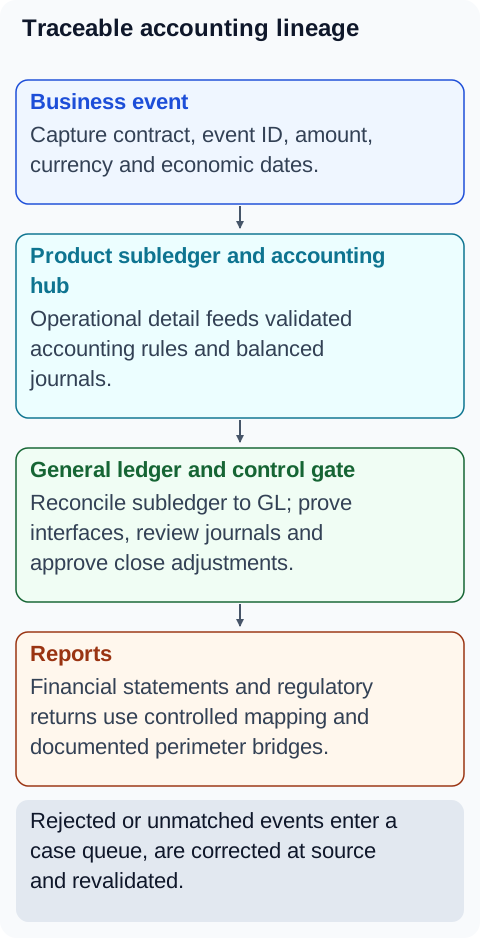
Follow one loan of 10,000 from approval to regulatory report:
- Origination — credit approval, contract signed, terms booked in the loan system (subledger).
- Disbursement — 10,000 credited to the borrower's account: loan subledger debits asset, credits customer account; GL receives a balanced journal via the accounting hub.
- Daily accrual — interest accrues each day using the effective interest rate; an expected-loss provision is recognised from day one (IFRS 9 staging, Section 9).
- Repayment — each instalment clears accrued interest receivable and principal under the contract. Collection does not recognise interest income again; earned interest not yet accrued needs its own recognition.
- Month-end close — subledger-to-GL reconciliation, suspense review, management sign-off (Daily, Monthly and Annual Close).
- Reporting — the loan appears in the published balance sheet, FINREP asset-quality templates, COREP credit-risk exposures, and Pillar 3 disclosures — all from the same lineage.
Breaks at any step (unposted journals, unmatched suspense, stale mappings) are the classic sources of restatements and audit findings.
9. Controls and risks
| Risk | Control | Evidence auditors expect |
|---|---|---|
| Incomplete postings (events never reach GL) | Completeness checks, sequence monitoring, daily reconciliation | Reconciliation with aged-break reporting |
| Wrong postings (bad mapping) | Version-controlled accounting rules, UAT, parallel runs | Rule inventory, test evidence, sign-off |
| Manual journal abuse | Maker-checker, restricted access, supporting documents | Journal log with approvals |
| Estimate manipulation (impairment, fair value) | Independent challenge, model validation, governance committees | Methodology papers, challenge minutes |
| Late or wrong regulatory submission | Validation rules, four-eyes submission, regulator query log | Submission archive, attestation |
The three-lines-of-defence model (Section 11) assigns these: management teams, including Finance operations, own processes and controls; designated second-line risk/compliance roles challenge them; Internal Audit independently assures.
10. Practical examples
Example A — Is this product profitable? A card portfolio earns 4.0 in interchange and fees, costs 2.2 to run, loses 0.9 to fraud and credit, and consumes capital costing 0.5. Economic margin after the illustrative capital charge: 4.0 − 2.2 − 0.9 − 0.5 = 0.4; statutory pre-tax profit before that management charge is 0.9, not the 1.8 the product dashboard first showed. Chapters on FTP and risk-adjusted returns teach this properly.
Example B — The deposit that moved twice. A corporate term deposit is booked to the wrong branch code. Customer balance is right, but management reporting misstates regional profit, liquidity classification may also be wrong if the affected field drives that mapping, and the statistical return needs correction. One field, three reporting impacts — a standard UAT scenario (Section 20).
11. Diagrams
The figures below show the income, balance-sheet and reporting relationships described above.
Figure 1. From activity to operating profit.
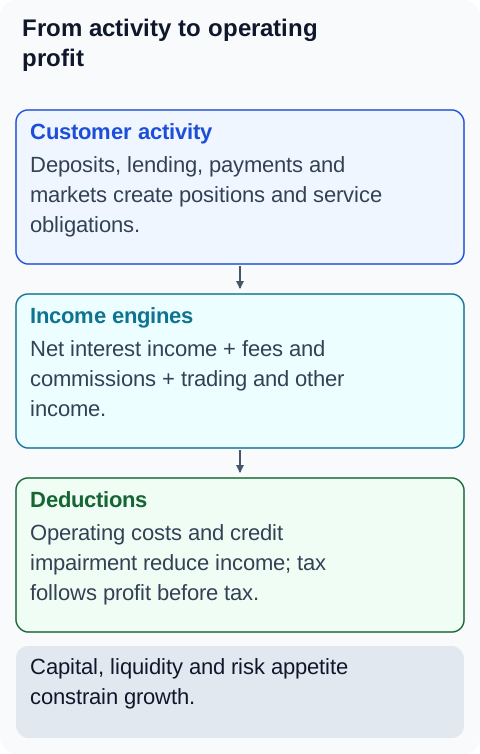
Figure 2. Balance sheet and net interest income.
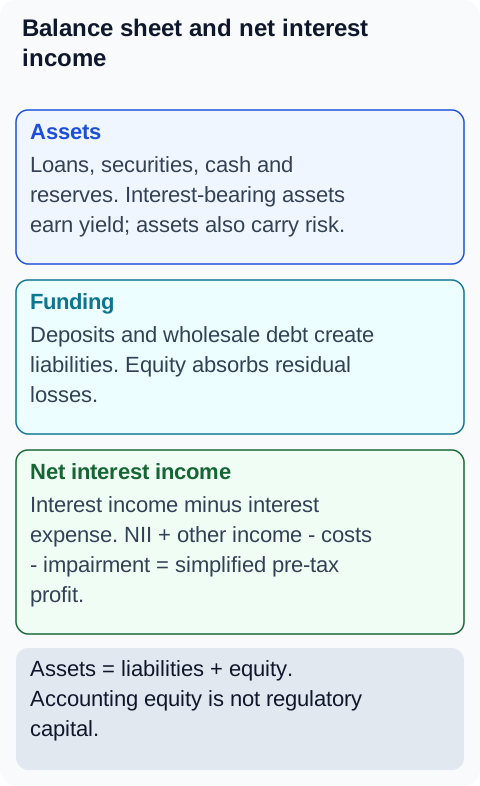
Figure 3. Traceable accounting lineage.
12. Tables
Table 1 — Where each later section fits on the map
| Section | Chapters | Main subject |
|---|---|---|
| 1 | 001–005 | How a Bank Works Financially |
| 2 | 006–010 | Accounting Foundations |
| 3 | 011–015 | Finance Technology |
| 4 | 016–020 | Deposits and Funding |
| 5 | 021–025 | Loans and Credit Products |
| 6 | 026–030 | Payments and Settlement |
| 7 | 031–035 | Treasury and Financial Markets |
| 8 | 036–040 | Financial Instruments Accounting |
| 9 | 041–045 | Credit Impairment |
| 10 | 046–050 | Hedge Accounting |
| 11 | 051–055 | Financial Controls and Close |
| 12 | 056–060 | Financial Statements |
| 13 | 061–065 | Performance and Pricing |
| 14 | 066–070 | Tax, Costs and Obligations |
| 15 | 071–075 | Capital and Prudential Planning |
| 16 | 076–080 | Liquidity and Interest-Rate Risk |
| 17 | 081–085 | Regulatory Reporting |
| 18 | 086–090 | Jurisdictional Reporting |
| 19 | 091–095 | Disclosure and Emerging Instruments |
| 20 | 096–100 | Data, Change and Integrated Practice |
Table 2 — Glossary of terms used in this chapter
| Term | Plain meaning |
|---|---|
| Intermediation | Sitting between savers and borrowers, transforming maturity, currency and risk |
| Net interest margin (NIM) | Net interest income divided by average interest-earning assets |
| Cost-to-income ratio | Operating costs divided by total income; lower is more efficient |
| Impairment / ECL | Estimated credit loss recognised before default happens (IFRS 9) |
| Funds transfer pricing (FTP) | Internal price a business line pays/receives for funding and liquidity |
| RWA | Risk-weighted assets — exposures adjusted for riskiness, the divisor of capital ratios |
13. Illustrative bank case study
A retail bank discovers its star product loses money. A mid-sized retail bank's dashboards showed unsecured personal loans as its most profitable product, with a 22% return on allocated equity. A finance review rebuilt the number: the FTP charge had not been updated after a rate rise (understating funding cost by 1.1%), collection costs sat in a central cost centre, and the expected-loss rate used a benign three-year window. Restated return: 6% — below the bank's 10% hurdle. Management repriced the product, tightened cut-offs, and moved collections cost into product P&L. Lesson: reported profit is a function of allocation choices; every assumption must be visible, versioned and challengeable. (Fictional training case; no specific bank or event is asserted.)
14. BA, developer, tester and operations guidance
- BA: For any finance requirement, capture the business event, the accounting entries (debits/credits, accounts, dimensions), the timing (booking vs value date), the reversal behaviour, and the downstream reports affected. Insist on numeric examples.
- Developer: Use governed and versioned posting logic, whether implemented in a product processor or a separate accounting rules engine. Preserve event IDs end to end for lineage, make interfaces replayable, and never silently drop a failed posting — route to exceptions.
- Tester: Test the full chain, not just the screen: post event → verify subledger → verify GL → verify reconciliation → verify report cell. Include boundary cases: backdated value dates, partial repayments, currency holidays, fee reversals.
- Operations: Own daily completeness checks and aged-break escalation. A break older than its tolerance is a control failure, not background noise.
15. Common mistakes
- Treating deposits as assets or loans as liabilities — the classic beginner inversion.
- Confusing profit with cash with liquidity with capital (Section 4.4).
- Assuming the general ledger and regulatory capital use the same number — capital starts from accounting equity then applies prudential deductions and filters.
- Believing product dashboards without asking which costs, losses and capital charges are included.
- Designing interfaces without reconciliation, replay and exception handling.
16. Key takeaways
- A bank transforms maturity, currency and credit risk and lives on the spread plus fees — after costs, losses and safety buffers.
- Deposits are liabilities; loans are assets; equity is thin by design.
- Profit, cash, liquidity and capital answer different questions; report all four.
- One business event flows through subledger → GL → statements → regulatory returns; reconciliation is the gatekeeper.
- Finance serves managers, investors, auditors and regulators simultaneously — allocation choices and estimates must be transparent.
17. References and verification notes
-
Basel Framework: NSFR: available and required stable funding are weighted by funding and asset characteristics over a one-year horizon, not a requirement to match every mortgage with equally long funding.
-
Basel Framework: LCR: 100% is the minimum in normal conditions for covered banks; HQLA buffers are intended to be usable in stress. Basel is a standard implemented through local law.
-
IIA: Three Lines Model: first- and second-line roles sit within management; Internal Audit provides independent third-line assurance. A Finance department is not automatically second line.
-
IFRS Foundation: IFRS 9: classification depends on business model and contractual cash flows; initial recognition and directly attributable costs follow IFRS 9. This is the IFRS track, not US GAAP CECL.
-
Concepts here follow IFRS (IAS 1 presentation, IFRS 7/9 financial instruments) as the main track; US GAAP (ASC 310/326, CECL) and national implementations differ — jurisdiction chapters flag specifics. Verify ratio definitions against the applicable rulebook version in force.
-
Basel framework: Bank for International Settlements, "Basel III: A global regulatory framework" and subsequent reforms; EU CRR/CRD, UK PRA Rulebook, US federal banking rules, RBI master directions apply locally.
-
Liquidity and capital metrics (LCR, NSFR, CET1) are introduced here and defined fully in Sections 15–16; do not use this chapter's simplified figures for any real calculation.
-
Worked numbers are fictional training simplifications. Rates, thresholds and templates change — always verify against the current official source before implementation.