Chapter 071: The Prudential Framework
Section 15: Regulatory Capital and Prudential Foundations · Chapter 071 of 100
This chapter explains the prudential framework from the reporting bank's perspective. Examples are fictional; accounting follows IFRS unless another framework is expressly identified.
1. Chapter opening
The prudential framework limits the risks a bank can take and the financial resources it must maintain. It combines capital, liquidity, leverage, governance, risk management and disclosure. Basel standards are international standards; enforceable requirements come from the applicable jurisdiction, bank category and supervisory decisions.
2. Learning objectives
- Explain the three Basel pillars and related liquidity/leverage safeguards.
- Distinguish accounting equity, eligible capital and loss-absorbing liabilities.
- Separate international standards, local law, proposals and phase-ins.
- Link prudential calculations to accounting and exposure data.
3. Business context
Banks fund long or risky assets with liabilities payable on different terms. Losses reduce resources available to absorb further losses, while withdrawals can cause liquidity pressure before insolvency. Capital does not itself prove cash is available; liquidity does not prove the assets can absorb losses.
4. Finance and accounting view
4.1 The prudential architecture
Pillar 1 sets minimum capital for prescribed risks and methods. Pillar 2 addresses supervisory review, governance and risks not adequately captured by Pillar 1; the ICAAP is the bank's own capital assessment, not a mechanical add-on table. Pillar 3 requires relevant disclosures to support market discipline. Capital buffers sit above minima and create conservation consequences when depleted; leverage constrains exposures independently of risk weights. LCR and NSFR address different liquidity/funding horizons.
4.2 Accounting to prudential reporting
Accounting equity is the starting point for a capital bridge, not automatically CET1. Qualifying instruments, deductions, filters, minority interests and regulatory scope change the numerator. RWA derive from exposures and approved rules, not simply accounting assets multiplied by one average percentage. A leverage exposure measure also includes specified derivative, securities-financing and off-balance-sheet adjustments.
Illustratively, a bank has assets 100, liabilities 92 and equity 8. An asset loss of 5 leaves assets 95, liabilities 92 and equity 3. The post-loss accounting equity/assets ratio is 3/95 = 3.158%, not 3%. This is an accounting illustration, not a regulatory leverage-ratio calculation.
4.3 Quality and implementation
CET1 is the highest-quality going-concern capital. Eligible AT1 and Tier 2 have different loss-absorption and eligibility features. Resolution frameworks such as MREL/TLAC can include qualifying liabilities beyond regulatory capital; they must not be treated as synonyms for Tier 2.
The fully phased Basel output floor compares aggregate model-based RWA with a prescribed percentage of aggregate standardised RWA; it is not a universal minimum risk weight for each loan. Local dates, phase-in percentages, discretions and prudential scope differ. Maintain separate current-law and future-rule scenarios. A consultation, final international standard or foreign jurisdiction's commencement date does not establish today's domestic reporting requirement.
5. Product and customer impact
Prudential constraints influence lending, deposit strategy and pricing, but no capital ratio authorises unsuitable lending. A liquidity buffer supports obligations to depositors; it should be usable under its governing rules and is not a guarantee against every run.
6. Regulatory and supervisory view
The Basel Framework is the international reference. Check enacted local rules, applicability, effective date and bank-specific decisions for a live filing. ECB SREP illustrates a particular supervisory regime. No universal fixed NPE floor, 1% IRRBB add-on or quarterly supervisory calendar is asserted. The 2011 and 2017 Basel documents cited below explain the standard's development, not current local law in every country.
7. Systems and data view
Maintain a rule inventory with authority, legal status, effective date, scope and version. Map GL equity to eligible capital and source exposures to RWA/leverage measures. Changes require a controlled interpretation, implementation tests and a bridge from previous results.
8. End to end process
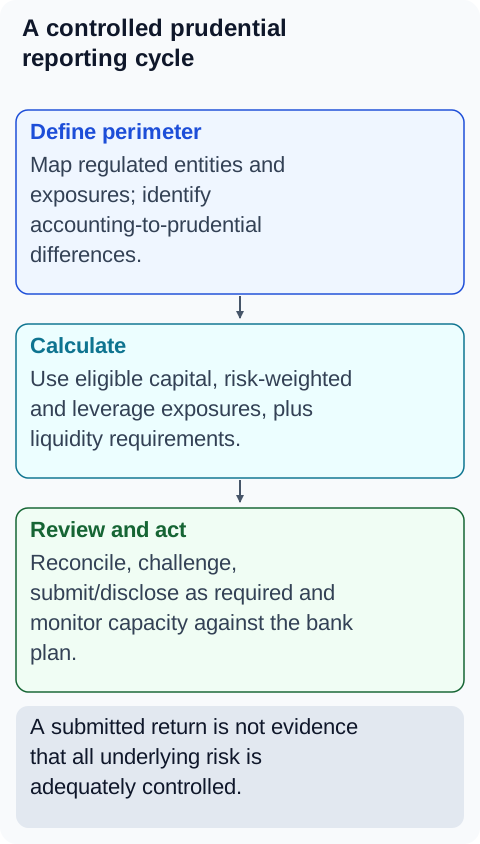
- Determine applicable entity and consolidation scope.
- Identify current rules and bank-specific requirements.
- Reconcile equity and exposures to source data.
- Apply eligibility, deductions, methods and buffers.
- Validate and review prudential returns and disclosures.
- Forecast capital/liquidity constraints and feasible actions.
9. Controls and risks
| Misinterpretation | Control |
|---|---|
| Basel standard treated as domestic law | Jurisdiction/status/effective-date register |
| Accounting equity labelled CET1 | Reconciled capital bridge |
| Capital confused with available cash | Separate liquidity and funding assessment |
| Future output floor booked as current | Current and future-rule versions |
| Resolution liabilities called Tier 2 | Instrument eligibility by framework |
10. Practical examples
Assume CET1 7.2% of RWA, a 4.5% CET1 minimum and a 3.0% combined conservation/countercyclical buffer, with sufficient capital to meet the separate Tier 1/total minima and no additional requirements or CET1 needed for a minimum TLAC requirement. Available CET1 above minima is 2.7%, or 90% of the buffer, putting it in the top buffer quartile. The Basel conservation standard requires at least 40% of relevant earnings retained, leaving at most 60% for covered distributions under that standard. Local MDA calculation, earnings basis and restrictions must be assessed separately.
11. Diagrams
Figure 1. Prudential standards and local law.
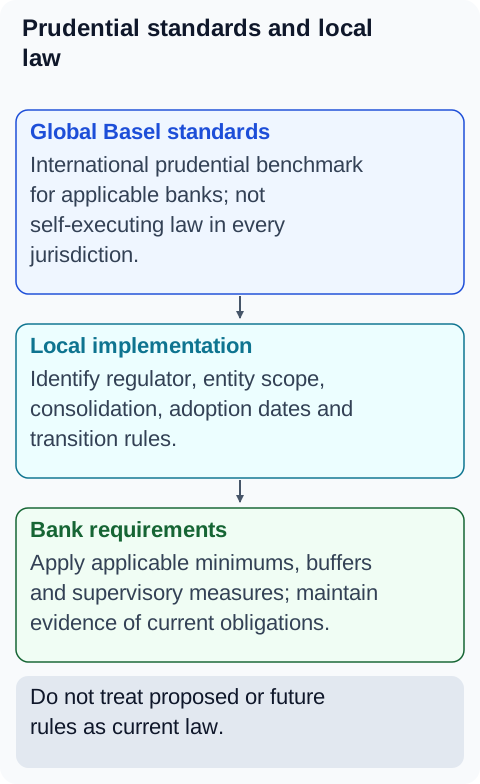 Figure 2. Three prudential pillars.
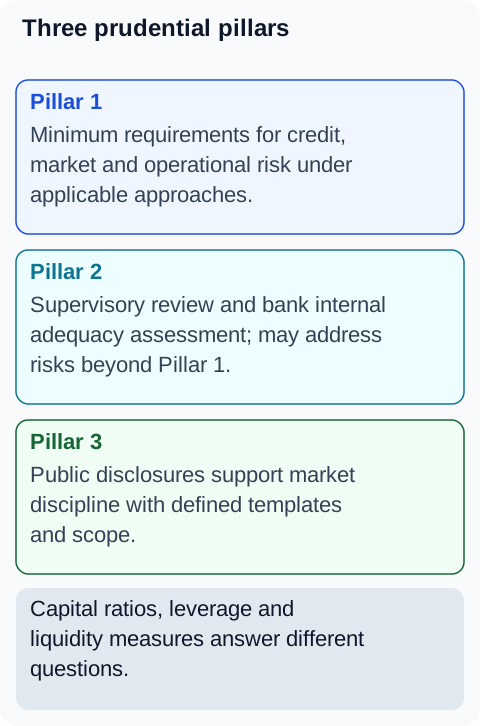 Figure 3. A controlled prudential reporting cycle.
12. Tables
| Framework component | Main purpose |
|---|---|
| Risk-based capital | Absorb prescribed risk losses |
| Leverage ratio | Limit exposure relative to Tier 1 capital |
| LCR | Short-horizon stressed liquidity |
| NSFR | Structural funding stability |
| Pillar 2 | Bank-specific risk/governance review |
| Pillar 3 | Public prudential transparency |
13. Fictional banking case study
A fictional bank used a future overseas capital rule in its domestic return. Review separated current domestic requirements from a planning scenario and corrected the filing through the applicable process. The bank added legal status and commencement evidence to its rule register.
14. BA, developer, tester and operations guidance
The equity-to-capital bridge supplies eligible resources. RWA provides a risk denominator. Ratios/buffers compare those resources with requirements; capital planning tests their evolution alongside liquidity and recovery options.
15. Common mistakes
- Equating equity/assets with Basel leverage.
- Treating Basel publication as immediate worldwide law.
- Applying the output floor to individual loans.
- Assuming all Pillar 2 risks have fixed global add-ons.
- Treating MREL/TLAC and regulatory capital as identical.
16. Key takeaways
Prudential accuracy begins with applicable scope and law, then reconciles resources and exposures. Capital, leverage, liquidity, governance and resolution capacity complement each other without being interchangeable.
17. References and verification notes
- Basel Framework: risk-based requirements and leverage: consolidated international standards.
- Basel III 2011 capital standard and 2017 reforms: underlying standard publications; local implementation controls current application.
- ECB SREP: jurisdiction-specific example.
- Ratios and case episodes are fictional.