Chapter 053: Nostro, Clearing and Suspense Reconciliation
Section 11: Reconciliation, Financial Control and Close · Chapter 053 of 100
This chapter explains nostro, clearing and suspense reconciliation from the reporting bank's perspective. Examples are fictional; accounting follows IFRS unless another framework is expressly identified.
1. Chapter opening
A nostro is an account our bank holds with another bank. Its positive balance is an asset in our bank's books and a deposit liability in the correspondent's books. Central-bank settlement accounts play a related cash-settlement role. A payment message, settlement confirmation and ledger posting are distinct pieces of evidence. A SWIFT message alone does not prove that cash moved.
Nostro reconciliation compares our internal cash ledger with the independent account statement. Clearing reconciliation proves scheme positions and their settlement. Suspense reconciliation proves temporary GL balances to identified open items. These controls are related but are not the same three-way match.
2. Learning objectives
By the end of this chapter you will be able to:
- Explain the nostro account: what it is, why it exists, and how it is used for payment settlement.
- Perform a nostro reconciliation: match internal ledger to external bank statement, identify breaks, and classify break types.
- Clear suspense items: explain why suspense exists, how it is cleared, and the triggers for clearing.
- Post journals for reconciliation breaks: suspense, investigation, and resolution (repair, return, write-off).
- Describe controls: daily reconciliation, aging escalation, break root-cause analysis, and suspense balance monitoring.
- Identify risks: settlement risk, reconciliation risk, suspense risk, and fraud risk : and the controls that mitigate each.
3. Business context
Reconcile at a risk-appropriate frequency, commonly daily for active settlement accounts and more frequently for intraday liquidity monitoring. Match references, original currency, amounts, booking dates and value dates. Compare opening balances, movements and closing balances; a correct closing balance can conceal offsetting omissions.
| Control | Compares | Detects |
|---|---|---|
| Nostro | Internal cash ledger versus external statement | Unbooked debits/credits and posting errors |
| Clearing | Scheme transaction/position records versus settlement and GL | Incorrect net positions or missing settlement |
| Suspense | GL versus open-item register and relevant source events | Orphan or duplicated temporary entries |
Large or suspicious breaks need prompt escalation; service levels depend on the scheme, risk and local policy. Age does not itself create a write-off or regulatory-reporting obligation.
4. Finance and accounting view
4.1 Nostro mechanics
Bank-side journals, fictional units:
| Event | Debit | Credit |
|---|---|---|
| Outgoing customer transfer settles | Customer deposit liability 100 | Nostro cash asset 100 |
| Incoming transfer credited to customer | Nostro cash asset 80 | Customer deposit liability 80 |
| Statement fee not yet booked, validated | Bank fee expense 2 | Nostro cash asset 2 |
Outgoing settlement reduces our cash asset, so it is a credit. The correspondent may show a debit to our account because it reduces its liability to us. Incoming cash is a debit in our books. If the receipt repays a loan instead, the credit is to the loan/interest receivable as appropriate, rather than to a deposit.
With opening cash 1,000, these movements give 1,000 - 100 + 80 - 2 = 978. Reverse an actual duplicate only after proving whether the duplicate exists in our ledger, the correspondent's record or both.
4.2 Suspense reconciliation
An outgoing flow may first post Dr customer deposit / Cr payment-clearing payable, then on settlement Dr clearing payable / Cr nostro. An incoming unidentified receipt may post Dr nostro / Cr unidentified-receipts liability; after the beneficiary is verified, Dr that liability / Cr customer deposit. Suspense can hold debit or credit balances depending on its purpose. It is not automatically the balance of all unsettled payments.
Prove the GL balance to the item register and relevant payment events. Retain gross debit and credit items; offsetting unrelated entries can hide errors. Clear only against evidence. Write-off requires an assessed loss, an approved accounting treatment and authority; an aged unidentified credit is not automatically income.
4.3 Break investigation and resolution
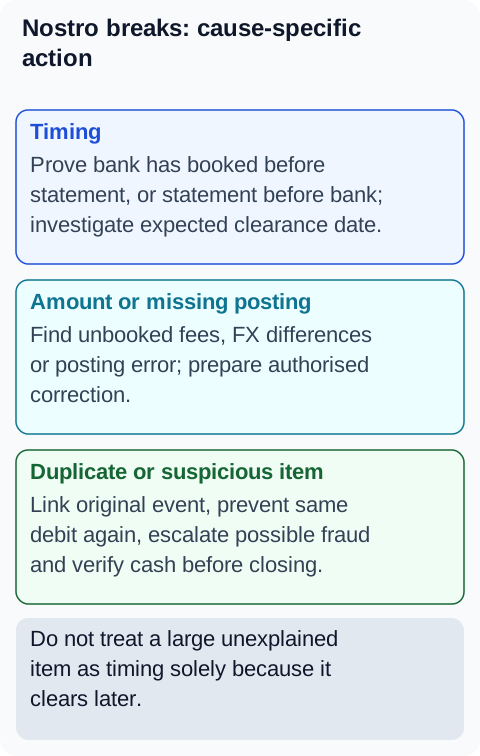
Classify timing, amount, duplicate, missing or suspicious items. A timing item needs evidence of a genuine processing interval and an expected clearance event. Same-day systems must not inherit a generic T+2 expectation. Correct a proven posting error, request correspondent repair where needed, or initiate a return through its own authorised process. Reconciliation does not authorise re-sending a payment.
4.4 Nostro account management
Monitor available funds, intraday limits, overdraft terms, fees and counterparty concentration separately from reconciliation. Under Basel LCR, eligible withdrawable central-bank reserves may qualify as Level 1 HQLA subject to the rules. Ordinary balances due from commercial banks are not Level 2 HQLA merely because they are liquid. Capital weights depend on counterparty, currency, jurisdiction and applicable approach, rather than a universal zero/20% split.
5. Product and customer impact
A break may reveal a customer payment problem, but it can also arise after successful settlement because our ledger missed an entry. Confirm scheme and correspondent evidence before describing a payment as delayed. Customer remediation follows the actual issue: missing credit, duplicate debit, incorrect amount or a settled transfer needing investigation.
6. Regulatory and supervisory view
Basel liquidity-risk principles support sound payment and intraday liquidity management. The Basel LCR framework defines HQLA eligibility. Reconciliation cadence, incident notifications and retention are determined by applicable local rules and bank policy. Independent review and restricted adjustment authority address the risk of someone concealing their own payment error; daily reconciliation is not asserted as one global statutory rule.
7. Systems and data view
Feed the engine with our GL/external-account subledger and independently received statements. Validate sequence numbers, currency, account identity and completeness. Statements may use legacy MT940 or MT950, ISO 20022 camt.053, intraday camt.052 or other agreed formats. Both MT940 and MT950 carry statement information; a simple summary-versus-detail distinction is misleading. Support the exact version and correspondent implementation in use.
8. End to end process
- Prove account and statement completeness.
- Match opening balances and movements to the internal ledger.
- Reconcile scheme clearing positions separately.
- Prove suspense GL balances to open items.
- Investigate residuals using payment and settlement evidence.
- Obtain approval for corrections, returns or assessed losses.
- Reconcile again and close the case with evidence.
- Feed root causes into routing, booking and data controls.
9. Controls and risks
| Risk | Control | Evidence |
|---|---|---|
| Missing statement or feed | Sequence and completeness checks | Input control report |
| Wrong settlement account | Approved routing master and account/currency checks | Route configuration |
| Aged unexplained item | Owner, due date and risk escalation | Case ageing |
| Concealed posting | Independent review and maker-checker adjustments | User and approval logs |
| Unidentified credit released to income | Liability assessment and authorised clearance | Beneficiary investigation |
10. Practical examples
Fictional example A: a 10m payment is routed to the wrong correspondent account. Internal and external evidence identifies the routing defect; a generic account checksum would not prove that the correct valid account was selected. Correct routing master data and investigate the settled funds through the correspondent.
Fictional example B: 500 payments post to the wrong clearing account. Reconcile each account and the underlying transaction identifiers, then transfer the proved balances with approval. Combining everything into one suspense account would hide, rather than fix, the account-level defect.
11. Diagrams
Figure 1. Internal nostro versus external record.
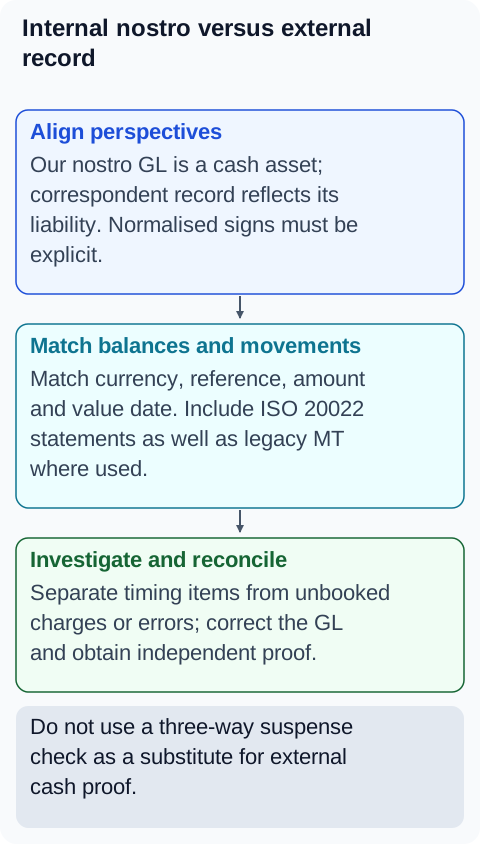
Figure 2. Three-way suspense proof.
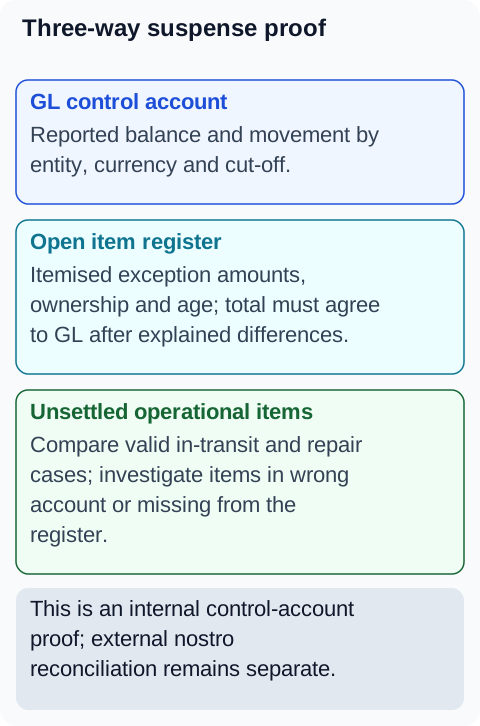
Figure 3. Nostro breaks: cause-specific action.
12. Tables
| Break | Evidence | Resolution |
|---|---|---|
| Timing | Valid settlement/batch pending | Track to observed clearance |
| Statement debit absent internally | Confirm fee, payment or other cause | Book correct expense/asset/liability |
| Internal duplicate | Source shows one valid event | Reverse proven duplicate |
| Wrong account | Routing and statement evidence | Approved correction or correspondent action |
| Suspicious | Inconsistent authority/reference | Immediate fraud/compliance escalation |
Age thresholds are bank-policy escalation points. None automatically authorises write-off, income recognition or a regulatory report.
13. Fictional banking case study
A fictional correspondent debits an unexpected 2m charge. Reconciliation identifies the unbooked debit; treasury checks the contractual fee terms and disputes it. Finance assesses the debit and any recovery claim independently before posting. A refund is booked when its recognition criteria are met, not assumed from the existence of a dispute. Balance monitoring and reconciliation serve separate purposes.
14. BA, developer, tester and operations guidance
Business analysts should map account identities, schemes, statement versions and each clearing/suspense purpose. Developers should preserve gross open items and source references. Testers should seed wrong-account, missing-statement, duplicate and offsetting-error cases. Operations should reconcile cash, clearing and suspense separately and communicate verified settlement status.
15. Common mistakes
- Reversing bank-side debit/credit directions because the statement uses the correspondent perspective.
- Treating a payment message as settlement proof.
- Assuming all suspense balances are unsettled payments.
- Writing off an item solely because of its age.
- Treating an ordinary interbank deposit as HQLA.
- Re-sending a payment to clear a reconciliation break.
16. Key takeaways
Reconcile internal cash assets to independent statements, scheme positions to settlement and suspense to open items. Investigate every unexplained difference with appropriate urgency. Only proved corrections clear accounting breaks; liquidity monitoring and payment status require additional evidence.
17. References and verification notes
- Basel LCR: eligibility of cash and central-bank reserves; ordinary financial-institution claims are not automatically HQLA.
- Basel liquidity-risk principles: payment and intraday liquidity controls.
- ISO 20022 catalogue: cash-management statement and notification definitions.
- All journals and cases are fictional bank-side examples. Scheme timing, local prudential implementation and correspondent statement specifications govern actual operations.