Chapter 062: Funds Transfer Pricing
Section 13: Management Finance and Bank Profitability · Chapter 062 of 100
This chapter explains funds transfer pricing from the reporting bank's perspective. Examples are fictional; accounting follows IFRS unless another framework is expressly identified.
1. Chapter opening
Funds transfer pricing (FTP) allocates funding and liquidity economics to products and business lines. Treasury is the internal counterparty; the bank's external income, expense and cash flows are unchanged by internal FTP entries. The policy defines which risks transfer and which remain with the business.
2. Learning objectives
- Construct funding charges and deposit credits with explicit components.
- Distinguish interest-reset tenor from contractual liquidity tenor.
- Reconcile internal FTP to the management P&L and treasury residual.
- Govern behavioural assumptions and avoid double-counting costs.
3. Business context
Without consistent FTP, a long loan funded by short deposits can appear highly profitable in the lending desk while treasury bears its maturity risk. Deposit businesses should receive credit for useful funding under validated assumptions. FTP is an incentive and risk-management system; it is not the price of an external borrowing transaction.
4. Finance and accounting view
4.1 Matched pricing
An illustrative three-year loan uses a base swap curve of 3.0%, a bank funding spread of 0.6%, contingent liquidity charge of 0.4% and an additional approved policy charge of 0.2%. Total FTP is 4.2%. A 5.5% loan yield leaves a 1.3% margin before credit, operating and capital costs. The 3.0% market curve is not itself the bank's unsecured funding cost.
Credit and liquidity components must correspond to the risk transferred. Buffer, resolution-funding or other charges require an explicit basis and must not duplicate costs already included in the spread. MREL is a jurisdiction-specific resolution requirement, not a worldwide FTP component.
4.2 Tenor and behaviour
A floating-rate five-year loan can reset interest every three months while still using five-year liquidity. Use separate interest-rate and liquidity assumptions. A prepayable fixed loan also creates option risk. Customer prepayment charges follow the contract and local law, not a mechanical pass-through of the treasury model.
For non-maturity deposits, estimate stable balances, repricing, decay and stress outflows by segment. Historical stability alone does not justify a seven- or ten-year replication tenor. Validate assumptions, back-test and set model-risk limits. A longer tenor need not have a higher curve rate when the curve is inverted.
Matched-term FTP on an existing fixed-rate loan is normally set at origination under that methodology; new-business quotes use current curves. Policy changes or reforecasting need transparent bridges, rather than silently repricing the whole fixed book and changing incentives retrospectively.
4.3 Management accounting
Internal loan FTP expense in a business line has equal treasury FTP income; deposit FTP income has equal treasury expense. These cancel on bank aggregation. Treasury's residual can reflect external funding, deliberate mismatch positions, hedges, basis risk and model error. A negative residual does not prove the FTP curve is wrong; investigate its components.
5. Product and customer impact
Pricing should include the actual service, credit and funding costs without disguising internal allocations as a customer tax or externally paid fee. A deposit's FTP credit rewards funding value but is not cash paid to the depositor.
6. Regulatory and supervisory view
US interagency SR 16-3 addresses funding and contingent liquidity risk FTP for its specified large-institution scope: domestic institutions with consolidated assets of at least USD 250 billion or foreign exposure of at least USD 10 billion, and foreign banking organisations with combined US assets of at least USD 250 billion. Its principles support proportionate design; it is not a global mandatory curve formula. Basel liquidity principles and applicable local requirements also inform risk management.
7. Systems and data view
Store approved curve versions, origination dates, contractual cash flows, repricing dates and behavioural assumptions. Trace each product charge to components. Separate the customer subledger from internal management allocation accounts and reconcile consolidated FTP to zero.
8. End to end process
- Define risks transferred and retained.
- Build approved curves and contingent-liquidity charges.
- Assign contractual and behavioural tenors.
- Lock or reset charges according to documented policy.
- Aggregate equal internal debits and credits.
- Explain treasury residuals and back-test assumptions.
9. Controls and risks
| Risk | Control |
|---|---|
| Liquidity tenor equals reset period | Independent cash-flow/tenor review |
| Cost counted in two components | Component inventory and reconciliation |
| Deposit model overstates stability | Segmentation, stress testing and back-testing |
| Retroactive margin changes | Controlled policy version and earnings bridge |
10. Practical examples
On a constant loan balance of 100 million, annual customer interest is 5.5 million and loan FTP is 4.2 million, leaving 1.3 million before other costs. On deposits of 80 million, FTP credit of 1.8% is 1.44 million and customer interest of 1.0% is 0.80 million, leaving 0.64 million. Net business FTP expense is 4.2 - 1.44 = 2.76 million; treasury receives the equal net credit. This does not establish overall bank profit because external funding, hedging and other costs remain.
11. Diagrams
Figure 1. FTP: internal funding allocation.
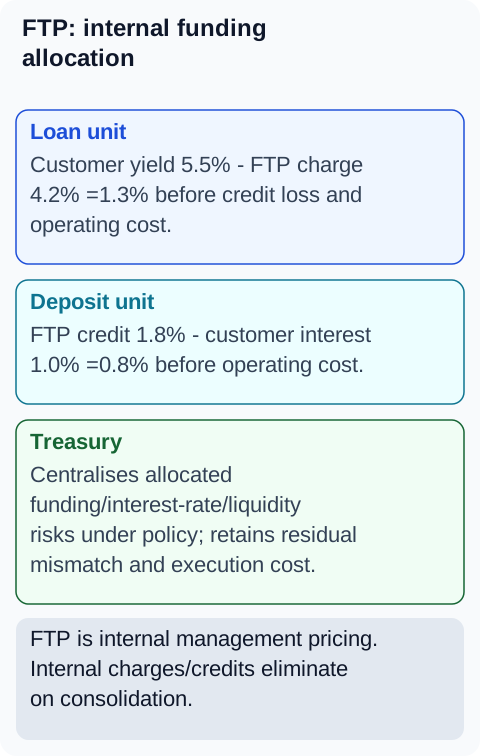
Figure 2. An illustrative five-year FTP rate.
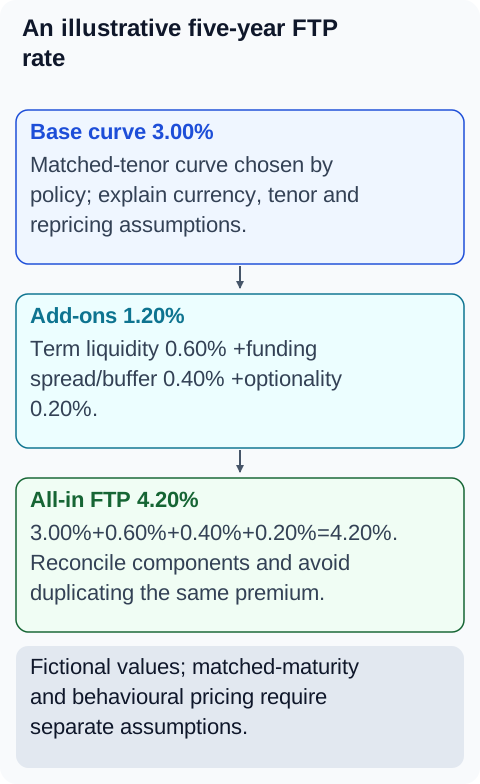
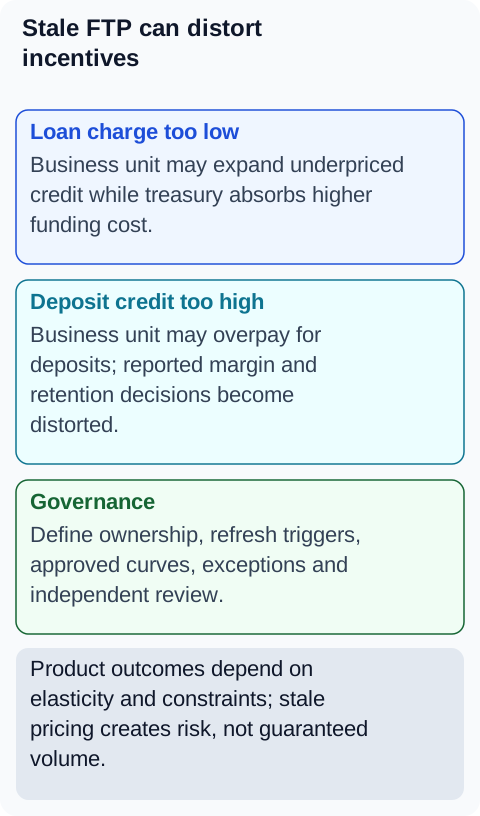
Figure 3. Stale FTP can distort incentives.
12. Tables
| Internal management entry | Business side | Treasury side |
|---|---|---|
| Loan funding charge 4.20 | Debit FTP expense | Credit FTP income |
| Deposit funding credit 1.44 | Credit FTP income | Debit FTP expense |
| Aggregation | Net expense 2.76 | Net income 2.76 |
These are internal management allocations, not customer or external settlement journals.
13. Fictional banking case study
A fictional bank charged floating loans only for their short interest-reset period. Review found that long contractual liquidity was left unpriced. It introduced a separate liquidity-tenor component, disclosed the effect on new-business margins and retained an approved treatment for existing deals. The correction transfers the intended risk cost; it does not remove borrower credit risk.
14. BA, developer, tester and operations guidance
Profitability uses FTP with service and credit costs. Risk-adjusted pricing adds the return needed on capital. ALM monitors the interest and liquidity positions transferred to treasury, including residual risks.
15. Common mistakes
- Treating the base swap curve as full bank funding cost.
- Sending all credit and operational risk to treasury.
- Equating floating interest tenor with liquidity tenor.
- Treating internal income as external cash.
- Calling every negative treasury residual a calibration error.
16. Key takeaways
FTP makes internal margins reflect approved funding and liquidity costs. Its credibility rests on explicit components, validated behaviour, equal internal entries and a clear explanation of the risks treasury actually receives.
17. References and verification notes
- Federal Reserve SR 16-3: US scope and FTP governance.
- Basel liquidity management principles: international guidance.
- Curves, spreads and customer examples are fictional assumptions, not current market quotations.