Chapter 035: Derivatives and Collateral
Section 7: Foreign Exchange and Treasury Instruments · Chapter 035 of 100
1. Chapter opening
Derivatives create contractual rights/obligations whose fair value depends on rates, currencies, prices or other variables. Notional is a reference amount, not the recognised exposure or maximum loss. Recognise fair value under the applicable policy, settle actual cash separately and apply eligible hedge accounting when designated.
Cash collateral held as security is normally accompanied by a return obligation; posted collateral can be a receivable. Some arrangements settle the derivative exposure through variation margin rather than collateralise it. Determine the actual legal/accounting substance before mapping journals. A margin call does not by itself erase all counterparty or liquidity risk.
2. Learning objectives
By the end of this chapter you will be able to:
- Explain fair value measurement (mark-to-market) for swaps, forwards and options through yield/term structure.
- Post daily derivative P&L, collateral received/posted, settlement and fee-driven costs.
- Apply collateral terminology precisely (threshold, minimum transfer, independent amount, eligible collateral, haircut) and journal each movement.
- Show how netting reduces credit exposure and affects accounting netting (IFRS 7/IAS 32 enforceability).
- Recognise routine failures (CSA breaches, valuation disputes, wrong collateral type, delayed settlement) and their controls.
3. Business context
Derivatives hedge or trade risk but require curve, credit, collateral and cash-flow controls. CVA reflects counterparty credit and DVA the bank's own credit in relevant fair-value measurement; assumptions must reflect market participants and the actual agreement. OIS discounting or a generic FVA label is not a universal formula for every contract.
Enforceable close-out netting can reduce default exposure while accounting remains gross. IAS 32 offsetting needs a currently legally enforceable right and intention to settle net or simultaneously. A right arising only on default is insufficient. Gross presentation under those requirements is proper presentation, not an 'overstatement' to correct through unsupported netting.
4. Finance and accounting view
4.1 Valuation and recognition
An at-market par interest-rate swap commonly has zero inception fair value; off-market terms and option premiums can create an initial amount. Remeasure a trading derivative through P&L: Dr Derivative asset / Cr Trading gain when value increases, or Dr Trading loss / Cr Derivative liability for a negative value. If a position crosses zero, clear the existing asset before recognising the liability; do not leave both for one contract.
A receive-fixed/pay-floating swap generally loses value when relevant rates rise. Use projected cash flows and discount curves consistent with market-participant assumptions and the collateral agreement; OIS discounting is common for collateralised portfolios, not a universal rule for every derivative. CVA adjusts counterparty credit; DVA adjusts own credit/non-performance risk. Fair-value adjustments must avoid double-counting and do not all have the same journal direction.
4.2 Collateral and settlement
Cash posted as refundable security: Dr Collateral receivable / Cr Cash. Cash received: Dr Cash / Cr Collateral payable. Received cash interest expense and posted cash interest income depend on the agreement and rate sign. Non-cash collateral is tracked with custody, ownership, eligibility and haircut records; normally receiving pledged securities does not create a recognised security asset.
For some centrally cleared arrangements, variation margin legally settles the derivative rather than collateralising it. Assess contract and clearing rules: settlement-to-market can reduce derivative carrying value; collateral-to-market leaves separate collateral receivable/payable. Initial margin is normally a separate restricted asset, with its own counterparty and access rights. Never call every margin movement 'not a payment'.
4.3 Netting, disputes and prudential treatment
IAS 32 offsetting requires a currently enforceable right and intent to settle net or simultaneously. Close-out rights that arise only on default can mitigate credit exposure but do not by themselves permit accounting offsetting. Gross presentation when IAS 32 criteria fail is correct presentation, not an overstatement.
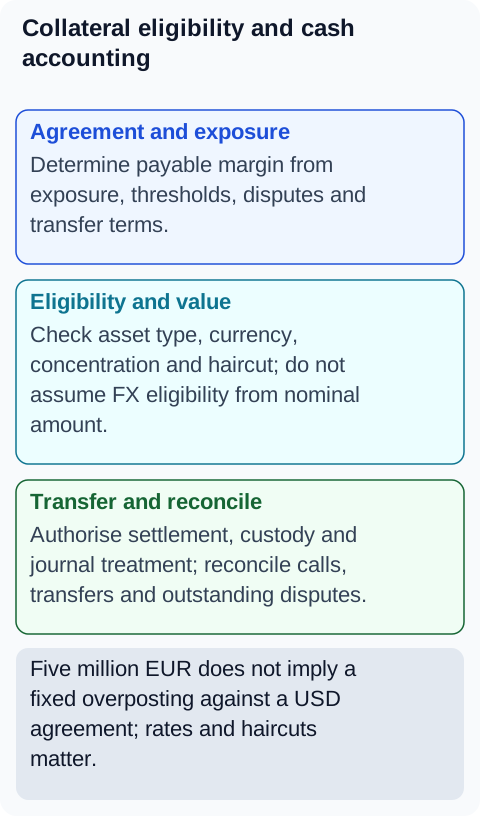
CSA terms define exposure threshold, minimum transfer, rounding, eligible collateral, haircuts, valuation and dispute procedures. Settle undisputed amounts and investigate model/price differences; negotiating a midpoint does not establish IFRS 13 fair value. Wrong-currency collateral is ineligible if the agreement does not allow it, even if its converted market value exceeds the call.
SA-CCR credit exposure and Basel leverage derivative exposure are separate calculations; the latter is not simply SA-CCR including alpha. Local implementation governs effective dates and permissions. Collateral HQLA eligibility follows actual asset category, restrictions and LCR rules, not the word 'collateral'.
5. Product and customer impact
Corporate swap contracts, the bank's dealer hedges and the associated collateral agreements are separate obligations. A corporate may pay fixed/receive floating to hedge debt; the bank has the opposite customer leg and may offset it with a dealer. Reconcile each legal counterparty, settlement and collateral balance separately.
Misvaluation or misposted collateral can create credit, liquidity, limit and reporting problems. It does not automatically invalidate the customer's economic hedge or relieve the bank of its contractual obligations. Escalate actual shortfalls, valuation disputes or performance risk using the contract and supported facts.
6. Regulatory and supervisory view
The international Basel SA-CCR framework specifies counterparty credit exposure as alpha times replacement cost plus potential future exposure, with alpha 1.4 under its baseline and detailed netting/collateral rules. Adoption dates and local modifications differ; avoid claiming universal replacement of CEM in 2017. CVA capital, leverage, margin and financial-statement rules are separate obligations.
IFRS 9 governs derivative recognition and measurement, IFRS 13 the fair-value approach, IAS 32 offsetting and IFRS 7 disclosures. Apply initial/variation margin rules only to in-scope counterparties and contracts. A government bond may be Level 1 HQLA, a qualifying corporate bond may be Level 2A/2B, and ineligible/encumbered holdings may not count.
7. Systems and data view
Link trade capture, approved market data/models, valuation adjustments, CSA terms, margin workflow, custody/cash, reconciliation and any hedge designation. Track threshold, minimum transfer, eligible collateral, haircuts and netting-set identifiers; reconcile cash collateral return obligations to settled cash.
Independent valuation/model review considers market benchmarks, portfolio calibration, realised recoveries/exposures, sensitivity and limitations. A single counterparty's survival/default does not prove a predicted probability correct or incorrect. Review frequency and redevelopment triggers follow risk and applicable requirements; preserve input/model versions and independent challenge.
8. End to end process
Daily derivative cycle: (1) market close → reprice portfolio; (2) IPV for material portfolios; (3) compute CSA collateral requirements; (4) generate margin calls; (5) confirm and settle collateral; (6) book GL postings; (7) reconcile collateral balances; (8) generate hedge-accounting entries if designated; (9) prepare risk reports (CVA, exposure, P&L); (10) archive audit trail (prices, models, collateral movements). Each step emits evidence for audit.
9. Controls and risks
| Risk | Control | Evidence |
|---|---|---|
| Valuation error | Independent price verification | IPV reports, variance analysis |
| Collateral shortfall | CSA compliance monitoring | Breach reports, escalation logs |
| Wrong collateral type | Eligibility filter, haircut governance | Collateral type reports |
| Netting enforceability | Legal opinion per jurisdiction | Opinion files, review schedule |
| Margin-settlement failure | Confirmation matching, cut-off control | Confirm vs settle reconciliation |
10. Practical examples
Fictional valuation dispute: bank marks swap at 12m, counterparty 10.8m. They settle the undisputed collateral while reviewing curves, trade terms, credit adjustments and market data. A negotiated 11.4m collateral amount is not automatically the accounting mark.
**Fictional eligibility failure:**5m EUR collateral arrives against a USD-only CSA call. At 1.10 it has USD 5.5m market value, but it is ineligible under those terms. Arrange the permitted substitute or an authorised amendment, applying haircuts and valuation after eligibility is established.
11. Diagrams
Figure 1. Derivative valuation to collateral proof.
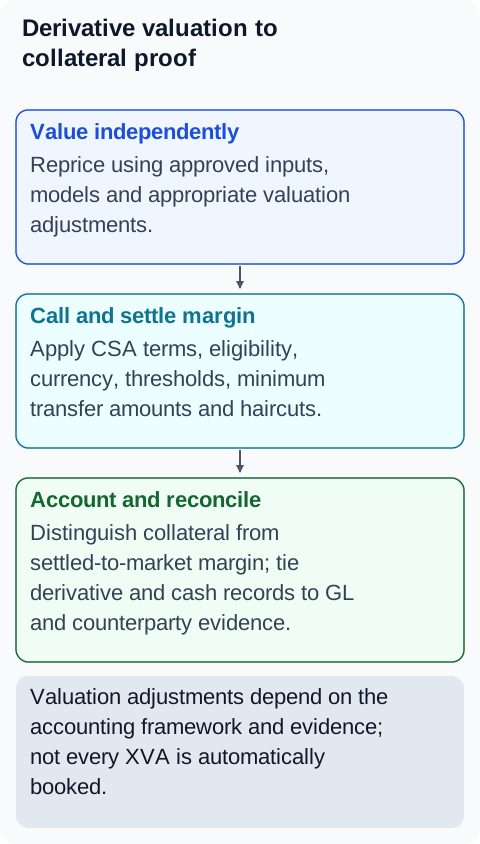
Figure 2. Netting: three different assessments.
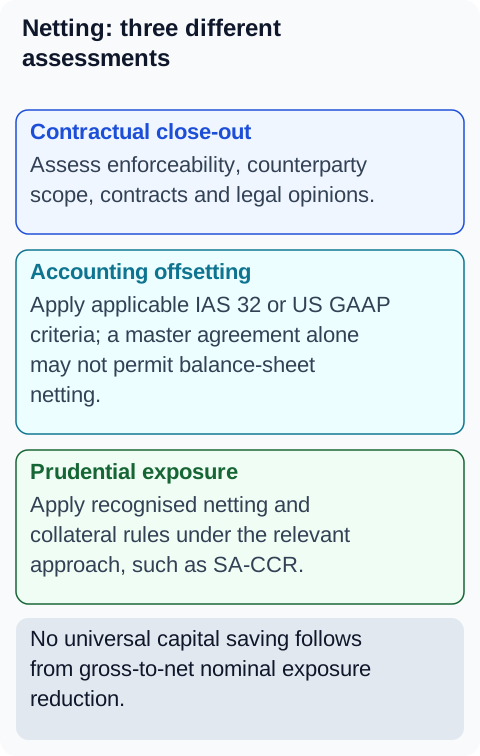
Figure 3. Collateral eligibility and cash accounting.
12. Tables
| Event | Debit | Credit |
|---|---|---|
| Positive derivative revaluation | Derivative asset | Trading gain |
| Negative derivative revaluation | Trading loss | Derivative liability |
| Refundable cash posted | Collateral receivable | Cash |
| Refundable cash received | Cash | Collateral payable |
| Received collateral interest owed | Interest expense | Interest payable |
| Collect positive derivative | Cash | Derivative asset |
| Settle negative derivative | Derivative liability | Cash |
Derivatives may also qualify for hedge accounting, changing gain/loss presentation. Regulatory and contractual haircuts are not IFRS 13 fair-value adjustments and do not determine the HQLA level.
13. Illustrative bank case study
Fictional bank scenario. A CSA requires replacement when collateral becomes ineligible. After a rating event, the bank identifies the actual contract rule, calculates the shortfall and pursues agreed replacement/dispute procedures. It separately assesses derivative credit valuation and any eventual close-out loss; an eligibility breach is not automatically a booked loss equal to the collateral amount. This training case does not assert an event at an unnamed real institution.
14. BA, developer, tester and operations guidance
- BA: Specify product terms, valuation sources, CSA parameters (threshold, MTA, eligible collateral, haircut), netting-set mapping, and hedge-designation criteria with business rationale.
- Developer: Price at market close; CSA engine with threshold and MTA logic; collateral-type filter; payment/allocation logic.
- Tester: Price shock scenarios, collateral shortfall scenarios, CSA breach escalation, valuation-dispute workflows.
- Operations: Reconcile collateral daily; resolve discrepancies within T+1.
15. Common mistakes
- Offsetting derivatives merely because default close-out netting is enforceable.
- Treating collateral received as income (it's security, not revenue).
- Ignoring CSA thresholds in daily collateral calculation.
- Failing to revalue collateral at haircut frequency.
- Not updating legal opinions for netting enforceability.
- Using stale market data for valuation.
16. Key takeaways
- Fair value, collateral rights and actual settlement are separate balances.
- Notional is neither asset value nor a complete exposure measure.
- IAS 32 offsetting requires both legal-right and settlement-intention criteria.
- Valuation adjustments follow the contract and market-participant assumptions.
- Reconcile derivative populations, collateral and settlement cash with independent price controls.
17. References and verification notes
- IFRS 9
- IAS 32 offsetting
- IFRS 13
- Basel counterparty credit risk
- Basel leverage derivatives
- Rules are applied under the reporting entity's adopted accounting framework and jurisdiction. Basel standards require local implementation; they are not themselves national law. All unnamed cases, amounts and operational thresholds are fictional training examples.