Chapter 025: Commitments and Financial Guarantees
Section 5: Lending and Credit Product Accounting · Chapter 025 of 100
Commitments and guarantees create promises before cash moves. Their accounting depends on the exact promise, the bank’s role and the funding/recovery rights when payment becomes due.
1. Chapter opening
An undrawn commitment has no funded loan principal yet, but may have a recognised ECL provision, fees and regulatory exposure. An IFRS 9 financial guarantee is a contract requiring specified payments to reimburse a holder for loss from a specified debtor’s failure to pay a debt instrument when due. A performance guarantee, collection mandate or advising service is not automatically that instrument. Classify the promise before choosing journals.
2. Learning objectives
- Separate funded loans, undrawn commitments and financial guarantees.
- Measure an IFRS 9 financial-guarantee liability without double-counting deferred premium and ECL.
- Post LC settlement from customer deposits or a funded claim.
- Distinguish advising, confirmation and collections.
- Reconcile nominal registers, accounting balances, limits and regulatory measures.
3. Business context
A bank may issue an LC, add confirmation, merely advise a credit, handle documentary collection, or issue a guarantee. Each role has different payment obligations. Nominal commitments consume limits and require monitoring, but nominal amount is not automatically a recognised accounting liability. Commercial risk, sanction restrictions, document rules, credit loss and liquidity outflows need distinct assessments.
4. Finance and accounting view
4.1 Sight LC and settlement perspective
Assume a 5m issuing-bank sight LC, validly issued with applicable incorporated rules. Record its nominal and limit utilisation in the contingent register. Assess the specific obligation’s accounting scope and any ECL provision; classify the issuance service/instrument fee under IFRS 9 or IFRS 15 as appropriate, not under one universal deferral rule.
When payment is due and the buyer has an available 5m deposit at this bank: Dr Buyer deposit liability 5m / Cr Nostro cash 5m. The deposit liability falls; no funded loan appears merely because the account was debited. If the bank instead provides contractual financing: Dr Funded buyer loan 5m / Cr Nostro cash 5m, with the loan’s initial measurement and ECL separately assessed. Release the contingent nominal as the obligation is fulfilled and reconcile related provisions; avoid counting the same exposure as both undrawn and drawn. An advising bank alone has no issuing/confirming payment undertaking and does not mirror the issuer’s credit-loss provision simply for forwarding the credit.
4.2 Deferred-payment obligations
A usance LC promises future payment subject to its terms and compliant presentation. Determine when an unconditional payable and an enforceable customer reimbursement receivable arise from the actual contract and applicable accounting policy. Where both qualify for recognition, a simplified entry is Dr Customer reimbursement receivable / Cr Acceptance or deferred-payment payable, with discounting and ECL assessed where applicable. Beneficiary discounting and separate buyer financing are distinct transactions. Do not label every acceptance as a new loan, or net the bank’s payment obligation against its customer receivable without the required offsetting criteria.
4.3 Financial guarantees: initial and subsequent liability
Assume an IFRS 9 financial guarantee with 10m maximum nominal, a received premium of 100,000 equal to initial fair value, not designated FVTPL, and no IFRS 17 election applicable. Initial journal: Dr Cash 100,000 / Cr Financial-guarantee liability 100,000. The nominal 10m remains separately recorded.
Subsequent measurement under IFRS 9 4.2.1(c) is the higher of the ECL amount and the amount initially recognised less cumulative income recognised using IFRS 15 principles. If ECL is 20,000 and the unreleased initial amount is 100,000, the liability is 100,000—not 120,000. If service/risk release supports income of 30,000: Dr Guarantee liability 30,000 / Cr Guarantee income 30,000, leaving 70,000 before remeasurement. If ECL is then 120,000: Dr Guarantee impairment expense 50,000 / Cr Guarantee liability 50,000, giving the required 120,000. The higher-of model is not an instruction to add a full separate ECL provision to every deferred premium.
A bid or performance guarantee may compensate for failure to perform rather than default on a debt instrument. Assess IFRS 9, IFRS 17 and, where outside those scopes, the applicable IAS 37/IFRS 15 treatment. The instrument’s name alone does not resolve scope.
On a valid call, recognise the payment obligation and use the existing guarantee liability in the settlement accounting. A reimbursement receivable requires an enforceable right and measurement/collectibility analysis; payment of 10m does not automatically produce a recoverable 10m loan asset. For illustration only, assume settlement is 10m, an enforceable separately measured recovery asset has initial fair value 6m and existing guarantee liability is 0.12m: Dr Recovery asset 6m; Dr Guarantee liability 0.12m; Dr Settlement loss 3.88m / Cr Cash 10m. Subsequent recovery impairment depends on the applicable asset accounting. Without a qualifying recovery asset, the residual payment is a loss, not a fictitious claim at full nominal.
4.4 Loan commitments and regulatory exposure
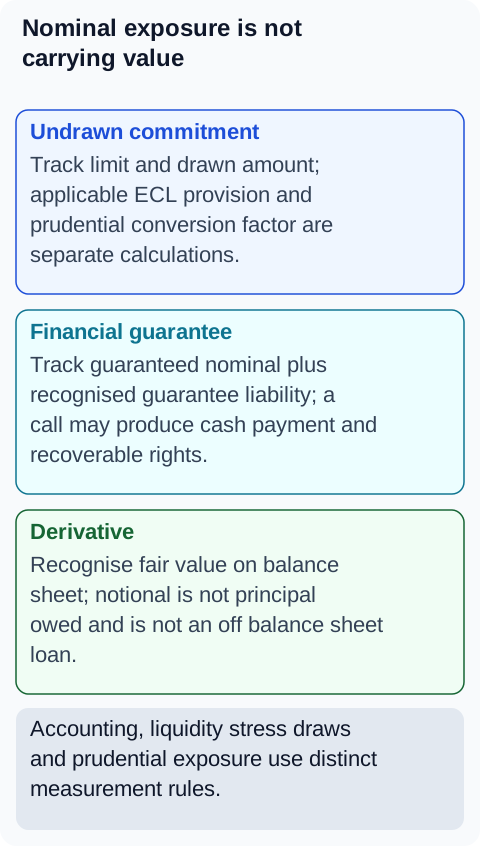
For a qualifying undrawn commitment within IFRS 9 impairment scope, Dr Impairment expense / Cr Commitment provision for ECL. On drawdown, recognise the loan and reconcile the drawn allowance and remaining undrawn provision. Do not release credit loss merely because the exposure becomes funded. Fees integral to a probable specific lending arrangement affect EIR when the loan is recognised; distinct ongoing commitment services require their own revenue assessment. Commitments at below-market rates and FVTPL-designated instruments require their specific IFRS 9 treatment.
Capital CCFs, large-exposure conversion and LCR stress outflows are separate regulatory calculations. The nominal, ECL exposure estimate, liability carrying amount and prudential exposure need explicit labels and their own reconciliations; do not assert one universal 20–50% CCF range.
5. Product and customer impact
Explain whether the bank is issuing, confirming, advising or collecting, what documents trigger its obligation, what facility limit is consumed and which fees are charged. ICC rules are contractual when incorporated. Where UCP 600 applies, the document-examination period and refusal notice require trained, timely handling. A missed valid-refusal requirement can preclude reliance on discrepancies; it is not a blanket statement that any missed internal SLA requires payment.
6. Regulatory and supervisory view
Apply sanctions and financial-crime obligations at the relevant transaction stages, including refreshed screening when facts change. Apply the current local prudential rules separately from contractual ICC rules and accounting scope. UCP 600, URDG 758 and URC 522 are different rulesets for different instruments; national law and the contract also matter. Check the incorporated edition and full rule text before deciding a real claim.
7. Systems and data view
Store instrument/role, legal promise, incorporated rules, nominal, limits, fee classification, scope decision, liability/provision, document presentations, refusal deadline, payment, reimbursement rights and settlement IDs. Reconcile contingent-register movements to accepted events, accounting balances and limit utilisation. SWIFT MT700-series trade messages are not automatically covered by the CBPR+ payment-message migration; use the actual trade-service standards and scheme documentation.
8. End to end process
- Classify the instrument and bank’s role.
- Approve credit, limit and legal/sanctions requirements.
- Register nominal and recognise applicable fees/liability/provision.
- Examine presentations and manage contractual notices.
- Recognise and settle due obligations under the actual funding arrangement.
- Assess any recovery asset and impairment.
- Release fulfilled/expired nominals and reconcile remaining obligations.
- Preserve documents and decisions under the applicable retention rules.
9. Controls and risks
| Risk | Control | Evidence |
|---|---|---|
| Performance guarantee mis-scoped | Contractual accounting-scope assessment | Approved memo |
| Premium plus ECL double-counted | Higher-of calculation | Liability roll-forward |
| Advice mistaken for confirmation | Role and undertaking check | Signed instrument |
| Deposit debit booked as new loan | Funding-source journal rule | Settlement and account proof |
| Recovery overstated | Legal rights and valuation analysis | Recovery assessment |
| Invalid refusal | Incorporated-rule deadline/notice review | Examination record |
10. Practical examples
The port-name variation: “Port Klang” versus “Port Kelang” does not, by itself, prove a discrepancy. Under UCP 600’s document examination principles, data need not be identical but must not conflict when read in context; trained examination must assess the actual documents and credit terms. Do not invent a 5m litigation outcome from a spelling variation.
The higher-of check: unreleased premium 70,000 and ECL 120,000 require total liability 120,000. An additional charge of 50,000 reconciles the liability; charging 120,000 on top of 70,000 overstates it.
Joint calls: multiple guarantees in one commodity/corridor can create correlated liquidity and credit loss. Stress the legal obligations and realistic recovery values rather than assuming all paid claims become performing funded loans.
11. Diagrams
Figure 1. Letter of credit: roles and accounting.
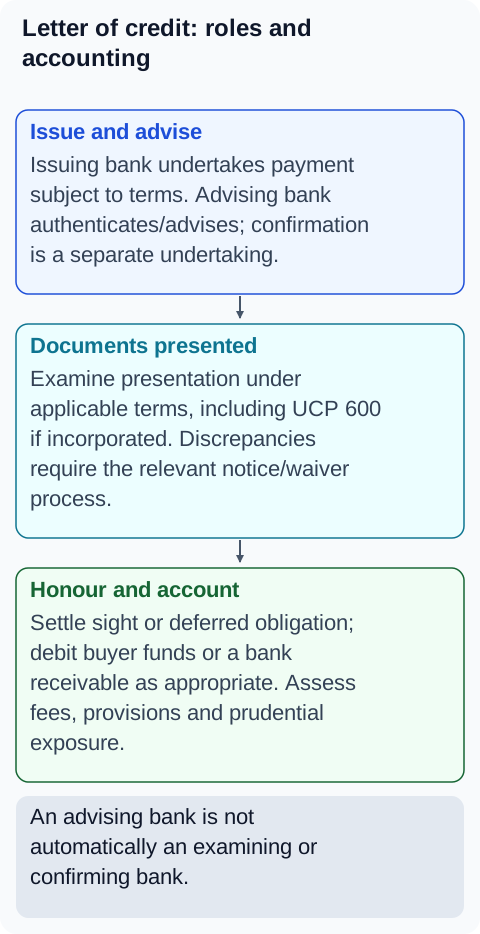
Figure 2. Financial guarantee measurement and call.
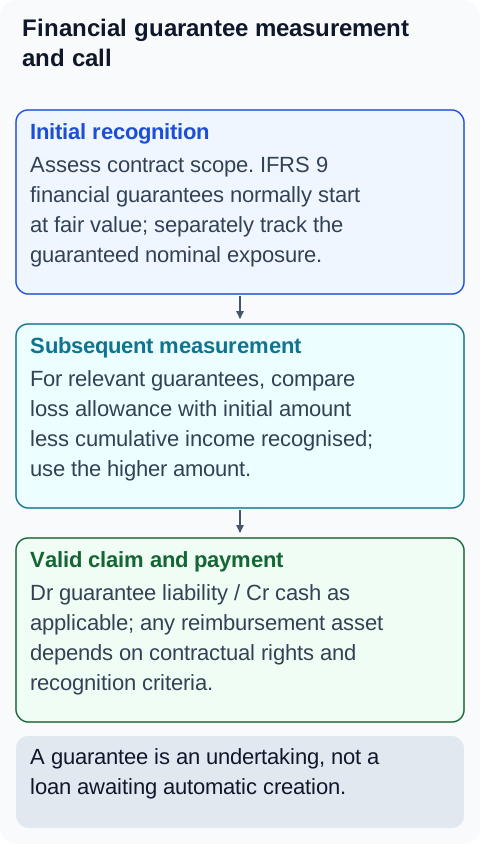
Figure 3. Nominal exposure is not carrying value.
12. Tables
| Measure | Meaning |
|---|---|
| Nominal guarantee/commitment | Maximum promise or facility amount under contract |
| Drawn loan principal | Funding actually advanced |
| IFRS 9 guarantee carrying amount | Applicable higher-of measurement |
| Commitment ECL provision | Expected credit loss on relevant undrawn exposure |
| Prudential converted exposure | Applicable approach and local conversion rule |
| Role | Payment undertaking |
|---|---|
| Advising only | Authenticates/advises; no added issuing/confirming undertaking |
| Confirming | Adds its own undertaking under the credit’s incorporated rules |
| Collection agent only | Handles documents/payments under mandate; no automatic credit undertaking |
13. Illustrative bank case study
The two roles were merged. A fictional bank applied its confirmation ECL rule to advising-only transactions and failed to identify several actual confirmations. The repair reconciled signed undertakings to the nominal register, fee records, liability/ECL calculation and regulatory exposures. Role classification, rather than the shared product label “LC”, controlled the accounting.
14. BA, developer, tester and operations guidance
- BA: define role, obligation, fee scope, call and reimbursement transitions.
- Developer: reconcile nominal, liability/provision, funding and settlement measures.
- Tester: test the higher-of arithmetic, deposit-funded payment and absence of a recovery right.
- Operations: use trained document examination and evidence for every notice/payment decision.
15. Common mistakes
- Applying IFRS 9 financial-guarantee accounting to every performance guarantee.
- Adding ECL to the full unreleased guarantee premium.
- Treating advising as a payment undertaking.
- Recording a deposit debit as a new funded loan.
- Recognising full nominal recovery without legal/valuation evidence.
- Assuming a port-name typo automatically creates a discrepancy.
16. Key takeaways
Off-balance-sheet nominal does not mean no recognised liability or provision. The bank’s legal role and accounting scope determine measurement; funding and recovery rights determine the settlement journals. Keep accounting, nominal and regulatory measures distinct.
17. References and verification notes
- IFRS Foundation: IFRS 9: classification depends on business model and contractual cash flows; initial recognition and directly attributable costs follow IFRS 9. This is the IFRS track, not US GAAP CECL.
- IFRS Foundation: IFRS 17: insurance risk and the contract scope must be assessed; a performance guarantee is not automatically an IFRS 9 financial guarantee.
- IFRS Foundation: IFRS 15: separate service revenue follows performance obligations; integral instrument fees follow IFRS 9.
- IFRS Foundation: IAS 37: a provision requires a present obligation, probable resource outflow and reliable estimate; contingent liabilities are disclosed unless the outflow possibility is remote.
Fictional examples. Financial-guarantee accounting references IFRS 9 4.2.1(c), with scope exceptions requiring assessment; IFRS 17 and IAS 37 are separate frameworks. ICC full rule text was unavailable through the research tool in this audit: UCP paragraph-level applications should be checked against the licensed incorporated rules before a real operational decision. No litigation or SWIFT trade-message migration date is asserted.