Chapter 091: Pillar 3 Disclosures
Section 19: Disclosure, Resolution and Emerging Reporting Requirements · Chapter 091 of 100
Markets can't discipline what they can't see. Pillar 3 forces banks to publish capital, exposures, RWA flows, buffers, leverage, liquidity and remuneration in standard templates — the public counterpart to COREP's supervisory data. This chapter runs Pillar 3 end to end: the three-pillar logic, template families, reconciliation to returns, and governance that signs public numbers.
1. Chapter opening
Pillar 1 computes minima, Pillar 2 adds supervisory judgement (ICAAP/SREP), Pillar 3 discloses both plus risk detail so investors, counterparties and analysts price discipline. Templates cover own-funds composition, RWA flows, credit/market/op-risk detail, leverage, liquidity, encumbrance, NPE, remuneration. Frequencies (quarterly/semi-annual/annual by template and bank size); disclosure policy governs materiality, proprietary-confidentiality boundaries and verification. Pillar 3 exists because capital requirements and supervisory review are insufficient on their own: without public disclosure, investors cannot distinguish well-capitalised banks from poorly capitalised ones, and the market cannot impose discipline through pricing. The disclosure framework transforms private supervisory information into public market intelligence, enabling bondholders, equity investors, counterparties, and rating agencies to make informed decisions.
2. Learning objectives
- Explain the three-pillar logic and Pillar 3's market-discipline role.
- List template families with source returns each.
- Reconcile Pillar 3 to COREP/FINREP (same lineage, public presentation).
- Apply materiality/proprietary/confidentiality filters with governance.
- Operate disclosure controls (tied-out, challenged, Board-approved).
3. Business context
Clear disclosure supports investors’ assessment of risk, capital and remuneration. Reconcile results, Pillar 3 and investor commentary on genuinely comparable facts, explaining legitimate basis differences. Transparency may affect confidence, but does not guarantee narrower spreads, a valuation uplift or immunity from rating pressure.
Banks’ assets can be difficult to assess and their funding includes demand deposits and short-term wholesale liabilities as well as longer-term debt. Pillar 3 supports comparison through prescribed definitions and presentation, but template applicability and frequency depend on the framework, bank scope and approach. Comparing peers requires attention to consolidation scope, local implementation and model differences. Disclosure quality does not guarantee a particular funding-spread or valuation outcome.
| Template family | Sources | Reads as |
|---|---|---|
| Own funds/composition | Capital engine | Quality of capital |
| RWA flows | RWA attribution | What moved risk |
| Credit quality | FINREP asset quality | Honesty about NPEs |
| Leverage/liquidity | Respective engines | Structural safety |
| Remuneration | HR + risk alignment | Incentive integrity |
4. Finance and accounting view
4.1 Reconciliation mechanics
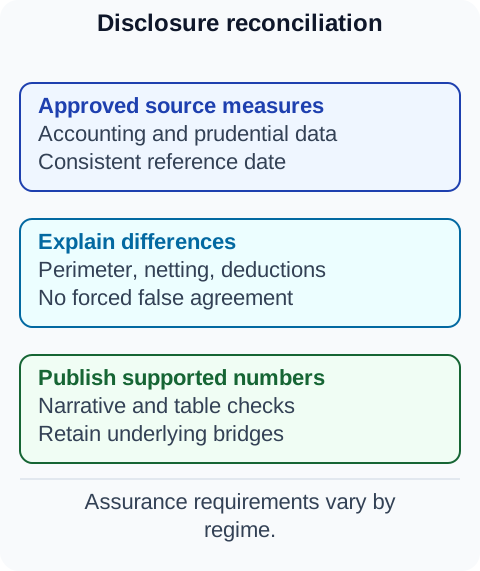
Trace each published number to an approved source: capital and exposure engines, financial statements, supervisory returns, liquidity calculations or HR records as appropriate. Reconcile differences in consolidation scope, reference date, averaging, definitions and rounding. Pillar 3 includes disclosures that have no identical COREP or FINREP cell; it is not a public copy of those confidential returns. Preserve a governed source-to-publication bridge and exact approved publication version.
Build a template-level applicability register and disclosure calendar. Map each fact to its defined basis and compare genuinely comparable reported amounts. For example, a quarterly average liquidity disclosure may differ correctly from a period-end liquidity return. Document that difference rather than change an accurate number to make it equal. Correct substantive source errors through the proper accounting, prudential or reporting workflow before publication.
4.2 Materiality and verification
Apply the governing disclosure rules before considering any omission. Basel permits exceptional proprietary/confidential omissions with appropriate explanation and general information, subject to national implementation; this is not a blanket permission to suppress fixed-template facts using a financial-statement materiality threshold. Maintain a Board-approved disclosure policy, effective internal controls, appropriate review and the required senior-officer attestation. Legal and regulatory teams approve any permitted exception and notification.
4.3 Deep dive: RWA-walk credibility engineering and remuneration-risk linkage proof
RWA-walk credibility (the quarterly story markets actually read): attribution completeness (every material move bucketed: new business, migration, model/methodology, FX, other — "other" capped with investigation mandate), narrative consistency (management commentary matches pack attribution verbatim — discrepancies discovered by analysts destroy more trust than bad numbers), peer benchmarking (density and walk patterns vs published peers with explained deviations), and forward guidance linkage (walks connect to planning: guided RWA trajectory with variance explanations). Walk preparation starts at close (attribution captured during computation, not reconstructed at disclosure) with owner sign-offs per driver. Reconcile genuinely comparable published and supervisory measures; unexplained errors or omissions can prompt questions, while documented scope, date or measurement differences may be valid.
The RWA walk explains changes in the bank’s measured risk exposure. Preserve evidence for new business, credit migration, model/methodology, FX and other prescribed categories. Investigate material unexplained residuals and use a bank-approved internal escalation threshold if helpful; an illustrative 1% threshold is not a universal Pillar 3 rule. Attribute changes using the actual template instructions rather than assume how analysts will price an unexplained movement.
Remuneration disclosure links awarded, deferred, retained, paid and adjusted amounts to risk governance. Applicable deferral periods, instrument mix and identified-staff criteria are jurisdiction-specific; a universal 3–7 year rule is misleading. Investigate whether malus or clawback trigger conditions are met and document decisions. Losses alone do not prove every award must be reduced, and zero malus is not by itself evidence of a failed committee.
Reconcile remuneration disclosures to approved HR and finance records across award years. Distinguish outstanding deferred awards from current-period payments and disclose required adjustments on the stated basis. Review privacy, aggregation and applicable identified-staff scope. Evidence that the policy operated matters more than an unsupported claim about which templates investors read most.
5. Product and customer impact
Public RWA/NPE splits by portfolio expose product strategy to competitors and activists — business mix decisions anticipate disclosure. Remuneration disclosure affects talent markets. Green/climate disclosures (see Climate and Sustainability Reporting) increasingly sit beside Pillar 3 — consistency across sustainability and prudential narratives is examined by both investors and supervisors. Product teams must understand that Pillar 3 disclosure will reveal the risk profile of their portfolios: a bank that is growing its unsecured lending book will see that growth reflected in the RWA walk, and investors will assess whether the growth is sustainable or risk-seeking. Transparency is not a reporting burden; it is a strategic constraint that influences product design, pricing, and portfolio management.
6. Regulatory and supervisory view
Basel disclosure standards and applicable local rules (EU ITS, PRA, US and RBI requirements have separate scopes and dates); attestation expectations (management responsibility statements); supervisors compare disclosures across banks (outlier analytics) and against filed returns (explain legitimate differences and investigate errors). Late, incomplete or misleading disclosure can result in action under the actual powers and facts; neither a mismatch nor an adverse outcome mechanically determines a finding. Supervisors also conduct thematic reviews: comparing NPE disclosures across banks to identify outliers, comparing RWA densities to assess model conservatism, and comparing remuneration structures to identify misalignment between pay and risk. Authorities may publish thematic findings; individual supervisory returns and findings are not automatically public.
7. Systems and data view
The disclosure system draws from approved financial, prudential, liquidity, risk and HR sources, using versioned applicable template mappings, reconciled workpapers and controlled narrative drafts. Drafting and review can proceed in parallel; publication requires narratives tied to the exact approved facts, explained basis differences and completed required approvals. Preserve snapshots, source bridges, final publication checks and the applicable calendar; do not assume every framework requires the same gap after financial results.
8. End to end process
- Determine disclosure applicability and sources. 2. Map approved facts to current templates. 3. Reconcile cells and explain basis differences. 4. Draft commentary with controlled versions and refresh it when facts change. 5. Challenge the complete pack. 6. Complete required senior attestation and approval, then publish. 7. Archive the exact version, monitor feedback and correct through governance. A Board-approved policy does not imply Board approval of every periodic pack unless required by applicable rules or bank policy.
9. Controls and risks
| Risk | Control | Evidence |
|---|---|---|
| Return-vs-disclosure gaps | Tie-out gates | Tie-out packs |
| Narrative-number drift | Controlled drafts tied to the final approved numbers | Version histories and final reconciliation |
| Omission abuse | Materiality policy + legal review | Materiality files |
| Late publication | Calendar with results linkage | Publication logs |
| Peer inconsistency | Cross-bank benchmarking review | Benchmarking packs |
| Remuneration disconnect | RemCo quantitative linkage | Meeting minutes |
10. Practical examples
A (fictional): RWA-flow explanation. A 2bn increase attributed to migration is supported by exposure populations, rating changes and calculation evidence. An unexplained residual requires investigation and correction where necessary. Clear explanation does not guarantee analyst acceptance or a specified number of supervisory queries.
B (fictional): Remuneration comparison. A bonus pool rises 20% while provisions double. Review the award years, risk adjustments, deferral, malus and clawback conditions and explain the approved decisions. The comparison alone does not establish misconduct or guarantee that commentary will defuse criticism.
10.3 Worked example: explaining the RWA movement (fictional, billions)
RWA moves 38.0→39.5, an increase 1.5. Attribution is new business+0.9, credit migration+0.7, approved model/methodology change−0.3 and FX+0.2:0.9+0.7−0.3+0.2=1.5. Reconcile the walk to closing RWA and preserve evidence, applicability dates and approval for each driver. This is a prudential movement report, not a journal entry or a provision calculation. A credit downgrade can affect both allowance and RWA through different methods; neither amount should be inferred from the other.
A hypothetical 15bp funding-spread change on 5bn issuance equals 7.5m annual interest. This sensitivity is arithmetically valid, but does not prove disclosure quality caused an observed spread move. Credit risk, market conditions, tenor and investor demand also affect pricing. Management should measure its actual review effort and financing outcomes without presenting fictional timings as evidence.
11. Diagrams
Figure 1. Produce Pillar 3 disclosure.
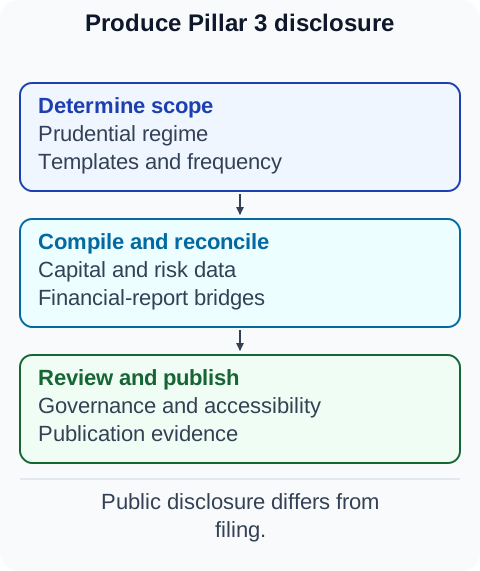 Figure 2. Three Basel pillars.
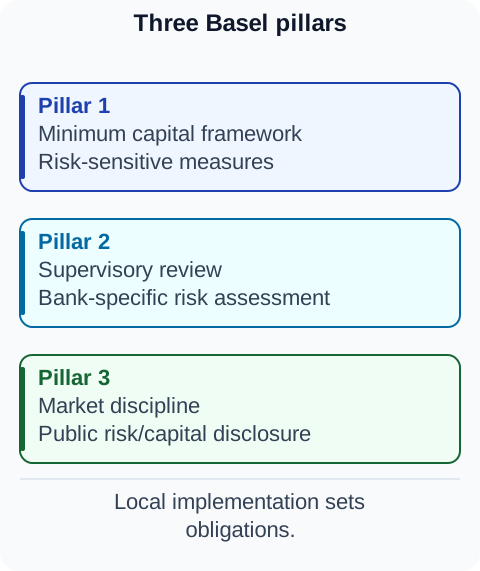 Figure 3. Disclosure reconciliation.
12. Tables
Table 1 — Template map (headline)
| Family | Source |
|---|---|
| Own funds/composition | Capital engine + COREP |
| RWA flows | Attribution packs |
| Credit quality/NPE | FINREP asset quality |
| Leverage/liquidity/encumbrance | Respective returns |
| Remuneration | HR + risk-alignment |
Table 2 — Verification gates
| Gate | Standard |
|---|---|
| Tie-out | Every cell to its defined approved source and bridge |
| Challenge | Committee queries answered |
| Approval | Required senior-officer attestation and approval tier; Board-approved disclosure policy |
| Consistency | Comparable facts agree; definition/scope/date differences explained |
13. Illustrative banking case study
An unexplained coverage ratio (fictional). Investors question a bank’s low NPE coverage. Finance reconciles gross NPE, allowances, collateral, write-offs, portfolio mix and reference dates to explain the comparison. Confidential FINREP is not a public filing that investors merely failed to read. Lower coverage is not automatically aggressive or conservative provisioning: expected recovery, collateral, product mix and write-off policies require analysis. Maintain disclosure-grade evidence throughout the year.
14. BA, developer, tester and operations guidance
- BA: Map templates to their defined financial, prudential, risk or HR sources; specify versioned tie-outs and required approval tiers.
- Developer: Version numbers and drafts together; tie final commentary to approved facts and reconcile comparable measures before publication.
- Tester: Tie-out failure paths; version-mismatch blocking; publication-vs-filed comparison.
- Operations: Calendar disclosure with results; track feedback and corrections.
15. Common mistakes
- Publishing narratives that were not refreshed and reconciled to the final approved numbers.
- Unexplained "other" in RWA walks.
- Materiality judgments without files.
- Unexplained differences between genuinely comparable published and filed measures.
- Remuneration narratives disconnected from risk outcomes.
- Treating Pillar 3 as a reporting exercise rather than a market-discipline mechanism.
- Failing to benchmark disclosures against peers before publication.
16. Key takeaways
- Pillar 3 has its own public-disclosure requirements; reconcile shared facts to returns and financial statements.
- Tie-outs connect every disclosure to its defined source and explain scope/date/measurement differences.
- Controlled drafting can run in parallel; final narratives must match the approved facts.
- Maintain RWA-flow and credit-quality evidence throughout the year; disclosure does not guarantee a market outcome.
- Apply the approved policy, required senior attestation and approval tier; challenge and archive the exact published version.
- Materiality considers both quantitative size and qualitative significance.
- Remuneration disclosure must demonstrate that the framework is operated, not just designed.
17. References and verification notes
- Basel disclosure framework: template applicability, frequency, governance and exceptional proprietary/confidential omissions; local law governs implementation.
- EBA reporting and disclosure frameworks: consult the applicable EU legal and technical version; do not import it unchanged into other jurisdictions.
- Family descriptions are headline simplifications.