Chapter 054: Daily, Monthly and Annual Close
Section 11: Reconciliation, Financial Control and Close · Chapter 054 of 100
This chapter explains daily, monthly and annual close from the reporting bank's perspective. Examples are fictional; accounting follows IFRS unless another framework is expressly identified.
1. Chapter opening
The close turns the bank's transaction records into a controlled accounting position for a specified date. Daily close supports operational integrity; monthly close adds estimates, management results and balance-sheet certification; annual close adds statutory presentation, disclosures and audit. They are connected cycles, with different deliverables, rather than three names for a stress-test review.
Closing the ledger does not mean every payment has settled. Unsettled receivables, payables and valid cut-off differences remain recorded and evidenced. A balanced trial balance proves debit/credit equality; it does not prove completeness, correct valuation or the right accounting period.
2. Learning objectives
- Distinguish daily, monthly and annual deliverables.
- Sequence source feeds, accruals, valuation, impairment, reconciliation and approval.
- Apply cut-off and subsequent-event principles.
- Control late journals, reopening and estimate changes.
- Produce a reproducible signed reporting snapshot.
3. Business context
A close calendar links each output to its prerequisites and owner. A loan subledger must finish accruals before the interest reconciliation; the ECL engine needs the appropriate exposure and risk snapshot before allowance sign-off; consolidation needs entity submissions and reciprocal proof. Compressing elapsed time safely means removing avoidable waiting and manual rework, while retaining material reviews.
| Cycle | Typical focus | Output |
|---|---|---|
| Daily | Feed completeness, cash, clearing, control accounts | Reconciled operating position |
| Monthly | Estimates, valuations, P&L and balance substantiation | Approved management/reporting snapshot |
| Annual | Full statements, notes, tax, subsequent events and audit | Authorised statutory accounts |
These are operating designs, not universally prescribed deadlines.
4. Finance and accounting view
4.1 Daily and monthly close mechanics
Daily work proves transaction counts and sums, subledger/GL alignment, cash and clearing, posting exceptions and suspense. Monthly work adds interest and fee cut-off, fair values, impairment, payroll, depreciation, provisions and tax. Review automatic reversals: an accrual reversed next month still needs the actual invoice or replacement accrual, otherwise expense can disappear.
For a fictional unpaid December service of 0.3m: Dr service expense 0.3 / Cr accrued liability 0.3. In January, reverse that accrual and book the 0.3 invoice, giving no extra January expense and a payable replacing the accrual. Alternatively book the invoice directly against the accrual if the system supports that controlled method. Do not use both methods for the same item.
4.2 Annual close and subsequent events
Annual close includes consolidation, current/deferred tax, accounting-policy review, comparatives, note consistency, going-concern assessment and authorisation. Under IAS 10, adjust for subsequent events giving evidence of conditions existing at the reporting date; disclose material non-adjusting events rather than backdating them. A borrower's January insolvency may confirm December impairment; a new post-year-end event requires a separate assessment.
4.3 Deep dive: controlled reopening and late journals
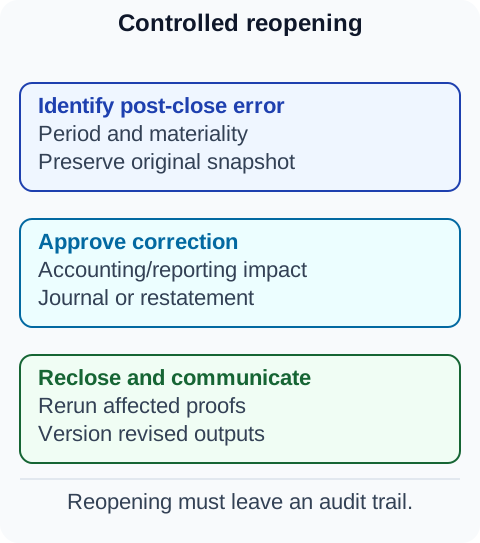
Freeze is a controlled snapshot, not a refusal to correct an error. A late journal requires evidence, authorised access and independent approval. Assess its effect on every downstream return, note, consolidation and management report. If the period is reopened, generate a new version and invalidate or refresh affected approvals. Preserve the original version and reason for change. Distinguish an error from a change in estimate under IAS 8: material prior-period errors generally require retrospective restatement, while estimate changes are generally prospective.
5. Product and customer impact
Finance cut-off errors may affect product profitability without affecting customers; interest-engine errors can affect both. When a close control reveals a rate or fee defect, trace customer records and assess correction/redress separately. Protect payment operations during close: period locks must not leave live transactions unprocessed.
6. Regulatory and supervisory view
IFRS close decisions support IAS 1, IAS 8 and IAS 10. They do not establish local filing deadlines. Regulatory returns can have different consolidation scope, measures and authorisation rules from statutory accounts. Board approval of an ICAAP is a separate governance process, informed by the close but not a replacement for it.
7. Systems and data view
A close orchestrator should track dependencies, feed status, reconciliation evidence, journal versions and approvals. Capture accounting date, value date and processing timestamp separately. Source data can arrive later without changing its economic cut-off; the pipeline needs rules for assessing and incorporating it. Role-based period access and exception logs make reopening reviewable.
8. End to end process
- Set the cut-off, calendar and dependencies.
- Prove source feed completeness and process subledgers.
- Reconcile GL control accounts and cash/clearing.
- Book and review estimates, valuations and tax.
- Substantiate balances and review movements.
- Consolidate and prepare reporting/disclosures.
- Approve the version and lock the period.
- Assess late information and subsequent events through controlled change.
9. Controls and risks
| Risk | Control | Evidence |
|---|---|---|
| Missing source feed | Completeness totals and dependency gate | Feed register |
| Wrong-period posting | Cut-off testing and date controls | Event-to-journal sample |
| Unsupported estimate | Method, inputs and independent review | Estimate workpaper |
| Late override | Restricted reopening and downstream impact review | Journal/approval log |
| Reused obsolete pack | Approval tied to version | Version comparison |
10. Practical examples
Fictional example: the December trial balance is signed before the final loan-accrual feed arrives. The feed adds 2m interest receivable and income: Dr receivable 2 / Cr interest income 2. Finance proves that the accrual relates to December, reopens through the authorised process, updates P&L, tax, consolidation and affected returns, and obtains new sign-offs. Passing the trial-balance equality check would not have detected the missing feed.
11. Diagrams
Figure 1. Close the books.
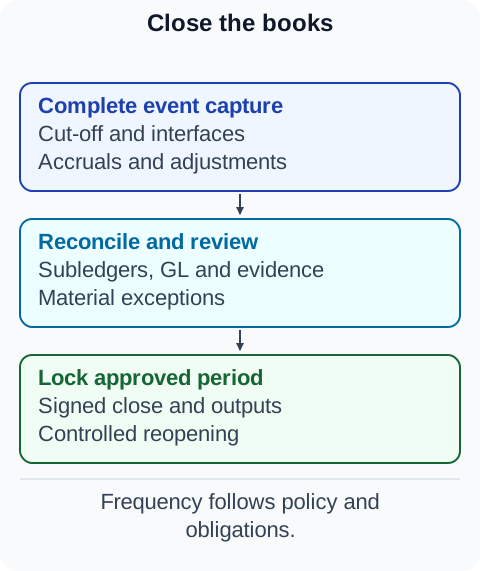 Figure 2. Close rhythms.
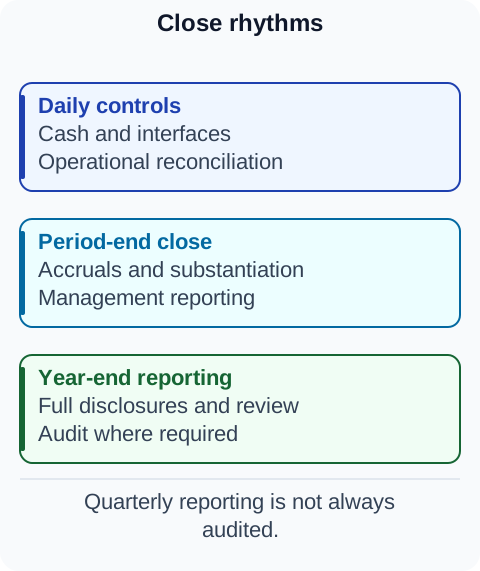 Figure 3. Controlled reopening.
12. Tables
| Gate | Required before approval |
|---|---|
| Completeness | Source counts and amounts reconcile |
| Accuracy | Subledger, valuation and estimate proofs |
| Cut-off | Correct period and dated residuals |
| Balance sheet | Account-level support and open-item assessment |
| Reporting | Statements/notes/returns reconciled on their respective bases |
| Version control | Final approvals match the released snapshot |
13. Fictional banking case study
A fictional bank's January reversal removed a December consulting accrual, but the invoice feed failed. January expense was understated and the payable was missing. A reconciliation of reversed accruals to invoices exposed the defect. The bank books the invoice in the appropriate period, fixes the failed interface and reviews the affected close versions. This demonstrates why reversal completion is not proof that an obligation vanished.
14. BA, developer, tester and operations guidance
Business analysts should document the calendar, dependencies and period/date rules. Developers should support controlled reopening and version-linked approvals. Testers should simulate missing feeds, duplicate accruals, late journals and stale approvals. Operations should keep a visible blocker queue and document each authorised exception.
15. Common mistakes
- Treating a balanced trial balance as complete financial evidence.
- Equating ledger close with payment settlement.
- Reversing accruals without invoice/re-accrual follow-up.
- Reusing sign-offs after the numbers change.
- Treating every post-year-end event as adjusting.
- Confusing statutory, supervisory and management outputs.
16. Key takeaways
Close the books on a common cut-off with proved feeds, reconciled balances and reviewed estimates. Annual reporting adds consolidation, disclosures and subsequent-event assessment. Late changes require new evidence and refreshed downstream approvals.