Chapter 030: Payment Exceptions
Section 6: Payment and Settlement Accounting · Chapter 030 of 100
1. Chapter opening
Payment exceptions do not all create suspense entries. A format failure before booking can be rejected with no GL journal. A failed instruction after customer debit but before settlement can leave a payment payable. An incoming cash receipt with no customer allocation can leave a liability. A bank-funded erroneous outgoing payment may create a recovery receivable, assessed for impairment. Identify the actual payment state and legal asset or obligation before selecting a journal.
Suspense is a temporary account classification, not permission to omit legal ownership, customer obligations or timely loss recognition. Reconcile each account to an itemised population and settlement evidence, with currency, age, owner and resolution path.
2. Learning objectives
By the end of this chapter you will be able to:
- Classify exceptions across the lifecycle (format, sanctions, account, funds, beneficiary, duplicate, cut-off, confirmation).
- Explain suspense clearing mechanics: why suspense exists, how it balances, and the triggers for clearing.
- Post repair, return and investigation journals without double-counting.
- Reconcile suspense balances at the frequency required by processing activity, risk and applicable rules, including daily or intraday where needed, and resolve aged items through authorised investigation and escalation.
- Prevent recurrence via root-cause feedback loops into upstream systems.
- Measure exception performance (volume, aging, causes, resolutions) and report to management.
3. Business context
Use exception volumes and costs to prioritise prevention, but label assumptions. Fictional bank: 50m payments a day at a 0.1% exception rate generates 50,000 exceptions. At 25 each, daily cost is 1.25m; for 360 processing days, annual cost is 450m. A 10% reduction in exceptions saves 45m on those assumptions, before fixed-cost and automation effects.
Taxonomy should distinguish validation failures, funds shortfalls, sanctions alerts, routing errors, duplicate/replay problems and uncertain settlement outcomes. A sanctions match is investigated by authorised staff; prescribed sanctions lists are not loosened to reduce alerts. Tuning matching/data quality under governance can reduce false positives. Never retry a timed-out payment until its settlement state is established.
4. Finance and accounting view
4.1 State determines accounting
Pre-booking rejection: no GL entry. Post-booking, pre-settlement outward cancellation: Dr Payment payable / Cr Customer deposit liability. Repair of the same instruction changes controlled data/state; do not debit the customer again. On actual settlement: Dr Payment payable / Cr Settlement asset.
Incoming unidentified cash: Dr Settlement asset / Cr Unallocated receipt liability. Customer allocation: Dr Unallocated receipt liability / Cr Customer deposit liability. Post-settlement returned outgoing value: Dr Settlement asset / Cr Return payable; then clear that payable to the customer deposit liability.
Investigation alone has no journal. A hold normally changes availability, not cash. A confirmed bank error that paid 50,000 from bank funds may create Dr Supported recovery receivable / Cr Cash; if uncollectible, Dr Operational loss / Cr Recovery receivable. If the bank owes the customer money, do not write off the liability to income or charge expense against it merely because it is aged.
4.2 Three reconciliations
Prove account balance to individual items; payment state to ledger booking; and cash ledger to external statement. A difference can be valid timing or a genuine defect, but must have evidence and age/ownership. Daily review is a useful bank control for high-volume accounts; intraday review may be necessary. It is not a universal law that every account everywhere must reconcile daily or every break must close within 2-5 days.
4.3 Resolution discipline
Repair and return are alternative resolutions of a given outstanding instruction; a later return after a successful repair can still be legitimate. Book each real event once. Release or write off a balance only when its asset/liability substance and legal rights support the entry. Customer compensation is classified according to its nature, not automatically as interest expense.
5. Product and customer impact
Customers need the real payment state, next action, responsible team and expected update. A time-sensitive supplier payment may merit faster escalation even when its principal is small. Liability for execution delays, interest or consequential losses depends on applicable law, contract and facts; do not promise identical compensation for every exception.
Avoid disclosing protected sanctions or AML information in an investigation message. Maintain a documented customer-redress decision independently from the operational recovery case.
6. Regulatory and supervisory view
UK Payment Services Regulations 2017 and EU PSD 2 specify execution and liability rules by transaction scope, currency, geography and time of receipt. The baseline for covered electronic transactions is often credit to the payee's provider by the end of the following business day; paper initiation and other scopes have different provisions. 'Same-day domestic, T+1 all cross-border' is incorrect.
Sanctions alert disposition, AML reporting, customer redress and operational incident notification follow their respective applicable obligations. A payment ageing five days does not itself create an automatic regulatory report or authority to return frozen funds.
7. Systems and data view
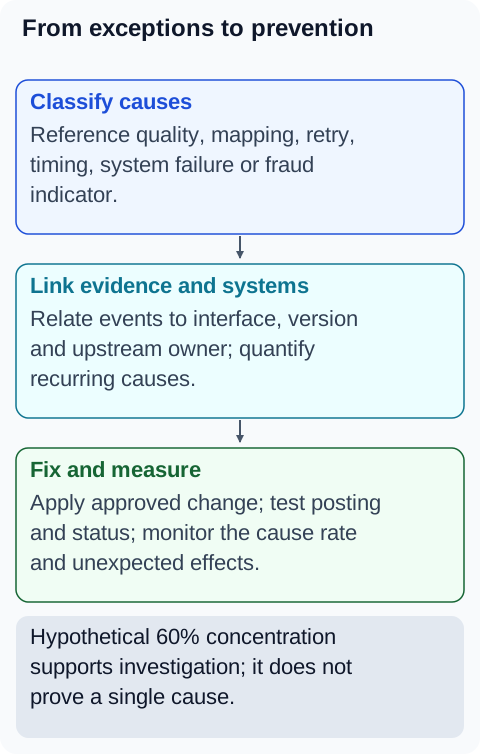
Classify exceptions by operational cause and actual accounting balance: unposted instruction, settlement payable, receivable, restricted funds, refund obligation or suspense item. Link investigation, lawful resolution, journals and reconciliation through the original event ID. Root-cause reports should distinguish upstream format errors from booking defects and liquidity failures.
Reconcile each account by entity/currency with item-level support. A single consolidated suspense account can obscure accountability and is not a universal repair. Workflow ownership, ageing, access controls and escalation evidence matter more than the number of accounts.
8. End to end process
Validate and log the exception; identify whether value moved; classify accounting substance; investigate and obtain appropriate approval; repair, reject, return or otherwise resolve the actual instruction; post only supported changes; reconcile the remaining population; update the customer lawfully; and record the root cause. A repaired instruction may later be legitimately returned. Write-off is not a routine alternative to investigating a customer liability.
9. Controls and risks
| Risk | Control | Evidence |
|---|---|---|
| Suspense breaks | Daily reconciliation, aging escalation | Reconciliation reports, break logs |
| Stale exceptions | SLA monitoring, escalation workflows | SLA reports, escalation logs |
| Double-counting | State-linked journals; no duplicated value movements | Journal review, audit trail |
| Unapproved write-offs | Approval workflow with documentation | Write-off log, approval records |
| Root-cause blindness | Exception taxonomy with system linkage | Root-cause reports, improvement logs |
10. Practical examples
Fictional example A: A 50,000 outgoing instruction is booked but not settled because of a routing error. The payment payable remains 50,000. After confirming no settlement, operations repairs or cancels it under authority; customer compensation of 85 posts separately if owed. No regulator fine is assumed from a fixed number of delay days.
Fictional example B: A name-match alert holds a time-sensitive instruction. Compliance uses identifiers and supporting evidence to clear a false positive, documents disposition and controls customer communication. The bank assesses any lost discount claim under its obligations; it does not modify the sanctions list to avoid a similar alert.
11. Diagrams
Figure 1. Payment exception resolution.
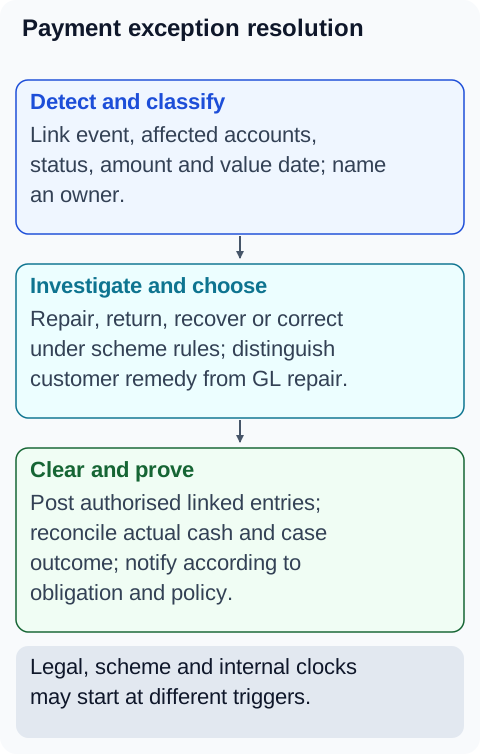
Figure 2. Incoming suspense: balanced resolution.
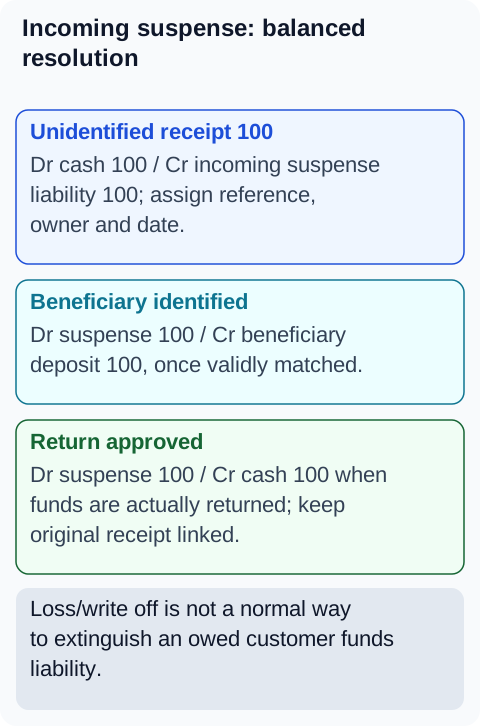
Figure 3. From exceptions to prevention.
12. Tables
| State | Accounting treatment | Resolution evidence |
|---|---|---|
| Rejected before booking | No journal | Validation/rejection log |
| Booked, not settled | Payment payable remains | Confirmed non-settlement, repair/cancel approval |
| Settled, return received | Cash receipt and return payable | Statement and linked return reference |
| Receipt unallocated | Cash asset plus liability | Beneficiary identification |
| Investigation pending | No invented cash movement | State inquiry and case record |
| Unrecoverable recovery asset | Loss/impairment clears asset | Rights, recovery assessment, approval |
Ageing thresholds are risk-based operating policies. They do not substitute for scheme deadlines, legal freezes or accounting measurement.
13. Illustrative bank case study
Fictional bank scenario. A batch is posted to the wrong suspense account. Item-level reconciliation identifies the erroneous account and original journals; approved linked corrections move the balances to their supported destination. A zero total across all suspense accounts would have concealed the defect. The fix is account/entity/currency ownership and matching, not automatic consolidation into one account. This training case does not assert an event at an unnamed real institution.
14. BA, developer, tester and operations guidance
- BA: Map all exception types, resolution paths, escalation rules, interest-compensation triggers and regulatory-reporting thresholds before build.
- Developer: Exception queue with aging, priority, and ownership; posting rules for each real event; reconciliation automation; root-cause classification at resolution.
- Tester: Format errors, sanctions hits, duplicate detection, cut-off breaches, stale exceptions, reconciliation breaks, write-off workflows.
- Operations: Reconcile suspense at the approved processing-cycle and risk frequency, daily or intraday where required; resolve aged items within the applicable SLA; classify root causes at resolution.
15. Common mistakes
- Booking the same value twice during repair/return processing.
- Reconciling suspense too infrequently for payment activity and risk, allowing breaks to accumulate.
- Treating suspense as a profit centre (it's a risk centre).
- Failing to classify root causes (exception management becomes reactive, not preventive).
- Failing to assess customer redress under applicable law and contract.
- Ignoring stale exceptions (ageing creates risk).
16. Key takeaways
- Exceptions are a daily population, not rare events — process them with discipline.
- Suspense reconciliation is a primary control: use the required processing-cycle and risk frequency, and investigate breaks promptly against their urgency and applicable deadlines.
- Root-cause classification transforms exception management from reactive to preventive.
- Record each real event once; legitimate outstanding suspense remains supported until resolved.
- Aging and escalation are time-critical — stale exceptions create regulatory and customer risks.
17. References and verification notes
- UK PSR 2017 execution provisions
- EU PSD 2 execution and liability provisions
- CPMI-IOSCO settlement principles
- Rules are applied under the reporting entity's adopted accounting framework and jurisdiction. Basel standards require local implementation; they are not themselves national law. All unnamed cases, amounts and operational thresholds are fictional training examples.