Cloud architecture for banks: landing zones, IaaS/PaaS/SaaS, hybrid cloud, IAM, resilience, backup, DR, FinOps and payment operating controls.
Part of the Cloud, APIs and Integration for Banking learning path.
A bank does not become cloud-ready by moving a payment server from a data center into a virtual machine. That only changes the address of the risk. Real cloud adoption in banking starts when the bank can prove that the workload is secure, resilient, observable, recoverable, governed, and integrated with the rest of the payment estate.
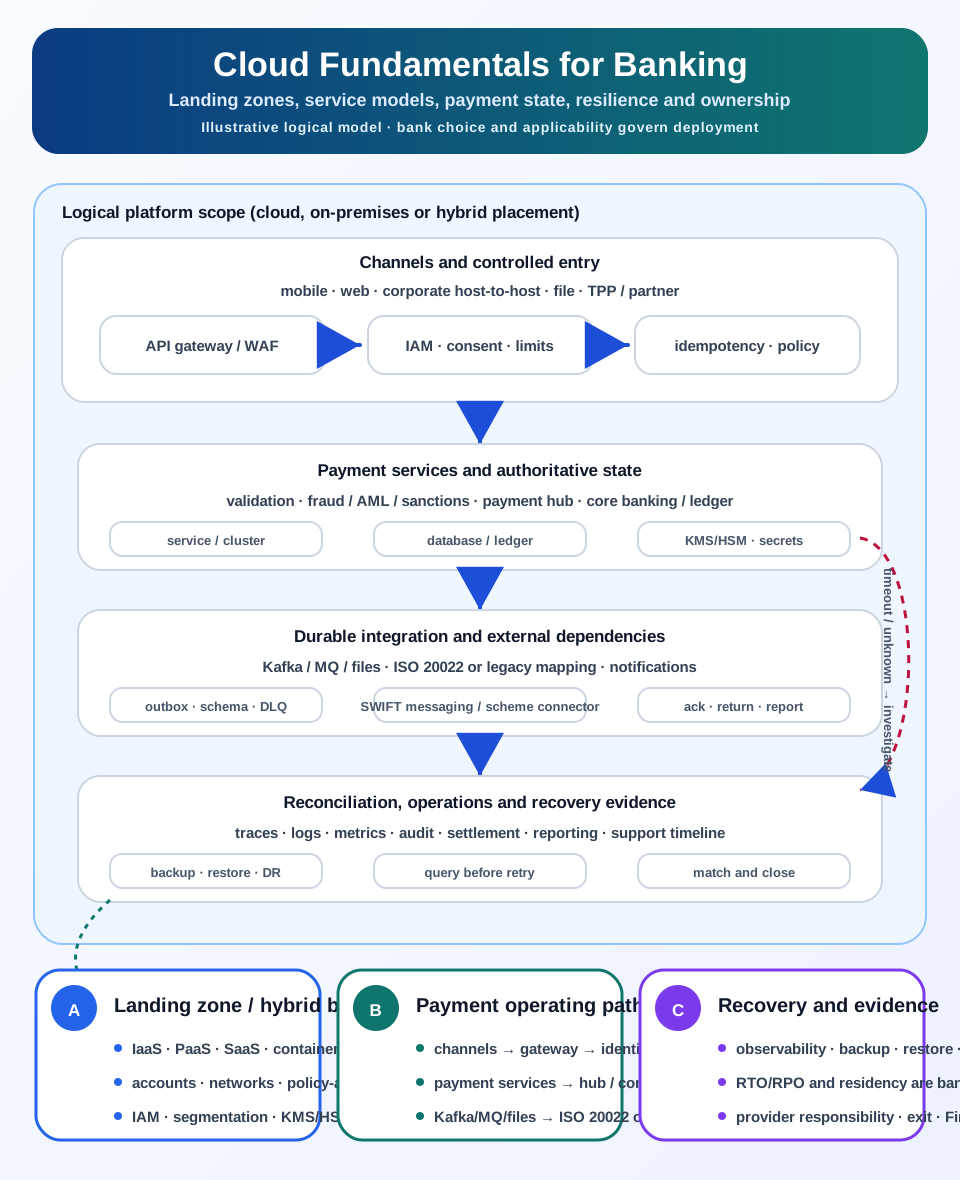
Scope and evidence (reviewed 5 October 2026). This is educational engineering guidance, not a universal banking-control prescription. Read each recommendation in the right category: generic cloud principle, technical standard or specialist guidance, jurisdictional/supervisory expectation, scheme/provider rule, or bank implementation choice. Applicability depends on the bank's jurisdiction, licence, criticality, data, service, contract and selected architecture; the cited sources are the authority for any dated or regulatory statement.
What This Chapter Is Really About
Cloud fundamentals for banking are not only about compute, storage, and networking. Those are the building blocks. The real subject is how a regulated financial institution uses those building blocks without weakening payment safety, customer trust, auditability, operational resilience, or control over critical services.
For a developer, architect, tester, production support engineer, business analyst, or product owner working around payments, cloud must be understood as an operating model. It changes how infrastructure is requested, how environments are separated, how secrets are stored, how releases move, how logs are retained, how failures are detected, how evidence is collected, and how regulators expect the bank to explain the design.
A payment system has a simple user-facing promise: money should move correctly. Behind that promise sits a chain of technical responsibilities. The payment instruction must be accepted only from a trusted channel. The instruction must be validated. The customer or account must be checked. Limits, fraud controls, sanction checks, balance checks, routing rules, cut-off rules, and duplicate checks may apply. The instruction may then move through internal ledgers, gateways, external schemes, correspondents, clearing houses, card networks, real-time payment rails, or file-based settlement flows. Each step creates state. Each state needs evidence.
Cloud changes the way this chain runs, but it does not remove the discipline. A cloud-hosted payment workload still needs deterministic state management, reliable integration, strict access control, secure data handling, tested recovery, controlled release, capacity planning, and strong operations. The bank may consume managed services, but the bank remains accountable for the service delivered to customers and counterparties.
Cloud In One Banking Sentence
Cloud is a controlled way to consume shared compute, storage, network, platform, and software services on demand, with automation and measured usage, while the bank keeps responsibility for governance, risk, data protection, resilience, and correct workload design.
The NIST definition of cloud computing is still the cleanest foundation: cloud provides on-demand network access to a shared pool of configurable resources that can be rapidly provisioned and released. For banking, that definition is only the start. A bank must translate it into operational reality: who can provision resources, which regions are allowed, which services are approved, how encryption keys are managed, which logs are immutable, how data is backed up, how the workload fails over, and how the bank exits a provider if the arrangement becomes unacceptable.
Cloud is not a location. Cloud is a method of running technology through programmable infrastructure, shared responsibility, policy enforcement, automation, and continuous evidence.
Why Banks Use Cloud
Banks use cloud because payments are no longer quiet, back-office systems that only process overnight files. Payments now sit inside mobile apps, merchant checkout flows, corporate treasury portals, open banking journeys, instant payment rails, wallet integrations, API marketplaces, fraud platforms, event streams, real-time dashboards, and regulatory reporting pipelines.
A traditional data center can run these systems, but it often struggles with the speed and elasticity expected by modern payment products. Banks need environments quickly for new features. They need burst capacity during salary days, tax dates, shopping events, government disbursements, card tokenization campaigns, IPO subscription periods, or corporate batch windows. They need analytics platforms that process more data than old reporting databases were designed for. They need secure sandboxes for API partners. They need isolated test environments where developers can validate payment flows without touching production data.
Cloud helps when the bank uses it deliberately:
- It reduces waiting time for infrastructure.
- It supports repeatable environments through infrastructure as code.
- It enables controlled scaling for payment APIs and event consumers.
- It improves disaster recovery options when regions and replication are designed correctly.
- It gives teams managed services for queues, databases, object storage, key management, monitoring, and deployment.
- It improves audit evidence when configuration, access, logs, and deployment history are captured consistently.
Cloud hurts when the bank treats it as easy hosting. Poor cloud adoption creates uncontrolled accounts, internet-exposed endpoints, weak identities, unclear ownership, duplicate logging, hidden costs, inconsistent backup policies, and production support confusion. In payments, that confusion becomes operational risk.
The Banking Cloud Mindset
A normal application team may ask, "Can we deploy this service to cloud?" A banking payment team must ask a stronger question: "Can we operate this service on cloud through a payment incident, a control review, a regulator question, a provider outage, a certificate expiry, a duplicate transaction investigation, and a disaster recovery test?"
That question changes the design.
The team does not only design a payment API. It designs identity, network entry, service-to-service authentication, secrets retrieval, data classification, retry behavior, idempotency, queue durability, message retention, database recovery, monitoring, operational runbooks, evidence retention, and change traceability.
The team does not only select a database. It decides whether the database stores ledger-critical data, operational state, derived reporting data, cached reference data, or non-critical session data. The recovery design depends on that classification. Losing a cache entry is different from losing the final status of a high-value payment.
The team does not only choose a region. It decides whether the region satisfies data residency, latency, regulator expectations, payment scheme connectivity, disaster recovery separation, and operational support coverage.
That is cloud fundamentals in banking: every cloud decision has a payment consequence.
What Banks Actually Put In Cloud
Banks rarely move everything at once. Most cloud journeys start with less sensitive workloads, then move toward more critical payment services as controls mature.
Typical early workloads include development environments, test environments, static web assets, document storage, analytics sandboxes, monitoring platforms, customer notification services, and non-production API gateways. These are useful because teams learn cloud patterns without immediately risking core ledger integrity.
The next stage often includes digital channels, fraud analytics, open banking APIs, merchant onboarding workflows, customer communication services, reporting pipelines, payment status dashboards, reconciliation workbenches, and partner integration layers. These systems touch payment data and may influence customer outcomes, so they need stronger controls.
The most sensitive stage includes real-time payment orchestration, account posting services, ledger-adjacent services, card authorization support systems, scheme connectivity, sanction screening workflows, and settlement-critical processing. These workloads can run on cloud, but only when the bank has mature landing zones, network segmentation, encryption, operational resilience, incident response, support processes, service ownership, and audit evidence.
The mistake is assuming cloud suitability is binary. It is not. A bank should assess each workload by business criticality, data sensitivity, transaction impact, integration complexity, recovery needs, regulatory obligations, and operational readiness.
Public, Private, Hybrid, And Multi-Cloud
Public cloud means the bank consumes services from a cloud provider running shared infrastructure. The bank does not share its application data with other customers, but the underlying infrastructure model is multi-tenant. Public cloud can be safe for banking when isolation, encryption, access control, auditability, resilience, and contracts are properly designed.
Private cloud means cloud-like infrastructure dedicated to one organization. It may run in the bank's data center or a hosted facility. It can give stronger physical control, but it may not offer the same breadth of managed services, elasticity, automation, or global scale as public cloud.
Hybrid cloud means the bank uses both cloud and on-premises infrastructure. This is common in payments because core banking, mainframes, HSMs, payment gateways, enterprise service buses, and old batch systems may remain on-premises while modern channels and integration layers move to cloud.
Multi-cloud means the bank uses more than one public cloud provider. This can reduce concentration risk for selected workloads, but it also increases complexity. The team must manage different identity models, network patterns, managed databases, monitoring tools, security controls, cost models, and operational procedures. Multi-cloud is useful only when the bank can operate it. A weak multi-cloud design gives the bank more failure modes, not more resilience.
For payments, the most common practical architecture is hybrid first, with selective multi-cloud where business and regulatory reasons justify it. A payment modernization program may host the mobile channel and API gateway in cloud, keep the ledger system on-premises, connect through private network links, and gradually move supporting services such as reporting, fraud signals, customer notifications, reconciliation analytics, and case management into cloud.
Service Models: IaaS, PaaS, SaaS, Containers, And Serverless
Infrastructure as a Service gives the bank virtual machines, disks, networks, firewalls, and load balancers. It feels familiar to teams coming from data centers. The bank still manages the operating system, patching, middleware, runtime, application, and much of the security configuration. IaaS is useful for lift-and-shift migration, legacy payment applications, vendor software that needs a VM, and controlled environments where the bank wants low-level control.
Platform as a Service gives the bank managed databases, managed queues, managed Kubernetes, API gateways, object storage, cache services, identity integrations, event streams, and serverless runtimes. PaaS can reduce operational workload, but it increases dependency on provider-specific behavior. A bank must understand backup guarantees, encryption models, network exposure, service limits, regional availability, maintenance windows, audit logs, and failure behavior.
Software as a Service gives the bank a complete application operated by a vendor. Examples around payments include fraud case management, sanction screening platforms, payment investigation tools, customer messaging systems, treasury portals, and regulatory reporting tools. SaaS is not automatically simple. The bank still needs due diligence, data protection review, integration design, identity federation, audit rights, exit planning, incident notification, and business continuity controls.
Containers package application code and dependencies into deployable units. In banking, containers are useful for microservices, payment validation services, routing engines, reconciliation workers, and API backends. Container orchestration platforms help scale and restart services, but the bank still needs image scanning, signed images, runtime policy, secrets injection, network policy, pod identity, resource limits, and release control.
Serverless functions run code without teams managing servers. They work well for small event-driven tasks: transforming a notification payload, validating an uploaded file, enriching a low-risk event, or triggering a workflow. They are not a universal answer for payment processing. Developers must understand cold starts, timeout limits, retry behavior, concurrency limits, idempotency, observability, and whether the function can produce duplicate side effects.
A practical payment platform often uses several models together. The card tokenization API may run on containers. A reporting pipeline may use managed streaming and object storage. A legacy gateway adapter may run on VMs. A customer notification processor may use serverless. The architecture is valid only if these pieces are governed as one payment service.
The Landing Zone: The First Real Control
A landing zone is the controlled foundation where cloud workloads live. It includes account or subscription structure, network design, identity integration, policy controls, logging, monitoring, encryption standards, approved regions, naming standards, tagging, backup requirements, deployment pipelines, and shared services.
In banking, a bank-controlled landing zone is a strong production baseline. Without it, teams create isolated cloud accounts that grow into uncontrolled environments. One team opens a storage bucket for testing. Another team creates a public endpoint for a demo. A third team stores a secret in an environment variable. Nobody knows which logs are complete. Nobody knows which region contains customer data. Nobody can prove that production access is restricted.
A bank-grade landing zone solves these problems before application teams deploy payment workloads.
A good landing zone separates platform responsibilities from workload responsibilities. The platform team owns shared identity, network, security tooling, logging, policy, key management standards, and guardrails. The payment application team owns business logic, data classification, service reliability, payment controls, runbooks, test evidence, and release quality. Security, risk, compliance, and audit functions review the design and evidence rather than manually approving every small technical step.
The landing zone should enforce simple rules:
- Production and non-production environments are separated.
- Internet exposure is denied by default.
- Approved regions are enforced.
- Logging cannot be disabled by application teams.
- Encryption is mandatory.
- Administrative access requires strong authentication and privilege approval.
- Cloud resources carry ownership and cost tags.
- Secrets are stored in managed vaults, not code or pipelines.
- Network egress is controlled and observable.
- Backups and retention match workload classification.
This is why cloud is an SDLC topic, not only an infrastructure topic. Developers inherit guardrails from the platform and design inside them.
Account And Environment Structure
The account structure is the cloud version of a bank's building layout. You do not put public reception, cash vault, trading desk, customer records room, disaster recovery controls, and vendor laptops in the same unlocked space. Cloud accounts and subscriptions need the same discipline.
A common pattern is to separate environments by lifecycle and risk: development, system integration testing, user acceptance testing, pre-production, production, disaster recovery, shared security, shared networking, and shared logging. High-risk payment workloads may also need separate accounts for critical components, such as ledger-adjacent services, key management, and regulated data stores.
The purpose is not cosmetic separation. It creates blast-radius control. If a developer accidentally misconfigures a development service, production payment processing should not be affected. If a compromised test credential appears in logs, it should not grant access to real customer data. If a production network rule changes, the change should pass a stronger approval path than a sandbox rule.
For payments, environment structure must match the SDLC. A payment message parser cannot behave one way in test and another way in production because the environments use different libraries, different queue settings, or different database collations. Infrastructure as code helps reduce this mismatch. The team defines the environment in code, reviews it, tests it, promotes it, and keeps evidence.
Network Design For Payment Workloads
Network design in banking cloud starts with one default assumption: nothing should be reachable unless there is a business reason, an approved path, and a logged control.
A payment workload normally has several network zones. The public edge handles traffic from customers, merchants, partners, or internal users. The API layer validates and routes requests. The application layer runs payment orchestration and business services. The data layer stores state. The integration layer connects to core banking, enterprise service buses, SWIFT interfaces, card systems, clearing gateways, fraud systems, sanction platforms, and notification services. The operations layer collects logs, metrics, traces, and security events.
These zones should not collapse into one flat network. A public API should not directly connect to a database. A batch file transfer host should not have broad access to the payment orchestration cluster. A reporting tool should not query production ledger tables without governed access. A vendor support connection should not reach every subnet.
Private connectivity matters. Banks often use dedicated circuits, private links, VPNs, or provider-private endpoints to connect cloud workloads to on-premises systems and managed services. Private connectivity reduces exposure but does not remove the need for authentication and authorization. A private network is not proof of trust. It is only one control.
Egress control is just as important as ingress control. Payment systems call external services: fraud scoring, sanction screening, name matching, address verification, notification providers, card token services, open banking partners, observability platforms, and regulatory endpoints. Each outbound path must be approved, logged, monitored, and protected against data leakage. If a payment service can call any internet address, the bank has created a quiet exfiltration route.
Good network design should answer these questions:
- Which clients can enter the workload?
- Which services can talk to each other?
- Which data stores can be reached from which compute layers?
- Which external endpoints are allowed?
- Which paths use private connectivity?
- Which traffic is inspected?
- Which DNS zones are private?
- Which logs show connection attempts and denied traffic?
- How does traffic move during failover?
For payment incidents, these answers matter immediately. When a payment API slows down, support must know whether the delay is at the edge, gateway, service mesh, queue, database, on-prem link, sanction vendor, or clearing adapter.
Identity And Access Management
Identity is the control plane of cloud. If identity is weak, every other control becomes weaker.
Bank cloud access should integrate with enterprise identity. Human access should use strong authentication, conditional access, role-based access, privilege elevation, session logging, and periodic review. Service access should use managed identities or workload identities wherever possible. Long-lived access keys should be avoided because they leak, get copied into scripts, and survive beyond their intended use.
A payment developer should not have permanent production administrator access. A production support engineer may need read-only access to logs and dashboards, plus tightly controlled break-glass access for emergency actions. A database administrator may need elevated access for approved maintenance, but not unrestricted access to application secrets. A CI/CD pipeline may deploy an application, but it should not have permission to disable logging or change network boundaries.
Access must align with duties:
- Developers build and troubleshoot in lower environments.
- Release pipelines deploy approved artifacts.
- Support teams investigate production issues using observability tools.
- Security teams monitor policy and threat signals.
- Platform teams manage shared services and guardrails.
- Auditors review evidence without altering systems.
Zero trust principles help because cloud workloads do not sit inside one trusted perimeter. NIST SP 800-207 frames zero trust around protecting resources and avoiding implicit trust based only on network location. In banking terms, a service should not trust another service merely because it is inside the same VPC or VNet. It should validate identity, authorization, context, and policy.
For payment workloads, this means service-to-service calls should use strong identity. A payment initiation API calling a fraud service should prove who it is. A reconciliation worker calling object storage should have only the bucket and operation permissions it needs. A settlement file generator should not be able to read unrelated customer documents. Least privilege is not a slogan. It is how the bank prevents a small compromise from becoming a payment platform compromise.
Secrets, Keys, And Certificates
Payment systems depend on secrets: API credentials, database passwords, signing keys, encryption keys, OAuth client secrets, MTLS private keys, SFTP keys, tokenization secrets, HSM access credentials, and certificates for internal and external trust.
Cloud makes secrets easier to centralize, but also easier to leak if teams are careless. Secrets do not belong in source code, container images, build logs, ticket comments, wiki pages, mobile apps, or unencrypted configuration files. They should live in managed secret stores or key vaults with access policies, rotation, audit logs, and environment separation.
Encryption keys require stricter thinking than ordinary passwords. Some data can use provider-managed keys. Some workloads need customer-managed keys. Some highly sensitive payment functions may require keys backed by hardware security modules or provider HSM services. Tokenization, PIN handling, card data handling, and scheme-specific cryptographic operations may require specialized controls outside a normal key vault.
Certificates create a separate operational risk. Payment integrations often fail because certificates expire. A real-time payment API can be perfectly coded and still fail because an MTLS certificate expired at midnight. Cloud operations should include certificate inventory, ownership, expiry alerts, renewal runbooks, non-production validation, and emergency rollback.
A bank-grade secrets design answers:
- Where is each secret stored?
- Which identity can read it?
- How is access logged?
- How often is it rotated?
- What happens during rotation failure?
- Is the secret different across environments?
- Can support see enough to diagnose without seeing the secret value?
- Is emergency access approved and recorded?
Data Classification And Data Residency
Payment data is not one thing. It has different sensitivity and different operational meaning.
A payment instruction may contain payer details, payee details, amount, currency, execution date, account identifiers, remittance information, routing information, charges, purpose codes, regulatory reporting data, and references. A payment status record may show whether money has moved, whether it failed, whether it is awaiting repair, whether it is under investigation, or whether settlement has completed. A fraud signal may contain behavioral information. A sanction screening result may contain sensitive match details. A reconciliation extract may combine internal and external references.
Cloud design must classify these data types. Some data can be stored in analytics form after masking or aggregation. Some data must stay in a specific jurisdiction. Some data must be retained for years. Some data must be deleted when no longer needed. Some data must never enter non-production environments unless masked or synthetic.
Data residency is not only about where the database lives. Logs can contain payment references. Object storage can hold exported files. Monitoring systems can capture payload snippets. Error traces can include customer identifiers. Backups can replicate to another region. Support screenshots can leak data. Machine learning feature stores can copy sensitive attributes. A data residency control fails if it protects the main table but ignores the surrounding operational data.
A payment cloud design should document data movement across the full lifecycle:
- request payloads
- API gateway logs
- application logs
- queues and dead-letter queues
- databases
- caches
- object storage
- search indexes
- analytics pipelines
- backups
- replicas
- test datasets
- support exports
- observability platforms
Only then can the bank prove where payment data lives and who can access it.
Storage And Database Choices
Cloud gives many storage options. The wrong choice creates payment risk.
Object storage is useful for payment files, bank statements, reconciliation extracts, audit evidence, reports, and archive data. It should use encryption, versioning where needed, access controls, lifecycle policies, malware scanning for inbound files, and retention rules aligned to business and legal requirements. A payment file bucket should not be a dumping ground. It needs folder or prefix standards, ownership, lineage, and controls over who can upload, read, delete, and restore.
Block storage supports virtual machines and databases. It matters for legacy payment applications, commercial off-the-shelf products, and migration workloads. It needs snapshot controls, encryption, backup schedules, and performance sizing.
Managed relational databases suit payment state, workflow tables, references, cases, limits, and transactional records where consistency matters. Teams must understand transaction isolation, locking, indexing, failover behavior, connection pooling, backup recovery, point-in-time restore, replication lag, patch windows, and maintenance events. A managed database reduces infrastructure work, but it does not design your schema or protect you from poor transaction boundaries.
NoSQL databases can support high-throughput access patterns such as idempotency stores, token lookup, customer preference lookup, API session state, or high-volume event metadata. They need careful key design. A poor partition key can overload one shard during peak payment traffic. A weak consistency model can create confusing payment state if developers use it for final records without understanding the guarantees.
Caches improve performance but must not become the system of record. A cache can store exchange rates, routing references, public bank codes, customer session data, or non-critical lookup data. A payment decision that moves money should not rely only on a cache value unless the stale-data behavior is explicitly safe.
The core question is simple: if this storage layer loses, delays, duplicates, or returns stale data, what payment consequence follows? That question should drive the architecture.
Compute Choices For Payment Workloads
Virtual machines, containers, managed app services, and serverless functions all have a place. The correct choice depends on workload behavior.
A legacy payment gateway adapter may need a VM because the vendor certifies only that runtime. The team should still automate the VM build, patch it, monitor it, harden it, restrict login, and avoid manual drift.
A payment orchestration service often fits containers or managed application platforms. Containers help when multiple services need independent deployment: payment initiation, validation, routing, status inquiry, repair, enrichment, notifications, reconciliation, and reporting. The platform must handle rollout strategy, health checks, autoscaling, service discovery, configuration, secrets, and logs.
Batch workers may run as containers, scheduled jobs, managed compute jobs, or serverless tasks. They need stronger controls around idempotency, restart behavior, file checkpoints, partial failures, and back pressure. A failed payroll file should not create duplicate payment instructions when the job restarts.
Serverless can help for event-driven glue, light transformations, document processing triggers, and notification flows. It becomes risky when developers ignore retries. Many serverless services retry failed events automatically. That is useful when sending a non-critical notification, but dangerous when calling an external payment initiation endpoint without an idempotency key.
For every compute choice, the architecture should define:
- deployment unit
- runtime owner
- scaling trigger
- startup and shutdown behavior
- retry behavior
- timeout limits
- resource limits
- patching model
- failure isolation
- logs, metrics, and traces
- rollback method
Payment Workload Patterns In Cloud
A modern payment cloud workload often uses a layered pattern.
The edge layer receives requests from mobile, web, corporate channels, partners, or internal systems. It terminates TLS, applies web protection, and forwards traffic to the API gateway.
The API gateway validates client identity, token scopes, request shape, quotas, and routing rules. It should not contain complex payment business logic. Its job is controlled entry.
The application layer validates payment instructions, applies business rules, creates idempotency records, records state changes, calls risk controls, and routes the instruction to the correct downstream path.
The integration layer connects to core banking, sanction screening, fraud engines, notification systems, account services, payment networks, file gateways, and enterprise data platforms.
The data layer stores workflow state, audit records, reference data, configuration, idempotency keys, operational events, and long-term archives.
The operations layer collects logs, metrics, traces, security events, deployment history, configuration changes, and incident evidence.
This layered model is easy to draw. The hard part is making every layer production-grade. The gateway must not become a bottleneck. The orchestration service must not lose payment state. The queue must not hide poison messages. The database must not deadlock under end-of-day batch load. The network link to core banking must not become a single point of failure. The dashboard must show business impact, not only CPU.
Resilience, RTO, RPO, And Payment Reality
Resilience in payments is not abstract uptime. It means the bank can continue delivering critical payment services through failures and recover safely when service is interrupted.
RTO means recovery time objective: how quickly the service must return after disruption. RPO means recovery point objective: how much data loss, measured by time, the business can tolerate. For many payment systems, the honest RPO target is near zero because losing accepted payment instructions creates financial and customer harm.
Different payment capabilities need different targets. A marketing preference service can tolerate longer recovery. A real-time payment initiation service cannot. A dashboard can be rebuilt from events. A ledger-adjacent payment state table cannot be casually reconstructed if source events are incomplete.
Cloud can improve resilience through multiple availability zones, regional replication, managed failover, automated scaling, immutable infrastructure, tested backups, and infrastructure as code. But resilience is never automatic. A workload can run across zones and still fail if all instances depend on the same database limit, same expired certificate, same bad release, same message schema bug, same third-party endpoint, or same network route.
Payment resilience needs both technical and business design:
- Can new payment initiation continue?
- Can status inquiry continue?
- Can already accepted payments complete?
- Can duplicate submissions be detected after failover?
- Can the bank stop selected channels without stopping all processing?
- Can settlement files still generate?
- Can operators see which payments are safe, pending, failed, or unknown?
- Can the bank communicate accurate status to customers and partners?
A strong cloud design distinguishes degraded mode from total outage. During a downstream sanction screening outage, the bank may queue certain payments, reject some high-risk flows, allow low-risk inquiry calls, and display accurate customer messaging. During a regional outage, the bank may fail over APIs, replay events, and reconcile pending states. During a provider-wide service issue, the bank may execute a continuity plan that prioritizes critical payment operations.
Backup, Restore, And Reconciliation
Backups are not useful until restore has been tested. In banking, restore must also be reconciled.
Suppose a payment database is restored to a point five minutes before an incident. During those five minutes, some payments may have reached the external clearing rail, some may have posted internally, some may have failed, and some may have been acknowledged to customers. Restoring the database without reconciling external state can create worse damage than the original outage.
That is why payment backup design must include transaction reconciliation. The team needs event logs, outbound request records, external acknowledgements, internal posting references, scheme references, and customer notification records. A restored system must know which payments require replay, which require inquiry, which require repair, and which must not be resent.
Cloud backups should be protected from accidental and malicious deletion. Backup accounts, vaults, or policies should be separated from workload administrators where possible. Backup retention should match regulatory, legal, and operational needs. Restore tests should be scheduled, evidenced, and reviewed.
Observability For Cloud Payments
Observability means the team can understand system behavior from its outputs: logs, metrics, traces, events, alerts, and business telemetry. For payments, observability must connect technical symptoms to payment impact.
A CPU alert alone is not enough. Support needs to know whether customers cannot initiate payments, whether corporate files are stuck, whether duplicate checks are failing, whether sanction checks are delayed, whether clearing acknowledgements are missing, whether settlement cut-off is at risk, or whether only a non-critical dashboard is slow.
Useful payment observability includes:
- API latency by endpoint, client, and channel
- error rate by payment type and downstream dependency
- queue depth, age, retry count, and dead-letter count
- database lock wait, connection pool usage, slow queries, and replication lag
- duplicate detection rate and idempotency conflicts
- sanction and fraud service response time
- external scheme acknowledgement delays
- file ingestion and file generation status
- reconciliation breaks by business date and source
- deployment versions correlated with incidents
- customer-visible failure messages
Trace correlation is critical. A single payment should carry a correlation ID across API gateway, application service, queue, database, downstream adapter, external call, notification, and reconciliation. The correlation ID should not expose sensitive payment data. It should let support follow the path without searching by account number or customer name.
Logs must be useful and safe. Developers should log state transitions, identifiers, decisions, and error context. They should avoid logging full payment payloads, secrets, authentication tokens, full PANs, sensitive customer details, or sanction match content unless the bank has a specific protected evidence design.
Security Monitoring And Threat Detection
Cloud security monitoring must cover both infrastructure and application behavior.
Infrastructure monitoring watches for suspicious access, privilege escalation, disabled logging, public exposure, unusual data transfer, unexpected region usage, unapproved services, security group changes, policy violations, vulnerable images, and malware signals.
Application monitoring watches payment-specific misuse: unusual API volume, repeated failed authentication, abnormal payment initiation patterns, suspicious beneficiary changes, repeated idempotency collisions, unexpected status inquiry bursts, high rejection rates, and changes in fraud decision patterns.
The strongest designs join these views. If a service account suddenly reads a large object store and the payment API sees abnormal traffic, the security team should not investigate those signals in isolation. If a new deployment changes outbound traffic patterns to an unapproved endpoint, operations should see it quickly.
Threat detection must feed incident response. Alerts need owners, severity rules, escalation paths, runbooks, and evidence retention. A payment incident that begins as a cloud configuration issue may become a customer-impacting operational event within minutes.
SDLC For Banking Cloud
Cloud adoption changes the SDLC because infrastructure becomes code. This is good for banks when teams use it properly.
A cloud payment change may include application code, database migration, queue configuration, IAM role change, network route, secret reference, dashboard update, alert threshold, container image, API gateway policy, and deployment pipeline update. Treating only the application code as the release is incomplete.
A bank-grade SDLC should cover:
- architecture review for critical payment flows
- threat modeling for APIs, data stores, identities, and integrations
- data classification before storage or logging design
- infrastructure as code review
- automated policy checks
- dependency and container image scanning
- secrets scanning
- unit and integration tests
- contract tests for APIs and events
- performance tests for peak payment windows
- resilience tests for dependency failures
- change approval based on risk
- automated deployment with rollback
- post-release monitoring and evidence capture
Developers should understand that controls are not paperwork added after delivery. Controls are part of the delivery mechanism. A pipeline that blocks public storage exposure is faster than a manual review meeting after exposure already happened. A policy that requires encryption is stronger than a checklist. A repeatable environment build is safer than an engineer manually clicking through a console at midnight.
Migration Strategy For Payment Systems
Payment cloud migration should be incremental and evidence-led.
The first step is discovery. The team maps applications, databases, file flows, APIs, queues, batch jobs, certificates, secrets, operational reports, support procedures, business owners, upstream systems, downstream systems, data classification, RTO, RPO, peak volumes, and incident history.
The second step is workload classification. Not every component deserves the same migration path. A static reporting portal may move quickly. A settlement-critical engine may require refactoring, parallel run, extended testing, and regulator engagement.
The third step is target architecture. The team decides whether to rehost, replatform, refactor, replace, retire, or retain each component. Rehosting moves a system with minimal changes. Replatforming moves it to managed services with some changes. Refactoring changes the architecture more deeply. Replacement uses a new product or service. Retention keeps the workload where it is for now.
The fourth step is control readiness. The landing zone, logging, IAM, network, keys, backup, monitoring, and operations must exist before the workload cutover.
The fifth step is migration execution. Data movement, interface switching, DNS changes, certificate changes, partner whitelisting, batch scheduling, rollback planning, and business validation must be coordinated. For payment systems, cutover windows matter because schemes and corporate customers follow cut-off times.
The sixth step is parallel validation and reconciliation. The bank should compare old and new outputs where possible: payment status, accounting entries, settlement files, reports, charges, notifications, exceptions, and operational metrics.
The final step is controlled decommissioning. Old infrastructure should not stay alive forever with live credentials and forgotten data. Decommissioning must remove access, archive evidence, preserve records, update diagrams, and close monitoring.
Payment-Specific Cloud Anti-Patterns
The most dangerous cloud anti-patterns in banking are usually ordinary engineering shortcuts with payment consequences.
One anti-pattern is treating a payment API as stateless when the business process is stateful. HTTP requests may be stateless, but a payment instruction is not. It moves from received to validated to accepted to submitted to acknowledged to settled or failed. Cloud autoscaling does not remove the need for durable state.
Another anti-pattern is using retries without idempotency. Cloud platforms make retry easy. Payment systems must make retry safe. Every operation that can create or submit a payment needs an idempotency key, duplicate detection, replay rules, and clear response behavior.
A third anti-pattern is logging full payloads for easy debugging. It helps in development and creates privacy, security, and regulatory risk in production. Good logs explain what happened without exposing unnecessary data.
A fourth anti-pattern is using managed services without understanding limits. A queue has throughput limits. A database has connection limits. A serverless runtime has timeout limits. An API gateway has payload and rate limits. A payment batch that works with 1,000 records in test may fail with 1 million records in production.
A fifth anti-pattern is designing only for cloud failure. Payment failures also come from downstream banks, partner APIs, scheme windows, malformed files, expired certificates, fraud service delays, sanction screening outages, DNS mistakes, and bad releases. Resilience must cover the full payment chain.
A sixth anti-pattern is assuming multi-cloud equals resilience. If the same application bug, same deployment pipeline, same identity provider, same DNS design, or same data corruption affects both clouds, the bank has duplicated cost without eliminating the main risk.
Functional View: What The Business Needs From Cloud
The business does not buy cloud because it likes subnets or object storage. It wants safer, faster, more reliable payment capabilities.
A retail payments team may want real-time payment initiation that handles morning and evening peaks without slowdowns. A corporate banking team may want file uploads to process consistently before cut-off. A treasury team may want payment status visibility across channels. A fraud team may want near-real-time signals. A compliance team may want evidence that sanction checks ran before release. An operations team may want dashboards that identify stuck payments before customers call. A regulator may want proof that critical operations can recover within stated tolerances.
Cloud architecture should make those outcomes easier. If it does not, the design is only technically modern, not operationally useful.
A good functional cloud design for payments provides:
- predictable payment acceptance
- clear status tracking
- safe duplicate handling
- controlled partner access
- timely customer notifications
- reliable file processing
- audit-ready evidence
- fast operational investigation
- tested recovery
- clear ownership
Technical View: A Reference Payment Cloud Flow
Consider a customer initiating an account-to-account payment from a mobile app.
The mobile app sends the request through TLS to the bank's edge. The edge applies protection against abusive traffic and forwards the request to the API gateway. The gateway validates the token, client, scope, device or channel context, request size, and rate limits. It attaches a correlation ID if one does not already exist.
The payment initiation service receives the request. It validates the schema, checks mandatory fields, normalizes the amount and currency, applies channel limits, checks idempotency, and writes an initial received state. It then calls account services for account status and balance information, calls risk and fraud services, calls sanction screening where required, and evaluates routing rules.
If the payment can proceed, the orchestration service writes the accepted state and publishes an event or message for downstream submission. A queue consumer picks up the work, builds the network-specific instruction, signs or encrypts data where required, and sends it to the internal payment gateway, payment hub, core banking system, or external scheme connector.
Responses and acknowledgements update the payment state. Customer notifications are triggered from state changes, not from fragile assumptions inside the request thread. Reconciliation later compares internal state with external acknowledgements, settlement reports, and accounting entries.
Cloud components support each step: API gateway, container runtime, managed identity, key vault, relational database, message broker, object storage, private connectivity, monitoring, tracing, alerting, and backup. But the payment correctness comes from the architecture: durable state, idempotency, controlled integration, clear statuses, and reconciliation.
Operational View: Production Support In Cloud
Production support changes in cloud because more things are software-defined. A support engineer may need to understand deployment versions, autoscaling events, managed service health, IAM changes, network policy changes, certificate status, queue depth, trace IDs, and cloud provider incidents.
A payment support runbook should avoid vague instructions such as "check the cloud logs." It should say exactly which dashboard shows API failure rate, which query shows stuck payment states, which queue shows unprocessed events, which alert indicates downstream timeout, which certificate is used for the scheme connector, which feature flag can disable a failing channel, and which escalation path owns each dependency.
Support access should be controlled. Read access to logs and dashboards should be available without giving production write access. Emergency changes should use break-glass procedures with approval, logging, and post-incident review. Manual data fixes should be exceptional, documented, reconciled, and approved through payment operations and technology leadership.
Cloud provider health events must be connected to business impact. A provider issue in one managed database service may or may not affect the bank's payment workload. The support team needs dependency mapping, not guesswork.
Cost And Capacity In Payment Cloud
Cloud cost is not only a finance issue. Poor cost design can become reliability risk.
Payment systems experience uneven traffic. Retail APIs may peak during mornings, salary days, weekends, shopping events, and bill payment periods. Corporate file processing may peak before cut-off times. Reconciliation may peak after settlement cycles. Fraud analytics may spike when transaction volume rises.
Cloud allows scaling, but scaling must be bounded and understood. If autoscaling is too conservative, customers see latency. If it is too aggressive, costs explode and downstream systems may be overwhelmed. A payment API can scale horizontally, but the core banking system behind it may not. A queue can absorb bursts, but if consumers cannot drain before cut-off, the business still fails.
Capacity planning should include:
- normal day volume
- peak day volume
- extreme but plausible volume
- batch size and file count
- downstream service limits
- database connection limits
- queue throughput
- API gateway quotas
- external provider rate limits
- failover capacity
- support dashboard thresholds
Cost tags matter because payment platforms often contain shared components. Without tags, teams cannot explain which product, channel, region, environment, or partner creates cost. Mature FinOps connects cost to usage and risk: the bank should know the cost of keeping a hot disaster recovery region, the cost of long log retention, the cost of high-frequency tracing, and the cost of over-retaining duplicate files.
Governance, Risk, And Audit Evidence
A bank cannot tell auditors, "the cloud provider handles it." Cloud works through shared responsibility. The provider secures and operates parts of the underlying cloud. The bank configures, deploys, monitors, governs, and operates its own workloads according to its responsibilities.
Audit evidence should be designed into the platform. Evidence includes architecture decisions, data classification, access reviews, policy definitions, infrastructure code history, deployment approvals, vulnerability scan results, backup tests, DR test records, incident reports, logging configuration, encryption settings, key rotation records, third-party due diligence, exit plans, and risk acceptances.
The best evidence is generated by normal work. A deployment pipeline that records approvals, artifact hashes, scan results, and deployment timestamps is better than a manually prepared spreadsheet. A policy engine that continuously reports non-compliant resources is better than a yearly screenshot exercise. Immutable logs are better than exported log files copied into email.
Regulators and supervisors expect banks to manage architecture, infrastructure, operations, outsourcing, resilience, and critical services. Different jurisdictions use different language, but the core expectation is consistent: the bank must understand and control the risk of the technology it depends on.
Cloud Outsourcing And Provider Dependency
Cloud is often treated as technology, but in banking it is also a third-party and outsourcing matter. A cloud provider may host services that support critical banking operations. That creates questions about due diligence, contractual rights, audit access, service location, subcontractors, concentration risk, contingency planning, and exit strategy.
A bank should know what would happen if the provider changes a service, retires a feature, has a regional outage, suffers a control issue, or becomes unacceptable for regulatory reasons. Exit planning does not mean the bank can instantly leave a major cloud provider with no disruption. It means the bank has documented options, understands dependencies, keeps data portable enough for realistic recovery, and can prioritize critical services.
Provider dependency also appears through managed services. A payment platform built heavily around one provider's proprietary database, event bus, identity model, and workflow engine may be efficient, but harder to move. That can be acceptable if the bank understands and accepts the tradeoff. Blind dependency is the problem.
Developer Checklist For Cloud Payment Workloads
Use this as a practical review before a payment workload goes live on cloud.
- The workload has a named business owner and technology owner.
- Data classification is documented for request, response, logs, events, backups, and reports.
- Approved regions and residency requirements are enforced.
- Production and non-production environments are separated.
- Infrastructure is defined as code and reviewed.
- Secrets are stored in a managed vault and rotated.
- Service identities use least privilege.
- Public exposure is intentional, reviewed, and protected.
- Private connectivity is used for sensitive internal integrations.
- Egress is restricted and logged.
- Payment state is durable and recoverable.
- Idempotency protects payment creation and submission.
- Retry rules cannot duplicate financial effects.
- Queue failure and dead-letter behavior are documented.
- Database backup and restore are tested.
- DR design matches payment criticality.
- Logs, metrics, and traces support payment investigation.
- Sensitive data is not exposed in logs.
- Alerts map to business impact.
- Runbooks explain operational actions clearly.
- Deployment, rollback, and emergency access are tested.
- Audit evidence is produced by normal SDLC and operations.
Small Payment Cloud Control Matrix
| Area | What to verify | Payment consequence if weak |
|---|
| Identity | Least privilege, MFA, service identity, access reviews | Unauthorized access to payment services or data |
| Network | Segmentation, private links, controlled egress | Lateral movement, data leakage, unstable integrations |
| Data | Classification, encryption, residency, retention | Privacy breach, regulatory issue, lost evidence |
| State | Durable writes, idempotency, recovery design | Duplicate, missing, or unknown payment status |
| Operations | Logs, metrics, traces, runbooks, alerts | Slow incident response and poor customer communication |
| Resilience | RTO/RPO, failover, backup restore, reconciliation | Extended outage or unsafe recovery |
| SDLC | IaC, scans, approvals, tests, rollback | Uncontrolled change in critical payment flows |
How To Read A Cloud Architecture Diagram For Banking
When you look at a cloud diagram, do not stop at the boxes. Ask what each box proves.
The landing zone proves governance. The workload layer proves application placement. The data layer proves state management. The integration layer proves controlled connectivity. The operations layer proves the bank can support, audit, and recover the service.
If a diagram has compute and databases but no identity, it is incomplete. If it has APIs but no logging, it is incomplete. If it has multiple regions but no reconciliation plan, it is incomplete. If it has queues but no dead-letter handling, it is incomplete. If it has encryption but no key ownership, it is incomplete. If it has a production path but no support path, it is incomplete.
For payment systems, the best diagram is not the prettiest one. It is the one that lets a developer, architect, tester, operator, auditor, and business owner understand how money movement stays controlled when something fails.
Bank payment estate: the cloud decision is not only about compute
A useful bank reference model starts with the business path, then places services around it. Mobile, web, corporate host-to-host, file and partner channels enter through an edge or API gateway. Identity, consent where relevant, entitlements, limits, validation and idempotency establish authority before the payment hub or orchestration layer calls fraud, AML and sanctions services. Durable payment state is then connected to the core banking or ledger, Kafka or MQ and file flows, ISO 20022 or legacy mapping, SWIFT or scheme adapters, notifications, accounting, reconciliation and reporting. The diagram is a logical model: a bank may combine, split or replace these components.
| Decision boundary | What the platform must make explicit | Production evidence and owner |
|---|
| Landing zone | Account/subscription/project hierarchy, environment separation, policy-as-code, shared services, ingress/egress and control-plane assumptions | Platform owner; baseline policies, exceptions and access review |
| Workload placement | IaaS, PaaS, SaaS, containers or serverless; hybrid link and failure boundary; data and residency classification | Architecture owner; decision record, threat model and service responsibility matrix |
| Payment state | Accepted, posted, externally accepted, settled, returned/repaired/recalled, reconciled or unknown | Payment product and operations; state transition evidence and reconciliation closure |
| Integration | API, Kafka, MQ or file contract; ordering, schema/version, replay, DLQ, cut-off and back-pressure behavior | Integration owner; contract tests, dashboards and runbook |
| Recovery | RTO/RPO, immutable backup scope, restore order, key/configuration/idempotency state and failover deduplication | SRE/platform plus business owner; restore and reconciliation test evidence |
| Provider and cost | Shared responsibility, concentration/exit, residency, support access, egress, HSM/KMS, telemetry and DR cost | Third-party risk, security and FinOps; contract, exit test and unit-cost review |
A payment failure is a state-and-evidence problem
If a caller times out after the ledger or rail may have accepted the instruction, the safe next step is not a blind retry. Query by deterministic payment/idempotency reference, inspect the hub, ledger, rail acknowledgement and settlement or reconciliation evidence, then choose a safe retry, repair, investigation or closure. A projection replay is different from replaying an external money-moving command. This is a bank implementation control pattern, not a universal regulatory sequence; the chosen state model and ownership must be approved for the product.
Platform controls that need a concrete owner
Kubernetes API/RBAC/admission/image provenance/runtime audit, serverless retry and concurrency limits, database consistency and backup, object-store immutability, KMS/HSM and certificate custody, secret delivery, CI/CD provenance and rollback, telemetry minimisation, and egress controls all cross service-team boundaries. Kubernetes Secrets are not a complete secrets-management design: official Kubernetes guidance warns that default storage and indirect Pod-creation permissions can expose secret material, so encryption at rest, RBAC, external stores and rotation must be designed together (Kubernetes Secrets). Private connectivity reduces exposure but does not establish trust; identity, authorization and monitoring still apply (NIST SP 800-207).
Related Cloud Library chapters
Use this foundation with APIs in Banking, Microservices Architecture, Event Driven Architecture, System Integration Patterns, Cloud Security and Secrets, and Observability and Resilience.
Official References
- NIST SP 800-145, The NIST Definition of Cloud Computing: https://csrc.nist.gov/pubs/sp/800/145/final
- NIST SP 800-207, Zero Trust Architecture: https://csrc.nist.gov/pubs/sp/800/207/final
- FFIEC Architecture, Infrastructure, and Operations Booklet notice, June 30, 2021: https://www.fdic.gov/news/financial-institution-letters/2021/fil21047.html
- AWS Well-Architected Framework, Financial Services Industry Lens, publication date January 27, 2026: https://docs.aws.amazon.com/wellarchitected/latest/financial-services-industry-lens/financial-services-industry-lens.html
- Microsoft Azure Cloud Adoption Framework, Landing Zone guidance: https://learn.microsoft.com/en-us/azure/cloud-adoption-framework/ready/landing-zone/
- Google Cloud Well-Architected Framework, Financial Services perspective, last reviewed July 28, 2025: https://docs.cloud.google.com/architecture/framework/perspectives/fsi
- EBA Guidelines on ICT third-party risk management and successor context: https://www.eba.europa.eu/activities/single-rulebook/regulatory-activities/internal-governance/guidelines-third-party-risk-management
- Basel Committee principles for operational resilience, March 31, 2021: https://www.bis.org/bcbs/publ/d516.htm
- CISA Cloud Security Technical Reference Architecture: https://www.cisa.gov/resources-tools/resources/cloud-security-technical-reference-architecture
- Kubernetes security and Secrets guidance: https://kubernetes.io/docs/concepts/security/ and https://kubernetes.io/docs/concepts/configuration/secret/
- OpenTelemetry context propagation: https://opentelemetry.io/docs/concepts/context-propagation/
- PCI Security Standards Council PCI DSS document library: https://www.pcisecuritystandards.org/standards/pci-dss/
- EBA Guidelines on ICT third-party risk management (applicability and successor context): https://www.eba.europa.eu/activities/single-rulebook/regulatory-activities/internal-governance/guidelines-third-party-risk-management
- Regulation (EU) 2022/2554 (DORA), where applicable: https://eur-lex.europa.eu/eli/reg/2022/2554/oj/eng
- SWIFT Customer Security Controls Framework document centre: https://www.swift.com/myswift/customer-security-programme-document-centre
- ISO 20022 official overview: https://www.iso20022.org/iso-20022
This application uses JavaScript for the full interactive experience. This text summary is served for accessibility and search indexing.