Payment integration patterns across APIs, MQ, events, files, batch, webhooks and adapters with contracts, retries, evidence and recovery.
Part of the Cloud, APIs and Integration for Banking learning path.
This is block 6 of 8 in the Cloud, APIs and Integration roadmap.
A payment does not move through one system. It crosses channels, customer identity, entitlement, limits, fraud, sanctions, payment hub, core banking, ledger, clearing rails, statement reporting, notifications, reconciliation, audit, and production support tooling. System integration is the discipline that keeps that movement understandable.
System integration patterns are not abstract architecture vocabulary. In payments, they decide whether a customer gets a clear status or a confusing pending state, whether a corporate bulk file can be restarted safely, whether a failed callback creates a duplicate notification, whether a retry sends money twice, whether a payment investigation has enough trace evidence, and whether support can explain what happened during a cut-off window.
The strongest payment platforms use more than one pattern. A mobile payment may start with a synchronous API. The payment hub may publish events. The sanction engine may work through a queue. A corporate file may arrive over SFTP. A reconciliation job may run in batch. A merchant may receive a webhook. A legacy core may still depend on MQ or fixed-length messages. The architecture challenge is not to choose one fashionable integration style. The challenge is to use the right pattern at the right boundary, with clear contracts, controls, observability, and recovery.
Scope and evidence (reviewed 5 October 2026). This is educational engineering guidance, not a universal banking-control prescription. Read each recommendation in the right category: generic cloud principle, technical standard or specialist guidance, jurisdictional/supervisory expectation, scheme/provider rule, or bank implementation choice. Applicability depends on the bank's jurisdiction, licence, criticality, data, service, contract and selected architecture; the cited sources are the authority for any dated or regulatory statement.
Visual Mind Map
Read this map as the practical control model for payment integration. The centre is not a tool. It is the discipline that keeps every integration boundary owned, versioned, secured, observable, and recoverable.
A simple rule keeps this map practical: use the simplest integration pattern that preserves payment correctness, customer-status honesty, operational recovery, and evidence. If any branch cannot answer who owns it, how it retries, how it prevents duplicates, how it is traced, and how support explains it, the integration is not ready.
Why Integration Is Hard In Payments
Payments are hard to integrate because the business action is serious. A failed notification can usually be retried without customer harm. A failed debit, duplicate posting, stale beneficiary update, missing sanctions hold, wrong charge amount, or incorrect settlement status cannot be treated casually.
A payment journey also has several truths. The channel may say the customer submitted the instruction. The payment hub may say it accepted the instruction. The ledger may say the debit posted. The clearing rail may say the message was accepted. The scheme may later reject or return it. Reconciliation may say settlement matched. Customer support needs one explainable timeline across all of those systems.
This is why integration design must separate technical success from business success. An HTTP 200 from a payment API may mean the request was accepted for processing, not that money moved. A queue acknowledgement may mean the broker stored the message, not that the downstream system posted it. A file transfer success may mean the file arrived, not that each payment inside the file passed validation.
Payment integration must also support old and new systems at the same time. A bank may expose REST APIs to mobile apps, exchange ISO 20022 files with corporates, consume MQ messages from a mainframe, publish Kafka events for analytics, call external fraud APIs, receive webhooks from fintech partners, and send settlement reports through batch jobs. A useful developer understands all of these styles and knows where each one fits.
The Main Integration Styles
Synchronous APIs are request-response interactions. The caller waits for the receiver. This is suitable when the customer or calling service genuinely needs an immediate answer: authentication, entitlement, account lookup, beneficiary validation, limit check, quote retrieval, duplicate check, payment initiation acceptance, and status enquiry.
Asynchronous messaging sends work to another system without making the caller wait for the complete downstream action. This is suitable for notification, fraud enrichment, case creation, reporting, statement generation, delayed posting, repair workflows, and background reconciliation.
Event publishing records business facts for interested consumers. This is suitable for payment lifecycle updates, status projections, operational dashboards, audit timelines, reconciliation triggers, customer activity feeds, and downstream data products.
File-based integration moves structured files between systems. It remains important for corporate payments, host-to-host banking, salary files, vendor payments, scheme reports, statement delivery, chargeback files, and regulatory submissions.
Batch integration runs scheduled processing over many records. This is suitable for cut-off handling, settlement windows, end-of-day processing, fee posting, interest calculation, liquidity reporting, archive movement, and control report generation.
Webhooks push events to external endpoints. This is suitable for merchant payment status, partner updates, corporate callback flows, and fintech workflow triggers.
Callbacks are asynchronous responses to earlier requests. They are common when one system submits a request and another system responds later with a result: document verification, account verification, fraud decision, payment investigation update, or long-running cross-border tracking result.
Polling asks repeatedly for status. It is not elegant, but it is sometimes necessary when the provider has no event push capability. Polling must be rate-limited, observable, and designed to stop cleanly.
Adapter and anti-corruption layers translate between systems without leaking one system's model into another. This matters when a modern payment service talks to a legacy core, a vendor product, a scheme gateway, or a country-specific clearing interface.
Canonical models define shared internal language. They help reduce duplication, but they must not become a giant enterprise object that nobody owns. Payment canonical models should be practical, versioned, and aligned with actual business concepts.
Synchronous API Integration
A synchronous API is the easiest pattern to understand: a caller sends a request and waits for a response. In payment channels this often appears as REST or gRPC behind a gateway. The mobile app asks whether a beneficiary can be paid. A corporate portal submits a payment instruction. A payment hub asks a limit service whether the customer has enough available limit. A status page asks for the latest known state.
Synchronous APIs are useful when the answer affects the immediate user journey. If the customer is entering a payment, the system should synchronously validate basic format, authentication, authorization, account ownership, available limit, duplicate intent, and obvious cut-off conditions. The customer should not wait for every downstream process, but the bank should not accept obviously invalid or unauthorized instructions.
A good payment API response is precise about what happened. accepted should mean the payment instruction was accepted for processing. It should not imply final settlement. rejected should include a safe reason code. pendingReview should tell the channel that a hold or investigation exists. completed should only be used when the system's definition of completion is truly met.
Developers must design timeouts carefully. A client timeout does not mean the server failed. The server may complete after the client gave up. That is why payment initiation APIs need idempotency keys. If the customer taps submit again, the system should recognize the same business intent and return the existing result instead of creating a second payment.
OpenAPI Specification 3.1.1 is a version used in this chapter; the specification evolves, so check the official latest page before treating a version as current. OpenAPI defines a standard language-agnostic interface description for HTTP APIs. For payment APIs, the OpenAPI contract should define paths, methods, request body, response body, status codes, error model, authentication, authorization scopes, idempotency header, correlation header, rate limits, examples, and deprecated fields.
Asynchronous Messaging
Asynchronous messaging decouples the producer from the worker. A service places a message on a broker or queue and continues. A consumer processes the message when capacity is available. This pattern is practical when the work is important but does not need to block the original request.
In payments, asynchronous messaging is used for notification, enrichment, repair tasks, statement generation, investigation creation, batch item processing, reconciliation preparation, and retryable integration with slow downstream systems. It also protects customer-facing APIs from slow back-office dependencies.
A message queue gives the bank a buffer. If the notification provider is slow, the payment API can still accept valid instructions. If the case management tool is down, cases can wait in a queue. If reconciliation processing spikes after a cut-off, workers can scale without forcing upstream systems to fail immediately.
The cost is operational complexity. A message can be duplicated. A consumer can crash after doing the work but before acknowledging the message. A downstream system can succeed but return a timeout. A poison message can block a queue. A backlog can grow silently. Therefore every payment consumer must be idempotent, observable, and recoverable.
A robust payment message includes message id, business key, correlation id, causation id, source system, type, version, timestamp, retry count where applicable, and safe payload data. Sensitive data should be minimized. The consumer should not need to parse logs to know which payment the message belongs to.
Dead-letter handling needs an explicit policy. If a payment status update cannot be consumed because a field is missing, the platform should send it to a controlled dead-letter process with enough evidence to repair or replay. Infinite retry creates noise and can delay valid messages. Silent discard creates invisible loss.
Event Publishing
Event publishing is different from sending a command. A command asks something to happen. An event records that something already happened. ScreenPayment is a command. PaymentScreened is an event. PostDebit is a command. DebitPosted is an event. Getting this grammar wrong creates real defects.
Payment events should be facts in past tense. PaymentInstructionReceived, PaymentValidated, PaymentRiskHeld, PaymentSentToRail, PaymentAcceptedByRail, DebitPosted, PaymentSettled, PaymentReturned, and PaymentReconciled are useful names because they tell consumers what fact changed.
Avoid vague events such as PaymentUpdated. That forces every consumer to compare old and new payloads to guess what happened. Vague events also make support timelines harder. A support engineer should see meaningful steps, not generic updates.
Event publishing is valuable when many systems need to react independently. A PaymentSettled event may update customer status, trigger a merchant notification, feed reconciliation, update operational metrics, support reporting, and archive an audit timeline. The payment hub should not call every consumer directly. It should publish the fact once through a governed event platform.
CloudEvents provides a vendor-neutral way to describe event metadata across services and platforms, and the project reached CNCF graduation on 25 January 2024. AsyncAPI helps describe message-driven and event-driven APIs. These standards do not solve payment design by themselves, but they provide useful contract language for cross-team integration.
Event publication must happen after durable state change. If the payment hub publishes PaymentAccepted before storing acceptance, a crash can create an event without a record. If it stores acceptance but fails to publish, downstream systems may never know. The outbox pattern solves this by writing the business state and an event record in the same local transaction, then publishing from the outbox.
File-Based Integration
File integration is old, but it is not obsolete. Banks still receive corporate payment files, salary files, vendor payment files, mandate files, statement files, scheme reports, returns files, settlement files, and regulatory extracts. File integration remains popular because it is predictable, auditable, and compatible with many enterprise treasury systems.
A file integration should not be designed as just upload and parse. It needs a control envelope. The receiving system should know who sent the file, when it arrived, file name, file type, file size, hash, record count, control total, expected currency, expected settlement date, duplicate file indicator, and processing status.
The file lifecycle should be explicit: received, virus scanned, decrypted if needed, signature verified if needed, schema validated, control totals checked, duplicate checked, parsed, itemized, accepted, rejected, partially accepted where policy allows, processed, reconciled, and archived.
Corporate bulk payment files require item-level tracking. A file may contain ten thousand payments. Some may pass validation and some may fail. The platform must explain file status and item status separately. A file-level processed state is not enough if hundreds of items failed due to invalid beneficiary details or cut-off violations.
File retries are dangerous. If the same file is resent, the bank must detect whether it is a duplicate, a corrected file, a cancellation file, or a new instruction file with a similar name. File idempotency should use more than file name. Use sender id, file reference, hash, control totals, and business date where appropriate.
File security is also critical. Payment files often contain sensitive account and beneficiary data. Use secure transfer, encryption, signature validation where required, restricted storage, malware scanning, retention rules, and audit logs. Temporary files are still payment data and must be protected.
Batch Integration
Batch integration processes groups of records on a schedule or business event. It is common in end-of-day payment operations because clearing windows, settlement cycles, interest, fees, statements, reconciliation, and reporting often follow calendar and cut-off logic.
A good batch design has restartability. If a job fails after processing 400,000 of 1,000,000 records, it should not require blind reprocessing from the beginning without duplicate protection. Use checkpoints, item status, deterministic keys, and control totals.
Batch jobs should publish progress. Operations should see records selected, records processed, records failed, total amount, currency totals, duration, current step, failed step, and estimated completion. Waiting for a large job to finish before knowing anything is poor production support design.
Payment batch jobs need calendars. A domestic rail may have business days and cut-offs. A cross-border route may depend on currency holidays. A settlement process may depend on scheme windows. The batch scheduler should understand business calendars or call a calendar service, rather than hardcoding assumptions.
Batch failure handling should distinguish technical failure from business exception. A database connection failure is technical. A payment item rejected due to invalid creditor account is business. Technical failures need retry or recovery. Business exceptions need repair, rejection, or customer communication.
A batch control report should show input totals, accepted totals, rejected totals, posted totals, pending totals, settlement totals, currency totals, and reconciliation differences. This is not only for operations; it is evidence.
Webhooks, Callbacks, And Polling
A webhook is an outbound HTTP call sent when something happens. Instead of a partner polling the bank for status, the bank calls the partner's registered endpoint. Webhooks are common in payment gateways, merchant integrations, fintech platforms, and modern API ecosystems.
Payment webhooks must be signed. A merchant should verify that the callback came from the bank and that the payload was not tampered with. Common controls include HMAC signatures, timestamp headers, nonce values, mTLS for high-trust connections, allowlisted endpoints, and replay protection.
Webhook delivery must be retried with discipline. If the partner endpoint is down, retry with backoff. Do not hammer the endpoint. Stop after a defined policy and expose failed deliveries through an operations view. A merchant should also be able to query status through an API because webhooks can fail.
Callbacks are asynchronous responses to earlier requests. The key design point is correlation. The callback must include the original request id or a stable business reference. Without correlation, the receiving system cannot safely match the result to the original payment or workflow.
Callbacks can arrive late, duplicated, or out of order. The payment platform must define timeout behavior. If a fraud callback does not arrive within the decision window, should the payment wait, reject, route to manual review, or proceed with limited controls? The answer is a business and risk decision, not just code.
Polling is when one system asks another system for status repeatedly. It is often used when the provider cannot push events or when a legacy system only exposes status query capability. Polling should define interval, maximum duration, backoff, stop condition, error handling, rate limit, business timeout, and alert threshold.
Adapters And Anti-Corruption Layers
An adapter hides the details of another system. An anti-corruption layer prevents an external or legacy model from spreading into the core domain model. In payment architecture, this is one of the most important patterns because banks connect to many systems that do not share the same language.
A legacy core may represent transaction state with old numeric codes. A payment hub may use vendor-specific status names. A clearing gateway may expose ISO 20022 messages. A fraud platform may return risk scores and reason codes. A card processor may use a different authorization model. An internal customer system may use account identifiers that should not leak outside its boundary.
Without an adapter, every consuming service learns every external quirk. That creates tight coupling. If the vendor changes a field, many services break. If a clearing rail changes a reason code, the whole platform needs patching.
A good adapter translates transport, protocol, schema, status, errors, identifiers, and timing semantics. It should produce a stable internal contract. It should also preserve raw external references for audit and investigation. Translation should not destroy evidence.
The adapter should own retry, timeout, circuit breaker, authentication, request signing, response validation, mapping, and error classification for that external boundary. Other services should not duplicate vendor-specific integration code.
Contract-First Integration
Contract-first integration means teams define the interface before implementation. For APIs, that often means OpenAPI. For event and message interfaces, that can mean AsyncAPI, schema registry definitions, JSON Schema, Avro, Protobuf, XML Schema, or a bank-specific contract standard.
The contract should define structure and behavior. Structure includes fields, types, required fields, formats, enums, and examples. Behavior includes idempotency, retry rules, status semantics, error model, timeout behavior, ordering expectations, versioning, security, rate limits, and support contacts.
Payment contracts should explicitly define money fields. Amount precision, currency, sign conventions, rounding, fees, charges bearer, FX quote reference, settlement amount, instructed amount, and equivalent amount should not be guessed. A small ambiguity can create reconciliation defects.
Contracts should also define status semantics. accepted, processing, pending, held, rejected, cancelled, sent, settled, returned, and repaired must mean specific things. Status names should not be UI labels pretending to be domain states.
Consumer-driven contract testing is useful where many consumers depend on one producer. A producer change should be tested against known consumer expectations before release. This is especially important for payment status APIs and event schemas because many systems depend on them.
Idempotency Across Boundaries
Idempotency means the same request or message can be safely processed more than once without creating additional business effect. In payments, idempotency is not a nice-to-have. It is a core safety control.
For payment initiation APIs, the client should send an idempotency key tied to the business intent. The server stores the key with request fingerprint, authenticated customer, account, amount, currency, beneficiary, and result. A retry with the same key should return the same outcome. A retry with the same key but different payment details should be rejected as a conflict.
For queues, consumers should store processed message ids or business keys. For ledger posting, idempotency should use a deterministic posting reference. For file processing, idempotency should detect duplicate files and duplicate items. For webhooks, receivers should deduplicate event ids. For callbacks, request id and result id should be checked.
Idempotency needs retention. If idempotency records expire too early, a delayed retry can create a duplicate. Retention should match the realistic retry and replay windows for the integration.
Reliability, Observability, And Support
Reliability is designed through several patterns working together: timeouts, retries, backoff, circuit breakers, bulkheads, rate limits, dead-letter queues, replay, reconciliation, and manual repair.
Each pattern has payment consequences. Too short a timeout creates false failures. Too aggressive retries can duplicate pressure on a fragile rail adapter. A circuit breaker may protect the platform but delay customer payments. A dead-letter queue without ownership becomes an unmanaged backlog. Replay without side-effect controls can resend notifications or duplicate actions.
Integration observability must show both technical health and payment meaning. CPU and memory are not enough. The platform needs request rate, error rate, latency, timeout count, retry count, queue depth, consumer lag, dead-letter count, webhook delivery success, callback delay, file arrival status, batch progress, and reconciliation breaks.
Payment observability also needs lifecycle counts: received, validated, risk held, rejected, accepted, posted, sent to rail, accepted by rail, settled, returned, repaired, cancelled, and reconciled. If technical metrics are green but sent to rail drops to zero during an open cut-off window, the system is not healthy.
Support tools should show a timeline. The timeline should combine API calls, events, messages, file steps, batch steps, callbacks, retries, dead letters, and manual actions. That is what makes an integrated payment estate supportable.
Security Across Integration Boundaries
Every integration boundary is a security boundary. Internal does not mean trusted. A service calling another service should authenticate. A partner webhook should be signed. A file should be transferred securely. A batch job should run under a controlled identity. A queue consumer should have permission only for the topics or queues it needs.
For APIs, use strong authentication, authorization scopes, mTLS where needed, token validation, request signing where appropriate, replay protection, rate limiting, and input validation. For files, use secure transfer, encryption, signatures, malware scanning, restricted storage, and retention controls. For messaging, use broker authentication, topic authorization, encryption, schema validation, and consumer purpose review.
Do not spread sensitive data across integrations. A notification event does not need full beneficiary account information. A fraud signal may need device and behavior data but should be protected. A support status API may need enough detail for investigation but should use role-based access.
Secrets used for integrations need owners, rotation, expiry monitoring, and incident runbooks. Certificates need inventory and renewal automation. A single expired certificate can stop open banking APIs, partner callbacks, SFTP transfers, or broker connections.
SDLC For System Integration Patterns
Integration design starts before coding. During requirements, identify each boundary: caller, receiver, owner, data, protocol, contract, SLA, security, retries, idempotency, observability, operational owner, and failure handling. If nobody owns the boundary, the system is not ready.
During design, decide the pattern deliberately. Use synchronous APIs where the caller needs an immediate decision. Use asynchronous messaging for decoupled work. Use events for facts that many consumers need. Use files where corporate or scheme processes require them. Use batch for scheduled high-volume processing. Use webhooks or callbacks for partner-driven asynchronous results. Use polling only when push is unavailable.
During build, implement the contract, idempotency, validation, mapping, retries, timeouts, circuit breakers, logging, metrics, tracing, and safe error handling. Avoid putting business rules only inside integration glue. Integration code should be boring, explicit, and testable.
During testing, include duplicate requests, duplicate messages, late callbacks, out-of-order events, missing files, corrupt files, invalid signatures, expired certificates, downstream timeout, partial success, queue backlog, dead-letter replay, and rollback. Test business outcomes, not only happy-path connectivity.
During release, confirm contract compatibility, configuration, secrets, certificates, network routes, access policies, dashboards, alerts, runbooks, rollback, and support training. A payment integration is not production ready if only developers know how to diagnose it.
Common Anti-Patterns
Using synchronous calls for everything creates long dependency chains. One slow reporting system can damage payment initiation.
Treating the queue as the system of record is unsafe. A broker is not a payment ledger. Important facts should be stored durably in the owning system, then published.
Vague status creates confusion. Pending validation, pending fraud review, pending rail acknowledgement, pending settlement, and pending repair are different states.
Missing idempotency is a serious payment defect. If retries can move money twice, the design is not acceptable.
No contract ownership causes drift. Consumers start depending on accidental fields. Breaking changes appear as incidents.
Hiding errors only in logs is poor support design. Payment operations need dashboards, timelines, queues, dead-letter views, and repair workflows.
Uncontrolled replay is dangerous. Replay should rebuild state or reprocess known work under a runbook. It should not blindly repeat external side effects.
What Good Looks Like
A strong payment integration design is clear about pattern, ownership, contract, security, idempotency, status, observability, and recovery. A developer can explain why an API is synchronous, why a message is asynchronous, why an event is published, why a file is accepted in batch, and what happens when each dependency fails.
The design makes customer status honest. It does not say completed when only accepted. It does not say failed when the result is unknown. It does not lose the difference between technical failure and business rejection.
The design gives production support evidence. A support engineer can trace the payment from channel to hub to ledger to rail to reconciliation. They can see retries, callbacks, files, batch steps, and manual repair actions. They can tell whether money moved, whether the rail accepted it, whether settlement matched, and which system owns the next action.
The best integration architecture is not the one with the most tools. It is the one where each boundary has a clear reason to exist and each failure mode has a controlled answer.
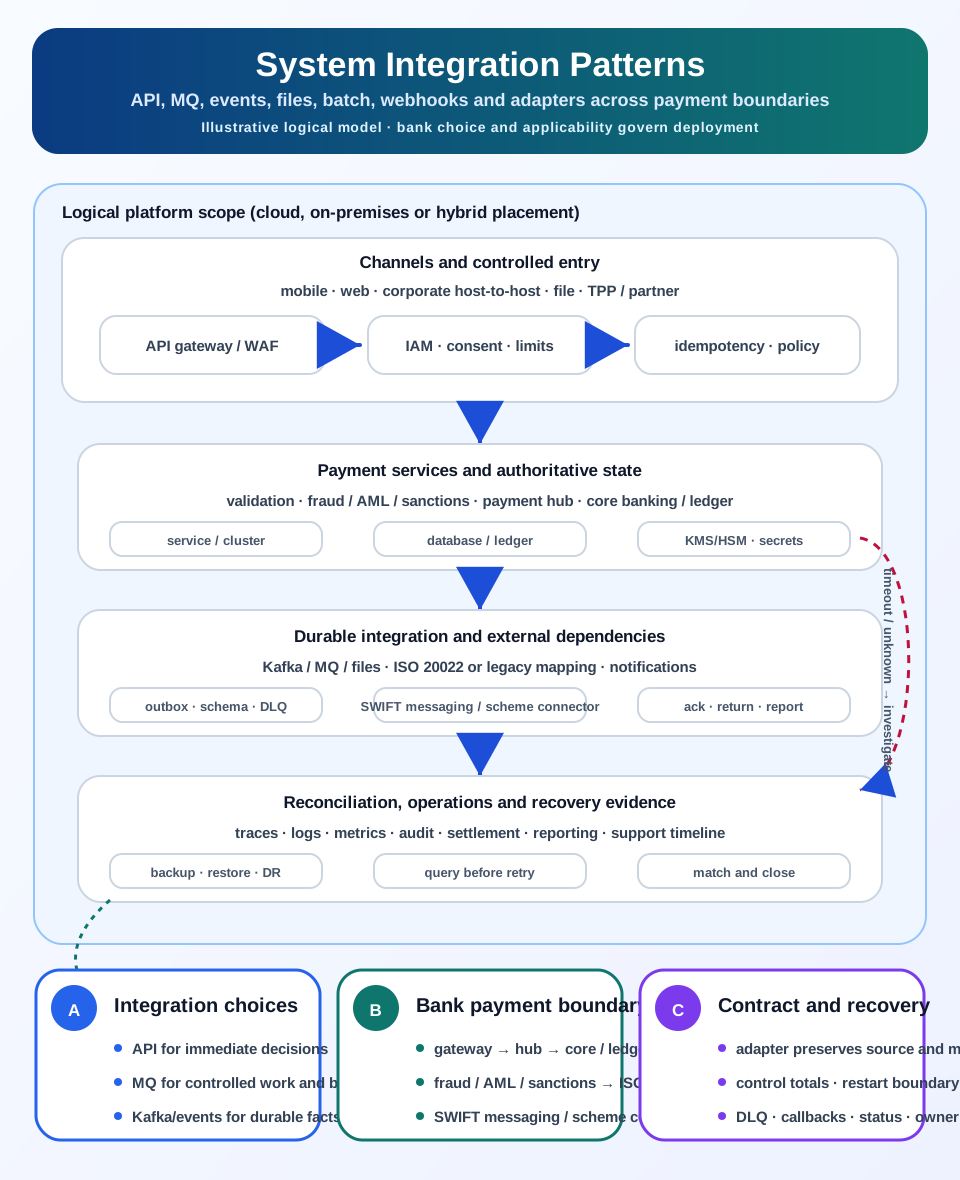
Cloud integration reference architecture
The right pattern depends on timing, durability, ownership and recovery. A bank may place API gateways and domain services in cloud while connecting privately to a core, MQ estate, SWIFT edge or scheme adapter on premises; another bank may select managed services. The diagram is a logical boundary map, not a claim that one provider or topology is required.
| Boundary | Suitable pattern and control | Failure handling |
|---|
| Channel to bank edge | API for authentication, validation, limits and acceptance | Idempotent retry; HTTP success is not settlement |
| Domain to work queue | MQ or managed queue for work needing controlled delivery | Back-pressure, retry budget, DLQ owner and duplicate handling |
| Domain to facts | Kafka/event stream after durable state | Partition/order key, schema compatibility, lag and projection replay |
| Corporate or scheme exchange | File/SFTP or managed file service with control totals | File integrity, item boundaries, restart checkpoint and reconciliation |
| Legacy/core boundary | Adapter or anti-corruption layer | Preserve source and translated message, mapping version and reason code |
| External partner | Webhook/callback or polling | Authenticity, replay protection, timeout, retry and status inquiry |
End-to-end failure scenario
A corporate file arrives successfully, but one item fails sanctions review and the downstream rail acknowledgement is missing. The file and item control totals remain the intake evidence; the item is held or rejected according to the selected risk policy; successfully accepted items are not replayed just because one item failed. Operations query the rail by deterministic reference, match ledger and settlement reports, repair only the affected item under maker-checker control, and close the reconciliation break. The same principles apply to an API, MQ message or event, but the contract and restart boundary differ.
OpenAPI fields such as idempotency and correlation are recommended payment-contract content, not fields mandated by OpenAPI. The official specification is versioned; use the latest OpenAPI page and date any version-specific teaching note. AsyncAPI and CloudEvents describe message/event contracts; they do not provide delivery guarantees or a bank's retention and evidence policy.
Cloud controls at every integration boundary
Record the cloud/on-prem trust boundary, private connectivity and egress, workload identity, gateway or broker ACLs, KMS/HSM and secret/certificate custody, data residency and retention, backup/restore scope, CI/CD contract gates, provider responsibility, concentration/exit and FinOps for egress, broker/storage and DR. Kubernetes or serverless components add runtime-specific controls, but do not change the need for business-level idempotency and reconciliation.
Related Cloud Library chapters
For the cloud placement and security baseline, see Cloud Fundamentals for Banking and Cloud Security and Secrets. For API and event contracts, see APIs in Banking and Event Driven Architecture.
Official References Used
This application uses JavaScript for the full interactive experience. This text summary is served for accessibility and search indexing.