Cloud security for bank payments: IAM, workload identity, KMS/HSM, certificates, secrets, segmentation, CI/CD, data protection and incident response.
Part of the Cloud, APIs and Integration for Banking learning path.
A cloud payment platform is only as safe as its weakest identity, secret, key, certificate, network route, workload policy, logging rule, and recovery path.
Scope and evidence (reviewed 5 October 2026). This is educational engineering guidance, not a universal banking-control prescription. Read each recommendation in the right category: generic cloud principle, technical standard or specialist guidance, jurisdictional/supervisory expectation, scheme/provider rule, or bank implementation choice. Applicability depends on the bank's jurisdiction, licence, criticality, data, service, contract and selected architecture; the cited sources are the authority for any dated or regulatory statement.
Cloud security in payments is not a separate checklist kept by a security team after the engineering work is finished. It is part of the payment architecture itself. Every payment service uses identities. Every service talks to databases, APIs, message brokers, payment hubs, fraud engines, sanctions platforms, key stores, file stores, settlement systems, reconciliation engines, observability platforms, and production support tools. Every one of those connections has credentials, permissions, network paths, encryption requirements, logging obligations, operational owners, and failure consequences.
That is why this topic belongs inside a payments engineering roadmap. A payment platform can have correct API logic and still be unsafe if secrets are stored in source code, if production access is too broad, if certificates expire silently, if Kubernetes secrets are treated as complete security, if database credentials never rotate, if service accounts can read every queue, if object storage exposes settlement files, if audit logs can be modified, or if a deployment pipeline can push production changes without evidence.
In normal applications, a weak secret may expose a profile, an order, or a dashboard. In payments, a weak secret can expose account data, allow unauthorized payment initiation, bypass a fraud or sanctions integration, change payment routing, corrupt status, leak reconciliation files, disable monitoring, or hide an attack inside production. The technical control and the business consequence are joined.
This chapter explains cloud security and secrets in payment-domain language. It is written for developers, business analysts, architects, testers, cloud engineers, platform teams, SREs, production support, security teams, compliance teams, and product owners who need to understand how cloud controls protect the movement of money. The focus is practical: identity and access, zero trust, secrets vaults, rotation, key management, certificates, TLS, network segmentation, workload security, Kubernetes, CI/CD, infrastructure as code, payment data protection, audit logging, monitoring, incident response, SDLC controls, and release readiness.
The Core Idea
Cloud security for payments means protecting the systems, identities, data, infrastructure, integrations, evidence, and operating processes that allow a bank or payment institution to move money safely. It includes public cloud, private cloud, hybrid cloud, container platforms, managed databases, managed Kubernetes, serverless functions, event brokers, API gateways, object storage, secrets managers, key management services, hardware security modules, CI/CD platforms, infrastructure as code, observability tooling, and incident response workflows.
The practical question is not Are we using cloud securely? That is too broad. The better question is: can each payment capability explain exactly who can access it, which identity it uses, which secret enables it, which key protects the data, which certificate secures the connection, which network path is allowed, which logs prove what happened, and how the platform recovers when that control fails?
For example, a payment initiation API may accept an instruction from a corporate channel. Behind that simple action, several controls are already active. The API gateway validates the client, rate limits the request, and forwards trace context. The authentication service confirms the user or client identity. The entitlement service checks whether the customer can initiate payments from the debit account. The payment service uses a workload identity to read configuration. It retrieves a database credential or uses managed identity. It calls a fraud service over a protected network path. It publishes a status event to an authorized topic. It logs safe evidence without exposing secrets or full account data. It uses encryption for stored payloads. It allows support teams to trace the payment without seeing sensitive data they do not need.
If any one of those controls is weak, the payment journey can become unsafe even when the business logic is correct.
Security Is Payment Correctness
A payment system is judged by correctness, not only by availability. Correctness means the right customer can create the right payment from the right account to the right beneficiary for the right amount, through the right rail, under the right controls, with the right status, and with evidence that can be explained later.
Security protects that correctness. IAM protects who may create, approve, modify, deploy, repair, or view payment data. Secrets management protects the credentials that systems use to talk to each other. Key management protects data and signing operations. Network controls protect which systems can reach each other. Logging protects the evidence. Monitoring protects detection. Incident response protects recovery.
A bank cannot treat these as background platform details. If a service account can modify payment routing tables without approval, payment correctness is at risk. If a support engineer can read raw secrets while investigating a failed payment, confidentiality is at risk. If a deployment pipeline can change fraud bypass rules without separation of duties, control integrity is at risk. If logs can be deleted by the same administrator who performed the action, audit evidence is at risk. If a certificate expiry stops open banking traffic, availability and customer trust are at risk.
Security becomes real when we connect it to payment outcomes.
What Must Be Protected
A cloud payment estate contains many assets that need different controls. A useful security design starts by naming them clearly.
Payment instructions are sensitive business records. They may include debtor account, creditor account, beneficiary name, amount, currency, execution date, remittance information, purpose code, charge details, regulatory data, ultimate debtor or creditor, and channel references.
Payment status records are also sensitive. A status timeline can reveal customer behavior, payment value, risk holds, investigation cases, returns, rejects, sanctions decisions, fraud signals, and operational failures.
Secrets are sensitive values that grant access or prove identity. They include database passwords, API keys, OAuth client secrets, private keys, signing keys, TLS private keys, broker credentials, service tokens, webhook signing secrets, SFTP keys, HSM credentials, vendor credentials, and emergency access credentials.
Keys perform cryptographic operations. They may encrypt payment payloads, sign API tokens, sign files, protect database fields, wrap data keys, secure backups, protect card or PIN operations, or support payment network connectivity.
Certificates identify systems and protect communication. They support public APIs, internal service-to-service TLS, open banking APIs, file transfer, message broker connections, database connections, partner callbacks, and scheme connectivity.
Configuration defines behavior. Payment routing rules, cut-off calendars, fraud thresholds, sanctions routing, retry policies, queue names, topic permissions, feature flags, and environment variables can all affect the payment journey.
Logs and audit trails are evidence. They prove what happened, who did it, when it happened, which system made a decision, and how the payment moved across boundaries.
Backups and archives are payment data too. A production database may be well protected while an exported backup, settlement file, reconciliation extract, or data science copy is weakly controlled. That is still a security issue.
Shared Responsibility In Cloud Payments
Cloud providers secure parts of the underlying cloud. The bank secures what it builds, configures, deploys, and operates on top of that cloud. The exact split depends on the service model.
In infrastructure as a service, the provider normally protects physical data centers, hardware, host virtualization, and base cloud services. The bank owns operating systems, network rules, IAM policies, data encryption choices, applications, secrets, logging, monitoring, and incident response.
In platform as a service, the provider may operate more of the runtime, but the bank still owns identity, configuration, data protection, access policy, application behavior, logging, and business control evidence.
In software as a service, the provider operates the application, but the bank still owns configuration, user access, data classification, integration secrets, audit review, contractual assurance, and operational procedures.
This matters because cloud incidents often happen in the customer-controlled layer. A managed database can still be exposed through a bad network rule. A managed object store can still be misconfigured. A managed Kubernetes cluster can still run unsafe workloads. A managed secrets manager can still expose secrets to an over-permissioned role. A managed CI/CD system can still leak secrets in logs.
For payment systems, shared responsibility should be documented per capability. The payment initiation API, payment event broker, settlement file store, fraud integration, reconciliation database, customer notification service, and support search tool should each have an owner and control view. The design should show what the provider controls, what the bank controls, which team owns configuration, which controls are monitored, and which evidence proves the control worked.
Zero Trust For Payment Workloads
NIST SP 800-207 describes zero trust as moving away from implicit trust based on network location and focusing protection on users, assets, and resources. The payment lesson is simple: being inside the bank network, inside the cloud account, or inside the Kubernetes cluster should not automatically mean a service or person is trusted.
A payment status service should not call a ledger adapter only because both run in the same private network. A fraud service should not read every raw payment payload only because it is deployed in production. A developer should not access settlement files only because they belong to the engineering group. A CI/CD pipeline should not deploy to production only because it runs inside the bank's cloud tenant.
Zero trust in a payment platform means each request is evaluated through identity, device or workload context, resource sensitivity, action type, environment, policy, and risk signal. A human user, a service account, a batch job, a serverless function, a Kubernetes pod, and a deployment pipeline should each have explicit permission for what they do. No identity should have broad power because it is convenient.
For human users, this means strong authentication, multi-factor authentication, privileged access management, just-in-time elevation, approval workflow, session logging for sensitive actions, and regular recertification. For payment production support, this often means a support person can view masked payment timelines but cannot read raw secrets or change routing configuration without elevated approval.
For workloads, this means workload identity, short-lived credentials where possible, mTLS or equivalent service identity, service-to-service authorization, network policy, and resource-level permissions. The payment initiation service may publish payment lifecycle events. It should not read sanctions investigation queues unless there is a clear need. The notification service may read safe status events. It should not access raw payment payload stores.
Zero trust does not mean every payment request becomes slow or manual. It means trust is earned through policy and evidence, not assumed from location.
Identity And Access Management
Identity and Access Management, or IAM, is the control system for who and what can perform actions. In payment cloud platforms, IAM must cover humans and machines equally.
Human identities include developers, testers, production support engineers, SREs, database administrators, platform engineers, security engineers, auditors, release managers, business operations users, compliance users, and vendor support users. Workload identities include payment services, CI/CD jobs, batch processes, event consumers, Kubernetes service accounts, serverless functions, database migration jobs, monitoring agents, backup jobs, and emergency automation.
The first rule is least privilege. A service that reads payment status should not modify payment routing rules. A reporting job should not write to the payment ledger. A deployment pipeline should not read production payment payloads unless there is a defensible reason. A support engineer may need a payment timeline, but not raw secrets. An analytics process may need masked payment attributes, not full account numbers and beneficiary details.
The second rule is separation of duties. The same person should not be able to write code, approve the release, deploy to production, change network routes, change key policies, modify audit logs, and approve their own emergency access. Banking controls often require maker-checker behavior for sensitive actions. Cloud IAM should support that governance instead of bypassing it.
The third rule is environment separation. Development, test, staging, pre-production, and production identities should be separated. Non-production service accounts should not access production secrets. Development tools should not connect to production payment databases. Test credentials should not be valid in production. Production certificates should not be copied into test environments for convenience.
The fourth rule is evidence. Every sensitive access should produce logs that show who accessed what, when, from where, using which identity, under which approval, and with what result. Evidence should be protected from modification by the same users who performed the actions.
IAM design should be reviewed as part of every payment release. A code change may be small, but a permission change can be huge. A new read all secrets policy is more dangerous than many application code changes.
Privileged Access And Break Glass
Privileged access is dangerous because it can change production. In payments, privileged access can modify routing, repair records, run scripts, read sensitive data, change IAM policies, rotate secrets, disable alerts, alter network controls, deploy code, or change database permissions.
Normal production access should be just-in-time. A support engineer requests access for a specific incident, payment file issue, failed batch, certificate problem, or queue backlog. The request has a reason, approver, duration, and scope. Access expires automatically. The session is logged. High-risk sessions may be recorded. After the task, evidence is retained.
Break-glass access is emergency access for serious incidents. It must exist because payment systems can fail outside office hours and during critical settlement windows. But it must be tightly controlled. Break-glass credentials should be protected, monitored, tested, and reviewed after every use. Use should trigger alerts. They should not become everyday shortcuts.
A good payment platform separates emergency recovery from routine operations. If teams use break glass every week because normal access is too slow, the access model is broken. If break glass is never tested, the bank may discover during an outage that it cannot recover.
Break-glass runbooks should answer practical questions. Who can approve? Which identities are used? How long does access last? Which systems are in scope? How is the session logged? How are changes reconciled after the incident? How are any exposed secrets rotated? How is business impact reviewed?
Secrets Management
A secret is any sensitive value that grants access or proves identity. In payment systems, secrets include database passwords, API keys, OAuth client secrets, client assertion signing keys, webhook signing secrets, private keys, TLS private keys, message broker credentials, SFTP keys, cloud access keys, vendor credentials, HSM credentials, service tokens, and emergency credentials.
The most basic rule is: secrets must not live in source code. They should not live in Git history, container images, mobile app binaries, plain configuration files, wiki pages, issue comments, chat messages, screenshots, or unmasked logs.
OWASP secrets guidance emphasizes centralization, lifecycle management, fine-grained access control, automation, rotation, and avoiding secrets in logs. For payments, those principles become operational controls. A fraud API key should have an owner, purpose, environment, rotation policy, expiry alert, allowed consumers, and emergency revocation path. A database credential should be scoped to the specific payment service and operation it performs. A webhook signing key should be versioned and rotated without breaking partners.
A secrets manager or vault stores secrets centrally, encrypts them, controls access through identity policies, logs retrieval, supports rotation, and allows applications to fetch secrets at runtime. Cloud-native options include services such as AWS Secrets Manager, Azure Key Vault, and Google Secret Manager. Dedicated systems such as HashiCorp Vault are also common. The exact product is less important than the operating discipline around ownership, access, rotation, audit, and recovery.
Static secrets are long-lived values such as a vendor API key or certificate private key. Dynamic secrets are short-lived credentials generated when needed, such as temporary database credentials. Dynamic secrets reduce exposure because stolen values expire quickly and can be revoked. Where dynamic secrets are not possible, static secrets need stronger rotation and monitoring.
A mature payment platform has a secrets inventory. It should show secret name, owner, environment, service, purpose, data classification, rotation frequency, last rotation date, expiry date, consumers, fallback approach, and incident contact. A secret without an owner is a future incident.
Secret Rotation
Rotation means replacing a secret with a new value and ensuring all valid consumers move safely to the new value. It sounds simple until production payments are using that secret every second.
A database password rotation can break payment initiation if the service cannot reload credentials. A broker credential rotation can stop event consumers and delay payment status. A TLS certificate rotation can break open banking TPP connections, partner APIs, or internal service calls. A signing key rotation can make messages fail verification. A vendor API key rotation can interrupt fraud screening. An SFTP key rotation can stop corporate file exchange.
Rotation needs design, not just a calendar. The team must identify the secret and owner, generate the new value securely, publish it to the secret store, allow old and new values during an overlap window where needed, update consumers without downtime, verify successful use, revoke the old value, monitor errors, and record evidence.
Applications should be designed for rotation. If a service reads a secret only once at startup, rotation may require restart. If the service is replicated, rolling restart must avoid downtime. If the secret is used by external partners, there may need to be a published transition period. If the secret signs outbound webhooks, receivers may need to accept both old and new signature keys temporarily.
Emergency rotation is different. If a secret is suspected compromised, the bank may not have time for a long overlap. The runbook should identify dependent services, customer impact, fallback options, revoke steps, verification steps, and communication paths. A payment platform should not discover its secret dependency map during a compromise.
The Bootstrap Secret Problem
Every secrets manager has a bootstrap problem. A service needs permission to retrieve a secret, but that permission itself must be established securely. This is where many designs become weak.
Bad designs put a master token inside the container image, deployment manifest, or environment variable. Better designs use workload identity, instance identity, Kubernetes service account federation, short-lived tokens, or platform-native identity federation. The application proves its workload identity to the secret manager and receives only the secrets it is allowed to use.
In payments, this matters because one leaked bootstrap credential can expose many downstream secrets. A notification service should not have a general vault token. A reconciliation batch should not have access to API gateway secrets. A CI/CD pipeline should not have a broad token that can read all production secrets.
The bootstrap model should be reviewed as carefully as the secrets themselves.
Kubernetes Secrets Are Not Enough By Default
Kubernetes Secrets are commonly used to provide sensitive data to Pods. They are better than hardcoding secrets, but they are not complete security by themselves.
For payment workloads, Kubernetes secret handling needs several controls. Enable encryption at rest for the Kubernetes API server data store. Restrict RBAC so only required identities can read secrets. Do not grant broad get secrets permissions to developers, service accounts, or automation. Limit namespace access. Avoid mounting secrets into pods that do not need them. Use external secrets integration where appropriate. Rotate secrets. Monitor secret access.
A common mistake is assuming that a Kubernetes Secret is automatically safe because the object type is named Secret. The real question is: who can read it, how is it encrypted, where is it mounted, how is it rotated, and what logs prove access?
Do not put all payment secrets in one namespace. Do not allow any pod creator to indirectly access all secrets in that namespace. Do not expose secrets as environment variables if process dumps, debug endpoints, or logs can leak them. Prefer mounted files or runtime retrieval depending on the platform and threat model. The right answer depends on the control environment, but the decision must be deliberate.
Key Management And HSMs
Secrets and cryptographic keys are related but not identical. A secret often grants access. A cryptographic key performs a cryptographic operation: encryption, decryption, signing, verification, wrapping, or derivation.
Payment systems use keys everywhere. Data encryption keys protect payment payloads. Key encryption keys protect data keys. TLS keys protect transport. API signing keys protect tokens. File signing keys protect payment files. Backup keys protect restore media. HSM-protected keys may be required for card, PIN, network, or high-assurance payment operations.
A cloud Key Management Service manages cryptographic keys and controls key usage. A Hardware Security Module provides stronger physical and logical protection for sensitive cryptographic operations. Some payment use cases need HSMs because keys must never leave protected hardware or because the control standard expects stronger key custody.
Envelope encryption is a common pattern. Data is encrypted with a data key. The data key is encrypted with a key encryption key managed by KMS or HSM. This allows efficient encryption while centralizing key control.
Key management needs lifecycle control: generation, import, storage, usage policy, rotation, disabling, destruction, backup, recovery, dual control where required, and audit. A key should have one purpose. The same key should not be used for unrelated purposes such as database encryption and payment file signing.
Key rotation is not only a security action. It can be a compatibility issue. Systems that verify old signatures or decrypt old records may need access to previous key versions. The architecture should distinguish active key, previous key, retired key, disabled key, and destroyed key.
Certificates And TLS
Certificates protect identity and encryption in transit. Payment APIs, open banking APIs, internal microservices, message brokers, databases, SFTP endpoints, partner integrations, service meshes, and scheme connections all depend on certificates.
Certificate failures are predictable. Expiry, wrong common name, missing subject alternative name, missing intermediate certificate, wrong private key, wrong trust store, revoked certificate, unsupported TLS version, weak cipher, environment mismatch, and clock skew all happen in real production estates.
In payments, certificate expiry can stop payment initiation, open banking traffic, corporate host-to-host file transfer, scheme connectivity, fraud calls, partner webhooks, or settlement reporting. Therefore certificate inventory and expiry alerting are mandatory. Every certificate should have owner, environment, purpose, issuer, expiry date, renewal method, dependent services, and rollback plan.
Short-lived certificates reduce exposure but increase automation pressure. Manual certificate replacement does not scale across microservices and cloud environments. Automated renewal is useful, but the automation itself must be monitored. A failed renewal job can be as dangerous as no renewal process.
Mutual TLS can authenticate both sides of a connection. It is common in high-trust payment integrations and internal service-to-service communication. But mTLS alone is not complete authorization. A service may prove its identity and still need policy that says whether it is allowed to perform that action.
Network Security
Cloud network security starts by reducing what is reachable. Payment systems should not expose databases, queues, caches, admin panels, internal dashboards, object stores, or management endpoints directly to the public internet.
A basic payment cloud network uses isolated virtual networks, private subnets, controlled routing, security groups or firewall rules, private endpoints for managed services, egress controls, DNS controls, WAF for public APIs, DDoS protection, and inspection for high-risk paths.
Segmentation matters. Production should be separated from non-production. Payment execution systems should be separated from general analytics. Cardholder data environments should be separated where PCI scope applies. Administrative access should go through controlled access paths, not public management endpoints.
Microsegmentation goes further by restricting service-to-service traffic. The payment initiation service may call validation and status services. It should not call every database. The notification service may consume safe status events. It should not access raw payment payload stores. Network policy should match the actual application dependency map.
Egress is often forgotten. Attackers like systems that can call anywhere. Payment workloads should not have unrestricted outbound internet access. Fraud vendor endpoints, sanctions APIs, cloud service endpoints, partner callback URLs, and scheme endpoints should be allowlisted and monitored. Unexpected outbound traffic from a payment workload should be treated as a signal.
API Gateway Security
Payment APIs are usually exposed through gateways. A gateway is not just a routing layer. It is a control point.
A payment API gateway may enforce TLS, client authentication, OAuth token validation, consent or scope checks, request size limits, schema validation, rate limits, IP allowlists, mTLS, threat protection, bot controls, WAF rules, and logging. It may also inject correlation identifiers and route traffic to the correct backend service.
For payment initiation, gateway errors must be designed carefully. If the gateway times out, the channel needs a safe status and a way to query later. If authentication fails, do not leak whether the account exists. If rate limits trigger, the response should be precise enough for a legitimate corporate client to recover without exposing security details.
Gateways should not hide business accountability. A gateway may validate a token, but the payment service still owns business authorization: account authority, payment permissions, limits, approval workflow, and idempotency.
Workload And Container Security
Payment workloads running in containers need secure build and runtime controls.
Images should come from trusted registries. Base images should be patched. Dependencies should be scanned. Images should be signed where the platform supports it. Build pipelines should produce provenance and evidence. Runtime policies should block privileged containers unless explicitly justified.
Containers should run as non-root where possible. File systems should be read-only where possible. Linux capabilities should be dropped. HostPath mounts should be avoided. Resource limits should be set. Admission controls should block unsafe deployments. Kubernetes network policies should restrict traffic. Pod security standards or equivalent controls should enforce baseline behavior.
Payment workloads also need secure configuration. A container image should not contain production secrets. It should not contain test certificates. It should not expose debug endpoints in production. It should not include unnecessary tools that expand attack surface. It should not log full payment payloads on error.
Runtime detection should watch for unusual process execution, unexpected network connections, credential access, container escape indicators, and policy violations. A payment workload that suddenly calls an unknown external IP is a security event.
CI/CD Security For Payment Platforms
CI/CD is part of the payment control environment because it changes production. A deployment pipeline can introduce code, configuration, infrastructure, IAM policies, network routes, secret references, and database migrations.
A payment CI/CD design needs identity separation. Build jobs, test jobs, deployment jobs, infrastructure jobs, and secret rotation jobs should not all use the same credential. A pull request build should not have access to production secrets. A forked build should not receive sensitive tokens. A deployment role should have only the permissions required for deployment.
Pipelines should avoid printing secrets. Debug output, failed commands, environment dumps, stack traces, and artifact uploads can leak credentials. Secrets masking helps, but teams should not rely only on masking. Pipeline scripts should be written as if logs may be reviewed by people who do not need secret values.
Approvals matter. A change to a payment UI label is not the same as a change to a fraud bypass flag, a KMS policy, an SFTP endpoint, or a production IAM role. CI/CD governance should classify changes and require stronger approval for higher-risk changes.
Build provenance also matters. The bank should know which source commit, dependency set, build environment, artifact, container image, approver, and deployment job produced the running service. During an incident, this evidence needs to be retained and searchable.
Infrastructure As Code And Policy As Code
Cloud incidents often come from misconfiguration. A storage bucket becomes public. A security group allows the world. A database has no encryption. A Kubernetes service account has cluster-admin. A secret is copied into plain text. A logging sink is disabled. A CI/CD role gains production admin.
Infrastructure as Code helps because configuration becomes reviewable, testable, repeatable, and auditable. Network rules, IAM policies, Kubernetes manifests, secrets references, encryption settings, logging sinks, backup settings, and monitoring rules should be defined as code where possible.
Policy as code checks these definitions before deployment. It can block public object storage, broad IAM actions, unencrypted databases, privileged containers, missing labels, missing logging, missing backup, unsafe ingress, or missing key rotation settings. Runtime drift detection then checks whether production still matches approved configuration.
For payment systems, infrastructure changes should have change evidence. Who changed the routing subnet? Who opened egress to a vendor endpoint? Who changed a KMS key policy? Who disabled log export? Who updated a secrets access policy? The answer should come from the platform, not memory.
Payment Data Security
Payment data includes more than card data. It includes account numbers, names, addresses, beneficiary details, remittance text, payment references, merchant information, device data, transaction history, status history, fraud scores, sanctions investigation references, settlement files, statement files, reconciliation extracts, operational logs, and audit trails.
Data classification should decide handling. Cardholder data and sensitive authentication data fall under PCI DSS when stored, processed, or transmitted by entities in scope. PCI DSS v4.0.1 was published in June 2024 as a limited revision to PCI DSS v4.0. Account data, personal data, banking secrecy data, and operational data may have additional regulatory and internal policy requirements depending on jurisdiction and bank policy.
Tokenization reduces exposure by replacing sensitive values with tokens. Masking reduces what users and logs can see. Encryption protects data at rest and in transit. Access control limits who can read or modify data. Retention policy removes data when it is no longer needed. Data loss prevention and monitoring can detect accidental exposure.
Do not log full PAN, CVV, PIN data, secrets, OAuth tokens, private keys, full account numbers, raw authentication data, or unnecessary payment payloads. Error logs are a common leak path. Payment failures often include payloads, headers, downstream responses, or stack traces. Logging standards should define what must be masked before production.
Backups also need protection. A database may be encrypted, but an exported backup can leak if stored in open object storage. Settlement files, reconciliation extracts, and data science copies need the same seriousness as online systems.
Object Storage And Payment Files
Object storage is widely used for cloud payment platforms. It may store uploaded corporate files, generated reports, reconciliation outputs, operational exports, batch artifacts, fraud evidence, support attachments, or archived payloads.
Object storage must be private by default. Public access should be blocked unless there is a very specific and approved need. Buckets or containers should have owners, environment labels, data classification, encryption, lifecycle rules, access policies, logging, and deletion controls.
Payment files need additional controls. A corporate file may include thousands of payments. A settlement report may reveal liquidity positions. A reconciliation extract may show account and transaction details. A rejected file may contain sensitive reason information. Temporary upload areas are still payment data.
Use malware scanning where files are accepted from external parties. Verify file hash and control totals where relevant. Encrypt at rest. Restrict access by role. Avoid long-lived public URLs. Use short-lived signed URLs only where necessary and log their use. Archive only what policy allows.
Audit Logging And Evidence
Security logs are not only for attackers. In payments, logs prove who did what, which control made a decision, when a payment changed state, who accessed a secret, who used a key, who changed a policy, and whether the bank followed process.
Audit logs should cover human access, workload access, secret retrieval, key usage, configuration changes, network rule changes, deployment actions, database access, privileged commands, policy changes, failed authorization, break-glass activity, certificate updates, and log pipeline changes.
Logs should be centralized, protected, retained, searchable, and tamper-resistant. Administrators who manage systems should not be able to silently delete their own audit trail. Logs should include time synchronization, identity, source, resource, action, result, correlation id, and reason where available.
For payment support, logs should connect to business evidence. If a payment was held by sanctions, support needs the payment timeline and safe reason code. If a secret was rotated and payment failures started, operations needs to link the rotation event to service errors. If a routing rule changed, audit needs to know who approved and deployed it.
Cloud audit logs should feed SIEM or security analytics. Alerts should focus on high-risk signals: unusual secret access, disabled logging, public exposure of private storage, privilege escalation, failed admin logins, impossible travel, unexpected production deployments, suspicious key usage, network policy changes, and data exfiltration patterns.
Monitoring Security In A Payment Cloud
Monitoring should combine infrastructure, application, security, and payment-domain signals.
Technical signals include API latency, error rate, CPU, memory, container restart count, database connection errors, queue depth, consumer lag, certificate expiry, secret retrieval errors, KMS throttling, and network denies.
Security signals include failed authentication, denied authorization, unusual secret access, unexpected key use, public storage policy changes, new admin permissions, disabled logging, unusual outbound traffic, vulnerability findings, policy violations, and risky deployment actions.
Payment-domain signals include payment initiation drop, unusual rejection spike, fraud decision delay, sanctions screening delay, payment status backlog, settlement file delay, reconciliation mismatch, notification failure, and unexpected manual repair volume.
The best monitoring joins these together. If certificate expiry causes fraud API calls to fail, the payment view should show fraud decision delay. If a secret rotation breaks a database connection, the payment view should show initiation failures and technical errors. If a network policy blocks a queue consumer, the payment view should show status event backlog.
Security monitoring without payment context creates noise. Payment monitoring without security context misses attacks. The two need to meet.
Incident Response For Secrets And Cloud Security
A secret incident needs speed and order. If a payment API key, database password, signing key, certificate private key, cloud access key, webhook secret, or SFTP private key leaks, the bank must contain the exposure without creating a larger outage.
The runbook should identify the secret owner, dependent services, blast radius, rotation steps, revocation steps, monitoring checks, customer impact, regulatory impact, evidence capture, and communication path. It should state when to pause payment flows, when to fail closed, when to use backup credentials, and who can approve emergency access.
Cloud incidents require timeline discipline. When did the exposure begin? Which identity accessed the resource? Which systems used the secret? Which payments were touched? Was data read, modified, or exfiltrated? Were logs intact? Which controls detected the event? Which controls failed?
Payment incident response should include technical teams, security, operations, compliance, legal, customer support, and business owners where impact requires it. The goal is containment, recovery, evidence, communication, and prevention.
A strong runbook separates investigation from action. Teams need to preserve evidence while rotating secrets quickly. They need to avoid deleting logs, overwriting traces, or destroying forensic value. They also need to avoid leaving compromised credentials active while waiting for perfect analysis.
Ransomware And Destructive Attack Readiness
Payment platforms must also consider destructive attacks. Ransomware and wiper-style attacks can damage availability, data integrity, backups, and support evidence.
Cloud controls help when designed correctly. Backups should be protected from deletion by compromised production identities. Recovery procedures should be tested. Critical infrastructure definitions should identify which payment services must recover first. Immutable logs can preserve evidence. Network segmentation can reduce spread. Least privilege can reduce blast radius.
A payment recovery plan should answer sequence questions. Do we restore the API first, the payment database first, the event broker first, the reconciliation store first, or the identity platform first? Which dependencies are mandatory for safe payment acceptance? Which flows fail closed? Which flows can operate in degraded mode? How are duplicate payments prevented after recovery?
Security resilience and payment resilience are linked.
Compliance And Control Mapping
Payment cloud security must be explainable to auditors, regulators, risk teams, and internal control owners. Frameworks help organize the conversation, but they do not replace architecture.
NIST CSF 2.0, published in February 2024, provides high-level cybersecurity outcomes across governance and risk management. ISO/IEC 27001:2022 defines requirements for an information security management system. PCI DSS v4.0.1 applies where payment account data is stored, processed, or transmitted in card environments. The swift Customer Security Controls Framework v2026 provides controls for the operating environment of swift users. OWASP provides practical application and secrets guidance. Cloud Security Alliance CCM provides cloud control structure.
A payment team should map controls to systems and evidence. For example, least privilege maps to IAM roles, access reviews, policy definitions, and logs. Secrets management maps to vault inventory, rotation records, access logs, and incident runbooks. Logging maps to log pipelines, retention settings, immutability controls, dashboards, and alert records. Change control maps to pull requests, approvals, pipeline logs, deployment records, and rollback evidence.
Control mapping should be specific enough to prove reality. A statement like we use encryption is weak. A stronger statement says which data is encrypted, where keys live, who can use keys, how keys rotate, where usage is logged, and how recovery works.
Threat Modeling Cloud Payment Systems
Threat modeling asks what can go wrong before production proves it the hard way.
For payment cloud security, threat models should include unauthorized payment initiation, account data exposure, beneficiary data modification, fraud bypass, sanctions bypass, routing manipulation, duplicate payment creation, payload tampering, replay attack, stolen API credentials, leaked database password, exposed object storage, compromised CI/CD pipeline, malicious insider, vulnerable container image, expired certificate, logging failure, backup compromise, and privilege escalation.
Each threat should connect to payment consequence. A stolen webhook secret may allow fake partner notifications. A leaked SFTP key may expose corporate files. A compromised deployment role may change payment routing. An over-permissioned service account may read settlement files. A weak KMS policy may allow unauthorized decryption. A disabled log export may hide an attacker.
Threat modeling should produce design actions, not only diagrams. Actions may include stronger IAM, mTLS, signed requests, schema validation, idempotency checks, object storage policies, key rotation, masked logging, network egress restrictions, CI/CD hardening, or new alerts.
Secure SDLC For Cloud Security And Secrets
Security must enter the SDLC before production.
During requirements, teams should identify data classification, payment flows, external parties, integration boundaries, regulatory scope, availability needs, audit needs, and support needs. The requirement should not only say use cloud securely. It should identify which payment assets need protection and which failure consequences are unacceptable.
During design, teams should define trust boundaries, IAM, workload identities, secrets, certificates, keys, encryption, network paths, logging, monitoring, backup, restore, and compliance evidence. Threat modeling should include secret theft, privilege escalation, misconfiguration, data leakage, token replay, insider access, supply chain compromise, certificate expiry, and logging gaps.
During build, developers should use approved libraries, never hardcode secrets, integrate with secret stores, mask logs, validate authorization, write secure defaults, and add tests for denied access. Platform engineers should define secure templates, policies as code, and safe deployment paths.
During testing, include secret rotation tests, expired certificate tests, missing permission tests, denied network path tests, KMS access failure, read-only secret access, log masking checks, backup restore checks, and break-glass drills. A system that works only when secrets never rotate is not production ready.
During release, verify IAM diff, network diff, data classification, logging configuration, secret references, key policies, vulnerability scan, image provenance, dependency scan, certificate expiry, monitoring, alerts, rollback plan, and support runbook.
After release, monitor access, errors, secret retrieval, key usage, network anomalies, configuration drift, vulnerability findings, and payment-domain impact.
Testing Cloud Security Controls
Security testing should not be limited to penetration testing near the end. Many controls can be tested continuously.
Unit and integration tests can verify authorization decisions. Contract tests can verify that APIs do not return sensitive fields. Log tests can verify that secrets and account numbers are masked. Infrastructure tests can check encryption, public access blocks, logging settings, IAM policies, and network restrictions. Pipeline tests can check that pull request builds do not receive production secrets.
Operational tests are equally important. Rotate a non-critical secret and observe whether services reload correctly. Expire a test certificate and verify alerting. Deny a network path and verify failure behavior. Revoke a service permission and verify the service fails safely. Attempt to access a secret from an unauthorized identity and verify alerting.
Payment-domain tests should verify consequences. If fraud API credentials fail, does the payment fail closed, route to review, or proceed? If sanctions connectivity fails, what status does the customer see? If a key is unavailable, are payments stopped safely? If logs are delayed, does support still have a usable timeline? These are business decisions expressed through technical controls.
Developer Practical Guidance
Developers working on payment cloud systems should follow a few practical rules.
Do not put secrets in code, logs, tickets, chat, screenshots, test data, or local config files. Use approved secret retrieval patterns. Know which identity your service runs as. Know which secrets it reads. Know which keys it uses. Know which logs it emits. Know which data it stores.
Do not assume internal traffic is safe. Validate caller identity. Enforce authorization. Use mTLS or service identity where required. Keep error messages safe. Avoid logging raw payloads. Avoid returning stack traces through APIs.
Design for retry and recovery. If a secret rotates, what happens? If KMS is temporarily unavailable, what happens? If a certificate expires, how is it detected? If a permission is missing, does the service fail closed? If a partner callback signature fails, how is it handled?
Treat configuration as production behavior. A feature flag, routing rule, queue name, endpoint URL, or allowlist entry can change the payment journey as much as code. Review it with the same seriousness.
Business Analyst Practical Guidance
A business analyst does not need to configure KMS or write IAM policies, but they do need to ask the right questions.
When a requirement says a payment service must call a vendor, ask how it authenticates, who owns the credential, how the credential rotates, what happens during expiry, what status the customer sees on failure, and what evidence support will have.
When a requirement says a support user can search payments, ask which fields are visible, which are masked, which actions are allowed, whether access is logged, and whether production access needs approval.
When a requirement says a corporate file is stored in cloud, ask who can access it, how it is encrypted, how long it is retained, whether downloads are logged, whether public links are blocked, and how duplicate or malicious files are handled.
When a requirement says open banking or partner APIs are supported, ask about certificates, consent, token validation, rate limits, callback signatures, replay protection, and incident handling.
Good payment security requirements are not abstract. They connect control behavior to customer outcome, operational process, and evidence.
Production Support Practical Guidance
Production support teams need visibility without unsafe access. They should not need raw secrets to diagnose payment failures. They should have dashboards, timelines, safe logs, correlation ids, status views, queue views, certificate expiry views, secret rotation records, deployment records, and runbooks.
For a failed payment, support should be able to see whether the failure came from authentication, entitlement, fraud, sanctions, payment hub, ledger, rail, notification, file transfer, queue backlog, certificate issue, network deny, secret retrieval failure, or downstream timeout.
For a security-related incident, support should know how to escalate. They should not rotate secrets casually or change IAM policies without approval. They should preserve evidence and follow runbooks.
A system is not supportable if every security issue requires a senior developer to read raw logs manually.
Common Anti-Patterns
Hardcoded secrets are still one of the clearest signs of weak engineering discipline.
One shared service account for many payment services destroys traceability and increases blast radius.
Broad IAM roles such as administrator, owner, or wildcard permissions are dangerous unless strictly temporary and controlled.
Treating Kubernetes Secrets as complete security creates false comfort.
Disabling TLS verification to make an integration work is not a fix. It removes identity assurance.
Logging raw payment payloads during errors creates data exposure through the support path.
Using public object storage for temporary payment files is unsafe unless explicitly designed and approved, which is rare.
Letting CI/CD pipelines access production secrets during pull request builds creates unnecessary exposure.
Manual certificate tracking through spreadsheets is weak for large estates unless supported by automated discovery and alerting.
Break-glass accounts used as normal admin accounts mean the privileged access process has failed.
A secrets manager without ownership, rotation, access review, and monitoring is only storage, not control.
What Good Looks Like
A mature cloud security and secrets design for payments has narrow identities, short-lived credentials where possible, strong secret storage, tested rotation, protected keys, private network paths, encrypted data, secure workloads, immutable audit logs, monitored configuration, and incident runbooks that have been tested.
It does not rely on one control. A stolen token should still face limited scope, short expiry, anomaly detection, network limits, and audit visibility. A misconfigured service should still be blocked by policy. A failed rotation should be detected before customers feel it. A production support action should leave evidence.
The best security architecture is not the one with the most tools. It is the one where a payment engineer can explain exactly which identity can access which resource, which secret enables which dependency, which key protects which data, which certificate secures which connection, which log proves which action, and what happens when any of those controls fail.
Release Readiness Checklist
Use this checklist before releasing a payment cloud service or changing a sensitive integration.
- The service identity is specific to the service and environment.
- IAM permissions follow least privilege and are reviewed.
- Production access is just-in-time or otherwise controlled.
- Secrets are stored in an approved secret manager.
- No secrets exist in code, images, logs, tickets, or documentation.
- Secret ownership, rotation, expiry, and incident runbook are defined.
- Certificates are inventoried, monitored, and renewable.
- KMS or HSM key usage is defined and logged.
- Network ingress and egress are restricted to required paths.
- Public access to payment data stores is blocked.
- API gateway controls are configured and tested.
- Logs mask sensitive data and preserve useful evidence.
- Audit logs are centralized and protected from tampering.
- CI/CD roles are scoped and do not expose production secrets to unsafe jobs.
- Infrastructure and policy changes are reviewable and auditable.
- Backup, restore, and recovery behavior are tested.
- Monitoring joins technical, security, and payment-domain signals.
- Runbooks cover secret compromise, certificate expiry, IAM failure, KMS failure, and network deny.
- Support can diagnose failures without unsafe access.
- Compliance evidence exists for the controls claimed.
Security boundary around a cloud payment estate
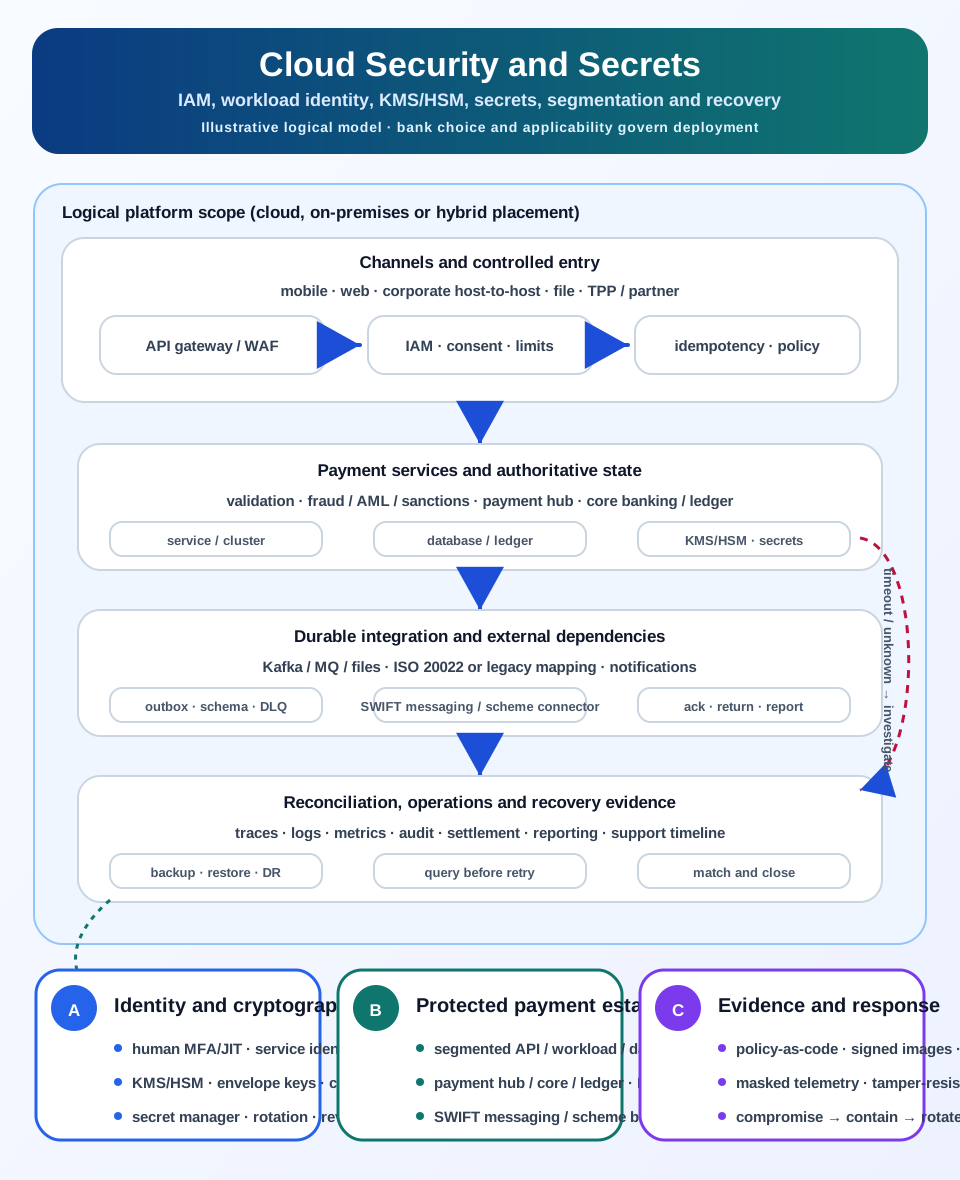
Security controls are easier to test when the bank can name the workload, data, actor, key, dependency and owner. A typical path is channel/API edge → IAM/consent/entitlement → payment service → fraud/AML/sanctions → hub/core/ledger → Kafka/MQ and rail/SWIFT boundary → notifications, accounting, reconciliation and reporting. The platform must also protect the control plane, CI/CD, support tools, backup copies and telemetry.
| Control | Implementation choice to document | Failure evidence and owner |
|---|
| IAM and workload identity | Human MFA/JIT, service identity, RBAC, separation of duties, break-glass expiry | Access review, denied request and approval trail; security/platform |
| KMS/HSM and certificates | Key purpose, custody, rotation, signing/decryption, certificate inventory and dependency behavior | Key-use audit, expiry alert and recovery test; security/crypto owner |
| Secrets | Approved manager or external store, injection path, rotation, revocation and bootstrap path | Secret access/rotation evidence, compromise runbook; service owner |
| Segmentation | Gateway, workload, data, broker, management and external zones; controlled egress | Network policy test, flow logs and exception expiry; platform/network |
| Payment data | Classification, masking/tokenisation where selected, non-production controls, residency, retention/legal hold | Data inventory, access log and deletion/hold evidence; data/compliance |
| Supply chain | CI/CD identity, dependency/image provenance, policy gates, rollback and migration safety | Build attestations, deployment approval and rollback test; DevSecOps |
| Recovery | Immutable backups, key/config/schema/idempotency scope, restore order and reconciliation | Cyber-recovery and failover test; SRE/payment operations |
Failure scenarios that must have an owner
A rotated certificate may break a SWIFT, partner or internal connection while the rest of the platform is healthy. A KMS/HSM outage may block decryption or signing. A network deny may be a correct control or an incorrectly deployed rule. A compromised secret requires containment, revocation, replacement, impact search and reconciliation, not only a password change. After destructive loss, restore data, configuration, mappings, schema registry, key access and idempotency state in a tested order before releasing new external commands. Each runbook records approval, separation of duties, expiry, evidence and customer/payment impact.
Kubernetes Secrets are not equivalent to a complete secrets-management service; official Kubernetes guidance discusses default etcd exposure and indirect access through Pod creation (Kubernetes Secrets). Private connectivity, mTLS, HSM, certificate inventory and tokenisation can be strong controls or selected design choices, but none is a universal answer without scope, threat model, contract and applicable requirement. PCI DSS applies to in-scope cardholder-data environments; SWIFT CSP/CSCF controls apply to relevant SWIFT users, not every bank API (PCI DSS, SWIFT CSP).
Related Cloud Library chapters
Use Cloud Fundamentals for Banking for landing zones and residency, APIs in Banking for edge controls, and Observability and Resilience for security telemetry, recovery and incident evidence.
Official References Used
This application uses JavaScript for the full interactive experience. This text summary is served for accessibility and search indexing.