Event-driven payment architecture: commands, business facts, Kafka/MQ, ordering, schema evolution, DLQ, replay, observability and reconciliation.
Part of the Cloud, APIs and Integration for Banking learning path.
A payment system becomes event driven when it stops forcing every service to wait in one long line and starts recording the facts that matter: a payment was received, validation passed, risk held it, funds posted, the rail accepted it, settlement matched, or the payment returned.
Scope and evidence (reviewed 5 October 2026). This is educational engineering guidance, not a universal banking-control prescription. Read each recommendation in the right category: generic cloud principle, technical standard or specialist guidance, jurisdictional/supervisory expectation, scheme/provider rule, or bank implementation choice. Applicability depends on the bank's jurisdiction, licence, criticality, data, service, contract and selected architecture; the cited sources are the authority for any dated or regulatory statement.
Event driven architecture is one of the most useful patterns in modern payment platforms, but it is also one of the easiest to misuse. A bank cannot treat payment events like casual notifications. A payment event may drive ledger posting, fraud decisions, customer alerts, merchant fulfilment, reconciliation, audit evidence, regulatory reporting, and operational recovery. If the event is wrong, late, duplicated, missing, or poorly named, the impact is not only technical. It can become customer harm, duplicate action, false status, settlement mismatch, or an incident that support cannot explain.
This chapter explains event driven architecture for payments in practical engineering language: events, commands, streams, queues, producers, consumers, ordering, retries, idempotency, schemas, replay, event sourcing, CQRS, reconciliation, observability, security, and SDLC.
What An Event Really Is
An event is a record that something happened. It is a fact, not a request and not a plan.
PaymentInstructionReceived means the platform received and recorded a payment instruction.
PaymentValidated means validation completed successfully.
PaymentRiskHeld means the risk process placed the payment on hold.
PaymentSentToRail means the payment instruction was sent to a clearing or settlement rail.
PaymentSettled means the payment reached the settlement point defined by the bank and scheme.
The wording matters. An event should describe a business fact in the past tense. If the system publishes ValidatePayment, that is not an event. It is a command. If the system publishes PaymentStatusUpdated, consumers must inspect the payload to understand what actually happened. If the system publishes PaymentRejected, the event is more useful, but the rejection source and reason taxonomy still need definition.
A payment event normally needs event id, event type, event version, timestamp, source service, correlation id, causation id, payment id, idempotency reference, channel, business status, safe reason code, schema version, and trace metadata. Sensitive payment data should be minimized. Every field should have a consumer purpose.
Event, Command, And Message
Developers often use event, command, and message as if they are the same. In payment architecture, the distinction prevents real mistakes.
A command asks a system to do something. InitiatePayment, ScreenPayment, RoutePayment, PostDebit, and SendNotification are commands. Commands usually have one intended handler. They can be accepted, rejected, retried, timed out, or scheduled.
An event says something already happened. PaymentInitiated, PaymentScreened, PaymentRouted, DebitPosted, and NotificationSent are events. Events can have zero, one, or many consumers. The producer should not need to know all consumers.
A message is the transport envelope. It may carry a command or an event. It may move through Kafka, RabbitMQ, Pulsar, cloud event buses, MQ, HTTP callbacks, or another broker.
A payment workflow fails when intent and fact get mixed. If a service publishes PaymentPosted before the ledger confirms posting, the event is false. Consumers may notify the customer or update status based on something that did not happen. If a service publishes SendPaymentToRail as an event and several consumers handle it, the payment may be sent more than once. Good event driven design keeps the grammar clean: commands request action; events record facts; messages carry them.
Why Payments Need Events
Payments are naturally distributed. A single payment can involve a channel, authentication service, entitlement service, payment initiation service, validation engine, limit service, fraud platform, sanctions platform, payment hub, core banking system, ledger, scheme gateway, notification service, reporting service, case management tool, and reconciliation platform.
A purely synchronous design forces the customer request to wait while every system completes. That creates long response times and fragile dependency chains. One slow notification provider can damage a payment journey. One delayed rail acknowledgement can block a mobile screen. One reporting outage can affect a transaction that should not depend on reporting.
Events let the bank separate the journey into facts and reactions. The payment initiation service records the instruction and emits PaymentInstructionReceived. Validation reacts and emits PaymentValidated or PaymentValidationFailed. Risk reacts and emits a decision. Routing reacts and selects the rail. Status consumes lifecycle events and builds a customer-facing view. Notification reacts to meaningful status changes. Reconciliation reacts to ledger, rail, and settlement events.
This does not mean everything becomes asynchronous. Some checks must happen before acceptance: malformed request, customer authority, idempotency, authentication evidence, account availability, or mandatory limits. The architecture question is not sync or async? The real question is which decisions must block the customer, which facts must be stored before returning, and which reactions can happen reliably after acceptance.
Event Streams Versus Queues
Traditional queues and event streams solve related but different problems.
A queue usually delivers a message to one competing consumer. Once consumed and acknowledged, the message is normally gone from the active queue. Queues are excellent for work distribution: process this payment file, send this notification, run this screening request, generate this statement.
An event stream is closer to an append-only log. Producers append events. Multiple consumer groups can read the same events independently. Events can be retained and replayed. Apache Kafka documentation describes event streaming as capturing data from sources in real time, storing event streams durably, processing them as they occur or later, and routing them to destinations. Kafka organizes events into topics and partitions, and it provides ordering within a partition.
In payments, queues are useful when work must be done once by one worker. Event streams are useful when several systems need to know the same fact.
SendPushNotification can be a queue command handled by the notification service. PaymentSettled is an event that may be consumed by status, notification, reconciliation, analytics, customer activity, merchant callback, and operational reporting. The producer should not send separate custom messages to every consumer. It should publish one clear business event and let authorized consumers subscribe.
Banks often use both. Mainframe MQ, enterprise messaging, Kafka, cloud event buses, RabbitMQ, and file-based events can coexist. The architecture should define which platform is used for which class of message. Do not put every message type on one tool only because that tool is popular.
The Event Backbone
The event backbone is the shared infrastructure that carries events across payment systems. It may be Kafka, Pulsar, cloud event bus, RabbitMQ streams, a managed streaming service, or a combination. The tool matters, but the operating model matters more.
A payment event backbone needs durable storage, replication, access control, encryption, retention, schema governance, replay capability, monitoring, consumer isolation, and operational recovery. It should support high-throughput streams such as payment status events, but also protect critical low-volume events such as sanctions holds or settlement mismatches.
Topic design is a major architecture decision. A topic should represent a useful event category and ownership boundary. Examples include payment.lifecycle.events, payment.risk.events, payment.ledger.events, payment.rail.events, and payment.reconciliation.events. The exact names should follow the bank's standards, but they should express business meaning.
Partitioning decides parallelism and ordering. If a topic is partitioned by payment id, events for one payment can stay ordered within a partition. If partitioned by account id, account-level ordering is easier but hot accounts can create imbalance. If partitioned randomly, throughput improves but related event order becomes harder to reason about.
Retention decides how long events remain available. A short retention may be enough for transient work queues. Payment lifecycle events often need longer retention or archival because replay, investigation, and audit matter. Retention should align with data classification, storage cost, privacy, regulatory needs, and operational recovery.
The backbone should not become a dumping ground. If every service publishes ungoverned events with unclear schemas, the event platform becomes a data swamp with lower latency.
Producers: Publish After Durable State
A producer is a service that writes an event. In payments, producers include payment initiation services, payment hubs, ledger adapters, fraud services, sanctions services, rail adapters, notification services, reconciliation services, and operations tools.
The most important producer rule is simple: publish only after the fact is durable. If the payment service receives an instruction and publishes PaymentInstructionReceived, it should have already recorded the instruction in its own database. If the ledger adapter publishes DebitPosted, it should have durable confirmation from the ledger. If the rail adapter publishes PaymentSentToRail, it should know exactly what was sent and have a reference for recovery.
The outbox pattern protects this rule. The service writes its business state and the event record in one local transaction. A separate publisher reads the outbox and sends the event to the broker. This avoids a dangerous split where the database update succeeds but the event publish fails, or the event publishes but the local state does not exist.
Producers should include correlation and causation. Correlation id connects all events in one payment journey. Causation id tells which prior event or command caused this event. If PaymentRouted was caused by PaymentRiskCleared, the support timeline becomes easier to reconstruct.
Producers should avoid leaking internal state names. A payment hub may have detailed internal statuses. Only publish events whose business meaning is stable and documented. If an internal code changes after a vendor upgrade, consumers should not break.
Consumers: React Without Damage
A consumer reads events and performs work. In payments, consumers may update read models, send notifications, trigger fraud enrichment, produce customer activity entries, update operational dashboards, create reconciliation cases, send merchant callbacks, or feed reporting.
Consumers must be idempotent. Brokers can redeliver. Consumers can crash after doing the work but before committing the offset. Network calls can time out after downstream success. If a notification consumer receives PaymentSettled twice, it should not send two customer confirmations. If a reconciliation consumer receives the same event twice, it should not create duplicate breaks. If a ledger consumer receives the same posting command twice, duplicate money movement becomes a serious incident.
A consumer should store processed event ids or use a deterministic business key. It should handle events it does not understand. It should tolerate optional fields. It should fail safely when required fields are missing. It should send poison messages to a controlled dead-letter process instead of retrying forever.
Consumers also own their lag. If the status projection is 10 minutes behind, the payment API may show stale information. If the fraud consumer is behind, payments may queue or risk decisions may arrive late. If reconciliation lag grows near settlement windows, operations may miss exceptions. Consumer lag is a business signal, not only a platform metric.
Ordering In Payment Events
Ordering is one of the hardest parts of event driven payments. People say events are ordered, but ordering is usually guaranteed only within a partition, queue, or key. It is not globally guaranteed across the whole payment estate.
For a single payment, the system should not process PaymentSettled before PaymentSentToRail. For a single account, the system may need debit and credit order for balance projections. For a corporate batch, individual payments may process in parallel while the batch summary has its own lifecycle. For fraud monitoring, event-time ordering may matter more than broker arrival order.
Partition keys express ordering needs. If payment lifecycle is the priority, use payment id as key. If account balance projection is the priority, account id may be better. If a topic serves consumers with different ordering needs, the topic may be too broad or consumers may need their own projections.
Ordering also interacts with retry. If event 3 fails and event 4 succeeds, the consumer may create impossible state. Some consumers must process strictly in order. Others can tolerate out-of-order arrival by using version numbers, timestamps, state machines, or buffering. Payment status services should be especially careful. A late PaymentPending event should not overwrite a later PaymentCompleted state.
Use monotonic sequence numbers where possible. A payment lifecycle sequence can help consumers reject stale transitions. State machines should define valid transitions. Do not let a generic event handler update status to whatever arrived last.
Delivery Guarantees And Exactly Once
Payment teams often ask for exactly-once processing. The intention is correct: do not lose events and do not process them twice. But exactly once is a carefully scoped guarantee, not magic.
Kafka Streams documents exactly-once processing semantics for stream processing, but those guarantees apply within specific boundaries. Once a consumer calls an external database, ledger, payment hub, email provider, sanctions system, or API, the complete guarantee depends on that external system too.
For payment architecture, the practical target is durable publishing, transactional producers where possible, idempotent consumers, deterministic keys, offset commits after durable processing, duplicate detection, reconciliation, and controlled recovery.
At-least-once delivery is common. It means an event should arrive, but it may arrive more than once. That is why idempotency matters. At-most-once delivery means an event will not duplicate, but it may be lost. That is usually unacceptable for important payment facts.
Exactly-once language should be used carefully in documentation. If the broker and stream processor provide exactly-once within their boundary, say that. Do not imply that a complete payment journey across external systems is magically exactly once. Real payment safety comes from idempotency, durable state, reconciliation, and controlled recovery.
Schema Design And Standards
An event schema is a contract. It tells producers what to publish and consumers what to expect. Without schema governance, event driven architecture becomes fragile.
A useful payment event schema separates metadata from business data. Metadata includes event id, type, version, timestamp, source, correlation id, causation id, trace context, and data classification. Business data includes payment reference, lifecycle state, amount, currency, rail, reason code, and related identifiers.
CloudEvents, a CNCF graduated project since January 25, 2024, provides a vendor-neutral way to describe event metadata for interoperability across services, platforms, and systems. AsyncAPI provides a way to describe message-driven APIs in a machine-readable format. These standards are useful because payment events need clear contracts across teams and tooling.
Schema evolution needs strict rules. Adding an optional field is usually safe. Removing a field is not. Renaming a field is breaking. Changing the meaning of a reason code is breaking. Changing timestamp semantics is breaking. Changing amount precision is dangerous. Changing whether a field is masked can create privacy risk.
A schema registry or equivalent governance process should track event versions, owners, compatibility checks, consumers, data classification, retention, and deprecation plans. A payment event should not be changed because one team needed a quick field for a dashboard.
Event Sourcing And CQRS
Event sourcing means the system stores state changes as a sequence of events and derives current state by replaying those events. Instead of storing only current_status = completed, the system stores the history: received, validated, risk cleared, routed, sent, accepted, posted, settled.
Event sourcing can be powerful in payments because audit history matters. It can reconstruct state at a point in time. It can support replay into new projections. It can expose how a payment reached its current state.
But event sourcing is not required for every event driven architecture. A bank can publish events without making the event log the official system of record. The ledger may remain the posting system of record. The payment hub may remain the execution system of record. A status service may maintain a projection built from events.
CQRS separates write behavior from read behavior. The write side handles commands: initiate payment, approve payment, cancel payment, repair payment, release held payment. The read side builds projections for queries: customer payment status, operations timeline, merchant callback status, reconciliation dashboard, daily volume, exception ageing, and customer activity feed.
CQRS helps mobile and partner channels query status without hammering the payment hub. The cost is eventual consistency. The read model may lag behind the write model. The API and UI must be honest about that.
Dead Letters, Replay, And Recovery
A poison event repeatedly fails processing. Maybe the schema is invalid. Maybe a required reference is missing. Maybe a consumer bug cannot handle a rare state. Maybe a downstream system rejects the update every time.
Blind retry is dangerous. It wastes capacity, blocks ordered processing, and hides the real problem. A controlled dead-letter process is required.
A dead-letter queue or topic should preserve the original event, failure reason, consumer name, timestamps, retry count, correlation id, and error classification. Operations should have a way to inspect, fix, replay, or close dead-letter cases.
Replay is powerful. If a status projection is corrupted, the bank can rebuild it by replaying lifecycle events. If a new reconciliation service needs historic events, it can consume from an earlier offset. If a consumer was down, it can catch up.
Replay is also risky. Replaying PaymentSettled should rebuild a read model; it should not send old customer notifications again, post duplicate ledger entries, or trigger merchant fulfilment twice. Side-effecting consumers need guards. A replay runbook should specify source topic, offset or time range, target consumer, side effects allowed, expected volume, validation checks, rollback plan, and sign-off.
Event Driven Fraud And Reconciliation
Fraud and risk systems benefit from events because they need signals from many sources: payment initiation, device behavior, beneficiary changes, login events, failed authentication, account changes, transaction history, merchant patterns, and customer behavior.
The payment workflow must define which risk decisions are blocking. A low-risk enrichment event may update monitoring later. A high-risk fraud hold may stop execution. A sanctions hit may require investigation. A scam warning may require customer step-up or confirmation.
Risk events need careful privacy and access control. Fraud signals can reveal sensitive logic. Sanctions details may be restricted. Consumers should receive only what they need. Internal reason codes may differ from external reason codes.
Reconciliation is where event truth gets tested against money truth. A payment platform may emit PaymentSentToRail, PaymentAcceptedByRail, DebitPosted, SettlementReported, and PaymentSettlementMatched. The reconciliation service consumes these events and compares internal state with external files, scheme reports, ledger entries, and settlement positions.
Event driven reconciliation reduces delay. Instead of waiting for end-of-day reports only, the bank can detect mismatches earlier. It can create exception cases when expected events do not arrive within a time window: sent but no acknowledgement, posted but no settlement, settled but no ledger entry, returned but status not updated.
Observability And Production Support
Event driven systems fail differently from synchronous systems. The API may look healthy while consumers are hours behind. The broker may accept events while one topic partition is overloaded. The payment service may publish correctly while the status projection is stale. Customers may see pending payments because a consumer group stopped.
Observability must include producer publish rate, publish failures, topic throughput, partition skew, consumer lag, processing latency, retry rate, dead-letter count, replay activity, schema compatibility failures, duplicate detection count, outbox backlog, broker disk usage, replication health, and offset commit failures.
Payment observability also needs business metrics: payments received, validated, held, rejected, sent, accepted, posted, settled, returned, and reconciled. A platform can have healthy CPU and still fail the business if PaymentSettled events are delayed.
Support needs a payment timeline, not only technical logs. The timeline should show event time, processing time, source service, event type, status effect, downstream reference, and correlation id. When a customer asks where the payment is, support should not answer by reading raw broker offsets.
Security And Governance
Events can leak data quickly because they are easy to copy and consume. A payment event may be read by several services. Without governance, sensitive data spreads across logs, topics, data lakes, test environments, and dashboards.
Access control should be topic-level and consumer-level. Not every service should consume every payment event. A marketing analytics service does not need full beneficiary account details. A notification service may need safe display fields but not fraud scores. A support projection may need more detail but should be protected by role-based access.
Encrypt traffic and data at rest. Manage broker credentials and certificates carefully. Rotate secrets. Monitor unauthorized subscription attempts. Mask sensitive fields in logs. Classify event fields. Define retention by data class.
Event governance should define ownership. Every topic should have an owner. Every event type should have an owner. Every consumer should have a declared purpose. Every dead-letter queue should have an owner. Unknown ownership is a production risk.
SDLC For Event Driven Payment Systems
Event driven architecture changes the SDLC because the contract is not only an API. The event itself is a contract.
During design, define event names, payload schemas, keys, ordering rules, retention, data classification, producer ownership, consumer ownership, replay policy, error handling, and observability. Draw the payment lifecycle as commands and events before coding.
During build, implement durable publishing. Use outbox where needed. Add idempotency to consumers. Validate schemas. Add correlation and causation ids. Avoid side effects during replay unless explicitly allowed.
During testing, include duplicate events, out-of-order events, missing events, delayed events, invalid schema, poison messages, broker outage, consumer crash, offset commit failure, replay, and dead-letter recovery. Also test business scenarios: fraud hold, sanctions hold, rail rejection, ledger posting failure, settlement mismatch, and payment return.
During release, check compatibility. A producer change can break many consumers. Use schema compatibility checks and consumer contract tests. Roll out new event versions carefully. Monitor lag, errors, and business status after deployment.
What Good Looks Like
A strong event driven payment architecture has clear facts, not vague messages. Producers publish after durable state changes. Consumers are idempotent. Topics have owners. Schemas are versioned. Events are partitioned by meaningful keys. Replays are controlled. Dead letters are investigated. Sensitive data is minimized. Status projections are honest about freshness. Reconciliation checks the event stream against ledger and settlement truth.
The architecture should make the payment journey more explainable, not more mysterious. A support engineer should be able to answer: what happened, when it happened, which service said it happened, what event proved it, who consumed it, what downstream action followed, and whether the money movement matched the event story.
Cloud event topology for a bank payment
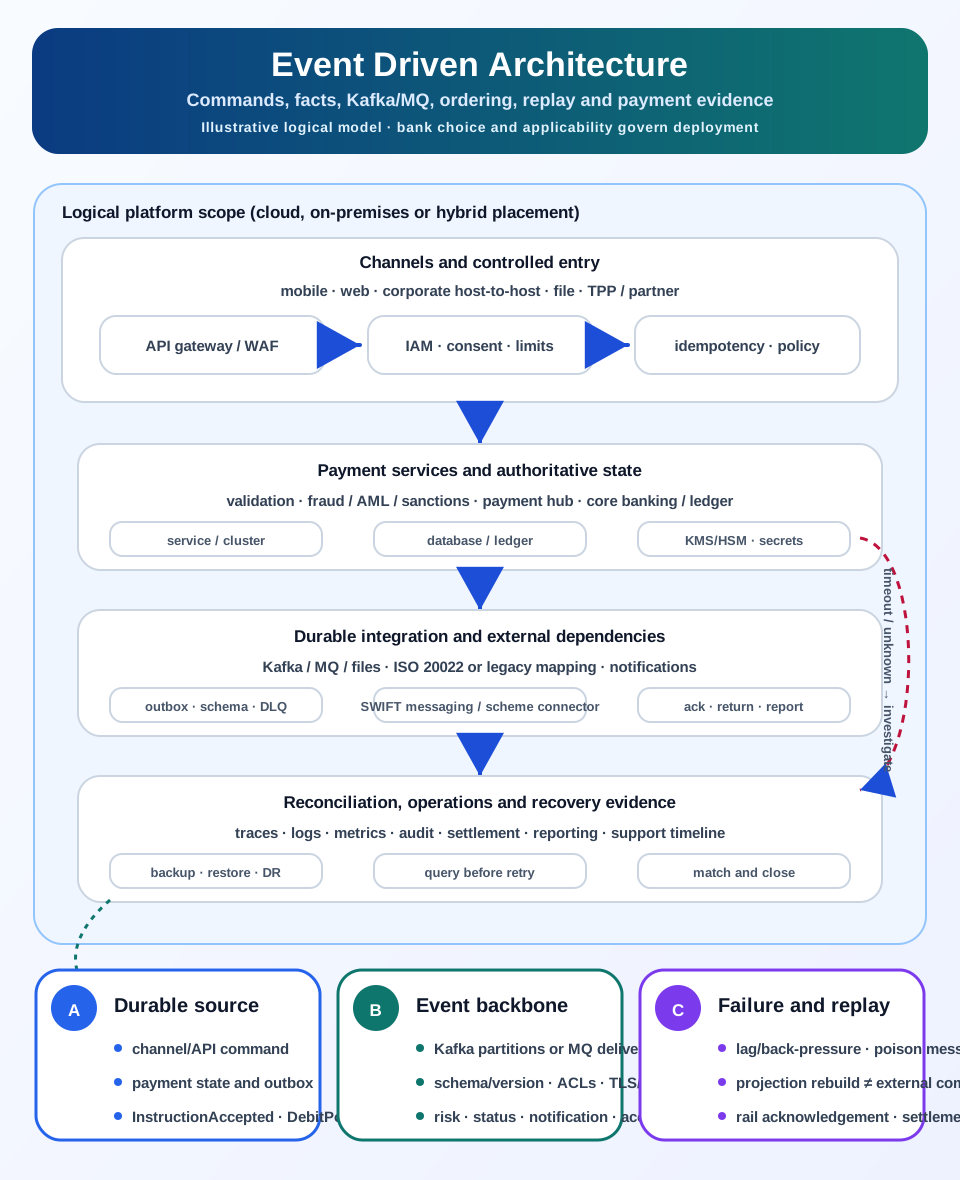
A practical event design starts with an authoritative payment state and then chooses the event backbone. Channels and APIs submit commands; the payment service or hub commits durable state; an outbox or equivalent publishes a business fact; Kafka, MQ or another selected broker delivers it; consumers update projections, risk cases, notifications, accounting, reconciliation and reporting. A file or SWIFT/rail acknowledgement can be an input event, but its scheme and message profile remain conditional.
| Contract field | Example decision | Why production cares |
|---|
| Message kind | Command, business fact or transport envelope | Prevents a replayed fact from becoming a new external side effect |
| Identity | Payment id, idempotency key, correlation/trace id, sequence/state version | Joins API, ledger, broker, rail and reconciliation evidence |
| Ordering | Partition or routing key such as payment id; MQ transaction/delivery semantics where selected | Protects state transitions without claiming global ordering |
| Schema | Compatibility policy, version, ISO 20022/legacy mapping-loss rule | Allows consumers to evolve without silent data loss |
| Recovery | DLQ owner, replay scope/rate/approval, projection rebuild versus command retry | Makes failure handling safe and auditable |
| Retention | Operational window versus legal/evidentiary record | Broker retention is not automatically the audit record |
Kafka partitions, MQ delivery semantics, CloudEvents and AsyncAPI solve different parts of the problem. None of them alone defines payment semantics, regulatory evidence, idempotency or external-money-movement guarantees (Kafka, CloudEvents, AsyncAPI).
Worked failure path: event accepted, action unknown
Suppose PaymentAccepted is committed, but the consumer calling a rail or notification provider times out. The consumer records its attempt and queries by deterministic reference before retrying. If the message is duplicated, the consumer returns the recorded outcome. If the schema is incompatible, the message goes to a controlled DLQ and the owning team protects the backlog. If the rail accepted the payment, the bank reconciles that acknowledgement and settlement evidence before any command replay. A projection rebuild may replay facts; it must not silently repeat a money-moving command.
Platform controls around the broker
The landing zone should define broker network boundaries, workload identity or ACLs, TLS/mTLS where selected, KMS/HSM and secret custody, topic/queue ownership, retention, cross-region replication, backup, lag/age SLOs, Kubernetes/serverless consumer limits, CI/CD schema gates, and FinOps for retention, egress and replicas. Sensitive account or beneficiary data should be minimised, classified and protected in topics, logs, test environments and support tools.
Related Cloud Library chapters
Use Microservices Architecture for service boundaries, System Integration Patterns for Kafka/MQ/file coexistence, and Observability and Resilience for lag, failure and reconciliation operations.
Official References Used
This application uses JavaScript for the full interactive experience. This text summary is served for accessibility and search indexing.