Payment observability and resilience: traces, logs, metrics, SLOs, unknown outcomes, incident response, backup, DR, failover and reconciliation evidence.
Part of the Cloud, APIs and Integration for Banking learning path.
This is block 8 of 8 in the Cloud, APIs and Integration roadmap.
A payment platform is not production-ready only because the code works in a happy-path test. It is production-ready when teams can see what is happening, understand why it is happening, contain failure before it spreads, recover without creating duplicate money movement, and prove the final outcome to operations, audit, support, product, risk, and the customer.
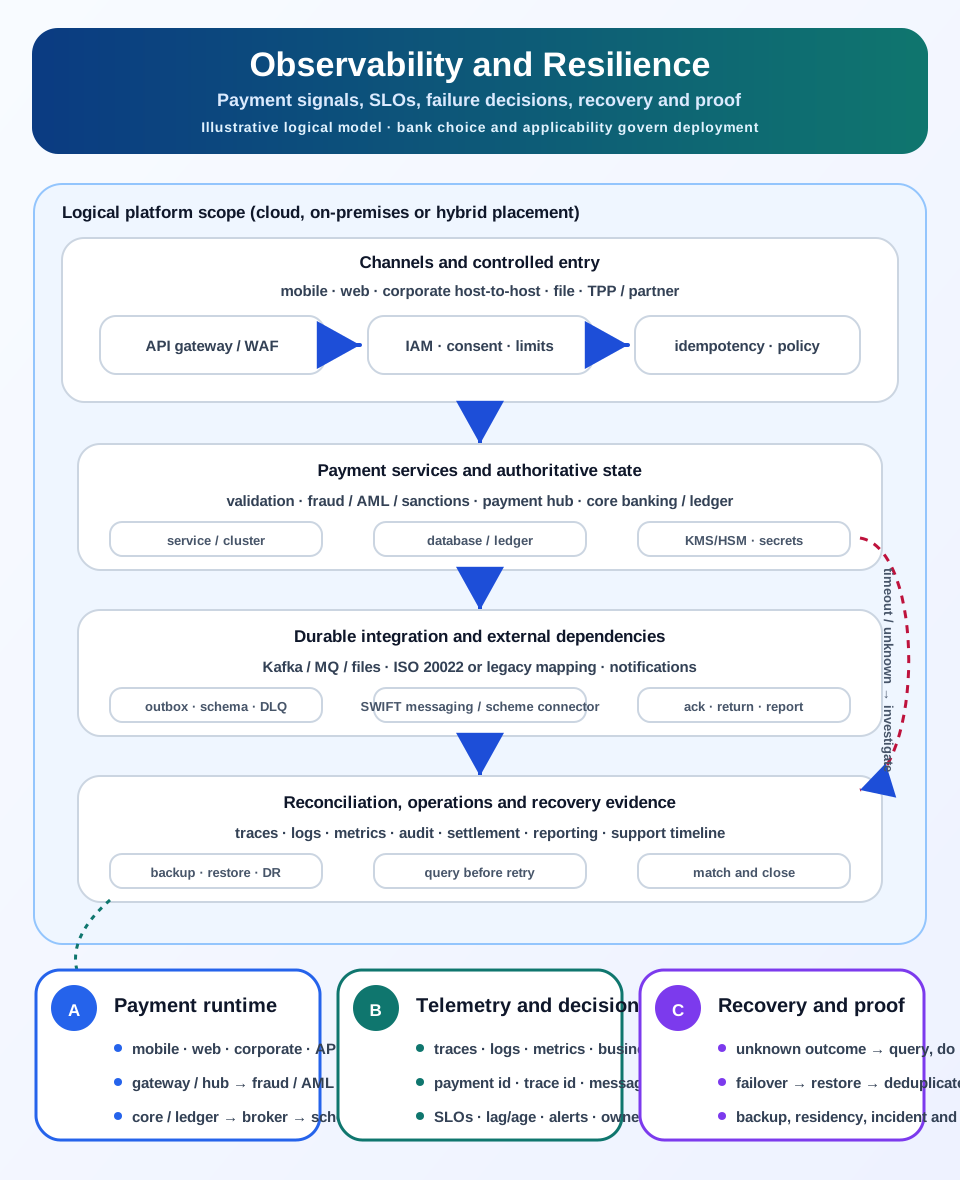
Scope and evidence (reviewed 5 October 2026). This is educational engineering guidance, not a universal banking-control prescription. Read each recommendation in the right category: generic cloud principle, technical standard or specialist guidance, jurisdictional/supervisory expectation, scheme/provider rule, or bank implementation choice. Applicability depends on the bank's jurisdiction, licence, criticality, data, service, contract and selected architecture; the cited sources are the authority for any dated or regulatory statement.
Observability and resilience are closely connected, but they are not the same thing. Observability gives the bank enough evidence to understand the behavior of a distributed payment system from the outside. Resilience gives the bank the ability to keep the service useful when something fails. A payment system needs both. A resilient system without observability may survive failure but leave teams blind. An observable system without resilience may explain failure beautifully while customers cannot pay.
In payments, this subject is more serious than generic uptime. A technical outage can stop customers from initiating payments. A partial outage can accept payments but fail to send them to a clearing rail. A monitoring gap can show all infrastructure as green while payment status events are stuck. A retry storm can duplicate pressure on a ledger or fraud engine. A bad replay can send duplicate notifications or recreate business actions. A failover can restore the API while reconciliation evidence remains broken. A dashboard can show CPU, memory, and response time, but still miss the fact that every payment is stuck in pending rail acknowledgement.
This chapter explains observability and resilience in payment-domain language. It is written for developers, business analysts, architects, testers, production support, SREs, cloud engineers, operations teams, incident managers, product owners, and risk teams. The goal is practical: understand which signals matter, how payment traces should be built, which dashboards are useful, how alerts should be designed, how resilience patterns behave, how incidents should be handled, and how recovery should protect payment correctness.
The Core Idea
The core idea is simple: every important payment action must leave enough safe evidence to explain the payment journey, and every important payment dependency must have a controlled failure answer.
A customer or corporate user submits a payment. The request may pass through a channel, API gateway, authentication service, entitlement service, validation service, limit service, fraud engine, sanctions engine, payment hub, routing component, ledger, event broker, notification service, clearing rail adapter, reporting service, reconciliation platform, and archive. Each component may succeed, fail, timeout, retry, queue, reject, or produce a delayed result.
If the payment fails, teams should not begin by guessing. They should be able to search by payment id, end-to-end reference, instruction id, correlation id, customer reference, file id, message id, UETR where relevant, channel reference, or internal transaction reference. They should see the timeline. They should see which system accepted the instruction, which checks passed, which dependency failed, whether money was posted, whether the rail accepted the message, whether status was published, whether notification was sent, and whether reconciliation matched.
That is observability in payment terms. It is not only logs, metrics, and traces. It is a joined production story.
Resilience is the second half. If fraud is slow, should the payment wait, route to review, reject, or fail closed? If a status event cannot be consumed, should the system retry, dead-letter, replay, or rebuild status from source records? If a ledger write times out, should the caller retry, query by idempotency key, or stop and investigate? If a region fails, which flows can fail over safely? If a batch job stops after processing half a file, how does it restart without duplicating accepted items?
Observability tells teams what happened. Resilience determines what happens next.
Why Generic Monitoring Is Not Enough
Traditional monitoring often starts with infrastructure: CPU, memory, disk, pod restarts, database connections, network errors, response times, and process health. These signals are useful. They are not sufficient for payment operations.
A payment service can have normal CPU while all payments are failing validation because a reference data cache is stale. An API can return HTTP 200 while the business status is only accepted for processing, not completed. A queue can have low depth while a downstream consumer is silently dropping invalid messages. A region can be healthy while the payment rail adapter is blocked by certificate expiry. A database can be available while a lock contention issue delays ledger posting. A channel can show normal login traffic while payment initiation drops sharply during a salary processing window.
Payment monitoring must therefore combine technical signals and business signals. It must answer whether the service is technically alive and whether the payment business function is behaving correctly.
For example, a payment initiation dashboard should not only show API latency. It should show received instructions, accepted instructions, rejected instructions, fraud holds, sanctions holds, duplicate detections, limit failures, ledger posting success, rail submission success, status publication lag, and customer-visible pending states.
A reconciliation dashboard should not only show job duration. It should show expected files, received files, matched items, unmatched items, amount differences, currency differences, missing confirmations, duplicate records, late records, and unresolved breaks by age.
A payment operations team does not care that a container is running if payments are not moving. A developer does not have enough information if they only know that something timed out. A product owner cannot communicate clearly if status is vague. Observability must connect infrastructure behavior to payment meaning.
Observability Versus Monitoring
Monitoring usually asks known questions. Is the service up? Is latency above threshold? Is the queue depth too high? Is the database available? Is the error rate increasing?
Observability lets teams ask new questions when the problem is not known in advance. Why are corporate bulk files slow only for one country? Why did instant payment rejections spike after a routing change? Why are status updates delayed only for one rail? Why did a payment show accepted in the channel but not appear in the reporting view? Why did reconciliation break after a certificate rotation? Why did retries increase without an obvious outage?
OpenTelemetry describes observability as understanding a system from the outside through telemetry such as traces, metrics, and logs. That definition is useful, but payment systems need one more layer: domain context. A trace without payment status is technical evidence. A trace with payment identifiers, state transitions, safe reason codes, rail references, and correlation ids becomes payment evidence.
A strong payment platform instruments both technical and business behavior. It does not wait for an incident before adding logs. It does not ask developers to deploy more instrumentation while a payment outage is active. It emits enough safe telemetry during normal operation so that unusual failures can be explained later.
The Production Payment Journey That Must Be Visible
A production payment journey is not a single request. It is a chain of decisions, records, side effects, confirmations, and controls.
A typical payment may begin with an initiation call from mobile banking, internet banking, corporate host-to-host, file upload, API partner, branch application, or internal operations screen. The channel authenticates the user or system. It checks entitlement. It captures or receives payment instructions. It sends the request to a payment API or hub.
The payment API validates syntax, mandatory fields, customer identity, debtor account, beneficiary details, value date, currency, amount, cut-off, duplicate indicators, limits, fees, charges, and regulatory fields. The payment then may pass through fraud screening, sanctions screening, account posting, routing, enrichment, transformation, message generation, rail submission, acknowledgement processing, status publication, notification, reporting, reconciliation, and archive.
Each step can produce a different result. A payment can be rejected before acceptance. It can be accepted but held for review. It can be posted but not submitted to the rail. It can be submitted but not acknowledged. It can be accepted by the rail and later returned. It can be repaired manually. It can be cancelled. It can be duplicated by a bad retry design. It can be technically successful but operationally unresolved because reconciliation is missing.
This is why observability should be designed around the payment lifecycle, not around isolated microservices. The platform must show the business state, the technical state, the owner of the next action, and the proof used to support that state.
The Main Signals
The classic signals are traces, metrics, and logs. In payment platforms, they should be joined with events, audit trails, status timelines, control totals, and reconciliation evidence.
A trace shows how one request or workflow moved across services. A payment initiation trace may begin at the API gateway and continue through authentication, entitlement, validation, limits, fraud, sanctions, payment hub, database, event broker, and notification. It should show timing and failure points.
A metric aggregates behavior over time. Examples include payment initiation rate, rejection rate, fraud hold rate, API latency, queue lag, dead-letter count, file processing duration, reconciliation match rate, ledger posting latency, and settlement confirmation delay.
A log records a specific event or message. Logs should be structured, safe, searchable, and correlated. A useful log says which payment, which service, which operation, which status, which error classification, which dependency, and which correlation id. It should not expose secrets, full account numbers, CVV, PIN data, private keys, or unnecessary raw payloads.
An event records a business fact. PaymentAccepted, DebitPosted, PaymentSentToRail, RailAccepted, PaymentReturned, and PaymentReconciled are more useful than generic PaymentUpdated events.
An audit trail records who or what changed something important. Payment routing rule changes, manual repairs, access approvals, deployment actions, secret rotations, key usage, and production support actions need audit evidence.
A status timeline joins the facts into one view. It is the support-readable story of the payment.
A control total proves file or batch consistency. For bulk files and settlement reports, counts and amounts are often as important as individual traces.
A reconciliation view proves whether financial records agree. Observability without reconciliation is incomplete for money movement.
Correlation Is The Backbone
Correlation is the backbone of payment observability. Without correlation, every team sees only its own fragment.
A channel may know the customer reference. The API gateway may know the HTTP request id. The payment hub may know an internal payment id. The ledger may know a posting reference. The event broker may know a message offset. The rail adapter may know a scheme reference. A cross-border payment may have UETR. A corporate file may have file id and item sequence. Reconciliation may use settlement reference. Support may begin with customer name, amount, date, and beneficiary.
A good observability design joins these identifiers deliberately. The platform should carry a correlation id across synchronous calls, asynchronous messages, events, logs, and callbacks. It should preserve business identifiers that are safe and useful. It should map external references to internal references. It should support search from multiple starting points because customers and operations rarely report incidents using the exact internal id preferred by developers.
Correlation must survive asynchronous boundaries. When a payment service publishes an event, the event should contain trace context or at least correlation and causation identifiers. When a queue consumer processes the event, it should continue the trace where possible or log the correlation id. When a batch process picks up file items, it should link file id, item id, payment id, and processing run id.
Correlation must also survive retries and replay. A retried message should not look like an unrelated new payment. A replayed event should be traceable to the replay action. A manual repair should be linked to the original payment and the support case.
The correlation model should be documented like an interface contract. It should define the canonical internal payment id, external instruction id, customer reference, scheme reference, file id, item id, message id, trace id, span id, causation id, and replay id. It should state which identifiers are mandatory at each boundary and which identifiers must not be exposed to customers or logs.
A weak platform treats these references as incidental fields. A strong platform treats them as production navigation.
Payment Trace Design
Distributed tracing is valuable because payment journeys cross many services. A trace should show the journey from a root operation to downstream operations. But payment trace design needs discipline.
Start with a root span that represents a meaningful business operation: InitiatePayment, ValidatePaymentFile, SubmitPaymentToRail, ProcessSettlementReport, GenerateStatement, ReconcilePayment, or HandlePaymentReturn. Avoid root names that are only technical, such as POST /submit, when the business operation is known.
Child spans should represent significant dependencies and decisions: authenticate customer, check entitlement, validate schema, check duplicate, apply limits, run fraud screening, run sanctions screening, reserve funds, post debit, select route, send to rail, publish event, send notification, write audit record, update status projection.
Span attributes should be safe. Include payment type, channel, scheme, rail, currency, country, status, reason category, environment, service version, and correlation id where allowed. Do not include full account numbers, secrets, raw payloads, private keys, sensitive authentication values, or unrestricted personal data.
For file processing, trace the file and item levels separately. A corporate file trace can show received, scanned, decrypted, validated, parsed, itemized, processed, completed, and archived. Each item may have its own payment trace. This avoids one giant trace that is impossible to read while still preserving linkage.
For batch, trace the processing run. Include run id, business date, selected records, processed records, failed records, total amount, currency totals, checkpoint, and restart status.
For events, use trace context where the platform supports it. When that is not possible, use correlation id and causation id consistently.
A payment trace is not a replacement for a ledger. It is evidence of flow, timing, and dependencies. The source of financial truth remains the appropriate system of record.
Trace Boundaries For Synchronous And Asynchronous Flows
Synchronous flows are easier to trace because the request thread moves through systems in sequence. A payment initiation API call can create one root trace, and downstream services can attach child spans. The trace can show where time was spent and where the request failed.
Asynchronous flows are harder. A payment service may publish an event, return to the caller, and let another worker continue the process later. A clearing rail may respond through a callback. A settlement file may arrive hours later. A reconciliation process may run overnight. These steps are not a single HTTP call, but they are still part of one payment journey.
The design answer is to use correlation and causation. Correlation says these records belong to the same payment or file. Causation says this event caused that next event. A PaymentAccepted event may cause a LedgerPostingRequested command. A LedgerPosted event may cause a RailSubmissionRequested command. A RailAccepted event may cause a CustomerStatusUpdated event. Tracing tools may represent these links differently, but the conceptual relationship must be preserved.
For developers, this means instrumentation cannot stop at controllers and outbound HTTP clients. Message producers, consumers, scheduled jobs, file processors, replay tools, database outbox publishers, and callback handlers must also participate.
Logs That Support Payment Operations
Logs are still essential, but unstructured logs are expensive during incidents. A useful payment log is structured and predictable.
A strong log includes timestamp, service name, environment, operation, severity, correlation id, payment id where safe, file id where relevant, message id, event type, status before, status after, dependency name, duration, error category, safe reason code, retry count, and outcome.
Avoid vague messages like failed processing request. During an incident, that line wastes time. A better log says payment rail submission failed, includes the rail adapter, safe failure category, correlation id, retry count, and whether the failure is retryable.
Avoid logging raw payloads by default. Payment payloads can contain account data, personal data, remittance information, beneficiary details, regulatory information, and sometimes sensitive operational data. Logs should mask or omit sensitive fields. Debug logging in production should be heavily controlled.
Logs should distinguish technical failure and business outcome. A sanctions rejection is not a system error. An invalid debtor account is a business validation failure. A database connection timeout is a technical failure. A duplicate idempotency key with matching payload is usually a safe repeat. A duplicate idempotency key with different payload is a conflict.
Production support needs logs that explain states. Developers need logs that explain code behavior. Auditors need logs that prove action. Security teams need logs that detect abuse. A good logging model supports all four without exposing unnecessary data.
Payment Log Taxonomy
A payment log taxonomy prevents every team from inventing its own language. The taxonomy should define categories such as validation, enrichment, authorization, duplicate check, fraud screening, sanctions screening, limit check, posting, routing, transformation, rail submission, rail acknowledgement, notification, reconciliation, manual repair, retry, replay, and archival.
Each log category should define expected fields. A validation log should identify validation rule category and safe reason code. A rail submission log should identify rail, message type, endpoint, submission reference, retry count, and response classification. A reconciliation log should identify source file, expected count, actual count, matched count, unmatched count, amount difference, and break category.
Severity should be consistent. A business rejection is usually not an error. It may be an info or business outcome record. A technical exception that prevents processing is an error. A suspicious access attempt may be a security warning or alert. A duplicate with matching idempotency key may be a normal repeat. A duplicate with mismatched payload may be a serious conflict.
Consistency matters during incidents. If one service logs sanctions rejects as errors and another logs them as info, dashboards become misleading. If one service uses timeout and another uses dependency unavailable for the same situation, alert grouping becomes weak. Standard vocabulary improves diagnosis.
Metrics That Matter In Payments
Metrics are the quickest way to see whether a payment capability is behaving normally. The wrong metrics create false confidence.
Basic technical metrics include request rate, error rate, latency, CPU, memory, database connection pool usage, queue depth, consumer lag, retry rate, dead-letter count, pod restart count, and dependency timeout count.
Payment metrics add meaning. Track payment initiation count, accepted count, rejected count, pending count, fraud hold count, sanctions hold count, duplicate detection count, limit failure count, debit posting success, rail submission success, rail acknowledgement delay, return count, recall count, cancellation count, reconciliation match rate, unmatched amount, unmatched count, notification success, and status publication lag.
Metrics should be sliced by dimensions that help diagnosis: channel, scheme, payment type, rail, currency, country, customer segment, endpoint, service, environment, and dependency. But high-cardinality dimensions must be controlled. Do not create metrics labeled by individual payment id or customer id; that can overload monitoring systems and create privacy issues.
Latency should be measured at meaningful boundaries. API latency is useful, but payment lifecycle latency is also needed. Measure time from submission to acceptance, acceptance to debit posting, debit posting to rail submission, rail submission to acknowledgement, acknowledgement to customer notification, and settlement to reconciliation.
Queue metrics need payment interpretation. A queue depth of ten thousand may be normal for batch processing but critical for instant payment status events. Consumer lag during a low-priority analytics stream is different from lag in a customer status projection stream.
Metric Cardinality And Cost Control
Metrics are powerful because they are cheap to aggregate, but they become expensive when labels explode. A label such as payment_id creates a new time series for every payment. That is usually wrong. It increases cost, slows queries, and may expose sensitive references.
Use dimensions that support operational grouping. Examples are payment product, rail, channel, country, currency, status category, dependency, deployment version, region, and environment. Avoid labels that represent individual customers, individual accounts, individual beneficiary names, raw references, and free text.
When individual investigation is needed, use logs and traces. Metrics should say where the pattern is. Logs and traces should explain the individual record.
This separation is important. A dashboard should show that payment status lag is high for one rail and one region. A trace should show the exact affected payment path. A log should show the exact dependency response or internal exception. A reconciliation record should prove final financial state.
SLIs, SLOs, And Error Budgets
A Service Level Indicator, or SLI, is a measurement of service behavior. A Service Level Objective, or SLO, is the target. In payment systems, SLIs and SLOs must represent customer and operational expectations, not only server health.
For a payment initiation API, a useful SLI may be the percentage of valid requests that receive a correct acceptance or rejection response within a defined time. For status enquiry, it may be the percentage of queries that return the latest known state within a defined latency. For instant payments, it may be the percentage of eligible payments that complete or receive a clear failure state within the scheme and bank target window. For file processing, it may be the percentage of files processed before cut-off with item-level status available.
Error budgets help teams manage reliability tradeoffs. If a service is within its error budget, teams may release improvements. If it burns budget too quickly, teams should slow risky change and focus on reliability. In payments, error budgets need business context. A small number of failures during a high-value settlement window may matter more than a larger number during a low-risk period.
SLOs should not encourage dishonest behavior. If a service marks payments as rejected quickly to satisfy latency, the SLO is wrong. If a service hides unknown states as success, the SLO is dangerous. Payment SLOs should reward correct, honest status and safe processing.
SLO Examples For Payment Capabilities
For retail payment initiation, an SLO can measure valid payment requests that receive a clear response within a defined threshold. The response may be accepted, rejected, or held, but it must be accurate and traceable.
For corporate file upload, an SLO can measure files that pass initial validation and receive item-level status before cut-off. The SLO should not only measure whether the upload endpoint accepted the file. A corporate customer needs to know whether the items were accepted, rejected, or pending action.
For status enquiry, an SLO can measure whether users see the latest known state within a defined delay. This prevents a system from looking available while showing stale payment status.
For rail acknowledgement, an SLO can measure time from internal rail submission to external acknowledgement or controlled unknown state. A timeout should not be treated as success or final failure unless the rail contract says so.
For reconciliation, an SLO can measure completion of matching and exception publication by business date and cut-off. A payment system that processes transactions but cannot reconcile them is not fully reliable.
For incident detection, an SLO can measure time from business-impacting anomaly to alert creation. This is different from time to resolve. Detection quality matters because late detection increases customer impact.
Dashboards For Different Audiences
One dashboard cannot serve everyone.
A developer dashboard should show service health, traces, dependency latency, error categories, deployment version, recent changes, resource usage, queue behavior, and exceptions.
A production support dashboard should show payment counts by status, failed files, stuck payments, pending states by age, rail delays, customer-visible impact, retry backlog, dead-letter queues, and recent incidents.
An operations dashboard should show cut-off readiness, batch progress, settlement file arrival, reconciliation status, liquidity-relevant delays, exception queues, and unresolved breaks.
A product or business dashboard should show customer impact, success rate, status delay, channel impact, payment type impact, and recovery status.
A security dashboard should show unusual access, secret usage anomalies, certificate expiry, suspicious outbound calls, logging gaps, and incident signals.
Dashboards should answer the next action. A dashboard that only shows red and green boxes is weak. It should tell which service is impacted, which payment flow is impacted, since when, how many payments are affected, whether money moved, what the customer sees, and which team owns the next step.
Dashboard Design For Mobile Reading
For this learning hub, mobile display matters. Large technical tables may look good on desktop and fail on phone screens. Payment observability content should therefore prefer short sections, clear labels, compact bullets, and diagrams that can zoom without pixelation.
Production dashboards inside banks have the same problem in a different form. Large dashboards with too many widgets become unusable during incidents. A clear incident dashboard should prioritize impact, affected flow, affected rail, current backlog, stuck status, owner, next action, and runbook.
A useful mobile-friendly dashboard pattern is: one headline status, one impact count, one time range, one owner, then drill-down sections. For example: Instant payments delayed, 2,413 payments pending acknowledgement, Started 09:12, Rail adapter team owning, Runbook IP-RAIL-ACK-01. That is more useful than twenty small charts.
Alerting Without Noise
Alerting should protect customers and operations, not exhaust teams.
An alert should be actionable. If nobody knows what to do when it fires, it is not a good alert. If it fires every day and nobody acts, it trains teams to ignore it. If it fires after customers already complain, it is late.
Payment alerts should combine technical and business signals. Alert when payment initiation drops unexpectedly. Alert when valid payments are accepted but not sent to the rail. Alert when status event lag exceeds a threshold. Alert when dead-letter queues contain payment lifecycle events. Alert when settlement files are late. Alert when reconciliation breaks exceed tolerance. Alert when instant payment completion time breaches target. Alert when certificate expiry is near for critical payment connectivity.
Static thresholds are not always enough. A fixed error threshold may miss abnormal drops in traffic. A fraud screening call volume of zero may be normal at night for one rail but critical during business hours for another. Baselines, calendars, cut-off windows, salary days, and scheme operating hours matter.
Severity should be based on impact. A minor logging warning may not need a page. A status backlog affecting customer-visible states during business hours may need immediate action. A reconciliation break may be urgent even if APIs are healthy. A suspected duplicate posting risk should be treated as critical.
Every alert should include a runbook link, owner, dashboard link, likely impact, and first diagnostic steps.
Alert Design For Payment Consequences
A payment alert should describe consequence, not only symptom. Queue lag high is a weak alert. Customer status updates delayed for instant payments is stronger. Rail acknowledgement callback failures affecting outward domestic payments is stronger still.
The alert should include a safe identifier for the affected product or rail, a start time, count of affected records where available, current severity, owner group, and suggested first checks. The alert should state whether the issue is customer-visible, financially risky, compliance-sensitive, or operationally contained.
Alerts should also handle silence. If a rail normally sends acknowledgement files every hour and none arrive, absence is a signal. If payment initiation traffic drops during business hours, absence is a signal. If a fraud screening dependency receives zero calls while payment volume is normal, absence is a signal.
Noise reduction is not about hiding problems. It is about grouping and prioritizing them. A single root failure should not page ten teams separately if one incident can coordinate response. At the same time, a low-volume but high-value settlement issue should not be buried under generic infrastructure warnings.
Resilience Patterns
Resilience is designed before the incident. The main patterns are timeouts, retries, backoff, circuit breakers, bulkheads, rate limits, load shedding, queues, dead-letter queues, idempotency, failover, graceful degradation, backup, restore, replay, and reconciliation.
Timeouts prevent one slow dependency from blocking the entire journey. But timeout values must match payment meaning. A customer-facing API may need a short timeout. A rail acknowledgement may arrive later. A batch file process may legitimately run longer. A timeout does not prove business failure; it proves the caller stopped waiting.
Retries help with temporary failures. But retries can be dangerous in payments. Retrying a ledger posting without idempotency can duplicate money movement. Retrying a notification may send multiple messages. Retrying a rail submission may create duplicate external instructions if the first attempt actually succeeded but the response was lost. Use idempotency keys, request fingerprints, deterministic references, and status checks.
Backoff prevents retry storms. If many services retry aggressively during a dependency outage, they can make recovery harder. Use exponential backoff with jitter where appropriate.
Circuit breakers protect the platform from repeated calls to a failing dependency. But opening a circuit has payment consequences. If the fraud service circuit opens, do payments fail closed, queue, route to manual review, or process under degraded controls? The answer must be a business and risk decision.
Bulkheads isolate failures. A slow reporting process should not exhaust resources needed for payment initiation. A non-critical notification backlog should not consume capacity required for ledger posting. Separate pools, queues, and limits help protect critical paths.
Load shedding rejects or delays lower-priority work when the system is under pressure. Payment platforms must define priority carefully. Instant payment execution may be higher priority than analytics export. Customer status enquiry during an incident may be high priority because it reduces support pressure.
Graceful degradation means the service continues in a limited but honest mode. A channel may allow status enquiry but pause new payment initiation. A reporting view may show delayed data with a timestamp. A notification service may queue messages for later while payment processing continues.
Idempotency As A Resilience Control
Idempotency is one of the most important resilience controls in payments. It means the same request or message can be processed more than once without creating an additional business effect.
Payment initiation APIs should use idempotency keys tied to business intent. A retry with the same key and same payload should return the original result. A retry with the same key and different payload should be rejected as a conflict.
Ledger posting should use deterministic posting references. If the posting request times out, the service should query by reference before attempting another posting.
Event consumers should deduplicate message ids or business keys. File processors should detect duplicate files and duplicate items. Webhook receivers should deduplicate event ids. Replay tools should distinguish rebuilding projections from repeating external side effects.
Without idempotency, resilience patterns become dangerous. Retry, replay, failover, and recovery can create duplicates. With idempotency, teams can recover more confidently.
Idempotency should not be treated as a controller filter only. It belongs in the business operation. The platform should store the idempotency key, request fingerprint, response state, processing state, final business reference, and conflict behavior. It should define expiry carefully. Some idempotency records must live long enough to cover customer retries, channel retries, partner retries, and delayed callbacks.
A common mistake is to make idempotency work for the first API call but not for downstream side effects. The API may avoid duplicate acceptance, but the message consumer may still duplicate ledger posting or rail submission. True payment idempotency follows the business operation end to end.
High Availability
High availability means the service can continue when components fail. It often uses redundancy, health checks, load balancing, horizontal scaling, multi-zone deployment, replicated databases, and automated restart.
For payments, high availability must protect the whole flow, not only the web tier. A payment API running in three zones is not enough if the database is single-zone, the message broker is unavailable, the fraud dependency has no fallback, or the rail adapter cannot fail over.
Health checks must be meaningful. A basic 200 OK from a service does not prove payment readiness. A readiness check may need to verify database connectivity, required configuration, broker connectivity, key access, and critical dependency status. But checks must not be too heavy or they become a source of load.
Auto-scaling helps with volume, but it does not solve every bottleneck. Scaling API pods will not fix database lock contention, downstream rate limits, or rail adapter capacity. Scaling consumers can process queues faster, but only if downstream systems can handle the load.
Database high availability is especially important. Payment data must not be lost. Replication, failover, consistency, and recovery behavior need testing. Some databases provide strong consistency. Others require careful design for eventual consistency. Payment systems must know which model they are using.
Active-Active And Active-Passive Reality
Active-passive designs keep a standby environment ready. They can be simpler to reason about, but failover may take longer. The standby must be tested. Data replication must be measured. Secrets, certificates, routes, DNS, gateway configuration, firewall rules, queues, object storage, and monitoring must be available in the standby region.
Active-active designs process traffic in more than one region at the same time. They can reduce downtime but are harder for payments. If two regions accept the same payment or update the same record independently, duplicates or inconsistent states can occur. Active-active payment platforms need strong ownership, deterministic routing, idempotency, conflict resolution, and reconciliation.
The right design depends on payment product, regulatory expectations, volume, latency, data residency, rail connectivity, and operational maturity. The important point is not the label. The important point is whether the bank can explain exactly how a payment is owned, processed, recovered, and proven during regional failure.
Disaster Recovery
Disaster recovery prepares for major failure: region outage, cloud service failure, data corruption, cyberattack, severe network issue, or operational mistake.
Recovery Time Objective, or RTO, is the target time to restore service. Recovery Point Objective, or RPO, is the acceptable data loss window. In payments, RPO is often extremely sensitive. Losing accepted payment instructions may be unacceptable. Losing audit logs may be unacceptable. Losing status projections may be recoverable if they can be rebuilt from source events.
Disaster recovery design should classify data. Some data is system of record and needs strong protection. Some data is projection and can be rebuilt. Some data is telemetry and needs retention for investigation. Some data is temporary and can be discarded. Treating all data the same makes recovery slower and more expensive.
Failover must be tested. A theoretical multi-region design is not enough. Teams need to know how DNS changes, traffic routing, database promotion, event replication, idempotency stores, object storage, secrets, certificates, and monitoring behave during failover.
A payment failover should not create split-brain processing. Two regions should not both believe they own the same payment execution unless the architecture is explicitly designed for active-active correctness. Active-active payment processing is possible, but it requires strong design around data consistency, routing ownership, idempotency, and reconciliation.
Recovery Is Not Only Uptime
A payment service can be technically restored while business recovery is still incomplete.
If the API is back but thousands of payments are stuck in pending status, recovery is not complete. If status views are rebuilt but reconciliation is broken, recovery is not complete. If customers can initiate new payments but old accepted payments are unknown, recovery is not complete. If operations cannot prove whether money moved, recovery is not complete.
Payment recovery should include service recovery, data recovery, status recovery, reconciliation recovery, customer communication, and audit evidence.
After an incident, teams should classify affected payments. Which payments were accepted? Which were rejected? Which were posted? Which were sent to rail? Which received rail acknowledgement? Which were duplicated? Which require manual repair? Which customers need communication? Which reports must be corrected?
This is why observability and resilience are inseparable.
Incident Management
Incident management is the structured response to an operational problem.
Detection may come from alerts, dashboards, customer support, partner reports, scheme notifications, reconciliation breaks, fraud teams, security monitoring, or developers. The detection source matters, but the incident process should converge quickly.
Triage should identify severity, affected services, affected payment types, customer impact, financial risk, regulatory risk, operational impact, start time, current state, and owner. A payment incident should not be triaged only by CPU or error rate. The first question is: what is the payment consequence?
Containment prevents spread. This may mean pausing a route, stopping a batch, disabling a risky retry, draining a queue, opening a circuit breaker, switching to a fallback, blocking a bad deployment, or stopping new payment acceptance while preserving existing records.
Communication should be clear and factual. Internal teams need known impact, unknowns, next update time, owner, and current action. Customer-facing communication should avoid overpromising. If the status is unknown, say it is being checked rather than claiming completion.
Resolution should restore the service and verify payment outcomes. Verification should include technical health, business metrics, affected payment review, reconciliation, and support readiness.
Post-incident review should identify what happened, why detection behaved as it did, why the system responded as it did, what made recovery slower, which controls worked, which controls failed, and which improvements are required.
Payment Incident Severity
Payment severity should be based on impact, not only technical error rate. A low error rate can still be critical if the affected flow is high value, regulatory, settlement-sensitive, or duplicate-risk. A high error rate can sometimes be moderate if the system is rejecting invalid requests correctly.
Severity should consider whether customers can initiate payments, whether accepted payments are moving, whether money has posted, whether rail submission is confirmed, whether statuses are trustworthy, whether reconciliation is possible, whether there is duplicate risk, whether cut-off is at risk, and whether regulatory reporting or customer communication is impacted.
A strong severity model separates availability, correctness, timeliness, financial risk, compliance risk, and communication risk. This prevents a team from treating a payment incident as solved because the API is back while payment outcomes remain unclear.
Blameless Does Not Mean Toothless
A blameless post-incident review does not mean soft conclusions. It means the review focuses on system behavior, decisions, controls, gaps, and improvements rather than personal blame.
For payment systems, reviews must be honest. If a retry design could duplicate payments, say so. If a dashboard hid business impact, say so. If a deployment had insufficient rollback, say so. If support lacked access to payment timelines, say so. If ownership was unclear, say so.
A strong review produces action items with owners and deadlines. Examples: add idempotency to rail submission, add status lag alert, add reconciliation dashboard, test certificate expiry, update failover runbook, reduce alert noise, add trace context propagation, change deployment approval for routing rules, add dead-letter replay procedure.
Learning is only real when it changes the system.
Testing Resilience
Resilience should be tested before real failure.
Test dependency timeouts. What happens if fraud is slow? What happens if sanctions is down? What happens if KMS throttles? What happens if the database is read-only? What happens if the broker is unavailable?
Test retry behavior. Does the system duplicate requests? Does it back off? Does it respect idempotency? Does it stop after a controlled limit? Does it create dead-letter records with enough evidence?
Test failover. Can the service move to another zone or region? Are secrets and certificates available? Does the database fail over correctly? Are event consumers safe? Does monitoring continue after failover?
Test replay. Can status projections be rebuilt safely? Can failed events be replayed without repeating external side effects? Can file items be reprocessed without duplicate posting?
Test recovery from bad deployment. Can the team roll back? Are database migrations reversible or forward-fixable? Is configuration versioned? Can routing changes be reverted?
Chaos engineering can help, but in payment environments it must be controlled. Experiments need scope, approvals, safety limits, rollback, monitoring, and business awareness. Randomly breaking production payment flows without guardrails is not maturity. Carefully testing known failure modes is maturity.
Test Cases Developers Should Actually Write
Test idempotency conflict handling. Send the same idempotency key with the same payload and confirm the original result is returned. Send the same key with a different payload and confirm the system rejects the request safely.
Test dependency timeout classification. Simulate fraud timeout, ledger timeout, rail timeout, and notification timeout separately. Confirm each one maps to the right payment state and alert category.
Test event consumer deduplication. Deliver the same event twice. Confirm downstream status projection does not duplicate business state and external side effects are not repeated.
Test outbox publication. Commit the payment record and event outbox entry in the same transaction where appropriate. Confirm the publisher can recover after restart without losing events or publishing duplicates without detection.
Test dead-letter handling. Send a message that fails schema validation, one that fails business validation, and one that fails due to temporary dependency outage. Confirm each is classified differently and has enough evidence for replay or repair.
Test reconciliation after partial failure. Process payments through posting and rail submission, then simulate missing acknowledgement or missing settlement file. Confirm operations can identify unmatched records and their ageing.
Batch And File Observability
Batch and file processing need special observability because one technical job may represent thousands or millions of payment items.
A file dashboard should show expected files, received files, missing files, sender, file type, business date, hash, control total, item count, accepted count, rejected count, pending count, duplicate count, total amount, currency totals, processing stage, and archive status.
A batch dashboard should show run id, schedule, business calendar, selected records, processed records, failed records, skipped records, checkpoint, restart count, duration, and output totals.
Item-level visibility is critical. A file can be processed while some items fail. A batch can complete while exceptions remain. Operations need both file-level and item-level status.
Restartability must be observable. If a batch restarts, teams should know from which checkpoint, which items were already completed, which were retried, and which were skipped due to idempotency.
Control totals are observability signals. Counts and amounts catch issues that traces may miss.
Event And Queue Observability
Event-driven payment platforms need visibility into topics, queues, consumers, offsets, lag, dead letters, schema failures, and replay activity.
Track consumer lag by topic and consumer group. But interpret lag by business priority. Lag in a customer status topic can be urgent. Lag in analytics export may be less urgent.
Track dead-letter queues. A dead-letter queue is not an archive. It is unresolved work. Each dead-letter message should have owner, reason, age, impact, and replay decision.
Track schema failures. If a producer changes an event schema and consumers fail, the incident may appear as consumer errors. Schema registry and contract testing reduce this risk.
Track replay. Replays should be deliberate, logged, authorized, and linked to incident or repair work. A replay should not silently create duplicate side effects.
Track event publication from source systems. If a payment is posted but the event is not published, downstream status and reporting can break. Outbox patterns and publication monitoring help.
Outbox, Inbox, And Replay Controls
The outbox pattern is common in reliable event-driven systems. The service writes the business change and the event record in a controlled way, often in the same database transaction. A publisher then sends the event to the broker. If the publisher fails, it can resume from the outbox. This reduces the risk that a payment is accepted but no event is published.
The inbox pattern helps consumers deduplicate messages. A consumer records the message id or business key before applying side effects. If the same message arrives again, the consumer can identify it and avoid duplicate processing.
Replay controls matter because replay is powerful and dangerous. Replaying events to rebuild a read model is different from replaying commands that send money to an external rail. Replay tools should require authorization, scope, dry-run where possible, audit logging, rate limits, and a clear mode that separates projection rebuild from external side effect.
A production replay should answer: who initiated it, why, which records are included, which side effects are disabled, what result was expected, what actually happened, and how it was verified.
Reconciliation As Observability
Reconciliation is a form of observability for money movement. It proves whether different records agree.
Technical telemetry may show that a payment was sent to the rail. Reconciliation shows whether expected settlement, ledger, statement, and external confirmations match. A payment platform is not fully observable if it cannot compare its internal truth with external truth.
Reconciliation observability should show matched items, unmatched items, aged breaks, amount differences, currency differences, duplicate records, missing files, late files, and repair status.
During an incident, reconciliation helps answer the most important question: did money move correctly? If the answer is unknown, customer communication and operational action must be cautious.
Security And Observability
Observability must be secure. Telemetry can leak sensitive data if poorly designed.
Logs, traces, metrics, dashboards, and exported reports may contain account numbers, names, remittance text, tokens, headers, secrets, internal endpoints, customer identifiers, and operational details. Masking, minimization, access control, retention, and audit are required.
Support users may need payment timeline visibility but not raw payloads. Developers may need stack traces but not customer personal data. Security teams may need access patterns but not all payment details. Observability permissions should be role-based.
Telemetry pipelines are production systems. If attackers can disable logs, change dashboards, delete traces, or hide alerts, incident response weakens. Protect observability infrastructure with the same seriousness as payment infrastructure.
Privacy And Retention In Payment Telemetry
Payment telemetry should follow data minimization. Do not send full account numbers, credentials, secrets, raw tokens, private keys, full remittance text, full customer names, or unnecessary personal data to general observability tools.
Masking should happen as early as practical. It is safer to prevent sensitive data from entering telemetry than to rely only on downstream filters. Where raw payload access is needed for a controlled support or compliance process, keep it separate, audited, role-based, and time-limited.
Retention should match purpose. High-cardinality trace detail may be kept for a shorter period. Audit evidence, incident evidence, and reconciliation evidence may need longer retention depending on policy and regulation. The chapter does not define legal retention periods because those vary by country and bank. The technical principle is that retention must be intentional and defensible.
SDLC For Observability And Resilience
Observability and resilience should be designed during requirements, not added after incidents.
During requirements, define business-critical flows, customer-visible states, operational states, support search keys, success criteria, failure criteria, SLA or SLO expectations, recovery expectations, audit needs, and reconciliation needs.
During design, define trace boundaries, log structure, metric names, event names, dashboards, alerts, runbooks, retry rules, timeout rules, idempotency model, failover behavior, data recovery, and replay controls.
During build, implement instrumentation, safe logging, correlation propagation, metrics, health checks, idempotency, retry policies, circuit breakers, dead-letter handling, and operational events.
During testing, verify traces, logs, metrics, dashboards, alerts, timeout behavior, retry behavior, duplicate prevention, queue backlog behavior, failover, replay, reconciliation, and runbook accuracy.
During release, verify dashboards, alerts, runbooks, ownership, support access, rollback, change evidence, and known failure behavior.
After release, review telemetry quality. If teams cannot diagnose issues from existing signals, improve instrumentation before the next incident.
Requirements Checklist For Business Analysts
A business analyst can improve observability and resilience by asking payment questions clearly.
For every payment state, ask who can see it, what it means, which system owns it, and how it changes. Pending is not enough. Pending validation, pending fraud, pending sanctions, pending ledger posting, pending rail acknowledgement, pending settlement, and pending repair are different.
For every failure, ask what the customer sees, what operations sees, what support can explain, what can be retried, what must not be retried, and what evidence proves the result.
For every file or batch, ask for control totals, item-level status, restart behavior, exception handling, reconciliation, and reporting.
For every dependency, ask what happens when it is slow, unavailable, inconsistent, or returns an unknown result.
For every incident, ask how affected payments are identified, how customer impact is counted, how communication is managed, and how recovery is proven.
These questions turn observability from a developer-only topic into a payment operating model.
Developer Guidance
Developers should instrument code as part of normal delivery.
Carry correlation ids across APIs, events, queues, files, and callbacks. Use structured logs. Emit metrics for technical and business outcomes. Create meaningful spans. Avoid sensitive data in telemetry. Distinguish business rejection from technical failure. Use idempotency. Design retry and timeout behavior deliberately. Include dependency names and safe error categories. Make dashboards and alerts part of the acceptance criteria.
Do not wait for production support to request logs after release. If a payment can fail, the failure should be observable. If a dependency can timeout, the timeout should be measured. If a queue can backlog, lag should be visible. If a replay exists, it should be audited.
Good instrumentation is not noise. It is operational evidence.
Developer Implementation Pattern
In an API service, create or receive the correlation id at the edge. Validate it. Put it into request context. Add it to logs. Add it to trace attributes. Pass it to downstream services. Include it in events. Never generate a fresh unrelated id halfway through the journey unless the original id is still preserved.
In a payment command handler, log the start and end of meaningful business operations. Emit metrics for accepted, rejected, held, failed, and unknown outcomes. Do not log raw payload. Do log safe reason categories. Make dependency calls with explicit timeouts. Classify exceptions. Use idempotency before side effects.
In an event consumer, record message id, event type, event version, source, correlation id, causation id, processing attempt, and outcome. Deduplicate before side effects. Use dead-letter queues with reason and owner. Do not dead-letter silently.
In a batch job, write run records. Record checkpoint, input selection, processed count, failed count, skipped count, output count, and control totals. Make restart behavior visible.
In a replay tool, separate read-model rebuild from side-effect replay. Require authorization and audit. Show preview counts before execution. Record exactly what was replayed.
Production Support Guidance
Production support needs tools that show payment meaning.
Support should be able to search by business references, not only internal ids. They should see timeline, status, dependency failures, retries, notifications, file processing, batch status, and reconciliation. They should see whether the issue is technical failure, business rejection, external rail delay, customer input issue, or unknown state.
Support runbooks should explain first checks, severity classification, escalation path, customer impact assessment, safe recovery actions, and what not to do. For example, do not blindly replay messages that may trigger external side effects. Do not manually mark payments complete without reconciliation evidence. Do not clear dead-letter queues without owner approval.
Support visibility should be safe. Mask sensitive fields. Log support actions. Use role-based access. Preserve evidence.
Architect Guidance
Architecture should define the operational model, not only component diagrams. A payment architecture should state where truth lives, where state transitions are recorded, how events are published, how projections are rebuilt, how idempotency is enforced, how messages are retried, how dead letters are handled, how failover works, and how reconciliation proves correctness.
Architects should identify critical paths and non-critical paths. Payment initiation, posting, rail submission, and status update may have different criticality than analytics export or marketing notification. Resource isolation, queue priority, and throttling should reflect that.
Architects should avoid designs where every service retries independently without shared policy. They should avoid hidden side effects in replay. They should avoid business states that cannot be explained from system records. They should avoid dashboards that show infrastructure without payment consequence.
Good architecture gives production teams a map before the incident.
QA And Testing Guidance
Testers should treat observability as testable behavior. A feature is not complete only because the payment succeeds. It is complete when success, rejection, timeout, retry, duplicate, callback, manual repair, and reconciliation paths are visible.
Test cases should verify that logs do not leak sensitive data. They should verify that traces contain safe identifiers. They should verify that metrics increment correctly for business outcomes. They should verify that dashboards change when test incidents are simulated. They should verify that alerts fire for the right reason and include useful runbook information.
For resilience, testers should simulate dependency failures and partial failures. Partial failures are more important than clean failures. A clean failure is easy to see. A partial failure, such as accepted payment with missing status update, is where banks often struggle.
Release Readiness For Observability
Before release, the team should demonstrate the operational story. Pick a sample payment and show the trace. Search logs by correlation id. Show status timeline. Show metric movement. Show dashboard view. Show alert behavior for a simulated failure. Show runbook. Show how support would answer the customer. Show how reconciliation would prove the result.
If the team cannot demonstrate this, the feature is not fully ready. It may function in test, but it is not yet operable.
Release readiness should include rollback and forward-fix strategy. Some payment changes cannot simply be rolled back if they changed data contracts, event formats, routing decisions, or ledger behavior. Observability should help identify which records were processed by which version.
Operational Scenarios
Scenario one: the rail adapter times out after submitting a payment. The caller does not know whether the rail received the instruction. The correct behavior is not blind retry. The system should record an unknown or pending acknowledgement state, query status where possible, use deterministic rail reference, avoid duplicate submission, alert operations if ageing exceeds threshold, and reconcile when external confirmation arrives.
Scenario two: a status event consumer is down. Payment processing continues, but customers see stale status. Infrastructure may look mostly healthy. A strong platform detects status lag, shows affected payment count, alerts the owning team, and lets support explain that processing may have continued but status display is delayed.
Scenario three: a corporate file processes halfway and the job crashes. Restart should continue from checkpoint, skip already completed items using idempotency, preserve file-level control totals, show item-level exceptions, and avoid duplicate postings.
Scenario four: reconciliation file is late. APIs may be healthy, but financial proof is incomplete. Observability should show expected file schedule, missing file alert, affected rail or account, pending match count, and operational owner.
Scenario five: a bad deployment changes validation rules. Rejections spike for one payment type. Observability should show deployment version, rejection category, affected channel, affected product, start time, and rollback or configuration revert path.
Scenario six: a region fails. The system should fail over according to tested design, preserve accepted instructions, prevent split-brain ownership, keep idempotency records available, recover status projections, and prove final outcomes through reconciliation.
What Good Looks Like
A strong payment observability and resilience design has correlated traces, structured logs, useful metrics, business-status dashboards, actionable alerts, owned runbooks, tested failover, safe replay, idempotent retries, dead-letter ownership, reconciliation visibility, and post-incident learning.
It can answer practical questions quickly:
- Did the customer submit the payment?
- Did the bank accept it?
- Was it posted?
- Was it sent to the rail?
- Did the rail acknowledge it?
- Was the customer status updated?
- Was notification sent?
- Did settlement and reconciliation match?
- Which system owns the next action?
- What should support tell the customer?
The best observability does not produce more screens. It produces faster understanding. The best resilience does not hide failure. It keeps payment behavior controlled, honest, and recoverable.
Release Readiness Checklist
Use this before releasing a payment service or integration.
- Every critical request has a correlation id.
- Correlation continues across APIs, events, queues, files, and callbacks.
- Logs are structured and safe.
- Traces show meaningful payment operations.
- Metrics include technical and business signals.
- Dashboards show customer and operations impact.
- Alerts are actionable and linked to runbooks.
- Payment statuses are precise, not vague.
- Retry behavior is idempotent.
- Timeout behavior is defined.
- Circuit breaker behavior has business approval where payment risk is involved.
- Queue lag and dead-letter queues are monitored.
- File and batch control totals are visible.
- Reconciliation breaks are visible and aged.
- Failover has been tested.
- Backup and restore have been tested.
- Replay is controlled and audited.
- Support can search using practical payment references.
- Security and privacy controls protect telemetry.
- Post-incident review produces tracked improvements.
Final Learning Summary
Observability and resilience are core operating controls for a payment platform. They are part of the payment product. Customers do not experience microservices, brokers, traces, and databases separately. They experience whether their money movement is accepted, clear, traceable, recoverable, and explainable.
A bank should be able to say what happened to a payment without guesswork. It should be able to contain a fault without creating duplicate money movement. It should be able to recover without hiding uncertainty. It should be able to prove outcomes through status, audit, and reconciliation.
For developers, the lesson is practical: instrument the business operation, not only the code path. For architects, design failure behavior before failure happens. For business analysts, define states and evidence clearly. For testers, test partial failure and recovery, not only success. For production support, use evidence and runbooks, not manual heroics. For leaders, measure reliability by customer and payment consequence, not by green infrastructure boxes alone.
The best payment platform is not the one that never fails. Every real system can fail. The best platform is the one that fails in controlled ways, detects the issue early, protects correctness, guides teams to the next action, and proves the final state clearly.
Cloud control-plane and recovery evidence
A green application dashboard does not prove that a payment completed. Observability must join runtime signals to payment state, while resilience must define what the bank does when a dependency fails. The selected cloud design should expose zone/region, provider control-plane, network, KMS/HSM, certificate, broker, database, storage, core/ledger, rail/SWIFT and reconciliation dependencies to the operating model.
| Failure or decision | Customer-visible state | Evidence before action | Owner |
|---|
| API/client timeout before acceptance | Not accepted or retryable | Request and idempotency lookup | API/service team |
| Ledger/hub timeout after possible acceptance | Unknown/pending investigation | Hub, ledger, event and status query; no blind external retry | Payment operations |
| Fraud/AML/sanctions dependency timeout | Hold, reject, manual review or selected degraded state | Risk policy, decision provenance and approval | Risk/product owner |
| Kafka/MQ lag, poison message or schema failure | Status freshness degraded | Offset/lag, DLQ, schema and consumer evidence | Event/platform owner |
| Region/control-plane/KMS/HSM loss | Degraded/outage | Failover eligibility, key/config availability and runbook | SRE/security |
| Restore or failover | Recovery in progress | Integrity checks, deduplication, replay scope and reconciliation | SRE/payment operations |
| Missing rail/settlement/report file | Pending/exception | Deterministic reference, control totals and external status query | Rail/reconciliation owner |
RTO and RPO are approved targets, not defaults. “Near zero” RPO, active-active, fail-open/closed, data residency, UETR use and retention all require a named business, risk, jurisdiction, scheme or architecture decision. Backup scope includes data, configuration, mappings, schema registry, keys or key-recovery material, idempotency state and runbooks where the selected design needs them. Restore testing must prove integrity, order, duplicate prevention, telemetry and reconciliation closure.
Telemetry also has a data boundary. Propagate trace and business correlation identifiers, but minimise raw account/beneficiary data, secrets, credentials and unnecessary payloads; protect support searches, events, logs and traces by role and retention. OpenTelemetry gives useful context-propagation and semantic guidance, but it does not decide a bank's legal retention, residency or payment evidence policy (context propagation, sensitive data).
Related Cloud Library chapters
Use Cloud Fundamentals for Banking for placement, backup and DR decisions; Event Driven Architecture for event lag and replay; and Cloud Security and Secrets for telemetry protection and response controls.
Official References Used
- OpenTelemetry Observability Primer, including traces, metrics, and logs: https://opentelemetry.io/docs/concepts/observability-primer/
- OpenTelemetry overview and vendor-neutral telemetry model: https://opentelemetry.io/docs/what-is-opentelemetry/
- Google Site Reliability Engineering book, including SLOs, monitoring distributed systems, alerting, incident management, and postmortems: https://sre.google/sre-book/table-of-contents/
- Google SRE books index, including Building Secure and Reliable Systems: https://sre.google/books/
- NIST Cybersecurity Framework 2.0 announcement, February 26, 2024, including Govern, Identify, Protect, Detect, Respond, Recover: https://www.nist.gov/news-events/news/2024/02/nist-releases-version-20-landmark-cybersecurity-framework
- NIST incident response project and lifecycle context: https://csrc.nist.gov/Projects/incident-response
- OpenTelemetry context propagation: https://opentelemetry.io/docs/concepts/context-propagation/
- OpenTelemetry sensitive-data handling: https://opentelemetry.io/docs/security/handling-sensitive-data/
- NIST SP 800-61 Rev. 3, Incident Response: https://csrc.nist.gov/pubs/sp/800/61/r3/final
- NIST Cybersecurity Framework 2.0: https://www.nist.gov/publications/nist-cybersecurity-framework-csf-20
- Basel Committee principles for operational resilience: https://www.bis.org/publications/202103-guidelines-principles-operational-resilience
- EIOPA DORA overview, where applicable: https://www.eiopa.europa.eu/digital-operational-resilience-act-dora_en
- EBA Guidelines on ICT third-party risk management: https://www.eba.europa.eu/activities/single-rulebook/regulatory-activities/internal-governance/guidelines-third-party-risk-management
- SWIFT Customer Security Programme: https://www.swift.com/myswift/customer-security-programme
This application uses JavaScript for the full interactive experience. This text summary is served for accessibility and search indexing.