Payment microservices in banks: bounded contexts, service ownership, Kubernetes, events, idempotency, failure isolation, release safety and reconciliation.
Part of the Cloud, APIs and Integration for Banking learning path.
A payment microservice is not a small REST API with a database. It is an independently owned payment capability with its own contract, data, release path, operational evidence, failure behavior, and responsibility inside the bank's money movement architecture.
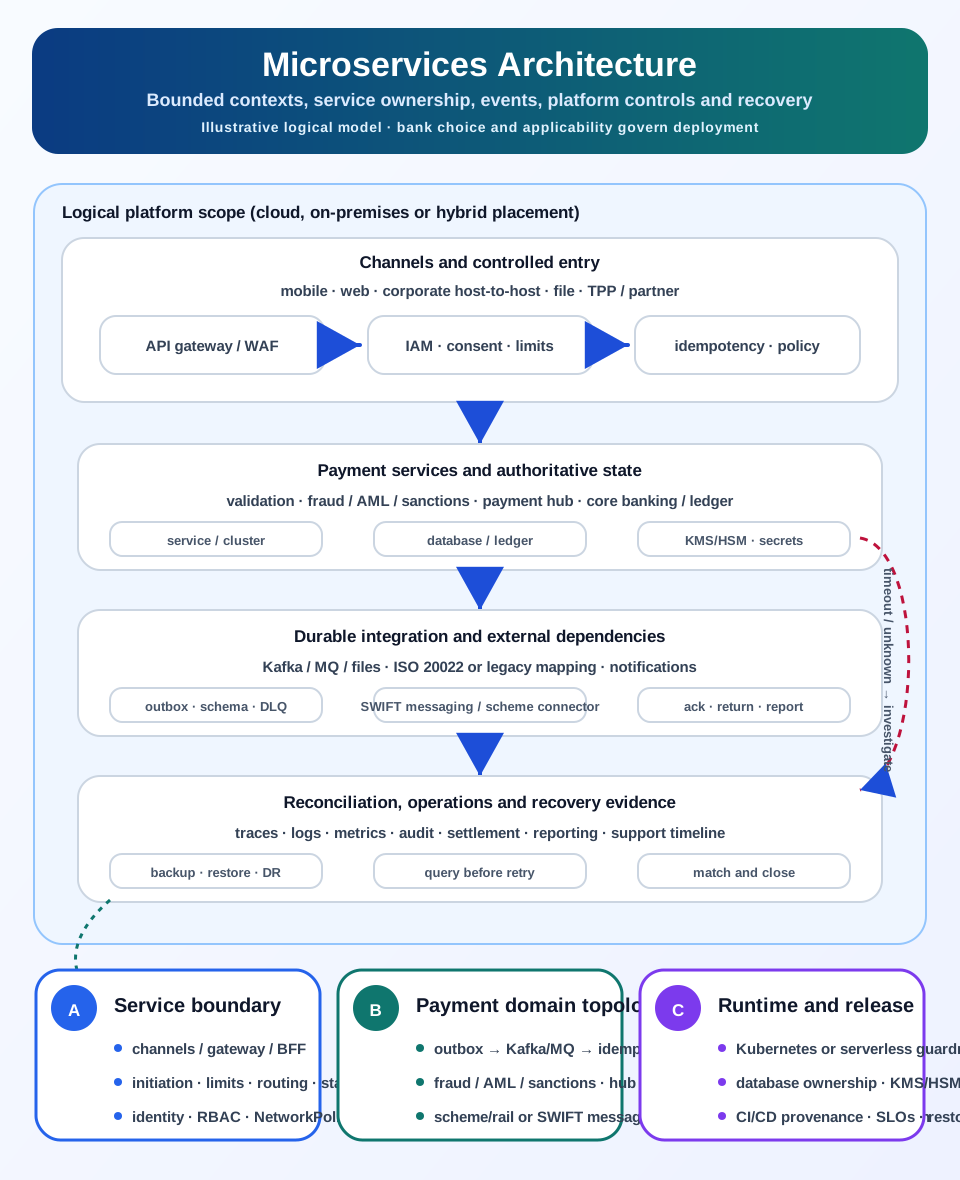
Scope and evidence (reviewed 5 October 2026). This is educational engineering guidance, not a universal banking-control prescription. Read each recommendation in the right category: generic cloud principle, technical standard or specialist guidance, jurisdictional/supervisory expectation, scheme/provider rule, or bank implementation choice. Applicability depends on the bank's jurisdiction, licence, criticality, data, service, contract and selected architecture; the cited sources are the authority for any dated or regulatory statement.
This chapter explains microservices architecture from a banking and payments point of view. The focus is not generic software fashion. The focus is how a bank can split payment capabilities safely: initiation, validation, account checks, limits, fraud, sanctions, routing, ledger integration, status, notification, reconciliation, audit, and production support.
A bank can build microservices badly and become slower than before. It can create a distributed monolith where every service calls every other service, every release needs a meeting, and every payment incident becomes a long bridge call. A bank can also use microservices well: clear boundaries, owned data, stable contracts, event-driven workflows, automated release paths, and support evidence that follows the payment from request to settlement.
The difference is not the word microservice. The difference is architecture discipline.
What Microservices Mean In A Payment Bank
A microservice is a small, independently deployable service that owns a specific business capability. The important words are business capability. In payments, a service boundary should not be chosen only because a table exists, a screen exists, or a developer wants a separate codebase. A boundary should represent a responsibility that can be owned, tested, deployed, monitored, scaled, and supported.
A payment initiation service may own the acceptance of payment commands from channels. A payment validation service may own scheme, account, and format checks. A routing service may own rail selection and cut-off logic. A payment status service may own the external lifecycle view. A notification service may own customer and partner notifications. A reconciliation service may own matching and exception evidence. A fraud decision service may own risk scoring integration. A sanctions screening adapter may own communication with screening platforms.
Each service needs a reason to exist. If a service does not own a meaningful capability, it becomes ceremony. If it cannot be deployed without breaking three other services, it is not independent. If it cannot be supported in production, it is not mature. If it shares its database with five other services, it is not really autonomous.
The best way to think about microservices in payments is this: each service should reduce confusion at a payment boundary. It should make ownership clearer, failure smaller, scaling more targeted, change safer, and evidence easier to find.
Why Banks Moved Toward Microservices
Older banking platforms were built around large applications. A core banking system owned accounts, balances, customer records, posting, interest, statements, and sometimes payments. A payment hub handled multiple rails but often grew into a large central workflow engine. Channels were tightly connected to backend systems. File processing, message queues, stored procedures, enterprise service buses, and nightly batches carried much of the integration burden.
That architecture was not irrational. Banks needed reliability, central control, audit, and stable processing. Monoliths were easier to reason about when everything lived in one deployment and one database transaction boundary. They were also easier to govern when releases happened a few times per year.
Digital banking changed the pressure. Mobile banking, instant payments, open banking, real-time notifications, richer fraud controls, cloud platforms, API gateways, partner integration, and continuous delivery pushed banks toward smaller change units. A bank cannot wait months to change a payment status API. It cannot scale an entire monolith only because status polling is high. It cannot let one partner integration defect delay a mobile release. It cannot rebuild the full payment platform every time one rail adds a field.
Microservices answer these pressures, but they are not free. They trade one kind of complexity for another. The old complexity was inside large systems. The new complexity is between systems. You gain independent deployment, targeted scaling, clearer ownership, and faster change. You also inherit distributed tracing, network failure, eventual consistency, contract testing, versioning, secrets, certificates, service discovery, dependency management, and incident coordination.
A bank should choose microservices when the independence is worth the operational cost.
The Payment Domain Is Stricter Than Generic Examples
Most microservices examples use e-commerce: product service, cart service, order service, inventory service, shipping service. These examples help beginners, but payments need stricter thinking.
A payment is not only an order. It is an instruction to move money, a control object, an accounting event, a fraud risk, a sanctions candidate, a customer communication, a regulatory record, a dispute object, and a reconciliation item. Once it enters the bank, it moves through states that may be customer-visible, scheme-visible, ledger-visible, and operations-visible.
That is why payment microservices need stronger guarantees than normal application services.
A payment service must understand idempotency because retries can create duplicate payments. It must understand lifecycle because accepted does not mean settled. It must understand authorization because a user may view payments but not approve them. It must understand cut-offs because a payment may be accepted today but executed tomorrow. It must understand asynchronous outcomes because a payment rail may respond later. It must understand reversals, returns, recalls, repair, and investigation because production does not end at the happy path.
Developers should not design payment microservices as CRUD around payment rows. A payment has commands and events: submit payment, validate payment, approve payment, reject payment, send payment, receive acknowledgement, post debit, mark settled, return payment, initiate recall, close investigation. Each action has rules and evidence.
A good microservice model starts from these business actions.
Bounded Contexts In Payments
A bounded context is a domain boundary where words have precise meaning. In payments, this matters because the same word can mean different things in different systems.
Take status. A channel may show processing. The payment hub may show accepted by gateway. The scheme may show pending settlement. The ledger may show posted. The customer may think the payment is complete. Operations may still consider it open for reconciliation. If one shared status field tries to satisfy everyone, the model becomes unclear.
A payment microservices architecture should separate contexts.
The payment initiation context owns incoming customer or partner commands. It cares about request validation, idempotency, authentication evidence, channel metadata, and initial acceptance.
The payment execution context owns processing through the payment hub and rails. It cares about routing, scheme rules, cut-offs, acknowledgements, and operational exceptions.
The accounting context owns ledger posting and balance impact. It cares about debit, credit, holds, reversals, value dates, and accounting entries.
The risk context owns fraud, sanctions, AML, and transaction monitoring decisions. It cares about risk signals, lists, rules, models, alerts, and investigation evidence.
The customer communication context owns notifications and customer-visible updates. It cares about timing, wording, channels, preferences, and safe disclosure.
The reconciliation context owns matching internal and external records. It cares about scheme files, settlement reports, ledger entries, exceptions, and ageing.
The support context owns investigation views. It cares about correlation identifiers, trace history, user actions, downstream responses, and case notes.
These contexts should not all share one payment table. They can share identifiers and events, but each context should own its own model.
Service Boundaries That Make Sense
A service boundary should pass four practical tests.
First, the service must own a business capability. Payment Routing Service makes sense if it owns rail selection, cut-off evaluation, and routing rules. Payment Helper Service does not tell anyone what it owns.
Second, the service must own its data. It may read reference data from another service, consume events, or hold a projection, but it should not depend on another service's private tables. Shared databases create hidden coupling and make independent release nearly impossible.
Third, the service must have operational ownership. A team should know its SLOs, dashboards, alerts, runbooks, dependencies, failure modes, and rollback path. A service with no owner becomes production debt.
Fourth, the service must be worth the network boundary. Every service call adds latency, failure modes, serialization, authentication, logging, tracing, and versioning. If two pieces of logic always change together and always need the same transaction, separating them may create pain without benefit.
In payments, good candidate services usually align with capabilities such as payment initiation, payment validation, payment routing, payment status, customer notification, consent, limits, pricing and charges, fraud decisioning, screening integration, reconciliation, statement enrichment, reference data, partner onboarding, and audit evidence.
Poor candidate services usually come from technical nouns only: database service, utility service, common service, mapper service, rules service without domain ownership, and generic orchestration service that slowly absorbs all business logic.
The Distributed Monolith Trap
A distributed monolith looks like microservices on an architecture diagram but behaves like a single fragile application.
You can spot it quickly. One customer action triggers a long chain of synchronous calls. Service A calls B, B calls C, C calls D, D calls E, and the user waits. Every service needs every other service to be healthy. A small schema change requires many deployments. Teams share one database. Events expose internal table rows instead of business facts. Production incidents require large group calls because no one knows where ownership sits.
In payments, a distributed monolith is dangerous because the payment journey already has enough real complexity. Fraud systems can be slow. Sanctions systems can return false positives. Payment rails can delay acknowledgements. Ledgers can reject posting. Channels can retry. Customers can abandon authentication. Adding unnecessary service coupling makes this worse.
A safer design keeps synchronous paths short and uses asynchronous events for work that does not need to block the initial response. It stores durable state before calling unreliable dependencies. It makes retries idempotent. It uses clear external statuses. It avoids forcing every service to know every other service's private model.
Microservices should reduce blast radius. If they increase it, the architecture is wrong.
Synchronous And Asynchronous Communication
Payments need both synchronous APIs and asynchronous messaging.
Synchronous APIs are useful when the caller needs an immediate answer. A channel may need to know whether a payment request was accepted. A payment initiation service may need to call an account service to confirm that the debtor account exists and belongs to the customer. A routing service may need reference data to decide the rail. A support UI may need a payment timeline.
Asynchronous messaging is better when the work can continue after initial acceptance. Fraud review may complete later. Sanctions screening may hold a payment. A scheme acknowledgement may arrive after submission. A notification may be sent after status changes. A reconciliation system may match settlement files later. A reporting service may consume payment events without slowing the payment path.
The mistake is using synchronous calls for everything. A long synchronous chain makes customer experience depend on the slowest dependency. It also makes failure handling messy. If the payment service calls risk, then routing, then ledger, then notification, and the notification service fails, should the payment fail? Usually no. Notification failure should not reverse a valid payment. This is a boundary decision.
A practical pattern is command plus event. The API receives a command such as InitiatePayment. The payment service validates and records the command. It emits PaymentReceived. Other services react. The payment workflow moves through events: PaymentValidated, RiskDecisionReceived, PaymentRouted, PaymentSentToRail, PaymentAcceptedByRail, PaymentPosted, PaymentSettled, PaymentRejected, or PaymentReturned.
The events should be business events, not database change noise. payment_status_column_updated is weak. PaymentRejectedDueToAccountClosed is useful internally if the domain allows that reason. External events may need safer reason codes.
Data Ownership And The Payment Truth
Microservices do not mean every service can invent its own truth about money.
The ledger remains the system of record for account postings. The payment hub may be the system of record for payment execution workflow. The channel or open banking service may be the system of record for customer initiation evidence. The reconciliation service may own matching results. The notification service may own delivery history.
Each service owns its truth within its boundary. The architecture must define which truth is authoritative for each question.
If the question is Was the debtor account debited?, the ledger or core banking posting record decides.
If the question is Did the customer submit this instruction through mobile banking?, the channel or payment initiation evidence decides.
If the question is Which rail was selected and why?, the routing service or payment hub decides.
If the question is Was the payment sent to clearing?, the payment hub or rail adapter decides.
If the question is Did the customer receive a push notification?, the notification service decides.
Trying to make one service own every answer creates a new monolith. Letting every service answer money questions independently creates inconsistency. The right approach is explicit ownership plus well-designed projections.
A projection is a local read model built from events or APIs. For example, a payment status service may hold a projection of payment lifecycle events so channels can query status quickly without hitting the payment hub every time. That projection must define freshness, replay behavior, and reconciliation rules.
Database Per Service, With Discipline
The phrase database per service is often repeated too casually. It does not mean every service must run a unique database engine. It means a service owns its persistence boundary. Other services do not read or write its private schema.
In a bank, physical database separation may be gradual. Multiple services may run on the same database platform or cluster for cost and operational reasons. But logical ownership must still be clear. Tables owned by the payment initiation service should not be updated by the notification service. A reconciliation service should not join directly into private payment hub tables because it is faster. Shortcuts become permanent coupling.
Data duplication is normal in microservices. A payment status service may store the current external status. A fraud service may store risk decisions. A reporting service may store analytical copies. A customer service may store customer display preferences. This duplication is acceptable when ownership and freshness are documented.
For payments, consistency must be designed carefully. You cannot wrap a customer notification, ledger posting, scheme submission, and analytics update in one distributed database transaction. Instead, you need durable local transactions, outbox patterns, idempotent consumers, compensation logic where possible, and clear operational recovery.
The outbox pattern is especially important. When a service changes its own database and needs to publish an event, it writes the event to an outbox table in the same transaction as the business change. A publisher then reliably sends the event to the message broker. This prevents the classic failure where the database update succeeds but the event never publishes.
Sagas In Payment Workflows
A saga is a sequence of local transactions coordinated through commands and events. It replaces the unrealistic idea that a distributed payment workflow can be one giant database transaction.
Consider a payment initiation. The system records the payment request. It validates the debtor account. It checks limits. It sends the instruction to fraud. It screens parties where required. It routes to a payment rail. It posts or reserves funds depending on product design. It sends the instruction. It receives acknowledgement. It updates status. It notifies the customer.
Each step may succeed, fail, time out, or require manual review. A saga defines what happens next.
If fraud rejects, the payment moves to rejected and no rail submission occurs. If sanctions holds, the payment moves to pending investigation. If the payment rail is temporarily unavailable, the system may retry or queue. If ledger posting succeeds but notification fails, the payment should not be reversed only because notification failed. If rail submission outcome is unknown, the system should use status inquiry or reconciliation before retrying blindly.
There are two common saga styles. In choreography, services react to events. In orchestration, a workflow orchestrator sends commands and waits for results. Payment banks often use a hybrid. Critical payment execution may be orchestrated by a payment hub or workflow engine. Supporting actions such as notifications, reporting, and analytics can be event-driven. The important rule is that the process owner must be clear.
Idempotency Is A Payment Safety Control
Idempotency means the same request can be retried without creating a second unintended effect. In payments, it is not an optimization. It is a safety control.
APIs time out. Mobile networks drop. Corporate systems retry files. Partner platforms resend requests. Message brokers redeliver events. Containers restart. Consumers crash after processing but before committing offsets. If the system treats every retry as a new payment, duplicate money movement becomes a real risk.
A payment initiation service should require an idempotency key for unsafe operations. It should bind that key to the caller, customer or corporate context, payment type, amount, currency, debtor, creditor, and request payload hash. If the same key arrives with the same payload, return the original result or current status. If the same key arrives with a different payload, reject it as a conflict.
Idempotency must continue beyond the API layer. Event consumers should also be idempotent. A notification service should not send five customer messages because the same event was redelivered. A ledger adapter should not post twice because the command was retried. A reconciliation service should not create duplicate exceptions because a settlement file was replayed.
Idempotency data needs retention. If keys expire too quickly, delayed retries can create duplicates. If keys never expire, stores grow endlessly. Retention should match payment risk, rail behavior, customer dispute windows, and operational policy.
Service Mesh In A Banking Platform
A service mesh handles infrastructure concerns for service-to-service communication. It can provide mutual TLS, service identity, traffic routing, retries, timeouts, circuit breaking, telemetry, and policy enforcement.
NIST SP 800-204A describes service mesh as a way to provide security infrastructure for microservices without changing each service's application code. NIST SP 800-204B discusses mutual authentication and attribute-based access control for microservices using service mesh. These ideas matter in banking because internal network trust is no longer enough. A payment status service should not call a ledger adapter only because it is inside the same cluster. The call should be authenticated, authorized, encrypted, observable, and policy-controlled.
A service mesh is not a replacement for payment authorization. It can prove that Service A is calling Service B. It cannot decide whether a customer is allowed to initiate a payment unless the application passes and enforces the right business attributes. Mesh policy and domain authorization must work together.
Service mesh also needs operational maturity. Bad retry policies can multiply load during an outage. A default timeout can be too long for a customer-facing path. A circuit breaker can protect a dependency but also change customer outcomes. mTLS certificate rotation must be monitored. Mesh upgrades can affect traffic. Treat mesh configuration as production code, not invisible platform plumbing.
API Gateway Versus Service Mesh
An API gateway and a service mesh solve different problems.
The API gateway protects and manages traffic entering the platform. It handles external clients, partner calls, mobile app APIs, open banking interfaces, authentication enforcement, rate limiting, request validation, version routing, and threat controls.
The service mesh manages traffic inside the platform. It handles service identity, encrypted service-to-service calls, internal traffic policy, retries, timeouts, circuit breaking, telemetry, and sometimes authorization policy.
Do not push everything into the gateway. Payment rules belong in payment services. Do not push customer-facing policy into the mesh only because it is technically possible. Use each layer for its job.
For example, the gateway may validate that a corporate channel has a valid token and that the request does not exceed rate limits. The payment initiation service should still validate account authority, payment limits, idempotency, payload shape, and approval evidence. The mesh may enforce that only the payment initiation service can call the routing service. The routing service still owns rail selection rules.
This layered control model makes failures easier to explain.
Kubernetes And Runtime Architecture
Modern microservices often run on Kubernetes or a managed container platform. Kubernetes provides primitives such as Pods, Services, Deployments, ConfigMaps, Secrets, health checks, scaling, and rolling updates. Kubernetes documentation describes Services as a way to expose applications running as one or more Pods behind a stable network endpoint.
For payment systems, Kubernetes is useful only when configured with discipline. A pod restarting is not a business event, but it can interrupt in-flight processing if the service is not designed properly. A readiness probe should not mark a payment service ready before it can connect to required dependencies. A liveness probe should not kill a service during a long but valid operation. Horizontal autoscaling should be based on meaningful signals such as CPU, memory, queue depth, latency, or request rate.
Stateful payment processing needs special care. If a service consumes messages, it must commit offsets only after durable processing. If a service owns a database migration, deployment order matters. If a service processes scheduled payments, leader election and duplicate execution controls matter. If a service holds in-memory workflow state, a restart can lose payment context. Prefer durable state over memory for payment decisions.
Namespaces, network policies, workload identity, image scanning, admission controls, and secret management need explicit control. A cluster that runs payment microservices is part of the bank's regulated technology estate.
Security Architecture
Security in payment microservices should assume that the network is not automatically trusted. Every service call should have identity. Sensitive traffic should be encrypted. Authorization should be explicit. Secrets should come from controlled secret stores. Logs should mask sensitive data. Access to production should be controlled, audited, and minimized.
Service-to-service authentication proves which workload is calling. Authorization decides whether that workload may perform the action. A notification service may read customer contact preferences but should not call a ledger posting endpoint. A reporting service may consume payment events but should not submit payment commands. An operations service may view a payment timeline but should require stronger controls for repair actions.
Secrets are a major risk. Payment services may need database credentials, message broker credentials, signing keys, encryption keys, certificates, API credentials for screening vendors, and keys for token validation. These should not live in source code, container images, environment dumps, or logs. Rotation must be tested. Expiry must be monitored.
Supply chain security matters because microservices multiply artifacts. Each service has dependencies, container images, build pipelines, base images, deployment manifests, and runtime policies. NIST SP 800-204D focuses on software supply chain security in DevSecOps CI/CD pipelines. For banks, this means dependency scanning, image signing, provenance, SBOMs where required, controlled registries, least-privilege pipelines, and approvals for sensitive changes.
Payment microservices also need data security. Account numbers, customer identifiers, payment references, beneficiary names, sanctions results, fraud signals, and dispute notes require careful masking and access controls. Developers should design logging before go-live, not after the first incident.
Resilience And Failure Isolation
Microservices help only if failures stay contained. A payment system must survive partial failure because partial failure is normal.
The fraud service may be slow. The sanctions provider may be unavailable. The notification vendor may fail. The payment hub may reject a rail submission. The ledger may be under load. The message broker may redeliver events. The Kubernetes node may restart. The API gateway may throttle. A downstream endpoint may return success after the caller times out.
Resilience patterns need payment meaning.
Timeouts prevent callers from waiting forever, but a timeout does not mean the downstream action failed. For payment submission, timeout handling must avoid blind retry without idempotency or status inquiry.
Retries help with transient failures, but retries can create overload or duplicate effects. Use bounded retries, backoff, jitter, and idempotency.
Circuit breakers protect dependencies, but they change user journeys. If a payment validation dependency is down, should the system reject, queue, degrade, or block new payment submissions? The answer depends on payment type, risk, regulation, and customer impact.
Bulkheads isolate capacity. A high-volume status polling problem should not consume all capacity needed for payment initiation. A partner integration issue should not take down retail mobile payments.
Queues absorb bursts, but queues also introduce delay. For urgent payments, queue depth and age must be visible. A payment sitting in a queue is not the same as a payment processed.
Graceful degradation is useful when the feature allows it. Notifications can be delayed. Analytics can lag. Some enrichment can run later. Core payment validation and authorization cannot be skipped casually.
Observability For Payment Microservices
Observability is the ability to understand what the system is doing from its external signals: logs, metrics, traces, events, and audit records. In payment microservices, observability is not only for engineers. It supports operations, customer service, incident response, risk, audit, and sometimes regulators.
Every payment journey should have a correlation id. That id should appear in gateway logs, service logs, event metadata, payment hub references, downstream adapter logs, and support views. A trace should show the path across services. Metrics should show request rate, latency, error rate, timeout rate, queue depth, event lag, retry rate, duplicate detection, rejected payment reasons, and downstream dependency health.
Logs should be structured. Free-text logs are hard to search during incidents. Use fields such as paymentId, correlationId, idempotencyKey, channel, serviceName, operation, status, errorCode, downstreamSystem, and durationMs. Mask sensitive values.
Distributed tracing is useful, but not enough. Traces show technical calls. Payment support also needs a business timeline: request received, customer authenticated, payment validated, risk cleared, sanctions cleared, route selected, sent to rail, accepted by rail, posted, notification sent, settlement matched. Build this timeline intentionally.
Release And Deployment Strategy
Independent deployment is one of the main reasons to use microservices. Independent deployment does not mean reckless deployment.
A payment microservice release should pass contract tests, unit tests, integration tests, security checks, performance checks for critical paths, database migration checks, backward compatibility checks, and rollback planning. The pipeline should build a signed artifact, scan dependencies, create deployment evidence, and promote through environments consistently.
Canary releases and blue-green deployments can reduce risk. A canary sends a small percentage of traffic to a new version before full rollout. This works well when the service is stateless or when state changes are backward compatible. It needs careful metrics. If the canary version increases payment rejection, latency, duplicate detection, or downstream errors, rollback should happen quickly.
Database changes are difficult. Services should use expand-and-contract migrations. First add new schema fields while old code still works. Then deploy code that writes both old and new forms if needed. Then migrate data. Then remove old fields only after consumers have moved. Breaking database changes during payment processing can create serious incidents.
Feature flags can help, but they must be governed. A flag that changes payment routing, risk behavior, fee calculation, or status mapping is a production control. It should have ownership, approval, audit trail, and rollback instructions.
Testing Strategy
Testing payment microservices requires more than unit tests.
Unit tests verify local logic: validation rules, idempotency behavior, status mapping, retry decisions, and payload transformation.
Contract tests verify that service APIs and events match what consumers expect. They protect independent deployment. If payment status service changes a field that mobile banking depends on, contract tests should catch it before production.
Integration tests verify real dependencies or realistic test doubles: database, message broker, gateway, identity provider, fraud adapter, sanctions adapter, payment hub adapter, and notification system.
End-to-end tests verify complete journeys, but they should be used carefully. Too many end-to-end tests become slow and brittle. Use them for critical payment flows: one-off payment, scheduled payment, rejected payment, duplicate retry, fraud hold, sanctions hold, status inquiry, notification, and reconciliation.
Resilience tests verify failure behavior. Kill a service. Delay a dependency. Redeliver an event. Drop a callback. Return a timeout after successful downstream processing. Fill a queue. Expire a certificate. Rotate a secret. Break a schema. These cases happen in production.
Performance tests must include realistic payment patterns. Status polling, batch submissions, peak salary days, merchant checkout bursts, instant payment spikes, and settlement file windows create different load shapes. Test the shape, not only average requests per second.
Payment Status As A Separate Capability
Payment status deserves careful design. Channels, customers, TPPs, merchants, operations, and reports all ask for status, but they do not need the same view.
A status service can consume events from payment initiation, payment hub, ledger, rail adapters, fraud, sanctions, and reconciliation. It can map internal states to external states. It can expose query APIs to mobile, web, corporate, partner, and support tools. It can preserve a timeline for investigation.
The service should not invent completion. If the ledger posted but the rail later returns the payment, status must reflect that lifecycle. If the payment is accepted for future execution, status should not look complete. If fraud review is pending, the customer message may need to be careful. If settlement is delayed, operations need a different view from the customer.
Status mapping should be versioned and tested. A small change in status mapping can affect customer calls, merchant fulfillment, partner reconciliation, and complaint handling.
Reconciliation In A Microservices World
Microservices increase the need for reconciliation because state is distributed. A payment may exist in the initiation service, payment hub, ledger, rail adapter, notification service, and reporting platform. These systems should agree on key facts, but they may update at different times.
Reconciliation checks that the payment instruction, ledger posting, rail submission, clearing response, settlement report, and external status line up. It also identifies exceptions: payment sent but not posted, posted but not settled, settled but not notified, rejected by scheme but shown as pending, duplicate reference, missing acknowledgement, amount mismatch, currency mismatch, or stale status.
A reconciliation service should consume events and files, match records, create exception cases, track ageing, and expose operational dashboards. It should not depend on manual spreadsheet checks as the primary control.
For developers, reconciliation means every service must emit enough identifiers. Payment id, end-to-end id, transaction id, scheme reference, account reference, amount, currency, date, rail, and correlation id need to be captured deliberately. Without identifiers, reconciliation becomes guesswork.
Operational Support And Runbooks
Production support for microservices is harder if the architecture lacks evidence. A support engineer investigating a delayed payment should not need to open ten dashboards and guess which service failed.
The platform should provide a payment timeline. It should show when the payment entered, which channel submitted it, which customer or corporate user authorized it, which idempotency key was used, which validations passed, which risk decisions occurred, which route was selected, when the hub accepted it, when the rail responded, when ledger posting happened, whether notification was sent, and whether reconciliation matched.
Runbooks should be scenario-based: API accepts payment but status does not progress; payment appears duplicated after channel retry; fraud service is slow; sanctions screening holds many payments; payment hub accepts but rail acknowledgement is missing; ledger rejects posting after payment acceptance; notification backlog grows; reconciliation finds settlement mismatch; one deployment increases rejection rate; certificate or secret rotation breaks internal calls.
Each runbook should state symptoms, dashboards, logs, identifiers, likely causes, customer impact, immediate mitigation, escalation path, and recovery evidence.
When Not To Use Microservices
Microservices are not automatically better. A modular monolith can be the right architecture when the team is small, the domain is not well understood, release frequency is low, traffic is moderate, or the organization lacks platform maturity.
A modular monolith means one deployable application with strong internal module boundaries. It can still use clean domain design, good APIs, tests, and observability. It avoids distributed network complexity while the domain model matures.
For a bank, the wrong time to split is before ownership is clear. If nobody knows whether routing belongs to the payment hub, a routing service, or a product configuration team, creating a microservice will not solve the problem. It will encode the confusion into infrastructure.
Use microservices when the service boundary is stable enough, the team can own production, the operational controls exist, and the independence has real value.
Practical Release Audit
| Decision | Good Signal | Warning Signal |
|---|
| Boundary | Owns a payment capability | Only wraps one table |
| Data | Private ownership | Shared database writes |
| Calls | Short sync path, events for workflow | Long blocking chain |
| Safety | Idempotency and recovery tested | Retry behavior unclear |
| Support | Traceable payment timeline | Logs spread across teams |
Before releasing a payment microservice, audit the service from five angles.
From the domain angle, confirm that the service owns a real payment capability and that commands, events, statuses, and data match the business language.
From the security angle, confirm service identity, authorization, encrypted traffic, secrets management, token validation, data masking, access control, and audit logging.
From the reliability angle, confirm timeouts, retries, circuit breakers, idempotency, dead-letter handling, queue replay, duplicate detection, and dependency degradation behavior.
From the data angle, confirm source of truth, projection freshness, schema ownership, event versioning, reconciliation identifiers, retention, and privacy classification.
From the operations angle, confirm dashboards, alerts, traces, runbooks, escalation paths, SLOs, support search, deployment rollback, and incident evidence. A service is not ready because it runs. It is ready when it can fail in understandable ways.
Cloud runtime and payment-domain boundaries
A service decomposition is useful only when the platform can operate it. The selected landing zone should define cluster/project boundaries, private connectivity to core and rail dependencies, workload identity, RBAC, NetworkPolicy or equivalent segmentation, admission and image provenance, KMS/HSM and secret delivery, data-store ownership, observability and break-glass access. Kubernetes, a service mesh or serverless runtime are implementation choices; the bank must document which controls are supplied by the platform and which remain with the service team.
| Boundary | Example owner | Required production behavior |
|---|
| Channel/API/BFF | Channel or API team | Authenticate, authorize, rate-limit, validate and bind idempotency before calling payment initiation |
| Payment initiation/execution | Payments product team | Own accepted state, downstream command, status inquiry and safe unknown-outcome handling |
| Risk | Fraud, AML and sanctions teams | Define hold/release/reject/manual-review behavior and decision provenance; do not assume fail-open/closed universally |
| Core/ledger and rail | Core/Payments platform plus scheme/rail owner | Separate posting, submission, acknowledgement, return/recall and settlement evidence |
| Event/data platform | Platform/data teams | Own outbox, schema, partition/order, DLQ/replay, retention and consumer access |
| SRE/security/support | Shared operations | Own SLOs, alerts, incident evidence, restore, access reviews and runbooks |
Worked cloud payment path
Mobile / web / corporate → gateway and identity → limits and idempotency → payment services → fraud / AML / sanctions → payment hub → rail or SWIFT adapter → core/ledger and status events → Kafka/MQ, notification, accounting, reconciliation and reporting. The arrows are not one transaction. Commands, business facts and transport messages have separate contracts. A ledger or payment hub timeout creates an unknown state; it does not authorize a second command. An outbox protects publication of a durable fact, but it does not make an external rail side effect exactly once.
Failure matrix for a service boundary
| Failure | Customer-visible state | Safe next action | Owner |
|---|
| Service timeout before durable acceptance | Not accepted or retryable | Retry with the same idempotency key if the contract allows | API/service team |
| Timeout after possible ledger/hub acceptance | Unknown/pending investigation | Query by reference; reconcile before replay | Payments operations |
| Broker lag or schema incompatibility | Status freshness degraded | Stop incompatible deployment, protect backlog, repair or replay projections | Event/platform owner |
| Region or cluster loss | Degraded/outage | Fail over only to a tested target; deduplicate after recovery | SRE/platform |
| Restore with missing mappings or keys | Recovery incomplete | Restore configuration, key access, schema and idempotency state before processing | Platform/security |
The ledger, hub or another component may be the authoritative posting record for a selected bank design; do not treat that as a universal architecture rule.
Related Cloud Library chapters
Pair this domain-decomposition chapter with Cloud Fundamentals for Banking for landing zones and service models, Event Driven Architecture for contracts and replay, and Observability and Resilience for SLOs and recovery evidence.
Official References Used
- NIST SP 800-204, Security Strategies for Microservices-based Application Systems, August 2019: https://csrc.nist.gov/pubs/sp/800/204/final
- NIST SP 800-204A, Building Secure Microservices-based Applications Using Service-Mesh Architecture, May 2020: https://csrc.nist.gov/pubs/sp/800/204/a/final
- NIST SP 800-204B, Attribute-based Access Control for Microservices-based Applications using a Service Mesh, August 2021: https://csrc.nist.gov/pubs/sp/800/204/b/final
- NIST SP 800-204C, Implementation of DevSecOps for a Microservices-based Application with Service Mesh, March 2022: https://csrc.nist.gov/pubs/sp/800/204/c/final
- NIST SP 800-204D, Software Supply Chain Security in DevSecOps CI/CD Pipelines, February 2024: https://csrc.nist.gov/pubs/sp/800/204/d/final
- Microsoft Azure Architecture Center, Microservices architecture style and design patterns, updated through 2026: https://learn.microsoft.com/en-us/azure/architecture/microservices/
- Kubernetes documentation, Services and networking concepts, modified March 24, 2026: https://kubernetes.io/docs/concepts/services-networking/
- NIST SP 800-204C, DevSecOps for microservices with service mesh: https://csrc.nist.gov/pubs/sp/800/204/c/final
- NIST SP 800-204D, software supply-chain security: https://csrc.nist.gov/pubs/sp/800/204/d/final
- Kubernetes probes and NetworkPolicy: https://kubernetes.io/docs/tasks/configure-pod-container/configure-liveness-readiness-startup-probes/ and https://kubernetes.io/docs/concepts/services-networking/network-policies/
- Apache Kafka documentation: https://kafka.apache.org/documentation/
- EBA Guidelines on ICT third-party risk management: https://www.eba.europa.eu/activities/single-rulebook/regulatory-activities/internal-governance/guidelines-third-party-risk-management
- Regulation (EU) 2022/2554 (DORA), where applicable: https://eur-lex.europa.eu/eli/reg/2022/2554/oj/eng
This application uses JavaScript for the full interactive experience. This text summary is served for accessibility and search indexing.