Banking API architecture and payment contracts: identity, consent, idempotency, status, webhooks, cloud controls, resilience and reconciliation.
Part of the Cloud, APIs and Integration for Banking learning path.
A payment API is not a button on a screen. It is a production contract that decides whether money can be requested, checked, routed, repaired, reported, cancelled, investigated, or rejected safely.
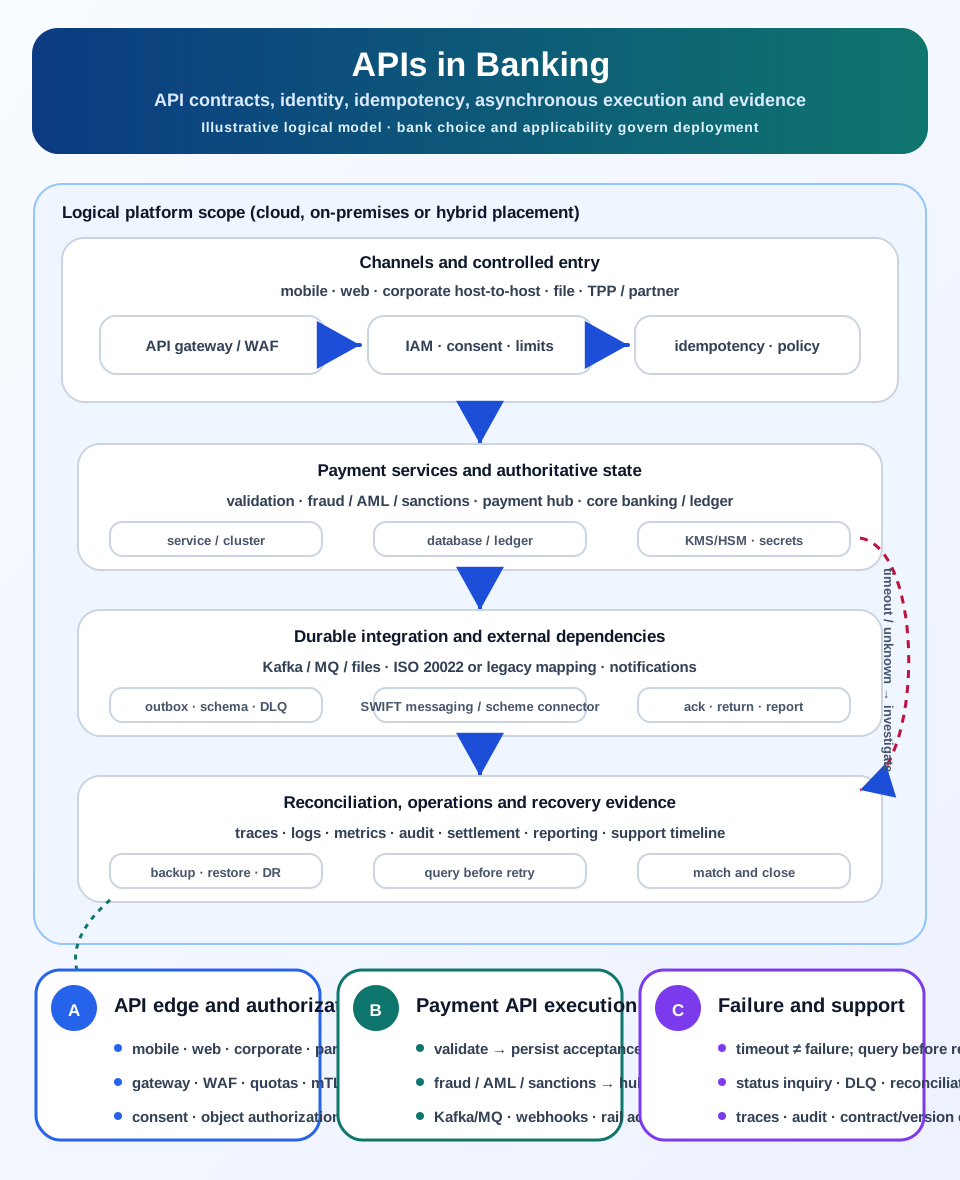
Scope and evidence (reviewed 5 October 2026). This is educational engineering guidance, not a universal banking-control prescription. Read each recommendation in the right category: generic cloud principle, technical standard or specialist guidance, jurisdictional/supervisory expectation, scheme/provider rule, or bank implementation choice. Applicability depends on the bank's jurisdiction, licence, criticality, data, service, contract and selected architecture; the cited sources are the authority for any dated or regulatory statement.
What This Chapter Is Really About
APIs in banking are usually explained as simple request and response interfaces. That explanation is technically true, but it is too small for real payment work. In a bank, an API is not only a way for one system to call another system. It is a governed boundary between channels, customers, partners, internal services, payment hubs, ledgers, fraud platforms, sanction systems, reporting systems, and operational support tools.
A payment API carries business authority. When a mobile app calls a payment initiation API, the API is not just moving JSON over HTTPS. It is accepting a possible instruction to move money. It must know who is calling, what the caller is allowed to do, which customer or corporate entity is represented, which account is in scope, which limits apply, whether consent exists, whether strong customer authentication is complete where required, whether the same request has already arrived, and whether downstream payment processing can safely continue.
That is why APIs in banking must be studied as architecture, not just syntax.
A good banking API protects the bank from accidental misuse, malicious misuse, operational confusion, data leakage, broken integrations, duplicate submissions, uncontrolled partner traffic, bad releases, and unclear audit trails. It also helps developers move faster because the rules are visible in a contract instead of hidden in old system behavior.
API In One Banking Sentence
An API is a controlled software contract that allows a known consumer to request a specific banking capability from a known provider, using a defined protocol, defined data model, defined security model, defined error model, defined operational behavior, and defined evidence trail.
In payments, this means an API is not complete because it returns 200 OK. It is complete when the calling system, business team, support team, security team, and audit team can all understand what the call means.
The API should answer simple questions clearly:
- Who called?
- On whose behalf?
- Which resource or payment object was requested?
- Which permission allowed it?
- What business state changed?
- Which downstream systems were touched?
- What identifier can support use to trace it?
- What should the caller do if the response is delayed, rejected, duplicated, or unknown?
If these questions are not clear, the API may work technically and still fail operationally.
Why Banking APIs Matter So Much
Modern banking does not run as one application. A payment journey crosses many boundaries.
A customer may start in a mobile app. A corporate user may upload a bulk file through a portal. A treasury system may initiate payments through host-to-host integration. A fintech may call an open banking API. A fraud engine may score the request. A sanction engine may screen parties. A payment hub may validate and route. A ledger may book entries. A reporting service may produce account statements. A notification service may update the customer. A reconciliation platform may compare internal and external state.
APIs are the controlled handshakes between these parts.
Without APIs, systems either integrate through direct database access, file drops, manual operations, proprietary adapters, or tightly coupled internal calls. Those models still exist in banks, and they are not always wrong. File-based integration is still normal for corporate payments and settlement reporting. Message queues still matter. SWIFT and ISO 20022 still matter. But APIs provide a cleaner way to expose services when synchronous access, digital channels, partner onboarding, near-real-time status, and developer-friendly integration are needed.
For payments, APIs matter because they support:
- mobile and web payment initiation
- corporate payment submission
- account and balance inquiry before payment
- beneficiary validation
- payment status inquiry
- payment cancellation or recall initiation
- payment repair workflows
- open banking account access and payment initiation
- partner and merchant integration
- fraud and sanction decision calls
- customer notification triggers
- reconciliation and operational dashboards
- internal service-to-service orchestration
An API estate becomes dangerous when each API is built in isolation. A bank needs consistent identity, authorization, naming, error handling, idempotency, versioning, monitoring, audit logging, and lifecycle management. Otherwise every integration becomes a special case.
APIs Are Not Direct Database Access
One of the cleanest ways to understand APIs is to compare them with database access.
Direct database access asks: "Can this system read or write this table?"
A banking API asks a better question: "Can this consumer perform this banking action under these conditions?"
That difference matters.
A table may contain account data, but an account-balance API can enforce customer ownership, consent, masking, channel restrictions, currency rules, cache rules, account status rules, and audit logging. A table may contain payment rows, but a payment-status API can return a safe business status instead of exposing internal workflow codes. A table may allow a payment record to be updated, but a payment-cancellation API can check scheme rules, cut-off time, payment state, user authority, and downstream reachability.
Direct database access is tempting because it looks fast. It avoids API design. It avoids gateway setup. It avoids contract testing. It avoids authentication design between systems. But it creates tight coupling and weak control. When the database schema changes, every consumer may break. When a consumer runs a heavy query, production performance may degrade. When access is over-granted, sensitive data may leak. When a payment state changes outside business logic, the bank may lose control of the lifecycle.
APIs create a service boundary. They do not magically solve every problem, but they make the boundary explicit.
Types Of APIs In A Bank
A bank normally has several classes of APIs. Mixing them up creates wrong designs.
Channel APIs serve customer-facing channels such as mobile banking, internet banking, branch applications, call center tools, and corporate portals. These APIs need strong user context, session controls, customer entitlements, channel limits, fraud signals, and clear customer-facing error behavior.
Partner APIs expose selected capabilities to trusted external partners, merchants, fintechs, treasury providers, or corporate customers. These APIs need onboarding, client registration, certificate management, contractual limits, quotas, consent, auditability, and operational communication.
Open banking APIs expose regulated account information and payment initiation capabilities to authorized third-party providers. These APIs require ecosystem-specific rules: consent, strong customer authentication, TPP identity, ASPSP responsibilities, dedicated interface requirements, operational reporting, and strict security profiles.
Internal service APIs connect bank-owned systems. A payment orchestration service may call account services, customer profile services, fraud scoring services, sanction screening services, FX rate services, charges services, limit services, notification services, and reporting services. Internal does not mean trusted without checks. Internal APIs still need authentication, authorization, observability, versioning, and operational ownership.
System APIs wrap old systems such as core banking, payment hubs, mainframes, card systems, or enterprise service buses. These APIs should protect legacy systems from direct consumer complexity. They translate modern API calls into the formats, timings, and constraints that older systems can handle.
Operations APIs support internal tools for investigation, repair, dashboarding, reprocessing, and support. These APIs are sensitive because they can expose payment state and sometimes trigger operational actions. They need strong role control, maker-checker where required, audit logging, and careful separation from customer-facing APIs.
Administrative APIs manage configuration such as routing rules, limits, partner setup, callback endpoints, webhook subscriptions, certificate metadata, and API product entitlements. These APIs require extremely strong controls because a bad configuration can affect many payments.
The Payment API Stack
A payment API stack usually has six layers.
The first layer is the consumer. This can be a mobile app, web app, corporate ERP, TPP platform, merchant platform, internal service, or operations portal. The consumer has its own identity, release cycle, error handling, and retry behavior.
The second layer is the edge. This includes DNS, TLS termination, content delivery, web application firewall, DDoS protection, bot controls, and traffic routing. For banking APIs, the edge is a security boundary and an availability boundary.
The third layer is the API gateway. The gateway validates tokens or certificates, checks quotas, routes requests, transforms headers where needed, validates schema where appropriate, blocks obvious threats, and generates access logs. A gateway should enforce common policy. It should not become a hidden payment engine.
The fourth layer is the API service. This is where business logic begins. A payment initiation service validates the instruction, checks idempotency, evaluates permissions, records initial state, calls business controls, and passes the work to orchestration or downstream systems.
The fifth layer is the payment and banking backend. This includes payment hub, core banking, ledger, fraud, sanctions, AML, FX, charges, limits, statement, notification, case management, reporting, and reconciliation systems.
The sixth layer is the operations and evidence layer. This includes logs, traces, metrics, audit events, release records, configuration history, monitoring dashboards, support runbooks, incident evidence, and reporting needed for operational and regulatory assurance.
A weak API design usually focuses only on layers three and four. A strong banking API design connects all six.
REST APIs In Banking
REST is common in banking because it uses HTTP, resource identifiers, standard methods, headers, status codes, and payload representations such as JSON. REST can be simple for developers and easy to document using OpenAPI.
But banking REST APIs need careful design. Payment actions do not always map cleanly to basic create-read-update-delete thinking.
For example, creating a payment instruction is not the same as inserting a row. It may start a workflow. It may require consent. It may require SCA. It may create an idempotency record. It may perform risk checks. It may reserve funds. It may submit to a payment hub. It may return an accepted state while final settlement happens later.
A RESTful payment API should expose business resources and actions clearly. Common resources include:
- accounts
- balances
- beneficiaries
- payments
- payment batches
- payment status
- consents
- mandates
- statements
- transactions
- limits
- confirmations
- investigations
- recalls
- refunds
- webhooks
The resource name should be stable and meaningful. An endpoint named /executePaymentNow may work, but it hides the resource model. An endpoint such as POST /payments creates a payment resource, while GET /payments/{paymentId} retrieves the state. If cancellation is possible, POST /payments/{paymentId}/cancellations often communicates the business action better than a vague update.
HTTP Methods And Payment Meaning
HTTP methods carry semantics. Developers should not use them casually in banking APIs.
GET retrieves a representation. It should be safe. It should not create a payment, change a limit, approve a beneficiary, or trigger a downstream submission. If a GET changes payment state, caching layers, monitoring tools, or crawlers can create accidental business effects.
POST usually creates a resource or triggers a business operation. Payment initiation commonly uses POST because the caller submits a new instruction. A POST is not automatically idempotent, so payment APIs must add idempotency design if the same request can be retried.
PUT replaces a resource at a known URI. It can be useful for updating a known configuration object or replacing a draft payment, but it is not always the right method for payment submission.
PATCH partially updates a resource. It can be used for limited update operations, but payment systems must be careful. A partial update to a payment after validation can break auditability unless state and authorization rules are strict.
DELETE removes a resource, but banking rarely "deletes" business records in the simple web sense. A beneficiary can be deactivated. A consent can be revoked. A draft can be removed. A submitted payment normally cannot be deleted; it can be cancelled, rejected, reversed, returned, recalled, or repaired depending on scheme and state.
The method should match business truth. If the operation is a payment recall, name it as recall. If it is consent revocation, name it as revocation. If it is a status inquiry, use retrieval. If it is a reprocessing action, protect it as an operational command.
API Request Anatomy
A banking API request has more than URL and JSON body.
The request line identifies the method and resource. The path should be stable and meaningful. Query parameters should filter or modify retrieval, not hide dangerous commands.
Headers carry context. Common headers may include authorization token, content type, accept type, idempotency key, correlation ID, client ID, channel ID, tenant or organization ID, request timestamp, signature metadata, language preference, and sometimes certificate-derived identity from a gateway.
The body carries the business payload. For a payment initiation API, this may include debtor account, creditor account, amount, currency, execution date, remittance information, payment type, requested priority, charge bearer, beneficiary reference, ultimate party details, purpose code, or structured address elements depending on product and scheme.
Metadata matters. A payment request without channel, initiating user, corporate context, or consent reference may be technically parseable but operationally incomplete.
A strong API request design separates three things:
- transport metadata, such as content type and correlation ID
- security metadata, such as token, certificate, signature, consent reference, and scopes
- business payload, such as account, amount, currency, beneficiary, and remittance details
When these get mixed together, integrations become fragile. For example, putting business authority only in a free-text payload field is weak. Putting sensitive data into headers that pass through multiple infrastructure logs can leak data. Putting correlation IDs inside the payload only can make gateway-level tracing harder.
API Response Anatomy
A response must tell the caller what happened, what the current state is, and what the caller should do next.
For a payment initiation call, 201 Created may mean the payment resource has been created. It does not necessarily mean the payment has settled. 202 Accepted may be better when processing continues asynchronously. 400 Bad Request may mean the request format or business validation failed before acceptance. 401 Unauthorized means authentication failed. 403 Forbidden means the caller is known but not permitted. 404 Not Found must avoid leaking whether another customer's resource exists. 409 Conflict often fits duplicate, state conflict, or idempotency conflict cases. 422 Unprocessable Content can be useful for syntactically correct payloads that fail business validation, depending on the bank's API standards. 429 Too Many Requests signals throttling. 500 and 503 must be handled carefully because payment outcome may be unknown.
The response body should carry a stable payment identifier when a payment resource exists. It should carry status, timestamps, and links or references for follow-up. It should not expose internal stack traces, database names, secrets, or raw downstream errors.
For errors, RFC 9457 Problem Details is useful because it gives a standard structure for machine-readable API errors. In banking, the bank can define payment-specific problem types such as invalid debtor account, unsupported currency, duplicate request, consent expired, execution date not allowed, cut-off passed, insufficient entitlement, downstream unavailable, or payment state unknown.
The most important rule: never make the caller guess whether money movement happened.
If the API cannot confirm final outcome, say that the status is pending or unknown and provide a safe inquiry path. Do not let the caller retry blindly.
Idempotency: The Core Payment API Discipline
Idempotency is one of the most important API concepts in payments.
A network timeout does not prove that the payment failed. It only proves that the caller did not receive the response. The server may have accepted the payment, sent it to the payment hub, posted it to the ledger, or submitted it to an external rail. If the caller retries without protection, the customer may create a duplicate payment.
An idempotency key protects this flow. The caller sends a unique key for the business operation. The API stores the key with a fingerprint of the request and the resulting state. If the same key arrives again, the API returns the same result or a safe conflict response instead of creating another payment.
Payment idempotency should not be an afterthought. It needs clear rules:
- Which operations require an idempotency key?
- Who generates the key?
- How long is the key retained?
- What fields form the request fingerprint?
- What happens if the same key arrives with a different amount or creditor?
- What happens if the first attempt is still processing?
- What response is returned after success, failure, timeout, or unknown state?
- How can support search by idempotency key?
A good payment API treats idempotency as a business safety control, not a convenience header.
For example, a corporate ERP submits a high-value supplier payment and receives a timeout after 20 seconds. The ERP retries the same request with the same idempotency key. The API recognizes the earlier accepted request and returns the existing payment resource. The ERP does not create a second payment. Support can trace both attempts using correlation ID and idempotency key.
That is the difference between a payment-grade API and a generic web API.
Correlation IDs And Payment Identifiers
Payment APIs need several identifiers, and each has a different job.
A correlation ID traces a technical request across gateway, services, queues, databases, downstream adapters, and logs. It helps support investigate latency, errors, and dependency failures.
An idempotency key protects a business operation from duplicate execution when the caller retries.
A payment ID identifies the payment resource inside the bank's API domain. It should be stable for status inquiry and support.
A business reference identifies the customer's or corporate client's reference. This may be an end-to-end reference used for reconciliation, but the bank should not rely on customer-entered values as the only unique technical key.
A message ID identifies a specific message or instruction in a scheme, payment hub, or ISO 20022 flow. It may change when a payment is transformed, batched, split, repaired, or resubmitted.
A UETR may identify a cross-border payment chain where applicable. It is very useful for tracking in SWIFT gpi and cross-border contexts, but it is not a universal identifier for every banking API operation.
A scheme reference or clearing reference may arrive later from downstream rails. It helps external investigation and reconciliation.
The API should not confuse these identifiers. If everything is called transactionId, developers, testers, support, and customers eventually misunderstand each other.
Synchronous And Asynchronous APIs
Some banking APIs can return the final result immediately. Many payment APIs cannot.
A balance inquiry can often be synchronous. An account-name check may be synchronous. A customer entitlement check may be synchronous. A payment initiation request may start synchronously but complete asynchronously because downstream steps involve fraud screening, sanction screening, payment hub processing, clearing, settlement, posting, or external acknowledgements.
A strong API design tells the caller which model applies.
In a synchronous model, the API returns a final business result inside the response. This works only when the bank can safely complete all required checks and state updates within the request timeout.
In an asynchronous model, the API accepts the request and returns a resource ID with a processing status. The caller then uses status inquiry, webhook notification, event subscription, or callback to learn the final state.
Payment initiation often uses a hybrid model. The API may synchronously validate the request, check authority, create a payment resource, and return accepted for processing. Later, the payment may become submitted, settled, rejected, cancelled, returned, or failed.
The danger is pretending an asynchronous process is synchronous. If the API returns success too early, customers may believe money has moved when only the instruction was accepted. If the API returns failure too aggressively after a timeout, callers may retry and create duplicate risk.
Status Design For Payment APIs
Payment status is not only a label. It is a contract.
A good API status model should distinguish technical processing from business outcome. processing is not the same as accepted. accepted is not the same as settled. submitted is not the same as credited. failed is not the same as rejected by scheme. cancelled is not the same as recalled. unknown is not the same as not found.
Payment APIs should define statuses carefully and document what each status means for the customer, bank, and downstream systems.
For example:
received means the API accepted the request payload for validation.accepted means the bank accepted the instruction for processing.pending_authorization means further customer or corporate approval is required.processing means downstream processing is underway.submitted means the payment was sent to a payment hub, scheme, or external connector.completed means the bank considers the payment completed according to the product definition.rejected means the instruction was rejected before completion.cancelled means a valid cancellation stopped the payment before execution.returned means money or instruction came back after submission according to rail rules.unknown means the bank cannot currently confirm final outcome and inquiry or reconciliation is needed.
The exact statuses depend on the bank and payment product. The important point is that statuses must be unambiguous.
API Gateway In Banking
The API gateway is the control point between consumers and services. It is not only a router.
A bank-grade gateway commonly handles:
- TLS termination or pass-through depending on security design
- client certificate validation
- token validation
- route selection
- schema checks
- quota and rate limit enforcement
- threat protection
- header normalization
- response filtering
- access logging
- correlation ID injection
- request size limits
- IP allow lists where appropriate
- API product entitlement checks
- analytics and usage reporting
The gateway should enforce common technical policy. It should not hide complex payment business decisions that belong in the application domain. If routing, sanction logic, balance handling, cut-off rules, or payment state transitions live only inside gateway policies, the architecture becomes hard to test and hard to audit.
Gateway policy should be observable and version-controlled. A change to a rate limit, route, header, client certificate rule, or schema validation rule can break real payments. Treat gateway configuration as production code.
Authentication, Authorization, And Consent
Authentication asks: who is the caller?
Authorization asks: what is this caller allowed to do?
Consent asks: has the customer or authorized party allowed this access or action?
Payments need all three, and they are not interchangeable.
A mobile banking customer may authenticate with the bank through app credentials and device binding. The API still needs authorization: can this customer initiate payments from this account, for this amount, through this channel? The API may also need step-up authentication or strong customer authentication for risky actions.
A corporate user may authenticate through a corporate channel. Authorization depends on mandate, role, approval matrix, account entitlement, payment type, limit, currency, and possibly dual approval. One user may be allowed to create a payment but not approve it. Another may approve domestic payments but not cross-border payments. A third may view balances but not initiate payments.
A TPP in open banking may authenticate as a regulated third party and act with customer consent. The bank must validate TPP identity, consent scope, consent status, customer authentication, and API permission. The TPP is not the customer. The consent does not automatically allow every account or every payment action.
Machine-to-machine APIs may use client credentials, mTLS, private key JWT, or other controlled authentication methods. The service identity should have limited scopes and limited resource access.
OAuth 2.0 In Banking APIs
OAuth 2.0 is widely used for API authorization. RFC 6749 defines the core authorization framework. In simple terms, OAuth allows a client to obtain limited access to a protected resource, either on behalf of a resource owner or on its own behalf.
In banking, OAuth is common but must be implemented carefully. A token is not a magic security shield. It must carry or reference the right permissions, expire appropriately, be validated correctly, and be protected against replay.
Common OAuth concepts in banking include:
- authorization server: issues tokens after authentication and policy checks
- resource server: API service that protects banking resources
- client: application calling the API
- resource owner: customer or entity whose data or payment capability is involved
- access token: credential used to access the API
- refresh token: credential used to obtain new access tokens where allowed
- scope: named permission such as read accounts or initiate payments
- grant type: method used to obtain a token
For payment APIs, scopes should not be too broad. A scope named payments is weak if it allows all payment actions. Better scopes and claims distinguish read, create, submit, cancel, status inquiry, and administration. The final authorization decision should also check account ownership, channel, consent, amount, currency, product, user role, and risk context.
OAuth 2.0 Security Best Current Practice, published as RFC 9700 in January 2025, strengthens expectations around safer OAuth usage. For banking APIs, the practical direction is clear: use authorization code with PKCE for user-facing flows, avoid unsafe legacy patterns, use exact redirect URI matching, sender-constrain tokens where feasible, and prefer stronger client authentication for confidential clients.
OpenID Connect And Identity Claims
OpenID Connect builds identity on top of OAuth 2.0. It is commonly used when the client needs to know who authenticated, not only what access token was issued.
In banking, identity claims must be handled with discipline. A token claim should not be trusted because it is present. The API must validate issuer, audience, expiry, signature, key rotation, token type, scopes, and claims. The API should reject tokens meant for another audience. It should avoid accepting tokens from untrusted issuers. It should not use display names or email addresses as authorization controls.
A useful token may carry customer ID, organization ID, user role, assurance level, authentication time, channel, consent ID, and permitted scopes. But each bank must define its own claim model and avoid leaking sensitive data inside tokens that may travel through logs or client systems.
FAPI And Financial-Grade API Security
Financial-grade API, or FAPI, is an OpenID Foundation profile for stronger API protection over OAuth. It matters because normal OAuth implementations can vary too much for high-risk financial APIs. FAPI narrows choices and raises the bar for security and interoperability.
The OpenID Foundation announced FAPI 2.0 as a final specification in February 2025. FAPI is relevant for open banking, open finance, payments, consent-based data sharing, and other high-risk API ecosystems.
FAPI focuses on stronger controls such as secure authorization flows, better client authentication, sender-constrained tokens, pushed authorization requests, replay protection, and conformance testing. It does not define payment data models by itself. It protects APIs; schemes and market standards define the business resources and payloads.
For a banking API designer, FAPI teaches an important lesson: high-risk payment APIs need fewer optional security choices, not more. Optionality can look flexible during design and become dangerous during implementation.
Mutual TLS And Certificate-Bound Tokens
Mutual TLS, or mTLS, means both server and client prove identity using certificates during the TLS handshake. In normal TLS, the client verifies the server. With mTLS, the server also verifies the client.
In banking, mTLS is common for partner APIs, open banking ecosystems, high-trust B2B integrations, and service-to-service communication. It helps prove that the calling software is associated with an expected certificate.
RFC 8705 defines OAuth 2.0 mutual TLS client authentication and certificate-bound access tokens. Certificate-bound tokens reduce the damage of stolen tokens because the token can be used only by the party holding the matching private key.
Operationally, mTLS creates responsibilities:
- certificate issuance
- certificate registration
- expiry monitoring
- renewal process
- revocation handling
- certificate-chain validation
- environment separation
- partner communication
- emergency rotation
- gateway and backend propagation
A payment API can fail at 1 AM not because the code is wrong but because a partner certificate expired. This must be visible in monitoring and owned in operations.
DPoP And Sender-Constrained Tokens
DPoP, defined in RFC 9449, is another way to sender-constrain OAuth tokens. Instead of binding the token to a TLS client certificate, DPoP uses an application-level proof of possession. The client proves it holds a private key by sending a signed DPoP proof with the request.
DPoP can be useful where mTLS is difficult, especially for some public client or modern app scenarios. It is not a universal replacement for mTLS. Banks need to evaluate ecosystem rules, client capability, threat model, interoperability, gateway support, and operational complexity.
The principle is what matters: bearer tokens are powerful but risky. If anyone who obtains the token can use it, stolen-token replay becomes a serious concern. Sender-constrained tokens reduce that risk by requiring possession of an associated key or certificate.
Pushed Authorization Requests
Pushed Authorization Requests, defined in RFC 9126, allow an OAuth client to send authorization request details directly to the authorization server first, receiving a reference URI that is later used in the browser-based flow.
This is useful in high-security banking flows because large or sensitive authorization parameters are not exposed loosely through front-channel redirects. It also lets the authorization server validate request details earlier and more reliably.
In open banking and payment initiation, pushed authorization can support stronger consent and authorization flows. The bank can bind the request details, client identity, redirect behavior, and user authentication flow more tightly.
For developers, the practical lesson is simple: payment authorization is not just a redirect dance. It is a controlled transaction that must resist tampering, replay, confusion between clients, and misuse of redirect paths.
API Keys Are Not Enough For Banking Payments
API keys identify an application. They are useful for analytics, basic client identification, routing, or low-risk integration. They are not enough for payment authorization.
An API key usually does not prove user identity. It often does not prove possession strongly. It may be copied, logged, embedded in mobile apps, shared between environments, or used beyond intended scope.
A bank may still use API keys as one part of API management, but payment APIs should rely on stronger controls: OAuth, mTLS, signed requests, scopes, claims, consent, device or channel context, user entitlements, fraud signals, and operational monitoring.
If a payment initiation API is protected only by an API key, the design should be challenged immediately.
Open Banking APIs
Open banking APIs allow authorized third-party providers to access account information or initiate payments with customer consent under a regulated or market-defined framework.
The exact rules differ by region. The UK Open Banking Standard defines read/write APIs, security profiles, customer experience guidelines, operational guidelines, and management information requirements. The Berlin Group NextGenPSD2 framework provides European XS2A API specifications and related documents, including OpenAPI files. Other markets have their own open banking and open finance models.
A typical open banking flow includes these actors:
- PSU: payment service user, usually the customer
- TPP: third-party provider
- ASPSP: account servicing payment service provider, usually the bank
- authorization server: issues tokens and handles consent/authentication
- resource server: exposes account or payment APIs
For account information, the TPP may request access to account balances and transactions. For payment initiation, the TPP may request creation of a payment initiation resource, customer authorization, and payment submission.
The bank must validate the TPP, the consent, the customer authentication, the scope, the payment details, and the final business rules. Consent is not a shortcut around payment controls. A consented payment still needs validation, entitlement, scheme handling, fraud controls, and audit trail.
Payment Initiation API Flow
A payment initiation API flow usually has several stages.
First, the caller prepares a payment request. It includes debtor account, creditor details, amount, currency, execution date, remittance information, and payment product. For corporate use, it may include batch references, organization context, approval group, and customer reference.
Second, the caller authenticates and obtains a token or proves identity through a configured mechanism such as mTLS. The API gateway checks technical access.
Third, the API service validates the payload. It checks mandatory fields, allowed values, account format, currency, date, payment product, payment type, and channel rules.
Fourth, the service checks business authority. This may include user entitlements, account ownership, corporate mandate, consent scope, transaction limits, approval matrix, and channel restrictions.
Fifth, the service checks payment controls. It may call fraud, sanction, AML, limit, FX, charges, and beneficiary validation services.
Sixth, the service creates a payment resource and records idempotency state. The API returns an accepted status and payment ID, or it rejects the request with a clear reason.
Seventh, downstream orchestration submits the payment to the payment hub, core system, or external connector. The final status may arrive later.
Eighth, the caller checks status or receives a notification. Reconciliation and audit systems record the final outcome.
Each stage should be designed and tested. A working happy path is not enough.
Account Information APIs
Account information APIs look simpler than payment initiation APIs because they usually read data. They still need strong controls.
An account balance API must decide which balance type to return: booked balance, available balance, interim available balance, closing booked balance, expected balance, or product-specific balance. The wrong balance can cause wrong customer decisions.
A transaction API must decide date range rules, pagination, sorting, pending transactions, booking dates, value dates, narrative fields, masked data, and statement references. It must prevent data exposure across customers, accounts, legal entities, and consents.
A corporate account API may need organization entitlements. A user may view one account but not another. A TPP may have consent for account A but not account B. A support user may need masked views.
Read APIs can still become high-risk because they expose sensitive financial behavior. Attackers value account lists, balances, transaction history, counterparties, merchant names, salary payments, loan repayments, and payment habits.
Status Inquiry APIs
Status inquiry APIs are critical in payments because they reduce duplicate risk and support customer transparency.
A caller should be able to ask: what happened to this payment? The answer should be safe, stable, and meaningful.
Status APIs should support lookup by bank payment ID. They may also support idempotency key, customer reference, end-to-end reference, batch ID, or scheme reference depending on product and security rules. They should avoid broad search unless caller authority is strong.
A good status response includes:
- payment ID
- current status
- status reason where safe
- timestamps
- amount and currency summary
- debtor and creditor summary with masking as needed
- next expected action if any
- links to cancellation, repair, or inquiry where allowed
For corporate bulk payments, status gets more complex. The batch may be accepted while individual transactions are rejected. The API must separate file-level status, batch-level status, and transaction-level status.
Bulk Payment APIs
Bulk payment APIs are common for corporate banking. They are different from single payment APIs.
A corporate client may submit hundreds or thousands of payments in one file or API request. The bank must validate file format, customer entitlement, duplicate file reference, number of transactions, total amount, cut-off time, payment types, currencies, debtor accounts, beneficiary details, and approval rules.
Bulk APIs need careful response design. The initial response may only confirm that the batch was received. Detailed validation results may arrive later. Some items may pass and some may fail. Repair may apply at item level or batch level. Approval may be required before execution.
Idempotency is more difficult for bulk. The API needs a batch idempotency key and often item-level uniqueness. If the caller resubmits after timeout, the bank must not duplicate all payments. If one item failed and the caller sends a corrected file, the bank must understand whether this is a new batch, a repair, or a duplicate.
Mobile-friendly documentation should explain bulk APIs in paragraphs, but the implementation must be exact.
Webhooks And Callback APIs
A webhook lets the bank notify a consumer when something changes. For example, a payment status changes from processing to rejected, a consent expires, a bulk file completes validation, or a report becomes available.
Webhooks are useful because polling creates load and delay. But webhooks create security and operational risks.
The bank must verify callback endpoint ownership. It must authenticate outbound calls where possible. It should sign webhook payloads. It must retry safely. It must avoid leaking sensitive data. It must prevent SSRF risk if clients can register arbitrary callback URLs. It must log delivery attempts. It must provide replay or status inquiry because webhook delivery can fail.
A webhook should usually carry an event summary and a reference, not a full sensitive payment payload. The consumer can call the bank's API to retrieve details under normal authorization controls.
Webhook retries require idempotency on the receiver side too. If the bank sends the same payment status event three times, the partner should not trigger three customer messages or three accounting updates.
API Error Handling In Payments
Payment API errors must be designed for machines and humans.
A developer needs a stable error code. A support team needs a traceable instance. A customer channel needs a safe message. A business analyst needs to map error categories to payment lifecycle states. A tester needs predictable behavior. An auditor needs evidence.
Errors should separate:
- transport errors
- authentication errors
- authorization errors
- validation errors
- business rule rejections
- duplicate request conflicts
- downstream dependency failures
- timeout or unknown outcome cases
- internal system errors
Do not expose raw downstream errors. If the sanction platform returns a technical stack trace, the API should not pass it to the customer. If the core banking system returns a cryptic legacy code, the API should map it to a controlled business reason where possible.
For payment APIs, the most dangerous error is an ambiguous one. A timeout after submission is not the same as validation rejection before acceptance. The API must tell the caller whether a safe status inquiry is required.
Rate Limiting, Quotas, And Traffic Shaping
Rate limiting is not only about stopping attackers. In banking, it protects critical downstream services and keeps payment flows fair.
A mobile banking API may need per-user limits, per-device limits, per-endpoint limits, and bot controls. A corporate API may need per-client limits, per-file limits, per-account limits, and peak-window controls. An open banking API may need ecosystem-defined availability and performance behavior.
Quotas define allowed usage over a period. Throttling slows or rejects traffic when limits are exceeded. Back pressure protects downstream systems when they are unhealthy. Circuit breakers stop repeated calls to failing dependencies.
Payment traffic shaping must consider business priority. Balance inquiry traffic should not starve payment submission. Partner test traffic should not affect production customers. A misbehaving corporate client should not degrade all payment processing. A status polling storm should not overload the payment hub.
The API should return 429 Too Many Requests with retry guidance where appropriate. But retry guidance must be realistic. Telling all clients to retry after the same number of seconds can create a synchronized traffic spike.
API Security Risks
OWASP API Security Top 10 2023 is useful for banking because it focuses on API-specific failures. The most important lesson for banks is that authorization failures are not theoretical.
Broken object level authorization means a caller can access another customer's resource by changing an ID. In banking, that could expose another account, payment, mandate, or statement.
Broken authentication means the API fails to reliably prove who is calling. In payments, that can lead to unauthorized initiation or data exposure.
Broken object property level authorization means the caller can view or update fields they should not touch. For example, a partner might submit a field that should only be set by the bank.
Unrestricted resource consumption means callers can exhaust expensive operations. In banking, repeated statement exports, huge date ranges, or bulk payment validation can create real operational load.
Broken function level authorization means a user can call an admin or repair function without the right role.
Unrestricted access to sensitive business flows matters strongly in payments. Even if every request is syntactically valid, bots or abusive clients may test account numbers, trigger OTP flows, harvest statuses, or overload beneficiary checks.
SSRF matters when APIs accept URLs, webhook endpoints, file locations, or callback configurations. A bad design can let attackers reach internal systems.
Improper inventory management is common when old API versions remain exposed. A forgotten payment API is still a payment API.
Unsafe consumption of APIs matters because banks rely on partners and vendors. If a bank blindly trusts responses from integrated services, an upstream compromise can flow into banking decisions.
Authorization Must Be Object-Level
In payment APIs, authorization cannot stop at endpoint level.
A token may allow GET /accounts/{accountId}/transactions, but the API must still check whether the caller can access that specific account. A user may have payment creation rights for one legal entity but not another. A TPP may have consent for one account and one permission set. A corporate approver may approve only within a threshold. A support analyst may view payment status but not customer address or full account number.
Endpoint authorization says: can this caller use this API?
Object-level authorization says: can this caller access this exact account, payment, consent, batch, beneficiary, mandate, or report?
Field-level authorization says: can this caller see or modify this exact field?
Payment APIs need all three.
A clean design centralizes authorization rules enough to keep behavior consistent but close enough to business data to make correct decisions. Hardcoding entitlement checks randomly inside services leads to inconsistent behavior.
Schema Validation And Business Validation
Schema validation checks whether the request shape is correct. Business validation checks whether the request is allowed.
A schema can say amount is required and must be a decimal. Business validation says whether that amount is within limit, allowed for the account, allowed for the channel, allowed for the currency, allowed before cut-off, and acceptable for the selected payment product.
A schema can say executionDate is a valid date. Business validation says whether the date is a business day, future date, same-day date, instant execution date, or prohibited by scheme rules.
A schema can say creditorAccount is a string. Business validation says whether the account format is valid, whether the country is supported, whether the beneficiary is allowed, and whether additional data is needed.
Developers should not confuse the two. Schema validation protects technical contract quality. Business validation protects payment correctness.
API Versioning
Banks cannot break consumers casually. A corporate client, TPP, mobile app, or internal system may take months to migrate.
API versioning should be planned from day one. Breaking changes should create a new version or follow a controlled deprecation process. Non-breaking changes may be allowed if clients can ignore new optional fields.
Breaking changes include removing fields, changing field meaning, changing enum values in a way clients cannot handle, changing authentication behavior, changing error codes, changing idempotency rules, changing status meanings, changing pagination behavior, and changing mandatory fields.
Versioning approaches include path versioning such as /v1/payments, header versioning, media type versioning, or API product versioning. The exact style matters less than consistency and communication.
A strong deprecation process includes:
- announcement
- migration guide
- sandbox availability
- compatibility period
- client impact analysis
- usage analytics
- support contact
- final retirement date
- monitoring after retirement
For banking APIs, versioning is not only a developer problem. It is a partner, operations, legal, compliance, and customer-impact problem.
OpenAPI And API Contracts
OpenAPI provides a standard way to describe HTTP APIs so humans and machines can understand the available paths, methods, parameters, payloads, responses, authentication requirements, and schemas.
A good OpenAPI contract is not documentation written after coding. It should be part of design, review, testing, mock generation, client generation, contract testing, security review, and change management.
For a payment API, the contract should define:
- endpoint purpose
- authentication and authorization model
- request headers
- idempotency requirement
- payload schema
- field definitions
- allowed enum values
- response statuses
- error model
- pagination rules
- rate limit headers
- examples
- callback or webhook behavior
- version information
Examples must be realistic but safe. Do not publish real customer data, real account numbers, real certificates, or live endpoint secrets.
OpenAPI alone cannot describe every payment rule. It can say a field exists. It may not fully explain cut-off behavior, mandate rules, repair process, sanction review behavior, or downstream settlement timing. The contract should link to business rules where needed.
API Documentation For Developers
Developer documentation should explain how to use the API without hiding risk.
A good banking API page tells developers:
- what the API is for
- who can use it
- which environments exist
- how to authenticate
- what consent or entitlement is required
- how idempotency works
- how status changes over time
- how errors should be handled
- how rate limits work
- how to test in sandbox
- what data is masked
- what audit identifiers are returned
- what support needs during incidents
Payment documentation should not say only "submit payment." It should explain accepted versus completed, retry behavior, duplicate prevention, cut-off handling, cancellation limits, and what to do when outcome is unknown.
The best documentation prevents bad integrations before they reach production.
Sandbox Design
Banking API sandboxes are not toys. They are controlled learning and integration environments.
A sandbox should let developers test authentication, token flows, consent, payment initiation, status inquiry, validation errors, duplicate behavior, throttling, and webhook delivery without using real money or real customer data.
A weak sandbox only returns static success responses. That creates a false sense of readiness. When the partner goes live, they encounter real validation rules, asynchronous statuses, expired consents, rate limits, certificate problems, and partial failures for the first time.
A strong sandbox simulates realistic payment states:
- validation success
- validation rejection
- pending authorization
- accepted for processing
- downstream timeout
- duplicate idempotency key
- cut-off passed
- insufficient permission
- consent expired
- status pending
- final rejected
- final completed
- webhook retry
The sandbox should also help the bank. It should record partner testing behavior, certificate readiness, API usage, repeated errors, and readiness signals before production onboarding.
API Testing In Banking SDLC
API testing must cover more than unit tests.
Unit tests check service logic. Contract tests check whether provider and consumer agree on request and response shape. Integration tests check downstream calls. Security tests check authentication, authorization, injection, token handling, replay risk, and unsafe object access. Performance tests check latency, throughput, and resource usage. Resilience tests check dependency failure behavior. Operational tests check logs, metrics, alerts, runbooks, and support evidence.
For payment APIs, test cases should include:
- duplicate submission after timeout
- same idempotency key with different payload
- expired token
- token for wrong audience
- missing consent
- consent for wrong account
- user without payment entitlement
- amount above limit
- unsupported currency
- execution date outside allowed window
- cut-off passed
- downstream fraud timeout
- sanction pending review
- payment hub unavailable
- database transaction failure after idempotency record
- webhook delivery failure
- status inquiry during processing
- batch with partial failures
Testing should prove the API fails safely. A payment API that handles only success is not ready.
Performance And Latency
API performance in banking has business meaning. Slow payment initiation creates customer frustration. Slow account inquiry breaks open banking experiences. Slow corporate upload validation can miss cut-off windows. Slow status inquiry increases support calls.
Performance design must separate user-facing latency from end-to-end payment completion. The API may return quickly with accepted for processing while downstream completion takes longer. That can be valid if the customer message is clear.
Key API performance measures include:
- p50, p95, and p99 latency
- error rate by endpoint and client
- throughput by channel
- gateway latency versus backend latency
- downstream dependency latency
- queue age
- timeout count
- retry count
- payload size distribution
- rate limit rejections
- database connection usage
Average latency hides pain. A payment API with an average of 300 ms can still have a p99 of 20 seconds during peak time. Customers experience the tail, not the average.
Pagination, Filtering, And Search
Account and transaction APIs need pagination. Without pagination, a request for years of transaction history can overload the API and database.
Pagination must be stable. If new transactions arrive while the client pages through results, the client should not miss or duplicate records. Cursor-based pagination often works better than offset pagination for changing datasets.
Filtering must be controlled. Allowing arbitrary filters on large datasets can become a performance and security problem. A transaction search API should restrict date ranges, account scope, fields, sorting, and result size.
For payment investigations, search needs a separate design. Support users may search by payment ID, customer reference, end-to-end ID, UETR, amount, date, account, or scheme reference. That is operationally useful but sensitive. Access must be role-controlled and logged.
API Payload Design
Payload design should be clear, stable, and aligned to business meaning.
Use field names that communicate purpose. Avoid cryptic abbreviations unless they are established banking terms. For example, debtorAccount and creditorAccount are clearer than src and dst. If a field maps to ISO 20022 concepts, explain it where useful, but do not force every developer to understand full XML standards to call a JSON API.
Use structured fields when structure matters. Postal address, party identification, account identification, and remittance information can become complex. Free text is easy at capture time and painful during screening, compliance, routing, and repair.
Use enums carefully. Every enum value becomes a contract. If payment status values are likely to evolve, document how clients should handle unknown values.
Use dates and times clearly. Payment APIs should specify timezone, date-only versus timestamp, business date versus processing timestamp, value date versus booking date, and cut-off interpretation.
Use amounts safely. Specify decimal precision, currency, sign conventions, allowed ranges, and rounding rules. Never let floating-point handling create payment amount defects.
JSON, XML, ISO 20022, And Translation
Banking APIs often use JSON at the channel or partner layer because it is developer-friendly. Payment networks and bank backends may use ISO 20022 XML, SWIFT MT, proprietary fixed formats, or files.
The API layer may translate JSON into internal canonical models and then into scheme-specific messages. This translation must be governed. A simple field mapping mistake can change creditor details, remittance information, routing data, charge bearer, purpose code, or regulatory reporting.
Do not assume JSON means simple. A JSON payment API can represent complex structured payment data. The bank should define which fields are mandatory for each payment product and scheme. The mapping to ISO 20022 or another downstream format should be traceable and tested.
For developers, the key is to understand the boundary. The API contract is what the caller sees. The internal canonical model is what the bank uses to normalize payment data. The scheme message is what the downstream network requires. These are related but not identical.
API Orchestration Versus API Composition
API composition means one API calls several services to assemble a response. For example, an account summary API may call account, balance, customer, and card services.
API orchestration means the API controls a workflow. Payment initiation often needs orchestration: validate, check entitlement, call fraud, call sanctions, record state, submit downstream, update status, notify customer.
Do not hide long-running payment orchestration inside a single synchronous API call unless all steps can complete reliably within the timeout. If the workflow continues after response, model it explicitly with statuses and events.
A payment orchestration API needs transaction boundaries. It should know which state changes are durable before calling downstream systems. It should avoid partial updates that leave the payment in an unclear state. It should use queues or workflow engines where asynchronous reliability is needed.
Service-To-Service APIs
Internal APIs are often more dangerous than external APIs because teams assume they are safe.
A fraud service API may accept payment context and return risk scores. A sanction service API may return screening decisions. An FX service may return rates. A charges service may calculate fees. A limit service may approve or reject transactions. A notification service may send messages. A ledger service may post entries.
Each internal API has payment impact. If a limit API fails open, high-risk payments may pass. If a fraud API times out and the caller ignores it, risk controls weaken. If a charges API returns the wrong currency, customer pricing breaks. If a notification API retries badly, customers receive duplicate messages.
Service-to-service APIs should use strong workload identity, least privilege, timeout policies, circuit breakers, schema contracts, business fallbacks, tracing, and clear ownership.
API Governance
API governance means the bank manages APIs as products and controls, not random endpoints.
A governance model should define standards for naming, versioning, authentication, authorization, error responses, idempotency, logging, data classification, documentation, testing, monitoring, deprecation, and ownership.
Every API should have an owner. Ownership means someone is responsible for contract changes, incidents, support, performance, consumer communication, evidence, and retirement.
An API catalog helps because hidden APIs become hidden risk. The catalog should show API purpose, owner, data classification, consumers, environments, authentication method, version, status, documentation, operational dashboard, and retirement plan.
API governance should not block delivery with unnecessary meetings. The goal is reusable standards and automated checks so teams move faster without creating uncontrolled risk.
API Lifecycle
An API has a lifecycle.
It starts with business need. The team identifies the capability: payment initiation, account inquiry, status check, consent management, repair action, reporting extract, or partner callback.
Then comes design. The team defines resources, methods, payloads, security, authorization, idempotency, errors, statuses, rate limits, and operational behavior.
Then comes review. Architecture, security, risk, compliance, operations, and business stakeholders review the API according to criticality.
Then comes implementation. Developers build the service, gateway configuration, tests, logs, dashboards, and deployment pipeline.
Then comes sandbox and certification. Consumers test expected and negative scenarios.
Then comes production release. The API is monitored, supported, and measured.
Then comes change. Versions evolve, fields are added, rules change, consumers migrate.
Then comes retirement. Old versions must be removed safely.
Ignoring lifecycle creates API sprawl. API sprawl is not just messy. In banking, it can become unmonitored exposure.
API Observability
API observability should connect technical behavior with payment business impact.
A dashboard should not show only request count. It should show payment initiation success rate, validation rejection rate, authorization failures, idempotency conflicts, status inquiry volume, downstream timeout rate, fraud service latency, sanction pending count, partner error rate, bulk file processing age, and API error categories.
Traces should connect gateway request, API service, downstream calls, queues, database writes, and external connectors. A support engineer should be able to trace one payment without reading sensitive payloads.
OpenTelemetry context propagation is a useful vendor-neutral way to carry trace context across service and messaging boundaries, but it does not define the bank's payment identifiers, retention, residency, redaction, or audit policy (OpenTelemetry context propagation).
Logs should record safe business identifiers, status transitions, decision points, and error categories. They should avoid full account numbers, PANs, secrets, tokens, full payloads, and unnecessary personal data.
API analytics should identify consumer behavior. A partner repeatedly calling status every second may need guidance or throttling. A mobile app version creating duplicate idempotency conflicts may have a client bug. A corporate client submitting huge files close to cut-off may need operational review.
Audit Evidence For Banking APIs
Payment APIs need evidence because they sit close to customer money and regulated data.
Useful API evidence includes:
- API contract version
- deployment version
- approval records
- change history
- access logs
- authentication events
- authorization decisions
- consent records
- payment state transitions
- idempotency records
- error records
- support actions
- certificate changes
- rate limit changes
- partner onboarding records
- incident timelines
The evidence should be searchable and retained according to policy. It should also be protected. Audit logs can contain sensitive metadata even when payloads are masked.
A strong API design produces evidence as part of normal processing. Manual evidence collection after an incident is slow and often incomplete.
Production Support For APIs
Production support for banking APIs needs clear runbooks.
A runbook should tell support how to diagnose common problems:
- authentication failures
- token validation errors
- certificate failures
- consent expired
- rate limit exceeded
- schema validation failure
- downstream timeout
- payment status stuck
- webhook delivery failure
- elevated latency
- duplicate idempotency conflicts
- batch file partial rejection
Support should know which logs and dashboards to check, what each error code means, when to escalate, what can be retried, what must not be retried, and when payment operations must be involved.
Support tools should provide safe visibility. A support user may need to see payment state, references, timestamps, and error reasons. They should not need full unmasked sensitive data for routine investigation.
API Resilience
An API can be available while the payment service behind it is unhealthy. Banking resilience must consider the full chain.
If the account service is down, payment initiation may not validate debtor account status. If the fraud service is slow, payment decisions may queue. If the sanction service is unavailable, the bank may hold payments depending on policy. If the payment hub is unavailable, the API may accept instructions into a durable queue or reject new submissions based on product rules. If the status service is down, customers may retry unnecessarily.
Resilience patterns include timeouts, retries, circuit breakers, bulkheads, queues, fallback responses, degraded mode, cache with clear staleness rules, active-active deployment, active-passive failover, and disaster recovery.
Retries must be safe. A retry that calls a downstream payment submission endpoint without idempotency can duplicate payments. A retry storm can overload a recovering system. Backoff, jitter, and maximum retry limits matter.
The API should communicate degraded behavior honestly. If status is temporarily unavailable, say so. If payment outcome is unknown, provide a safe inquiry path.
Data Privacy And Minimization
Banking APIs should return only the data needed for the caller's purpose.
A payment status API may not need full debtor address. A transaction list may not need full counterparty account details. A support API may need masked values. A TPP API must follow consent scope. A mobile API should not return internal risk markers unless the channel needs them.
Data minimization reduces damage if a token leaks, a client is compromised, logs are exposed, or a consumer misuses data.
Masking must be consistent. Do not mask in one endpoint and expose the same field in another endpoint without reason. Do not rely on frontend masking only. The API should enforce what data leaves the bank boundary.
API And Payment Compliance
APIs touch compliance in several ways.
Sanction screening may depend on data captured through the API. If the API allows unstructured or incomplete party information, screening quality suffers. AML monitoring may depend on payment purpose, customer type, counterparty, geography, channel, and behavior. Fraud monitoring may depend on device, session, IP, beneficiary, velocity, and pattern signals. Regulatory reporting may depend on purpose codes, residency, party details, and transaction classification.
An API should not strip useful compliance data just because the first version of the channel does not display it. It should also not collect unnecessary data without purpose. The API design must connect capture, validation, screening, monitoring, reporting, and retention.
For open banking, compliance also includes consent management, TPP access, interface availability, incident handling, and operational reporting depending on jurisdiction.
Common Banking API Anti-Patterns
The first anti-pattern is building APIs as thin database wrappers. This exposes internal structure and bypasses business control.
The second anti-pattern is using one generic endpoint for many unrelated actions. A path such as /process with an action field in the body hides authorization, monitoring, documentation, and testing complexity.
The third anti-pattern is returning success before the bank knows what success means. Payment acceptance, submission, completion, and settlement are different.
The fourth anti-pattern is relying on client-side validation. Clients can be wrong, old, compromised, or bypassed. Server-side validation is mandatory.
The fifth anti-pattern is using broad scopes. A token with all_payments_access is easier to manage but harder to defend.
The sixth anti-pattern is logging too much. Full payload logging may help one defect and create a larger privacy/security issue.
The seventh anti-pattern is no idempotency on payment creation. This is one of the fastest ways to create duplicate risk.
The eighth anti-pattern is no owner for old API versions. Forgotten APIs become unpatched doors.
The ninth anti-pattern is gateway-only security. Gateway controls are important, but backend services must still validate authority and context.
The tenth anti-pattern is designing APIs without production support input. If support cannot diagnose it, the API is not production-ready.
Practical Design Walkthrough: Single Payment API
Suppose a bank exposes POST /payments/domestic-credit-transfers for a mobile or internet banking channel.
The consumer sends an access token, idempotency key, correlation ID, and JSON payload with debtor account, creditor account, amount, currency, requested execution date, and remittance information.
The gateway validates TLS, token structure, audience, expiry, client, route, request size, and basic schema. It applies rate limits and forwards the request to the payment API service.
The service validates the payload deeply. It checks account format, currency, amount precision, execution date, debtor account status, beneficiary rules, channel limits, and customer entitlement.
The service checks idempotency. If the key is new, it records the request fingerprint. If the key exists with the same payload, it returns the earlier result. If the key exists with a different amount or creditor, it returns a conflict.
The service calls fraud and sanction controls. Depending on policy, it may reject, hold, approve, or continue.
The service creates a payment resource with status accepted or pending_authorization. It returns a payment ID and clear next step.
Downstream workers submit the payment to the payment hub or core system. Status updates flow back into the API domain. The customer channel calls GET /payments/{paymentId} or receives a notification.
Every step generates traceable, safe evidence.
That is a real payment API. It is not just POST plus JSON.
Practical Design Walkthrough: Open Banking Payment Initiation
In an open banking payment initiation flow, a TPP does not simply send a payment and move money.
The TPP creates or prepares a payment initiation request through the bank's API. The bank validates the TPP identity, API access, request structure, payment product, and required fields. The bank may return a consent or payment initiation resource that needs PSU authorization.
The PSU authenticates with the bank through a secure flow. The bank checks SCA, consent, account access, payment details, and risk rules. After authorization, the payment can move into processing.
The TPP receives status updates through polling or callback depending on the standard and implementation. The bank remains responsible for safe payment processing and accurate status.
The technical design must protect against tampered redirect URIs, stolen authorization codes, token replay, consent confusion, wrong account access, and ambiguous payment state.
This is why open banking APIs require strong security profiles and careful operational rules.
Practical Design Walkthrough: Corporate Bulk API
A corporate client submits a payment batch through API or host-to-host integration.
The API receives the batch metadata and file or structured payload. It validates client identity, certificate, organization entitlement, file size, record count, hash, duplicate batch reference, debtor account permissions, and product eligibility.
The API may return 202 Accepted because full validation takes time. A background process validates individual payments. Some may pass, some may fail, and some may require repair or approval.
The corporate client needs batch status and item status. The bank must provide clear states: received, validating, partially accepted, rejected, pending approval, processing, completed, partially completed, or failed.
The API should not force the corporate client to guess from a generic error. Corporate operations depend on clear status before cut-off.
Developer Implementation Notes
Developers building banking APIs should treat these rules as basic engineering hygiene.
Never trust the client. Validate on the server.
Never use token presence as full authorization. Check object access.
Never create payment side effects without idempotency.
Never return internal errors directly.
Never log secrets, tokens, or full sensitive payloads.
Never assume internal network means trusted caller.
Never make retry behavior unclear.
Never build an API without a status model.
Never release without monitoring and support runbooks.
Never leave old versions exposed without ownership.
These are not theoretical preferences. They are the difference between a clean production payment platform and an incident waiting to happen.
Small Mobile-Friendly Control Matrix
| Control | What it protects | Payment impact |
|---|
| OAuth scopes and claims | API permission | Prevents over-broad payment access |
| mTLS or DPoP | Token replay risk | Reduces misuse of stolen credentials |
| Idempotency key | Duplicate submission | Prevents accidental double payment |
| Correlation ID | Traceability | Speeds investigation and support |
| Object authorization | Account/payment ownership | Prevents cross-customer data exposure |
| Rate limiting | Platform stability | Protects critical payment services |
| Problem details | Error clarity | Helps callers recover safely |
| API catalog | Inventory | Prevents forgotten exposed APIs |
How To Read An API Architecture Diagram
When you look at an API diagram for banking, check whether it shows the full control path.
Does it show who calls the API? Does it show the gateway? Does it show identity and consent? Does it show the business service layer? Does it show payment systems and integrations? Does it show observability and audit? Does it show where idempotency is enforced? Does it show how support traces a payment?
If the diagram only shows client to API to database, it is not a banking API architecture. It is a sketch.
A real banking API diagram should make the payment consequence visible. A developer should understand where to validate. A tester should understand where to break the flow safely. A support engineer should understand where to investigate. An architect should understand ownership boundaries. A business analyst should understand the payment lifecycle. An auditor should understand evidence.
Final Working Rule
A banking API is ready only when it is safe under retry, safe under timeout, safe under wrong access, safe under partner misuse, safe under old client versions, safe under downstream failure, safe under audit review, and clear enough for production support to explain what happened to a payment.
If the API cannot answer what happened to the money, the API is not finished.
Cloud platform controls behind a banking API
An API contract is only one layer of a bank service. The selected landing zone should define environment separation, private or public ingress, egress allow-lists, workload identity, RBAC, policy-as-code, secrets and KMS/HSM ownership, container/serverless guardrails, data-store consistency, backup scope, telemetry redaction and provider responsibility. Multi-cloud is an option for a specific concentration, portability or resilience objective; it is not automatically safer, cheaper or required.
| API concern | Bank-facing production decision | Failure or control evidence |
|---|
| Edge and identity | Gateway/WAF, OAuth/FAPI or another applicable profile, mTLS/DPoP where selected, consent and object/field authorization | Token and certificate audit, abuse controls, denied-request evidence |
| Payment contract | Idempotency key, stable payment reference, status meanings, error taxonomy, version/deprecation and inquiry endpoint | Contract tests, duplicate/timeout tests, support timeline |
| Asynchronous work | Outbox/inbox, Kafka/MQ delivery and ordering, schema compatibility, webhook authenticity, DLQ/replay authority | Lag/age SLOs, replay approval, reconciliation evidence |
| Bank execution | Payment hub, ledger/core, fraud/AML/sanctions, ISO 20022/legacy mapping, rail/SWIFT boundary | Acknowledgement, posting, return/recall and reporting references |
| Recovery | Zone/region/control-plane/provider failure, immutable backup, key/config restore, failover deduplication | RTO/RPO test, restore order, customer-status and reconciliation closure |
| Delivery economics | CI/CD separation of duties, SBOM/provenance where adopted, rollout/rollback, egress, retention and DR cost | Release evidence, unit cost per payment or call, FinOps review |
Three flows that expose whether the API is real
- Mobile single payment: authenticate and authorize the actor, validate account/limits and idempotency, run applicable risk checks, persist the accepted state, submit asynchronously where selected, expose a precise status and reconcile later. A client timeout does not prove the payment failed.
- Corporate bulk or host-to-host: authenticate the channel and file, verify control totals and item boundaries, report item-level status, support partial failure and restart from a known item boundary, then match the file and settlement reports. A file-transfer success is not payment completion.
- Open-banking PISP: validate the third-party identity and consent/SCA result, bind the approved payment details to the submitted instruction, run the normal bank risk and execution path, and expose callbacks/status according to the relevant ecosystem. FAPI 2.0 and RFC 9700 are security guidance/profiles for applicable ecosystems, not a universal payment data model (FAPI 2.0, RFC 9700).
OpenAPI describes an interface; it does not mandate every payment field. Idempotency, correlation, rate limits, support references and business status are recommended payment-contract profile content. ISO 20022 is a structured financial-message methodology with market-practice and mapping governance, not automatically a REST API contract (ISO 20022, OpenAPI).
Related Cloud Library chapters
For the platform baseline, see Cloud Fundamentals for Banking. For the external ecosystem, see Open Banking APIs; for asynchronous and operational behavior, see Event Driven Architecture and Observability and Resilience.
Official References
- IETF RFC 9110, HTTP Semantics, June 2022: https://www.ietf.org/rfc/rfc9110.html
- IETF RFC 6749, OAuth 2.0 Authorization Framework, October 2012: https://www.rfc-editor.org/info/rfc6749/
- IETF RFC 9700, Best Current Practice for OAuth 2.0 Security, January 2025: https://www.rfc-editor.org/info/rfc9700/
- IETF RFC 8705, OAuth 2.0 Mutual-TLS Client Authentication and Certificate-Bound Access Tokens, February 2020: https://www.rfc-editor.org/rfc/rfc8705.html
- IETF RFC 9126, OAuth 2.0 Pushed Authorization Requests, 2021: https://www.rfc-editor.org/info/rfc9126/
- IETF RFC 9449, OAuth 2.0 Demonstrating Proof of Possession, September 2023: https://www.rfc-editor.org/rfc/rfc9449.html
- IETF RFC 9457, Problem Details for HTTP APIs, July 2023: https://www.rfc-editor.org/rfc/rfc9457.html
- OpenAPI Specification: https://spec.openapis.org/oas/
- OpenID Foundation FAPI Working Group, FAPI 2.0 final notice, February 19, 2025: https://openid.net/wg/fapi/
- OWASP API Security Project and API Security Top 10 2023: https://owasp.org/API-Security/
- UK Open Banking Read/Write API Version 4.0: https://openbankinguk.github.io/read-write-api-site3/v4.0/
- Berlin Group NextGenPSD2 OpenAPI specifications: https://gitlab.com/the-berlin-group/nextgenpsd2
- NIST SP 800-207, Zero Trust Architecture: https://csrc.nist.gov/pubs/sp/800/207/final
- OpenAPI Specification latest: https://spec.openapis.org/oas/latest.html
- ISO 20022 official overview: https://www.iso20022.org/iso-20022
- OpenID FAPI 2.0 Security Profile, final: https://openid.net/specs/fapi-security-profile-2_0-final.html
- RFC 9700, OAuth 2.0 Security Best Current Practice: https://www.rfc-editor.org/rfc/rfc9700.html
- EBA Guidelines on ICT third-party risk management: https://www.eba.europa.eu/activities/single-rulebook/regulatory-activities/internal-governance/guidelines-third-party-risk-management
- Regulation (EU) 2022/2554 (DORA), where applicable: https://eur-lex.europa.eu/eli/reg/2022/2554/oj/eng
- PCI DSS document library: https://www.pcisecuritystandards.org/standards/pci-dss/
- OpenTelemetry context propagation: https://opentelemetry.io/docs/concepts/context-propagation/
This application uses JavaScript for the full interactive experience. This text summary is served for accessibility and search indexing.