Chapter 080: IRRBB and Liquidity Adequacy Assessment
Section 16: Liquidity, Funding and Interest Rate Risk · Chapter 080 of 100
Rates rise 2% in a year. The bank's mortgages reprice slowly, its deposits reprice instantly, and 200 million of annual NII quietly evaporates — while the economic value of its long fixed-rate book falls even faster. Interest rate risk in the banking book (IRRBB) is the ALM risk that defines treasury strategy: borrow short, lend long, and live with the gap. This chapter measures it through gaps, EVE and NII lenses, models behaviour honestly, and hedges deliberately.
1. Chapter opening
IRRBB is the risk to earnings and value from rate moves on banking-book positions (loans, deposits, bonds held for yield — not the trading book, which has its own market-risk framework). It arises from repricing mismatches (assets and liabilities resetting at different times), yield-curve twists, basis differences (different reference rates), and customer options (prepayments, early withdrawals). Supervisors prescribe standardised shocks and outlier thresholds; treasury manages within ALCO limits using balance-sheet shaping and derivatives. Liquidity adequacy assessment (ILAAP) runs alongside as the liquidity-strategy proof (see Liquidity Risk and the Funding Profile).
The fundamental source of IRRBB is the maturity transformation that defines banking. Banks borrow short (deposits, interbank, repo) and lend long (mortgages, corporate loans, bonds) — earning the spread between long-term asset yields and short-term funding costs. This spread is the bank's primary source of income, but it comes with a cost: when interest rates change, the asset and liability sides of the balance sheet reprice at different times, creating gaps in earnings and value. A bank that borrows at floating rates and lends at fixed rates benefits when rates fall (funding costs drop while asset yields remain fixed) but suffers when rates rise (funding costs rise while asset yields remain fixed). This asymmetry is the essence of IRRBB.
The Basel IRRBB standard uses six prescribed EVE interest-rate scenarios and a supervisory outlier test based on a decline exceeding 15% of Tier 1 capital. It is a supervisory indicator, not an automatic booked loss or automatic identical capital surcharge. National implementation sets the enforceable calculation and response. The Basel framework incorporates revised shock calibration from 1 January 2026; implementation teams must select the applicable jurisdictional rule and currency calibration, not assume a generic ±200bp shock. BCBS final shock recalibration.
2. Learning objectives
By the end of this chapter you will be able to:
- Build a repricing gap ladder and estimate NII sensitivity to parallel rate moves.
- Contrast EVE (value) and NII (earnings) lenses and explain when they conflict.
- Name gap, basis and optionality risk components with examples.
- Apply behavioural assumptions (deposit stickiness, prepayment CPR) with scepticism.
- Describe standard hedges (interest-rate swaps, balance-sheet shaping) and their accounting.
- Explain outlier tests and what breaching them triggers supervisory-wise.
3. Business context
IRRBB decides product strategy: fixed-rate mortgage booms when rates are low create tomorrow's EVE losses; deposit franchises (sticky current accounts) are structural hedges worth more as rates rise; prepayment waves when rates fall strand high-yield assets. Treasury's balance-sheet shape — not just its derivatives — is the primary hedge. Mis-measured IRRBB produces the classic failure: record NII today (riding the gap) while economic value bleeds, discovered only when rates turn and hedges aren't there.
The product-strategy dimension of IRRBB is often underappreciated. When rates are low, banks aggressively originate fixed-rate mortgages — because fixed-rate mortgages are attractive to customers (rate certainty) and because the bank's funding cost is low (deposits earn nothing, interbank rates are near zero). The bank earns a healthy spread on the fixed-rate mortgages, and NII grows. But the bank is building a portfolio of long-duration fixed-rate assets funded by short-duration liabilities — a gap that will widen as rates rise. When rates do rise, the bank's NII falls (because funding costs increase while asset yields remain fixed) and the EVE falls (because the present value of the fixed-rate assets declines more than the present value of the short-duration liabilities). The NII growth during the low-rate period was not free money — it was a bet that rates would stay low, and the bet was wrong.
A persistent deposit franchise may provide behavioural funding and repricing advantages, but demand deposits are withdrawable and can reprice. Separate balance retention, customer-rate beta (pass-through), repricing lag and migration between products. A low-rate current account is not a perpetual risk-free liability. Internal model assumptions and supervisory caps limit the duration benefit; sensitivity testing must consider faster withdrawal and repricing.
| Risk component | Example | Managed by |
|---|---|---|
| Gap (repricing mismatch) | 5-year fixed mortgages funded by instant deposits | Repricing limits, swaps, fixed-rate funding |
| Yield-curve (non-parallel) | Short rates rise, long rates don't | Curve scenarios, tenor limits |
| Basis | Assets on one reference rate, liabilities on another | Basis limits, basis swaps |
| Optionality | Prepayments surge as rates fall; deposit flight as rates rise | Behavioural models, option-adjusted hedging |
4. Finance and accounting view
4.1 Gap mechanics (fictional, billions)
The gap is rate-sensitive assets minus rate-sensitive liabilities by next repricing date. Suppose a negative 30bn gap reprices immediately and remains for a year. A parallel 2 percentage-point increase reduces annual NII by approximately 0.6bn (30 × 0.02), before deposit beta, basis and other effects. If repricing occurs three months into a 12-month horizon, the remaining nine-month impact is 0.45bn (30 × 0.02 × 9/12). A positive 20bn gap repricing at month six adds 0.2bn for the remaining six months. Under these stated timings the net change is -0.25bn.
Do not apply a full-year factor to every position in a 0-3 month bucket; use actual reset dates or a documented midpoint approximation. EVE discounts the complete relevant cash-flow profile and cannot be obtained by adding annual NII gaps. Include basis risk, embedded options, modelled deposit behaviour and hedges in both lenses.
4.2 EVE vs NII conflict
A pay-fixed swap protecting near-term NII can worsen EVE under falling-rate scenarios (locked-in fixed payments lose value). ALCO must optimise both lenses against appetite — single-lens hedging is how banks "solve" earnings and break value. Outlier tests compare worst-case EVE decline to Tier 1 capital (threshold commonly 15% — verify current jurisdictional calibration); breaching flags intensified supervision and potential Pillar 2 capital add-ons (under the applicable Pillar 2 framework).
The EVE-NII conflict is one of the most challenging aspects of IRRBB management. EVE measures the present value of all future cash flows from banking-book assets and liabilities — a long-term, value-based measure. NII measures the net interest income over the next 12 months — a short-term, earnings-based measure. A hedge that protects NII may harm EVE, and vice versa. For example, a pay-fixed swap that converts floating-rate funding into fixed-rate funding protects NII against rising rates (the bank's funding cost is locked in). But if rates fall, the swap's fixed payments become more expensive than market rates — reducing EVE. ALCO must therefore manage both lenses simultaneously, using dual-lens limits that prevent over-optimization of one lens at the expense of the other.
The outlier test is the supervisory backstop for EVE. It compares the worst-case EVE decline (under the most adverse prescribed scenario) to the bank's Tier 1 capital. Exceeding the applicable threshold identifies a supervisory outlier for assessment. The authority considers the calculation, risk management, economic circumstances and available powers before deciding whether risk reduction, additional capital or another measure is appropriate. The test does not ensure that all future losses are absorbed or prescribe an automatic identical response.
4.3 Behavioural modelling (where models earn their keep)
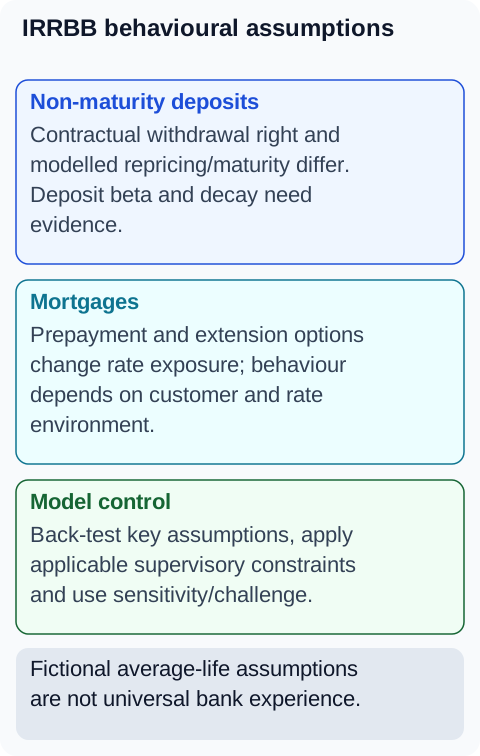
Non-maturity deposits: contractual overnight, behavioural years — modelled with decay profiles, pass-through rates (how much of market moves reach customer rates) and regulatory caps on assumed stickiness. Term deposits: early-redemption optionality under rate stress. Mortgages: conditional prepayment rates (CPR) varying with rate incentives, seasonality, burnout. Each assumption needs back-testing, sensitivity disclosure, and governance (model governance in Finance Data Governance and BCBS 239 and controlled changes in Delivering Accounting and Reporting Change). The 2022–23 rate shock rewrote many banks' deposit-stickiness models the hard way: flight happened faster than history suggested.
The behavioural modelling of non-maturity deposits is the most model-dependent component of IRRBB measurement. The contractual maturity of a current account is overnight — the customer can withdraw the entire balance at any time. But the behavioural maturity is years — most customers maintain their current account for long periods, regardless of rate changes. The gap between contractual and behavioural maturity is the "stickiness" of the deposit — and the stickiness is the key assumption in IRRBB measurement. If the model assumes that 80% of current accounts are sticky (behavioural maturity of 5 years), the bank's NII sensitivity to rate changes is much lower than if the model assumes that only 50% are sticky.
Back-test retention, migration and rate beta against recent rate and stress conditions. Historical persistence may overstate a bank's future stability when digital transfers, depositor concentration or pricing competition change. Compare modelled and realised behaviour by segment; material misses require documented reassessment. Illustrative 80% and 50% retention assumptions are sensitivities, not claims about the banking industry.
4.4 Hedging and hedge accounting preview
Economic hedges: interest-rate swaps (pay fixed/receive floating or reverse), balance-sheet shaping (issue fixed-rate bonds to match fixed assets), option purchases (caps/floors for optionality). The hedge-accounting chapters explain accounting: fair-value hedges for fixed-rate exposures, cash-flow hedges for floating-rate variability, portfolio (macro) hedges for portfolio interest-rate hedging under the applicable IAS 39 or IFRS 9 policy; the EU IAS 39 carve-out is jurisdiction-specific — designation, documentation and effectiveness testing decide whether P&L reflects the economics or whipsaws (see Hedge Documentation and Effectiveness and the related hedge-accounting chapters).
The hedging toolkit for IRRBB is extensive but has trade-offs. Interest-rate swaps are the most common hedging instrument — they allow the bank to convert fixed-rate exposures to floating (or vice versa) without changing the underlying assets or liabilities. But swaps create counterparty credit risk (the risk that the swap counterparty defaults), require collateral (which creates intraday liquidity demands), and require accounting under the applicable framework; electing qualifying hedge accounting adds designation, documentation and effectiveness requirements. Balance-sheet shaping is a lower-maintenance alternative — issuing fixed-rate bonds to match fixed-rate assets can reduce repricing mismatch without derivatives; cash-flow timing, optionality, basis and behavioural differences can leave residual risk. But balance-sheet shaping reduces flexibility (the bank is locked into the fixed-rate funding) and may not be possible in all markets (if the bank cannot issue fixed-rate bonds at acceptable cost).
5. Product and customer impact
IRRBB shapes what customers are offered: fixed-rate periods lengthen when treasury wants long assets (and shorten when it fears them); deposit pass-through lags market moves asymmetrically (up slow, down fast — conduct scrutiny applies); prepayment charges balance customer flexibility against reinvestment risk; teaser rates create repricing cliffs. Product teams must clear rate-sensitive launches with treasury — unhedged campaign volumes become gap positions overnight.
Deposit pricing affects customer outcomes as well as NII. Product governance must assess fairness, communication and relevant conduct obligations. There is no universal rule requiring every deposit rate to track each policy-rate move mechanically; contract terms and local conduct rules govern. Keep pricing assumptions distinct from assertions about a regulator's investigation or a mandatory pass-through formula.
Prepayment changes reinvestment and hedge economics. Assess contractual rights, local restrictions, conduct obligations and product disclosures before imposing a charge; some jurisdictions/products restrict or prohibit such charges. The bank’s economic break cost is not automatic authority to pass that cost to the customer. Model volume, reinvestment timing, funding repricing and derivative close-out effects together.
6. Regulatory and supervisory view
IRRBB framework (BCBS standards, EBA guidelines, PRA rules, RBI/Fed implementations — verify locally): standardised shocks, disclosure templates, outlier tests, governance expectations (ALCO ownership, independent risk measurement, audit coverage). ILAAP/liquidity adequacy runs the parallel liquidity proof (see Liquidity Risk and the Funding Profile). Supervisory examinations probe behavioural assumptions hardest — challenger models, sensitivity analysis and evidence of Board understanding are expected artefacts, not nice-to-haves.
Where applicable, ILAAP assesses liquidity adequacy over institution-specific short and longer horizons, including interaction with rates and other risks. LCR’s 30-day regulatory stress is one input, not a universal ILAAP survival target. Rate-driven deposit repricing, withdrawal and collateral movements need coherent scenarios without treating IRRBB and liquidity as identical measures.
The supervisory examination of behavioural assumptions is the most challenging aspect of IRRBB supervision. Supervisors use challenger models — independent models that re-estimate the bank's IRRBB using different assumptions — to test the bank's results. If the challenger model produces significantly different results (say, NII sensitivity 30% higher than the bank's model), the supervisor will challenge the bank's assumptions and may require the bank to adjust its model. The key assumptions under scrutiny are: deposit stickiness (what percentage of deposits are behaviourally stable?), pass-through rates (how much of rate changes reach customer rates?), prepayment rates (what percentage of loans prepay when rates change?), and the correlation between these assumptions and the rate scenario.
7. Systems and data view
ALM system: contract-level cash-flow projection (every loan, deposit, bond, derivative with repricing attributes), behavioural-model overlays, scenario engine (prescribed + internal shocks), EVE/NII calculators, hedge-design tools, and limit monitoring with ALCO dashboards. Data imperatives: repricing attributes complete per contract (rate type, reset dates, caps/floors, prepayment flags), behavioural parameters versioned, scenario definitions locked per cycle, and full rerun reproducibility for audit and supervisory challenge.
The ALM system is the technological backbone of IRRBB management. It must project cash flows for every banking-book instrument — loans, deposits, bonds, derivatives — over a multi-year horizon, applying behavioural assumptions and interest-rate scenarios. The system must support both regulatory scenarios (the prescribed shocks) and internal scenarios (custom scenarios that reflect the bank's specific risk profile). The system must also support sensitivity analysis — what happens if deposit stickiness is 10% lower than assumed? What happens if prepayment rates double?
The data quality requirements are exacting. Every instrument must have complete repricing attributes: rate type (fixed or floating), reference rate (SONIA, SOFR, etc.), reset date (when the rate next changes), maturity date (when the instrument matures), caps/floors (if applicable), and prepayment features (if applicable). Missing or incorrect attributes produce incorrect cash-flow projections, which produce incorrect IRRBB measurements. The data quality must be validated at every cycle — a completeness check (every instrument has all required attributes) and an accuracy check (the attributes match the contract terms).
8. End to end process
Quarterly IRRBB cycle: (1) freeze positions and validate repricing attributes; (2) run behavioural overlays with approved parameters; (3) compute EVE/NII across all prescribed + internal scenarios; (4) attribute moves (gap vs basis vs optionality vs new business); (5) test against limits and outlier thresholds; (6) propose actions (hedges, balance-sheet shaping, product-mix changes) to ALCO; (7) execute approved hedges; document designation at inception of the hedge relationship only where qualifying hedge accounting is elected; an existing derivative may be designated prospectively, without retroactive hedge accounting; (8) disclose per templates; (9) back-test and recalibrate models. Steps 4 and 9 separate managed IRRBB from measured-but-ignored IRRBB.
9. Controls and risks
| Risk | Control | Evidence |
|---|---|---|
| Stale repricing attributes | Attribute completeness checks, product-change triggers | Completeness dashboards, change logs |
| Behavioural model drift | Back-testing, sensitivity bands, challenger review | Back-test packs, validation reports |
| Single-lens hedging | Dual EVE+NII limit framework | Limit packs showing both lenses |
| Economic hedge and accounting effects differ | Assess normal derivative accounting versus elected qualifying hedge accounting; retain documentation from inception of the designated hedge relationship where elected | Accounting-policy decision and relevant hedge files |
| Outlier breach unmanaged | Escalation protocol, pre-agreed action menu | Escalation records, ALCO minutes |
10. Practical examples
A: Deposit repricing lag (fictional). On 100bn deposits, 60% current accounts reprice by 50bp and 40% term balances by 150bp. Weighted funding-cost change = 0.6 × 50 + 0.4 × 150 = 90bp, increasing annual cost 0.9bn if applied for a full year. Assets of 100bn repricing by 180bp add 1.8bn income, so the simplified NII uplift is 0.9bn. If only current-account rates rise another 100bp next year, annual cost rises another 0.6bn. A percentage decline in total NII needs the starting NII amount; it cannot be inferred as 15% from these figures alone.
B: Prepayment and funding (fictional). Refinancing changes an asset yield from 5.5% to 4%, reducing income 150bp on reinvested balances. If floating funding also falls from 2% to 0.5%, the margin on a matched balance remains 3.5%; the effect is not automatically a 150bp net loss. Timing, prepayment volume, funding beta and hedges decide the outcome. Loan principal repayment is Dr cash / Cr loan asset; new lending is Dr loan asset / Cr cash or customer deposit liability as applicable. EVE changes remain model results rather than journals unless the accounting basis requires remeasurement.
11. Diagrams
Figure 1. A simplified repricing gap.
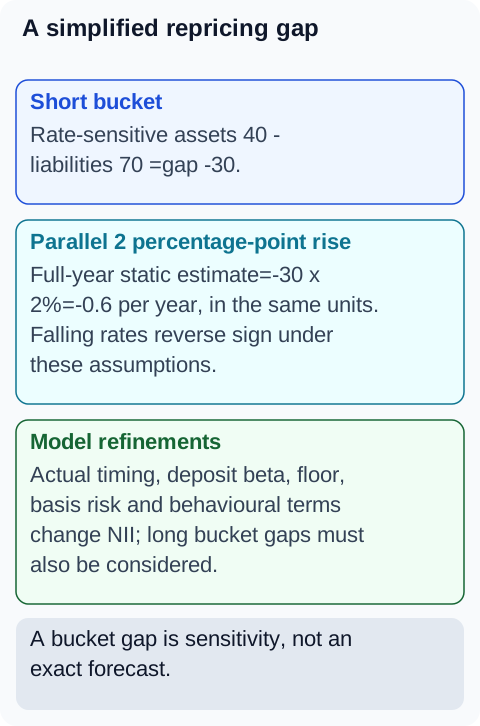
Figure 2. IRRBB: economic value and earnings.
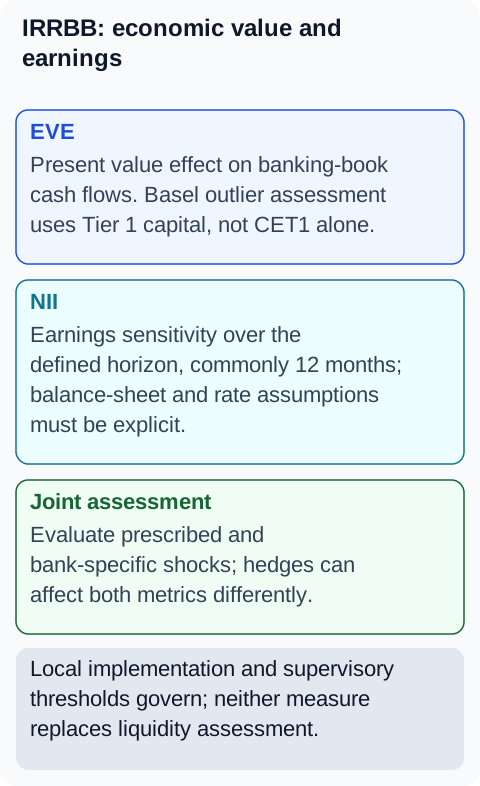
Figure 3. IRRBB behavioural assumptions.
12. Tables
Table 1 — IRRBB scenario toolkit
| Scenario | What it reveals |
|---|---|
| Parallel up/down | Gap direction and scale |
| Steepener / flattener | Tenor-concentration risk |
| Short-rate up/down | Funding-cost sensitivity |
| Basis widening | Reference-rate mismatch |
| Prepayment surge / deposit flight | Optionality tails |
| Historical replay (e.g., rapid-hike episode) | Behaviour under real stress |
Table 2 — Hedge instrument map
| Exposure | Hedge | Accounting home (preview) |
|---|---|---|
| Fixed-rate loans/bonds | Pay-fixed/receive-floating swap (offset fixed asset interest) | Fair-value hedge |
| Floating-rate funding variability | Pay-fixed swap (lock cost) | Cash-flow hedge |
| Pipeline (mortgages offered, not yet drawn) | Forward-starting swaps, swaptions | Cash-flow hedge (if eligible) |
| Portfolio of fixed assets | Portfolio hedge | Applicable IAS 39/IFRS 9 policy; EU carve-out is not universal |
| Prepayment optionality | Swaptions, callable funding | Option premium + effectiveness testing |
13. Illustrative banking case study
Long fixed assets, confidence-sensitive funding (fictional). A bank finances fixed-rate securities with withdrawable deposits. Higher rates reduce securities' fair values and raise funding competition; withdrawals can force sales. Unrealised economic value loss, recognised OCI or profit-and-loss effects, and prudential capital treatment depend on the accounting classification and jurisdiction. The scenario demonstrates interacting rate and liquidity risk; it is not an account of a specific 2023 bank's losses or regulatory compliance.
14. BA, developer, tester and operations guidance
- BA: Specify repricing attributes per product, behavioural parameters with sources, scenario sets, and dual-lens limit definitions — with hand-worked gap examples.
- Developer: Project cash flows from contracts deterministically; version behavioural parameters; lock scenario definitions per cycle; make reruns bit-reproducible.
- Tester: Recompute EVE/NII independently on sample portfolios; test boundary scenarios, behavioural extremes, and hedge-designation linkages to accounting.
- Operations: Guard attribute completeness at product setup; calendar the quarterly cycle with owner deadlines; track limit usage intraday for traded components.
15. Common mistakes
- Managing NII while ignoring EVE (or vice versa).
- Treating contractual maturities as behavioural truth.
- Assuming deposits stay sticky because they always have.
- Assuming economic hedging automatically qualifies for or requires hedge accounting; assess residual risk and the actual accounting effects.
- Running scenarios but never acting on breaches.
- Failing to back-test behavioural models against recent rate shocks.
- Ignoring the interaction between IRRBB and liquidity risk.
16. Key takeaways
- Gap × rate move ≈ NII impact; EVE captures the full value consequence.
- Both lenses need limits — single-lens hedging relocates risk, not remove it.
- Behaviour (stickiness, prepayment) dominates contractual terms in outcomes.
- Standard shocks + outlier tests make IRRBB supervisory-consequential.
- Hedge accounting is a policy/eligibility decision with documentation and effectiveness conditions; economic hedges can exist without designation.
17. References and verification notes
- BCBS IRRBB standard and final shock recalibration: IRRBB measurement, outlier test and1January2026 international implementation date for revised shocks. Local implementation determines enforceable dates and any additional NII outlier measure.
- IFRS 9: hedge-accounting eligibility and documentation; portfolio and IAS 39 choices require framework-specific assessment.