Chapter 049: Hedge Documentation and Effectiveness
Section 10: Hedge Accounting and Balance Sheet Management · Chapter 049 of 100
1. Chapter opening
Document a qualifying hedge at inception of the relationship. The instrument need not be newly traded: an existing derivative can be designated from a later valid inception, prospectively. Record the actual inception timestamp and valuation; do not invent a day-one designation to erase prior undesignated P&L.
Under IFRS 9, demonstrate an economic relationship, credit risk not dominating the resulting value changes, and a hedge ratio reflecting actual risk management without deliberate accounting imbalance. IAS 39 and ASC 815 need their own documented methods and criteria.
2. Learning objectives
- Assemble an identifiable item, instrument, risk, objective and hedge ratio.
- Establish valid inception timing and eligibility evidence.
- Apply IFRS 9 qualification without importing IAS 39's numeric band.
- Assess changes, ineffectiveness, rebalancing and discontinuation.
- Preserve reproducible valuations, journal evidence and IFRS 7 disclosures.
3. Business context
Risk management may act before accounting designation. Finance must distinguish economic hedge trade approval from designation approval. A pending documentation workflow does not entitle the bank to recognise OCI while waiting.
The designation should explain the risk source in ordinary banking terms: fixed-rate loan benchmark exposure, floating-rate funding variability, highly-probable currency cash flows or foreign-operation translation. The purpose informs risk selection and assessment; vague descriptions such as 'reduce volatility' are insufficient to identify what is actually measured.
4. Finance and accounting view
4.1 Documentation contents
Identify the instrument by trade ID, entity, counterparty, maturity and designated proportion; identify the item by contract or eligible population, currency, timing and quantity. Define the risk component and evidence that it is separately identifiable and reliably measurable where required. Record the risk-management objective, strategy, hedge type, ratio, assessment method and expected sources of ineffectiveness.
For forecast transactions, retain highly-probable support and enough specificity to determine whether an actual event is the hedged event. A hypothetical derivative can help measure an item's cash-flow change but is a measurement technique, not a device to insert derivative features absent from the item.
4.2 Assessment and measurement
Matching critical terms may support a qualitative assessment when appropriate. Mismatched reset dates, indices, maturities, credit exposure, basis or prepayment assumptions can require quantitative analysis. A high correlation or regression R² is evidence, not the whole IFRS 9 test. Assess at inception and on an ongoing basis, at least at each reporting date or significant change, under the applicable policy.
Measure accounting ineffectiveness separately from qualification. Fictional asset fair-value hedge has instrument gain 5 and designated-risk item loss 4.8: P&L gain 0.2. A 90% or 104.17% offset calculation alone neither guarantees IFRS 9 qualification nor demonstrates every IAS 39 requirement.
4.3 Rebalancing versus ending
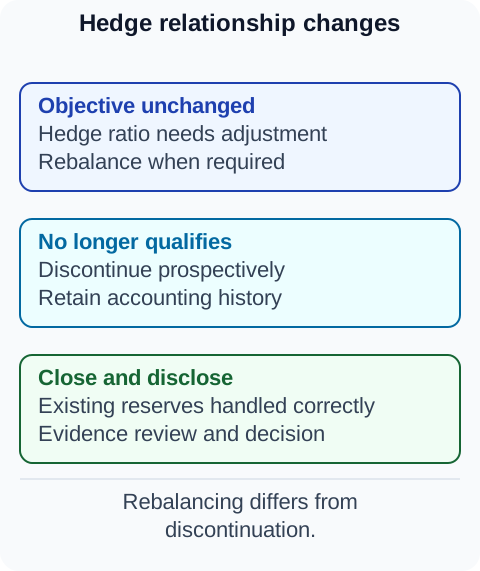
When the IFRS 9 risk-management objective remains the same but a ratio change is needed to keep qualification, apply the rebalancing requirements, measure ineffectiveness first and update documentation. It is a continuation where the criteria are met. If the objective changes or qualification ceases after applicable rebalancing, discontinue prospectively for the affected portion.
Voluntary discontinuation solely to achieve a preferred accounting result is not permitted for an IFRS 9 relationship that still meets its objective and qualification. IAS 39 policy treatment must be considered independently rather than copying that IFRS 9 rule.
4.4 Correcting mistakes
Separate a current estimate change, a genuine exposure event and an error using IAS 8. A missed material historic entry may need retrospective correction; a new model assumption based on new information is not automatically a prior-period error. Preserve original and corrected calculations and obtain financial-reporting approval. Never rewrite archived designation dates or validation results.
5. Product and customer impact
Documentation changes the bank's accounting, not the customer's contract. A relationship discontinued for accounting may remain an economic hedge. Management reports should identify that difference to avoid liquidating an economically useful trade merely because OCI qualification has ended.
Transparent reporting explains the actual causes of ineffectiveness. An apparent perfect offset may be caused by incorrect valuation inputs, omitted credit adjustments or measuring both sides with the same unsuitable model.
6. Regulatory and supervisory view
IFRS 9, retained IAS 39, local endorsement and US ASC 815 are distinct. IFRS 9 does not impose a universal 80-125% retrospective band. Supervisory model-risk guidance and IRRBB requirements supplement governance within their jurisdiction and scope; they do not replace financial-reporting qualification.
IFRS 7 hedge disclosures connect strategy to instruments, item changes, reserve/basis movements and ineffectiveness. Accounting policy and applicable local differences should be visible before a reviewer compares hedge results across banks.
7. Systems and data view
A designation register should be immutable for original approved versions, with subsequent amendments timestamped. Store item/instrument links, quantities, risk, framework, objective, assessment, valuation source, model version, approvals and status. Preserve rejected designations as well as successful ones.
Access controls should separate trade capture, valuation changes, designation approval and journal release proportionately. A document signed after period end cannot prove that required inception documentation existed earlier; retain actual contemporaneous evidence.
8. End to end process
- Capture economic objective and proposed relationship.
- Check eligibility and forecast/component evidence.
- Complete and approve documentation at valid inception.
- Lock original version and produce initial valuation evidence.
- Monitor terms, credit, quantities and objective changes.
- Assess qualification, measure ineffectiveness and process allowed changes.
- Reconcile journals and deliver the disclosure/evidence pack.
9. Controls and risks
| Risk | Control | Evidence |
|---|---|---|
| Backdated designation | Timestamped inception workflow | Original approved record |
| Unsupported forecast | Probability evidence and event matching | Forecast/actual bridge |
| Wrong framework | Explicit policy field and test method | Policy approval |
| Deliberate ratio imbalance | Compare designation to risk management | Quantity and sensitivity analysis |
| Credit dominates | Credit-spread/counterparty review | Assessment conclusion |
| Unrecorded change | Event-driven reassessment | Versioned amendment |
10. Practical examples
Fictional late designation: a swap traded 1January is validly designated 1March with fair value 2. Its pre-designation gain remains accounted for under the ordinary derivative policy. A subsequent gain 3 is assessed under the new relationship; no retrospective reclassification of the January-February gain is justified.
Fictional credit deterioration: a derivative economically tracks benchmark rates but counterparty credit deterioration dominates its change. Escalate the IFRS 9 credit-risk criterion; matching rate sensitivities does not overcome it.
Fictional monitoring metric: regression slope 1.08 and R²0.92 pass bank monitoring limits. The review still examines eligible risk, documented objective, forecast probability and credit dominance. Passing two numbers is not blanket permission for hedge accounting.
11. Diagrams
Figure 1. Document an IFRS 9 hedge.
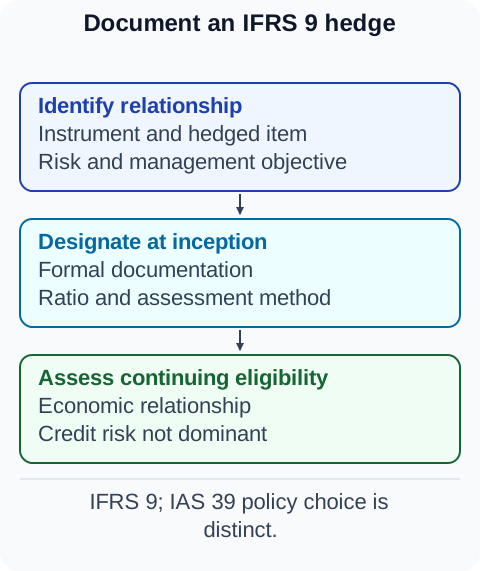 Figure 2. Effectiveness requirements.
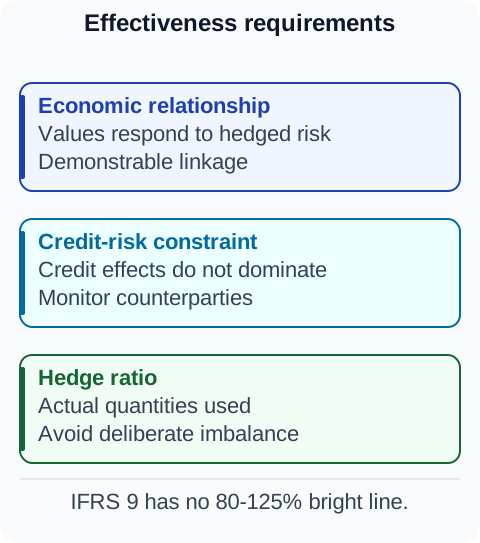 Figure 3. Hedge relationship changes.
12. Tables
| Documented field | Review question |
|---|---|
| Risk and component | Is the measured risk the designated risk? |
| Ratio and quantities | Do they reflect actual risk management? |
| Method | Does it fit known mismatches and chosen framework? |
| Inception | Is contemporaneous evidence available? |
| Forecast support | Can actual occurrence be matched objectively? |
| Change record | Continuation, rebalance or discontinuation, and why? |
13. Illustrative bank case study
Fictional bank case: traders economically hedge a planned foreign-currency issuance, while the designation file describes only a generic funding programme. Finance cannot identify the hedged amount and period. The bank recognises the undesignated derivative result, specifies an eligible future relationship and designates it prospectively when the requirements are met. Documentation is corrected without rewriting history.
14. BA, developer, tester and operations guidance
- BA: Define designation data, valid timing, framework and event controls.
- Developer: Preserve original versions; separate approvals and valuation/journal services.
- Tester: Test late designation, rejected approval, credit dominance, quantity reduction and framework-specific assessment.
- Operations: Maintain evidence, monitor changes and reconcile close disclosures.
15. Common mistakes
- Assuming economic intent alone permits OCI accounting.
- Backdating designation or copying an old forecast file.
- Applying one effectiveness band to every framework.
- Confusing qualification with the amount of ineffectiveness.
- Calling every ratio update a new designation.
- Releasing surviving reserves or basis without hedge-type analysis.
16. Key takeaways
- Required documentation must exist at valid relationship inception.
- Existing instruments can be designated prospectively.
- Qualification is framework-specific and more than a correlation metric.
- Monitor credit, quantities, objective and probability changes.
- Reproducible valuation and immutable evidence support the journals.
17. References and verification notes
- IFRS 9 documentation and assessment
- IAS 39 hedge requirements
- IFRS 7 disclosures
- IAS 8 correction principles
- Rules are applied under the reporting entity's adopted accounting framework and jurisdiction. Basel standards require local implementation; they are not themselves national law. All unnamed cases, amounts and operational thresholds are fictional training examples.