Chapter 096: Finance Data Governance and BCBS 239
Section 20: Finance Data, Change Delivery and Practical Capstones · Chapter 096 of 100
Finance and Risk need governed measures, complete populations and reproducible reports. BCBS 239 supports those capabilities; this chapter applies its principles without inventing universal architectures, deadlines or capital penalties.
1. Chapter opening
BCBS 239 contains 14 principles:11 focused on banks’ governance, risk-data aggregation and reporting, plus 3 on supervisory review, remedial action and supervisory cooperation. The bank principles cover governance and architecture; accuracy/integrity, completeness, timeliness and adaptability; and accurate, comprehensive, clear/useful, appropriately frequent and distributed risk reports. The original scope focused on systemically important banks; national supervisory application and subsequent expectations require assessment. It is not a globally self-executing law or a universal “answer every question within hours” rule.
2. Learning objectives
- State BCBS 239 principles grouped (governance, accuracy, completeness, timeliness, adaptability).
- Design golden-source/MDM architecture with survivorship rules.
- Implement lineage catalogues queryable from report to source.
- Set DQ rules with quarantine and SLA discipline.
- Run aggregation with manual-adjustment governance (expiry, attribution).
3. Business context
Good data governance supports limits, pricing, close and reporting. A failed data control can prompt supervisory action, but there is no automatic universal 50–100bp capital add-on or staffing/cost benchmark. Capital requirements commonly use risk-weighted amounts or other defined bases, not an arbitrary total-balance-sheet multiplication. A CDO can coordinate governance; named business/Finance data owners still need clear decision rights and accountable controls.
4. Finance and accounting view
4.1 Critical data and measures
For each critical data element, document meaning, owner, authoritative source for its particular use, quality checks and consumers. Contractual principal, IFRS carrying amount, regulatory EAD and collateral market value are different measures. A source-system field is not automatically authoritative for every purpose: loan servicing can supply principal, Finance supplies fee/ECL measurement, Risk supplies approved model inputs and Reporting applies return-specific scope.
Master-data survivorship must be field-specific, with provenance and conflict resolution. “Most recent wins” can overwrite an authoritative legal entity with a bad upload. Accounting consolidation, legal ownership and prudential connected-client groups are different relationships; preserve the reasons for each grouping.
4.2 Reconciliation and snapshots
Suppose a 10m contractual loan population includes accrued interest 0.1m, unamortised integral fees 0.05m and ECL0.2m. Gross carrying amount is 10.05m; net is 9.85m. A regulatory exposure measure may also include undrawn commitments and its prescribed adjustments. Reconcile components, entity/currency, dates and population before declaring a mismatch. A balanced GL does not establish complete risk data; a matching portfolio total can still hide borrower misclassification.
Preserve the reporting-date input/run/mapping versions and any approved adjustment. Retain earlier and corrected snapshots so a refiling is reproducible. A later data correction does not automatically require a formal financial-statement restatement; determine its accounting/reporting status, materiality and actual correction process.
4.3 Manual adjustment governance
The register needs amount, accounts/data points, legal entity, currency, period, reason, source evidence, maker/reviewer, affected reports and remediation status. Review age, recurrence and concentration. A structural data fix should reduce workarounds; legitimate recurring valuation, consolidation or accounting estimates may remain necessary manual processes. Increasing adjustment count does not by itself prove architecture decay, and “zero all manual journals” is not a sound goal. Expiry of an approval or review date must trigger reassessment—not silently reverse a valid recognised balance.
4.4 Capability and self-assessment
Assess each applicable bank principle with evidence and acknowledge gaps. Supervisory principles describe the supervisor’s role; the bank supports review with evidence. Run risk-based aggregation drills for the actual required stress timeframe, with known perimeters, control totals, stale-data flags and lineage. Controlled spreadsheets/EUC are not universally forbidden; inventory, access, versioning, independent review and reconciliation apply to their risks. Funding and prioritisation should address specific deficiencies rather than invented industry ROI numbers.
5. Product and customer impact
Entity resolution and quality affect customer limits, servicing and communications. Use an appropriate lawful basis for personal data, not consent as the only basis. Bank processing may depend on contract, legal obligation or another applicable basis; special-category and cross-border processing have additional tests. Apply minimisation, access control, lawful retention and correction while preserving required reporting/audit evidence. A deletion request does not automatically override statutory retention.
6. Regulatory and supervisory view
BCBS 239, local risk-data guidance, financial-reporting controls and privacy duties have distinct scopes. Confirm the bank’s actual supervisory perimeter and remediation requirements. Poor risk-data capability can influence supervisory measures, but no one-to-one automatic SREP score, P2R uplift or distribution ban is prescribed here. Do not compute a hypothetical RWA-based capital add-on on total assets.
7. Systems and data view
A reference architecture can include source ingestion, governed identity/reference data, accounting/risk enrichment, versioned snapshots, quality/reconciliation services and report lineage. Batch, intraday or real-time processing follows the risk and reporting need; BCBS 239 does not mandate every source change stream immediately. Record accepted, rejected and pending populations, manual adjustments and final report acceptance. Make lineage traceable through transformations and aggregations without exposing unauthorised personal information.
8. End to end process
- Identify reports, applicable principles and critical measures.
- Assign owners and authoritative sources by use.
- Map population and transformation lineage.
- Reconcile quality and measurement differences.
- Govern adjustments and preserved snapshots.
- Self-assess gaps and remediate with evidence.
- Test stress timeliness and recovery under realistic conditions.
9. Controls and risks
| Risk | Control | Evidence |
|---|---|---|
| Orphan data | Ownership register | Coverage reports |
| Ungoverned spreadsheet aggregation | Risk-appropriate EUC controls or migration to a governed platform | Inventory, version/review records and output proof |
| Unreviewed topsides | Attribution, review dates and source-remediation tracking; preserve valid balances | Adjustment analytics and renewal/correction decisions |
| Drill failure | Crisis-aggregation exercises | Drill packs |
| Lineage gaps | Queryable lineage catalogue | Lineage samples |
| DQ rule bypass | Quarantine + SLA enforcement | Quarantine reports |
| Snapshot tampering | Immutability + audit trail | Snapshot logs |
| Schema-change disruption | Schema-change governance | Change logs |
10. Practical examples
Fictional drill: a request arrives 09:00; team obtains a dated CRE population 09:10; draft 09:35 identifies 40m stale/missing collateral valuations; a 60m risk/Finance difference is reconciled 10:05 using explicit timing and measure bridges; delivered 10:20 with limitations. Elapsed 80 minutes, not 90. A10:30 follow-up answered 10:45 takes 15 minutes. A haircut is not automatically a valid substitute for a missing valuation; use a documented permissible estimate and state limitations.
**Adjustment trend:**300→250→180→120→60 over five observations is an 80% reduction from 300, not zero within four quarters. Assess whether reduced workarounds reflect genuine source repair or missing required adjustments.
Capital illustration: an assumed 25bp requirement increase on 100bn RWA would require 250m additional capital; at an assumed 10% annual capital charge,25m/year. This is arithmetic, not a claim that a failed drill produces that supervisory uplift. Do not substitute a 100bn total balance sheet for 100 bnRWA, or claim causal ROI without probability and cash-benefit evidence.
11. Diagrams
Figure 1. Trace finance data.
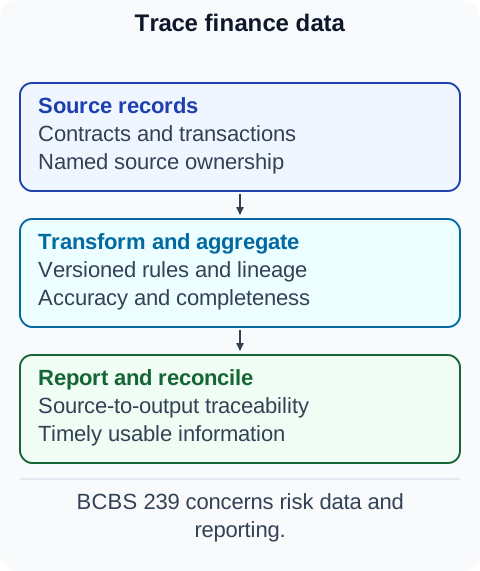 Figure 2. Data governance roles.
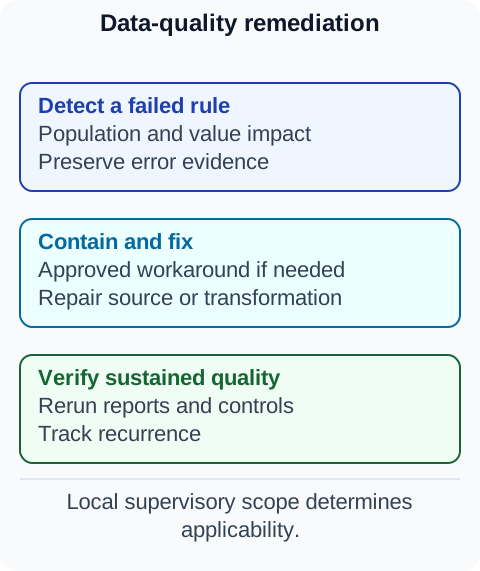
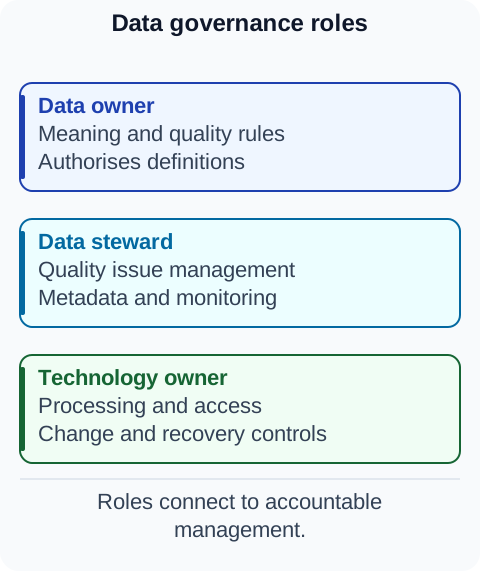 Figure 3. Data-quality remediation.
12. Tables
| Governance record | Required distinction |
|---|---|
| Owner/source register | Authoritative by measure and use |
| Entity relationships | Legal, accounting and prudential grouping |
| Reconciliation | Population, date, perimeter and measurement bridge |
| Adjustment register | Valid recurring estimate versus structural workaround |
| Snapshot versions | Original, approved changes and corrected filing |
| Drill result | Actual elapsed time, accuracy, completeness and limitations |
13. Illustrative bank case study
The entity was absent from the query. In this fictional case, a group exposure response omitted two subsidiaries. The total had matched the selected entities but not the required group perimeter. Review corrected the population, explained the impact and added perimeter checks. No real bank’s CDS spread, remediation cost or automatic supervisory penalty is asserted.
14. BA, developer, tester and operations guidance
- BA: Specify owners, golden sources, lineage scope and DQ rules per critical element.
- Developer: Build MDM/snapshots/lineage/DQ as platform, not project code; enforce adjustment review dates technically; never reverse a valid recognised balance solely because approval expires.
- Tester: Lineage sampling; drill execution; review-expiry alerts and valid-balance preservation.
- Operations: Work DQ quarantine daily; track topside ageing like breaks.
15. Common mistakes
- Counting 11 as the complete BCBS 239 principles.
- Treating one source/field as authoritative for all measures.
- Mixing accounting and prudential perimeters.
- Reversing valid balances solely because an adjustment review expired.
- Claiming an automatic capital uplift from a drill result.
- Treating controlled EUC as automatically prohibited.
16. Key takeaways
Ownership, explicit measures, complete perimeters, reproducible transformations and independent reconciliation underpin risk-data governance. Assess actual scope and capabilities; improvement metrics must measure reliable outcomes.
17. References and verification notes
- BCBS 239: 14 principles:11 bank-focused plus 3 supervisory; scope and domestic application need assessment. No prescribed universal database, staffing or response deadline.
- ICO lawful-basis guide: current UK guidance updated 2 April 2026 lists seven lawful bases, including recognised legitimate interest; select the applicable basis and additional conditions rather than assuming consent is universal.
- IFRS 9: accounting classification/impairment and prudential risk measures are separate; use endorsed period version.
Fictional drill times and capital arithmetic. BCBS 239 is a 14 principle framework; local scope and supervisory requirements remain distinct. ICO guidance concerns UK data protection; other jurisdictions and special processing need their own legal assessment.