Chapter 079: Intraday Liquidity and Collateral Management
Section 16: Liquidity, Funding and Interest Rate Risk · Chapter 079 of 100
10:42 a.m.: the RTGS queue holds 12 payments worth 800 million, the USD nostro hits its cap in 20 minutes, and a margin call for 50 million just landed. End-of-day ratios mean nothing right now — only intraday cash and collateral decide whether the bank pays on time. This chapter runs intraday liquidity hour by hour: positioning, forecasting, collateral mobilisation, and the controls that prevent a daylight overdraft becoming a default.
1. Chapter opening
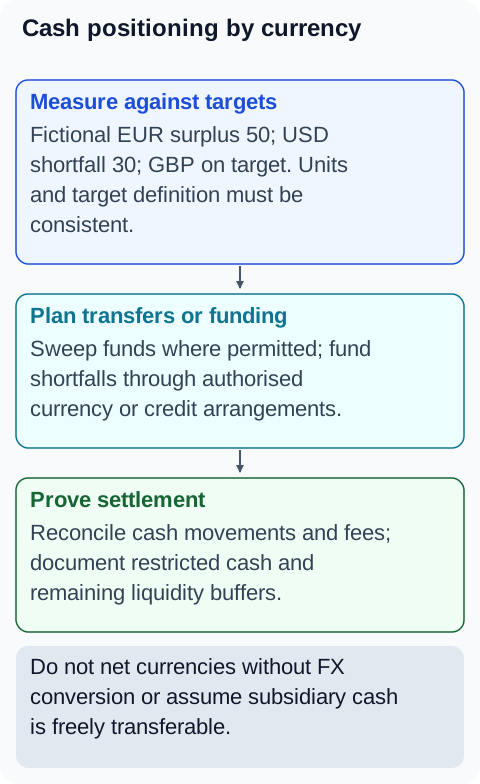
Intraday liquidity is the ability to meet payment and settlement obligations as they fall due during the day. Unlike LCR’s prescribed 30-day stress measure and NSFR’s one-year structural funding horizon, intraday is a real-time battle against queues, cut-offs and margin calls, fought with opening balances, intraday credit lines, collateral and prioritisation. Cash positioning — sweeping currencies and entities to target balances — is its daily routine. This chapter covers the timetable, the tools, collateral mechanics, and the reporting supervisors demand.
The distinction between intraday liquidity and longer-term liquidity metrics (LCR, NSFR) is fundamental. The LCR compares eligible HQLA with prescribed 30-day stressed net outflows; it does not guarantee survival or timely settlement. The NSFR measures whether the bank's funding profile is sufficiently stable over a one-year horizon. Neither metric addresses the bank's ability to make payments during the business day. A bank can have an LCR of 200% and an NSFR of 120% but still fail to meet its payment obligations at 11:00 a.m. because it cannot mobilize cash quickly enough. This is the intraday liquidity challenge — and it is a daily, real-time operational risk.
The consequences of intraday failure are severe. A missed RTGS payment does not just affect the bank — it cascades through the payment system, affecting counterparties, clearing systems, and ultimately the broader financial system. The Basel Committee's guidance on intraday liquidity management (BCBS d 248) emphasizes that intraday failures can undermine confidence in the payment system and create systemic risk. Supervisors therefore require banks to monitor, measure, and manage intraday liquidity with the same rigor they apply to longer-term liquidity metrics.
2. Learning objectives
By the end of this chapter you will be able to:
- Walk the intraday timeline from opening balances through cut-offs to close.
- Forecast intraday needs: opening position + expected flows + buffers.
- Explain collateral mechanics: pledging, haircuts, margin calls, encumbrance.
- Position cash across currencies and entities with sweep journals.
- List intraday tools: queues, priorities, intraday credit, liquidity-saving mechanisms.
- Describe intraday reporting (BCBS intraday tools) and escalation triggers.
3. Business context
An intraday failure can create immediate settlement and liquidity disruption: missed RTGS payments cascade to counterparties, settlement-system penalties accrue, and counterparties cut limits — turning one bad day into a funding event. Collateral is the fuel: pre-positioned eligible assets convert to intraday credit, but encumbered or ineligible collateral doesn't count, and margin-call spirals (falling prices → more collateral → fire sales) transmit market stress into liquidity stress. Treasurers consider observed peak usage, stressed payment timing, eligible resources, mobilisation constraints and contingency capacity when sizing daylight buffers; averages alone conceal peaks.
The collateral dimension deserves particular emphasis. Collateral is the lubricant of the financial system — it secures exposures, enables credit, and facilitates settlement. But collateral is only useful if it is eligible, unencumbered, and available when needed. A bank that holds 100 billion of government bonds may discover that 80 billion is already pledged as collateral for existing obligations, leaving only 20 billion available for new needs. If a margin call of 30 billion arrives, the bank must either find additional eligible collateral (which may not be available), sell assets (which may crystallize losses), or draw on intraday credit facilities (which may not be available in stress). The collateral management challenge is therefore not just about having enough collateral — it is about having the right collateral, in the right place, at the right time.
Maintain a versioned operating-hours and cut-off matrix for each system, service, currency, holiday calendar and daylight-saving convention, including the bank's earlier customer cut-off. T2 replaced TARGET2 in 2023; T2, CHAPS and Fedwire have distinct message deadlines and business-day rules. A single generic clock time is unsafe. An instruction accepted before a cut-off is not proof of settlement; confirm final system status and settlement-account movement.
| Time | Battle | Tool |
|---|---|---|
| Open | Know starting position per currency/account | Opening feeds, credit-line confirmations |
| Morning | Client outflows, salary batches | Prioritisation, queue management |
| Midday peak | RTGS bulge, margin calls, cross-currency needs | Intraday credit, collateral mobilisation, sweeps |
| Cut-off sequence | Currency deadlines cascade | Fund-or-fail decisions, client communication |
| Close | Square positions, report usage | Sweep to targets, file intraday metrics |
4. Finance and accounting view
4.1 Positioning journals (fictional, single currency, millions)
All entries are from the bank's perspective. Transfer 30 from the bank's own central-bank account to its own correspondent account: Dr nostro asset 30 / Cr central-bank cash asset 30. The correspondent statement and central-bank debit must reconcile to the transfer identifier; a payment acknowledgement alone is insufficient. A transfer between legal entities additionally creates reciprocal intercompany receivable/payable entries, eliminated only in consolidation.
Draw 100 of collateralised intraday credit: Dr central-bank cash 100 / Cr intraday borrowing 100. Repay principal: Dr intraday borrowing 100 / Cr central-bank cash 100. A separately charged fee is Dr fee expense / Cr cash for the actual fee. Availability, fees and interest depend on the facility; some central-bank intraday credit is interest-free if repaid on time. It cannot be treated as universally charged overnight lending.
An FX swap exchanges currencies on the near leg and reverses on the far leg. Book both currency cash movements and recognise the derivative under the applicable accounting framework; do not represent it as a single-currency 'FX-swap payable'. Maintain functional-currency translation, settlement-risk and forward-value records.
Returnable cash initial margin: Dr margin receivable 20 / Cr cash 20, subject to the contract and accounting policy. Variation margin may be collateral or legal settlement of the derivative exposure; settlement-style margin reduces the derivative balance instead of automatically creating a receivable. Recognise fair-value losses separately. Pledged securities normally remain on balance sheet unless derecognition criteria are met, with encumbrance and custody records updated.
4.2 Collateral mechanics
Eligible collateral (central-bank frameworks, CCPs, bilateral CSAs — each with own haircut tables): pledged value = market value × (1 − haircut). Price falls trigger margin calls: top up with cash or securities same-day (often intra-hour). A missed call can lead to default or close-out only under the actual agreement, cure periods, legal enforceability and applicable safeguards. Collateral realisation and netting are contractual/legal processes, not automatic consequences of every delay. Rehypothecation rights (where permitted) let received collateral be reused — multiplying interconnectedness, tracked under disclosure rules. Wrong-way risk (collateral correlated with counterparty default) gets dedicated supervisory attention.
Collateral capacity equals eligible market value after the collateral taker's contractual or regulatory haircut, concentration limits and existing use. For an illustrative asset value of 100 and haircut 2%, capacity is 98. If value falls to 90 and the haircut becomes 10%, capacity falls to 81, a 17 reduction. Haircuts vary by instrument, maturity, currency and facility; they are not universal ranges for all government or corporate bonds.
Reuse requires a legal right, operational control and compliance with segregation requirements. Uncleared initial margin under the BCBS-IOSCO framework is subject to protection arrangements and constrained reuse; received CCP initial margin is not a free inventory of collateral for a participant to rehypothecate. Variation margin and repo collateral have different legal treatments. Track ownership, return obligations, reuse consent and location without counting the same available asset twice.
4.3 Forecasting and buffers
Forecast opening resources, confirmed queues, expected client receipts, funding maturities, margin calls and cut-offs. Size available resources using observed peak usage, plausible stressed timing, collateral eligibility, mobilisation speed and contingency capacity. Historical maximum plus an add-on is one design input, not a prescribed universal buffer formula. Investigate breaches for data, modelling, market, operational and funding causes; do not automatically blame the model or dismiss market changes.
The forecasting challenge is that intraday flows are inherently uncertain. While confirmed payment queues provide a reliable picture of outbound flows, inbound flows are less predictable — a corporate client may delay a payment, a correspondent bank may process a transfer slowly, or a central bank may settle a transaction at an unexpected time. The forecast must therefore incorporate both the expected flows and the uncertainty around those flows, typically through a range of scenarios (best case, base case, worst case) rather than a single point estimate.
An average usage of500m cannot explain a2bn observed peak. Assess that peak and scenarios exceeding it, the time and location of resources, reliable intraday credit and mobilisation constraints. Avoid counting the same cash/collateral twice; a single historical maximum does not alone prescribe the buffer required by every institution.
5. Product and customer impact
Intraday discipline surfaces as payment reliability: time-critical payments (completions, M&A closings, salary files) met or missed; cut-off promises kept; margin-call-driven asset sales that move client-portfolio pricing. Corporate intraday credit lines (daylight overdrafts) are products with their own pricing and limits — under-priced daylight exposure subsidises client risk with bank liquidity. Customer communication during intraday stress ("your payment will settle in the next cycle, here's the confirmation") needs pre-written playbooks, not improvisation.
The corporate intraday credit product is an important example of how intraday liquidity management affects product design. Corporates with volatile cash flows may need intraday credit to cover short-term funding gaps — for example, a corporate that must pay its suppliers at 10:00 a.m. but does not receive customer payments until 2:00 p.m. The bank can provide a daylight overdraft facility that covers the gap, with pricing that reflects the bank's cost of providing the intraday credit (central-bank fees, collateral costs, operational costs). The pricing must also reflect the risk that the corporate may not receive the expected inflows — if the customer payments are delayed, the daylight overdraft becomes an overnight overdraft, which carries higher costs and different regulatory treatment.
The customer communication dimension is often underestimated. When a payment is delayed — whether because of a system issue, a margin call, or an intraday liquidity constraint — the customer needs timely, accurate information about the status of the payment and the expected settlement time. Pre-written communication templates, approved by legal and compliance, ensure that the bank's response is consistent, accurate, and compliant with regulatory requirements (including applicable confidentiality and AML suspicious-activity tipping-off restrictions where relevant; fraud delay alone does not impose a universal tipping-off prohibition).
6. Regulatory and supervisory view
BCBS intraday-liquidity monitoring tools (daily maximum usage, available balances, time-specific obligations, client payments made on behalf of others, among the standard set) are the supervisory lens — reported with escalation triggers, and capability assessed in SREP/liquidity reviews. Client-money and settlement-system rules impose hard deadlines. Collateral frameworks (central-bank eligibility, CCP margin models under EMIR-style regimes, uncleared-margin rules UMR) dictate what counts and when — verify the applicable regime locally. Assess incident notification against the applicable supervisor, payment-system and operational-resilience rules; not every delay has the same notification duty.
The BCBS toolset distinguishes seven measures. For all reporting banks: daily maximum intraday liquidity usage, available intraday liquidity at the start of the day, total payments and time-specific obligations. Correspondent banks additionally measure payments made on behalf of correspondent customers and intraday credit lines extended to customers. Direct payment-system participants additionally measure intraday throughput. Daily maximum usage derives from cumulative net debit/credit positions; preserve the daily profile and the three largest negative and three largest positive daily cumulative net positions and the daily averages over the reporting period. For opening available liquidity, report the three smallest daily amounts and their daily average, not merely the busiest day.
Uncleared derivative margin rules apply by counterparty type, thresholds, exemptions and local implementation. Initial margin addresses potential future exposure; variation margin covers current exposure. Initial margin may be calculated using an approved model or standard schedule under applicable rules, not invariably SIMM. Segregation and reuse restrictions protect posted initial margin. Capture margin calls, settlement deadlines and disputes independently from derivative valuation and accounting treatment. BCBS-IOSCO margin framework.
7. Systems and data view
Intraday stack: real-time position monitor (per currency, account, system), payment-queue dashboard with priority controls, collateral inventory with eligibility/haircut engines, margin-call workflow with deadline tracking, forecasting engine with pattern/behavioural models, and escalation alerting (queue depth, cap proximity, cut-off countdowns). Data rules: positions in real time (not EOD snapshots), collateral valued intraday with haircut tables versioned, forecasts back-tested, and all intraday actions logged for the post-day review.
The real-time position monitor is the nerve centre of intraday liquidity management. It must aggregate positions across all currencies, accounts, and systems — including nostro accounts, vostro accounts, central-bank settlement accounts, payment system queues, and intraday credit facilities. The monitor must update in real time (or near-real time) as payments are submitted, settled, and returned. The monitor must also provide visibility into the bank's position relative to its limits — daylight overdraft limits, payment queue thresholds, and collateral eligibility limits.
The forecasting engine is the proactive component of the intraday stack. It uses historical payment patterns (day-of-week effects, month-end effects, payroll cycles, seasonal patterns) to predict the bank's intraday cash position throughout the day. The forecast is updated continuously as actual flows are received, providing a rolling forecast-vs-actual comparison that identifies deviations early. The forecast must also incorporate known future events — large payments, margin calls, funding maturities — that are scheduled but not yet settled.
8. End to end process
One business day: (1) pre-open: confirm balances, lines, collateral, forecast; set priorities; (2) morning: release client batches, watch queues; (3) midday: fund peaks, meet margin calls, sweep currencies; (4) cut-off cascade: fund-or-fail decisions per currency with client notices; (5) close: square to targets, repay intraday credit, file usage metrics; (6) post-day review: forecast-vs-actual, breach analysis, buffer adequacy. Steps 1 and 6 are where control lives — the day itself is execution.
The pre-open step (step 1) is the foundation for the entire day. It involves confirming the opening balances across all accounts, verifying that intraday credit lines are available and undrawn, confirming that collateral is eligible and unencumbered, running the forecast for the day, and setting priorities for payment processing. The pre-open should be completed before the payment systems open — typically 30–60 minutes before the first settlement cycle. The pre-open is not just a technical exercise — it is a decision-making process. If the forecast shows a shortfall in a particular currency, the treasury must decide whether to fund the shortfall (via FX swap, HQ transfer, or intraday credit) or to prioritize payments to conserve liquidity.
The post-day review (step 6) is where control improvements happen. It involves comparing the forecast to actual flows, identifying deviations and their causes, assessing whether the buffer was adequate, and updating the forecast model based on the day's experience. The post-day review should be documented and tracked — persistent deviations require attribution to changing client/market behaviour, operational disruption, missing data, resource constraints or model weaknesses. The review should also assess the effectiveness of the priority framework — were the most important payments funded first? Were less important payments delayed appropriately?
9. Controls and risks
| Risk | Control | Evidence |
|---|---|---|
| Daylight overdraft beyond appetite | Real-time usage vs limit monitoring, auto-escalation | Usage dashboards, breach logs |
| Missed cut-off cascade | Cut-off countdown with fund-or-fail protocol | Cut-off compliance records |
| Collateral shortfall at margin call | Pre-positioned buffers, eligibility monitoring | Collateral adequacy reports |
| Forecast failure | Back-testing, buffer add-ons, scenario runs | Forecast-vs-actual packs |
| Manual rerouting errors in stress | Playbooks, dual control on manual payments | Playbook attestations, error logs |
| Encumbered collateral counted as available | Real-time encumbrance tracking | Encumbrance reports |
10. Practical examples
Example A: Delayed receipt (fictional). Opening available cash is 20m; a confirmed outbound obligation is 180m; an expected 200m receipt is late. The immediate shortfall is 160m. Treasury draws 160m against eligible pre-positioned collateral, settles the outbound and repays after the receipt is confirmed. A zero-interest intraday facility would have no interest charge if repaid within its rules; any fee must follow the contract. The draw, payment, receipt and repayment are four separate events whose journals and settlement statements reconcile. Forecast cash is not settled cash.
Example B — Margin-call Monday. Bond prices gap down; three CCPs call 120m total by 10:00; encumbered assets can't cover twice. Treasury sells liquid bonds (crystallising 8m loss) to meet calls. Lesson: margin-call stress scenarios must assume simultaneous calls across venues — siloed per-venue planning understates the peak. The bank's margin-call stress test had modeled each CCP independently, assuming that margin calls would be staggered throughout the day. In reality, the market move triggered simultaneous calls from all three CCPs within a two-hour window. The bank's pre-positioned collateral was sufficient for the largest single CCP call but not for the combined total. The forced sale of liquid bonds — which had to be sold at market prices in a falling market — crystallized a loss of 8 million. The lesson: margin-call scenarios must assume correlation across venues, because market moves affect all venues simultaneously.
11. Diagrams
Figure 1. Intraday liquidity control.
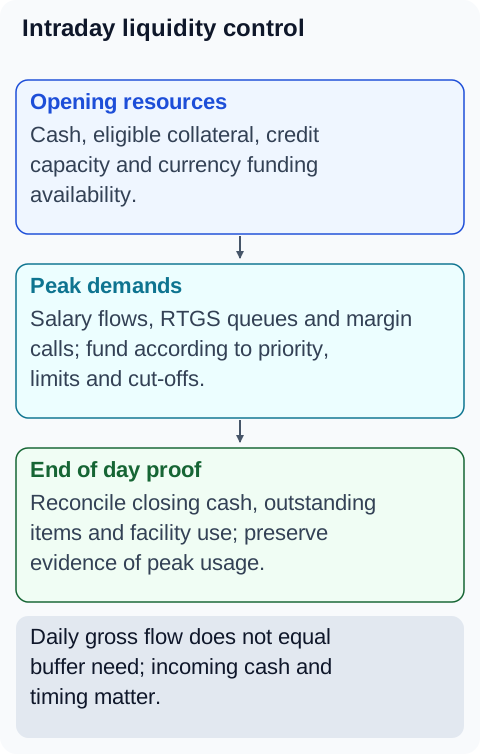
Figure 2. Haircut and margin: a worked example.
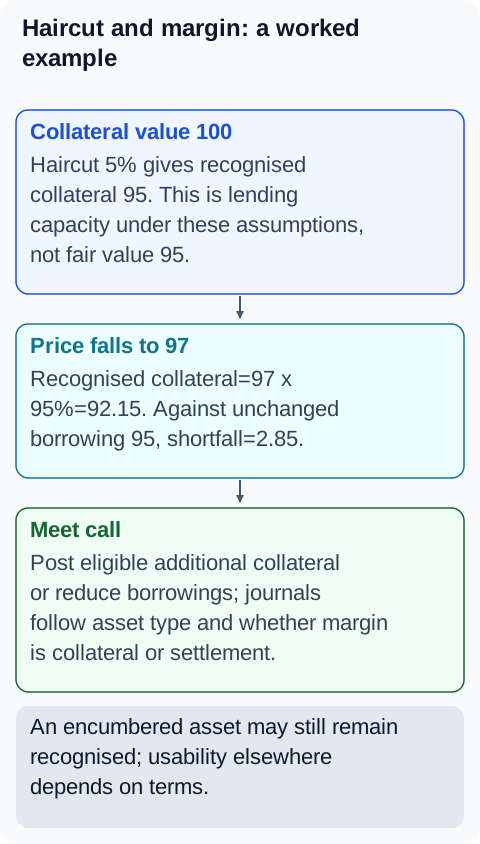
Figure 3. Cash positioning by currency.
12. Tables
Table 1 — Intraday journal map
| Event | Debit | Credit |
|---|---|---|
| Move own-account cash to nostro | Nostro asset | Other cash asset |
| Sweep within same legal entity | Destination cash asset | Nostro asset |
| Draw intraday credit | Central-bank account | Intraday credit liability |
| Repay intraday credit + fee | Intraday credit + fee expense | Central-bank account |
| Post returnable cash initial margin | Margin receivable | Cash |
| Margin returned | Cash | Margin receivable |
| Pledge collateral | (flag encumbered; no derecognition) | — + disclosure |
Table 2 — Intraday monitoring toolkit (BCBS-style)
| Tool | Question answered |
|---|---|
| Daily maximum intraday liquidity usage | Daily cumulative net debit/credit profile and prescribed period summaries |
| Available intraday liquidity at start of day | Opening resources, by applicable source and currency |
| Total payments | Daily total value of payments sent and received under the tool’s definitions |
| Time-specific obligations | What must pay by when? |
| Payments on behalf of correspondent customers | Additional tool for correspondent banks |
| Intraday credit lines extended | Daylight risk granted to clients? |
| Intraday throughput | Additional tool for direct participants: proportion of outgoing payments settled by specified times |
13. Illustrative banking case study
Gridlock at noon (fictional). A software change leaves outbound instructions queued. Treasury sees the queue increase but no central-bank debits, while the customer subledger marks payments as pending. The incident team restores processing under dual control, checks duplicates and confirms each final settlement result. Funding is assessed against the revised queue and actual receipts; emergency credit cannot repair a message-processing fault on its own. Reconcile the recovered queue to customer postings and settlement statements before closing the incident.
14. BA, developer, tester and operations guidance
- BA: Specify position-monitor scope (currencies, accounts, systems), queue rules, cut-off matrix, margin-call SLAs and escalation triggers as functional requirements with thresholds. Ensure that the requirements cover all currencies and payment systems the bank uses.
- Developer: Stream positions real-time; countdown cut-offs visibly; automate margin-call calculation and deadline tracking; log every intraday action. Build the cut-off countdown as a prominent dashboard feature, with alerts at T-60, T-30, and T-15 minutes.
- Tester: Queue-exhaustion, cut-off misses, simultaneous margin calls, forecast-vs-actual divergence, manual-rerouting paths, daylight-limit breaches. Test the system's behavior under simultaneous stress conditions — multiple margin calls, delayed inflows, and cut-off pressure at the same time.
- Operations: Pre-position collateral before stress, not during; rehearse fund-or-fail decisions; file usage metrics honestly — hidden peaks become real limits. Maintain a collateral pre-positioning schedule that ensures eligible collateral is available before the day's peak payment periods.
15. Common mistakes
- Sizing buffers to averages instead of maximum intraday usage.
- Counting encumbered assets as available liquidity.
- Discovering cut-offs by missing them.
- Treating margin calls as back-office admin instead of liquidity events.
- Hiding forecast misses instead of recalibrating.
- Siloed per-venue margin-call planning that underestimates simultaneous peaks.
- Treating intraday credit as a permanent funding source rather than a temporary bridge.
16. Key takeaways
- Intraday is real-time: queues, cut-offs and margin calls decide the day, not ratios.
- Collateral pre-positioned converts surprises into fees instead of failures.
- Sweeps, intraday credit and prioritisation are the daily tools — all need limits and logs.
- Peak usage, stress timing, mobilisation and contingency resources inform buffer design; back-testing tests the assumptions.
- Operational resilience and liquidity capacity interact, but neither replaces the other: cash cannot repair every outage, and system availability does not create cash.
17. References and verification notes
- BCBS intraday liquidity monitoring tools, April 2013: seven monitoring tools, stress scenarios and reporting scope; the LCR does not calibrate intraday liquidity.
- BCBS-IOSCO uncleared margin framework: margin purpose, thresholds and collateral protection; apply local implementing law.