Chapter 097: Delivering Accounting and Reporting Change
Section 20: Finance Data, Change Delivery and Practical Capstones · Chapter 097 of 100
A rule change succeeds when its legal status, accounting meaning, application date and tested output remain traceable through delivery. This chapter works that lifecycle without turning invented factors or template IDs into live requirements.
1. Chapter opening
Deliver accounting/reporting changes from an identified rule or policy through impact, design, implementation, testing, adoption and monitoring. Record whether the source is a consultation, final rule, interpretation or internal policy; publication, effective date, first reporting date, transition relief and local adoption can differ. A future rule may need implementation work now without being current accounting law.
2. Learning objectives
- Run horizon scanning (pipeline, dates, ownership per rule).
- Write impact assessments (scope, cost, options, recommendation).
- Build traceability (rule → requirement → test → cell).
- Plan parallel adoption with cutover/rollback gates.
- Operate BAU handover (training, runbooks, hypercare exit).
3. Business context
Finance subject-matter experts, developers, testers, data owners and vendors share finite capacity. Sequence common-engine changes and reporting deadlines explicitly. Early adoption is available only where the accounting/legal framework permits it; a project’s earlier readiness does not authorise earlier application. Track material dependencies and contingency costs using actual bank estimates, not universal annual-rule or staffing benchmarks.
4. Finance and accounting view
4.1 A concrete change without fictional legal calibration
Assume a fictional Reporting RuleR changes an exposure classification and adds 40 data points for returns fromQ3. The inventory identifies source fields, accounting/prudential measure, affected entities/portfolios, mappings, disclosures and validation rules. Link source paragraphR12 to requirementREQ088, design/map version 9, testTEST312 and affected report points. These identifiers are invented tracking IDs—not claimed COREP template coordinates, SME factors or current legal thresholds.
Record before/after semantics and boundary cases, not merely new output labels. A prudential NPE backstop deduction does not automatically require an equal accounting ECL provision; analyse recognised loss estimates and capital adjustments separately. If a change affects only reporting presentation, it may require no accounting journal.
4.2 Parallel and effective-date controls
Run identical preserved inputs through old/new implementations. Classify differences as intended rule changes, data/perimeter changes, timing, approved precision or defects. A new taxonomy need not produce identical cells or totals when meanings change; compare the correctly mapped semantics. If two rules share code but applyQ3 andQ4 respectively, test/version the combined implementation while preserving each rule’s application date. Do not accidentally enable theQ4 rule duringQ3 because it was cheaper to deploy one package.
4.3 Adoption and recoverability
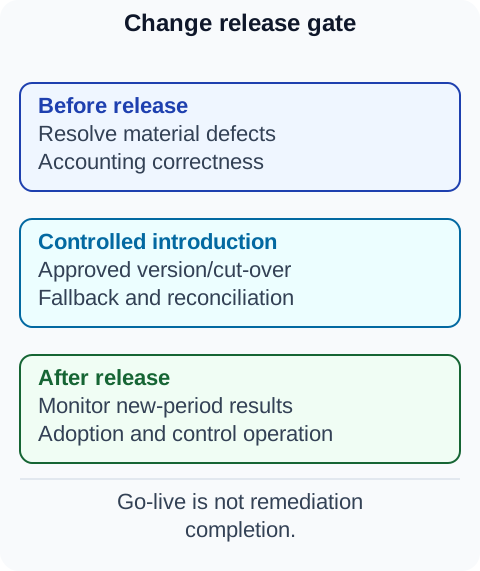
Define cutover evidence, accountable approval, unresolved-risk treatment, data migration, rollback/forward recovery and customer/reporting implications. Technical rollback cannot erase a legally settled payment or silently restore old accounting after valid new postings. Train preparers/reviewers for actual changed definitions; version runbooks and support decisions. Hypercare duration and post-implementation review timing are risk-based bank choices, not universal two-cycle/+90 day law.
Traceability can use a controlled repository, spreadsheet or dedicated tool if it provides the required relationships, history, review and completeness for the scale. Five fixed levels or a particular software product is not a universal supervisory requirement. A failed trace exposes a gap to resolve; it does not automatically establish a legal violation.
5. Product and customer impact
A regulatory capital or disclosure change does not automatically authorise repricing a customer’s signed loan. Assess contractual variation rights, notices and conduct obligations. Grandfathering can concern prudential treatment rather than customer terms; state exactly which obligation transitions. Distinguish accounting policy adoption from an operational product change.
6. Regulatory and supervisory view
Apply the actual current rule, transitions and supervisory implementation requirements to the bank’s scope. Vendor delay does not remove the bank’s obligations. A manual workaround, phased filing or exception needs the applicable permission and controls; do not assume a supervisor may waive any binding rule. Keep proposals and final amendments separately recorded.
7. Systems and data view
Maintain a source/version register, requirements/design records, mapping and code versions, test evidence, old/new comparisons, approval history, migration controls, runbooks and issue tracking. Bidirectional traceability needs to show what a source changes and why a filed output has its current meaning. Preserve actual tested versions and defects; a retrospective clean-looking matrix does not replace history.
8. End to end process
- Register source status, scope and dates.
- Assess measures, populations, outputs and dependencies.
- Design approved changes and traceable boundary tests.
- Build with application-date controls.
- Independently test and attribute parallel differences.
- Approve recoverable cutover under actual rules.
- Train/support the operating teams.
- Review results and close evidenced gaps.
9. Controls and risks
| Risk | Control | Evidence |
|---|---|---|
| Untraced cells | Coverage analytics (100% traced) | Trace matrices |
| Vendor lag | Readiness tracking + contingency | Vendor plans, workarounds |
| Change collision | Portfolio sequencing | Portfolio board packs |
| Hypercare drift | Exit criteria + dates | Exit sign-offs |
10. Practical examples
Bundled delivery: three fictional changes need 14 person-months if implemented separately; controlled shared work uses 8 person-months. Saving 6 person-months is 42.86%, not automatically 30%, and is capacity rather than necessarily cash. Preserve separate application dates and test combined interactions.
Vendor contingency: estimate the cost and completeness of a manual mapping path, obtain required approval and reconcile outputs. An assumed 120,000 contingency cost does not establish that late filing would cost 2m; use actual legal obligations and scenario evidence.
Capital versus impairment: compare the applicable capital-backstop adjustment with the accounting allowance. A40m prudential shortfall does not prove that 40m additional impairment expense is required.
11. Diagrams
Figure 1. Accounting/reporting change.
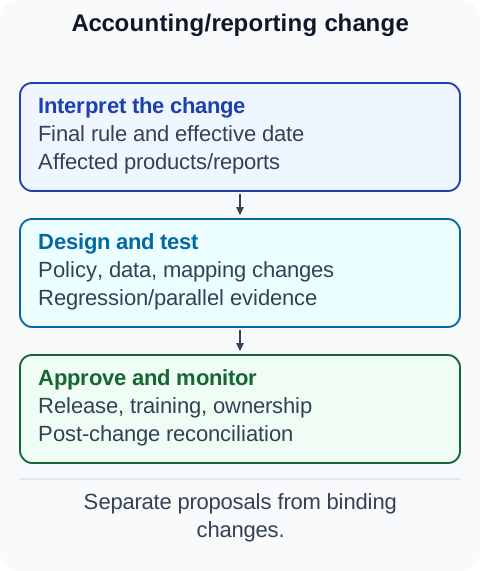 Figure 2. Requirement traceability.
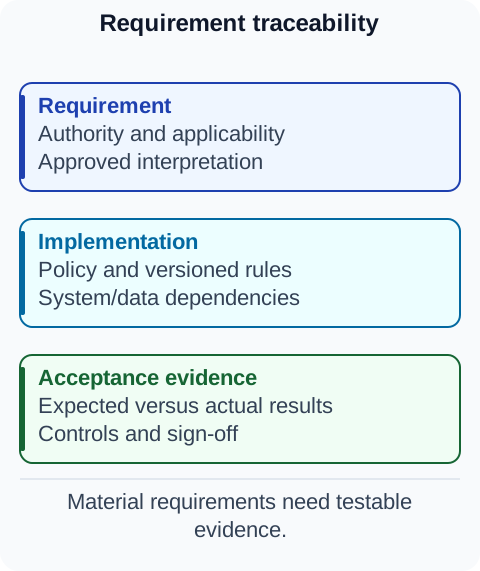 Figure 3. Change release gate.
12. Tables
| Gate | Concrete evidence |
|---|---|
| Scope | Authoritative source, status, entity/period register |
| Design | Before/after semantics and affected populations |
| Test | Independent expected outcomes, boundaries and interactions |
| Parallel | Attributed intended changes and defects |
| Cutover | Dates, approval, migrated balances and recovery |
| Adoption | Current runbooks, trained owners and issue exit criteria |
13. Illustrative bank case study
The change had no owner. A fictional bank’s disclosure update was omitted because Finance and IT each assumed the other was accountable. The repair assigned one delivery owner, recorded the actual correction process and linked source, requirements and tested output. No real filing breach or regulatory outcome is asserted.
14. BA, developer, tester and operations guidance
- BA: Write traceability from day one (paragraph → req → test → cell); assess impacts with options.
- Developer: Version rule implementations; support parallel environments; instrument traceability.
- Tester: Coverage-gate testing (100% traced cells tested); parallel proofs.
- Operations: Own adoption (training, runbooks, hypercare); track PIR actions.
15. Common mistakes
- Implementing a proposal as a final rule.
- Confusing publication with mandatory application.
- Mixing prudential deductions with accounting provisions.
- Enabling bundled rules before their dates.
- Treating technical rollback as reversal of settled legal events.
- Reconstructing traceability instead of preserving it.
16. Key takeaways
Identify the actual source and date, preserve semantic traceability, independently test changed measures and deliver controlled adoption. Reuse code and evidence without merging distinct legal obligations.
17. References and verification notes
- BCBS 239: 14 principles:11 bank-focused plus 3 supervisory; scope and domestic application need assessment. No prescribed universal database, staffing or response deadline.
- IFRS 9: accounting classification/impairment and prudential risk measures are separate; use endorsed period version.
RuleR and tracking IDs are fictional and are not live regulatory citations or template coordinates. The worked example is a delivery/control design, with actual law and bank-specific accounting policy determining the implementation.