Chapter 010: From Business Event to Financial Statement
Section 2: Accounting Foundations for Banking · Chapter 010 of 100
Month-end day three: the CFO asks a simple question — "Are we done?" — and nobody can answer, because reconciliations are half-signed, two feeds arrived late, and the ECL run is still going. Close is where every concept in Block 2 meets the calendar: events become journals (006), through the CoA and hub (007), with correct timing (008, 009), into statements someone signs. This chapter runs the full chain and the three close rhythms that govern bank life.
1. Chapter opening
The event-to-statement chain has six links: capture, rule, post, balance, adjust, present. Close is the periodic discipline that forces each link to complete on time with evidence: daily flash discipline, monthly management truth, quarterly market-grade disclosure, annual audited record. This chapter walks the chain end to end, compares the close rhythms, details substantiation, and shows how Section 2's machinery produces Section 1's statements.
2. Learning objectives
By the end of this chapter you will be able to:
- Trace any banking event through all six links to the published statement line.
- Contrast daily, monthly, quarterly and annual close in scope, speed and evidence.
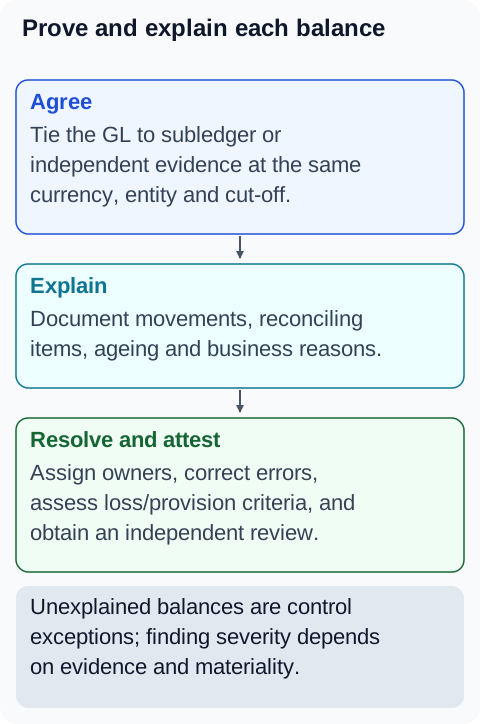
- Run a balance-sheet substantiation pack: agree, explain, clear, sign.
- List period-end adjustments (accruals, ECL, valuations, provisions, tax, eliminations) with owners.
- Explain analytical review: variance thresholds, bridges, and challenge.
- Diagnose close failures: late feeds, break backlogs, attestation gaps.
3. Business context
Close speed is management speed: banks closing in 12 days decide with stale numbers while faster rivals reprice; rushed closes produce errors that restatements later expose. Investors and supervisors read close discipline as governance signal — repeated late filings, qualified audits and post-close adjustments erode confidence faster than one bad quarter. For programmes, "we'll fix it in hypercare" dies at first close: the close tests every interface, rule, calendar and RACI simultaneously, which is why Delivering Accounting and Reporting Change and Testing Finance Systems develop controlled parallel-run and close testing.
| Close | Decides | Fails as |
|---|---|---|
| Daily flash | Trading limits, liquidity actions, break triage | Errors compounding unseen for weeks |
| Monthly | Pricing, bonuses signalled, cost action | Decisions on fiction; year-end shocks |
| Quarterly | Market guidance, dividends signalled, supervisory returns | Misleading markets; corrections |
| Annual | Audit opinion, AGM, tax filings, bonuses paid | Qualification, enforcement, litigation |
4. Finance and accounting view
4.1 The six-link chain, worked
Take a 20,000 small-business loan disbursed 28 March, quarter-end 31 March (assume three contractual accrual days under the specified start/end convention): (1) Capture — origination system books the contract with all dates and dimensions; (2) Rule — engine v3.2 fires the disbursement template (Dr Loan / Cr Customer account) plus day-one ECL staging; (3) Post — hub validates and GL posts 28 March, period Q1; (4) Balance — loan subledger ties to GL; trial balances; (5) Adjust — three days of EIR accrual, day-one ECL provision, FTP charge, cost allocation sweep; (6) Present — the loan sits in Q1 balance sheet, three days of income in Q1 P&L, exposures in FINREP/COREP from the same lineage. Miss link 2's ECL staging and Q1 understates provisions; miss link 5's accrual and income shifts quarters.
4.2 Period-end adjustment inventory
| Adjustment | Owner | Engine or manual | Review focus |
|---|---|---|---|
| Interest/fee accruals | Financial Control | Engines + top-up journals | Roll-forwards, completeness |
| ECL allowances and staging | Risk + Finance | ECL engine, committee overlay | Staging moves, overlay governance (Section 9) |
| Fair values, FX revaluation | Treasury finance / valuation control | Pricing engines + IPV | Independent verification (Section 8) |
| FTP and cost allocations | FP&A / Treasury | Allocation engines | Driver review (Funds Transfer Pricing and Customer, Product and Channel Profitability) |
| Provisions (legal, redress, restructuring) | Legal/HR/Compliance + Finance | Manual with evidence | IAS 37 triggers, estimation support |
| Tax (current + deferred) | Tax | Computation tools | Rate changes, recoverability of DTAs |
| Intercompany eliminations | Group Finance | Consolidation engine + manual | Matching both sides (Intercompany Elimination and Foreign Operations) |
| Post-balance-sheet events | Disclosure committee | Assessment memos | Adjusting vs non-adjusting (IAS 10) |
4.3 Analytical review: proving the story, not just the arithmetic
Every close ends with variance analysis: actual vs prior period and vs forecast, threshold-driven (for example, ±5% and material absolute) explanations that cite business causes with numbers — "NII +3%: loan growth 2%, rate +1%, offset by deposit repricing." Unexplained variances block sign-off; boilerplate ("market movements") is sent back. Bridges (waterfalls from last period to this) make multi-factor moves auditable. Supervisors and auditors re-perform this review independently — consistent explanations across packs is itself a control.
4.4 Consolidation in brief (full chapter later in course)
Group close adds: uniform policies across entities, foreign-operation translation (assets/liabilities at closing rate, income/expenses at transaction-date rates; an average is allowed only if a reasonable approximation, differences generally in OCI under IAS 21), full intercompany elimination (balances, income, dividends, profits in inventory), associate/joint-venture equity accounting, and non-controlling interest presentation. The two standing failures: translation using wrong rates, and one-sided eliminations (worked in Intercompany Elimination and Foreign Operations).
5. Product and customer impact
Close rhythms touch customers through statement cycles (aligned to monthly close — late adjustments after statement generation create "corrected statement" embarrassments), interest application dates, fee billing runs, and annual summary documents (tax certificates, interest statements) that must tie to the audited ledger. Product launches scheduled across quarter-ends need straddle handling (Booking Date, Value Date and Reporting Date) designed upfront, or first-period product P&L misleads permanently via wrong comparatives.
6. Regulatory and supervisory view
Each close feeds obligations: monthly management and internal liquidity snapshots; FINREP/COREP/Pillar 3 returns and disclosures at the frequencies applicable to the entity and individual template and market disclosures with executive responsibility statements; annual audited accounts, AGM approval, tax filings and full Pillar 3. Filing calendars are law-backed with penalties; late or corrected submissions invite supervisory queries that expand into reviews. External audit intensity steps up by rhythm (interim review where required or commissioned, annual audit for entities within the relevant scope, and going-concern assessment — ISA 570), and auditors' management letters from each close become next year's control agenda.
7. Systems and data view
Close architecture: the close calendar master (tasks, owners, dependencies, deadlines per entity/ledger), workflow tracking (who did what, late-task escalation), snapshot discipline (reporting marts frozen per close version — reruns reproducible), approximately-right-first-time feeds (late-feed SLA with automatic escalation to producers), and the adjustment workbench (manual journals with maker-checker inside the close window, all expiring into review). Close acceleration comes from moving work left: daily reconciliations, continuous substantiation, flash automation — never from skipping review.
8. End to end process
Model month-end (Day 0 = last business day): D0–D1: freeze, flash P&L, break triage, late-feed escalation. D2–D3: engines run (accruals, FTP, allocations), manual journals posted, reconciliations executed. D4–D5: substantiation packs completed, variance commentary drafted, business attestations collected. D6+: results published to management, regulatory compilation uses reconciled close data plus governed risk, liquidity and reference-data inputs, post-mortem logs improvements. Quarter-end adds external reporting and disclosure work; ECL and valuations must still be updated at every applicable reporting date, including monthly closes where material; year-end adds full audit, impairment testing, going concern and governance sign-offs (months). Publish the calendar; track slippage publicly; protect the reviewers' time — review squeezed is assurance lost.
9. Controls and risks
| Risk | Control | Evidence |
|---|---|---|
| Late/partial feeds corrupting the close | Feed SLAs, completeness checks, close-blocking rules | Feed dashboards, block logs |
| Unreviewed manual adjustments | Threshold approvals, expiry, post-close adjustment analysis | Adjustment logs, true-up reports |
| Stale snapshots / rerun drift | Versioned frozen snapshots, rerun-equality checks | Snapshot registry, rerun proofs |
| Attestation gaps under time pressure | Outstanding-attestation blockers, escalation | Attestation tracker, overrides log |
| Close findings recurring | Post-mortem actions with owners and dates | Action tracker, repeat-finding metrics |
10. Practical examples
Example A — The feed that cried on D2. The cards feed arrives 18 hours late with 4 million of interchange missing from flash. With SLA + block rules, close pauses honestly, stakeholders are told, and the fee true-up posts with disclosure. Without them, flash publishes fiction and bonuses get signalled on it. Lesson: honest lateness beats punctual fiction — design the close to say "not ready."
Example B — Post-close adjustment autopsy. Ten percent of quarterly profit comes from post-close top-side journals. Analysis shows three products with systematically late fee feeds — a data problem wearing an accounting costume. Fix owned by Technology with Finance acceptance criteria. Lesson: trend post-close adjustments by root cause; accounting workarounds for data failures must expire.
11. Diagrams
Figure 1. Six links from event to statement.
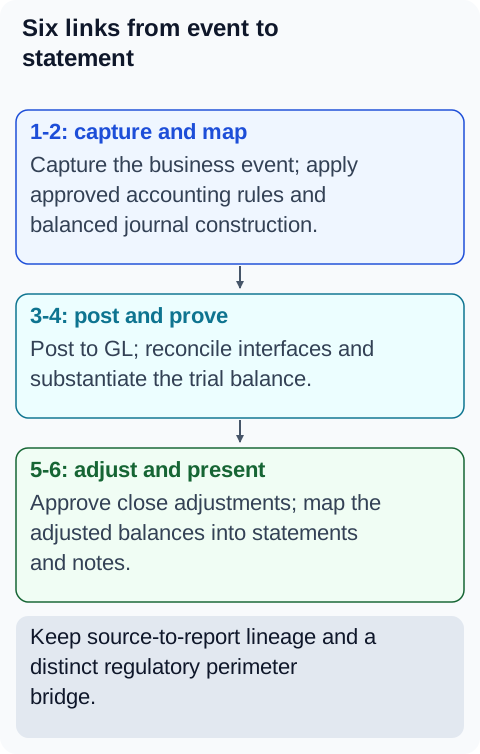
Figure 2. Daily, monthly and annual close.
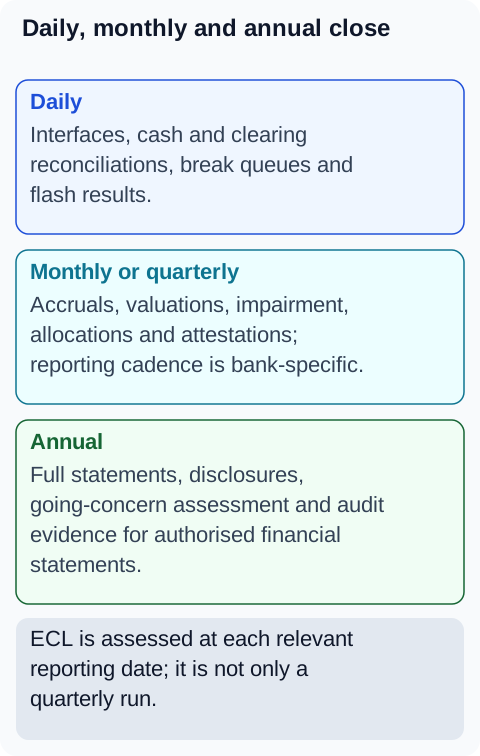
Figure 3. Prove and explain each balance.
12. Tables
Table 1 — Section 2 concept map to the close
| Chapter | Concept | Close dependency |
|---|---|---|
| 006 Double-entry | Balanced journals, reversals | Trial balance integrity; correction method |
| 007 CoA/hub/models | Leaves, dimensions, rules, tie-outs | Reconciliation completeness; mapping stability |
| 008 Accruals/cut-off | Timing truth, roll-forwards | Income/cost in the right period |
| 009 Dates | Booking/value/reporting ownership | Straddles, backdating discipline |
| 010 This chapter | Chain + rhythms + substantiation | Signed, filed, trusted numbers |
Table 2 — Close health metrics for the CFO dashboard
| Metric | Good | Investigate |
|---|---|---|
| Days to management results | 3–5 (monthly) | 10+ with no improvement plan |
| Post-close adjustments (% of profit) | <2%, falling | >5% or rising |
| Reconciliation breaks aged >30 days | Zero material | Any material aged break |
| Manual journals (% of postings) | Low and falling | Rising; topside concentration |
| Attestations outstanding at sign-off | Zero | Any (signed late = qualified trust) |
| Repeat audit findings | Zero | Any repeat, especially cut-off ownership |
13. Illustrative bank case study
The quarter that closed twice. A bank published quarterly results, then quietly corrected them three weeks later — a 15% profit overstatement from an ECL staging feed that ran on stale exposures plus uneliminated intercompany income. The correction was honest; the damage was in what it revealed: no feed-version check, no elimination tie-out, attestation signed before reconciliations finished. Remediation (feed SLAs, snapshot versioning, blocker rules, re-sequenced sign-offs) became the industry conference presentation everyone photographs. Lesson: sequence is a control — attestations after reconciliations, publication after attestation, no exceptions. (Fictional training case; no specific bank or event is asserted.)
14. BA, developer, tester and operations guidance
- BA: Model the close as a first-class process: calendar, dependencies, SLAs, blocker rules, evidence per task. Requirements that ignore close-day behaviour fail on close day.
- Developer: Version snapshots and feeds; make reruns deterministic; build the adjustment workbench with expiry and approval; surface lateness honestly in dashboards.
- Tester: Run a full mock close in UAT: freeze, engines, journals, tie-outs, substantiation, variances, lockdown, regulatory extract — with late feeds and seeded breaks. Test the rerun-equality of snapshots.
- Operations: Protect the calendar; escalate late feeds immediately; never sign attestation over open material breaks — your signature is the control.
15. Common mistakes
- Signing attestations before reconciliations complete.
- Treating post-close adjustments as routine instead of root-causing them.
- Accelerating close by cutting review rather than moving work left.
- Forgetting intercompany elimination and currency translation in group closes.
- Publishing flash as fact without labelling estimates.
16. Key takeaways
- Six links — capture, rule, post, balance, adjust, present — and every link needs an owner and evidence.
- Daily discipline buys monthly truth; monthly truth buys quarterly trust.
- Substantiation (agree, explain, clear, sign) is where balances earn their place in statements.
- Sequence is a control: reconciliations before attestation, attestation before publication.
- Apply the posting, account-mapping, cut-off and close controls together. The deposit and loan lessons then apply them to specific bank products.
17. References and verification notes
-
IFRS Foundation: IFRS 9: classification depends on business model and contractual cash flows; initial recognition and directly attributable costs follow IFRS 9. This is the IFRS track, not US GAAP CECL.
-
IFRS Foundation: IAS 10: adjusting events evidence conditions at the reporting date; non-adjusting events concern later conditions and material ones require disclosure.
-
Consolidation/translation headlines per IFRS 10/IAS 21/IAS 27-28; post-period events per IAS 10; going concern per IAS 1/ISA 570 — full group-reporting mechanics arrive in later blocks; verify current endorsed versions for implementation.
-
Filing calendars, review vs audit requirements and AGM rules are jurisdiction- and listing-specific; confirm local obligations.
-
All figures, timelines and thresholds are illustrative training simplifications; adapt to the bank's close calendar and materiality framework.