Chapter 059: Intercompany Elimination and Foreign Operations
Section 12: Financial Statements and Group Reporting · Chapter 059 of 100
This chapter explains intercompany elimination and foreign operations from the reporting bank's perspective. Examples are fictional; accounting follows IFRS unless another framework is expressly identified.
1. Chapter opening
Intercompany balances are genuine legal-entity assets and liabilities but disappear on consolidation. External loans, funding costs, credit losses and some exchange effects remain. A consolidation adjustment is recorded in the group reporting layer; it does not cancel the contractual loan or remove the subsidiaries' settlement obligations.
2. Learning objectives
- Match and eliminate reciprocal balances and internal income.
- Distinguish monetary-item remeasurement from foreign-operation translation.
- Preserve external ECL and external financing costs.
- Reconcile group eliminations to entity accounts and explain FX differences.
3. Business context
A parent funds a foreign subsidiary, which lends to external customers. Treasury must price and settle the internal facility, tax must substantiate its arm's-length terms and group finance must eliminate it. Local liquidity or capital restrictions can prevent the subsidiary returning cash even though its financial results are consolidated. Group accounting scope and prudential transferability are separate assessments.
4. Finance and accounting view
4.1 Reciprocal balances and interest
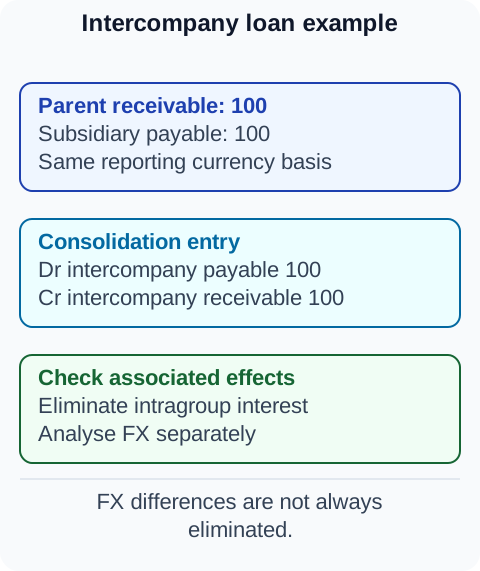
Assume all amounts in this example are USD millions. The parent lends 200 to a USD-functional subsidiary at 5%; the subsidiary lends that amount externally at 6.5%. Annual internal interest is 10 and external interest is 13. Eliminate the internal loan/borrowing of 200 and internal accrued interest receivable/payable of 10. Eliminate the parent's interest income of 10 against the subsidiary's interest expense of 10. Group external interest income is 13, not 3. The subsidiary's margin of 3 is measured after its internal funding charge; the group's external funding expense has not been specified.
An external-client ECL allowance of 8 remains after consolidation: the external gross loan of 200 has a net carrying amount of 192, excluding any separately accrued interest. Do not reverse external impairment because an internal funding facility is eliminated. An allowance on the internal facility itself is eliminated with the internal asset for the consolidated accounts, while remaining relevant in the lender's separate accounts.
4.2 Currency accounting
An EUR-functional parent initially translates its USD loan at the transaction-date rate and subsequently remeasures this monetary asset at closing rates. The USD-functional borrower has no currency mismatch on that loan. The resulting parent's exchange difference generally remains in consolidated profit or loss, despite eliminating the reciprocal principal. The IAS 21 exception for a monetary item forming part of a net investment requires the relevant settlement criteria; an ordinary term loan is not a net investment merely because management labels it strategic.
Translation of the USD-functional subsidiary into EUR presentation currency is different: assets and liabilities use closing rates and income/expenses use transaction-date rates, with suitable averages only where appropriate. The translation difference is in OCI. Historical equity, distributions and retained earnings need their respective rates; the translated opening equity is not itself an opening translation reserve.
5. Product and customer impact
Customers continue to owe their external loans after internal funding is eliminated. The group cannot remove a customer's interest or ECL from its accounts simply because the originating bank is internally funded. Currency hedges should address the identified exposure rather than a consolidated accounting balance alone.
6. Regulatory and supervisory view
IAS 21 governs functional currency, monetary-item exchange differences and foreign-operation translation. IFRS 10 requires elimination of intragroup transactions. OECD transfer-pricing guidance supports arm's-length analysis; domestic law determines tax documentation, interest deductibility and deadlines. A low internal lending rate can understate the parent's taxable income; an excessive rate can create an excessive deduction in the borrower. There is no universal biennial study requirement.
7. Systems and data view
Use common counterparty identifiers, agreement IDs, currency, principal, accrued interest and settlement dates. Report both original currency and entity functional currency. Group adjustments need an owner and a reconciliation to source entities. Tax and consolidation views may use different analyses but cannot invent different contractual terms for the same facility.
8. End to end process
- Confirm reciprocal contracts, balances and accrued interest in original currency.
- Resolve timing, classification and currency differences before elimination.
- Align accounting policies and apply external ECL.
- Eliminate internal balances and income/expense.
- Translate foreign operations and classify FX under the appropriate rules.
- Reconcile retained external balances, group profit and translation reserves.
9. Controls and risks
| Risk | Evidence/control |
|---|---|
| One-sided elimination | Two-entity confirmation and matched agreement |
| Customer ECL removed | External/internal counterparty flag review |
| FX incorrectly eliminated | Functional-currency and net-investment memo |
| Tax pricing unsupported | Contemporary terms, comparables and local tax review |
10. Practical examples
Assume a static USD net investment of 500 with no income, distributions or other changes. At USD 1.08 per EUR it translates to EUR 462.963; at USD 1.00 per EUR it translates to EUR 500. The translation gain is EUR 37.037. A perfectly matched hedge of half that exposure would offset EUR 18.519 of this spot translation movement, leaving EUR 18.519 before tax and other effects. A real forward's valuation also reflects forward points, timing and hedge effectiveness; its actual gain or loss cannot be inferred solely from spot rates. Hedge ineffectiveness in profit or loss is not subtracted from the OCI reserve.
11. Diagrams
Figure 1. Intercompany consolidation.
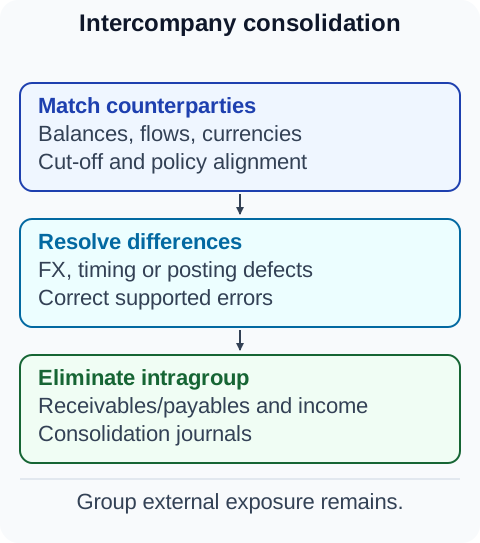 Figure 2. Foreign operation translation.
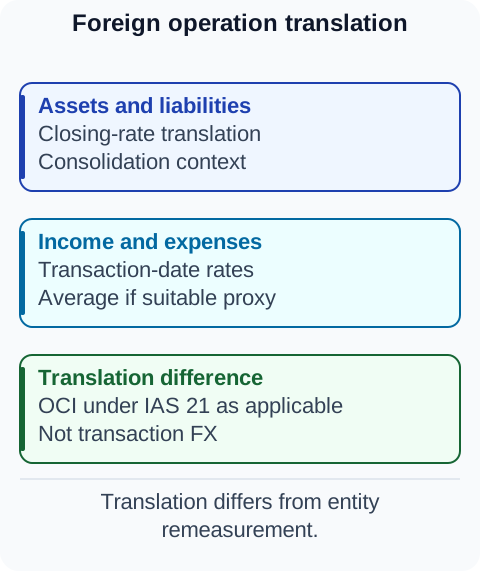 Figure 3. Intercompany loan example.
12. Tables
| Group consolidation entry | Debit | Credit |
|---|---|---|
| Eliminate subsidiary borrowing/parent loan | Borrowing 200 | Loan asset 200 |
| Eliminate internal accrued interest | Interest payable 10 | Interest receivable 10 |
| Eliminate internal interest | Interest income 10 | Interest expense 10 |
These entries balance in the group consolidation layer; source-entity journals remain intact.
13. Fictional banking case study
A fictional banking group eliminated both sides of an internal loan but also removed the external customer's impairment. Review identified that the automation used funding source instead of legal counterparty to select eliminations. Restoring the customer's allowance of 8 corrected group net loans and profit. Finance repaired the selection rule and rechecked every affected counterparty.
14. BA, developer, tester and operations guidance
Group consolidation establishes which entities and transactions enter the accounts. Deferred tax analyses the local tax effects of exchange and elimination differences. Capital planning separately assesses foreign capital availability and eligible minority interests.
15. Common mistakes
- Reporting only the subsidiary's internal-funding margin as group revenue.
- Eliminating all exchange differences with the principal.
- Treating a closing-rate translated equity amount as the translation reserve.
- Reversing external ECL when internal funding disappears.
- Applying one tax documentation timetable worldwide.
16. Key takeaways
Eliminate internal rights, obligations and income without erasing external credit exposure. Reconcile original currencies first; then account for monetary-item remeasurement, foreign-operation translation and any qualifying hedge separately.
17. References and verification notes
- IFRS 10: consolidation and intragroup eliminations.
- IAS 21: currency accounting.
- OECD transfer pricing: international principles; check domestic implementation.
- All numerical examples and case episodes are fictional.