Open banking architecture for AIS, PIS and consent-led payments: TPP trust, OAuth/FAPI, SCA, payment hubs, status, callbacks and recovery.
Part of the Cloud, APIs and Integration for Banking learning path.
Open banking APIs are where banking, security, identity, customer consent, payment initiation, account data, regulatory control, and real production operations meet. They look simple from the outside because the visible experience is usually a few screens: connect your bank, approve consent, return to the third-party app, view accounts, or initiate a payment. Under the surface, the architecture is much stricter. A bank is exposing account and payment capabilities to external regulated parties, while still remaining responsible for protecting the customer, protecting the account, protecting the payment rail, protecting the ledger, protecting availability, and producing evidence for audit and dispute handling.
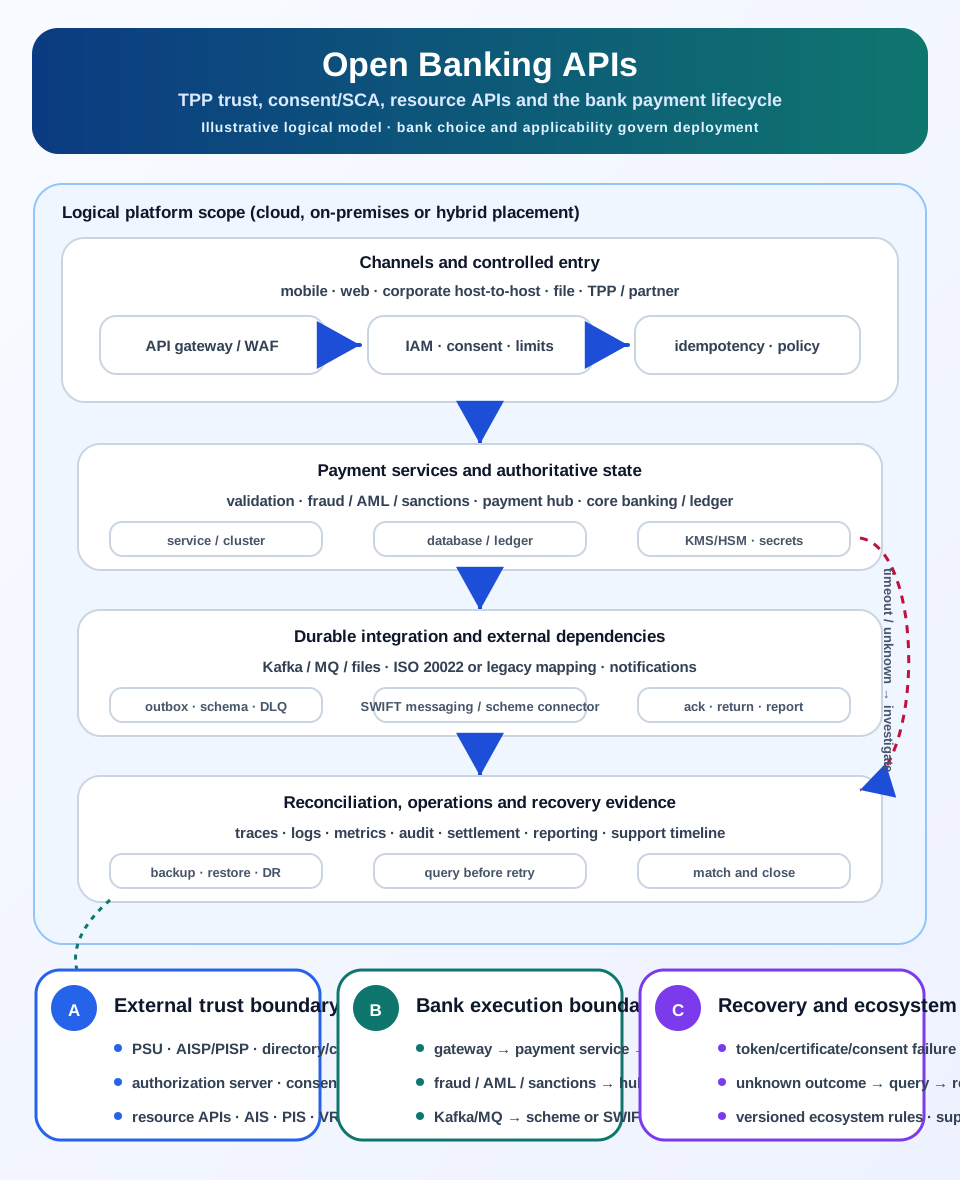
Scope and evidence (reviewed 5 October 2026). This is educational engineering guidance, not a universal banking-control prescription. Read each recommendation in the right category: generic cloud principle, technical standard or specialist guidance, jurisdictional/supervisory expectation, scheme/provider rule, or bank implementation choice. Applicability depends on the bank's jurisdiction, licence, criticality, data, service, contract and selected architecture; the cited sources are the authority for any dated or regulatory statement.
This chapter explains open banking APIs as a practical engineering subject, not as a marketing idea. The focus is payments, but not only payments. A developer, solution architect, production support engineer, tester, business analyst, or operations lead should be able to read this and understand how open banking works inside a bank: the actors, the consent model, OAuth and FAPI security, account information APIs, payment initiation APIs, confirmation of funds, variable recurring payments, integration with payment hubs, operational risk, support model, SDLC controls, and the architecture decisions that decide whether the platform survives real traffic.
What Open Banking Really Means
Open banking means a customer can allow an authorized third party to access selected banking services through controlled APIs. The bank does not give the third party the customer's password. The bank does not allow uncontrolled screen scraping as the strategic model. The bank exposes a governed interface, authenticates the customer through the bank's own channel or authorization server, records the customer's consent, and issues limited technical credentials that allow the third party to access only the approved scope.
In payment terms, open banking changes one important thing: a payment journey does not always have to start inside the bank's own mobile app, branch, corporate portal, or card network. A regulated payment initiation service provider can ask the customer to approve a payment from the customer's bank account. Once the customer approves, the bank processes the instruction through its normal payment execution stack. That stack may include validation, account checks, fraud controls, sanctions where applicable, limits, booking, routing, clearing, settlement, status updates, notifications, reconciliation, and investigation.
This is why open banking is not a separate toy system. It is another entry channel into the bank's serious production capabilities. If the open banking API is weak, the weakness flows into payments, account data, customer experience, regulatory reporting, operational support, and incident handling.
A proper open banking API platform answers these questions clearly:
- Which regulated third party is calling?
- Which customer authorized the access?
- Which consent was granted?
- Which account is in scope?
- Which data or payment capability is allowed?
- Which authentication event supports the access?
- Which token or certificate proves the caller identity?
- Which API version and contract were used?
- Which payment object or account resource was touched?
- Which downstream system accepted, rejected, delayed, or completed the work?
- Which audit evidence proves what happened?
If these questions cannot be answered, the implementation is not ready for real banking, even if the API returns JSON successfully.
The Core Actors
The language varies by market, but the roles are consistent.
The customer is often called the PSU, or Payment Service User, in PSD2 language. This can be a retail customer, a small business owner, or a corporate user depending on the product. The customer owns the permission decision. The customer may grant access to account information, approve a payment, or revoke consent.
The bank or account provider is often called the ASPSP, or Account Servicing Payment Service Provider. It holds the account, authenticates the customer, exposes APIs, validates third-party access, and executes payments or returns account data according to the customer's consent and regulatory rules.
The third party is commonly called a TPP, or Third Party Provider. A TPP may operate as an AISP, PISP, or CBPII depending on permission type. An AISP reads account information. A PISP initiates payments. A CBPII confirms whether funds are available for card-based payment instruments. Some organizations may hold multiple permissions.
The regulator, directory, or trust framework gives the ecosystem its identity foundation. It answers the critical question: how does a bank know that this third party is authorized? In the UK model, the Open Banking Directory and certificates are central to trust. In European PSD2 ecosystems, qualified certificates and national competent authority registers are used. In many markets, the exact trust model differs, but the principle is the same: the API cannot rely on a self-declared client name.
The authorization server is the security component that authenticates the customer, asks for consent approval where required, and issues tokens. The resource server hosts the actual APIs. In a clean architecture, the authorization server and resource APIs are separate concerns, even if the same vendor platform provides both.
The payment hub, core banking system, ledger, fraud platform, sanctions platform, notification system, and operational tooling are not always called open banking components, but they decide whether the service works in production. Open banking exposes the front door. The bank's internal systems still perform the actual banking work.
Open Banking Is Not Screen Scraping
Before open banking APIs became common, some third-party financial apps used screen scraping. The customer would share online banking credentials with the third party. The third party would log in as if it were the customer and read data from web pages.
That model is dangerous for serious banking. It trains customers to share passwords. It makes it hard for the bank to distinguish customer activity from third-party activity. It creates brittle integrations because web pages change. It weakens audit trails. It can over-expose data because the third party sees whatever the customer login can see, not only the data needed for the service.
Governed open banking APIs can improve the model by introducing explicit consent, regulated third-party identity, token-based access, defined scopes, clear API resources, security profiles, revocation, monitoring, and operational reporting. The customer authenticates with the bank. The third party receives a limited access token. The bank can observe the third-party channel separately. This is technically cleaner and operationally safer.
For payment initiation, this difference is critical. A payment should not be initiated because a third party imitated the customer browser session. It should be initiated because a regulated PISP created a payment consent or payment instruction, the bank authenticated the customer, the customer approved the payment details, and the bank accepted the instruction into its controlled payment lifecycle.
The Main API Families
Open banking APIs normally fall into a few major families.
Account Information Services allow authorized access to account and transaction data. This includes account identifiers, balances, transactions, beneficiaries, direct debits, standing orders, scheduled payments, statements, product details, and party data depending on the standard and consent. In payments, account information is important because a third-party app may check balances, categorize transactions, verify incoming and outgoing activity, support cash-flow analysis, or help a corporate user prepare payments.
Payment Initiation Services allow an authorized third party to initiate payments from a customer's account. Depending on the market and implementation, this may include domestic payments, scheduled payments, standing orders, international payments, file payments, bulk payments, or variable recurring payment setups. The bank must still run payment validation, available funds checks, account status checks, limits, fraud controls, cut-off checks, scheme validation, and execution.
Confirmation of Funds allows a provider to check whether an account has enough funds for a proposed amount, usually without exposing the full balance. This is useful when the business need is a yes or no funds confirmation rather than full account data access.
Event notification APIs allow the bank to notify a third party that something changed, such as consent status, payment status, or resource availability. Without eventing, third parties poll repeatedly. Polling can increase load, cause stale experiences, and make production support harder.
Variable Recurring Payments, often called VRP in the UK context, allow a customer to authorize a third party to initiate a series of payments under agreed constraints. VRP is important because it moves open banking beyond one-off payment initiation into controlled recurring account-to-account payment use cases. The engineering challenge is bigger because the consent needs constraints such as maximum amount, frequency, expiry, debtor account, creditor details, and cancellation rules.
Why Open Banking Is Harder Than Normal APIs
A normal partner API might expose a service to a known corporate client under a private contract. Open banking is broader. The bank may need to support many third parties, common standards, regulated roles, customer redirection, consent dashboards, strict security profiles, availability reporting, version migrations, operational incident processes, and ecosystem conformance testing.
The API is not only a technical endpoint. It is part of a legal and operational system. A badly worded consent screen can create regulatory risk. A missing audit record can create dispute risk. A slow status endpoint can create customer confusion. A non-idempotent payment initiation endpoint can create duplicate-payment risk. A weak token binding design can create security risk. A poor sandbox can delay TPP onboarding. A vague error code can create unnecessary support tickets.
For developers, the key mindset is this: open banking APIs are secure workflow contracts. They are not simple CRUD APIs. Account data access is controlled by consent state and customer authority. Payment initiation is a multi-step workflow with state transitions and irreversible consequences. Security is not a separate header; it is part of the business meaning of every call.
Regulatory Models And Standards
The UK Open Banking specification family describes RESTful APIs that allow TPPs to access information and initiate payments for customers with customer consent. The versioned official documentation includes account and transaction APIs, payment initiation APIs, confirmation of funds, variable recurring payments, event notifications, resources, data models, and version control. The UK ecosystem also uses strong security and directory patterns.
The Berlin Group NextGenPSD2 framework is another important European model. It provides implementation guidelines and OpenAPI files for access-to-account interfaces. The Berlin Group download page states that it offers the most recent NextGenPSD2 Access to Account Framework documents and was last updated on 02 December 2025. For architects, the key point is that different regions can implement PSD2-style access through different API profiles, naming rules, and consent approaches.
OpenID FAPI is central to modern open banking security. FAPI stands for Financial-grade API. It is not a payment API by itself. It is a security profile based on OAuth and OpenID Connect patterns for high-value API use cases. The OpenID Foundation notes that FAPI 2.0 was approved as final on 19 February 2025. FAPI 2.0 aims to improve interoperability and reduce optionality, with mechanisms for fine-grained and transactional authorization, replay detection, and stronger security at both authorization and resource server interfaces.
OAuth 2.0 is the authorization framework. PKCE protects authorization code flows against code interception. Mutual TLS can authenticate clients and bind tokens to certificates. Pushed Authorization Requests move authorization request parameters through a back-channel request so they are less exposed to browser tampering. DPoP provides proof-of-possession at the application layer. These are not buzzwords in open banking. They are direct controls against token theft, request tampering, replay, client impersonation, and weak authorization binding.
PSD2 remains relevant where its ecosystem and national implementation apply. The European Commission's payment-services page records the legislative review and timeline; as of this review, do not describe PSD3 or the Payment Services Regulation as universal final obligations without checking adoption, entry into force, transposition and the institution's scope. Architects should design for controlled regulatory change rather than hard-coding one jurisdiction's endpoint list.
The Consent Object
Consent is the heart of open banking. A consent is not just a checkbox. It is a durable business object with identity, scope, time, account selection, status, evidence, and revocation behavior.
For account information, the consent normally records which permissions were requested. Examples may include accounts, balances, transactions, beneficiaries, direct debits, standing orders, scheduled payments, parties, statements, or product data. It records the expiration date or access duration. It records the TPP, customer, accounts selected, status, creation time, authorization time, last access time, and revocation time.
For payment initiation, consent is more transactional. It records payment details such as amount, currency, debtor account, creditor account, creditor name, remittance information, requested execution date, payment type, and possibly scheme-specific fields. Strong customer authentication should be tied to the actual payment details that matter. If the amount or creditor changes after authorization, the payment should not silently continue as if the customer approved it.
For variable recurring payments, the consent is a mandate-like control object. It should define the allowed payment envelope. That envelope may include maximum individual amount, maximum cumulative amount, frequency limits, valid period, debtor account, creditor, purpose, and revocation rules. The system must enforce the envelope at every subsequent payment attempt, not only at consent creation time.
A consent object needs a clean status model. Draft or awaiting authorization means the TPP has requested access but the customer has not approved. Authorized means the customer approved. Rejected means the customer declined. Revoked means the customer or bank removed permission. Expired means the consent is no longer valid by time. Suspended means temporary access is blocked due to risk, account status, legal hold, or operational intervention. Consumed may apply to single-use payment consents.
The most common engineering mistake is treating consent as a static row. Consent is a lifecycle. It is read by authorization, APIs, customer dashboards, TPP support, risk systems, audit, reporting, and sometimes dispute teams. It needs history, not only current state.
Account Information Flow
An account information flow begins when a customer chooses to connect a bank account to a third-party application. The TPP creates an account access consent request at the bank. The request declares the permissions needed and the duration requested. The bank validates the TPP identity, validates the request shape, creates a consent resource, and returns an identifier.
The customer is then redirected to the bank's authorization experience. The bank authenticates the customer using its own strong customer authentication methods. The bank shows the requested access in plain language: what the TPP wants, why it wants it if available, how long access lasts, which accounts can be selected, and how revocation works. The customer approves or denies.
If the customer approves, the bank binds selected accounts and permissions to the consent. The authorization server issues tokens to the TPP according to the security profile. The TPP then calls account APIs with the access token. The resource server checks the token, the TPP identity, the consent status, the requested permission, the account selection, and any data minimization rules before returning data.
The flow continues after the first call. Each account-data request should update access evidence. The bank may enforce refresh token rotation, consent expiry, re-authentication rules, rate limits, and behavior monitoring. The customer should be able to view and revoke the consent through a bank dashboard. Production support should be able to trace the consent without seeing unnecessary customer secrets.
For developers, the important point is that account access is not authorized only at login. Every resource call must be checked against the consent. If an access token says accounts but the consent has been revoked, the call should fail. If the consent allowed Account A but the request asks for Account B, the call should fail. If the customer removed one account from consent scope, the API should enforce the new scope.
Payment Initiation Flow
A payment initiation flow is more sensitive because it can move money. The PISP creates a payment consent or initiation resource with the proposed payment details. The bank validates the PISP identity, payment type, payload schema, creditor fields, debtor selection approach, currency, requested execution date, and idempotency key. The bank may perform early validation, but it should be clear which checks are final and which checks happen later.
The customer is redirected to the bank. The bank authenticates the customer. The bank displays the payment details that matter: amount, currency, creditor name, creditor account, reference, requested date, charges where relevant, and source account selection. The customer approves or rejects. This approval is not generic. It should be dynamically linked to the transaction details where regulation requires that control.
After approval, the PISP submits the payment or the bank continues execution depending on the API model. The bank creates a payment instruction in its payment processing layer. The instruction passes through validation, account checks, limits, fraud scoring, sanctions screening where applicable, payment hub routing, ledger posting or reservation, clearing submission, status updates, and final reconciliation.
The PISP needs status. The customer needs status. Operations need status. The bank must expose a controlled status model that is useful but not misleading. Accepted for processing does not mean settled. Pending does not mean failed. Rejected should provide safe reason codes. Completed should align with the scheme and booking reality. Unknown or delayed states should be handled honestly, especially when downstream payment rails are asynchronous.
Idempotency is non-negotiable. If the PISP retries a payment initiation because the network timed out, the bank must not create duplicate payments. The idempotency key, debtor account, creditor details, amount, currency, and payment type should be handled carefully. A retry with the same idempotency key and identical payload should return the same result or the current status of the same payment. A retry with the same key but different payload should be rejected as a conflict.
Status Design
Payment status is one of the places where open banking implementations become confusing. Internal systems have many statuses: created, validated, repair, warehoused, pending funds, pending sanctions, pending fraud review, accepted by hub, sent to scheme, accepted by scheme, rejected by scheme, posted, settled, returned, recalled, cancelled, failed, timed out, and manually repaired. Exposing all of that directly to a TPP is not always appropriate.
The public API should expose a stable external status model. It should hide internal noise but not hide meaningful payment consequences. Internal status can be mapped into external status with clear rules. Support teams should have a trace view that shows both external and internal status so they can explain what happened.
A practical external model might distinguish these meanings:
| Status | Meaning |
|---|
| AwaitingAuthorization | Customer approval is not complete. |
| Accepted | The bank accepted the instruction for processing. |
| Pending | Processing is ongoing and final outcome is not known. |
| Rejected | The bank or downstream system rejected the instruction. |
| Completed | Execution reached the defined completion point. |
| Cancelled | The instruction was cancelled before completion. |
The exact names should follow the applicable standard. The architecture point is that every exposed status must have a documented trigger, owner, and support explanation. Do not use status names as decoration. They drive customer experience, TPP behavior, reconciliation, and incident triage.
Strong Customer Authentication
Strong Customer Authentication, or SCA, means the bank must authenticate the customer using strong controls before allowing sensitive actions such as account access or payment initiation, unless an exemption applies. SCA typically uses at least two independent factors from knowledge, possession, and inherence. In modern banking this may involve mobile app approval, device binding, biometrics, one-time passcodes, hardware tokens, behavioral checks, or risk-based controls.
For open banking, SCA has two jobs. First, it proves that the real customer is present. Second, for payments, it should bind approval to the payment details. This second part is often called dynamic linking in PSD2 language. The customer should not approve an empty action that can later be changed into a different payment.
A strong implementation shows the customer what is being approved. For account access, this means the TPP name, requested permissions, duration, and selected accounts. For payment initiation, this means amount, currency, creditor, debtor account, reference, and execution date. For VRP, this means the payment envelope and future-payment constraints.
From an engineering view, the SCA event should produce evidence. The system should store authentication method, timestamp, customer identifier, consent identifier, risk decision, device or session reference where allowed, and the business details approved. This evidence supports disputes, fraud investigation, regulatory review, and production debugging.
Do not put SCA only in the user interface layer. The API and backend must know whether SCA is complete for the requested action. A payment service that trusts a front-end flag such as scaPassed=true is weak. The backend should verify authorization state from a trusted authorization server or consent service.
OAuth, Tokens, And FAPI
Open banking usually uses OAuth-style authorization because the third party needs delegated access. The customer does not hand credentials to the third party. Instead, the customer authorizes access at the bank, and the TPP receives tokens with limited scope.
In a basic OAuth authorization code flow, the client redirects the customer to the authorization server. The authorization server authenticates the customer and returns an authorization code to the client. The client exchanges the code for tokens through a back-channel call. The access token is then used to call APIs.
For financial APIs, basic OAuth is not enough. Open banking raises the bar with FAPI and related controls. PKCE helps prevent intercepted authorization codes from being used by an attacker. Mutual TLS authenticates the client using certificates and can bind tokens to the certificate. PAR allows sensitive authorization parameters to be pushed through a secured back channel before browser redirection. DPoP can bind tokens to a proof-of-possession key at the application layer. JAR and signed request objects may be used in some profiles to protect request integrity. JARM may be used in some ecosystems to protect authorization responses.
The practical reason is simple: money and sensitive account data require stronger assurance than a generic web login integration. If a token can be stolen and replayed from another client, the resource server is exposed. If authorization request parameters can be tampered with, a customer may approve something different from what the TPP intended. If client identity is weak, a fake TPP can attempt ecosystem abuse.
A production platform should make token validation deterministic. The resource server should validate issuer, audience, expiry, scope, client identity, token binding, certificate status where applicable, and consent linkage. It should reject tokens that are syntactically valid but not valid for this API, this consent, this account, this operation, or this client.
Certificate And Directory Trust
The bank must know that the caller is an authorized TPP. That is a trust problem, not only an API key problem.
In regulated ecosystems, third-party identity is commonly anchored in certificates, directories, registers, or authorization metadata. The bank may validate organization identity, software statement, roles, regulatory status, certificate chain, certificate revocation, and allowed permissions. Dynamic client registration may be used to register TPP software clients with the bank or ecosystem directory.
Certificate operations are a major production concern. Certificates expire. Certificates are rotated. Certificates can be revoked. Intermediate CA chains change. TPPs can onboard incorrectly. Directory availability can affect validation. Different environments need separate trust chains. Support teams need to know whether a failed API call is caused by invalid payload, revoked certificate, expired certificate, wrong transport certificate, wrong signing certificate, missing role, or bad client registration.
A mature open banking platform includes a certificate inventory, expiry alerting, revocation checking, onboarding workflow, rotation runbook, emergency revocation process, and traceable certificate-to-client mapping. Without this, production incidents become slow and unclear.
API Gateway Responsibilities
The API gateway is the first controlled banking boundary after the network edge. It should terminate or validate TLS according to architecture, enforce mutual TLS where required, validate client certificates, apply threat protection, check request size, validate allowed methods, rate-limit traffic, route to services, and generate access logs.
The gateway should not contain deep payment business logic. It can enforce common policy, but payment validation belongs in payment services and payment hubs. A gateway that knows too much about payment semantics becomes hard to test and hard to change. A gateway that knows too little becomes only a proxy. The right design is a controlled split: common security and traffic controls at the gateway, domain rules in services, final payment execution rules in payment platforms.
For open banking, gateway logs need strong correlation. Every request should carry a correlation identifier. The bank should be able to connect gateway log, authorization event, consent record, resource API log, payment hub reference, ledger reference, scheme reference, notification event, and support case. If this chain breaks, support will struggle to answer basic questions.
The gateway should also support version routing. Open banking standards evolve. A bank may need to operate multiple API versions during transition periods. Version routing must be explicit and observable. Silent behavior changes are dangerous because TPPs depend on stable contracts.
Resource Server Design
The resource server is where API requests become banking resource access. It should not blindly trust gateway decisions. Defense in depth matters. The resource server should independently validate claims needed for business enforcement: token scope, consent id, client id, customer context, account scope, operation type, and permission.
For account APIs, resource servers should enforce object-level authorization. It is not enough to know that the TPP has an account-information token. The server must know exactly which account resources the consent allows. If the customer selected only a current account, the API should not return savings account details. If the consent includes balances but not transactions, the API should not return transaction history.
For payment APIs, the resource server should validate payload consistency. Amount, currency, creditor, debtor, remittance, execution date, and payment type should be checked before accepting the instruction. It should enforce idempotency before creating downstream work. It should store the incoming request safely so production support can reconstruct the instruction without relying on downstream systems only.
A good resource server is boring in the right way. It rejects bad requests early, logs useful evidence, avoids exposing internal details, protects downstream systems from unnecessary load, and produces stable responses.
Account Data Engineering
Account information APIs are read-only from a payment-movement perspective, but they are not low risk. Account data reveals salary, benefits, rent, medical payments, debt, gambling, charities, merchant behavior, income volatility, and personal relationships. For corporates, it can reveal suppliers, payroll patterns, liquidity stress, and business strategy.
Data minimization is essential. Return only the data allowed by consent and required by the API contract. Mask or omit fields where the standard and business need allow. Avoid leaking internal account status codes, branch operational codes, risk flags, staff notes, or system-only identifiers.
Data freshness must be clear. A balance may be real-time, near-real-time, or cached. A transaction may be booked, pending, reversed, or enriched. A statement line may reflect ledger posting while a payment status is still awaiting scheme confirmation. If the API mixes these meanings without clear data definitions, third-party applications will make wrong decisions.
Performance matters because account aggregators may call repeatedly across many customers and accounts. APIs should support pagination, date filters, stable sorting, caching policy, and rate limits. They should avoid heavy direct queries on core systems. A common design is to use a read-optimized data layer fed from core banking and payment systems, with careful freshness indicators and reconciliation back to source systems.
Payment Data Engineering
Payment initiation APIs create operational obligations. Once a payment is accepted, many systems need consistent identifiers. The API may have an external consent id, payment id, idempotency key, TPP request id, correlation id, payment hub id, core banking transaction id, scheme reference, ledger posting id, and case management id.
The architecture should not pretend one identifier can solve every need. Instead, it should maintain a reference map. The customer-facing reference, TPP-facing reference, bank internal reference, and scheme reference may differ. Production support needs a way to search across them.
Payment payloads should preserve original instruction data. Do not lose the original creditor details, remittance text, requested execution date, charge bearer, debtor account selection, or regulatory reporting fields during transformation. In investigations, the original instruction often matters as much as the final normalized payment object.
Payment status should be event-driven internally. Even if the external API is synchronous, the real payment lifecycle may be asynchronous. The API may accept the request and later receive events from fraud, sanctions, payment hub, scheme gateway, ledger, or exception handling. The open banking layer should listen to these events or query reliable status projections.
Integrating With The Payment Hub
The payment hub is usually the point where open banking stops being an API topic and becomes a payments production topic. The hub validates payment type, enriches data, applies routing rules, coordinates payment schemes, handles cut-offs, manages retries, sends files or messages, receives acknowledgements, updates status, and supports investigations.
The open banking platform should not bypass the payment hub unless there is a very strong reason. Bypassing creates duplicate validation logic, duplicate routing rules, duplicate audit trails, and inconsistent operational handling. A payment initiated through open banking should pass through the same control fabric as a payment initiated from mobile banking or corporate banking, with differences only where the channel truly requires them.
The integration should define a clean contract. The open banking service sends a validated payment instruction to the hub with all required fields, customer context, TPP context, consent reference, SCA evidence reference, idempotency reference, and channel identifier. The hub returns an acceptance response, rejection, or pending state. Later status changes are propagated back to the open banking layer for TPP inquiry and event notification.
The hub should know the origin channel. Open banking payments may have different fraud patterns, customer service paths, scheme choices, customer claims, and reporting needs. But origin should not become a reason to skip controls. The channel is metadata for control and reporting, not a shortcut around payment safety.
Fraud And Risk Controls
Open banking changes fraud patterns. A bad actor may attempt to trick a customer into approving a TPP connection. A compromised TPP may misuse valid consents. A malicious client may attempt consent phishing, redirect manipulation, token replay, payment redirection, account enumeration, or high-volume probing.
Fraud controls should operate across the full journey. At consent creation, the bank can inspect TPP identity, requested scopes, unusual permission combinations, redirect URI, customer profile, device context, and risk signals. At authentication, the bank can apply step-up controls. At payment approval, the bank can evaluate amount, creditor, account, velocity, known scam indicators, mule-account risk, and customer behavior. At execution, the bank can use existing payment fraud engines.
Open banking risk decisions must be explainable enough for operations. If a payment is blocked, support should know whether the block came from consent risk, customer authentication, payment fraud, sanctions, account status, limit breach, scheme validation, or downstream failure. A generic access denied response may be safe externally, but internal evidence must be precise.
For customer protection, the consent dashboard is important. Customers should see which TPPs have access, what access they have, when it expires, and how to revoke it. If a customer calls support, the support agent should be able to explain active consents in plain language.
Sanctions, AML, And Financial Crime
Open banking payment initiation does not remove financial crime obligations. The bank still needs appropriate sanctions screening, AML monitoring, transaction monitoring, fraud controls, and regulatory reporting according to payment type, jurisdiction, account, parties, and risk profile.
Domestic low-value account-to-account payments may have different screening needs than international payments. Corporate bulk payments have different needs from retail one-off payments. The open banking layer should collect and pass sufficient information for downstream screening. It should not strip creditor details or remittance data that financial crime systems need.
A common issue is loss of party quality. If the PISP submits a creditor name and account identifier, and the open banking layer maps only the account identifier into the payment hub, downstream systems may lose useful screening and investigation context. Another issue is inconsistent field normalization. Names, addresses, references, and identifiers should be transformed carefully and auditable.
Monitoring should include TPP-level patterns. A normal customer-level AML system may not notice that one TPP is generating unusual traffic across many customers. Open banking platforms need ecosystem-level monitoring: high reject rates, unusual consent creation, unusual payment velocity, repeated failed authentication, excessive status polling, abnormal debtor or creditor concentration, and suspicious redirect behavior.
Confirmation Of Funds
Confirmation of Funds is easy to underestimate. It may only return whether sufficient funds are available, but it still touches sensitive account state. The API should confirm only what the consent and role allow. It should not expose actual balance unless the permission covers balance access. It should handle unavailable accounts, blocked accounts, dormant accounts, restricted accounts, currency mismatch, and system outages carefully.
A funds confirmation response should be precise without leaking too much. A simple yes or no may be enough externally. Internally, the bank should log why a no was returned: insufficient available balance, account not found within consent, account blocked, technical unavailable, currency mismatch, or request not authorized. Those internal reasons support support teams and monitoring.
For payments, confirmation of funds is not the same as guaranteed execution. Funds may be available at the time of check and unavailable later. Holds, pending transactions, fraud decisions, sanctions decisions, account restrictions, and cut-off rules can still affect execution. The API documentation and support runbooks should not imply a stronger guarantee than the bank actually provides.
Variable Recurring Payments
Variable Recurring Payments are one of the most important open banking payment patterns because they can support recurring or repeated account-to-account payments without requiring the customer to approve every individual payment in the same way as a one-off payment. The customer approves a consent envelope. The PISP later initiates payments within that envelope.
The engineering problem is constraint enforcement. A VRP consent may allow payments up to a maximum amount per transaction, a maximum cumulative amount, a maximum number of payments per period, a valid date range, a specific debtor account, a specific creditor, and a specific purpose. Every payment attempt must be checked against those constraints at execution time.
The system needs a reliable usage ledger for VRP. If the envelope allows five payments per day or a maximum cumulative monthly amount, concurrent requests must not bypass the limit. This requires transactional control, locking or atomic counters, idempotency, and race-condition testing. A VRP platform that checks limits using stale cached reads can allow overuse.
VRP also needs clear revocation. If the customer revokes the consent, future payments must stop. In-flight payments need defined behavior. TPP notification may be needed. Customer dashboards must show the mandate-like details in language that customers can understand.
Error Design
Open banking error design should be useful without leaking secrets. A TPP needs to know whether a request failed because of validation, authentication, authorization, consent status, idempotency conflict, rate limit, unsupported payment type, downstream unavailability, or processing timeout. But the response should not expose internal system names, risk rules, sanctions details, stack traces, database errors, or security configuration.
Use stable error codes. Use human-readable messages carefully. Use correlation ids. Use HTTP status codes consistently. Use problem-details style payloads where appropriate. Document retry behavior. A 500 with no correlation id is poor production behavior. A 400 for a temporary downstream outage is misleading. A 403 for revoked consent is different from a 401 for invalid token.
Payment APIs especially need clear handling of unknown outcomes. If the bank accepted a payment but the client timed out before receiving the response, the TPP may retry. Idempotency must protect against duplicates. The API should let the TPP retrieve the payment by idempotency key or returned payment id where the standard allows. Support teams need a runbook for unknown, pending, and duplicate-looking cases.
Rate Limits And Traffic Management
Open banking APIs are public-facing bank infrastructure. They need rate limits, quotas, burst controls, and traffic shaping. The goal is not only to protect the bank from malicious traffic. It is also to protect core banking and payment systems from accidental overload caused by badly written clients.
Rate limits should be designed at multiple levels: TPP organization, software client, customer, consent, endpoint, IP range, and downstream dependency. A balance endpoint may tolerate different traffic from a payment initiation endpoint. A status polling endpoint may need special controls because TPPs often poll aggressively when webhooks are not available.
The platform should return clear retry guidance where the standard allows. Internally, monitoring should show which TPPs are consuming capacity, which endpoints are hot, which downstream systems are slow, and whether throttling is protecting or harming customer experience.
Traffic management is not only runtime configuration. It belongs in TPP onboarding and developer documentation. A good sandbox teaches clients how to poll responsibly, handle 429, use event notifications, cache account data where allowed, and retry idempotently.
Event Notifications And Webhooks
Open banking ecosystems increasingly need event-driven patterns. Payment status changes, consent revocation, account-access changes, and resource availability updates should not always depend on polling.
A webhook model lets the bank notify the TPP when something important changes. But webhooks create their own security and reliability problems. The bank must verify callback endpoints during registration. It must sign events or protect delivery through a secure channel. It must retry with backoff. It must avoid leaking sensitive data in event payloads. It must provide event identifiers so TPPs can deduplicate. It must support replay or recovery after TPP downtime.
For payment status, a good event architecture separates event notification from source of truth. The webhook tells the TPP that status changed. The TPP can call the payment status API to fetch current state. This avoids putting too much sensitive detail into asynchronous messages and reduces the impact of missed events.
Sandbox And Conformance
A serious open banking platform needs a useful sandbox. A sandbox that only returns happy-path mock data is not enough. Developers need to test expired consent, revoked consent, invalid certificate, wrong scope, malformed payload, idempotency replay, payment rejection, pending status, rate limit, unavailable downstream system, duplicate callback, and version migration behavior.
Conformance testing matters because open banking is an ecosystem. If every bank interprets the standard differently, TPP integration cost rises and customer experience becomes inconsistent. The UK Open Banking standard includes specifications, swagger files, security profiles, operational guidelines, testing guidance, and conformance tools. Berlin Group also provides implementation guidelines and OpenAPI files.
A bank should treat conformance as part of SDLC, not as a one-time launch activity. Every release that changes API behavior should run contract tests, security tests, regression tests, and selected TPP journey tests. Version changes should be communicated through a formal change process.
SDLC For Open Banking APIs
Open banking APIs need disciplined delivery because a defect can affect external parties immediately. The SDLC should begin with standard interpretation. Product, legal, compliance, security, architecture, engineering, operations, and customer experience teams should agree exactly what the endpoint must do.
API design should produce an OpenAPI contract, field definitions, sample requests, sample responses, error model, status model, idempotency rules, authentication requirements, authorization requirements, rate limits, and operational behavior. The contract should be reviewed before implementation.
Threat modeling should happen early. The team should examine redirect attacks, token replay, certificate misuse, consent tampering, account enumeration, payment duplication, parameter manipulation, logging leaks, callback spoofing, downgrade attacks, and dependency failure.
Implementation should keep boundaries clear. Gateway policy should stay in gateway configuration or shared middleware. Consent logic should stay in the consent service. Authorization logic should stay with identity and token validation. Payment execution should go through payment services and hub integration. Audit should be consistent and immutable enough for evidence.
Testing should include unit tests, API contract tests, security profile tests, negative authorization tests, consent lifecycle tests, payment workflow tests, idempotency tests, concurrent VRP tests, performance tests, resilience tests, and operational drills. Manual testing alone is not acceptable for open banking.
Release should include version notes, TPP communication where needed, backward compatibility checks, monitoring updates, runbook updates, and rollback or mitigation plans. After release, teams should monitor traffic, error rates, latency, TPP-specific issues, consent conversion, payment status delays, and downstream pressure.
Production Support Model
Open banking support requires a cross-system view. A TPP may report that account access is failing. The root cause could be certificate expiry, invalid token, revoked consent, customer account closure, gateway throttling, resource API defect, downstream core banking slowness, data projection lag, or TPP payload error.
A PISP may report that payment status is stuck. The root cause could be customer not completing SCA, consent consumed, idempotency conflict, fraud review, sanctions hold, payment hub delay, scheme outage, ledger posting delay, callback failure, or status mapping defect.
Support tooling should allow search by TPP id, client id, consent id, account token reference, payment id, idempotency key, correlation id, customer id where permitted, payment hub reference, and time window. Logs should redact sensitive data but preserve enough metadata to investigate.
Runbooks should be scenario-based. Examples include: TPP cannot connect, token exchange failing, consent approved but account API returns forbidden, payment created but not visible, payment duplicate suspected, status mismatch between TPP and bank, webhook delivery failing, certificate expired, directory unavailable, high 429 rate, high 5xx rate, and downstream payment hub outage.
Open banking operations should also track ecosystem metrics: API availability, latency, error distribution, rejected consents, successful consents, payment acceptance rate, payment completion rate, top TPP traffic, top endpoint load, sandbox usage, production incidents, and customer complaints.
Data Privacy And Retention
Open banking is built on customer permission, but permission does not mean unlimited data use. The bank should store only what it needs for consent, audit, security, support, regulatory obligations, and dispute resolution. TPPs also have obligations, but the bank's platform must enforce its own controls.
Logs are a common privacy risk. Developers may accidentally log full account numbers, transaction narratives, addresses, bearer tokens, authorization codes, certificates, consent payloads, or personally sensitive references. Logging standards should specify what is allowed, what must be masked, and what must never be logged.
Retention should match purpose. Consent records, authorization evidence, payment instruction evidence, audit trails, and support case records may have different retention periods. The architecture should avoid mixing all open banking data into one ungoverned store.
Subject access, deletion requests, consent revocation, and dispute investigations should be considered in data design. A platform that cannot locate open banking records reliably will struggle with privacy operations.
Versioning And Change Management
Open banking APIs evolve. Standards introduce new versions. Fields are added. Security profiles change. Payment products expand. Regulatory expectations change. TPPs need time to adapt.
A strong versioning strategy defines which changes are backward compatible and which require a new version. Adding an optional response field may be compatible. Renaming a field, changing a status meaning, changing authentication behavior, or removing a payment type is not. Even compatible changes should be tested with strict clients because some clients fail when unknown fields appear.
Change management should include documentation, sandbox availability, migration windows, deprecation dates, TPP communications, monitoring of old-version traffic, and support readiness. The API gateway can route versions, but governance decides when a version can be retired.
Practical Architecture Pattern
A practical bank implementation often looks like this.
The external TPP connects through the internet edge and API gateway. The gateway performs TLS and policy checks. The authorization server handles OAuth, FAPI, consent authorization, customer authentication, and token issuance. The consent service stores account and payment permissions. The open banking resource services implement account information, payment initiation, confirmation of funds, VRP, and event notification APIs.
Behind the resource services, adapters connect to core banking, payment hub, ledger, fraud, sanctions, notification, statement, customer profile, account service, and data platforms. An event bus carries payment and consent status changes. Observability captures logs, metrics, traces, audit events, and operational dashboards. A developer portal and sandbox support TPP onboarding and testing.
The architecture should avoid one giant open banking service. Consent, authorization, account data, payment initiation, event notification, and operations have different responsibilities. But it should also avoid over-fragmentation. Too many tiny services can make tracing and support harder. The right split is based on ownership, data boundaries, release risk, and operational clarity.
Common Failure Modes
Open banking implementations commonly fail in predictable ways.
The first failure is weak consent enforcement. The consent looks correct during authorization, but resource APIs do not enforce it consistently at every call.
The second failure is duplicate payment creation. Timeout and retry behavior is not tested properly, idempotency is incomplete, or downstream systems do not understand idempotency.
The third failure is poor status mapping. Internal payment states leak into external APIs, or external statuses hide important differences that TPPs need to handle.
The fourth failure is certificate and registration fragility. TPP onboarding works manually during testing but fails under certificate rotation, expired certs, multiple software clients, or directory changes.
The fifth failure is data overexposure. APIs return fields not required by consent, logs store sensitive payloads, or operations tools expose too much information.
The sixth failure is uncontrolled polling. TPPs repeatedly call account or payment-status endpoints because event notifications are missing, unclear, or unreliable.
The seventh failure is sandbox unreality. The sandbox does not simulate production errors, so TPPs pass certification but fail during real incidents.
The eighth failure is treating open banking as a compliance project only. The bank builds the minimum endpoints but does not invest in observability, runbooks, support search, versioning, developer experience, and production resilience.
Developer Checklist
Before an open banking API goes live, a developer should be able to answer these questions without guessing.
Is the TPP identity validated from a trusted source? Is the certificate valid and mapped to the correct client? Is the access token intended for this resource server? Is the consent active? Does the consent include this operation? Does it include this account? Has the customer completed the required authentication? Is the request idempotent? Is the payment payload unchanged from the approved consent? Are downstream validations complete? Is the response status accurate? Is the error code safe and useful? Is the correlation id present? Are logs masked? Can production support trace the request? Can the customer revoke access? Can a TPP test this scenario in sandbox? Can the bank measure latency and availability? Can the bank roll back or mitigate a bad release?
If the answer is no for any of these, the API may still compile, but it is not production mature.
Open Banking And Payments In One End-To-End Example
Consider a customer buying a product from a merchant that supports account-to-account payment through a PISP. The merchant checkout sends the customer to the PISP. The PISP creates a payment request for 250.00 in the required currency, with the merchant account as creditor and an order reference. The PISP calls the bank's payment consent endpoint.
The bank validates the PISP, creates the consent, and redirects the customer to the bank. The customer logs in through the bank's SCA method. The bank shows the payment details. The customer approves. The authorization server records evidence and issues the appropriate token or authorization result.
The PISP submits or confirms the payment. The open banking payment service checks that the submitted payment matches the approved consent. It checks idempotency. It records the request. It calls fraud and risk controls. It sends the payment to the payment hub. The hub validates scheme rules, account status, available balance, cut-off, routing, and posting behavior. The payment is accepted and later completed through the relevant payment rail.
The bank exposes payment status to the PISP. The merchant receives confirmation according to its integration. The customer sees the payment in account activity. The bank records audit evidence. If something fails, production support can trace from merchant order reference to PISP request id, consent id, payment id, hub reference, ledger entry, and scheme response.
That is open banking in real payments. It is not only redirect and token. It is a controlled bridge from external digital commerce into the bank's money movement infrastructure.
What Good Looks Like
A good open banking API platform is secure by design, not secure by documentation. It validates third-party identity, customer consent, token scope, account scope, request integrity, payment details, and downstream state at the right places.
It is practical for developers. The API contract is clear. Error responses are consistent. Sample payloads are realistic. Sandbox behavior includes failure paths. Versioning is visible. Idempotency rules are documented. Status meanings are stable. Certificates and client registration are understandable.
It is operationally supportable. Every request has correlation. Every consent has history. Every payment has traceability. Logs are useful and masked. Dashboards show availability, latency, error rate, TPP behavior, endpoint pressure, and downstream dependency health. Runbooks explain what to do during certificate failures, token failures, consent mismatch, payment delays, duplicate suspicion, and webhook failures.
It is payment-aware. It does not treat payment initiation as a generic POST. It understands customer approval, dynamic linking, idempotency, payment hub integration, fraud controls, sanctions and AML where relevant, cut-offs, statuses, settlement realities, returns, recalls, reconciliation, and dispute evidence.
It is ready for change. Open banking is moving toward broader open finance, stronger fraud controls, richer payment models, premium APIs, and more sophisticated consent. The architecture should allow new scopes, new resources, new payment types, new security requirements, and new reporting without rewriting the whole platform.
Cloud placement and bank responsibility
Open-banking endpoints are an external channel into the bank's payment and account-data estate. A landing zone or equivalent platform boundary should define public-edge controls, private paths to resource services, workload identity, Kubernetes or serverless guardrails, data stores, KMS/HSM and certificate custody, secrets delivery, telemetry redaction, backup/restore and provider responsibility. Multi-cloud is a bank choice for a stated objective, not a universal requirement.
| Open-banking step | Cloud and bank control | Evidence and failure handling |
|---|
| TPP and directory trust | Validate ecosystem identity, certificates and registration; do not rely on a client-supplied name | Directory/certificate decision, expiry alert, revocation runbook |
| Consent and SCA | Bind customer, scope, account, amount/payee and expiry; retain the applicable authentication evidence | Consent history, replay protection, revocation and mismatch reason |
| AIS/PIS/VRP resource | Enforce object/field scope, idempotency, rate limits, version and status semantics | Authorization tests, API logs without raw secrets, support lookup |
| Execution | Use the normal validation, limits, fraud/AML/sanctions, hub, core/ledger and rail path | Payment reference, ISO 20022 or scheme message reference where applicable |
| Callback and status | Authenticate callbacks, deduplicate them and keep polling/status semantics honest | Retry/DLQ evidence, freshness and reconciliation metrics |
| Recovery | Query unknown outcomes before retry; restore data, keys, consent and idempotency state together | RTO/RPO, restore proof, payment and consent reconciliation |
A payment initiation failure that must be designed before launch
A PISP can receive a successful consent approval while token exchange, payment submission, fraud review, hub posting, rail acknowledgement or callback delivery fails. The customer-facing state must say which boundary is known and which is pending; the bank must retain the consent, payment, correlation, ledger and downstream references. When the rail or ledger result is unknown, query by the deterministic reference and reconcile before any external money-moving retry. Return, recall, repair, settlement and reporting states belong to the bank's payment lifecycle even when the request began in a third-party app.
The official UK Open Banking specification site is versioned; at the time of this review its latest page should be checked for the active Read/Write, Directory, DCR and MI Reporting versions (latest specifications). Open-banking SCA, availability, dedicated-interface, AIS/PIS/VRP and reporting obligations depend on the jurisdiction and ecosystem. Governed APIs can reduce credential sharing and improve delegation and auditability when correctly implemented; they do not remove the bank's responsibility for access control, payment execution or reconciliation.
Related Cloud Library chapters
Use APIs in Banking for general contract and payment-API mechanics, Cloud Fundamentals for Banking for placement and platform controls, and System Integration Patterns for files, queues, adapters and reconciliation.
Official References Used
This application uses JavaScript for the full interactive experience. This text summary is served for accessibility and search indexing.