Chapter 016: Current and Savings Accounts
Section 4: Deposit and Funding Accounting · Chapter 016 of 100
It is 2 a.m. and the savings-interest batch has posted double interest to 40,000 accounts. By 9 a.m. customers see inflated balances, the GL is overstated, and reversal decisions must be made before payments drawn on wrong balances cascade. Deposit accounting looks simple — money in, money out — until volume, timing and interest rules collide. This chapter covers current and savings account accounting end to end: balances, interest, fees, overdrafts, tax, dormancy and closure.
1. Chapter opening
Current and savings accounts are the bank's core liabilities: instant-access money the bank owes back on demand. Accounting must track every account's balance to the penny, accrue interest expense daily, deduct charges and withholding tax correctly, handle overdrafts that flip liabilities into assets, and close or safeguard accounts cleanly. This chapter gives the full journal patterns, the interest mechanics, and the controls that keep millions of accounts agreeing with the GL every night.
2. Learning objectives
By the end of this chapter you will be able to:
- Post deposits, withdrawals, transfers, interest accruals, charges and tax deductions correctly.
- Explain how credit interest (on savings) and debit interest (on overdrafts) accrue and capitalise.
- Account for arranged vs unarranged overdrafts including ECL treatment.
- Describe dormancy, unclaimed balances and deceased-account handling with ledger effects.
- Reconcile the deposits subledger to the GL and diagnose standard breaks.
- List the liquidity-reporting consequences of deposit behaviour (stickiness, LCR treatment preview).
3. Business context
Deposits can provide relatively low-cost funding and very high transaction volumes; cost, concentration and behaviour differ by customer, product and market. Product design (tiered rates, bonus conditions, fee bundles) directly creates accounting complexity: each condition is a rule the interest engine must evaluate nightly. Rate competition moves billions between banks within days — finance must re-measure funding cost (FTP credits to the deposit-gathering unit) and liquidity assumptions continuously. Overdraft pricing sits under conduct-regulatory microscopes in many jurisdictions, constraining a historic profit line.
| Feature | Accounting consequence |
|---|---|
| Tiered/bonus savings rates | Conditional accrual logic; bonus forfeiture reversals |
| Instant-access promise | Intraday memo vs booked balance split; 24/7 posting |
| Overdraft facility | Undrawn commitment tracked off balance sheet with ECL where in scope; drawn amount is a loan asset |
| Fee bundles / packaged accounts | IFRS 15 allocation across services (Understanding Bank Profit and Loss) |
| Joint accounts, mandates, minors | Ownership controls; authorisation checks before posting |
4. Finance and accounting view
4.1 Core journals (fictional amounts)
Cash deposit 1,000: Dr Cash 1,000 / Cr Savings deposit 1,000. Withdrawal 200: Dr Savings deposit 200 / Cr Cash 200. Internal transfer 500 savings→current (same customer): Dr Savings 500 / Cr Current 500 — no cash moves. Accrue interest 3: Dr Interest expense 3 / Cr Accrued deposit interest payable 3. At capitalisation: Dr Accrued interest payable 3 / Cr Savings deposit 3; do not charge expense twice. Monthly account fee 5: Dr Current account 5 / Cr Fee income 5. Withholding tax 1 on interest (jurisdiction rate-dependent): Dr Savings deposit 1 / Cr Tax payable 1, then remitted Dr Tax payable / Cr Cash.
4.2 Interest mechanics
Credit interest accrues daily on cleared balances using the contractual rate and day-count convention, tiered where applicable (balance-band evaluation each night); bonus interest accrues conditionally and reverses if conditions fail. Debit interest on overdrawn balances accrues at the applicable contractual rates, subject to conduct restrictions; an unarranged rate need not be higher, often calculated separately and notified per conduct rules. Capitalisation (adding accrued interest to the balance) compounds future accruals — the engine must distinguish accrued-not-yet-capitalised from capitalised in both subledger and GL, or reconciliations drift.
4.3 Overdrafts: when deposits become assets
An arranged overdraft is a pre-agreed limit: drawings within it create an overdrawn balance reported as a loan asset with ECL from day one (IFRS 9), plus undrawn-portion ECL. Unarranged excess drawings require contractual and conduct treatment under applicable rules; persistent unarranged use signals financial difficulty with forbearance and staging implications (Section 9). Interest and fees on overdrafts follow the same accrue-then-settle pattern, with conduct caps applied before posting in regulated markets.
4.4 Dormancy, death, closure
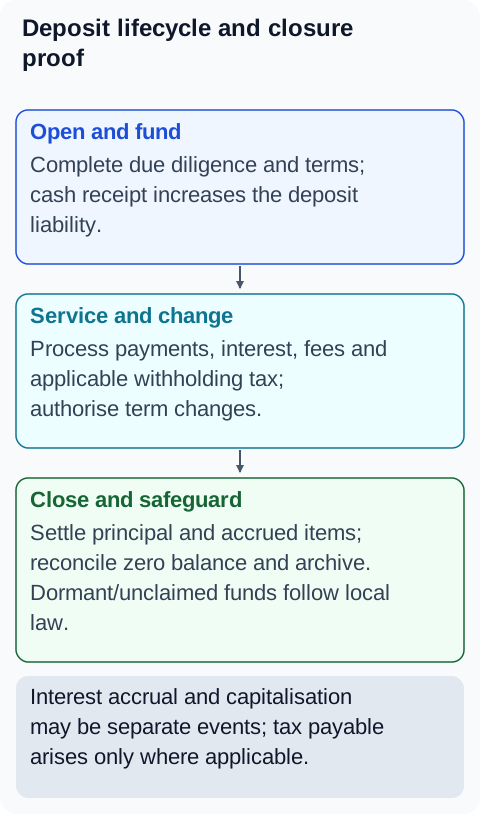
Apply the actual dormancy/inactivity definition and permitted restrictions by jurisdiction and product. Preserve the customer liability and continue interest that remains contractually owed; inactivity does not itself justify a universal debit freeze or loss of interest. Unclaimed balances may escheat to the state after statutory periods — Dr Deposit / Cr Escheatment payable, with reclamation handling. On death notification, apply lawful mandate/access controls, including any joint-account rights, and pay entitled recipients under applicable estate law. Interest follows the contract and law, rather than a universal bank-policy payout rule. Closure journals must zero principal, accrued interest, pending fees and tax lines simultaneously — partial closures are a classic break source.
5. Product and customer impact
Customers experience deposit accounting as balance accuracy, interest fairness and fee transparency. Pain points with accounting roots: pending vs available confusion (memo/batch timing, The Chart of Accounts); interest "missing" after tier changes (band-evaluation order); fees applied before notified (event sequencing); restrictions after fraud flags (assess the actual legal and operational hold; customer funds remain a deposit liability unless an evidenced reclassification is appropriate—see Payment Exceptions). Statements and app transaction histories are accounting outputs — narrative quality, value-date display and reversal labelling (Booking Date, Value Date and Reporting Date) determine whether customers trust or dispute them.
6. Regulatory and supervisory view
Deposit protection schemes (for example FSCS, FDIC, DICGC and national EU deposit-guarantee schemes — jurisdiction-specific limits and scope) require depositor/account data demonstrating coverage under the applicable scheme and its actual preparation or payout deadlines — an accounting-and-data readiness test, not just a report. Dormancy/escheatment follows national law. Overdraft and fee practices face conduct rules and caps that vary sharply by jurisdiction — verify locally before pricing or provisioning. LCR deposit categories follow prescribed criteria, including applicable insurance coverage and relationship or transactional-account tests for stable retail deposits. NSFR weights follow prescribed counterparty and maturity rules; behavioural evidence is used only where permitted, not to override contractual maturity. Maintain the required classifications and evidence (Section 16).
7. Systems and data view
Deposit platform nightly cycle: post the day's transactions → accrue interest per account → sweep fees/charges/tax → capitalise where due → update GL control totals → reconcile subledger to GL (account-count and balance tie-outs) → publish balances to channels. Intraday, memo processing holds funds for authorisations and instant payments. Key controls: end-of-day completeness (every channel feed consumed), interest-rate table versioning with re-performance, dormancy flag automation, and GL tie-out exception handling and safe service-continuity decisions; customer-serving ledgers may operate before an aggregated GL batch posts.
8. End to end process
Opening to closure for one savings account: (1) application, KYC/AML checks, product selection, mandate capture; (2) account created with product code driving rate rules and dimensions; (3) first funding posts Dr Cash/Cr Deposit; (4) daily accruals accumulate, monthly capitalisation compounds; (5) fees and withholding tax deducted with advices; (6) rate changes applied prospectively with customer notice; (7) dormancy monitoring after inactivity; (8) closure request → settle interest to date, deduct pending items, pay out, zero all lines, archive with retention. Not every administrative step emits a journal. At closure the customer liability and relevant accruals must be settled or lawfully transferred; lifetime interest expense and fee income remain in the bank's books.
9. Controls and risks
| Risk | Control | Evidence |
|---|---|---|
| Double-posted interest/fees (batch rerun) | Idempotent batches, rerun guards, balance-change monitoring | Batch logs, rerun approvals, exception reports |
| Interest on wrong tier/rate | Rate-table versioning, re-performance sampling | Rate change records, sample recalculations |
| Dormant-account abuse | Activity flagging, dual control on dormant debits | Dormancy reports, access logs |
| Tax under-deduction | Residency/relief documentation checks, jurisdiction rule tables | Tax deduction samples, relief forms |
| Subledger–GL drift | Daily balance + count tie-out, break ageing | Reconciliation packs, sign-off |
10. Practical examples
Example A — The double-interest night. Batch reruns after a crash without idempotency guard; 40,000 accounts credited twice (~800,000 total). Response: freeze affected postings, reverse the duplicate leg with clear narratives (never silent delete), reconcile to the penny, disclose to the audit trail, compensate customers charged fees on wrong balances. Prevention: rerun-safe batch design (Section 20 test case).
Example B — Bonus-rate forfeiture. Savers promised +1% bonus for no withdrawals; 3,000 withdraw and lose the bonus. Engine must reverse previously accrued bonus (Dr Accrued bonus interest payable / Cr Interest expense for the unearned/unvested amount, subject to the contract and applicable law) with statements explaining the drop. Lesson: conditional accruals need reversal-tested logic and customer communication designed together.
11. Diagrams
Figure 1. Current and savings deposit accounts.
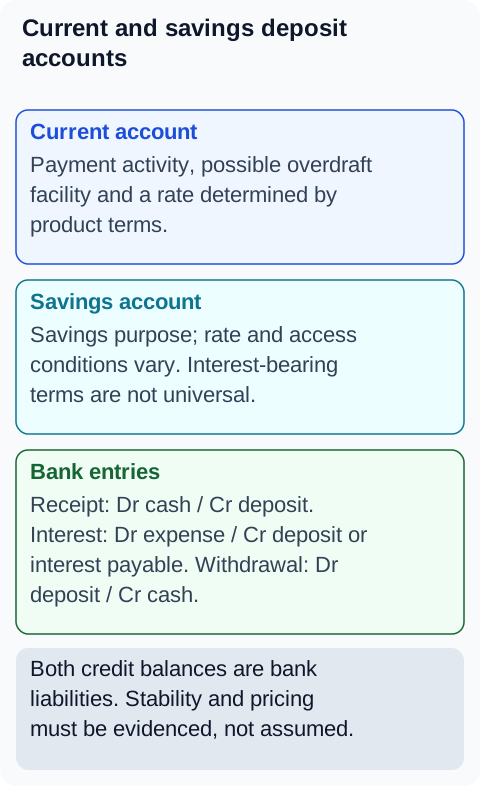
Figure 2. From deposit balance to drawn credit.
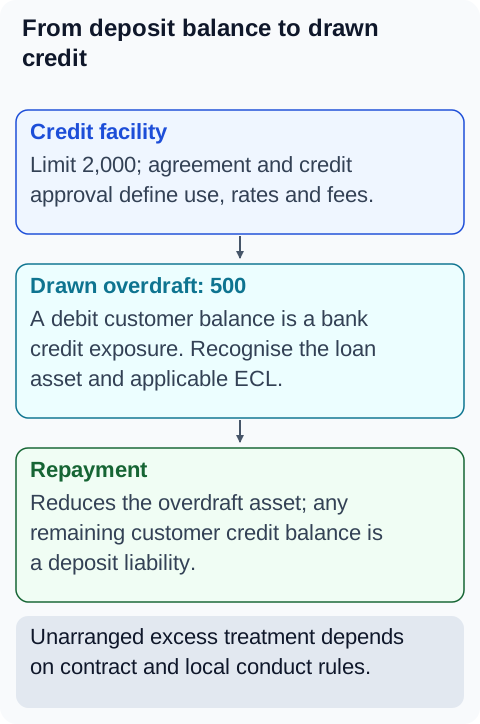
Figure 3. Deposit lifecycle and closure proof.
12. Tables
Table 1 — Deposit event journal map
| Event | Debit | Credit |
|---|---|---|
| Cash deposit | Cash | Deposit liability |
| Withdrawal | Deposit liability | Cash |
| Interest accrued | Interest expense | Deposit liability (or accrued-interest sub-account) |
| Interest capitalised | (Accrued-interest sub-account) | Deposit principal (reclassification) |
| Account fee | Deposit liability | Fee income |
| Withholding tax | Deposit liability | Tax payable |
| Overdraft externally drawn from zero balance | Overdraft loan asset | Settlement payable, then cash when payable settles |
| Dormant escheatment | Deposit liability | Escheatment payable |
| Closure payout | Deposit liability | Cash |
Table 2 — Deposit data for downstream uses
| Consumer | Needs from deposit accounting |
|---|---|
| FTP desk | Balances by stickiness/behaviour for funding credits |
| LCR/NSFR reporting | Prescribed counterparty, insurance/relationship and maturity classifications, with supporting evidence |
| Deposit protection (SCV) | Aggregated per-depositor view within payout deadline |
| Conduct/treating-customers-fairly | Fee and interest disclosure evidence |
| Marketing/product | Balance flows, attrition, rate sensitivity |
13. Illustrative bank case study
The interest-riot that wasn't about rates. A bank's savings migration to a new platform recalculated tiered interest with bands evaluated in the wrong order — 200,000 customers underpaid small amounts for three months. Totals were immaterial; complaints were not. Remediation cost dwarfed the shortfall: penny-level recalculation, back-payments with apology interest, regulator notification, and a re-performance control over every rate-table release. Lesson: interest accuracy is trust infrastructure; test band boundaries, not just standard cases. (Fictional training case; no specific bank or event is asserted.)
14. BA, developer, tester and operations guidance
- BA: Specify rate rules as decision tables (bands, conditions, forfeitures, day-count, rounding) with worked examples per path — prose rate descriptions are defect factories.
- Developer: Version rate tables; make batches idempotent and re-runnable; separate accrued vs capitalised balances in data; apply approved containment on a GL tie-out failure without automatically withholding all customer access.
- Tester: Boundary-test tiers (band edges ±0.01), condition forfeitures, leap days, rate-change-mid-period, dormancy transitions, closure-with-pending-items, and full batch reruns.
- Operations: Review daily tie-outs and interest-variance reports before balances publish; treat any unreconciled difference as customer-impacting until proven otherwise.
15. Common mistakes
- Treating deposits as assets in journals or commentary.
- Forgetting withholding tax deduction and remittance legs.
- Accruing bonus interest unconditionally, then firefighting forfeitures.
- Letting batches rerun without idempotency guards.
- Closing accounts with residual accrued/tax lines that linger for years.
16. Key takeaways
- Current and savings accounts are demand liabilities; journals mirror each other, rates and behaviour differ.
- Interest accrues daily, capitalises periodically, deducts tax where required — all engine-driven.
- Overdrafts convert liabilities to provisioned assets with conduct constraints.
- Dormancy, death and closure are controlled accounting paths, not admin afterthoughts.
- Daily subledger–GL tie-out is the heartbeat; interest accuracy is the trust.
17. References and verification notes
-
FSCS: deposit protection: for failures after 30 November 2025, the ordinary limit is £120,000 per eligible person per authorised institution, aggregated across shared licences; exclusions and special temporary high balance rules apply.
-
Basel Framework: NSFR: available and required stable funding are weighted by funding and asset characteristics over a one-year horizon, not a requirement to match every mortgage with equally long funding.
-
Basel Framework: LCR: 100% is the minimum in normal conditions for covered banks; HQLA buffers are intended to be usable in stress. Basel is a standard implemented through local law.
-
IFRS Foundation: IFRS 9: classification depends on business model and contractual cash flows; initial recognition and directly attributable costs follow IFRS 9. This is the IFRS track, not US GAAP CECL.
-
Liability and interest recognition per IFRS (IFRS 9 amortised-cost mechanics for deposits at par; IAS 1 presentation); deposit protection, dormancy/escheatment, withholding and overdraft-conduct rules are jurisdiction-specific — verify the applicable FSCS/FDIC/DICGC or national EU scheme limits, national dormancy law, tax rates and fee caps locally.
-
Liquidity stickiness classifications preview Section 16; confirm current LCR/NSFR calibration in the applicable rulebook.
-
All amounts, rates and periods are fictional training illustrations.