Chapter 017: Term Deposits
Section 4: Deposit and Funding Accounting · Chapter 017 of 100
A treasurer watches 2 billion of term deposits mature next Friday. Will they roll over at today's higher rates, walk to a competitor, or fragment into instant access — and what does each path cost in interest, liquidity and FTP? Term deposits are simple contracts with far-reaching consequences: locked funding the bank prices, accrues, taxes, breaks and ladders. This chapter covers term-deposit accounting from booking to maturity, early-withdrawal penalties, rollover mechanics and the maturity ladder that feeds treasury.
1. Chapter opening
A term deposit fixes principal, rate and maturity: the customer locks money away, the bank gains stable funding and owes fixed interest. Accounting accrues interest over the reporting period, handles rollovers or extensions according to contractual substance, applies contractual early-break terms where withdrawal is permitted, deducts withholding tax, and reports every deposit into maturity buckets that drive NSFR and interest-rate-risk measurement. This chapter works each pattern with journals and numbers.
Term deposits are the bank's most predictable source of wholesale-like funding from retail and corporate customers. Unlike current accounts (which are contractually repayable on demand but behaviourally stable), term deposits have a fixed maturity date — early withdrawal rights and any penalty depend on the contract and local law. This certainty of term makes term deposits valuable for treasury: they can be laddered to match asset maturities, they contribute to the NSFR (Net Stable Funding Ratio) as stable funding, and they provide a predictable basis for interest-rate risk measurement. The trade-off is that term deposits typically pay higher rates than current accounts (reflecting the customer's sacrifice of liquidity) and may be subject to early-withdrawal penalties that create customer-conduct risks.
The accounting for term deposits is straightforward in principle — accrue interest daily, pay principal plus accrued interest at maturity — but the operational details are complex. The day-count convention (actual/360, actual/365, 30/360) affects the accrual calculation. The compounding frequency (daily, monthly, quarterly, annually) affects the effective yield. The withholding-tax regime (which varies by jurisdiction and customer type) affects the net payout. And the early-withdrawal mechanics (penalty rate, recast, notice period) create edge cases that require careful handling.
2. Learning objectives
By the end of this chapter you will be able to:
- Post term-deposit booking, daily accruals, maturity payout, rollover and early-break journals.
- Compute a rate-recast penalty and explain its P&L signature (negative expense).
- Distinguish renewal, rollover with additions, and partial withdrawals in ledger terms.
- Explain how the maturity ladder feeds NSFR, IRRBB and FTP tenor pricing.
- Apply withholding-tax deduction and reporting duties (jurisdiction-dependent).
- List the controls over rate changes, break approvals and maturity operations.
3. Business context
Term deposits are the treasurer's favourite retail funding: predictable, behaviourally stable, NSFR-friendly. Campaigns ("4% for 1 year!") move volumes fast — and create cliffs when tranches mature together. Pricing must cover FTP funding value, expected retention, and the option the customer holds to break early. Accounting makes the cost visible daily through accruals, so margin analysis never waits for maturity.
The campaign dynamic is a critical treasury consideration. When treasury needs to raise term deposits — because the maturity ladder shows a funding gap, or because NSFR requires more stable funding — it launches a campaign with an attractive rate. The campaign succeeds: 2 billion of term deposits are raised at 4% for 1 year. But the campaign creates a maturity cliff: 2 billion is assumed, for this fictional campaign, to mature together in 12 months. If rates have risen by then, the bank must either offer a higher rate to retain the deposits (increasing funding costs) or accept the outflow (replacing the deposits with more expensive wholesale funding). If rates fall, a customer locked at 4% has benefited during the fixed term, but may reject the lower renewal rate or change product.
The pricing of term deposits must therefore consider not just the current rate, but the expected retention rate (what percentage of deposits will roll over at maturity?), the FTP value of the deposit (how much is the deposit worth to treasury, given its expected term and stability?), and the cost of the early-withdrawal option (what is the expected cost if the customer breaks the deposit before maturity?). Each of these inputs involves judgement and modelling, and each affects the margin the bank earns on the deposit.
| Product variant | Accounting complexity |
|---|---|
| Fixed rate, fixed term | Straight-line/EIR accrual; simple maturity |
| Auto-renewal | New contract generation; rate re-fixing; disclosure |
| Callable/notice deposits | Behavioural maturity estimation for liquidity |
| Foreign-currency deposits | FX revaluation of principal + interest (Ch on FX) |
| Senior-citizen / staff preferential rates | Segment reporting; benefit-in-kind considerations vary |
4. Finance and accounting view
4.1 Booking and accruals (100,000 at 4% for 1 year, fictional)
For a fictional 100,000 deposit at 4%, assume a 360-day contractual term and Actual/360, no compounding, no costs and principal at par. Booking: Dr Cash 100,000 / Cr Term deposit principal 100,000. One-day contractual accrual is 100,000 × 4% / 360 = 11.111111; accumulate at sufficient precision and round under policy. A 30-day period earns 333.33; the full 360-day term earns 4,000.
Under Actual/365 for the same actual 360 days, interest would be 3,945.21. For 365 actual days, Actual/360 gives 4,055.56 while Actual/365 gives 4,000. Do not substitute a calendar year for the convention denominator. Contractual coupon accrual and EIR expense may differ where compounding, discounts or integral costs are material.
Accrue Dr Interest expense / Cr Accrued interest payable. At maturity with no tax: Dr Principal 100,000 + Dr Accrued interest payable 4,000 / Cr Cash 104,000. If an illustrative 10% withholding applies to interest, first Dr Accrued interest payable 400 / Cr Tax payable 400, then pay the customer 103,600; remit Dr Tax payable 400 / Cr Cash 400. Withholding transfers liability, not the bank's interest expense.
4.2 Early withdrawal: penalty plus recast
Use only lawful contractual early-withdrawal terms; some products prohibit early withdrawal and others permit it with or without a fee or rate recast. For a fictional permitted 180-day break on the 100,000 Actual/360 deposit, the 4% accrued interest is 2,000. Assume the contract instead entitles the customer to 2% for that held period, or 1,000. If the 2,000 remains accrued and unpaid: Dr Accrued interest payable1,000 / Cr Interest expense1,000, then Dr Principal100,000; Dr Accrued interest payable1,000 / Cr Cash101,000. If interest has already been credited, use the relevant legally available customer balance and authorised correction rather than this unpaid-accrual entry.
A separate penalty requires its own contractual entitlement and accounting classification; it is not automatically IFRS 15 fee income. Integral liability economics and extinguishment effects follow the applicable IFRS 9 treatment. Compare total settlement with current carrying amount and avoid counting the same deduction twice. Tag the non-recurring effect for margin analysis without changing the contractual payout.
4.3 Rollover and renewal
A renewal may close one deposit and create a new one, or extend existing terms. Preserve old/new contract linkage, customer instruction, changed rate, accrued interest and maturity. Assess IFRS 9 liability modification or extinguishment by substance; a new system ID alone does not decide derecognition. Capitalising earned interest increases the renewed principal without recognising the expense again.
Renewal notice and withdrawal rights follow the contract and local conduct law; there is no universal 30-day notice requirement derived from the EU deposit-guarantee directive. A notice deposit has a notice restriction; do not automatically call it on-demand. LCR treatment uses prescribed category and maturity/withdrawal rules, not a blanket 100% outflow for all demand deposits or an arbitrary bank-selected behavioural percentage.
4.4 Maturity ladder and treasury use
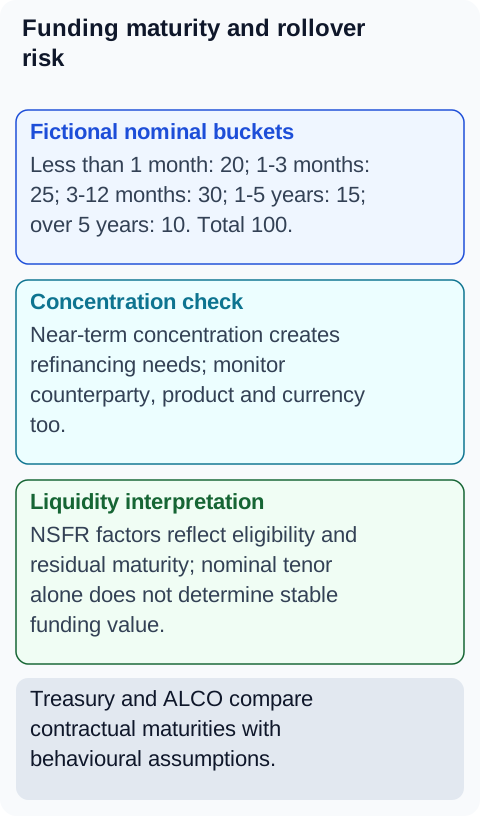
Every term deposit lands in a residual-maturity bucket (<1m, 1–3m, 3–12m, 1–5y, >5y). Concentrations ("cliffs") force refinancing at unknown future rates — ALCO limits bucket shares. NSFR assigns stable-funding factors by maturity and counterparty; IRRBB measures repricing gaps from the same ladder. FTP credits the deposit-gathering unit by tenor — longer stable funding earns richer credits, which is why branches push 5-year campaigns when treasury needs duration.
The maturity ladder is the bridge between term-deposit accounting and treasury management. The ladder shows the bank's term-deposit profile by residual maturity — how much matures in each bucket, and therefore how much must be refinanced or replaced. The ladder is updated daily as deposits are booked, mature, and broken. It is the primary tool for identifying refinancing risk (concentrations in near-term buckets), NSFR compliance (whether the bank has sufficient stable funding), and FTP pricing (what tenor credit to assign to each deposit product).
The NSFR stable-funding factor varies by maturity and counterparty type. Under the Basel NSFR standard, qualifying liabilities with residual maturity of at least one year generally receive 100% available stable funding. Shorter stable retail/SME deposits generally receive 95%, less-stable retail/SME deposits 90%; many short-dated wholesale categories use other factors. Apply the actual category, maturity and local implementation. The factors are prescribed by the Basel Committee and implemented locally — verify the current factors in the applicable rulebook.
5. Product and customer impact
Customers judge term deposits on rate fairness and break flexibility: advertised vs effective yield (compounding frequency disclosure), renewal notices (auto-roll at lower rates without notice is a conduct flashpoint in several jurisdictions), break penalties applied consistently, and tax certificates matching credits. Premature-break calculators in apps must match engine recasts to the penny — mismatches destroy trust faster than low rates.
The customer experience of term deposits is defined by transparency and consistency. The advertised rate must match the rate the customer receives — any discrepancy (for example, a promotional rate that reverts to a lower rate without clear disclosure) is a conduct risk. The break penalty must be applied consistently — if one customer receives a penalty waiver and another does not, the inconsistency creates fairness concerns. The tax certificate must accurately reflect the interest paid and the tax deducted — errors in tax certificates create compliance risks and customer complaints.
The premature-break calculator is a critical customer-facing tool. When a customer requests an early withdrawal, the calculator must show: the accrued interest at the original rate, the recast interest at the break rate, the penalty amount, and the net payout. The calculator's output must match the engine's calculation exactly — any discrepancy (even a few pence) undermines customer trust. The calculator must also be updated whenever the bank's break policy changes — a calculator that shows the old penalty amount creates customer confusion and potential complaints.
6. Regulatory and supervisory view
Deposit protection covers term deposits within scheme limits and payout timelines — SCV readiness includes term positions. Early-break and renewal practices face conduct scrutiny (fair value assessments, renewal-notice rules vary by jurisdiction). Liquidity reporting consumes contractual maturities plus behavioural adjustments under supervisory standards; interest-rate-risk disclosures use repricing ladders. Tax deduction, reporting (for example, interest statements, cross-border information exchange regimes like CRS where applicable) follows national law — verify locally.
Deposit protection is a critical consideration for term deposits. In most jurisdictions, deposits are protected up to a specified limit (for example, €100,000 in the EU, £120,000 per eligible person per authorised institution in the UK for failures after 30 November 2025, $250,000 per depositor, per insured bank, per ownership category in the US). Term deposits within the protected limit are covered by the deposit guarantee scheme, which means that if the bank fails, the customer will be repaid up to the limit. Amounts above an ordinary limit need the actual scheme assessment, including any qualifying temporary-high-balance or ownership-category coverage. An uninsured balance may still have a claim in insolvency; no full recovery is promised. The bank must disclose the deposit-protection status to the customer, and the disclosure must be clear and prominent.
The conduct scrutiny of early-break and renewal practices is increasing. Supervisors are examining whether banks are applying break penalties fairly (are penalties applied consistently across customers?), whether renewal notices are clear and timely (do customers understand the renewal terms?), and whether the effective yield on term deposits matches the advertised yield (are there hidden costs or charges?). Banks that fail to meet conduct expectations face enforcement action, customer redress costs, and reputational damage.
7. Systems and data view
Deposit system maturity engine: nightly accruals per contract, maturity diary (auto-flag T-30/T-7/maturity-day actions), renewal-notice generation, break-workflow with recast calculation, tax computation and certificate feeds, GL postings with principal/interest/tax split, and ladder feeds to treasury/liquidity systems. Controls: rate-table versioning, recast re-performance, maturity-diary completeness (every maturing contract actioned — none silently auto-rolled against policy), and GL tie-out of principal + accrued per product.
The maturity diary is the operational heartbeat of the term-deposit function. It tracks every term deposit by its maturity date and generates actions at T-30 (renewal notice), T-7 (final renewal reminder), and maturity day (payout, renewal, or break). The T-30/T-7 actions are illustrative internal timings, not universal notice requirements. The diary must be complete — every maturing deposit must have an action assigned (payout, renew, or break) — and the actions must be executed on time. A deposit that matures without an action is a control failure: the customer's money is either paid out (which may not be the bank's intention) or left in an unorganized state (which creates accounting and customer-service issues).
The rate-table versioning control ensures that the correct rate is applied to each deposit. When the bank changes its deposit rates, the rate table is updated with an effective date. The system must apply the rate that was in effect when the deposit was booked — not the current rate. If the rate table is not version-controlled, the system may apply the wrong rate to existing deposits, creating misstatements and customer complaints.
8. End to end process
One 1-year deposit's journey: (1) sale with advice showing rate, compounding, break terms, tax note; (2) booking with value-date funding; (3) daily accruals for the actual contractual term; (4) T-30 renewal notice with prevailing rates; (5a) maturity: payout or rollover/extension analysed according to substance; or (5b) early break: approval, recast, penalty, payout; (6) tax deduction, remittance and certificate; (7) GL and ladder updated at each step; (8) archived with full journal history. The maturity diary is the operations heartbeat — review it daily, not at month-end.
9. Controls and risks
| Risk | Control | Evidence |
|---|---|---|
| Wrong accrual (rate/day-count) | Rate versioning, re-performance, ladder-to-GL tie | Rate logs, sample recalcs |
| Silent auto-renewals against policy | Renewal-notice workflow, customer instruction records | Notice logs, instruction archive |
| Miscalculated breaks | Automated recast, dual check on manual breaks | Recast reports, approval records |
| Maturity cliff unmanaged | Bucket-limit monitoring, ALCO reporting | Ladder packs, limit breaches log |
| Tax mis-deduction | Residency documentation, rule-table testing | Deduction samples, certificates |
10. Practical examples
Example A — The cliff. A 4%-campaign raises 800 million maturing the same week rates hit 5.5%. Retention falls to 40%; 480 million leaves in days, forcing wholesale replacement at higher cost. Lesson: stagger campaign maturities by design; price retention scenarios, not just acquisition. The bank had launched a campaign offering 4% on 1-year term deposits, with a maturity date of 15 March. The campaign was successful, raising 800 million. However, rates rose to 5.5% by the following March. When the deposits matured, only 40% (320 million) rolled over at the new rate. The remaining 480 million left — transferred to competitors offering 5.5% on new term deposits. The bank was forced to replace the 480 million with wholesale funding at 5.5%, increasing its funding cost by approximately 7.2 million per annum (480 million × 1.5% additional cost). The lesson: stagger campaign maturities to avoid cliffs, and price retention scenarios (what happens if rates rise?) before launching campaigns.
Example B — Negative-expense confusion. Break recasts post 150,000 of negative interest expense in March. FP&A celebrates a "cost saving" until Finance explains it's a one-off break effect. Lesson: tag recast/penalty journals with distinct codes so analytics separates structural margin from break noise. The bank's FP&A team observed a 150,000 reduction in interest expense in March and flagged it as a positive variance. Investigation revealed that the reduction was caused by 50 term deposits that were broken early, with interest recast from 4% to 2% — a total recast of 150,000. The recast was a one-off event, not a recurring saving. The fix was to tag recast journals with a distinct code (e.g., "TD-BREAK-RECAST") so that FP&A could exclude them from recurring variance analysis. Lesson: tag recast/penalty journals with distinct codes so analytics separates structural margin from break noise.
11. Diagrams
Figure 1. A one-year term deposit.
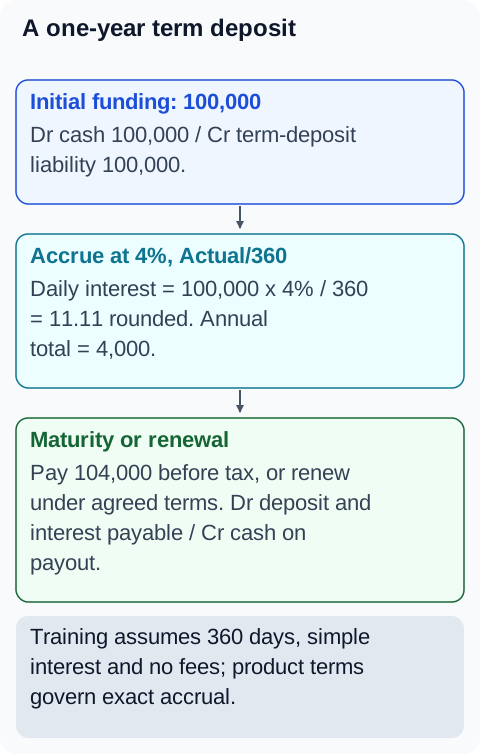
Figure 2. Early withdrawal: a contractual recast.
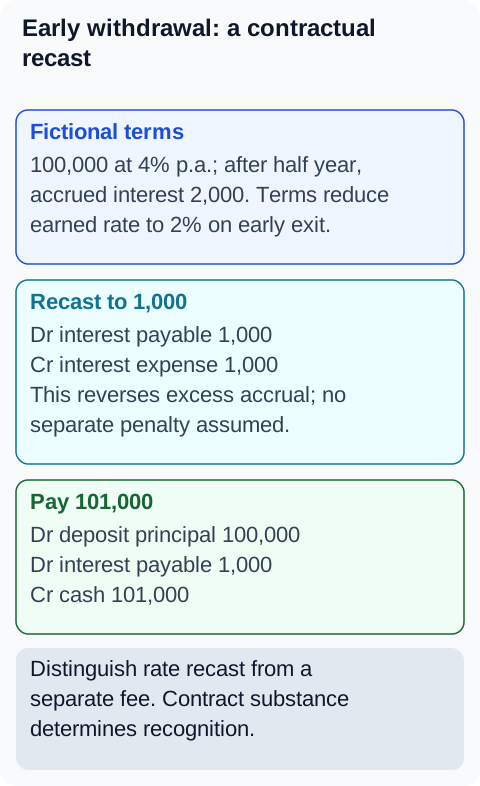
Figure 3. Funding maturity and rollover risk.
12. Tables
Table 1 — Term deposit journal map
| Event | Debit | Credit |
|---|---|---|
| Booking | Cash | Term deposit principal |
| Daily accrual | Interest expense | Term deposit accrued interest |
| Maturity payout after separate withholding journal | Principal + remaining accrued interest | Cash equal to the remaining liability |
| Withholding tax | Term deposit | Tax payable |
| Early-break recast | Term deposit (accrued slice) | Interest expense (negative) |
| Separate break deduction | Relevant deposit/accrual liability | Classification follows contract and IFRS 9/15 scope; not automatically service income |
| Renewal | Old deposit (principal ± interest) | New deposit principal |
Table 2 — Maturity bucket uses
| Bucket | Treasury question | Reporting use |
|---|---|---|
| <1 month | Can we refinance the cliff? | LCR short-end pressure |
| 1–12 months | What reprices, and at what rate? | NSFR factors, IRRBB gaps |
| 1–5 years | Is the core stable? | Stable funding credit |
| >5 years | Duration for structural hedging? | Applicable funding factors and separate hedge assessment |
13. Illustrative bank case study
A renewal instruction is missed. In this fictional case, a depositor asks for maturity payout but the system automatically renews. Operations checks the timestamped instruction, reverses the erroneous renewal under the approved workflow, recalculates contractual interest/tax and explains the correction. The control improvement is a reconciliation of maturity diary, instruction and posted disposition, with notice timing set by the actual product and local rules.
14. BA, developer, tester and operations guidance
- BA: Specify accrual formula (rate source, day-count, rounding, compounding), break rules (penalty + recast matrix), renewal options and tax logic per product — with numeric examples per path.
- Developer: Version rate tables; automate recasts; preserve renewal/extension versions with lineage and assess derecognition by substance; feed ladders daily with contract-level detail.
- Tester: Accrue across leap days and rate changes; break at every elapsed fraction; renew with additions/partial withdrawals; verify tax certificates tie to postings.
- Operations: Work the maturity diary daily; dual-check manual breaks; monitor bucket concentrations and report breaches before they mature.
15. Common mistakes
- Losing lineage when renewing or extending a contract; assess IFRS 9 extinguishment/modification rather than relying only on the system contract ID.
- Treating every break charge as service-fee income; classify contractual compensation and integral amounts by substance.
- Letting negative-expense recasts pollute margin analysis untagged.
- Ignoring maturity cliffs until the refinancing week.
- Applying tax rules of one jurisdiction to another's deposits.
- Auto-renewing without adequate customer notice.
- Failing to reconcile GL to customer advice for accrued interest.
16. Key takeaways
- Book and accrue term deposits; assess renewal/modification/extinguishment by contractual substance, not a new system ID.
- Early breaks follow actual contractual rights; identify recast, settlement and any distinct fee without double-counting.
- Negative-expense recast entries must be tagged and explained.
- The maturity ladder is treasury's funding map and liquidity's evidence.
- Renewal and break journeys are conduct-regulated — design them with compliance.
17. References and verification notes
-
FSCS: deposit protection: for failures after 30 November 2025, the ordinary limit is £120,000 per eligible person per authorised institution, aggregated across shared licences; exclusions and special temporary high balance rules apply.
-
Basel Framework: NSFR: available and required stable funding are weighted by funding and asset characteristics over a one-year horizon, not a requirement to match every mortgage with equally long funding.
-
Basel Framework: LCR: 100% is the minimum in normal conditions for covered banks; HQLA buffers are intended to be usable in stress. Basel is a standard implemented through local law.
-
IFRS Foundation: IFRS 9: classification depends on business model and contractual cash flows; initial recognition and directly attributable costs follow IFRS 9. This is the IFRS track, not US GAAP CECL.
-
Amortised-cost accrual per IFRS 9; renewal/break economics per contract law and conduct rules that are jurisdiction-specific (renewal notices, break-penalty fairness, tax deduction rates, CRS reporting) — verify locally.
-
NSFR/IRRBB uses of maturity data are introduced here and defined in Sections 7 and16; confirm current calibration.
-
All amounts, rates and buckets are fictional training illustrations.