Chapter 015: Reliable Accounting Interfaces
Section 3: Finance Systems and Accounting Architecture · Chapter 015 of 100
In this fictional scenario, the new reporting platform processes 2m events nightly — except the 3% that fail silently, the 1% that duplicate, and the FX feed that arrives incompatible every month-end. Interface reliability is platform reliability: contracts, idempotency, sequencing, replay and exception handling designed in, not wished for. This chapter builds reporting platforms on interfaces that don't lie, lose or duplicate.
1. Chapter opening
Platform layers (ingestion → validation → enrichment → calculation → aggregation → distribution) connected by contracted interfaces (format/schema version, frequency/SLA, completeness proofs, error semantics). Reliability properties: idempotent receivers (replays safe), ordered processing (sequence keys, out-of-order buffers), exactly-once effects (dedupe on event IDs), replayable history (immutable event log), and quarantined failures (never silent drops). This chapter specifies, builds and operates them.
Interface reliability in banking finance platforms is not a technical nice-to-have — it is a regulatory requirement. Supervisors expect that reported numbers can be traced to source data through contracted interfaces, with evidence that every source event was either processed correctly or identified, owned and resolved. The "silent 3%" failure pattern — events that fail validation and are logged but never processed, creating systematic understatement — is among the most dangerous failure modes because it is invisible until external benchmarking or independent reconciliation or supervisory review discovers it. The interface layer is where data quality is enforced: schema validation catches structural errors, business-rule validation catches content errors, completeness proofs catch missing data, and deduplication catches retry-induced duplicates. Each layer must be designed with explicit failure semantics — what happens when the check fails — because "log and continue" is the path to undetected misstatement.
The contractual framework governing interfaces must be treated with the same rigour as legal contracts. Each interface contract specifies: the data format (Avro, JSON, XML with schema version), the frequency and timing (daily at 02:00, intraday deltas every 15 minutes), the completeness proof (record count, hash, control total), the error semantics (reject with specific codes, quarantine on structural failure, retry on transient failure), and the sunset provisions (legacy versions deprecated with migration timelines). These contracts are versioned — schema v7 replaces v6 with a 90-day overlap period — and enforced by automated validation gates that reject non-conforming data. The contract register must be maintained with the same discipline as a legal-contract register: changes require impact analysis, stakeholder approval, and parallel proof before deployment.
2. Learning objectives
- Specify interface contracts (schema, SLA, proofs, error semantics).
- Design idempotent, ordered, replayable ingestion.
- Operate exception queues (classify, own, SLA, root-cause).
- Prove completeness (counts, hashes, control totals end to end).
- Plan platform cutover (parallel, phased, big-bang trade-offs).
- Design event-ID schemes that prevent duplicate processing.
- Implement quarantine discipline for failed data.
3. Business context
Interface failures are close failures (missing feeds block sign-off), reporting failures (partial data files wrong), and audit failures (unreconciled gaps). Platform programmes succeed on interface discipline (Delivering Accounting and Reporting Change contracts enforced in code) and fail on "we'll fix feeds later." Vendor platforms need exit/entry data contracts with the same rigour as internal feeds — lock-in hides in undocumented interfaces.
The business impact of interface failures manifests across three timeframes. Immediate failures — a feed arriving late or incomplete — block the close process, delaying sign-off and creating cascade delays for regulatory filings. A single missing feed at 02:00 can delay close completion by hours if the data is needed for provisioning, valuation or reconciliation engines that run in sequence. Medium-term failures — systematic data-quality issues that persist for weeks — create reporting errors that require restatement, consuming management attention and damaging analyst confidence. Long-term failures — undocumented vendor interfaces that cannot be exited without proprietary data formats — create vendor lock-in that limits strategic flexibility and increases costs. Each failure type requires different prevention: immediate failures require SLAs with escalation; medium-term failures require quality monitoring with trend analysis; long-term failures require contractual exit provisions documented at inception.
Vendor lock-in through undocumented interfaces is an underappreciated risk. A bank implementing a new core banking system discovers that the vendor's reporting module outputs data in a proprietary format that cannot be consumed by any other system — the bank is locked into the vendor's reporting capability, and exit requires rebuilding all reporting from scratch. The contractual provision that should have been negotiated at inception — standard data export formats, documented schemas, and exit-assistance obligations — would have prevented this lock-in. Banks implementing vendor platforms must treat data contracts as critically as functional specifications: the vendor's obligation to provide data in usable formats must be documented, tested, and enforced with the same discipline as the vendor's obligation to deliver functional software.
| Property | Implementation | Proves |
|---|---|---|
| Idempotency | Event-ID dedupe tables | Replay tests |
| Ordering | Sequence keys + buffers | Out-of-order suites |
| Completeness | Counts/hashes/totals | Reconciliation packs |
| Replay | Immutable event log | Rebuild drills |
4. Finance and accounting view
4.1 Contract and failure mechanics (fictional loan-events feed)
A fictional nightly feed carries schema version, stable source/action identity, event type, source time, accounting attributes and control totals by currency and entity. The producer signs or transmits a trusted manifest with expected count, byte hash and financial totals. A matching hash proves the received bytes match the manifest; it does not prove the producer extracted every economic event. Tie extraction coverage to source journals and sequences independently.
Reject a corrupt file or manifest failure before posting. For record-level business failures, either reject the batch or admit valid records under a documented partial-acceptance design that retains every rejected record and reconciles the full population. Neither approach permits silent omission. Distinguish accepted-for-processing from committed-to-GL acknowledgements.
An idempotency key and its posted outcome must commit atomically with the journal, or be coordinated through a proved transaction/outbox design. If an acknowledgement is lost after commit, retry returns the existing result. If the transaction rolled back, retry may post once. Record a conflicting reuse of an ID with a different payload as an exception, not a harmless duplicate.
4.2 Cutover strategies
Parallel (dual-run full cycles, difference attribution, cutover on zero-unexplained — safest, costliest), phased (by product/entity with rollback per phase), big-bang (single cutover with tested rollback — fastest, riskiest, needs proven fallback). Finance migrations need risk-appropriate parallel evidence and authorised acceptance under the bank’s governance; no global rule mandates a fixed number of parallel closes or Board approval for every cutover. Test realistic recovery, including transactions that cannot be erased after legal settlement.
The parallel-run methodology is the gold standard for finance platform cutovers because it provides the highest confidence that the new system produces the same results as the legacy system under identical conditions. The bank operates both systems simultaneously over a risk-appropriate set of full cycles, including relevant period-end, annual and exception cases; the number is an approved migration-design decision — with every balance, journal and report independently produced by both systems. The critical output is difference attribution: every difference between legacy and new must be categorised as (a) expected differences (explainable by known design changes), (b) timing differences (explainable by processing-sequence variations), or (c) unexplained differences (potential errors requiring investigation). Cutover proceeds only when unexplained differences are zero or immaterial. The parallel-run cost is substantial — dual operations, dual reconciliation, extended timelines — but the potential cost of a failed cutover includes correction, supervisory findings and loss of confidence; quantify the scenario instead of assuming a universal multiple.
Phased cutovers — migrating by product, entity or business line with per-phase gates and rollback — offer a middle ground between parallel and big-bang approaches. Each phase is a mini-cutover with its own parallel-run evidence, gate review and rollback capability. The advantage is blast-radius containment: a defect in one phase is isolated to that phase, and remaining phases continue unaffected. The disadvantage is extended timeline and complexity: managing multiple phases with interdependencies requires careful sequencing, and partial migration creates temporary dual-system operation across the bank. Most finance platforms use phased cutovers for complex migrations — cost and risk depend on population, coexistence complexity, rollback feasibility and testing.
4.3 Deep dive: dedupe architecture at scale and cutover-strategy selection economics
Dedupe architecture (replay-safe at millions of events): event-ID design (globally unique, deterministic from business keys — persisted action identity remains stable on retry; use namespaces and cross-system correlation), dedupe stores (high-performance lookups with retention exceeding maximum replay windows — expired dedupe entries resurrect duplicates), exactly-once effects (dedupe check + state change in single transactions — check-then-act races eliminated by design), and duplicate analytics (duplicate rates by source trending — rising duplicates signal producer retry storms needing upstream fixes, not just filtering). Chaos testing (deliberate duplicate floods, out-of-order bursts, partial batches) proves dedupe under adversarial conditions — production generates all three eventually.
Event-ID design is the foundation of deduplication reliability. The action identity must be unique within the defined source namespace and stable across retries. Preserve cross-system correlation and distinguish separate valid actions; two independently created systems do not automatically derive the same ID. Once assigned, retain the identity with its payload and posted outcome. A loan-origination event might derive its ID from a persisted source-event UUID or source namespace plus immutable action sequence (loan ID and date alone cannot distinguish two valid actions on one day), ensuring that retries of the same origination produce the same ID and are deduped. The dedupe store must retain IDs for longer than the maximum replay window — if a source system can replay events up to 30 days, the dedupe store must exceed that 30-day replay window with an approved safety margin, or preserve equivalent durable posted identity. The dedupe check must be atomic with the state change — if an ID is marked processed before the journal commits, a retry can be skipped and the posting lost, so the check-and-process must be wrapped in a single database transaction. Duplicate analytics — tracking duplicate rates by source, time-of-day and event type — provide early-warning signals: rising duplicate rates indicate producer retry storms that should be investigated upstream rather than filtered downstream.
Cutover-strategy selection economics: parallel costs (dual operations, reconciliation effort, extended timelines — quantified upfront with explicit budget) vs big-bang risks (failure blast radius × probability, rollback feasibility honestly assessed — unproven rollback makes big-bang uninsurable regardless of savings); phased hybrids (entity/product waves with per-wave gates and rollback — blast radius contained, timeline extended moderately) suit most finance platforms. Decision framework scores reversibility (can each wave roll back independently?), observability (defect detection speed per strategy), and business continuity (close/reporting never interrupted — blackout windows negotiated, never assumed). Board-level risk acceptance for big-bang needs quantified blast radius with rehearsed rollback — otherwise the proposed cutover lacks credible acceptance evidence and should be redesigned under the bank’s change governance.
The economic comparison requires honest quantification of both cost and risk. Parallel-run costs include: dual staffing (finance, IT, operations teams running both systems), dual reconciliation (every balance reconciled between systems), extended timeline (typically 4–8 weeks for a full parallel cycle), and opportunity cost (management attention consumed by migration instead of business-as-usual). Parallel-run costs must be estimated for the actual scope rather than assumed from a universal industry range. Big-bang savings include: shorter timeline (days instead of weeks), single-staffing (no dual operations), and faster benefit realisation. But big-bang risk is a function of blast radius (how many balances are affected by a failure), probability (historical failure rates for similar migrations), and impact (restatement costs, supervisory findings, market reaction). A big-bang migration affecting 50 billion of balances with a 5% failure probability and 200 million restatement cost creates an expected risk cost of 10 million — comparable to the parallel-run cost. When rollback is untested, the probability term increases dramatically because failures cascade instead of being contained.
5. Product and customer impact
Platform reliability surfaces as on-time statements, accurate balances from day one post-migration, and uninterrupted regulatory reporting through change. Customer migrations (account/portfolio moves between systems) need balance-proof communications (before/after statements reconciled) and fallback windows. Interface failures with customer impact need incident communications, not silence.
Customer-facing migration communication must balance transparency with confidence. A retail customer receiving a notification that their account is migrating to a new system expects reassurance that their balances are safe, their transaction history is preserved, and their service will not be interrupted. The communication must include: before/after balance examples for their currency, a migration timeline with specific dates, a fallback procedure if anything goes wrong, and a contact point for queries. Corporate clients need more detailed briefings: data-format changes for accounting integrations, API endpoint changes for automated feeds, and reconciliation-procedure adjustments for their treasury systems. Silence during migration is not an option — customers who discover balance discrepancies without prior communication immediately lose confidence, and unexpected discrepancies can damage confidence. Assess actual remediation and communication costs rather than asserting a universal tenfold relationship.
6. Regulatory and supervisory view
Supervisors examine platform-change risk (migration plans, parallel evidence, rollback readiness, data-integrity proof) pre/post go-live for material systems; outsourcing/cloud interfaces carry audit-right and exit-plan duties; reporting continuity must be demonstrated through change (no missed filings "due to migration" accepted without prior agreement).
Supervisory expectations for material-system migrations have formalised significantly post-Basel's operational-resilience framework. The migration plan must be documented with: scope (which systems, data, and processes are migrating), timeline (with specific milestones and gate reviews), risk assessment (with quantified blast radius and probability), parallel-run evidence (with zero-unexplained differences), and rollback procedure (with demonstrated capability). Supervisors may require pre-approval for migrations affecting regulatory reporting systems — the bank must demonstrate that the migration will not interrupt reporting continuity, miss filing deadlines, or compromise data integrity. Outsourcing and cloud interfaces add additional requirements: audit-right provisions must ensure the bank can inspect the cloud provider's operations, exit plans must demonstrate the ability to migrate away from the provider without data loss, and change-management provisions must ensure the bank is notified of provider changes that affect interface contracts.
7. Systems and data view
Platform reference: API/file/streaming gateways with contract enforcement → validation (schema, completeness, business rules) → idempotent ingestion → event store (immutable) → domain services (enrichment, calculation) → marts → distribution, with dead-letter queues, replay tooling, and lineage capture. Controls: contract versioning, dedupe tables, sequence monitoring, quarantine analytics, rollback-tested deployments.
The platform architecture must be designed for reliability from the ground up, not retrofitted after failures. The ingestion layer enforces contracts through automated validation — non-conforming data is rejected with specific error codes before it enters the processing pipeline. The event store is immutable — once an event is recorded, it cannot be modified or deleted, ensuring audit trail integrity and replay capability. Domain services are stateless where possible — enrichment, calculation and aggregation operate on the event stream without maintaining internal state that could be lost on failure. Dead-letter queues capture events that fail processing after exhausting retries — these queues are monitored with alerts and SLAs, and their contents are investigated and resolved within defined timeframes. Replay tooling enables reprocessing from any point in the event store — essential for corrections, retroactive adjustments and disaster recovery. Lineage capture records the full journey of every data element from source to report — enabling auditors to trace any reported number back to its source event through every transformation.
8. End to end process
- Specify contracts per interface. 2. Build idempotent receivers + validation. 3. Prove completeness end to end. 4. Parallel-run full cycles. 5. Cut over (phased/parallel-gated). 6. Hypercare with rollback armed. 7. Retire legacy with proof.
9. Controls and risks
| Risk | Control | Evidence |
|---|---|---|
| Silent drops | Completeness proofs + quarantine | Proof packs |
| Duplicate posting | Event-ID dedupe | Replay-test logs |
| Schema drift | Version gates + sunset paths | Version registers |
| Untested rollback | Mandatory rollback drills | Drill packs |
| Vendor lock-in | Exit-data contracts tested at inception | Contract registers |
| Late feeds | SLA monitoring with escalation | SLA dashboards |
10. Practical examples
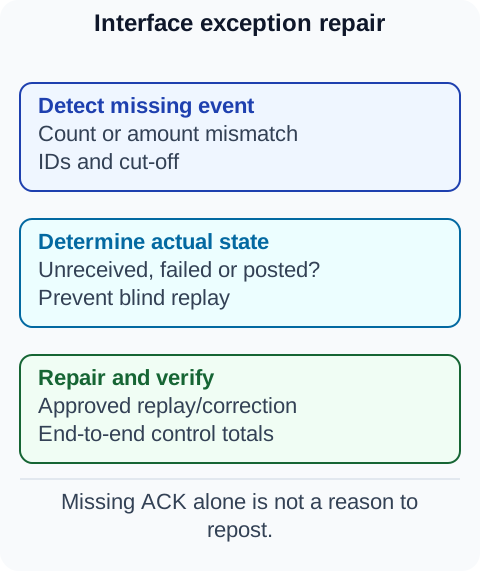
Missing partition: an expected 200,000-record event file contains 196,400 records, a shortfall of 3,600 (1.8%). Compare sender/receiver counts, amount totals and partition identifiers as well as checksums. A hash proves integrity only against a trusted independently obtained digest; it does not itself know the expected population. Quarantine according to the designed atomic unit, obtain corrected data and reconcile every accepted event.
Safe resend: rejected records have not been marked posted; genuinely committed records retain their original idempotency outcomes. On replay, prove no missing and no duplicate journals. A preliminary internal estimate may carry explicit limitations; final reporting needs the actual complete population or a permitted, recorded exceptional process.
Phased cutover: reconcile each entity’s source and journal populations before progressing. Define whether rollback concerns uncommitted processing, reversal of committed accounting or a new corrective event; a technical rollback cannot erase a legally settled payment.
11. Diagrams
Figure 1. Reliable accounting ingestion.
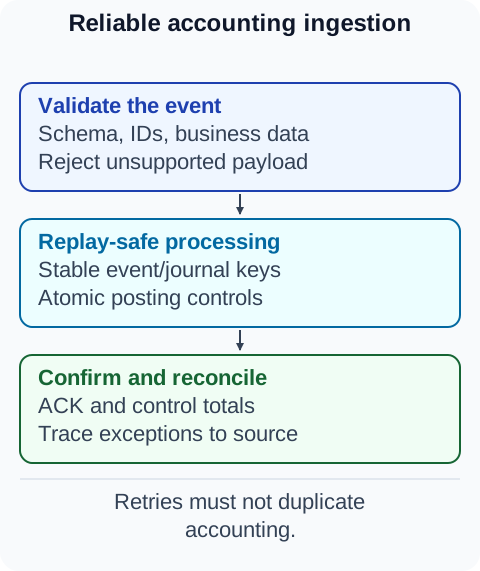 Figure 2. Interface contract.
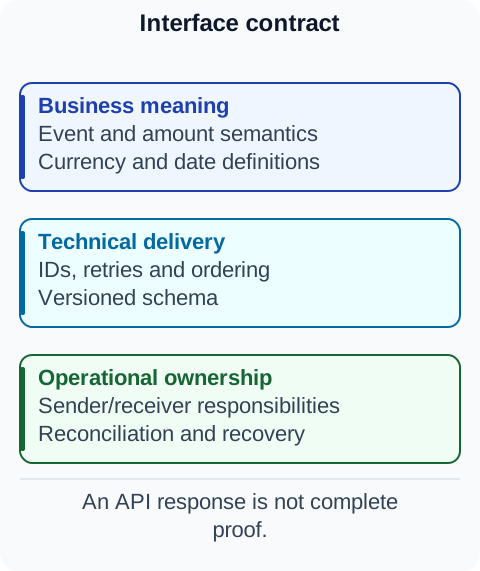 Figure 3. Interface exception repair.
12. Tables
Table 1 — Contract template (illustrative)
| Field | Example |
|---|---|
| Schema/version | events v7, sunset v6 +90d |
| Frequency/SLA | 02:00 daily, late-escalate 03:00 |
| Completeness | Count + hash + control total |
| Errors | 4xx fix-source, 5xx retry, quarantine |
Table 2 — Cutover comparison
| Strategy | Risk | Cost |
|---|---|---|
| Parallel | Lowest | Highest |
| Phased | Medium, contained | Medium |
| Big-bang | Highest | Lowest upfront |
13. Illustrative bank case study
A missing population remains visible. In this fictional case, 3% of 2 million nightly events, or 60,000, fail validation. The reconciliation reports them as rejected, with amount, currency, product and owner. Operations corrects the input or approves the accounting disposition, then safely replays. Event count alone does not quantify a balance or ratio misstatement: inspect whether events are snapshots, deltas, duplicates or reversals and calculate the actual affected amounts.
14. BA, developer, tester and operations guidance
- BA: Specify contracts (schema, SLA, proofs, errors) per interface with failure cases.
- Developer: Dedupe on event IDs; version contracts; build replay + quarantine tooling.
- Tester: Duplicate storms, partial files, schema drift, out-of-order streams, rollback drills.
- Operations: Monitor feed health continuously; enforce SLAs; drill replays quarterly.
15. Common mistakes
- Consuming files without completeness proofs.
- Admitting partial files without the designed acceptance boundary, full population reconciliation and retained rejected items.
- No dedupe (replay = duplicate postings).
- Big-bang cutovers without proven rollback.
- Vendor interfaces without contracts or exit data rights.
- Logging validation failures without creating exception queues.
- Treating interface reliability as a technical concern rather than a regulatory requirement.
16. Key takeaways
- Contracts (schema/SLA/proofs/errors) govern every interface.
- Idempotent + ordered + replayable + quarantined = reliable.
- Parallel-run full cycles; gate cutover on zero-unexplained.
- Completeness proofs catch silent drops — the deadliest failure.
- Rollback drilled, hypercare owned, legacy retired with proof.
- Dedupe architecture must be designed for adversarial conditions, not happy paths.
- Exception queues with owners and SLAs are where data quality is enforced.
17. References and verification notes
- BCBS 239: risk data aggregation principles: governance, architecture, accuracy, completeness, timeliness and adaptability underpin risk-data aggregation; scope and supervisory application vary. It prescribes neither one warehouse architecture nor universal numeric reconciliation tolerances.
- Outsourcing/cloud interface duties and change-risk expectations per applicable supervisory guidance — verify locally; data-protection constraints on test data per privacy law.
- Contracts and thresholds are illustrative training designs.