Chapter 092: Recovery and Resolution Reporting
Section 19: Disclosure, Resolution and Emerging Reporting Requirements · Chapter 092 of 100
Friday 6pm: supervisors ask whether the bank can produce resolution-critical data by Monday — liability structure, critical functions, FMI access, valuation capability. Recovery and resolution reporting answers in peacetime so the weekend never comes unprepared. This chapter covers recovery indicators/plans, resolution data (liabilities, functions, FMIs, valuation), and the testing that proves weekend-readiness.
1. Chapter opening
Recovery planning: indicator ladders (capital, liquidity, profitability, asset-quality triggers) firing progressively stronger actions (de-risking, disposals, capital raises) with governance and communication plans. Resolution reporting: liability data (bail-in-able stock, hierarchy, holders), critical-function maps (payments, custody, lending with substitutability analysis), FMI access inventories, operational continuity (service catalogues, separability), and valuation capability (resolution valuations Val 1/2/3 at speed). Playbooks tested via dry runs.
Recovery planning identifies credible bank-led options before failure; resolution planning supports authority-led execution under applicable statutory conditions. Failure can arise from liquidity or other viability problems even when an accounting balance sheet shows positive equity. Authorities assess capability and impediments under their own requirements; a missed internal 48-hour drill does not automatically establish non-resolvability or a fixed MREL surcharge.
The "failing well" concept is deliberately paradoxical: a bank can be solvent (passing capital tests) but failing (losing market confidence, experiencing deposit flight, unable to roll wholesale funding). Recovery planning addresses the "failing well" scenario — how the bank restores confidence and viability without resolution. Resolution planning addresses the "beyond recovery" scenario — how authorities act when statutory resolution conditions are met; completion or failure of every recovery option is not a universal prerequisite. Both require data; both require testing; both decay without maintenance.
2. Learning objectives
- Design recovery-indicator ladders with calibrated triggers and actions.
- Inventory resolution data (liabilities, functions, FMIs, services, valuation).
- Explain bail-in mechanics (sequence, NCWO safeguard) at headline level.
- Run resolvability dry-runs (data weekend, valuation sprint, communication test).
- Describe impediment removal (findings → structural/data remediation).
3. Business context
Resolvability needs credible information, legal execution and continuity capability. Recovery options should be prepared and tested, but buyer interest, funding access and approvals cannot be guaranteed in crisis. Authorities can require remediation of impediments, including structural changes where the law permits. No automatic lower MREL or universally applicable 48-hour valuation deadline follows from a clean data room.
MREL calibration is authority-set and considers the preferred strategy and applicable rules. Resolvability work can support an effective strategy, but an arbitrary 1–3% total-liability surcharge for weak data has no universal basis. Measure any actual requirement change from the authority decision, and compute issuance cost as amount×incremental spread, separating reference-rate interest and fees.
Counterparty behaviour is the second channel. Unsecured counterparties (wholesale depositors, derivatives counterparties, bondholders) set limits based on perceived resolution risk. A bank perceived as unresolvable faces higher counterparty charges, reduced unsecured limits, and in extremis, exclusion from counterparty networks. The data that demonstrates resolvability — clean liability maps, tested critical-function separability, pre-positioned valuation capability — can inform counterparties’ risk assessments, alongside creditworthiness and market conditions; neither lower limits nor funding costs follow mechanically from a clean data exercise.
| Plan | Triggers | Peak action |
|---|---|---|
| Recovery | Indicator ladder (amber→red) | Disposals, raises, de-risking |
| Resolution | Point of non-viability | Bail-in, bridge bank, sale |
4. Finance and accounting view
4.1 Data mechanics
Maintain instrument and creditor records, legal bail-in scope, insolvency rank, maturity and holder information needed for the chosen tools. A simplified capital loss sequence is CET1, then AT1, then Tier 2, followed by other creditors according to national hierarchy, exclusions and applicable safeguards. Secured liabilities may be excluded to their secured amount, covered deposits have protection, and treatment of unsecured excess or uninsured deposits follows law. Short residual maturity can prevent a debt instrument qualifying as MREL/TLAC while it remains legally subject to bail-in; resource eligibility and bail-in scope are separate tests.
Critical functions: activity volumes (payment volumes processed, custody assets under administration, lending balances managed), substitutability evidence (how quickly could a critical function be transferred to another entity — payments might be transferable in 24 hours with pre-agreed contingency arrangements; lending might take 3–6 months due to contract novation requirements), provider dependencies (which third-party systems, utilities, or outsourcing arrangements support the critical function — a payment function dependent on a single clearing-system connection has different substitutability than one with redundant connections). FMI access: memberships (direct memberships in payment systems, clearing houses, central counterparties), agent dependencies (where the bank accesses an FMI through an agent — the agent relationship must be mapped and the contingency for agent failure documented), contingency (backup arrangements if primary FMI access is lost — backup memberships, alternative clearing arrangements). Valuation: data rooms pre-built (loan tapes, derivative portfolios, collateral schedules) with rapid-valuation playbooks and valuer engagement terms. NCWO (no-creditor-worse-off) safeguard needs insolvency-counterfactual capability — the ability to compare the resolution outcome to the insolvency outcome for each creditor class, demonstrating that no creditor is worse off in resolution than it would be in insolvency.
4.2 Testing and impediments
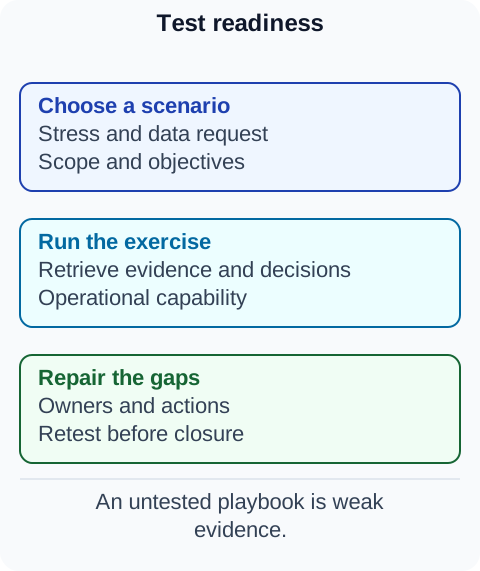
Dry runs test data production, valuation support and communication against the authority’s applicable requirements and a bank’s documented internal targets. A48-hour data exercise can be useful but is not a universal legal deadline. Valuation 1 assesses whether resolution conditions are met; Valuation 2 informs resolution action, write-down/conversion and transfer decisions; Valuation 3 is an ex-post independent insolvency-counterfactual assessment for the no-creditor-worse-off safeguard. They are not respectively hold-value, sale-value and three valuations all due within 48 hours.
4.3 Deep dive: valuation sprint capability and impediment-removal economics
Maintain valuation-ready loan tapes, derivative inputs, collateral data and financial information with reconciliation, freshness controls and secure rapid access. Pre-arrange independent valuer access and test production times. Support methodologies for the different resolution valuation purposes, sensitivities and provisional estimates where permitted. The SRB updated its valuation-capability expectations in December 2025; the bank must use the current applicable requirements and authority-specific delivery times rather than declare every bank unresolvable if it misses an invented 48-hour standard.
Cost remediation using the bank’s actual proposals: data quality, service separation, booking-model simplification, FMI contingency and legal execution. The resolution authority determines whether an impediment remains and any requirement change; spending on IT does not mechanically reduce MREL. For a hypothetical 1bn additional debt issuance at 20bp extra spread, annual incremental interest is 2m, not 20m. Prioritise by severity, legal deadline, dependencies and feasibility, with funded milestones and escalation.
4.4 Deep dive: indicator calibration and rehearsed triggers
Indicator calibration science (thresholds that fire usefully, not noisily): historical back-testing (would triggers have fired 6–12 months before known stress episodes with acceptable false-positive rates — calibrated on 2008/2020/2023 data, not theory; a trigger that fires every year in normal conditions is noise, not signal), forward sensitivity (trigger levels tested against plan/stress paths — a base-case breach can reveal a genuinely risky plan, while failure to respond in a sufficiently severe adverse path requires investigation; assess thresholds and the plan together), and combination logic (single-amber monitoring, double-amber escalation, any-red response — correlated deterioration auto-escalates per the §10.3 case pattern). Annual recalibration with methodology review (thresholds age as business mix shifts — a bank growing its wholesale funding share will see its liquidity indicators deteriorate naturally; static thresholds drift into irrelevance silently).
War-gamed triggers (decisions rehearsed, not improvised): tabletop exercises (ALCO walks a trigger breach with live data — who decides what within which hours, communications drafted in-session; the exercise tests not just the trigger mechanism but the governance response: does the treasurer have authority to act, or must the Board convene?), action dry-runs (disposal data rooms opened, buyers sounded without commitment, capital mandates drafted — readiness without execution cost; the disposal dry-run tests whether the bank could actually sell an asset within the timeline required in resolution), and trigger-fire post-mortems (every real or drill firing reviewed: timely? proportionate? complete? — calibration refined from experience; a trigger that fires late or produces an inadequate response is a calibration finding, not just an operational one). Supervisors attend selected exercises as observers where regimes invite — tested execution provides evidence beyond written plans; assess results under the authority’s actual expectations without inventing a scoring multiplier.
5. Product and customer impact
Resolution planning aims to preserve critical functions, protect covered deposits and minimise disruption. It cannot promise every payment, deposit withdrawal or credit draw will operate without interruption throughout a resolution weekend. Applicable law may permit temporary stays or moratoria, and deposit-guarantee protection is distinct from uninterrupted access to an account. Disclosures must explain the actual protection and limitations.
Assess client-asset safeguarding, account and mandate transferability, operational continuity contracts and FMI access under the governing law. Do not assume customer mandates can always transfer without consent or that all client funds are trust assets. Customer communication describes what transfers, which services remain available, any lawful restrictions and how claims or insured payouts are handled.
6. Regulatory and supervisory view
Recovery planning concerns bank-led options before failure; resolution planning concerns authority-led strategies and statutory tools. EU BRRD/SRMR, Bank of England frameworks and US regimes have different scopes, cycles and publication rules. US Dodd-Frank section 165(d) resolution plans describe orderly resolution under applicable insolvency law and must not be conflated with TitleII Orderly Liquidation Authority or a presumed universal single-point-of-entry strategy. Indian PCA is a supervisory intervention framework, not a complete equivalent of EU bail-in law.
Keep a jurisdiction-specific register of plan cycles, information requirements, valuations, testing duties and public summaries. Individual resolvability findings are not automatically public. Cross-border execution needs legal recognition, cooperation and operational evidence; a general statement that the group is weekend-ready does not establish each legal power or continuity capability.
7. Systems and data view
Maintain a reconciled liability inventory, function/service and FMI dependency catalogues, valuation-ready source data and versioned playbooks. Define freshness, secure access, restoration and production-time targets from the authority’s requirements and internal risk assessment. Drill failures receive dated remedies. Continuous readiness does not require a universal monthly refresh, quarterly authority login or real-time system for every data element; capabilities must meet the relevant delivery and quality requirements.
8. End to end process
- Maintain inventories continuously (liability, function, FMI data updated as transactions occur).
- Calibrate recovery triggers (annual recalibration with back-testing and forward sensitivity).
- Pre-negotiate options (disposal buyers, capital backstops, central-bank facilities — each with documented terms and conditions).
- Test data, valuation support and communications under applicable cycles and risk-based internal scenarios, recording delivery times and deficiencies.
- Remediate impediments (findings tracked to deadline with escalation for slippage).
- Submit plans; attest readiness (Board attestation based on evidence, not assertion).
- Re-test on the required cycle and after material changes; monitor whether previous evidence remains valid.
9. Controls and risks
| Risk | Control | Evidence |
|---|---|---|
| Stale data rooms | Refresh SLAs + spot drills | Drill results |
| Untested playbooks | Required and risk-based test programme | Test packs |
| Unmapped dependencies | Service/FMI catalogues | Dependency maps |
| Communication vacuum | Pre-written cascades | Template libraries |
| Valuation incapability | Pre-engaged valuers with methodology | Engagement terms |
| Indicators never fire | Back-tested calibration with annual refresh | Calibration packs |
10. Practical examples
A (fictional): Data exercise. A timed rehearsal identifies missing creditor records and valuation inputs. Management assigns remedies and re-tests production; success in a later exercise is evidence for that scope and scenario, not a guarantee of real resolution execution.
10.3 Worked example: recovery-indicator ladder (fictional)
Internal triggers are CET1 below 11% amber/below 10% red, LCR below 130% amber/below 110% red and NPE ratio above 4% amber/above 6% red. These are illustrative management thresholds, not statutory minima or automatic resolution conditions. Current CET1 is 8.1bn/RWA 75bn=10.8%; LCR125% and NPE4.2% also breach the chosen amber limits. A documented combination rule prompts a stronger management response, subject to the authority and approvals for each action.
Assume an asset sale reduces RWA by 1.5bn with no sale loss, tax or other CET1 effect:8.1/73.5=11.0204%. Cancelling 150m of dividends, assuming that amount is then eligible retained CET1, gives 8.25/73.5=11.2245%. The improvement is about 0.4245 percentage points, not an unexplained move to 11.3%. Assess disposal losses and accounting recognition before relying on this outcome. An AT1 issue can increase Tier 1 but does not directly increase CET1. Reassess liquidity and credit indicators separately; a capital-ratio improvement does not make them green.
11. Diagrams
Figure 1. Recovery indicator response.
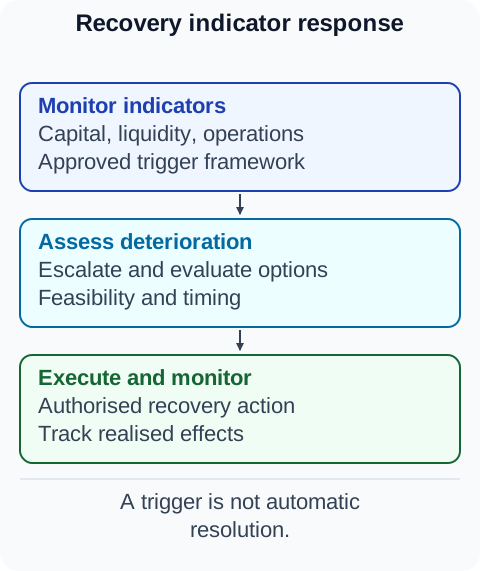 Figure 2. Resolution information.
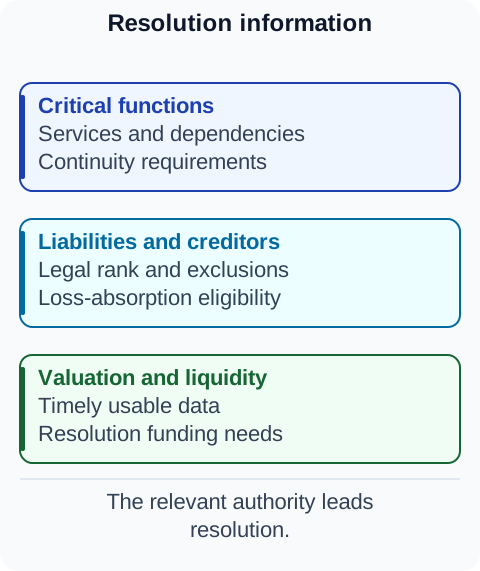 Figure 3. Test readiness.
12. Tables
Table 1 — Resolution data inventory
| Data | Contents |
|---|---|
| Liabilities | Eligibility, holders, hierarchy, maturity |
| Functions | Volumes, substitutability, dependencies |
| FMIs/services | Memberships, agents, continuity |
| Valuation | Tapes, portfolios, playbooks |
Table 2 — Recovery triggers (illustrative)
| Level | Example trigger | Action class |
|---|---|---|
| Amber | CET1 −1pt, LCR −20pts | Enhanced monitoring |
| Red | Buffer breach, rating watch | Disposals, raises |
| Black | Viability doubt | Resolution handover prep |
13. Illustrative banking case study
A timed readiness exercise (fictional). A bank produces a reconciled liability inventory and critical-function map, but derivative-holder data and a service-transfer agreement remain incomplete. Independent valuation support identifies missing collateral inputs. These findings receive owners, funded remedies and re-test dates. The exercise does not establish that all resolution tools could be executed, that every customer service would continue, or that authorities would select bail-in. No unsupported percentage of “peacetime preparation” is claimed.
14. BA, developer, tester and operations guidance
- BA: Specify inventories, trigger ladders, playbook contents and drill acceptance criteria.
- Developer: Build always-fresh data rooms; version playbooks; automate trigger monitoring.
- Tester: 48-hour pack production; valuation-sprint completeness; communication-cascade timing.
- Operations: Drill regularly; remediate impediments on deadline; keep valuer relationships warm.
For BA teams: the inventory specification must define the exact data elements required for each resolution tool. Bail-in requires: instrument identifier, notional amount, maturity date, bail-in eligibility status, creditor hierarchy position, holder identity (where required), governing law, and cross-default provisions. Critical-function transfer requires: function name, provider entity, system dependencies, contractual arrangements, substitutability timeline, and client-impact assessment. For developers: the data room must be designed for weekend access — with defined data freshness and extraction procedures that meet applicable delivery requirements. A reconciled batch, event feed or real-time service can be appropriate to the specific data and deadline; validate access, currency and completeness. For testers: an illustrative 48-hour drill runs Friday 6pm to Sunday 6pm; use the actual required delivery window — the drill must test not just data production but also the governance response (who is called, who decides, who communicates). For operations: the valuer relationship is a critical dependency — a valuer who has not been contacted in 12 months may not be available or willing to produce a valuation over a weekend.
15. Common mistakes
- Plans as documents, never drilled.
- Stale data rooms (quarter-end only freshness).
- Unmapped service/FMI dependencies.
- Communication improvised under stress.
- Treating resolvability as a reporting exercise.
- Valuation source data not maintained to the defined freshness requirements.
- Trigger ladders with combination rules never tested.
- Impediment remediation plans without funded budget lines.
16. Key takeaways
- Recovery ladders (indicators → actions) and resolution data (liabilities/functions/valuation) are maintained continuously.
- Dry runs provide evidence within their tested assumptions; gaps receive dated remediation and further testing.
- Valuation-ready data supports distinct resolution valuations within applicable delivery requirements.
- Communication templates pre-written for every audience.
- Resolvability decays — cyclical testing sustains it.
17. References and verification notes
- SRB valuation capabilities, updatedDecember2025, and valuation framework: distinct purposes and NCWO assessment.
- FSB Key Attributes: international resolution principles, implemented through local law.
- Federal Reserve resolution plans: US section165(d) plans and applicable instructions.
- Scenarios are illustrative training designs.