Chapter 090: Cross-Jurisdiction Reporting Case Study
Section 18: Regional Regulatory Reporting Tracks · Chapter 090 of 100
This fictional group reports through four local entities in London, Frankfurt, New York and Mumbai. It reconciles each local accounting and prudential basis to group IFRS, coordinates four local closes and meets separate filing calendars with accountable approval. One group sign-off cannot replace required local approvals or deadlines.
1. Chapter opening
This fictional group closes a quarter for a UK parent, EU subsidiary, US intermediate holding company and Indian banking subsidiary. Group IFRS consolidation does not replace local statutory and prudential reporting. Use US GAAP for the assumed US ledger and the applicable Indian accounting requirements and RBI IRAC rules for the Indian bank; do not assume Indian banks already report under Ind AS. RBI’s final 2026 ECL directions commence on 1 April 2027 for the specified commercial-bank scope, while current IRAC directions continue until then. Entity obligations, permitted data sharing and filing deadlines belong in a dated register.
2. Learning objectives
- Reconcile local accounting to group IFRS with bridge discipline.
- Manage solo-vs-group scope differences across four regimes.
- Synchronise disclosure calendars with phased sign-offs.
- Run a disclosure committee challenging cross-jurisdiction consistency.
- Handle multi-regime queries without contradictory responses.
3. Business context
Cross-jurisdiction reporting requires parallel local closes, accounting adjustments, prudential perimeter bridges and coordinated responses. Entity capital and liquidity requirements may restrict distributions even when consolidated headroom is strong. Quantify the bank’s actual operating cost and legal transfer restrictions rather than assert a universal industry reporting budget. Branch-versus-subsidiary and booking-model decisions need a reporting-impact assessment before implementation.
| Entity | Framework | Scope quirk |
|---|---|---|
| UK parent | IFRS + PRA | Ring-fenced reporting |
| EU sub | IFRS + CRR/ECB | SSM significance |
| US IHC | GAAP + Fed tailoring | CECL timing gaps |
| India sub | Applicable Indian accounting + RBI | IRAC versus group IFRS classification |
4. Finance and accounting view
4.1 Bridge mechanics (fictional quarter)
Credit classification. Indian IRAC NPA, IFRS 9 credit-impaired/Stage 3, EU NPE and US nonaccrual measures have different definitions. A bridge must identify the same exposures, not subtract labels with incompatible populations. IFRS 9 includes rebuttable default and significant-increase-in-credit-risk presumptions and qualitative evidence. An account more than 90 days past due cannot simply be called IFRS-performing because a forward-looking model is optimistic. Restructuring does not create a universal 180-day IRAC classification threshold.
For an explicitly assumed portfolio, IRAC NPA is 1,200m, group IFRS credit-impaired gross loans are 1,250m: subtract 20m of duly supported scope differences and add 70m of credit-impaired current loans =1,250m. The 20m is a perimeter adjustment, not an assertion that overdue loans escape IFRS impairment. Preserve account-level classifications and the evidence supporting any rebuttal.
Allowance basis. A fictional US amortised-cost portfolio has a CECL allowance 450m and group IFRS allowance 300m. The 150m difference consists of 90m from lifetime CECL versus 12-month IFRS Stage 1 measurement and 60m from supported modelling/measurement differences. IFRS Stages 2 and 3 both use lifetime ECL; Stage 1’s 12-month ECL reflects lifetime cash shortfalls arising from defaults possible in the next 12 months. AFS debt follows its distinct US allowance model. Assess tax effects and book approved group adjustments separately from local entries.
Reciprocal elimination. Entity A records an intercompany loan asset 500m; entity B records the corresponding borrowing liability 500m. Confirm currency, cut-off and accrued interest, then eliminate the reciprocal balances at the applicable consolidation level. A deposit asset and deposit liability could instead form another reciprocal pair; a loan and unrelated deposit are not automatically a match.
Headroom and calendars. Each entity’s headroom is measured against its own applicable requirements and distribution constraints; percentages from different regimes are not fungible resources. Preserve local deadlines and any market-disclosure obligations. Group coordination must not delay a local filing or required disclosure while waiting for every entity. Approved reconciliations explain scope, reference-date and measurement differences; public disclosure does not reproduce confidential supervisory returns wholesale.
4.2 Sign-off chain
Entity CFOs attest local packs, regional reviewers challenge bridges, and the group disclosure committee coordinates consistent definitions and commentary. Audit-committee and Board involvement follow the applicable policy and legal requirements. Preserve dissent, approval authority and the exact approved version. Reconcile published measures to their relevant filing or source, including explained scope and presentation differences; equality is required only for genuinely identical facts.
4.3 Deep dive: college coordination mechanics and the query-response library
Supervisory colleges coordinate home and host authorities within the relevant legal framework. They do not make all capital decisions unanimous or erase national authority. Document which joint decisions, confidentiality gateways and crisis coordination arrangements apply to the actual group. A consistent narrative should explain different local measures rather than force identical numbers.
The practical mechanics of college operation require detailed preparation: the home authority (typically the parent's NCA) circulates a draft joint risk assessment for review by host authorities, each of which may request additional data or challenge characterisations. The group's regulatory affairs team must coordinate with all four entity-level compliance teams to ensure that the data submitted to each authority is consistent — a discrepancy between what the PRA receives from the parent and what the ECB receives from the EU subsidiary can trigger a cross-border supervisory enquiry. Information sharing requires a lawful gateway under the relevant statutory and confidentiality framework. Memoranda of understanding can document cooperation arrangements but do not themselves override privacy or bank-secrecy law. Banks must understand these gateways to anticipate what their home authority will share with hosts and vice versa.
Maintain a query-response library with question, authority, scope, reference date, owner, response, evidence, approval and outcome. Reuse validated definitions with case-specific figures, and check new responses against previous versions. Protect confidential data and obey each authority’s deadline. Measure response time and follow-up queries internally; no universal percentage saving or guarantee of reduced examination intensity follows from having a library.
5. Product and customer impact
Booking location, currency and guarantee structures can change reporting, capital and disclosure obligations. Customer communications must satisfy each applicable obligation, with legal review of conflicts rather than assuming a universal “strictest regime” resolves them. Explain entity-level pricing or availability constraints accurately while protecting confidential information. Cross-border product approval assesses every affected entity’s reporting, privacy, conduct and operational requirements.
6. Regulatory and supervisory view
Supervisory colleges coordinate home and host authorities within the group’s actual legal framework. Some frameworks provide defined joint decisions; others preserve separate authority decisions. Maintain the applicable college mandate, information-sharing gateways and escalation arrangements. Responses may legitimately differ in definitions, scope and deadlines, while using reconciled underlying evidence. Do not stereotype every authority’s queries or assume all models and buffers require a joint college decision.
7. Systems and data view
Multi-GAAP close factory: local ledgers (maintained per local GAAP) → framework adjustments (local-accounting deltas computed by qualified accountants) → group IFRS consolidation (standard IFRS processing) → solo+group reporting engines per regime (regime-specific calculation and formatting) → disclosure packs with regime tags (each pack clearly labelled with applicable framework and regulatory authority). Controls: bridge tie-outs per framework (every bridge item reconciled with supporting evidence), calendar orchestration (sign-off dates tracked across entities with dependency mapping), query-response library (consistent answers reused, new responses screened for contradictions), secrecy-flagged data handling (data subject to bank-secrecy restrictions identified and segregated). The technology architecture must support parallel processing: all four entities close simultaneously, bridges are computed in parallel, and group consolidation runs after all entities complete — a critical-path exercise where one entity's delay affects the entire group's timeline.
8. End to end process
- Close local books per framework (simultaneous multi-entity close with defined cut-off points).
- Bridge to group IFRS (documented bridge with supporting evidence for every material difference).
- Consolidate with scope discipline (elimination of intra-group items with reciprocal proofs).
- Build solo + group returns per regime (regime-specific templates and calculation rules).
- Committee-challenge consistency (disclosure committee reviews cross-entity and cross-framework consistency).
- Phase sign-offs with calendars (entity CFOs → regional → group → audit committee → Board).
- Publish approved disclosures; coordinate queries (single response owner per theme, library enforcement).
9. Controls and risks
| Risk | Control | Evidence |
|---|---|---|
| Framework confusion | Regime-tagged packs, bridges | Tag audits |
| Contradictory query answers | Central response ownership | Response library |
| Calendar collisions | Orchestrated sign-off plan | Calendar compliance |
| Trapped-capital blindness | Entity headroom packs | Entity dashboards |
| Intra-group elimination error | Reciprocal confirmation process | Elimination reconciliation |
| Translation risk | FX rate methodology documentation | Rate-source logs |
10. Practical examples
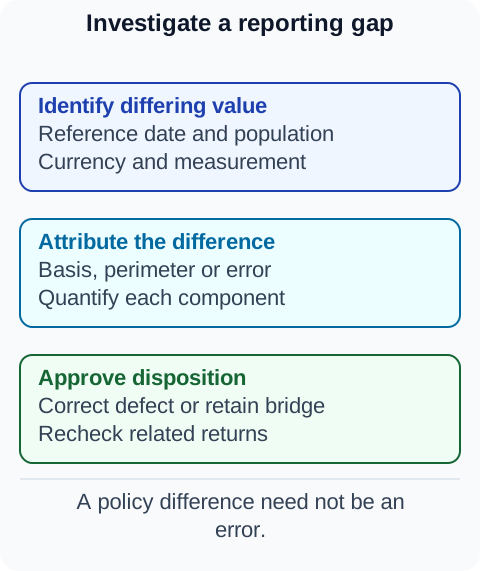
A (fictional): Classification bridge. A supervisor asks why local NPA and group Stage 3 balances differ. Finance provides the 1,200−20+70=1,250m exposure bridge above, with source IDs, perimeter evidence and qualitative impairment assessments. It reports the allowance bridge separately; exposure and allowance differences cannot be added as if they were the same measure.
B (fictional): Calendar collision. A local filing precedes group results. The entity meets its actual deadline with approved local numbers. Group reviewers retain the filing snapshot and bridge later consolidation adjustments. Sharing draft packs with another authority requires a valid confidentiality gateway; an embargo cannot override securities disclosure law.
10.3 Worked example: one coordinated answer (fictional, millions)
A common-scope EU NPE measure rises from 1,000 to 1,300. The movement is credit deterioration+120, newly identified qualitative unlikely-to-pay cases+80, reporting-perimeter addition+60 and FX translation+40: total+300. The bank supplies account populations and applicable definitions, then separately reconciles the UK prudential-default and US nonaccrual views. It does not describe 90+40+25 as a 300m bridge or claim those regulatory terms are interchangeable. Each response follows the requested local format and deadline; central coordination preserves a common evidence set, not necessarily identical wording or totals.
11. Diagrams
Figure 1. Cross-jurisdiction close.
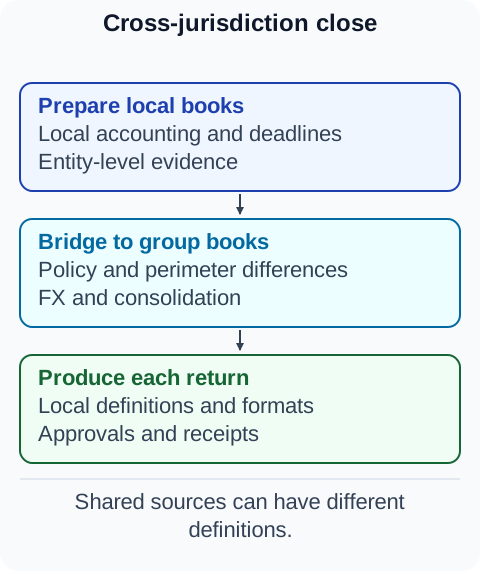 Figure 2. Cross-regime bridges.
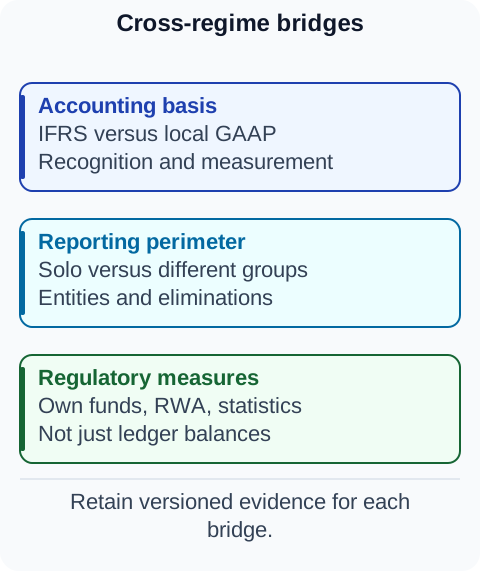 Figure 3. Investigate a reporting gap.
12. Tables
Table 1 — Quarter bridge extract (fictional m)
| Item | Local | Group IFRS | Bridge |
|---|---|---|---|
| India NPA / group credit-impaired loans | 1,200 | 1,250 | Scope −20; qualitative impairment +70 |
| US allowance (CECL) | 450 | 300 (ECL) | Timing −90; supported modelling/measurement −60 |
| Intra-group | 500 solo | 0 group | Elimination |
| UK ring-fenced | 800 | 800 | No adjustment |
Table 2 — Internal sign-off sequence (illustrative; fit actual deadlines)
| Step | Owner | Timeline |
|---|---|---|
| Solo attestation | Entity CFOs | Day 5–10 |
| Regional review | Regional finance heads | Day 10–15 |
| Consistency challenge | Disclosure committee | Day 15–25 |
| Audit committee | Audit committee chair | Day 25–30 |
| Final sign | Board | Day 30–35 |
| Publication | Group communications | Per regime deadlines |
13. Illustrative banking case study
Four definitions, one portfolio (fictional). Three entities respond independently to an asset-quality query using different populations and labels. The defect is that nobody supplies a bridge, not that legitimate local definitions differ. Remediation establishes response ownership, approved local definitions, exposure-level reconciliation and entity review before submission. Cost and query outcomes are measured from the bank’s own records; this scenario is not a documented real-bank enforcement episode.
14. BA, developer, tester and operations guidance
- BA: Specify framework bridges (document every difference between local GAAP and group IFRS with supporting evidence), scope rules (which entities, which consolidation methods, which eliminations), calendar orchestration (dependency mapping across entities and regimes), and query workflows per regime (response templates, review processes, library integration).
- Developer: Tag regimes immutably (every data point tagged with its source framework); automate bridges (reduction of manual bridge construction); orchestrate sign-off calendars (automated workflow with escalation triggers); implement query-response library with consistency checking.
- Tester: Cross-framework cases (same economic event, different reporting outcomes); calendar-collision paths (parallel sign-off processes with dependency checks); bridge tie-outs (every bridge item reconciled with evidence); query-response library consistency (new responses screened against existing library).
- Operations: Run the multi-regime calendar as one production line (central calendar with entity-level milestones); library every answer (mandatory logging of all supervisory responses); coordinate query responses (central ownership with entity-level contributor SLAs); maintain college engagement materials (regular updates to home and host authorities).
15. Common mistakes
- Mixing frameworks without bridges or tags — creates inconsistency that supervisors detect through cross-checks.
- Uncoordinated query responses that cannot explain their different definitions, populations or dates.
- Calendar collisions forcing premature disclosure — a structural problem that requires proactive calendar management.
- Entity headroom blindness at group level — trapped capital that is invisible at the consolidated view.
- Smoothing dissent instead of recording challenge — governance finding waiting to happen.
- Assuming all supervisors accept the same definitions — they don't, and the differences must be documented.
- Failing to update bridge documentation when methodologies change — a common source of restatement.
16. Key takeaways
- Bridge local→group→supervisory every cycle; publish required reconciliations — differences documented, not assumed.
- Coordinate queries centrally with a response library — single owner per theme, consistency enforced.
- Orchestrate calendars; phase sign-offs deliberately — dependency mapping prevents bottlenecks.
- Entity headroom packs prevent trapped-capital surprises — visibility across the group.
- College engagement requires coordinated submissions — one voice across jurisdictions.
- Sign-off chain is functional, not ceremonial — each layer adds genuine assurance.
- Local accounting, group consolidation and prudential reporting remain separate obligations connected by approved bridges and evidence.
17. References and verification notes
- RBI current IRAC directions and final 2026 ECL directions, commencement1April2027.
- IFRS9 and OCC allowance guidance: framework-specific allowance measurement.
- Federal Reserve reporting forms: use the actual applicable form instructions for deadlines.
- All numbers and sequences are fictional training designs.
- Basel Committee principles for the supervision of cross-border banks (BCBS d 184); EBA Guidelines on cooperation and information exchange between authorities.
- MoU templates for supervisory colleges (FSB/BCBS guidance).