Chapter 094: Climate and Sustainability Reporting
Section 19: Disclosure, Resolution and Emerging Reporting Requirements · Chapter 094 of 100
Sustainability disclosures use different, reconcilable measures of impact and financial risk, according to the bank’s applicable frameworks. This chapter works financed emissions, data quality and target arithmetic, then separates standards from the local requirements and future effective dates.
1. Chapter opening
Bank sustainability reporting covers governance, strategy, risk management, metrics and targets. Separate impact measures such as financed emissions from financial-risk measures such as stressed credit losses. Financed emissions can be material without being a recognised accounting liability; climate information can affect financial-statement estimates without becoming a separate ESG journal. IFRS S1/S2 use information relevant to providers of capital; EU ESRS uses its applicable double-materiality framework. A common data foundation does not make those scopes identical.
2. Learning objectives
- Compute asset-specific financed-emissions attribution.
- Explain data quality, portfolio coverage and restatement.
- Separate taxonomy eligibility, alignment, GAR and broader banking-book metrics.
- Distinguish standards, local law, voluntary frameworks and future effective dates.
- Reconcile sustainability disclosures to the relevant lending population and evidence.
3. Business context
Banks need borrower activity/emissions, asset locations and contractual exposure data. The financial-reporting perimeter, financed-emissions portfolio and taxonomy denominator can differ. Reconcile those differences explicitly. Do not assume a universal 100:1 footprint ratio,10–20bp funding benefit or automatic capital add-on from a disclosure score. Target economics depend on portfolio composition, market prices and actual financing terms. Board and management responsibilities follow applicable rules and the bank’s governance; Finance and business data operations own controls, designated second-line functions challenge them and Internal Audit provides independent assurance.
4. Finance and accounting view
4.1 Asset-specific attribution
PCAF Part A’s third edition is dated December 2025. Apply the selected asset-class method and version, rather than one EVIC denominator for every exposure. For business loans to a listed company, assume outstanding amount 10m, EVIC50m and company emissions 100,000 tCO₂e: attribution 10/50=20%, financed emissions 20,000 tCO₂e. For an unlisted company, use the prescribed total equity plus debt basis. EVIC includes equity and debt without deducting cash; it is not an ordinary enterprise value that has subtracted cash.
For a project with total equity plus debt 50m, this bank’s 10m outstanding exposure attributes 20% of project emissions. Debt lenders are not automatically allocated 100% when equity also finances the project. For commercial real estate, the cited PCAF method uses outstanding loan/investment divided by property value at origination, with its specified fallback/update rules. It is not a free choice to report whole-building emissions based on the lender’s operational control. Keep financed, facilitated and insurance-associated emissions distinct; avoided-emissions estimates are supplemental and must not silently offset the core financed-emissions inventory.
4.2 Taxonomy metrics and accounting boundaries
Taxonomy eligibility asks whether an activity is covered by the taxonomy; alignment additionally requires the relevant substantial-contribution criteria, do-no-significant-harm tests and minimum safeguards. GAR uses its legally defined numerator and denominator, exclusions, KPI basis and reference period. A5bn aligned numerator over 50bn covered denominator gives 10%; it is not necessarily 10% of total assets. BTAR is a separate banking-book metric with broader counterparty coverage under its relevant EU reporting instructions; it is not merely a non-EU extension of GAR. An absence of mandatory borrower disclosure is not proof that the underlying activity is environmentally ineligible. Apply the current permitted data/estimate and denominator rules for the specific KPI.
Financed emissions, taxonomy alignment and labels do not independently determine IFRS 9 classification, ECL stage or capital risk weight. Assess financial cash-flow effects, credit risk, valuations and applicable prudential rules separately.
4.3 Data quality and a defensible transition target
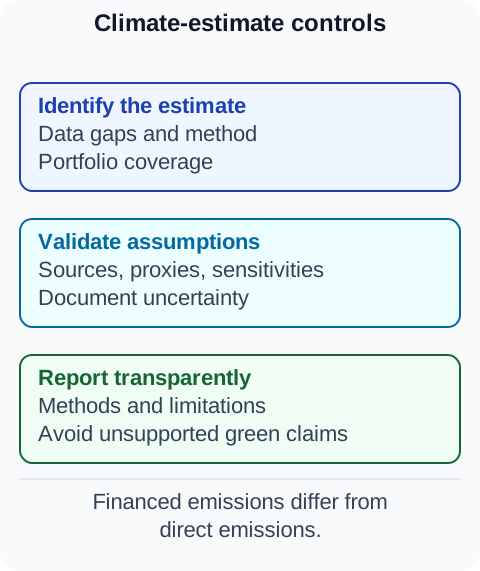
In a fictional 10bn portfolio, exposures 4bn,3.5bn and 2.5bn carry asset-method quality scores 2,3 and 5. Exposure-weighted score=(4×2+3.5×3+2.5×5)/10=3.1, with 1 highest and 5 lowest quality. If all exposures are included using allowed estimates, exposure coverage is 100%; this does not mean 100% verified emissions. Disclose measured versus estimated shares, scope, exclusions, data dates and method version.
If financed emissions are 1.2+0.9+0.8=2.9 MtCO₂e over 10,000m lent, intensity is 290 tCO₂e per million. A30% intensity reduction target implies 203t/m. Reducing emissions 15% in a slice responsible for 40% of emissions gives 6% portfolio absolute reduction, not 12%; a 40% exposure share alone does not establish that emissions weight. Adding 2bn at 50t/m to an unchanged 10bn book at 290t/m gives 3.0Mt/12,000m=250t/m, a 13.79% intensity decline, even though absolute emissions rise 0.1Mt. Distinguish real-world emissions reduction, borrower engagement, exposure sale/runoff and denominator dilution. State target-method coverage and validation edition; no unverified universal SBTi 67%/90% rule is asserted.
5. Product and customer impact
Green and sustainability-linked products need their own contractual definitions, allocation/KPI evidence and customer disclosures. A low financed-emissions intensity does not prove an individual product is green or principal-protected. Obtain client data lawfully, retain provenance and explain estimate limitations; do not present a proxy as a measured borrower result.
6. Regulatory and supervisory view
Status checked 3 October 2026: IFRS S1/S2 were issued in 2023 and have standard effective dates for annual periods beginning 1 January 2024; jurisdictional adoption determines mandatory use. IFRS S2 greenhouse-gas disclosure amendments issued December 2025 become effective for annual periods beginning 1 January 2027, with early application permitted. The Basel Committee’s June 2025 climate-disclosure framework is voluntary for jurisdictions to consider; it does not create a universal mandatory January 2026 EU GAR/BTAR rule.
UK listed-issuer snapshot: the FCA’s final PS26/19, published 30 September 2026, requires in-scope listing categories to report against UK SRS on a comply-or-explain basis for accounting periods beginning on/after 1 January 2027, with first reporting in 2028. Optional transition relief is one year for Scope 3 and two years for wider S1 sustainability disclosures. Existing scoped TCFD-aligned listing requirements apply before the new periods; other entity/product requirements remain separate. This is a final future rule, not a proposal already mandatory for 2026 accounts.
For EU CSRD/ESRS, taxonomy disclosures, EU prudential ESG disclosures and other national regimes, maintain the actual entity-scope, adopted legal-text, reporting-period and transition register. Do not infer local scope, assurance progression or deadlines from the ISSB effective date. A consultation and an adopted rule have different status.
7. Systems and data view
Preserve borrower/asset identity, emissions boundary and year, exposure dates, denominator source, quality score, location data, taxonomy tests, method version and approvals. Reconcile portfolio counts and amounts to Finance with bridges for scope and dates. Version recalculations and base-year restatements. Restrict vendor/manual overrides and retain evidence for estimates and claims.
8. End to end process
- Establish applicable frameworks, materiality and perimeters.
- Reconcile the lending/investment population.
- Collect and quality-score lawful borrower/asset evidence.
- Apply asset-specific attribution and KPI rules.
- Review financial-statement estimate implications separately.
- Reconcile totals and movement explanations.
- Review/assure disclosures according to actual requirements.
- Track targets with absolute and intensity effects separately.
9. Controls and risks
| Risk | Control | Evidence |
|---|---|---|
| Greenwashing claims | Evidence-before-adjective rule, legal review | Claim-evidence packs |
| Proxy-data opacity | Quality scoring + coverage disclosure | DQ dashboards |
| Target without plan | Delivery-plan mandate per target | Plan packs |
| Framework drift | Mapping version control | Version logs |
| Methodology break | Restatement policy + comparability bridge | Restatement packs |
| Data vendor failure | Multi-source validation + manual override protocol | Vendor assessment logs |
The controls table reflects a critical principle: ESG controls follow the same rigor as financial controls. Every published metric needs an audit trail back to source data, a documented methodology, a quality assessment, and a chain of review and approval. The "evidence-before-adjective" rule means no claim (green, sustainable, net-zero) is published without a supporting evidence pack that withstands regulatory and legal scrutiny.
10. Practical examples
Use the fully specified 3.1 quality score,290t/m starting intensity and 250t/m growth example above as independent calculation tests. Add cases for missing borrower emissions, changing EVIC, property valuation fallback, an excluded portfolio, methodology restatement and a target achieved only through asset sale. Each result needs a population/assumption bridge; a favourable direction alone does not prove environmental progress.
11. Diagrams
Figure 1. Sustainability reporting.
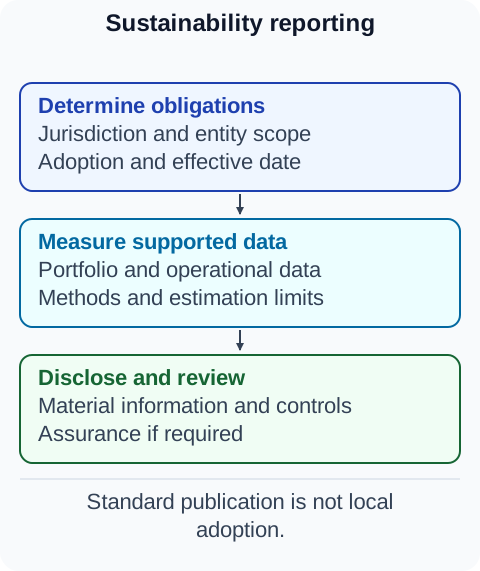 Figure 2. Distinct sustainability lenses.
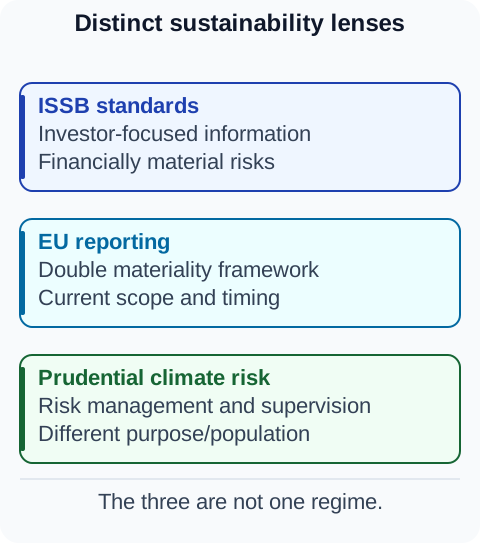 Figure 3. Climate-estimate controls.
12. Tables
| Measure | Must state |
|---|---|
| Financed emissions | Portfolio scope, attribution method, emissions boundary/year |
| Quality score | Asset-method scoring and weighting basis |
| Coverage | Included exposure and measured/estimated shares |
| GAR/BTAR | Applicable legal numerator/denominator and KPI basis |
| Target | Base year, absolute/intensity basis, coverage and levers |
| Rule register | Entity scope, status, effective date and reliefs |
13. Illustrative bank case study
A baseline claim is corrected. In this fictional bank, a target presentation used a proxy-heavy inventory but labelled it verified. Review corrected the data-quality disclosure, recalculated the baseline and explained the target bridge. No lawsuit, share-price movement, settlement or funding benefit from a real bank is asserted.
14. BA, developer, tester and operations guidance
- BA: specify each framework’s perimeter, attribution and quality rules.
- Developer: version data, methods and restatement movements.
- Tester: independently calculate scores, intensities and denominator effects.
- Operations: preserve source evidence and escalate missing/contradictory claims.
15. Common mistakes
- Confusing financed emissions with an accounting provision.
- Using EVIC for every asset class.
- Allocating all project emissions only to lenders.
- Calling 100% estimated coverage 100% verified data.
- Treating denominator dilution as absolute decarbonisation.
- Presenting future/voluntary frameworks as current mandatory local law.
16. Key takeaways
Use asset-specific methods, explicit quality/coverage and separate impact from financial risk. Reconcile targets and exposures, and apply each framework’s actual status, scope and reporting date.
17. References and verification notes
- IFRS S 1: Issued 2023 and effective for annual periods beginning in 2024; mandatory local adoption differs.
- IFRS S 2: Governance, strategy, risk management, metrics and targets; local adoption and transitions differ.
- IFRS S 2 greenhouse-gas amendments: Issued December 2025, effective for annual periods beginning 1 January 2027, with early application permitted; not automatically mandatory in 2026.
- PCAF Part A, third edition, December 2025: Asset-specific attribution and data quality reviewed. Pages 42,57,70 and 77 explain debt/equity, EVIC and property-value bases.
- Basel voluntary climate disclosure framework: Published 13 June 2025; voluntary for jurisdictions to consider. It does not universally mandate EU GAR/BTAR reporting from January 2026.
- FCA PS 26/19: Final rules published 30 September 2026: UK SRS on a comply-or-explain basis for scoped listing categories from accounting periods beginning 1 January 2027, with first reports in 2028. Optional Scope 3 one-year and wider IFRS S 1 two-year reliefs apply as specified.
- FCA reporting requirements: Updated 30 September 2026; existing TCFD listing requirements remain distinct from future UK SRS and other firm reporting obligations.
All portfolio figures are fictional. Primary-source status was checked 3 October 2026. UK snapshot is specific to the scoped listed issuers; it does not establish all banks’ sustainability obligations.