Chapter 078: Net Stable Funding Ratio
Section 16: Liquidity, Funding and Interest Rate Risk · Chapter 078 of 100
LCR compares HQLA with prescribed 30-day stressed net outflows; NSFR measures the weighted structural funding profile over a one-year horizon. Neither ratio guarantees survival. A bank rolling overnight paper against 25-year mortgages passes daily liquidity while building structural fragility the LCR never sees. The Net Stable Funding Ratio forces year-long funding discipline: available stable funding must cover required stable funding, with factors rewarding stickiness and penalising illiquidity. This chapter computes NSFR and uses it to steer the balance sheet.
1. Chapter opening
NSFR=ASF/RSF must be at least 100% under the Basel ongoing standard, using a one-year structural horizon. Basel stable and less-stable retail/small-business deposits below one year receive 95% and 90% ASF; qualifying non-financial corporate funding below one year receives 50%, and financial-institution funding below six months generally receives 0%. RSF differs by asset category, maturity and encumbrance. These are prescribed factors, not estimated retention percentages; national implementation governs actual requirements.
2. Learning objectives
- Assign ASF factors to capital, deposits and wholesale funding.
- Assign RSF factors to cash, securities, loans, encumbered assets and OBS.
- Compute NSFR on a worked balance sheet with interpretation.
- Explain NSFR vs LCR (structural vs survival) with complementary use.
- Describe steering levers (tenor extension, deposit mix, encumbrance control).
- Recognise how NSFR incentivises longer-term funding and penalises excessive maturity transformation.
3. Business context
NSFR prices maturity transformation structurally: long mortgage growth needs long funding (covered bonds, term deposits, capital); wholesale-dependent models face permanent penalty; assets encumbered for at least one year carry 100% RSF; shorter encumbrance has differentiated treatment — securitisation strategy must clear NSFR, not just capital. ALCO sets NSFR appetite with buffer; treasury prices tenor via FTP consistently (see Funds Transfer Pricing).
The pre-crisis banking model relied on overnight wholesale funding to finance long-dated assets — a strategy that delivered spread but created catastrophic rollover vulnerability. When short-term markets froze in August 2007, banks with high wholesale-funding dependence faced existential pressure despite adequate capital ratios. The NSFR was introduced precisely to prevent this structural mismatch from rebuilding. It forces banks to demonstrate that their asset books — from mortgages to corporate loans to encumbered collateral pools — are funded by liabilities with meaningful staying power. For business-line managers, this means every new lending product must be evaluated not only for profitability and capital efficiency, but for its structural funding cost. A long mortgage may receive 65% RSF if it meets the qualifying risk-weight criteria, or 85% under other performing-loan categories. Pricing and funding plans must use the applicable treatment rather than infer it from original tenor alone.
| Basel category | Factor | Key condition |
|---|---|---|
| Qualifying capital and eligible funding ≥1 year | 100% ASF | Apply capital and maturity eligibility criteria |
| Stable retail/small-business deposits <1 year | 95% ASF | Stable-deposit definition, not a chosen retention percentage |
| Less-stable retail/small-business deposits <1 year | 90% ASF | Not 50% merely because uninsured or rate-sensitive |
| Qualifying non-financial corporate funding <1 year | 50% ASF | Apply the prescribed counterparty/category tests |
| Qualifying operational deposits | 50% ASF | Separate prescribed operational-deposit category; can include eligible financial-institution counterparties |
| Financial-institution funding <6 months | 0% ASF | Other categories may differ |
| Cash and central-bank reserves | 0% RSF | Relevant Basel criteria |
| Unencumbered Level 1 securities | 5% RSF | Excluding cash/reserves |
| Unencumbered Level 2A / 2B | 15% / 50% RSF | Eligibility criteria apply |
| Eligible unencumbered mortgages ≥1 year | 65% RSF | Standardised credit risk weight ≤35% |
| Other performing non-financial loans ≥1 year | 85% RSF | Excludes loans qualifying for65% or another prescribed category; apply all criteria |
| Assets encumbered ≥1 year | 100% RSF | Encumbrance duration matters |
4. Finance and accounting view
4.1 Worked NSFR (fictional, millions; Basel categories)
The balance sheet balances: assets and funding are both 100,000. Funding is capital 8,000, stable retail 40,000, less-stable retail 30,000, eligible debt with residual maturity above one year 10,000 and financial-institution funding below six months 12,000. ASF = 8,000 + 38,000 + 27,000 + 10,000 + 0 = 83,000.
Assets are cash/reserves 5,000, unencumbered Level 1 securities 15,000, qualifying mortgages 45,000 (assumed standardised risk weight ≤35%), other long performing corporate loans 20,000 and assets encumbered above one year 15,000. RSF = 0 + 750 + 29,250 + 17,000 + 15,000 = 62,000. An additional 5,000 undrawn committed credit/liquidity facility receives 5% RSF under this Basel example, adding 250. Total RSF = 62,250; NSFR = 83,000 / 62,250 = 133.33%. Derivative-specific and other categories are omitted, not assumed zero for a real bank. Basel NSF30.
The ratio is a regulatory calculation rather than a journal. The underlying debt issuance, deposits, loan drawdowns and cash transfers still post to the bank's ledger. Internal retention models inform liquidity strategy and challenge classification evidence; they do not let a bank select a midpoint from a factor range.
4.2 Steering and interaction
Levers: extend eligible wholesale tenor: for qualifying financial-institution funding,0% below six months,50% from six to less than twelve months,100% at least one year; other counterparties/categories can differ, grow stable deposits, reduce encumbrance, shorten asset duration, sell illiquid portfolios. Review LCR and NSFR together while preserving distinct horizons and factors. Some changes benefit both; others trade off funding cost, cash-flow stress and structural stability. Apply actual categories and asset/funding effects.
Model the complete balance-sheet effect of each action. Replacing overnight financial funding with eligible five-year debt can raise ASF, but proceeds also create assets with RSF. Qualifying stable retail deposits receive 95% versus 90% for less-stable retail; acquiring a current account is not itself proof of stable classification. Releasing collateral changes RSF according to asset and remaining encumbrance categories. Undrawn revolvers receive an off-balance-sheet RSF treatment and drawn loans their own factors; there is no universal lower factor for every revolver than every term loan.
4.3 Deep dive: encumbrance optimisation and the behavioural-tenor audit trail
Encumbrance is NSFR's silent killer: every pledged asset carries RSF by residual encumbrance period (covered-bond pools, repo pledges, CCP margin, central-bank operations), and encumbrance levels drift upward in calm markets (cheap secured funding seduces treasurers) exactly when stress later demands unencumbered buffers. Optimisation playbook: encumbrance budgeting (ALCO limits by source with headroom, like RWA budgets), collateral upgrade trades (pledge lower-quality eligible, preserve HQLA — with concentration monitoring), tenor-matched encumbrance (short pledges roll; long pools lock — ladder encumbrance maturities like funding), and contingency unencumbering (pre-negotiated release triggers, substitution rights). Encumbrance disclosure (asset encumbrance templates) makes the strategy public — markets punish opacity here faster than levels.
Share governed source data across NSFR, FTP and IRRBB while keeping the measurement rules distinct. NSFR uses prescribed maturity/category tests, FTP prices internal funding costs and IRRBB models balance retention and repricing. The same deposit may therefore have different justified attributes in each calculation. Preserve contract maturity, early-withdrawal rights and internal behavioural assumptions separately, with documented rule and model changes.
Classify regulatory stable and less-stable deposits using the prescribed definitions. Under Basel, these categories receive 95% and 90% ASF respectively. The factors are not caps chosen from a bank's cohort-survival result. FTP, IRRBB and internal stress models may use different behavioural dimensions for the same deposits; govern and explain those differences instead of forcing one tenor across all engines.
5. Product and customer impact
NSFR reaches product design through counterparty, contractual maturity, asset type and encumbrance. A five-year eligible debt issue receives 100% ASF, but its proceeds also create an asset whose RSF must be recognised. A mortgage's RSF depends on eligibility and standardised risk weight, not simply its 25-year original tenor. Easy withdrawal does not automatically reduce a less-stable retail deposit to 50% ASF. Product pricing should reflect regulatory factors alongside distinct internal behavioural liquidity estimates.
6. Regulatory and supervisory view
The Basel NSFR requires at least 100% on an ongoing basis and quarterly reporting; it took effect at Basel level on 1 January 2018. It is not direct domestic law. EU, UK, US and Indian implementations have their own scope, calibrations and reporting instructions. US applicability is based on the relevant prudential categories and thresholds, not only the label 'advanced approaches'. Internal targets above 100% are bank appetite decisions rather than a universal 105-110% legal buffer. Basel NSF20.
7. Systems and data view
The NSFR engine requires contractual residual maturity, counterparty type, deposit classification, asset eligibility, standardised risk weight and residual encumbrance duration. Preserve rule tables by jurisdiction and effective date. Undrawn committed facilities receive the applicable NSFR RSF factor; this is not a credit-risk capital CCF. Join the GL to collateral, funding and commitment registers, and reconcile exclusions and netting adjustments. Behavioural inputs used in internal projections must be identified separately from regulatory factor assignment.
8. End to end process
- Map prescribed contractual maturity/category tests; identify separate internal behavioural projections. 2. Flag encumbrance. 3. Apply ASF/RSF factors. 4. Convert OBS. 5. Compute ratio + attribution. 6. Steer via ALCO (tenor, mix, encumbrance). 7. Report and project under stress.
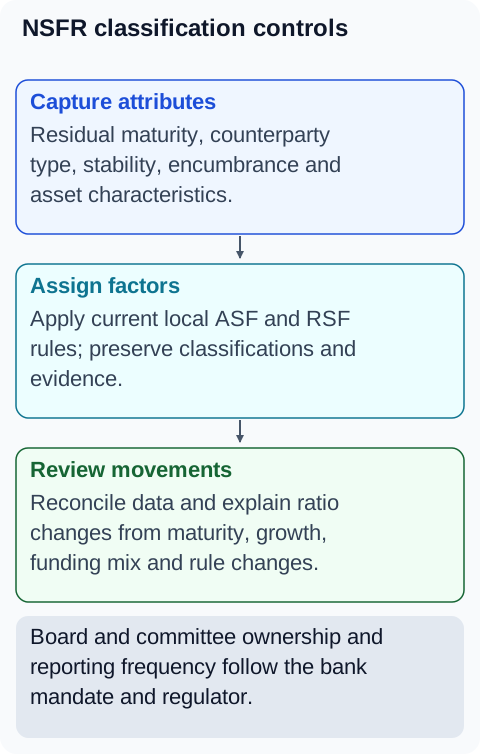
At the calculation date, reconcile funding and assets to the ledger, apply prescribed maturity buckets and encumbrance rules, add off-balance-sheet RSF and explain movements by business, maturity migration and rule changes. Project future NSFR using explicit contractual run-off and business assumptions. An unchanged balance sheet can lose ASF as debt ages across a boundary.
9. Controls and risks
| Risk | Control | Evidence |
|---|---|---|
| Behavioural tenor substitutes for regulatory maturity | Preserve prescribed contractual/category assignment; govern internal projection assumptions separately | Rule assignments and model evidence |
| Encumbrance under-flagging | Collateral-register completeness | Encumbrance tie-outs |
| Factor staleness | Versioned regulatory tables | Version logs |
| Single-ratio management | Joint LCR×NSFR packs | Combined dashboards |
| OBS RSF errors | Product-to-RSF mapping governance | RSF rule approvals |
| Behavioural assumption inconsistency | Cross-engine reconciliation (FTP/IRRBB/NSFR) | Reconciliation reports |
10. Practical examples
A: Tenor boundary (fictional). An 8bn financial-institution borrowing with 12 months remaining has 100% ASF. Just below one year but still at least six months it receives 50%, reducing ASF by 4bn. With RSF of 62.25bn unchanged, NSFR falls by 6.43 percentage points. Below six months the same borrowing receives 0%, creating another 4bn fall. A two-year facility issued January 2024 crosses below one year in January 2025, not January 2026. B: Covered bonds (fictional). Replacing 5bn overnight financial funding with eligible long debt adds 5bn ASF; encumbering 5bn mortgages for above one year increases their RSF from 3.25bn to 5bn, a 1.75bn increase. The combined ratio effect must be calculated against the starting numerator and denominator; it is not automatically neutral.
11. Diagrams
Figure 1. NSFR: stable funding and required funding.
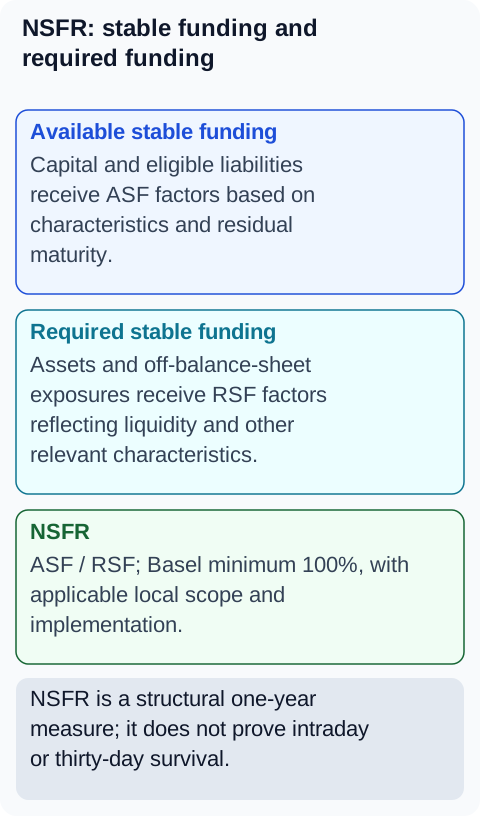 Figure 2. A fictional NSFR calculation.
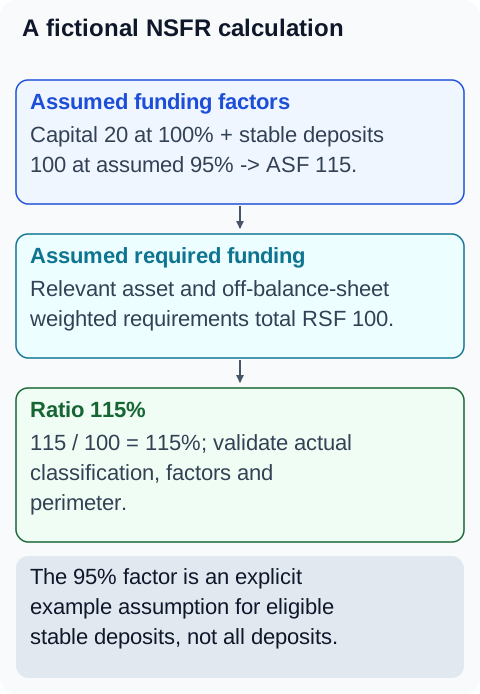 Figure 3. NSFR classification controls.
12. Tables
Table 1: Worked summary (fictional millions)
| Side | Amount |
|---|---|
| ASF | 83,000 |
| RSF including undrawn commitments | 62,250 |
| NSFR | 133.33% |
Table 2: Steering effects
| Action | Effect requiring modelling |
|---|---|
| Replace short funding with eligible long debt | ASF increases; asset proceeds also have RSF |
| Originate qualifying mortgages | RSF and cash use increase |
| Encumber assets for above one year | RSF moves to 100% |
| Release a short pledge | Factor depends on remaining encumbrance and asset category |
13. Illustrative banking case study
The overnight funding model (fictional). A bank finances long structured assets through overnight repo. Collateral remains eligible until counterparties refuse renewal or increase market haircuts. The stress plan must cover simultaneous refinancing needs and restricted monetisation. This illustrates why short-term liquidity and structural funding are complementary. It is not a historical bank failure and does not imply Basel LCR or NSFR rules existed in 2007.
14. BA, developer, tester and operations guidance
- BA: Specify regulatory contractual/category logic and separate internal behavioural projections, encumbrance sourcing and factor tables. Document the mapping between product attributes and ASF/RSF classifications with worked examples for each product type.
- Developer: Share source data and govern purpose-specific assumptions across FTP/IRRBB/internal liquidity projections; version factor tables. Build automated encumbrance-flagging feeds from collateral management systems with real-time or near-real-time latency.
- Tester: Tenor-boundary positions; encumbrance flag flips; OBS conversion; joint LCR×NSFR scenarios. Test the interaction where an action improves NSFR but degrades LCR, ensuring the joint dashboard captures the net effect.
- Operations: Watch maturity diary for ASF cliffs; attest encumbrance completeness monthly. Maintain a rolling 24-month maturity diary showing all funding instruments approaching the 1-year residual threshold.
15. Common mistakes
- Managing LCR while ignoring NSFR drift.
- Overriding prescribed NSFR contractual maturity with behavioural tenor; internal projections need separate validation.
- Unflagged encumbrance understating RSF.
- Growing long assets without matching ASF plan.
- Treating NSFR as reporting, not steering.
- Forgetting OBS drawdown RSF conversion.
- Porting ASF/RSF factors across jurisdictions without verifying local calibration.
16. Key takeaways
- NSFR = ASF ÷ RSF ≥ 100%: stable money funds illiquid needs over one year.
- Tenor, stickiness and encumbrance decide the ratio more than size.
- Joint LCR×NSFR view prevents single-lens gambling.
- Steering levers (tenor, mix, encumbrance) are ALCO's monthly work.
- Govern shared inputs and explain distinct regulatory factors, FTP tenors and IRRBB behaviour.
- NSFR is structural but can change daily through balances, valuations, encumbrance and maturity-bucket migration.
17. References and verification notes
- Current Basel NSFR: NSF20 ongoing minimum and reporting; NSF30 prescribed ASF/RSF factors, encumbrance and off-balance-sheet treatment. National law and instructions determine the local return.