Chapter 077: Liquidity Coverage Ratio
Section 16: Liquidity, Funding and Interest Rate Risk · Chapter 077 of 100
Day 9 of a stress: retail outflows accelerate, wholesale won't roll, downgrade triggers extra collateral — and the LCR compares eligible HQLA with prescribed 30-day stressed net outflows. It is a standardised metric, not a guarantee of survival or timely settlement. The Liquidity Coverage Ratio forces banks to pre-fund their own 30-day nightmare with assets saleable in that nightmare. This chapter computes it: HQLA grading, run-off assumptions, inflow caps, and the monitoring that keeps it honest daily.
1. Chapter opening
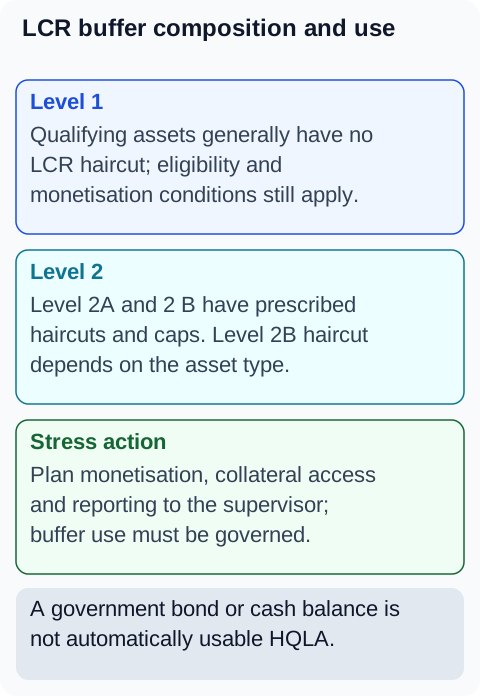
LCR = HQLA ÷ net stressed outflows (30 days) ≥ 100%. HQLA tiers (Level 1 cash/reserves/top sovereigns; Level 2A quality bonds with 15% haircut; Level 2B capped lower-quality with 25–50% haircuts; caps: Level 2 ≤ 40%, 2B ≤ 15% — verify locally). Outflows apply run-off rates by liability type (stable retail ~3–5%, less-stable ~10%, wholesale far higher, drawdowns, downgrade triggers, margin). Inflows capped at 75% of outflows (no self-funding fantasy). Reported in prescribed templates with averaging/smoothing rules varying by jurisdiction. The LCR was introduced as part of Basel III following the 2007–2009 financial crisis, which exposed the fragility of banks that held illiquid assets funded by short-term wholesale liabilities. The ratio's design philosophy is deliberately conservative: it assumes a severe but plausible stress scenario lasting 30 days, during which the bank must survive without central bank emergency assistance. This 30-day horizon was chosen to give authorities sufficient time to assess the situation and, if necessary, arrange an orderly resolution — making the LCR a bridge to intervention rather than a guarantee of indefinite survival.
2. Learning objectives
- Grade HQLA (L1/2A/2B) with haircuts and caps.
- Apply run-off rates to deposits, wholesale, drawdowns and triggers.
- Cap inflows and compute net outflows with a worked example.
- Explain intraday vs LCR interaction, using Intraday Liquidity and Collateral Management.
- Describe monitoring, breach escalation and buffer-usability doctrine.
3. Business context
LCR reshapes balance sheets structurally: HQLA portfolios (low yield) drag NII; stable-deposit franchises gain strategic value; wholesale-funded models face permanent cost. Optimisation (collateral upgrades, deposit mix shifts) is legitimate balance-sheet management; window-dressing (month-end inflation) is misconduct supervisors test with averaging. Buffer usability: drawing below 100% in stress is permitted with supervisory notification and rebuild plans — stigma managed by pre-communication. The structural impact is profound: banks that historically relied on wholesale funding now maintain larger HQLA buffers, accepting a permanent drag on net interest income. This has shifted competitive advantage toward retail-focused banks with deep, stable deposit franchises. The LCR also creates demand for high-quality government bonds, influencing sovereign debt markets — a feedback loop where banking regulation affects the very assets it relies on for safety. Liquidity optimisation has become a core treasury function: collateral transformation (upgrading eligible assets through repo), deposit gathering strategies (tiered pricing to attract stable balances), and intraday liquidity management (minimising idle balances while meeting payment obligations) all respond directly to LCR incentives.
| Liability | Run-off (headline, verify) | Behaviour |
|---|---|---|
| Stable retail | 5%;3% only under qualifying insurance conditions | Insurance plus relationship/transactional criteria |
| Less-stable retail | At least 10% under Basel; higher buckets may apply | Prescribed classification |
| Qualifying operational deposits | 25%, with limited qualifying insured treatment | Operational-dependency criteria; excess balances excluded |
| Non-operational wholesale | 40–100% | Flees first |
| Undrawn commitments | Prescribed by counterparty and credit/liquidity facility type | Drawn in stress |
4. Finance and accounting view
4.1 Worked LCR (fictional, millions)
Fictional Basel example, millions: assume 8,000 eligible cash/reserves,9,000 qualifying Level 1 sovereigns and 10,000 eligible Level 2A bonds. After the 15% Level 2A haircut, HQLA=8,000+9,000+8,500=25,500; Level 2 is 33.33%, below the 40% cap, assuming no relevant unwind adjustment. Outflows are stable retail 40,000×5%=2,000; less-stable retail 30,000×10%=3,000; financial-institution funding 10,000×100%=10,000; non-operational, non-financial corporate funding 10,000×40%=4,000; other prescribed drawdowns/triggers 3,000. Total outflows 22,000. Eligible inflows 9,000 are below the 75% cap 16,500; net outflows 13,000. LCR=25,500/13,000=196.15%.
The ratio is not proof that cash reaches every account before a deadline. A regulatory weighted ladder can reconcile the calculation, while an operational cash forecast needs actual contractual flows, settlement timing, asset monetisation and currency. Preserve both views rather than treat weighted run-offs as scheduled customer withdrawals.
4.2 Operations and usability
Daily calculation with intraday monitoring overlay (Intraday Liquidity and Collateral Management); currency dimension (significant-currency monitoring, convertibility limits); collateral/margin flow capture; downgrade-trigger inventory (rating-linked outflows contractualised). Breach protocol: notify supervisor, explain drivers, present rebuild actions with dates — pre-written playbook, not improvisation. The operational burden extends beyond calculation to data quality: HQLA eligibility requires real-time knowledge of encumbrance status (pledged assets are not available), regulatory haircut tables (versioned for rule changes) and separate market repo haircuts, and counterparty identity (sovereign vs bank vs corporate classification affects haircuts and caps). Stable retail classification requires the applicable prescribed insurance plus relationship or transactional-account criteria. Retain evidence of those tests, including behavioural information where the rule or supervisory assessment requires it; historical retention alone is neither a substitute nor a universal extra classification test. Do not assign a stable tag solely on a relationship manager’s preference.
4.3 Deep dive: intraday-LCR linkage and the monetisation-testing regime
The 30-day LCR does not capture every intraday peak or time-specific payment obligation. Share source positions, collateral availability and escalation between teams, but retain the distinct methods: prescribed LCR run-off factors do not change because an internal intraday model predicts faster flows. Intraday stresses may require different timing, amounts and market haircuts. A strong ratio does not compensate for missed settlement obligations, and intraday capacity does not waive the LCR requirement.
Monetisation-testing regime (proving HQLA saleable): repo-line test drawings (frequency appropriate to the portfolio and applicable framework, varied counterparties, timed from instruction to cash with SLA grading), test sales (small lots across asset classes with P&L recorded and market-impact measured), central-bank pledge pre-positioning (collateral schedules lodged, tested, haircut-verified), and currency-specific testing (significant-currency buffers tested in home markets, not assumed convertible). Test failures (3-day sale, rejected pledge, unusable currency) downgrade HQLA recognition internally before supervisors do it externally. Annual monetisation attestation (treasurer signs test programme adequacy) closes the loop — paper facilities without drawings are findings waiting for stress to expose. The monetisation test is conceptually simple but operationally demanding: it requires the treasury to actually sell a portion of its HQLA portfolio in normal markets and measure how long it takes to receive cash, what price impact occurs, and whether the counterparty is willing to transact at the expected haircut. Banks that discover their HQLA is illiquid in normal conditions face an uncomfortable question: what happens in stress?
5. Product and customer impact
LCR values products: transactional current accounts (stable classification) earn premium FTP; large rate-chasing balances cost more (less-stable); committed lines carry drawdown assumptions priced into fees; downgrade-triggered facilities (rating grids in loan docs) create cliff outflows — product teams must clear triggers with treasury. Deposit campaigns target stable-classifiable balances explicitly. The product impact extends to pricing and design: notice periods and early-withdrawal terms must be assessed against the applicable rules; instant access alone does not exclude stable-retail treatment. Transaction banking products (cash management, payment processing) generate operational deposits that benefit from lower run-off assumptions — creating a virtuous cycle where product design, deposit stability, and LCR efficiency reinforce each other. Conversely, wealth management products with large volatile balances are expensive from an LCR perspective, pushing banks to either reprice these relationships or restructure the product to reduce withdrawal velocity.
6. Regulatory and supervisory view
The Basel LCR minimum is 100% in normal times; use of the buffer during financial stress can take the ratio below 100%, with supervisory assessment and communication. The capital conservation and countercyclical buffers are capital requirements, not additions to the LCR, and their distribution restrictions must not be imported into liquidity-ratio arithmetic. The EU applies Commission Delegated Regulation (EU) 2015/61 as amended; the US and other jurisdictions use their own scope, factors and reporting schedules. Basel LCR.
7. Systems and data view
LCR engine: HQLA inventory with eligibility/haircut/cap logic (versioned haircut tables, encumbrance tracking, counterparty classification), liability classification (prescribed stable/less-stable/operational criteria with supporting evidence), run-off application, inflow recognition with cap math, currency splits (significant-currency identification and separate LCR calculation), template generator (regime-specific XBRL or flat-file formats). Controls: classification QA (prescribed stable-tag eligibility evidenced and tested at a risk-appropriate cadence), regulatory haircut-table versioning by jurisdiction and effective date; market valuation updated separately, cap enforcement (Level 2 and 2B caps calculated automatically, not manually), daily sign-off with breach escalation (automated alerts when LCR approaches predefined thresholds). The system architecture must support real-time or near-real-time calculation: banks operating under daily reporting requirements need LCR computed from same-day positions, not previous-day snapshots. This requires integration with the core banking system (for liability positions), the treasury management system (for HQLA inventory), and the market-data feeds (for haircut and pricing inputs).
8. End to end process
- Classify balances under prescribed criteria, including qualifying insurance and relationship/transactional tests; retain the applicable supporting evidence.
- Value HQLA with haircuts/caps (eligibility check, haircut application, Level 2/2B cap enforcement).
- Apply run-offs and triggers (liability-by-liability classification, contractual trigger inventory, drawdown assumptions).
- Recognise capped inflows (maturity matching, 75% cap enforcement).
- Compute ratio + currency splits (aggregate LCR and significant-currency LCR separately).
- Monitor vs limits; escalate breaches (threshold alerts, daily sign-off, breach protocol activation).
- Report templates; feed ILAAP/stress (regime-specific templates, stress-scenario LCR projections).
9. Controls and risks
| Risk | Control | Evidence |
|---|---|---|
| Stable-tag inflation | Prescribed insurance and relationship/transactional criteria, supporting evidence and QA | Tag evidence files |
| Window-dressing | Averaging, intra-period monitoring | Daily series |
| Trigger blindness | Contractual trigger inventory | Trigger register |
| Cap/haircut error | Versioned tables, dual review | Table logs |
| Currency convertibility assumption | Tested convertibility, currency-specific buffers | Test results |
| Encumbrance blindness | Real-time encumbrance tracking | Encumbrance reports |
10. Practical examples
A: Timing (fictional). A 150% LCR can coexist with a shortage before receipts arrive. Moving a maturity from day 5 to day 20 improves timing but leaves it inside the same 30-day LCR window. B: Trigger economics (fictional). Removing a 500m contingent outflow releases 500m of buffer only if that outflow is binding in the bank's target calculation. A 50bp annual carry saving on 500m is 2.5m, before other costs, rather than 10m. C: Eligibility (fictional). An otherwise qualifying 2bn Level 2B corporate bond portfolio with a 50% regulatory haircut contributes 1bn before caps. If it becomes ineligible and no cap was binding, HQLA falls 1bn. Bid-offer spread and the prescribed regulatory haircut are different measures.
11. Diagrams
Figure 1. LCR numerator and denominator.
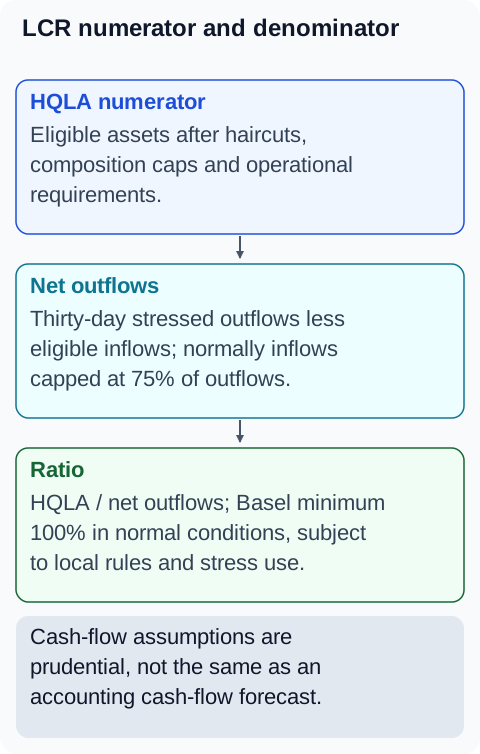 Figure 2. A fictional LCR calculation.
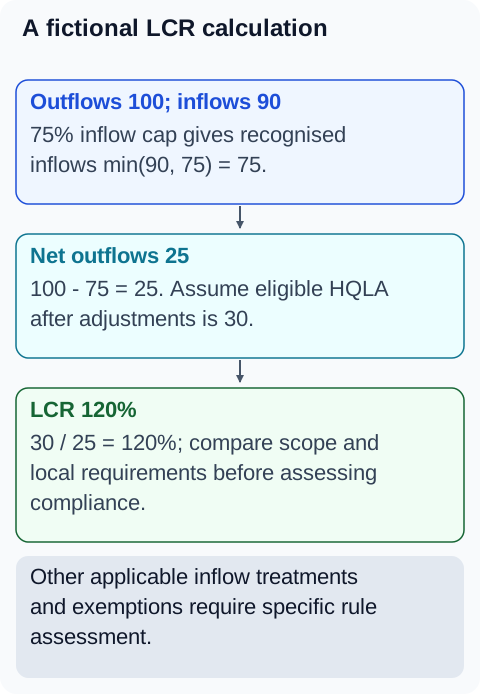 Figure 3. LCR buffer composition and use.
12. Tables
Table 1 — HQLA grading (headline, verify)
| Tier | Assets | Haircut | Cap |
|---|---|---|---|
| Level 1 | Cash, reserves, top sovereigns | 0% | — |
| Level 2A | Quality covered/govt-related | 15% | L2 ≤ 40% total |
| Level 2B eligible RMBS | Only qualifying residential mortgage-backed securities | 25% | Level 2B combined ≤15% of total HQLA, subject to all rules |
| Other eligible Level 2B | Qualifying corporate debt/equities meeting the specified criteria | 50% | Same combined Level 2B cap; overall Level 2 cap also applies |
Table 2 — Worked summary (fictional m)
| Line | Amount |
|---|---|
| HQLA (post-haircut/cap) | 25,500 |
| Outflows | 22,000 |
| Inflows (capped) | 9,000 |
| Net outflows | 13,000 |
| LCR | 196.15% |
Table 3 — Allocation of regulatory weighted flows (fictional m, days 1–30; not an actual-cash forecast)
| Day bucket | Outflows | Inflows | Net | Cumulative |
|---|---|---|---|---|
| Days 1–7 | 8,000 | 2,000 | 6,000 | 6,000 |
| Days 8–14 | 6,000 | 2,500 | 3,500 | 9,500 |
| Days 15–21 | 4,000 | 2,000 | 2,000 | 11,500 |
| Days 22–30 | 4,000 | 2,500 | 1,500 | 13,000 |
13. Illustrative banking case study
High ratio, inaccessible cash (fictional). A group reports a high liquidity ratio but holds assets in a subsidiary subject to transfer restrictions. Treasury checks the local entity's needs, legal transfer capacity, currency and settlement lead time. A consolidated surplus cannot automatically cover a parent's morning cash deficit. Remediation pre-positions eligible collateral and preserves local buffers rather than assuming all group cash is transferable.
14. BA, developer, tester and operations guidance
- BA: Specify classification tests (stable/less-stable/operational with prescribed eligibility and supporting evidence requirements), run-off tables, trigger inventory and cap logic with worked positions; document currency-specific rules and encumbrance treatment.
- Developer: Version tables (haircut, run-off, cap); enforce caps automatically; compute currency splits; escalate breaches automatically based on threshold alerts; integrate with real-time HQLA inventory.
- Tester: Cap-boundary HQLA mixes (test Level 2 cap binding); trigger firing (simulate downgrade events); inflow-cap binding (test 75% cap); averaging vs point-in-time (compare daily LCR to monthly average); monetisation test scenarios.
- Operations: Classify with evidence (maintain behavioural analysis files); monitor ladders not just ratios (daily cash-flow bucket analysis); rehearse breach playbooks (quarterly tabletop exercises); manage HQLA monetisation test programme.
15. Common mistakes
- Reading the ratio without the maturity ladder and currency splits — the headline can mask maturity clustering.
- Assigning stable tags without prescribed qualifying insurance and relationship/transactional evidence, or treating historical retention as sufficient by itself.
- Ignoring downgrade triggers until downgraded — triggers create cliff outflows that must be inventory-tested.
- Counting trapped HQLA as available — transferability is not assumed, it is tested.
- Window-dressing month-ends (supervisors average) — averaged disclosure and point-in-time compliance have their own applicable requirements.
- Confusing prescribed LCR haircuts with market repo haircuts or bid-offer spreads; market prices may fall without a regulatory haircut change.
- Separating LCR from intraday liquidity — they are complementary views of the same risk.
16. Key takeaways
- LCR = haircut HQLA ÷ (stressed outflows − capped inflows) ≥ 100%.
- Prescribed deposit/facility classifications decide run-offs; evidence supports the legal criteria.
- Ladders, currencies and transferability qualify the headline ratio.
- Usability doctrine permits dipping with plan and notice — but stigma is real.
- Daily monitoring with breach playbooks, not month-end arithmetic.
- Monetisation testing proves HQLA is real — test sales, test drawings, test pledges.
- Intraday and LCR are complementary — assess both rather than infer a universal supervisory score from either alone.
17. References and verification notes
- Current Basel LCR standard: eligibility, operational availability, caps, outflows and inflows.
- EU LCR regulation: EU-specific legal rules; use the consolidated applicable text.