Chapter 026: Internal Transfers and Domestic Payments
Section 6: Payment and Settlement Accounting · Chapter 026 of 100
1. Chapter opening
An internal transfer reallocates the bank's deposit liabilities: the payer's balance falls and the payee's rises, without an external cash movement. An external payment also changes the bank's settlement assets or obligations. Customer booking, clearing acceptance, interbank settlement and legal finality are distinct events. Banks may use transit accounts even for RTGS; the accounting design must explain each outstanding balance rather than presume every account is zero at midnight.
The lifecycle below is an illustrative operating model. Scheme rules and applicable law determine when an instruction becomes irrevocable and when settlement becomes final. Posting to the customer's account alone proves neither.
2. Learning objectives
By the end of this chapter you will be able to:
- Walk a payment through initiation, authorisation, posting, clearing and settlement naming each journal.
- Post internal transfers, domestic clearing payments and RTGS payments correctly.
- Distinguish duplicate prevention, settled returns and recall requests under applicable scheme/legal recovery rights.
- Apply domestic product/scheme charges with separate principal and fee journals.
- Explain finality and why scheme rules override ledger intuition.
- List the intraday controls that stop a payment problem becoming a loss.
3. Business context
Payment operations coordinates customer promises, settlement liquidity and evidence. Straight-through-processing targets and cut-offs are bank and scheme parameters, not universal 99% standards. A payment may be credited to a beneficiary before the interbank obligation settles, creating an exposure that treasury and finance must recognise.
| Payment | Customer service | Interbank mechanics |
|---|---|---|
| Internal | Same-bank transfer | Deposit-liability reallocation; no external settlement |
| Batch ACH/Bacs | Processing cycles | Deferred net settlement under system rules |
| RTGS/CHAPS | High-value or urgent | Each eligible transfer settles gross in central-bank money |
| Instant | Funds made available quickly | May use gross settlement or prefunded/deferred net arrangements |
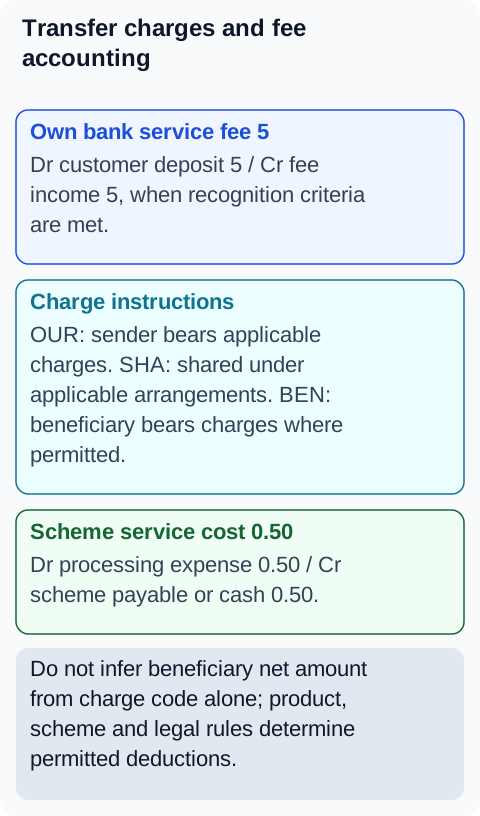
Domestic charges follow the applicable product and scheme. OUR/SHA/BEN are principally cross-border charge-allocation conventions; they are not a universal domestic fee taxonomy.
4. Finance and accounting view
4.1 Balanced journals from the bank's perspective
For a same-bank transfer of 5,000: Dr Payer deposit liability 5,000 / Cr Payee deposit liability 5,000. Neither side is customer cash on the bank's books. An authorisation hold normally changes available balance only; it does not by itself create a financial-statement journal.
For an external payment booked before settlement: Dr Payer deposit liability 5,000 / Cr Outward settlement payable 5,000. At confirmed settlement: Dr Outward settlement payable 5,000 / Cr Central-bank settlement asset 5,000. The receiving bank, if it credits only on settlement, posts Dr Central-bank settlement asset 5,000 / Cr Beneficiary deposit liability 5,000. Other valid posting sequences use receivables/transit accounts and must reconcile to the same economic result.
A 5 payment-service fee: Dr Payer deposit liability 5 / Cr Fee income 5, when the applicable revenue-recognition criteria are met. A scheme fee of 0.50: Dr Scheme fee expense 0.50 / Cr Scheme payable 0.50; payment then clears that payable to cash. Do not mix a fee charge with the principal settlement journal.
4.2 Rejection, return and recall
Reject a duplicate instruction before additional booking. If the duplicate already posted, reverse only the erroneous booking with linkage; if both payments settled, initiate recovery rather than pretend one was rejected.
Pre-settlement cancellation of the 5,000 payment clears the payable: Dr Outward settlement payable / Cr Payer deposit liability. A post-settlement return is a new incoming movement: Dr Settlement asset / Cr Return payable, then Dr Return payable / Cr Payer deposit liability. A recall is a recovery request and normally has no cash journal until value is recovered or a separate reimbursement obligation is recognised. Scheme rules may provide rights or duties beyond consent-based recovery; record the actual legal basis.
4.3 Finality and reconciliation
Match customer bookings, scheme messages and settlement statements by payment reference, amount, currency and value date. Legal finality attaches at the system's specified point, not at a generic central-bank debit timestamp or messaging confirmation. Settlement-final transfers can still be followed by a separate return or recovery transaction.
Reconcile each clearing-account balance to genuine unsettled items, including permitted next-cycle positions. An unexplained residual is a break; an evidenced overnight payable is not automatically a defect. Cash availability, value dating and customer execution obligations require separate controls.
The IFRS 9 May 2024 electronic-payment amendments apply for annual periods beginning on or after 1January2026, subject to local adoption. A qualifying policy election can derecognise a liability before settlement only when the standard's cancellation/access/insignificant-settlement-risk conditions are met. It does not redefine legal finality, establish cash receipt or justify treating every submitted payment as settled.
5. Product and customer impact
Customers need accurate status, expected execution time, charges and recovery options. Distinguish 'accepted', 'debited', 'settled' and 'beneficiary credited' using the actual scheme state. Publish relevant cut-offs and any product-specific fee rules before confirmation. Domestic charges should not be described by a universal OUR/SHA/BEN taxonomy.
Salary files and house purchases need stage-specific incident messages. A recall request does not guarantee recovery, but applicable fraud-reimbursement rights may exist independently. The bank must assess those rights rather than tell every customer that reimbursement depends only on the beneficiary's consent.
6. Regulatory and supervisory view
The CPMI-IOSCO Principles for Financial Market Infrastructures distinguish settlement finality, money settlement and operational risk. National payment law and scheme participation rules specify execution times, cancellation rights, customer reimbursement and reporting duties. Sanctions duties depend on the applicable regime; an alert requires documented disposition and lawful handling of funds, not an automatic return.
For UK consumer APP fraud, use the PSR's current reimbursement regime and its scope, exclusions and allocation rules; do not infer liability from how much the receiving bank recovered. Accounting recognises a reimbursement liability or provision when the relevant criteria are met, independently of the cash-recovery case.
7. Systems and data view
Payment hub architecture: channels → validation/screening → posting engine (memo + GL legs) → clearing/settlement gateways (scheme formats, increasingly ISO 20022) → reconciliation (expected vs scheme-confirmed vs settled) → exceptions workflow. Design rules: idempotency keys end to end, immutable payment state machine with an illustrative instruction sequence (initiated → authorised → posted → cleared → settled). Actual booking, clearing/netting and settlement stages or their order depend on the scheme and accounting policy; RTGS need not have a separate clearing stage. A settled return is a new value movement, while a recall is a recovery request. Further design rules: no silent state edits, scheme-format versioning, and intraday liquidity feeds to treasury per RTGS queue depth. One payment ID chains all journals (lineage for Chapter 053: Nostro, Clearing and Suspense Reconciliation).
8. End to end process
Fictional 500,000 house purchase: validate instruction, authorisation, available balance and applicable controls; release any hold when the actual booking occurs; debit buyer deposit liability and credit outward settlement payable; submit the payment; on settlement evidence debit payable and credit central-bank cash. Confirm the beneficiary status and post separately supported fees.
Reconcile all outstanding clearing items to their real state. Successfully settled payments should clear their related payable; unrelated next-cycle positions may remain. A defect found after final settlement requires correction/recovery assessment, not cancellation of the original final settlement.
9. Controls and risks
| Risk | Control | Evidence |
|---|---|---|
| Duplicate payments from retries | Idempotency on event IDs, duplicate detection | Duplicate-reject logs, replay tests |
| Misdirected payments (wrong details) | Confirmation-of-payee / verification, dual authorisation for large | Verification logs, auth records |
| Settlement with unfunded position | Intraday liquidity monitoring, RTGS queue management | Liquidity dashboards, queue logs |
| Recall treated as return (wrong debit) | Classification workflow with legal review | Case records, reclassification audits |
| Unreconciled clearing balances | Intraday clearing tie-out, supported closing items | Clearing reconciliation packs |
10. Practical examples
Fictional salary duplicate: a file attempts to book 20,000 salaries twice. Duplicate controls stop 19,982 repeats;18 are actually posted. Reverse erroneous unsettled bookings through approved linked entries. For any settled repeats, follow the scheme/legal recovery process and assess customer redress and the bank's liability separately. Customer booking is not the legal-finality test, and a bank error does not automatically make the employer responsible for compensation.
Fictional APP scam: a customer sends 40,000; lawful action preserves 12,000 while 28,000 is unavailable. Recovery and applicable reimbursement obligations are separate. Determine scheme/jurisdiction, eligible customer, time limits, exceptions and current reimbursement rules before recognising the actual obligation. Do not infer an automatic 28,000 loss or a universal 50/50 allocation merely from the remaining balance.
11. Diagrams
Figure 1. Internal transfer versus external payment.
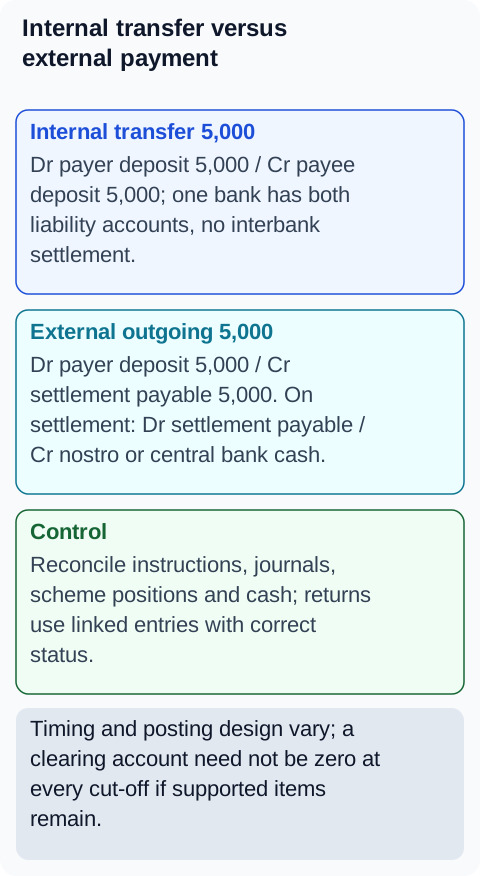
Figure 2. Duplicate, return and recall.
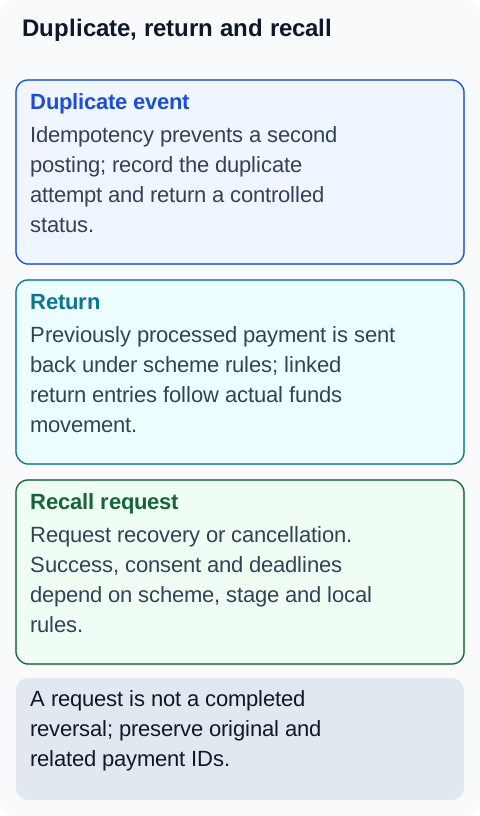
Figure 3. Transfer charges and fee accounting.
12. Tables
| Event | Debit | Credit |
|---|---|---|
| Book external principal | Payer deposit liability | Outward settlement payable |
| Confirm cash settlement | Outward settlement payable | Settlement asset |
| Cancel before settlement | Outward settlement payable | Payer deposit liability |
| Receive returned value | Settlement asset | Return payable |
| Credit returned value | Return payable | Payer deposit liability |
| Bank-funded compensation | Appropriate loss/expense | Customer deposit liability |
All journals must balance in the bank's functional currency. A hold, recall request or status message alone is not a journal. Reconcile outstanding positions at each scheme cycle and period cut-off.
13. Illustrative bank case study
Fictional bank scenario. A treasury forecast omits a holiday-related payment peak. Time-critical RTGS instructions queue without cash settlement. The bank obtains actual funding, communicates status and reconciles failed or settled items separately. Customer redress is assessed under applicable obligations. The lesson is to align liquidity forecasts with customer deadlines; queued messages are not settled payments. This training case does not assert an event at an unnamed real institution.
14. BA, developer, tester and operations guidance
- BA: Specify state machine, finality points, charge options, cut-off times and recall windows per payment type — with journals per stage.
- Developer: Idempotency keys mandatory; immutable states; scheme-format versioning; real-time liquidity signals to treasury.
- Tester: Duplicate storms, cut-off boundaries, recall-before/after-finality, scheme-file mismatches, RTGS queue exhaustion, confirmation-of-payee mismatches.
- Operations: Review supported clearing balances and queue depths intraday; run recall playbooks by the clock, with customer updates at each stage.
15. Common mistakes
- Returning a duplicate (double-pay) instead of rejecting it.
- Treating recalls as returns and debiting innocent payees.
- Assuming ledger posting equals finality.
- Ignoring intraday liquidity until RTGS queues form.
- Generic failure messages that hide stage-specific recovery options.
16. Key takeaways
- Customer booking, clearing and settlement are distinct events.
- Internal transfers move deposit liabilities; external transfers also create settlement obligations or cash movements.
- Reject before booking, reverse erroneous bookings with linkage, and record settled returns as new value movements.
- Finality and recovery rights depend on applicable law and scheme rules.
- Clearing balances must equal evidenced unsettled items; unexplained residuals require investigation.
17. References and verification notes
-
Electronic-payment liability derecognition amendments: IFRS 9 B 3.3.8–10, EU 2025/1047
-
Rules are applied under the reporting entity's adopted accounting framework and jurisdiction. Basel standards require local implementation; they are not themselves national law. All unnamed cases, amounts and operational thresholds are fictional training examples.