Chapter 027: Cross-Border Payments and Correspondent Banking
Section 6: Payment and Settlement Accounting · Chapter 027 of 100
1. Chapter opening
A nostro is our account with another bank; the same account is that bank's vostro liability to us. These terms describe perspective, not reciprocal accounts in two currencies. A positive nostro is normally an asset; an overdraft is a liability requiring the appropriate presentation. A nostro can be domestic or foreign and in domestic or foreign currency.
Correspondent payments move balances held between banks. Swift carries instructions and status information; it does not itself transfer the deposits. Serial instructions follow the intermediary chain. Cover instructions and funding follow separate paths and require explicit matching. A common reference improves traceability without proving legal settlement finality.
2. Learning objectives
By the end of this chapter you will be able to:
- Define nostro, vostro, loro and internal/transit accounts and state each one's balance-sheet home.
- Post a three-hop correspondent payment with fees and FX correctly.
- Explain serial vs cover payment methods and their ledger differences.
- Run nostro funding: forecasting, sweeping, cut-offs and overdraft avoidance.
- Apply charge options (OUR/SHA/BEN) across a chain with deduction handling.
- List the sanctions, AML and screening gates specific to cross-border flows.
3. Business context
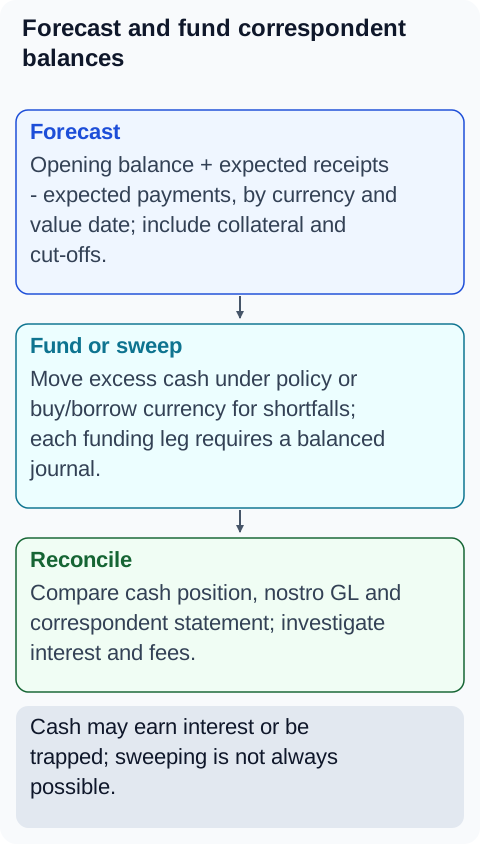
Treasury forecasts currency outflows, incoming value, correspondent credit limits and cut-offs. Positive nostro balances have a funding cost and may earn interest under the account agreement; they are not necessarily non-interest-bearing or trapped. Concentration, transfer restrictions and withdrawal availability determine liquidity usefulness.
Correspondent withdrawal can reduce access and increase rerouting costs. Do not attach universal corridor fee increases or historical bank counts without a dated dataset. Correspondent due diligence is risk-based; enhanced due diligence is not automatically required for every payment in a high-cost corridor.
| Account from our bank's view | Typical presentation | Control |
|---|---|---|
| Positive nostro | Due from banks/cash as appropriate | Internal ledger to correspondent statement |
| Vostro held for respondent | Due to banks | Respondent balance, charges and instruction reconciliation |
| Nostro overdraft | Liability | Limit, funding and gross/net presentation assessment |
| Transit account | Asset or liability by substance | Item-level age and settlement evidence |
4. Finance and accounting view
4.1 One balanced USD chain
Assume all accounts in this example are USD, with a 100,000 SHA instruction, a 50 sender fee charged separately, a 25 intermediary deduction and a 20 beneficiary-bank deduction. No FX conversion is included.
| Bank | Debit | Credit |
|---|---|---|
| Sender A | Customer deposit liability 100,050 | USD nostro asset 100,000; fee income 50 |
| Correspondent B | Vostro liability owed to A 100,000 | Nostro asset with C 99,975; fee income 25 |
| Beneficiary bank C | Vostro liability owed to B 99,975 | Beneficiary deposit liability 99,955; fee income 20 |
Each bank's journal balances. Sender outlay is 100,050, beneficiary receives 99,955, and total fees are 95. Only 45 is deducted from principal. The vostro at B and nostro at A are mirror records of the same account relationship. If C receives funds through its own nostro instead, its receipt is Dr Nostro asset, not a debit to an unspecified 'vostro/nostro receipt'.
4.2 Instruction versus funding
Serial customer transfers use pacs.008 along the instructed chain. A cover arrangement sends the customer instruction to the beneficiary bank and the associated interbank cover via correspondents, commonly pacs.009 COV. MT 103 and MT 202 COV describe the legacy equivalent; a plain MT 202 should not be used to conceal customer-cover data. Swift's CBPR+ MT/ISO coexistence for in-scope payment instructions ended in November 2025; message families and infrastructure usage must be checked separately rather than describing all Swift traffic as migrated.
A beneficiary bank receiving an instruction before funding must determine whether it has an unconditional receivable and whether it can credit the beneficiary under its credit and scheme arrangements. Missing cover is an operational and liquidity issue; a mismatch is investigated and screened on its facts, not automatically characterised as a sanctions breach.
4.3 Funding, charges and FX
Fund a nostro with an actual asset transfer: Dr Destination nostro / Cr Source cash asset; an inter-entity funding loan uses the appropriate payable/receivable, and those balances eliminate only on consolidation. Reconcile correspondent fees and interest to advice and statements.
OUR allocates relevant charges to the payer, SHA shares payer-side and payee-side charges, and BEN allocates charges to the beneficiary, where permitted. OUR is not a universal guarantee of full receipt: scheme rules, correspondent agreements and product guarantees determine the outcome. Certain jurisdictions require shared charges or prohibit principal deductions for covered transactions.
Foreign-currency journals require separate currency legs converted to functional currency, with FX dealing positions and any trading spread identified. Do not balance a EUR debit directly against an unconverted USD credit. IAS 21 retranslation of monetary nostro balances generally takes FX differences to P&L; foreign-operation translation is a different OCI process.
5. Product and customer impact
Disclose the quoted FX rate, charges, expected deductions and execution conditions under applicable rules. More hops can add cost and delay, but cover is not intrinsically faster than serial processing and missing a cut-off does not always mean exactly one day. Tracking supports status visibility; a message receipt or tracker update is not the correspondent-account settlement proof.
Corporate customers need references, value dates, gross instructed amount, credited amount and charge advice to match invoices. Investigate deduction differences using actual bank/scheme evidence; do not promise that every intermediary's full fee breakdown is always available in a tracker.
6. Regulatory and supervisory view
FATF Recommendation 16 addresses originator and beneficiary information, with national rules governing enforceable obligations, thresholds and timing. The current FATF Recommendations publication is updatedJune 2026 and includes revised payment-transparency material, while the authority also retains pre-revised Recommendation 16 for reference. Maintain an explicit national adoption/transition register: publication of the international standard does not make every revised provision already-effective national law. Existing local payment-transparency and sanctions rules remain applicable.
FX principal settlement risk arises when a bank pays the currency it sold before receiving the currency it bought. Payment-versus-payment makes one currency's final settlement conditional on the other's and reduces this principal risk. It does not remove replacement-cost, funding, operational or all correspondent risks; an eligible CLS-settled transaction is not a guarantee against every loss.
7. Systems and data view
The stack links origination, risk controls, FX, funding, correspondent messaging, status tracking and statement reconciliation. Preserve UETR and local references where applicable, currency, amount, value date and actual charge records. MT 940 and camt.053 are account-statement formats; MT 940 is not the same as a payment instruction. Legacy formats may remain in some interfaces after the CBPR+ message migration.
Risk-control alerts require lawful disposition; not every alert is a confirmed breach. Reconcile nostro ledger entries to external statements and the expected population, using intraday advices where available. Track accepted-but-unsettled, settled-but-uncredited and unmatched-statement states separately rather than infer cash movement from messaging.
8. End to end process
One SHA payment's journey: (1) initiation with charge-option advice and FX quote; (2) screening passes; (3) Dr Customer / Cr Nostro leg 1 with UETR; (4) intermediary deducts fee, forwards reduced amount; (5) beneficiary bank credits net amount, deducts its fee; (6) beneficiary queries shortfall — investigation follows UETR hop by hop; (7) each bank's nostro/vostro statements arrive; (8) auto-match clears expected legs; (9) unmatched legs age in transit with daily review; (10) month-end: nostro balances revalued, confirmed, attested. Steps 6–9 are where Chapters 019–020 live.
9. Controls and risks
| Risk | Control | Evidence |
|---|---|---|
| Unfunded nostro → failed payments | Real-time position monitoring, cut-off discipline | Position dashboards, cut-off breach logs |
| Chain breaks with value in flight | UETR tracking, per-hop confirmations | Tracker records, confirmation logs |
| Sanctions breach mid-chain | Pre-release + cover screening, stop lists | Screening logs, stop evidence |
| Deduction disputes | Charge-option disclosure, fee schedules | Disclosure records, fee advices |
| Stale nostro balances | Daily statement matching, break ageing | Nostro reconciliation packs |
10. Practical examples
Example A — The missing 45. Beneficiary expected 100,000, got 99,955. Investigation via UETR: intermediary A took 25 (disclosed), beneficiary bank took 20 (its standard inward fee, undisclosed to sender). Resolution: sender's bank updates pre-transfer disclosure to include typical inward fees on this corridor; complaint closed with goodwill. Lesson: SHA means mapping the whole chain's fees, not just your own.
Example B — Cover without instruction. 2 million cover arrives with no matching instruction (truncated reference). Funds sit in transit while screening holds them; beneficiary's supplier threatens default. Fix: reference-preservation rules with correspondents, standing repair procedures, and escalation SLAs. Lesson: reference truncation is a data contract — enforce it bilaterally.
11. Diagrams
Figure 1. One account relationship, two bank views.
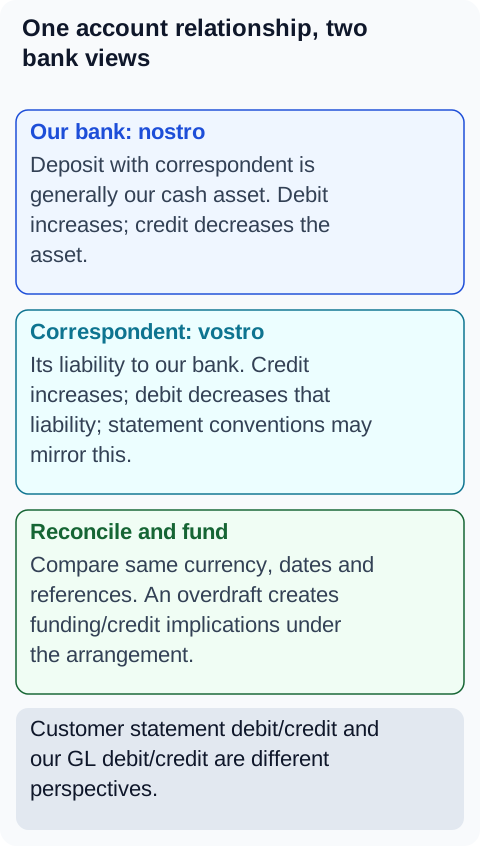
Figure 2. Serial and cover correspondent payments.
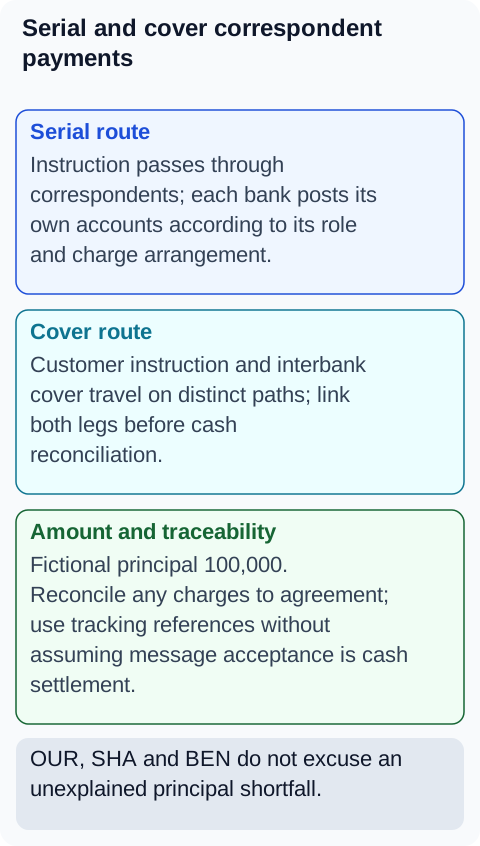
Figure 3. Forecast and fund correspondent balances.
12. Tables
| Arrangement | Information path | Funding and control |
|---|---|---|
| Serial | Customer instruction through intermediaries | Mirror interbank bookings; track actual value and deductions |
| Cover | Customer instruction direct; cover separate | Match reference, amount, currency, value date and transparency data |
| Nostro funding | Treasury instruction | Reconcile source asset decrease to destination asset increase |
| FX conversion | Contracted currency exchange | Separate currency amounts; functional-currency balance and spread proof |
Use the three-bank journals in section 4 as the principal journal map. A message acknowledgement is evidence of message processing; a statement entry or settlement confirmation supports value movement.
13. Illustrative bank case study
Fictional bank scenario. A fictional bank uses one USD correspondent in a corridor. Service termination leaves accepted instructions needing investigation and alternative routing. Operations verifies which legs settled before rerouting; treasury funds the replacement nostro and finance prevents duplicate booking. Backup access is tested rather than inferred from a second bank name in a contact list. This training case does not assert an event at an unnamed real institution.
14. BA, developer, tester and operations guidance
- BA: Specify hop sequence, charge option, FX handling, UETR propagation and cut-off per corridor — plus the investigation procedure for shortfalls.
- Developer: Preserve references end to end; stream nostro positions real-time; hard-stop screening; ingest camt.053/MT 940 with line-reference fidelity.
- Tester: Multi-hop with deductions, truncated references, cover/instruction mismatch, cut-off misses, currency holidays, recall mid-chain.
- Operations: Fund before cut-off; chase transit breaks same-day; track corridors' fee behaviour and warn front-office of changes.
15. Common mistakes
- Calling every nostro an asset without checking its sign: a positive balance is our claim with a bank, domestic or foreign; an overdraft is a liability.
- Promising full receipt on SHA payments.
- Letting cover and instruction detach without screening flags.
- Truncating references that downstream matching needs.
- Funding nostros after cut-off and paying overdraft for routine flows.
- Failing to monitor de-risking signals from correspondents.
- Assuming FX margins are immaterial — they are not.
16. Key takeaways
- Nostro = our asset with them; vostro = our liability to them; transit must reconcile to genuine outstanding items.
- Every hop posts mirrored legs with fees — UETR chains them.
- Serial sends payment instructions through the chain; cover separates beneficiary instructions and cover instructions. Money moves through account entries, not inside messages.
- Nostro funding is daily treasury-operations teamwork against cut-off clocks.
- SHA transparency across the whole chain is a product duty, not a footnote.
17. References and verification notes
- Swift payment-instruction coexistence update: confirms that in-scope CBPR+ payment-instruction coexistence ended in November 2025; other message-family milestones require their own current references.
- FATF recommendations and payment transparency
- IAS 21
- CPMI-IOSCO settlement principles
- Rules are applied under the reporting entity's adopted accounting framework and jurisdiction. Basel standards require local implementation; they are not themselves national law. All unnamed cases, amounts and operational thresholds are fictional training examples.