Visual overview
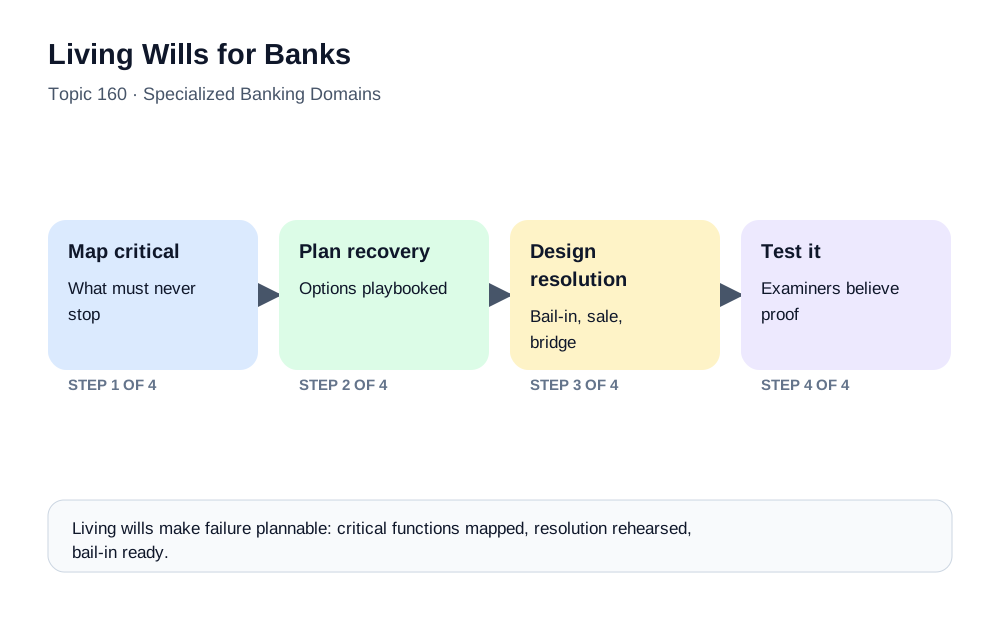
Living Wills for Banks at a glance — Resolution plans, recovery planning, regulatory requirements.
Recovery Planning, Resolution Planning, Critical Functions, Bail-In, and Orderly Bank Failure
A living will for a bank is a plan for how the bank could fail without bringing down customers, payment systems, markets, or taxpayers with it. The idea may sound unusual: why should a bank plan for its own failure? Because the global financial crisis showed that when large, complex banks fail without preparation, the damage can spread quickly through the financial system.
Banks provide critical services: deposits, payments, lending, custody, clearing, market access, trade finance, liquidity, and credit to the real economy. If a major bank becomes non-viable, authorities need a way to preserve critical functions, protect insured depositors, allocate losses to investors according to legal hierarchy, and avoid panic.
This chapter explains living wills from a practical banking perspective: recovery planning, resolution planning, critical functions, resolvability, bail-in, TLAC/MREL-style loss-absorbing capacity, operational continuity, cross-border challenges, and why failure planning is part of modern bank safety.
Learning objectives
By the end of this chapter, you should be able to:
- Explain what a bank living will or resolution plan is.
- Understand the difference between recovery planning and resolution planning.
- Identify critical functions that must continue during bank stress or failure.
- Explain bail-in, bridge bank, sale of business, and orderly wind-down.
- Understand TLAC, MREL-style resources, loss absorption, and creditor hierarchy at a high level.
- Describe operational continuity requirements for systems, staff, vendors, payment access, and data.
- Recognise cross-border resolution challenges.
- Explain why living wills protect financial stability and reduce taxpayer bailout risk.
1. What a Living Will Means
A bank living will is a plan that explains how a bank can be resolved if it becomes non-viable.
It is usually called a resolution plan.
The plan helps regulators understand:
- what the bank does;
- which functions are critical;
- which legal entities matter;
- where capital and liquidity sit;
- how losses could be absorbed;
- how deposits and payments could continue;
- how systems and staff would keep operating;
- how the bank could be sold, restructured, bailed in, or wound down;
- what obstacles make resolution difficult.
The goal is not to predict every future crisis. The goal is to make failure manageable if it happens.
2. Recovery vs Resolution
Recovery and resolution are related, but different.
| Area | Recovery planning | Resolution planning |
|---|---|---|
| Who leads | Bank management | Resolution authority or regulator |
| Timing | Before failure, while bank is still viable | When bank is failing or likely to fail |
| Goal | Restore strength and avoid failure | Resolve bank without systemic disruption |
| Tools | Capital raise, asset sale, cost cuts, funding plan, risk reduction | Bail-in, bridge bank, sale, transfer, wind-down |
| Control | Bank remains in control | Authority may take control or direct actions |
| Customer aim | Maintain confidence and operations | Preserve critical services and protect stability |
A recovery plan asks: how can the bank save itself?
A resolution plan asks: if the bank cannot save itself, how can authorities resolve it safely?
3. Why Living Wills Became Important
The 2008 financial crisis showed that some banks were too large, interconnected, or complex to fail safely.
When a major institution fails suddenly, problems can spread through:
- interbank lending;
- derivatives exposures;
- payment systems;
- securities financing;
- custody and collateral;
- money markets;
- depositor confidence;
- credit availability;
- cross-border branches and subsidiaries.
If governments believe failure would create systemic collapse, they may feel forced to use taxpayer support. Living wills were developed to reduce that problem by making banks more resolvable.
The policy goal is simple: banks should be able to fail without destroying the financial system.
4. Critical Functions
Critical functions are banking services whose sudden interruption could harm financial stability, customers, or the real economy.
Examples include:
- deposit-taking;
- retail and corporate payments;
- clearing and settlement;
- custody services;
- lending to households and businesses;
- trade finance;
- market-making in important products;
- treasury and liquidity services;
- access to financial market infrastructures;
- operational services supporting other banks or clients.
A living will must identify which functions are critical and how they could continue during resolution.
5. Resolution Strategies
Resolution authorities may use different strategies depending on the bank and legal framework.
| Strategy | Meaning |
|---|---|
| Single Point of Entry | Resolution action is taken at parent or holding company level |
| Multiple Point of Entry | Different subsidiaries or regional groups are resolved separately |
| Bail-in | Certain liabilities are written down or converted to equity |
| Bridge bank | Critical operations are transferred temporarily to a new bank |
| Sale of business | Parts of the bank are sold to a healthy buyer |
| Asset separation | Bad or illiquid assets are moved to separate vehicle |
| Orderly wind-down | Non-critical activities are closed over time |
The chosen strategy depends on structure, cross-border operations, critical functions, available buyers, legal powers, and market conditions.
6. Bail-In
Bail-in means certain investors and creditors absorb losses by having their instruments written down or converted into equity.
The purpose is to recapitalise or resolve the bank without using taxpayer money.
A simplified loss hierarchy may look like this:
- common equity shareholders;
- additional tier 1 instruments;
- tier 2 instruments;
- eligible senior unsecured debt;
- other unsecured creditors, depending on law;
- uninsured deposits only where permitted and after protected classes.
Insured deposits, secured claims, client assets, and certain protected liabilities are usually treated differently depending on jurisdiction.
The exact hierarchy is legal and country-specific. The important concept is that losses should fall on investors who accepted risk before public funds are used.
7. Loss-Absorbing Capacity
Large banks may be required to maintain resources that can absorb losses in resolution.
Common global terms include:
- TLAC: Total Loss-Absorbing Capacity, used for global systemically important banks.
- MREL: Minimum Requirement for Own Funds and Eligible Liabilities, used in some jurisdictions.
These resources may include equity and eligible debt that can be written down or converted.
The aim is to ensure the bank has enough loss-absorbing resources so critical functions can continue while losses are allocated to shareholders and creditors according to rules.
8. Operational Continuity
Financial loss absorption is not enough. The bank must still operate.
Operational continuity planning covers:
- core banking systems;
- payment systems;
- card systems;
- digital banking channels;
- data centers and cloud services;
- customer service;
- treasury operations;
- clearing and settlement access;
- custody and collateral systems;
- vendor contracts;
- staff retention;
- access to records;
- legal entity service agreements;
- regulatory reporting;
- cyber and resilience controls.
If payroll, payment processing, settlement, or customer account access fails during resolution, confidence can collapse even if the legal plan is strong.
9. Legal Entity Mapping
Large banks may operate through many legal entities, branches, subsidiaries, service companies, and booking locations.
A living will maps:
- legal entities;
- business lines;
- critical functions;
- customer groups;
- assets and liabilities;
- capital and liquidity;
- guarantees;
- intra-group exposures;
- service dependencies;
- technology systems;
- financial market infrastructure memberships;
- booking models;
- cross-border dependencies.
This mapping helps authorities understand what can be separated, sold, transferred, or wound down.
10. Data and Management Information
During resolution, authorities need reliable information quickly.
Banks must be able to produce data on:
- deposits;
- insured and uninsured balances;
- creditor hierarchy;
- collateral;
- derivatives exposures;
- liquidity position;
- payment obligations;
- critical customers;
- legal entity balance sheets;
- intercompany funding;
- market positions;
- operational dependencies;
- vendor contracts;
- staff and key roles.
Poor data quality can make a bank harder to resolve. In a crisis, no one has time to clean years of inconsistent records.
11. Cross-Border Resolution
Cross-border banks are difficult to resolve because different countries may have different priorities.
Challenges include:
- home regulator versus host regulator interests;
- local depositor protection;
- ring-fencing of capital or liquidity;
- different insolvency laws;
- different creditor hierarchies;
- local payment-system access;
- branches versus subsidiaries;
- data access across borders;
- political pressure;
- currency and settlement issues;
- recognition of foreign resolution actions.
A global bank may be one brand to customers but many legal entities to regulators.
12. Resolvability Barriers
A living will should identify barriers that make resolution difficult.
Examples include:
- too many complex legal entities;
- critical services trapped inside the wrong entity;
- poor data quality;
- no clear separability of business lines;
- shared IT systems without exit plan;
- vendor contracts that terminate on resolution;
- lack of loss-absorbing capacity;
- weak liquidity transfer arrangements;
- unclear deposit insurance records;
- heavy reliance on one funding source;
- missing playbooks for payment-system access;
- untested operational continuity plans.
Regulators may require banks to remove or reduce these barriers before a crisis.
13. Deposit Insurance and Customer Confidence
Deposit insurance protects eligible depositors up to a defined limit, depending on jurisdiction.
It supports confidence by reassuring customers that protected deposits remain safe even if a bank fails.
Resolution planning must connect with deposit insurance data:
- who is the depositor;
- what accounts they hold;
- what balances are insured;
- what balances are uninsured;
- whether records are accurate;
- how quickly insured customers can access funds.
If deposit records are messy, payout or transfer becomes slower and trust weakens.
14. Practical Example
A large bank becomes non-viable after severe credit losses and funding stress.
A prepared resolution approach may involve:
- authority determines bank is failing or likely to fail;
- insured deposits and critical payment functions are protected;
- shareholders and eligible debt holders absorb losses;
- viable operations move to a bridge bank or continue after bail-in;
- critical staff and vendors keep systems running;
- customer accounts remain accessible;
- non-critical businesses are sold or wound down;
- market and customer communication is coordinated;
- data and reports support authority decisions;
- losses are allocated according to legal hierarchy.
The aim is not to make failure painless. The aim is to make it orderly.
15. Common Misconceptions
Misconception 1: Living wills mean the bank expects to fail.
No. They are preparedness tools. Planning for failure improves discipline and reduces systemic risk.
Misconception 2: Resolution planning is only a regulatory document.
A useful plan affects legal structure, data quality, funding, contracts, systems, governance, and operational resilience.
Misconception 3: Bail-in means all depositors lose money.
Deposit treatment depends on law, insurance, hierarchy, and resolution strategy. Insured deposits are generally protected.
Misconception 4: Capital is enough to resolve a bank.
Capital matters, but operational continuity, data, systems, liquidity, staff, contracts, and payment access also matter.
16. Frequently Asked Questions
What is a bank living will?
It is a resolution plan explaining how a bank could be resolved safely if it becomes non-viable.
What is the difference between recovery and resolution?
Recovery is the bank's plan to restore itself before failure. Resolution is the authority-led process if the bank fails or is likely to fail.
What is bail-in?
Bail-in writes down or converts eligible liabilities so investors and creditors absorb losses instead of taxpayers.
What are critical functions?
They are banking services that must continue because sudden failure would harm customers, markets, or financial stability.
Why does operational continuity matter?
Because deposits, payments, cards, systems, staff, vendors, and data must continue working even while legal and financial restructuring happens.
17. Key Terms
- Living will: Bank resolution plan prepared before failure.
- Recovery plan: Bank-led plan to restore viability during stress.
- Resolution plan: Authority-focused plan for orderly failure.
- Critical function: Service whose disruption could harm stability or customers.
- Bail-in: Writing down or converting liabilities to absorb losses.
- Bridge bank: Temporary bank used to continue critical operations.
- TLAC: Total Loss-Absorbing Capacity.
- MREL: Minimum Requirement for Own Funds and Eligible Liabilities.
- Resolvability: Ability of a bank to be resolved without systemic disruption.
- Single Point of Entry: Resolution at parent level.
- Multiple Point of Entry: Resolution at subsidiary or regional level.
- Creditor hierarchy: Order in which losses are allocated.
- Deposit insurance: Protection for eligible deposits up to a limit.
- Operational continuity: Ability to keep critical systems and services running.
18. Interview Insights
Interviewers may ask living-will questions to test whether you understand bank failure as a managed regulatory process.
Strong answers usually mention:
- recovery versus resolution;
- critical functions;
- bail-in;
- bridge bank or sale of business;
- loss-absorbing capacity;
- legal entity mapping;
- operational continuity;
- cross-border challenges;
- deposit protection;
- data readiness.
A good short answer:
"A bank living will is a resolution plan showing how the bank could fail in an orderly way while preserving critical functions such as deposits, payments, and market access. It helps authorities allocate losses, maintain operations, protect financial stability, and avoid taxpayer bailouts where possible."
19. Course Closing Summary
Living wills complete the banking journey because they show the final safety discipline of the industry: even failure must be planned.
Across this course, we moved from basic banking purpose to deposits, lending, payments, risk, regulation, markets, operations, technology, inclusion, and resolution. The full picture is clear: banking is not one product or one system. It is a trust infrastructure for the economy.
For banking learners, the final lesson is this: good banking is not only about growth and innovation. It is about safety, fairness, resilience, operational discipline, and the ability to protect customers even under stress.
End of Basics of Banking course.
<!-- MBA-DEEP-DIVE-START -->Living Wills Deepening — Recovery Options, Resolvability, Critical Services, Bail-In Execution, and Operational Continuity
Resolution planning starts with the objective, not the failure scenario
The core objective is to make failure manageable without severe systemic disruption while preserving functions that are critical to the financial system or real economy. The Financial Stability Board’s Key Attributes remain the international umbrella standard for effective resolution regimes. The 2024 revised publication reiterates the aim of orderly resolution without taxpayer exposure to loss from solvency support while maintaining vital economic functions. A bank’s living-will work should therefore be judged by practical resolvability rather than by the length of a document submitted to an authority.
Recovery and resolution planning should share information but preserve different decision rights
Recovery is management’s effort to restore viability while the institution remains a going concern. Resolution is authority-led action when normal recovery is no longer credible or the legal trigger for resolution is met. The same data about capital, liquidity, legal entities, critical functions, collateral, contracts, and operations may support both processes, but governance is different. A recovery playbook should not assume that management will retain control once resolution begins.
Recovery planning should contain executable options rather than aspirations
“Raise capital” is not an executable option unless the bank knows the likely instruments, investor capacity, timeline, approvals, market conditions, dilution, and operational steps. “Sell assets” requires an identified portfolio, data room, valuation, legal transfer process, buyer universe, and liquidity impact. “Reduce risk-weighted assets” may take too long in a crisis. Each recovery option should include trigger, owner, execution time, financial impact, dependencies, customer impact, obstacles, and circumstances in which the option becomes unavailable.
Recovery capacity should consider interaction between options
A bank cannot always add the maximum benefit of every recovery action. Selling a business may reduce future earnings and make a capital raise less attractive. Pledging assets for emergency liquidity can make them unavailable for sale. Cutting lending can preserve liquidity while damaging franchise value. The bank should therefore estimate combined recovery capacity under realistic sequencing and avoid double-counting the same resource.
Recovery indicators should cover more than regulatory ratios
Capital and liquidity ratios are essential, but deterioration can appear first in deposit outflow, wholesale funding spreads, collateral calls, rating changes, payment delays, market value, asset-quality indicators, customer complaints, intraday liquidity, or operational incidents. A graduated indicator framework can trigger enhanced monitoring, management action, recovery governance, or formal escalation before minimum requirements are breached.
Escalation thresholds should have owners and decision forums
An indicator is useful only if someone is required to act when it is crossed. Recovery governance should define who validates the data, who convenes the crisis forum, what options are considered, who can authorize execution, and how regulators are engaged. Thresholds may include early-warning, recovery, and severe-stress levels. The bank should test whether information reaches senior decision makers quickly enough under weekend or cross-border conditions.
Resolution planning is built around a preferred strategy and credible alternatives
A resolution authority may plan to recapitalise a group through bail-in at a parent, transfer critical operations to a bridge institution, sell businesses, resolve major subsidiaries separately, or use other powers available under local law. The plan should identify the preferred strategy and practical alternatives if market conditions make it impossible. A strategy without an operational implementation plan is not a living will.
Single Point of Entry is a group structure, not simply a label
Under a single-point-of-entry approach, resolution action is generally concentrated at a top entity while operating subsidiaries remain open if losses and recapitalisation can be managed through the group structure. For this to work, the parent needs appropriate loss-absorbing capacity, downstream resources, legal mechanisms, governance, and information. Critical subsidiaries also need enough liquidity and operational continuity to keep serving customers during the process.
Multiple Point of Entry requires credible separability
If major regional or business subgroups can be resolved separately, the institution needs legal and operational independence sufficient for each resolution action. Shared technology, treasury, data, staff, brands, and service companies can make separation difficult. The plan should show which dependencies remain and how services continue if one subgroup enters resolution while another does not.
Critical functions should be identified through impact and substitutability
A function may be economically important because many customers rely on it, because other institutions depend on it, because the market lacks substitute providers, or because interruption would disrupt payments, credit, custody, clearing, or other vital services. The bank should distinguish critical functions from profitable businesses and from internal “critical systems.” A function can be critical to society even if it is not the bank’s largest revenue source.
Critical shared services should be mapped underneath critical functions
A retail-payment function may depend on core banking, identity, fraud controls, payment gateways, data centres, telecoms, customer service, settlement accounts, card processors, cloud, vendors, and staff. Resolution planning should connect each critical function to the services, applications, legal entities, contracts, assets, licences, and people required to deliver it. Otherwise authorities know what must continue but not how to keep it running.
Service mapping should include failure of group support
A subsidiary may rely on a parent company for technology, treasury, HR, data, risk, or procurement. If the parent enters resolution, those services cannot be assumed to continue informally. Intragroup service agreements should define scope, pricing, ownership, termination, access to assets, and continuity during stress. Critical operations should not be trapped behind a service provider that becomes legally or financially unable to perform.
Operational continuity is one of the hardest parts of resolution
Capital can be written down overnight, but technology, people, buildings, networks, vendors, and licences must continue working the next morning. The plan should address payroll, privileged access, cloud subscriptions, software licences, data centres, payment connectivity, market data, cybersecurity, facilities, call centres, and outsourced operations. A bank that is financially recapitalised but operationally paralysed has not been resolved successfully.
Vendor contracts should be reviewed for resolution-resilient terms
A key supplier may have rights to terminate because of insolvency, change of control, non-payment, credit deterioration, or legal-entity changes. Resolution planning should identify critical vendors, contractual vulnerabilities, prepayment or funding needs, access to data and licences, and alternatives. Where law or contract permits, terms can be structured to support continuity. Concentration in one vendor should be considered in resolvability assessments.
Staff retention can become a resolution dependency
A trading platform, payment gateway, risk model, or settlement process may depend on a small group of specialists. In severe stress, employees may leave unless roles, compensation, authority, safety, and communication are managed. Critical-staff inventories and succession plans help authorities understand what human capability must be retained. Knowledge should also be documented so continuity does not depend entirely on individual goodwill.
Management information must be available at crisis speed
The FSB Key Attributes emphasise the ability to produce sufficiently detailed, accurate, and timely information for resolution. Authorities may need legal-entity balance sheets, deposit data, creditor hierarchy, collateral, derivatives, secured funding, payment obligations, intragroup exposures, market positions, and operational dependencies within hours rather than weeks. Resolution data should therefore be generated and tested regularly rather than assembled manually only during annual planning.
Legal-entity balance sheets should reconcile to the group
A consolidated balance sheet hides where assets, liabilities, capital, and liquidity actually sit. Resolution decisions occur through legal entities and creditor claims. The bank should be able to produce reconciled entity-level positions and explain intercompany balances. If an internal funding receivable in one entity is a liability in another, both sides and their legal terms must match.
Creditor hierarchy data needs instrument-level accuracy
Bail-in, liquidation comparison, and creditor safeguards depend on knowing which legal entity issued an instrument, its governing law, seniority, security, maturity, holder, contractual terms, and eligibility for loss absorption. Generic ledger categories may be insufficient. Data should distinguish secured, preferred, subordinated, senior, depositor, operational, and other classes according to applicable law without assuming one global hierarchy.
Bail-in execution is an operational project compressed into crisis time
Writing down or converting liabilities requires identifying instruments, determining valuation and losses, applying the legal hierarchy, communicating with market infrastructures, registrars, custodians, paying agents, exchanges, and investors, updating accounting, and establishing new equity or ownership records. The plan should define the sequence and data needed to execute these steps over a resolution weekend or other compressed timetable.
Bail-in should not be taught as a universal treatment of every creditor
Resolution law specifies exclusions, safeguards, protected deposits, secured claims, client assets, and other treatments that differ across jurisdictions. The educational concept is that shareholders and eligible creditors can absorb losses and recapitalise critical operations rather than relying on taxpayer solvency support. The exact waterfall must be taken from the law applicable to the specific legal entity and instrument.
Valuation is central to resolution decisions
Authorities need estimates of asset value, liabilities, losses, capital needs, and the value of businesses under different strategies. Valuation under crisis conditions can be difficult because markets may be illiquid and data uncertain. Banks should maintain data and valuation capability that can support rapid analysis. Resolution planning should identify portfolios where valuation would be especially complex and what expertise is required.
Loss absorption is not enough; liquidity after resolution matters
A recapitalised bank can still fail if it cannot meet payment, margin, deposit, collateral, or settlement outflows. Resolution liquidity planning should estimate needs under stress, available unencumbered assets, central-bank or market facilities subject to rules, collateral operational readiness, and the effect of customer confidence. Funding in resolution must be considered separately from solvency.
Intraday liquidity can become critical during resolution
Payment systems and market infrastructures may require settlement during the day while depositors and counterparties are uncertain. The bank should know expected peak intraday positions, collateral needs, settlement accounts, credit lines, and operational procedures. A failed outgoing payment or CCP margin call can undermine confidence even if end-of-day liquidity looks sufficient.
Collateral mobilisation should be pre-engineered
It is not enough to know that securities exist. The bank must know which legal entity owns them, whether they are encumbered, where they are custodied, whether they are eligible at a relevant facility, what haircut applies, who can instruct movement, and how quickly transfer can occur. Data and operational testing turn theoretical liquidity into usable liquidity.
Deposit data must support protection and continuity
Resolution and deposit-insurance authorities may need to identify eligible depositors, aggregate accounts, apply exclusions or limits under local law, and transfer or make funds available rapidly. Customer master errors, duplicate identities, unclear beneficial ownership, stale address data, or inconsistent product classification can slow protection. Single-customer-view style capabilities, where required, are therefore financial-stability infrastructure.
Deposit transfer may be preferable to payout in some strategies
A resolution authority may transfer insured or other deposits and matching assets to a purchaser or bridge bank rather than pay depositors and close the relationship. The bank should be able to identify and technically transfer the accounts, balances, accrued interest, holds, mandates, customer data, and necessary history. Customer access should continue with clear communication and minimal disruption.
Bridge-bank readiness requires a build-or-transfer playbook
A bridge institution may need licences or statutory powers, governance, systems, staff, premises, accounts, payment access, contracts, and customer communication. Authorities and banks should know what can be transferred legally and technically. A bridge strategy is not executable if every critical system licence belongs only to the failed legal entity and cannot be continued.
Sale-of-business strategies need separable data and contracts
A potential buyer needs to understand the assets, liabilities, customers, risks, and operational services being acquired. Business lines should have identifiable financials, data, contracts, staff, and systems. Where everything is deeply entangled, sale becomes slow and value is destroyed. Resolvability work can therefore influence ordinary architecture by encouraging cleaner service boundaries.
Separability analysis should distinguish economic and operational perimeter
A profitable business may still be impossible to sell quickly because it depends on a group-wide core, central customer master, shared licences, or employees in another entity. The bank should identify what must travel with the business and what services can be supplied temporarily under transition agreements. Transitional service arrangements need pricing, duration, data access, security, and exit plans.
Resolution planning should consider payment-system and FMI membership
Critical banking services can depend on direct or indirect access to RTGS, instant payment schemes, card networks, securities depositories, central counterparties, and other financial market infrastructures. Membership terms may react to financial distress or legal entity change. The plan should identify continuity requirements, collateral, settlement bank arrangements, participant IDs, technical connectivity, and communication with operators.
Correspondent-banking access can be a hidden critical dependency
Cross-border payments may rely on nostro accounts and correspondent relationships that counterparties can restrict during stress. Resolution planning should identify major corridors, accounts, currencies, legal agreements, and alternatives. A domestic deposit bank may appear operationally stable while its customers suddenly lose international payment capability because correspondents withdraw services.
Derivatives can accelerate stress through collateral and termination rights
Large market positions can generate margin calls, close-out exposure, and liquidity needs. Resolution regimes may include temporary stays or other mechanisms under applicable law, while contractual frameworks and cross-border recognition matter. The bank should know netting sets, collateral, counterparties, governing law, clearing arrangements, and termination provisions. A consolidated derivatives number is not sufficient for execution.
Resolution should preserve client assets distinctly from bank assets
Custody, brokerage, fiduciary, or client-money businesses may hold assets that are not economically the bank’s property. Systems and legal records should identify and segregate them according to applicable requirements. Poor books can delay return or transfer of client assets and damage market confidence. Resolution planning should therefore connect custody records, legal terms, reconciliations, and operational access.
Cross-border cooperation is essential for global groups
A multinational bank can have a home authority, many host authorities, local deposit insurers, central banks, securities regulators, and market-infrastructure supervisors. They may face different laws and domestic objectives. Crisis Management Groups and institution-specific cooperation arrangements, where applicable, are designed to support coordination. The bank should be able to provide consistent data and explain how the preferred strategy affects each major jurisdiction.
Host authorities care about local continuity and resources
A global strategy can be credible at parent level but unacceptable to a host if local depositors, payments, or critical lending depend on resources that might be transferred elsewhere. Resolution planning should identify capital and liquidity positioning, local critical functions, intragroup exposures, and legal barriers. Transparent pre-crisis planning can reduce the incentive for emergency ring-fencing when stress arrives.
Internal TLAC or equivalent loss-absorbing resources support subsidiary recapitalisation
For groups using single-point-of-entry strategies, material subsidiaries may need internal instruments or arrangements through which losses can be passed up and capital restored without putting the operating entity into separate insolvency. The exact requirements differ by framework. The operational lesson is that resources must be issued by the correct entity, legally effective, recognised, and mapped to the strategy rather than being a group-level accounting assumption.
Resolution entities and material subgroups should be explicit in architecture
Treasury, finance, legal, and risk systems should know which entities are expected to enter resolution and which operating subsidiaries are intended to continue. This affects funding, liability issuance, guarantees, service contracts, and reporting. A plan that exists only in a regulatory team but is invisible to ordinary group structure creates implementation risk.
Resolvability assessments should drive structural change
The FSB framework expects authorities to assess whether resolution strategies are feasible and credible, including continuity of critical services, intragroup exposures, information capability, and cross-border arrangements. When material barriers exist, authorities can require changes depending on local powers. Banks should therefore treat resolvability findings as architecture and operating-model issues, not as wording to improve in next year’s plan.
Complex legal structures can hide loss and liquidity paths
Multiple holding companies, branches, service entities, booking vehicles, and guarantees may have legitimate business purposes but can complicate resolution. Legal-entity simplification can reduce uncertainty, although it must be balanced against tax, regulatory, customer, and business requirements. The objective is not the fewest entities possible; it is a structure whose critical functions and loss-bearing mechanisms can be understood and acted upon quickly.
Intragroup guarantees and cross-defaults need mapping
Stress in one entity can trigger obligations in another through guarantees, keepwell agreements, derivatives, financing, or contractual default clauses. These linkages can undermine a strategy that assumes entities are separable. Legal and treasury inventories should identify trigger conditions, amount, governing law, collateral, and beneficiary. Contract databases should be searchable in crisis time.
Resolution communication should be prepared before the crisis
Customers, employees, markets, investors, counterparties, rating agencies, payment schemes, vendors, and governments may need different messages. The first hours are crucial for confidence. Templates should explain which services continue, how deposits are treated, what customers need to do, and where reliable information is available without making promises that depend on unresolved legal decisions.
Rumour management has become an operational-resilience issue
Digital communication can spread speculation rapidly and enable customers to move funds quickly. Crisis teams should monitor misinformation, coordinate public statements with authorities, and ensure customer channels can handle surges. Communication cannot substitute for liquidity, but poor communication can intensify liquidity stress. Resolution playbooks should include social and digital channels, not only press releases.
Cybersecurity controls must survive extraordinary governance
Resolution can involve new administrators, emergency access, large data transfers, system changes, and vendor involvement. Security teams should define how privileged access is granted and revoked, how monitoring continues, how keys and certificates are managed, and how threat response works if normal senior management changes. Attackers may view a crisis as an opportunity because staff attention is divided.
Operational resilience testing should include resolution-like disruption
A bank can test whether critical services continue if a parent service company is unavailable, staff are reduced, funding is constrained, a vendor demands assurance, or legal entities are separated. These scenarios reveal hidden dependencies that ordinary disaster recovery may miss. Traditional DR assumes the institution remains intact; resolution can change ownership, contracts, and legal control while technology must still run.
Resolution data should have predefined cut-off times
A legal-entity balance sheet at yesterday’s close may be inadequate if billions have moved intraday. The plan should define which information can be produced in near real time, at end of day, or after controlled estimation. Timestamp and valuation basis matter. Authorities should know whether figures are accounting values, market values, regulatory values, or estimates so they are not combined incorrectly.
Data lineage is crucial when decisions can transfer billions of liabilities
Every critical field should have a source, calculation, owner, and reconciliation. If deposit-insurance eligibility is derived, the logic should be documented. If creditor ranking depends on instrument attributes, those attributes should trace to legal documentation. Manual spreadsheets may support analysis, but uncontrolled spreadsheets should not be the sole source for execution-critical decisions.
Playbooks should identify the sequence of legal and technical actions
A weekend resolution might require authority decisions, board or administrator changes, valuation, write-down instructions, security identifier updates, account transfer, core configuration, payment participant changes, public communication, and market opening readiness. Each step should have prerequisites and fallback. Sequencing errors can create inconsistent legal and accounting states even when every individual action is correct.
Resolution weekend timing should include external cut-offs
Securities depositories, payment systems, central banks, custodians, registrars, exchanges, and correspondent banks operate on their own calendars and cut-offs. The plan should know when instructions must be delivered for changes to be effective before markets reopen. A perfect internal timetable that misses an external infrastructure deadline can make the strategy non-executable.
No-creditor-worse-off or equivalent safeguards require data and valuation
Many resolution frameworks include creditor safeguards intended to prevent resolution treatment from producing worse outcomes than the relevant insolvency counterfactual, though the exact legal formulation differs. This requires valuation of what creditors actually receive in resolution and what they would have received in liquidation. Instrument data and valuation methodologies therefore have consequences long after the initial resolution decision.
Recovery option testing should connect to resolution readiness
If management’s recovery options repeatedly depend on selling the same business that resolution planners assume will be transferred, the interaction should be understood. Successful recovery may change the group’s resolution structure; failed recovery actions may consume liquidity or collateral. Recovery and resolution teams should share scenario assumptions while maintaining their distinct mandates.
Scenario: deposits leave faster than the recovery plan assumed
A severe confidence event causes digital deposit outflows well above the plan’s base stress. Recovery governance escalates, liquidity buffers are mobilised, contingency funding is activated, and options are reassessed. When management can no longer restore viability within the required timeframe, the resolution authority uses current data to evaluate the preferred strategy. The crisis is handled as a transition of governance, not a sudden discovery that resolution information is unavailable.
Scenario: a critical vendor threatens service suspension
The bank’s payment-processing platform is operated by a group service company and relies on an external software provider. Resolution planners had already identified the dependency, mapped licence rights, arranged continuity provisions, and documented payment obligations. The service continues while ownership changes. Without that preparation, a contract clause could have disrupted customer payments at the worst possible moment.
Scenario: bail-in recapitalises the group but a subsidiary lacks cash
Loss-absorbing instruments restore solvency at the resolution entity, yet one operating subsidiary faces large settlement and depositor outflows. The resolution liquidity playbook identifies eligible collateral and funding mechanisms and moves resources under approved arrangements. This shows why solvency and liquidity must be managed separately even inside the same resolution strategy.
Business analysts should model resolution as executable capability
Requirements should cover data production, legal-entity mapping, critical-function mapping, creditor inventory, deposit classification, collateral mobilisation, service continuity, user access, payment membership, vendor contracts, communication, transfer, bail-in processing, bridge-bank migration, and audit evidence. Each capability needs owner, trigger, data source, frequency, service level, and test result. A narrative plan becomes credible when these capabilities can be demonstrated.
Testing should involve decision makers as well as systems
Tabletop exercises can simulate deteriorating liquidity, market closure, cyber incidents, depositor runs, cross-border disagreement, and failure of a recovery option. Technical tests can prove data extraction, collateral movement, account transfer, access changes, and communication. Senior management and authorities should understand what decisions are required and how quickly. The purpose is to expose uncertainty while there is still time to fix it.
Authoritative-source discipline prevents jurisdictional confusion
The FSB Key Attributes provide the international standard and common concepts, but national law determines resolution triggers, powers, creditor hierarchy, deposit protection, bail-in scope, funding, and procedural safeguards. Educational material should therefore explain the global framework while making clear that execution differs by jurisdiction. A bank should use current home- and host-authority requirements for its actual plan.
Closing perspective
A living will is evidence that a bank understands itself deeply enough to be taken apart, recapitalised, transferred, or wound down without losing sight of the services society needs. The hard work lies in legal-entity data, payment continuity, liquidity, contracts, people, systems, collateral, creditor records, and cross-border cooperation. Resolution planning is successful when authorities do not need the bank to remain healthy in order to understand how it works.
Living wills turn resolution theory into executable banking information
A bank's recovery and resolution planning should answer two different questions. Recovery planning asks how the bank itself could restore viability after severe stress by taking management actions such as raising capital, conserving liquidity, selling assets, reducing risk, changing funding, or restructuring parts of the business. Resolution planning asks how authorities could manage the failure of the bank if recovery is not enough, while protecting critical functions, preserving financial stability, and applying the applicable legal framework. The plans are connected, but they should not be confused.
A “living will” is useful only when the information can be used under pressure. A long document that explains the organisation but cannot identify legal entities, critical services, funding needs, contracts, dependencies, or executable actions quickly is weak operational evidence. Resolution planning therefore forces a bank to understand itself in a level of detail that ordinary organisation charts often do not provide.
Start with critical functions and map the services beneath them
Criticality is not determined by whether an internal team considers a product important. The analysis asks what economic or financial function could create serious disruption if it stopped abruptly. Depending on the institution, this can include deposit access, payment services, custody, clearing, lending to important customer segments, market services, or other functions whose interruption could affect customers and financial stability.
Once a critical function is identified, the bank should map what is required to keep it operating. That includes legal entities, applications, data, staff, premises, payment and market infrastructures, correspondent accounts, vendors, cloud services, licences, intellectual property, operational procedures, and funding. A critical payment service may depend on a technology platform owned by one entity, staff employed by another, a data centre operated by a supplier, and settlement accounts in several markets. Resolution planning is designed to expose these cross-dependencies before stress makes them urgent.
Legal-entity mapping matters because resolution acts on legal entities
Banks often manage customers and technology through business lines that cut across legal entities. A global payments platform can support several banks inside a group. Shared service companies may own technology or employ staff. Funding can move between entities. Contracts may be booked in one entity while customer service is performed elsewhere.
Resolution planning therefore needs a legal-entity view of assets, liabilities, capital, liquidity, contracts, operational services, and customer relationships. Management should know which entity can continue operating if another entity is separated, sold, restructured, or enters resolution. Intercompany dependencies should be documented with enough precision to understand whether services can legally and operationally continue.
Service agreements between group entities deserve particular attention. An informal assumption that “the group will keep supporting us” may not survive a legal separation. Critical services should have clear agreements, pricing, access rights, data rights, and continuity arrangements capable of functioning during stress.
Capital and loss-absorbing capacity must be usable where losses occur
Resolution frameworks often rely on sufficient capital and eligible loss-absorbing resources so losses can be absorbed and the institution can be recapitalised or restructured without relying on ordinary customer deposits as a management tool. The exact regulatory requirements vary by jurisdiction and institution, but the operational principle is stable: resources need to be positioned and structured so the resolution strategy can actually use them.
A group-level amount is not enough if resources are trapped in the wrong legal entity or cannot be transferred during stress. Finance, treasury, and resolution teams should understand issuance entities, internal funding, maturity, governing law, creditor hierarchy, and constraints on moving resources. Management information should show where loss absorption and recapitalisation capacity sits relative to the entities that perform critical functions.
Liquidity in resolution can be different from solvency
A bank can be recapitalised on paper and still fail operationally if it cannot meet payments, margin calls, collateral needs, withdrawals, or settlement obligations. Resolution planning therefore needs realistic liquidity analysis. Teams should identify the cash outflows that could accelerate during stress, which assets can generate liquidity, which central or market facilities may be accessible subject to applicable conditions, and which operational steps are required to mobilise collateral.
Intraday liquidity matters as well as end-of-day totals. A bank may have sufficient resources overall but face timing mismatches during a payment day. Resolution liquidity analysis should therefore understand settlement accounts, payment queues, securities settlement, derivatives margin, collateral movements, correspondent balances, and cut-off times.
The analysis should also consider that ordinary funding assumptions can fail during resolution. Unsecured markets may close, counterparties may reduce limits, customers may move deposits, and collateral haircuts may increase. The plan should avoid assuming that stressed funding behaves like normal funding.
Operational continuity can determine whether a resolution strategy is credible
A resolution strategy may be legally sound but operationally impossible if critical technology, data, people, or supplier contracts cannot continue. Banks should identify critical shared services and understand how they remain available through a legal restructuring.
Third-party contracts can contain termination, change-of-control, insolvency, or access provisions that matter during stress. Procurement and legal teams should know whether a critical vendor could suspend service and what the bank would do if renegotiation were required quickly. Concentrated suppliers and proprietary platforms deserve additional attention when replacement would take months or years.
Data access is equally important. The bank should be able to produce timely information on deposits, liabilities, collateral, liquidity, legal entities, creditor classes, customer accounts, positions, and operational dependencies. If key resolution data requires days of manual spreadsheet assembly, the plan may be difficult to execute during a fast-moving crisis.
Valuation capabilities support real decisions
Resolution can require rapid estimates of assets, liabilities, losses, capital needs, and business values. These are not ordinary year-end valuations performed under normal conditions. Data may be incomplete, markets may be stressed, and decisions may have to be made quickly.
A bank should understand which systems and teams can produce the necessary inputs, how valuations are reconciled, which assumptions are most uncertain, and how governance handles conflicting estimates. Data lineage matters because decision-makers need to know whether a number is sourced from a ledger, risk model, market price, management estimate, or manual adjustment.
The objective is not false precision. It is to give authorities and bank management enough reliable information to compare options and understand the effect of uncertainty.
Communication needs pre-designed decision paths
A resolution event creates intense information demand from customers, employees, counterparties, market infrastructures, regulators, vendors, investors, media, and other stakeholders. Improvised communication can create additional instability. The bank should therefore maintain communication playbooks linked to likely resolution actions.
Customer messages need to be operationally accurate. If deposits remain accessible but a particular channel is temporarily restricted, communication should say exactly that. Employees need to know which instructions are authoritative. Market infrastructures and correspondent banks may require evidence about continued participation, liquidity, or legal status. Communications teams should be connected to legal, treasury, operations, and technology decision-makers so public statements reflect real service capability.
Resolution playbooks should describe actions, prerequisites, and evidence
A useful playbook does not merely state “sell the business” or “transfer critical functions.” It explains what must happen to make the action executable. Which legal approvals are required? Which assets and liabilities move? What customer and contract data is needed? Which systems need configuration changes? How are accounts reconciled? How are payment routes and settlement instructions updated? What happens to employees and suppliers? Which customer communications are triggered?
Each major action should identify decision owners, prerequisites, dependencies, timing constraints, data sources, operational risks, and fallback options. Complex actions can be broken into stages so teams understand what must happen in the first hours, first day, and following days.
Testing exposes assumptions that documents hide
Tabletop exercises and simulations are valuable because they force teams to use the plan. A scenario can create simultaneous liquidity stress, technology disruption, deposit outflows, market volatility, or legal-entity problems. Participants then test whether data is available, decisions can be made, contacts are current, and playbooks are understandable.
An exercise should not be judged by whether participants successfully follow the script. The most valuable outcome is finding where the script is unrealistic. A required report may take too long. A key employee may be the only person who knows a process. A vendor contact may be outdated. A liquidity action may require collateral data that is not available intraday. These findings should become remediation actions with owners and deadlines.
Reverse stress thinking can also help. Instead of asking only whether a chosen scenario can be survived, the bank can ask what combination of events would make recovery impossible and force entry into resolution. That encourages management to understand cliff effects and dependencies rather than relying on gradual stress assumptions.
Recovery and resolution planning improves ordinary bank management
The value of living wills is not limited to failure. The discipline can reveal duplicated legal entities, undocumented service dependencies, trapped liquidity, weak data lineage, concentrated vendors, unclear intercompany contracts, or systems that cannot produce information quickly. Fixing those weaknesses improves resilience in normal times.
A bank with strong resolution readiness knows what its critical functions are, which entities and systems support them, where capital and liquidity sit, how data can be produced, which contracts matter, and which actions are executable under stress. The plan is credible because it is connected to operating systems, people, evidence, and tested playbooks rather than existing only as a regulatory document.
That is the central meaning of a banking living will: it is a practical map for preserving essential functions and enabling an orderly response when normal recovery is no longer sufficient. The quality of the plan is visible not in its page count but in whether the bank can explain and execute the necessary actions quickly, consistently, and with evidence.
<!-- MBA-DEEP-DIVE-END -->