Visual overview
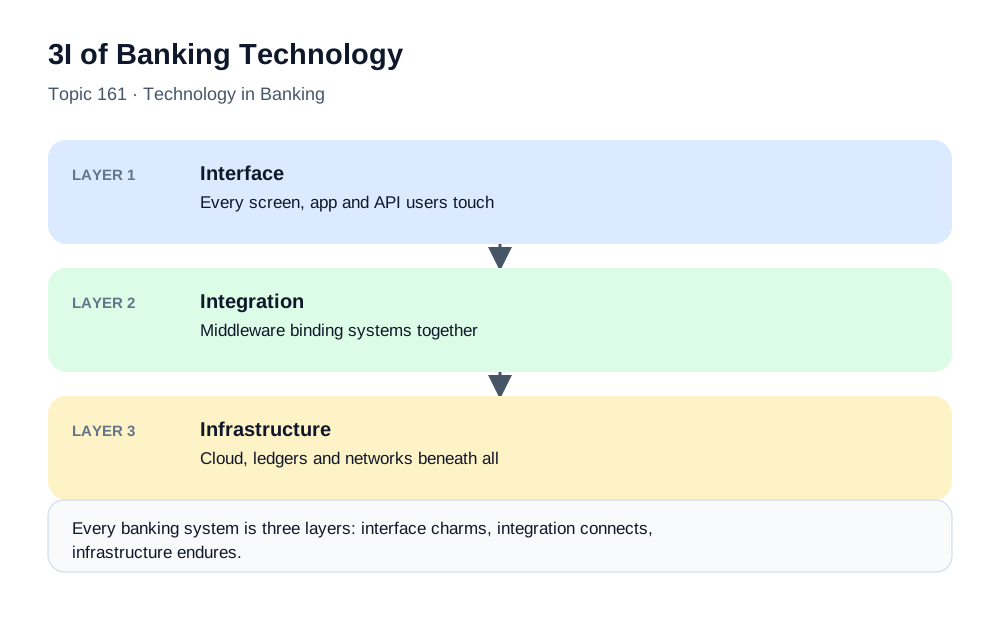
3I of Banking Technology at a glance — Interface, Integration, and Infrastructure — the three layers behind every banking system.
Interface, Integration, and Infrastructure — The Three Forces Behind Every Banking System
A customer opens a mobile banking app, selects a saved beneficiary, types an amount, and taps Send. Three seconds later, a green confirmation appears. From the customer's perspective, nothing more happened than a simple tap on a small screen. From a technology perspective, that single tap triggered a cascade of events across dozens of systems — events that involved user-facing screens, machine-to-machine communication, servers, databases, security controls, and networks spanning multiple countries. The customer saw one layer. The bank ran three. Understanding those three layers is the foundation of banking technology literacy, and the simplest way to understand them is through the framework known as the 3I of Banking Technology: Interface, Integration, and Infrastructure.
Many banking technology environments can be usefully examined through this lens, while recognising that real architectures also have product, data, security, governance and operating-model boundaries. Interface is everything a person or a system touches. Integration is everything that moves information from one place to another. Infrastructure is everything that keeps the first two working. These three layers are distinct from each other in the skills they demand, the vendors who serve them, and the ways they fail. They are analytical layers rather than a mandatory architecture, and the framework is most useful as a shared map for conversations about technology strategy, system design, project delivery and operational incidents.
Interface — The Surface Every User Touches
Interface is the layer where human beings and external systems meet the bank. When most people hear the word interface, they picture a mobile application with a clean design and smooth animations. That is a real and important interface, but it is only one of many that a bank operates simultaneously. The mobile banking application serves retail customers. The internet banking portal serves customers who prefer a browser. The ATM serves customers who need cash or a quick balance check. The branch teller's screen serves staff who are helping customers face to face. The call centre agent's screen serves staff resolving queries over the phone. The corporate banking portal serves treasury and finance teams at business customers who manage cash across multiple accounts and need multi-level approval workflows. The operations repair screen serves staff who fix payment exceptions. The reconciliation dashboard serves analysts who investigate breaks between what the bank instructed and what the clearing network settled. The API portal serves developers at fintech companies and corporate partners who want to integrate directly with the bank's systems.
Each of these is an interface. Each one has its own user experience design, its own security model, and its own set of requirements. The mobile app must load in under two seconds and present the most common actions one tap away. The teller screen must surface the customer's full relationship instantly so the teller can serve the next customer efficiently. The operations repair screen must present a failed payment message in human-readable form, highlight the specific field that failed, and offer the likely correction — because a skilled operator handling hundreds of repairs per shift saves or loses minutes per case that multiply into enormous cost. The corporate portal must support configurable approval workflows where a junior treasurer initiates a payment and a senior treasurer approves it before the bank releases it. None of these can be treated as afterthoughts. The interface is, for every user, the entire bank. Poor interface quality degrades customer trust, reduces staff throughput, increases operational error rates, and ultimately costs the bank more than any technology budget line.
Good interface design in banking is not about aesthetics. It is about whether the interface respects the user's time and reduces friction. A well-designed screen validates input as the user types, preventing invalid data from reaching downstream systems where it costs far more to fix. It shows clear status information throughout a transaction lifecycle — not a spinner that spins indefinitely, but a meaningful progression: Validating, Screening, Submitting, Confirmed. It surfaces the right information for the context the user is in, without burying critical details behind multiple tabs or requiring the user to remember information across screens. The cumulative difference between a good and a bad interface shows up in the bank's customer satisfaction scores, its staff retention, and its operational cost per transaction. Banks that invest in great customer interfaces while neglecting operational interfaces discover that customers are happy but internal teams are slow, error-prone, and expensive to run.
Integration — The Connective Tissue of Banking Systems
Integration is the second I, and it is the layer that most people outside banking technology have never heard of, even though it is where most operational complexity lives and where most incidents originate. Integration is everything that moves information from one place to another — inside the bank and between the bank and the outside world. When a customer taps Send on the mobile app, an API call carries the instruction from the mobile backend to the payment hub. The payment hub calls the fraud engine through another API. The fraud engine returns a risk score. The payment hub calls the sanctions screening service. The screening service returns a result. The payment hub posts an accounting entry to the general ledger. The instruction then routes outbound — through an internal messaging gateway — to an external network. For a domestic payment, it reaches the national real-time payment infrastructure. For a cross-border payment, it reaches the SWIFT network, formatted as an ISO 20022 message carrying structured data about the ordering customer, the beneficiary, the purpose, and the routing path. A status update flows back through the same chain. The notification service receives an event and pushes a message to the customer's phone.
Integration takes several forms that banks use in combination. Synchronous API calls are the real-time pattern where one system makes a request and waits for an immediate response — appropriate when the caller needs an answer before it can proceed, such as a fraud score before releasing a payment. Asynchronous messaging through queues and message brokers is the decoupled pattern where one system places a message on a queue, another picks it up and processes it in its own time — appropriate when resilience matters more than immediate response, and when the producer and consumer should not be tightly linked so that a failure in one does not bring down the other. Event streaming platforms like Apache Kafka carry a continuous flow of events from producers to any number of subscribed consumers, enabling real-time analytics, audit trails, and reactive systems that respond the moment something happens. File transfers remain in use for batch flows — a corporate customer's payroll file containing thousands of payment instructions uploads once and the payment hub processes them in sequence, which is efficient for large volumes that do not require individual real-time confirmation.
The patterns that govern how these forms are combined are as important as the forms themselves. Orchestration places one central system — typically the payment hub — in control of the sequence of calls, like a conductor directing an orchestra. The hub decides what to call, in what order, with what logic applied to the results. This pattern gives visibility and control but creates a single point where failures concentrate. Transformation is the work of converting data from one format to another at every boundary where two systems speak different languages — from the bank's internal canonical format to ISO 20022 for SWIFT payments, or from an incoming card message format to the bank's internal transaction record. A single cross-border payment may pass through four or five transformations on its outward journey and as many again on the return of the status update. End-to-end reference identifiers — unique codes attached to every instruction from the moment it enters the bank — must survive every transformation intact so that the payment can be located, tracked, and reconciled at any point in its lifecycle by any system in the chain.
Weak integration is one of the most costly conditions a bank can live with. Payments get stuck between systems with no alarm. Statuses fail to propagate, leaving customers seeing a pending transaction that has already settled. Data becomes inconsistent between systems, so the customer sees one balance on the mobile app and the operations team sees a different one on their screen. Reconciliation breaks accumulate because systems have lost the shared identifiers that would allow automatic matching. Every break becomes a manual investigation. Every investigation is a cost. Every escalation is a customer complaint. Banks with strong integration platforms run high straight-through processing rates — meaning payments flow from initiation to settlement without any human touch — and the cost per payment is measured in fractions of a cent. Banks with weak integration run high manual intervention rates, and the cost per payment grows accordingly. Integration strength is invisible to customers but completely visible in operating cost, regulatory compliance quality, and the speed at which the bank can launch new products or onboard new partners.
Infrastructure — The Foundation Everything Stands On
Infrastructure is the third I, and it is the layer that everything else depends on. It is the servers that run applications, the databases that store every account record and every transaction, the networks that carry traffic between systems and between the bank and the outside world, the cloud platforms that provide elastic capacity, the middleware platforms that host the message brokers and event streaming systems that integration depends on, the API gateways that sit at the bank's perimeter and handle authentication and rate limiting for every inbound API call, the monitoring tools that watch every system in real time, the log aggregation platforms that collect every line of every application's output for forensic investigation and regulatory audit, the security controls that protect data in motion and at rest, the backup systems that capture the state of every critical system on a schedule tight enough that data loss can be bounded, and the disaster recovery sites that stand ready to take over operations if a primary data centre fails.
Modern bank infrastructure is almost always hybrid. Core banking systems may run on traditional servers in the bank's own data centres, protected by the bank's own staff and subject to the bank's own change management processes. Public-facing digital channels — mobile backends, internet banking platforms, API gateways — may run on public cloud platforms where auto-scaling absorbs traffic spikes without manual intervention. Regulatory data sovereignty rules in many jurisdictions require that certain categories of customer data remain within specific geographic boundaries, so the cloud strategy must account for where data lives and where processing occurs. The mix is not arbitrary; it reflects regulatory requirements, latency needs, vendor capabilities, and strategic decisions about what the bank wants to operate itself and what it wants to delegate to specialist providers.
Database infrastructure is among the most critical in the environment. A bank's data estate normally includes authoritative systems of record for accounts and transactions, alongside product, reporting, analytics and operational stores that must be reconciled. Some critical paths use clustered databases and synchronous or quorum-based replication, while others use asynchronous replication, queues or journal reconstruction depending on recovery objectives and workload. No replication pattern removes the need for backups, recovery testing, reconciliation and evidence. End-of-day processing, interest calculations, asset classifications and regulatory reporting may use separate services or data products, so teams must define lineage and cut-off rules rather than assume one database is the source for everything.
Monitoring is what separates a bank that discovers problems from customer complaints from a bank that discovers them before customers notice. Every application server, every message queue, every database node, every network link publishes metrics continuously — transaction volumes, processing latencies, error rates, queue depths, CPU utilisation, memory pressure. These metrics flow into time-series databases where alerting rules compare them against configured thresholds and page operations staff the moment something drifts out of range. Log aggregation platforms ingest every application log line and make them searchable in seconds — essential when an incident is active and the team needs to trace exactly what happened across a dozen systems simultaneously. Distributed tracing attaches a unique identifier to each request as it enters the system and carries it across every service the request touches, so that the team can reconstruct the complete journey of any individual transaction in near real time. A bank with excellent monitoring detects incidents in seconds and begins recovery in minutes. A bank with poor monitoring detects incidents when the phone starts ringing.
Security infrastructure is layered by design. Firewalls at the perimeter block traffic that should never reach internal systems. Intrusion detection systems watch for patterns that suggest an attacker is probing or moving through the network. Identity and access management systems govern who can log in to what, enforcing the principle that every person and every service account should have access only to the specific things they need for their specific role. Encryption protects data in motion on every network connection using transport layer security, and protects data at rest in databases and storage so that physical access to a drive or a backup tape yields nothing without the corresponding keys. Secrets management systems store the credentials and API keys that services use to authenticate to each other, rotating them on schedules and preventing them from appearing in application code or configuration files where they could be exposed. The security operations centre runs around the clock, staffed by analysts watching for threats and ready to activate incident response procedures when something is detected. Security is not a single control; it is a discipline of overlapping layers, each of which provides protection when the layers around it fail.
How the Three Work Together
The 3I layers are designed separately but operate as one. Consider a corporate customer uploading a payroll file containing two hundred employee salary payments through the corporate banking portal. The interface — the upload page — validates the file format, displays a summary for confirmation, and submits the file on approval. Integration carries the file from the portal to the payment hub through a queue, using durable delivery, deduplication and idempotent processing so a restart does not create duplicate financial effects. The hub parses the file into two hundred individual instructions, calls the limit engine, fraud engine and sanctions-screening service through API integrations, posts accounting entries to the general ledger, routes domestic payments through the national clearing gateway and cross-border payments through the SWIFT gateway with ISO 20022 message formatting, and publishes status events for every outcome. The portal, subscribed to those events, updates each payment's status in real time. The reconciliation system receives parallel feeds from the hub's internal records and from clearing-network confirmations, matching on an end-to-end reference that should survive every transformation. Infrastructure supports every step: the servers, data stores, networks, brokers, monitoring and recovery controls all need evidence that the payroll run was processed correctly.
When any of the three layers is weak, the failure shows up in the other two. Weak interface produces bad input that reaches integration as invalid or malformed data, causing downstream rejections and repairs that the operations team handles manually. Weak integration produces lost messages, inconsistent statuses, and reconciliation breaks that the reconciliation system flags and that analysts investigate at cost. Weak infrastructure produces slowness, outages, and timeouts that degrade every interface response and cause integration calls to fail, triggering retry cascades that amplify the load on systems already under stress. The failure modes of each layer look different and require different skills to diagnose and resolve, which is why the 3I framework is useful — it gives the team a shared language for identifying which layer a problem is in before investing in a solution.
Why Every Banking Professional Needs to Understand All Three
A business analyst who understands the 3I framework gathers requirements that cover all three layers: the experience the interface must deliver, the information flows that integration must carry, and the availability and performance targets that infrastructure must meet. An architect who understands it designs channels that share downstream services through well-defined integration boundaries, and chooses infrastructure patterns — redundancy, failover, circuit breakers, retry policies — that make the integration resilient when components fail. A developer who understands it writes code that validates at the interface boundary, honours integration contracts precisely, logs at every integration point with enough detail to trace any transaction, and emits the metrics that monitoring depends on. A tester who understands it verifies not just the happy path but every timeout, every rejection, every status update from every downstream system, and every recovery scenario from every infrastructure failure. An operations team that understands it watches dashboards that cover all three layers, maintains repair screens that resolve integration exceptions efficiently, and runs incident processes that identify which layer caused the problem before escalating.
Management that understands the 3I framework allocates capital across all three rather than concentrating investment in the most visible layer. The mobile application is the most visible part of the interface layer, and there is always pressure to add features and refresh designs. That pressure is legitimate. But it must not crowd out investment in integration strength — which is harder to demonstrate in a product demo but which determines the bank's operational cost, regulatory compliance quality, and ability to launch new products rapidly. And it must not crowd out infrastructure reliability — which is the least glamorous investment of all but which is what stands between the bank and an incident that makes national news. The 3I framework makes this balance visible. It gives leaders a way to see all three layers equally clearly and to ask the right questions about each: where are the weaknesses, what are the risks, what would it cost if this layer failed, and what would it cost to make it stronger?
The 3I of Banking Technology is not an advanced concept for senior architects. It is a foundational lens that every banking professional benefits from understanding early in their career. Every transaction a customer makes, every payment a business submits, every regulatory report a compliance team files, every risk a credit committee reviews — all of it moves through an interface, through integration, and on top of infrastructure. Seeing all three layers clearly is the difference between understanding the bank as the customer sees it — a screen, a tap, a confirmation — and understanding the bank as it actually is: a system of systems, held together by the 3I.
The 3I at a Glance
| Characteristic | Interface | Integration | Infrastructure |
|---|---|---|---|
| Essence | Visible interaction layer | Movement and coordination layer | Stability and reliability layer |
| Customer Channels | Mobile, Internet, ATM, Corporate Portal | — | — |
| Staff Screens | Branch Teller, Call Centre, Manager Dashboard | — | — |
| Operational Tools | Repair Queues, Investigation Screens, Reconciliation Dashboards | — | — |
| System APIs | Open Banking, Partner, Regulator Submission APIs | — | — |
| File Interfaces | Bulk Payment Upload, Statement Download, Regulatory File Delivery | — | — |
| Mechanisms | — | Files, Messages, APIs, Events, Queues | — |
| Patterns | — | Orchestration, Choreography, Transformation, Routing | — |
| Inbound Flows | — | Channel to Core, Channel to Payment Hub, Partner API Ingestion | — |
| Outbound Flows | — | Clearing Networks, Correspondent Banks, Card Networks, Real-Time Rails | — |
| Reconciliation and Status | — | End-to-End References, Acknowledgements, Return Flows, Dispute Trails | — |
| Compute and Data | — | — | Application Servers, Database Clusters, Storage Tiers, Log Platforms |
| Networks and Connectivity | — | — | Data Centre Fabric, Leased Lines, Cloud Interconnects, Internet Edge |
| Middleware Platforms | — | — | Message Brokers, API Gateways, Event Streaming Platforms, Transformation Engines |
| Security and Identity | — | — | Firewalls, Access Management, Encryption, Security Operations Centre |
| Resilience and Recovery | — | — | High Availability Clusters, Disaster Recovery Sites, Backup Systems, Capacity Planning |
| Failure Modes | Confusing Screens, Weak Validation, Hidden Status | Stuck Payments, Missing Statuses, Broken References, Manual Workarounds | Outage, Latency Spikes, Queue Buildup, Security Exposure |
| Cross-Pillar Relationships | Captures and Submits · Returns Status To | Runs On · Carries Traffic For | Sustains |
| Role Lenses | Developer, Tester, Management | Business Analyst, Developer, Tester, Operations, Management | Architect, Developer, Tester, Operations, Management |
| Payment Lifecycle | Validate, Confirm | Screen, Route, Reconcile | Post, Settle |
3I Banking Technology Deepening — Architecture Boundaries, Transaction Integrity, Resilience, Security, and Change
The 3I framework becomes powerful when every requirement has an owner in each layer
A banking feature is rarely complete because a screen exists. A payment beneficiary feature, for example, needs an interface that captures and confirms beneficiary data, integrations that validate and distribute it, and infrastructure that stores, protects, observes, and recovers the service. Requirements should therefore ask three questions every time: what does the user or calling system experience, what information must move between components, and what platform capability keeps the journey available and trustworthy? This prevents teams from discovering non-functional and integration requirements only after development begins.
Interface includes machine-facing contracts as well as human screens
A corporate API is an interface even when no person sees it. So is a file format, command-line operations tool, event subscription, or regulatory submission endpoint. The defining characteristic is that the interface forms a boundary where one actor interacts with a capability. Good interface design therefore includes schemas, validation, error semantics, versioning, entitlements, rate limits, and documentation for machine consumers alongside accessibility, navigation, and clarity for human users.
Human interface design should expose financial state, not technical state
Customers do not benefit from messages such as “HTTP 500” or “downstream timeout.” They need to know whether money moved, whether an instruction can be retried, and what action is safe. Operations staff need more technical detail, but even their screens should translate distributed-system state into banking meaning. A successful interface separates customer truth, operational diagnosis, and engineering telemetry while keeping them connected through a common transaction reference.
Interface validation should reject what can never be valid and preserve what downstream systems need
Early validation reduces repair cost, but aggressive front-end simplification can damage data. Names, addresses, identifiers, remittance information, business references, and regulatory fields may need characters or lengths unfamiliar to a local channel. The interface should validate against the applicable business contract rather than arbitrary screen assumptions. Data that is optional for one product should not be discarded if another downstream process needs it.
Accessibility is a banking capability
Customers and staff may use screen readers, keyboard navigation, enlarged text, high contrast, alternative input, or assisted channels. Accessibility affects authentication, payments, disclosures, dispute handling, and onboarding, not only page layout. Interface standards should include accessibility in definition of done and regression testing. A compliant backend cannot compensate for a critical financial action that some customers cannot physically complete.
Operational interfaces deserve the same design discipline as customer apps
Repair, investigation, reconciliation, fraud, sanctions, treasury, and support screens are often built for expert users under time pressure. Good operational UX can reduce financial loss by making reason, amount, account, timestamps, status, evidence, and allowed actions visible together. Dangerous operations should require appropriate authority and make consequences clear. A cluttered repair screen can create duplicate payments or incorrect releases just as easily as a customer-facing defect.
Integration architecture should begin with ownership of business state
When several services hold copies of a transaction, the bank needs to know which system is authoritative for instruction, customer balance, screening result, settlement status, and reporting state. “System of record” should be defined by data domain rather than used as a vague label. Other systems can cache or project the data, but conflict resolution must follow explicit ownership. Otherwise teams spend incidents arguing about which database is correct.
A canonical model can reduce coupling but should not erase scheme meaning
Banks often translate channel or network messages into an internal representation so multiple systems do not need to understand every external format. This can simplify integration, but a canonical model should preserve information needed for legal, regulatory, routing, reconciliation, and customer purposes. Flattening rich structured data into generic text can make future transformation impossible. Canonicalisation should remove unnecessary variation, not meaningful semantics.
Transformation is a controlled business process
Changing an external message into an internal model and then into another network format can alter code sets, names, addresses, identifiers, dates, amounts, and references. Every mapping should define source field, target field, transformation rule, default behaviour, validation, truncation policy, and exception path. Silent truncation is particularly dangerous because the message may remain technically valid while losing information important for screening or reconciliation.
Integration contracts should define failure as carefully as success
An API specification that documents only a 200 response is incomplete. Banking integrations need business rejects, technical failures, timeouts, duplicate requests, authorization failures, unavailable dependencies, partial completion, and retry rules. Consumers should know whether an error means “nothing happened,” “the request was rejected,” or “outcome unknown.” Those states drive very different financial behaviour.
Timeouts create uncertainty rather than proving failure
If a service times out after submitting a payment to a downstream system, the downstream may already have accepted it. Automatically retrying can create a duplicate unless the integration is idempotent. The caller should retain the request reference, query authoritative state where possible, and retry using a mechanism that the receiver can recognise as the same logical instruction. This is a fundamental difference between ordinary application errors and financial transaction processing.
Idempotency belongs in the business contract
A technical request identifier alone may not be enough if different channels can submit the same business instruction. The architecture should define the idempotency scope, key, retention period, and returned result. Duplicate detection should not incorrectly block legitimate repeated transactions that happen to have the same amount and beneficiary. Good design distinguishes repeated transport from repeated customer intent.
Event-driven architecture needs event ownership and semantic versioning
Publishing an event such as PaymentCompleted sounds simple, but consumers need to know what “completed” means, which entity owns the fact, what fields are guaranteed, whether events can arrive late or twice, and how corrections are represented. Events are long-lived contracts. Adding fields is often safer than changing meaning. If semantic behaviour changes, producers and consumers need a migration strategy rather than an undocumented release note.
Event order should never be assumed without proof
Distributed systems can deliver events out of order because of partitioning, retry, concurrency, or recovery. A status consumer should not blindly replace “settled” with a late “processing” event. Messages should include version, event time, sequence, or other business ordering information where required. State-transition validation protects downstream systems from stale updates.
Exactly-once processing is often an outcome built from several controls
Messaging platforms may offer delivery guarantees, but the financial outcome still depends on consumer logic, database transactions, idempotency, acknowledgement timing, and external side effects. A service can consume one message once and still create two downstream payments if it retries after an uncertain response. Teams should define exactly which business effect must occur once and test failure at every step around it.
Queue depth is a business-risk indicator
A growing message queue may mean payments, reports, notifications, fraud checks, or reconciliations are delayed. Infrastructure monitoring should translate technical backlog into oldest-message age, affected transaction count, value, customer impact, and deadline risk. Operations can then prioritise based on banking consequence rather than CPU charts. Queue recovery should also control surge load so downstream services are not overwhelmed when the backlog drains.
Batch files remain first-class banking integrations
Payroll, statements, regulatory data, clearing, reconciliation, and corporate payments can still use files because the pattern efficiently moves large datasets with predictable controls. File integration requires naming, encryption, signing, transmission, duplicate control, completeness checks, record counts, control totals, acknowledgement, archival, and replay rules. “Legacy file” should not mean uncontrolled file. Some batch flows are intentionally optimal for their business purpose.
File arrival and business date are different concepts
A file received after midnight may belong to the previous processing date; a file received early may be future-dated. Systems should use scheme and business calendars rather than server date alone. Cut-offs, holidays, time zones, daylight-saving changes, and retry can affect routing. Batch orchestration should make effective business date visible and test boundary conditions explicitly.
Integration security should authenticate workloads as strongly as users
Services, queues, APIs, databases, and file gateways need machine identities with least privilege. Shared long-lived credentials make accountability weak and rotation difficult. Certificates, workload identities, short-lived tokens, managed secrets, and mutual authentication can improve assurance depending on architecture. Every integration should answer: which workload is calling, what is it allowed to do, and how can its access be revoked?
Infrastructure is a service model, not a list of servers
Compute, storage, database, network, identity, secrets, monitoring, backup, recovery, and deployment capability together create a platform on which banking applications operate. Teams should define service levels and control responsibilities for each layer. Whether hardware is on premises or in public cloud does not remove the need for capacity, patching, access, resilience, and recovery. Cloud changes how responsibility is shared, not whether responsibility exists.
Shared responsibility should be mapped for every cloud service
With infrastructure-as-a-service, the bank may manage operating systems and much of the security stack; with managed databases or software services, the provider manages more. The bank remains responsible for configuration, identities, data, entitlements, integration, monitoring, and regulatory obligations within its role. Architecture documentation should state who patches what, who backs up what, who controls encryption keys, and who responds to an incident.
Availability should be measured across the customer journey
A mobile application server can be healthy while authentication, fraud, core banking, payment gateway, or notification is unavailable. Service-level objectives should therefore reflect critical journeys such as login, balance, card authorisation, or payment submission. Component uptime is useful engineering telemetry but can overstate real customer availability. Synthetic transactions and distributed tracing help measure the service end to end.
Resilience is the ability to continue or recover safely, not simply to stay online
A degraded service that posts incorrect balances is worse than a controlled outage. For each dependency, teams should decide whether to retry, queue, degrade, fail closed, use cached data, or stop processing. The correct choice depends on financial risk. A marketing preference service can fail open; a sanctions, entitlement, or accounting control may not be safely bypassed. Resilience design should preserve integrity before convenience.
Circuit breakers protect systems but need business-aware fallbacks
When a dependency repeatedly fails, a circuit breaker can prevent endless calls that worsen the outage. The user and upstream workflow still need a defined outcome. Read-only data may use a recent cache with a clear timestamp; a payment decision may enter pending state; a critical validation may reject or hold. Infrastructure patterns become safe only when product and risk teams define the business fallback.
Retry storms can turn a small failure into a major outage
If thousands of clients retry immediately after a timeout, recovering services can be overloaded before they stabilise. Exponential backoff, jitter, queueing, rate limits, and central retry control can reduce amplification. Mobile clients should not each implement aggressive retry independently. Incident engineering should estimate worst-case retry volume as part of capacity testing.
Capacity planning should include business peaks and recovery peaks
Salary dates, tax deadlines, market events, holidays, government benefits, product launches, and crisis periods can increase load. Backlog recovery after downtime can create an even larger peak. Capacity testing should include normal growth, burst traffic, degraded dependencies, security controls, and message drain. Scaling only the front-end tier does little if a database, fraud engine, or external network is the bottleneck.
Database consistency requirements should follow the financial record
Not every data field requires the same consistency. Customer preferences can often tolerate eventual consistency; available balance and posting state may require stronger transactional guarantees. Architects should identify invariants such as total debits and credits, uniqueness, limit consumption, and state transitions. Choosing a distributed database because it scales well is incomplete without deciding how financial invariants are preserved.
Ledger design should separate accounting truth from workflow convenience
A payment workflow may move through many statuses while the accounting ledger records actual financial postings. Systems should not rewrite historical entries to make current state easier to query. Reversals and adjustments should preserve audit history. A clear boundary between transaction workflow and ledger accounting helps reconciliation and explains why a “cancelled” payment can still have related financial entries.
Time is data in a banking system
Event time, booking time, value date, settlement date, business date, posting date, and customer-visible timestamp can differ. Systems should store the relevant concepts explicitly and use controlled time sources. Time-zone conversion should occur at presentation or well-defined boundaries, not through ambiguous local server settings. Incident reconstruction is nearly impossible when services disagree about time.
Clock synchronisation supports security and reconciliation
Authentication tokens, certificates, event ordering, log correlation, settlement windows, and forensic evidence all depend on reliable time. Infrastructure should use managed synchronisation and monitor drift. A few minutes of clock error can make valid tokens fail or cause events to appear in impossible order. Time service is therefore a critical infrastructure dependency even though customers never see it.
Observability should connect metrics, logs, traces, and business events
Metrics show patterns, logs explain local behaviour, distributed traces show a request path, and business events show what happened to the financial instruction. Together they let teams answer whether an incident is infrastructure saturation, application defect, integration timeout, or business rejection. Observability standards should define correlation IDs, safe logging, retention, access, sampling, and key business metrics.
Logging should never become a shadow database of sensitive information
Detailed debugging can accidentally capture passwords, tokens, account numbers, card data, customer documents, message payloads, or cryptographic secrets. Logging standards should define masking and prohibited fields. Engineers should be able to trace an instruction through safe identifiers rather than search by personal information. Central log platforms require strong access controls because their breadth makes them attractive targets.
Alerting should be designed around actionability
Thousands of low-quality alerts create fatigue. Every production alert should have an owner, severity rationale, threshold, runbook, and expected action. Alerts can combine technical and business conditions: a small error rate may be critical if it affects high-value settlement, while a large volume of harmless retries may be lower priority. Tuning should be part of steady-state operations, not a one-time launch task.
Reconciliation is the control that proves integration truth
Even with APIs, queues, events, and distributed traces, independent records can diverge. Reconciliation compares what one system believes happened with another authoritative record. It can match customer instruction to booking, booking to outbound message, clearing result to settlement account, and ledger to reporting. Architecture should design stable identifiers and extractable data for reconciliation from the start.
Suspense accounts are controlled uncertainty, not a dumping ground
When money cannot immediately be allocated, accounting may use suspense or control accounts. Each item should carry reference, origin, amount, currency, age, reason, owner, and expected resolution path. Ageing and reconciliation prevent unresolved items from accumulating invisibly. Infrastructure and integration defects often surface financially through suspense balances, making them a valuable operational signal.
Security should operate across all three layers
Interface security includes safe authentication, authorization presentation, session handling, and customer warnings. Integration security includes service identity, API authorization, message integrity, secret management, and network controls. Infrastructure security includes hardening, segmentation, patching, vulnerability management, privileged access, monitoring, and recovery. Treating security as one gateway at the perimeter leaves internal pathways unprotected.
Zero-trust principles fit banking when implemented pragmatically
Networks should not grant broad trust simply because a workload is “inside.” Identity, least privilege, strong authentication, policy enforcement, device or workload context, and continuous monitoring can reduce lateral movement. Implementation should reflect legacy systems and operational reality. A zero-trust programme succeeds by shrinking unnecessary trust relationships, not by purchasing a product with that label.
Secrets lifecycle should be automated wherever possible
Passwords, keys, certificates, and tokens expire, leak, and outlive staff. Central secret stores, controlled issuance, rotation, inventory, ownership, and emergency revocation reduce dependency on manual spreadsheets. Applications should retrieve secrets at runtime rather than store them in source code. Certificate expiry has caused major banking outages, so lifecycle monitoring is both security and availability management.
Cryptographic key ownership should match business responsibility
Payment signing, data encryption, tokenisation, customer authentication, and infrastructure TLS can use different keys with different consequences. Keys should have owners, usage restrictions, rotation, backup, dual control where appropriate, and disaster-recovery arrangements. Losing a key can make data inaccessible; exposing it can undermine trust. HSMs and managed key services are tools inside a wider governance process.
Privileged access is an operational capability that needs emergency design
Production incidents sometimes require elevated access. The bank should provide controlled break-glass mechanisms with strong authentication, approval, limited duration, session recording or logging as appropriate, and post-use review. Engineers should not maintain permanent administrator rights “just in case.” Emergency access works best when it is tested before an emergency.
Change management should recognise that interface, integration, and infrastructure releases interact
A harmless-looking API field change can break a channel; a database patch can change latency; a firewall rule can interrupt settlement; a new mobile version can increase authentication load. Release plans should map dependencies and compatibility. Backward-compatible contracts and progressive rollout reduce risk, but critical banking changes still require end-to-end testing and clear rollback or forward-recovery plans.
Feature flags can separate deployment from activation
Code can be deployed safely while a feature remains disabled until downstream systems, operations, and business teams are ready. Activation can then be limited to a cohort or percentage. Feature flags themselves need governance: stale flags create complexity, security-sensitive flags need access control, and activating a feature can be as material as deploying code. Audit history should show who changed critical flags and when.
Database migrations need compatibility across rolling releases
If old and new application versions run simultaneously, schema changes must support both until the rollout is complete. Destructive changes should occur only after consumers have migrated. Backfills need capacity planning and reconciliation. A deployment pipeline that treats database migration as one command can create long outages on large banking tables.
Disaster recovery should prove business recoverability
Replicating servers to another region or data centre does not prove the bank can resume service. DR testing should validate identity, keys, DNS, network routes, databases, queues, external connectivity, payment certificates, vendors, batch schedules, reconciliation, and user access. Recovery-point and recovery-time objectives should be measured using actual end-to-end services. The first real disaster should not be the first time the complete stack is started elsewhere.
Backups should be tested for restore and protected from attackers
A backup that has never been restored is only an assumption. Banks should verify restore procedures, integrity, encryption, retention, and access. Ransomware resilience may require immutable or isolated copies and credentials separate from production. Recovery plans should identify which data must be restored consistently together so ledger, transaction, and reference data do not return to incompatible points in time.
Active-active design introduces consistency questions
Running in multiple locations simultaneously can improve availability, but it requires careful handling of data replication, transaction ordering, failover, duplicate processing, and external routing. Some workloads are easier to run active-active than core ledgers. Architecture should choose resilience patterns by business requirement rather than assuming the most distributed design is always superior.
Legacy systems can remain safe when boundaries are explicit
A mainframe or older core is not automatically risky because of age. Risk comes from unsupported software, scarce skills, hidden dependencies, weak interfaces, poor observability, manual deployment, or security limitations. Modern APIs and event layers can expose stable capabilities while migration proceeds gradually. Replacement should have a business case and risk strategy, not be driven solely by the word “legacy.”
Strangler migration reduces all-or-nothing transformation risk
New capabilities can be built around an existing core, gradually moving functions behind controlled interfaces until old components can be retired. This requires precise routing and data ownership so two systems do not both become authoritative. The migration architecture should include reconciliation and rollback between old and new paths. Incremental change is safer only when coexistence is governed.
Technical debt should be expressed in banking consequences
A duplicated integration may increase reconciliation breaks; an unsupported library may increase cyber exposure; manual deployment may lengthen recovery; an undocumented batch may risk regulatory reporting. Translating technical debt into customer, financial, operational, regulatory, or resilience risk helps management prioritise. “Old code” alone is not a useful risk measure.
Vendor products should fit the bank’s architecture rather than redefine it accidentally
A payment hub, core, fraud engine, cloud service, or SaaS platform can provide strong capability, but its data model, workflow, release cycle, and integration pattern may become a de facto architecture. Banks should understand extension points, portability, data ownership, exit, resilience, and contractual dependencies before deep adoption. Procurement should include architecture and operational requirements, not only feature comparisons.
Outsourcing does not outsource end-to-end accountability
A cloud or software provider may operate infrastructure or application components, but the bank remains responsible for customer service and applicable obligations. Monitoring should include provider performance, incidents, capacity, security notifications, data location, subcontractors, and recovery. Contracts should support information and assistance during incidents. The bank should know how to continue or exit if the service becomes unavailable.
Cost optimisation should preserve reliability and control
Cloud scale-down, log-retention reduction, database tier changes, or removal of redundant links can save money while quietly weakening resilience. FinOps and architecture teams should understand the service’s criticality before optimising. Unit-cost metrics are useful when paired with availability, latency, error rate, recovery, and customer-impact measures. Cheapest infrastructure is not the objective; controlled cost for required service is.
Technology metrics should lead to banking outcomes
Deployment frequency, CPU, latency, and defect counts are useful, but leadership also needs straight-through processing, payment exception rate, reconciliation breaks, account-opening completion, fraud loss, customer-visible downtime, recovery time, and manual interventions. Linking technical measures to business outcomes creates shared accountability across product, operations, and engineering.
Architecture decisions should have explicit trade-offs
Synchronous calls offer immediate answers but create runtime dependency. Events improve decoupling but complicate eventual consistency. Central orchestration gives control but can become a bottleneck. Choreography improves autonomy but can make end-to-end state harder to see. Public cloud increases elasticity but changes dependency and governance. Good architecture does not pretend trade-offs disappear; it records why one was accepted for a particular banking journey.
Scenario: fraud service becomes unavailable during instant-payment peak
The interface keeps receiving payment requests, but the orchestration layer recognises that a mandatory fraud decision is unavailable. Rather than bypassing the control, high-risk transactions enter a controlled pending or unavailable state according to policy, customers receive an accurate message, retries are paced, and monitoring shows queue value and age. Once the service recovers, processing resumes without duplicate payments. Interface, integration, and infrastructure behaviour were designed together.
Scenario: a Kafka consumer reprocesses events after recovery
A reconciliation consumer restarts from an earlier offset and sees some settlement events again. Idempotent processing recognises already-applied business event IDs and does not create duplicate reconciliation records. Metrics show duplicate deliveries but zero duplicate financial effects. The platform guarantee and application guarantee together produce the required outcome.
Scenario: a database region fails during card authorisation
Traffic shifts to the surviving architecture according to the tested resilience design. The bank preserves authorization limits and customer balance integrity rather than serving stale data indiscriminately. Operations observe the failover through synthetic transactions and business metrics. After restoration, data is reconciled before the failed region resumes full participation.
Business analysts should ask the 3I questions for every failure mode
For each journey, define what the user sees, which systems exchange what data, which component owns each state, what happens if a dependency times out, what infrastructure target applies, how the event is monitored, what operations can do, and how financial records reconcile. These questions turn vague non-functional requirements into concrete acceptance criteria.
Architects should treat banking integrity as a cross-layer invariant
The architecture should preserve authentication, authorization, uniqueness, amount, currency, customer ownership, state progression, accounting balance, traceability, and evidence regardless of how many components participate. No microservice boundary should make those responsibilities disappear. Technology patterns are valuable only when the bank’s financial invariants remain true.
Testers should inject controlled failure across all three layers
Test invalid interface input, duplicate clicks, API timeout, queue delay, out-of-order event, database failover, certificate expiry simulation, vendor outage, retry storm, partial batch, corrupted file, slow fraud response, region failure, and recovery. Then verify customer status, financial postings, audit trail, reconciliation, and operational alerts. Resilience testing should prove that the bank fails safely, not merely that services restart.
Operations should own the live service, not just react to tickets
Service ownership includes dashboards, alerts, runbooks, capacity, known errors, change calendar, vendor escalation, incident command, problem management, and continuous improvement. Incidents should produce root-cause and corrective actions across the relevant I rather than a temporary restart. Repeated manual recovery is evidence that architecture or automation still needs work.
Closing perspective
Interface, Integration, and Infrastructure form a useful mental model because they force banking technology to be viewed from the person or system using a service, the movement and transformation of financial information, and the platform that keeps the whole chain trustworthy. The deepest lesson is that the three layers cannot be optimised independently. A beautiful interface built on ambiguous state, a modern integration layer built on weak ledgers, or resilient infrastructure supporting unsafe business logic will still fail the customer. Bank-grade technology aligns all three around financial integrity, explainable state, security, resilience, and recoverability.
<!-- MBA-DEEP-DIVE-END -->