Visual overview
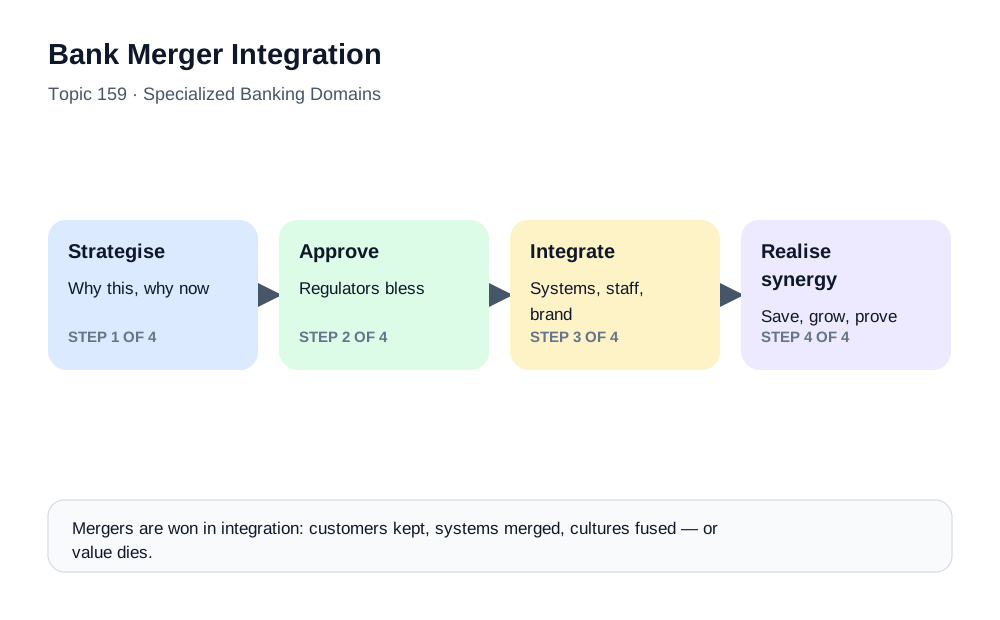
Bank Merger Integration at a glance — M&A in banking, integration planning, synergy realization.
M&A in Banking, Integration Planning, Core Migration, Customer Continuity, and Synergy Realisation
A bank merger is not only a corporate transaction. It is the joining of customer accounts, deposits, loans, cards, branches, employees, licenses, risk models, regulatory reports, payment connections, treasury positions, legal entities, vendor contracts, data warehouses, mobile apps, and core banking systems.
In many industries, a merger can be messy without immediately harming the public. In banking, customers still need salary credits, card payments, ATM withdrawals, loan EMIs, trade payments, mobile banking, branch access, and deposit safety during the transition. A badly executed merger can create customer disruption, regulatory findings, operational losses, employee uncertainty, technology outages, and reputational damage.
This chapter explains bank merger integration from a practical banking perspective: why banks merge, how integration is planned, what happens to customers and branches, why core banking migration is difficult, how risk and compliance are combined, and how banks measure whether the merger actually created value.
Learning objectives
By the end of this chapter, you should be able to:
- Explain why banks merge or acquire other banks.
- Understand merger types: consolidation, absorption, resolution merger, cross-border acquisition, and capability acquisition.
- Describe the main phases of bank merger integration.
- Identify integration workstreams across customers, branches, people, technology, risk, finance, treasury, operations, and compliance.
- Explain why core banking migration and data mapping are high-risk activities.
- Understand customer impact around account numbers, IFSC/sort codes, cards, loans, digital channels, mandates, and statements.
- Identify merger risks such as service disruption, data loss, culture clash, NPA surprises, regulatory gaps, and synergy failure.
- Explain how merger success is measured after legal completion.
1. What Bank Merger Integration Means
Bank merger integration is the process of combining two banking organisations after a merger or acquisition decision.
It may include:
- legal entity merger;
- regulatory approvals;
- branch network rationalisation;
- product harmonisation;
- customer communication;
- employee integration;
- core banking migration;
- digital channel consolidation;
- payment system integration;
- treasury and ALM integration;
- risk policy alignment;
- finance and reporting consolidation;
- vendor and contract integration;
- brand transition;
- synergy tracking.
The legal merger date is only one milestone. Real integration often continues for months or years.
2. Why Banks Merge
Banks may merge for several reasons.
| Reason | Meaning |
|---|---|
| Scale | Larger balance sheet, customer base, and transaction volume |
| Cost efficiency | Reduce duplicate branches, systems, vendors, and support functions |
| Geographic expansion | Enter new markets quickly |
| Capital strength | Create stronger institution with better lending capacity |
| Technology uplift | Move weaker bank customers to stronger platforms |
| Product expansion | Add cards, wealth, treasury, SME, digital, or corporate capability |
| Resolution | Protect depositors by moving weak bank into stronger institution |
| Competitive pressure | Build size to compete with large domestic or global banks |
| Diversification | Reduce dependence on one geography, segment, or product |
| Government or regulator policy | Strengthen banking system through consolidation |
A merger should not be judged only by size. The real question is whether the combined bank becomes safer, more efficient, more customer-friendly, and more profitable.
3. Types of Bank Mergers
| Type | Description | Example situation |
|---|---|---|
| Consolidation merger | Two or more banks combine into a larger institution | Regional banks combine for scale |
| Absorption | One bank absorbs another bank | Large bank takes over smaller bank |
| Resolution merger | Weak or failing bank is merged into stronger bank | Regulator protects depositors and continuity |
| Cross-border acquisition | Foreign bank acquires or merges with local bank | Global bank enters domestic market |
| Capability acquisition | Bank buys fintech or specialised business | Bank acquires digital lending or payments capability |
| Branch or portfolio acquisition | Bank buys selected assets, branches, or customer portfolios | Purchase of credit card portfolio or branch network |
Each type has different risk. A healthy strategic merger is different from a distressed resolution merger where asset quality and confidence may be urgent concerns.
4. Regulatory Approval
Bank mergers require strong regulatory review because banks are systemically important.
Regulators may assess:
- depositor protection;
- financial stability;
- capital adequacy;
- liquidity position;
- asset quality;
- governance and management fitness;
- competition impact;
- customer continuity;
- branch access;
- technology migration plan;
- operational resilience;
- anti-money-laundering controls;
- cross-border supervisory coordination;
- resolution implications.
The exact approval path depends on jurisdiction, ownership type, listed status, public-sector involvement, and transaction structure.
5. Integration Phases
A bank merger usually moves through phases.
| Phase | Main focus |
|---|---|
| Strategy and due diligence | Understand financials, risks, systems, customers, contracts, culture |
| Deal approval | Board, shareholder, regulator, government, or court approvals where needed |
| Integration planning | Define target operating model, workstreams, milestones, risks, and governance |
| Day 1 readiness | Ensure legal merger date causes no service disruption |
| Stabilisation | Maintain customer service, staff clarity, regulatory reporting, and issue tracking |
| Systems integration | Migrate core, payments, cards, digital, risk, finance, and data platforms |
| Optimisation | Rationalise branches, products, vendors, processes, and organisation structure |
| Synergy realisation | Track cost savings, revenue growth, customer retention, and risk improvements |
Good integration starts before legal completion. Waiting until after approval to plan is risky.
6. Integration Workstreams
Bank mergers need many parallel workstreams.
| Workstream | Key questions |
|---|---|
| Customer | What changes for accounts, cards, loans, fees, statements, digital access? |
| Branches | Which branches remain, merge, relocate, or close? |
| Technology | Which systems survive and which are migrated? |
| Data | How are customer, account, loan, transaction, and history records mapped? |
| Payments | How do clearing, RTGS, ACH, cards, SWIFT, APIs, and mandates continue? |
| Risk | Which credit, market, liquidity, operational, and model-risk policies apply? |
| Compliance | How are KYC, AML, sanctions, complaints, and regulatory reports aligned? |
| Treasury | How are liquidity, funding, investment portfolios, and ALM merged? |
| Finance | How are ledgers, charts of accounts, tax, and financial reports combined? |
| HR | How are roles, grades, benefits, leadership, and culture integrated? |
| Legal | Which contracts, litigation, licenses, and obligations transfer? |
| Vendors | Which contracts are retained, renegotiated, terminated, or migrated? |
| Communications | What do customers, staff, regulators, partners, and markets need to know? |
The hardest part is coordination. A technology change may affect customer communication, regulatory reporting, branch scripts, reconciliation, and complaint volumes.
7. Core Banking Migration
Core banking migration is often the most difficult part of a merger.
It may involve moving:
- customer master records;
- account balances;
- deposit products;
- loan accounts;
- interest accruals;
- standing instructions;
- mandates;
- cheque books;
- cards and limits;
- transaction history;
- lien and freeze information;
- KYC status;
- nominee details;
- fees and charges;
- GL balances;
- regulatory classifications.
Migration must preserve accuracy. Even a small balance mismatch can create customer complaints, audit issues, and regulator attention.
8. Data Mapping and Reconciliation
Data mapping translates information from one bank's systems into another bank's format.
Typical mapping questions:
- Are customer IDs unique?
- Do product codes match?
- Are account statuses equivalent?
- Are interest rules identical?
- How are dormant, blocked, lien, deceased, minor, or joint accounts represented?
- How are loan delinquency statuses mapped?
- How far back does transaction history migrate?
- What happens to duplicate customers?
- How are branch codes and relationship managers mapped?
- How are regulatory fields preserved?
Reconciliation must compare source and target records before and after migration.
Important checks include:
- customer count;
- account count;
- balance totals;
- loan outstanding;
- accrued interest;
- GL control totals;
- product totals;
- transaction history samples;
- exception reports;
- customer-impacting breaks.
9. Payments and Channel Continuity
Payment continuity is critical during a merger.
Banks must handle:
- account number changes;
- IFSC, sort code, routing number, BIC, or branch code changes;
- old identifiers remaining valid during transition;
- direct debit and standing instruction continuity;
- salary credits;
- pension credits;
- card settlement;
- ATM routing;
- cheque clearing;
- UPI or instant payment handles where applicable;
- SWIFT and correspondent arrangements;
- merchant acquiring and POS settlement;
- API and open banking integrations;
- customer notifications and redirection.
The customer should not have to discover the merger through a failed salary credit or rejected EMI debit.
10. Product Harmonisation
Merged banks often have different products.
Examples:
- different savings account fees;
- different minimum balance rules;
- different loan rates;
- different card rewards;
- different overdraft rules;
- different statement formats;
- different penalty charges;
- different digital limits;
- different customer segments;
- different service levels.
The bank must decide whether to grandfather old terms, migrate customers to new products, or run parallel products temporarily.
Product changes need clear customer communication and regulatory review where required.
11. People and Culture
People integration is not a soft topic. It affects execution risk.
Challenges include:
- employee anxiety;
- duplicate roles;
- leadership selection;
- branch transfers;
- grade and salary differences;
- union concerns;
- different decision styles;
- culture clashes;
- talent loss;
- training needs;
- unclear reporting lines.
If staff do not understand what is changing, customers will receive inconsistent answers. Strong internal communication is therefore a customer-control tool.
12. Customer Communication
Customers need clear, timely, repeated communication.
They may need to know:
- whether account number changes;
- whether branch changes;
- whether cheque book remains valid;
- whether card remains valid;
- whether mobile app changes;
- whether IFSC or routing details change;
- whether loan EMI mandate changes;
- whether fees or rates change;
- whether deposits remain protected;
- whom to contact for help;
- what date changes take effect.
Communication should use multiple channels: SMS, email, app notification, website, branch posters, call center scripts, statements, and relationship managers.
13. Key Risks
| Risk | What can go wrong | Control focus |
|---|---|---|
| Customer disruption | Payments, cards, branches, or apps fail | Day 1 readiness, fallback plans |
| Data migration risk | Balances or customer data migrate incorrectly | Reconciliation, testing, sign-off |
| Technology outage | Core or channel migration fails | Dress rehearsals, rollback, command center |
| Regulatory risk | Reports, KYC, AML, or capital data wrong | Compliance mapping, parallel reporting checks |
| Asset quality risk | Hidden bad loans emerge | Due diligence, portfolio review |
| Culture risk | Staff uncertainty damages execution | Communication, leadership, training |
| Synergy risk | Expected savings do not materialise | Benefit tracking, accountability |
| Conduct risk | Customers moved to unsuitable products | Product review and communication |
| Cyber risk | Change period creates vulnerabilities | Access control, monitoring, vendor review |
| Reputation risk | Public loss of trust | Transparent communication and issue resolution |
Merger risk is often not one large failure. It is many small failures happening at the same time.
14. Day 1 Readiness
Day 1 is the legal or public effective date when the merged bank must operate without confusion.
Day 1 readiness includes:
- customer FAQs;
- branch scripts;
- call center training;
- website and app messages;
- regulator notifications;
- employee role clarity;
- payment identifier continuity;
- incident command center;
- critical vendor readiness;
- high-risk customer support;
- media and investor communication;
- issue escalation process.
Day 1 should focus on stability. Deep optimisation can come later.
15. Measuring Merger Success
Success should be measured beyond legal completion.
Useful metrics include:
- customer retention;
- deposit retention;
- loan portfolio quality;
- NPA movement;
- complaint volumes;
- service downtime;
- migration defects;
- employee attrition;
- branch rationalisation progress;
- cost synergy achieved;
- revenue synergy achieved;
- technology milestone completion;
- regulatory issues;
- customer satisfaction;
- return on investment.
A merger that looks good in a presentation but loses customers, staff, data quality, or control is not a successful merger.
16. Practical Example
Two banks merge. Bank A uses one core banking system and Bank B uses another. Both have savings accounts, loans, cards, digital channels, and branch networks.
The integration team must:
- decide target core banking system;
- map customer and account data;
- identify duplicate customers;
- preserve balances and transaction history;
- test interest and fee calculations;
- keep old payment identifiers working during transition;
- train branch and call center staff;
- communicate changes to customers;
- run migration rehearsals;
- reconcile balances after cutover;
- monitor complaints and failed transactions after go-live.
The merger is not complete when the logo changes. It is complete when customers can bank normally and the combined institution works as one controlled bank.
17. Common Misconceptions
Misconception 1: A bank merger is mainly a finance deal.
It is also a technology, operations, customer, regulatory, people, data, and risk programme.
Misconception 2: Bigger bank automatically means better bank.
Scale helps only if integration is well executed and the combined bank serves customers better.
Misconception 3: Core migration is only an IT task.
Core migration affects customer balances, statements, payments, loans, interest, fees, regulatory reporting, and complaints.
Misconception 4: Customers do not care about backend integration.
Customers care when payments fail, cards stop, apps change, branches close, or statements look wrong.
18. Frequently Asked Questions
Why do banks merge?
Banks merge for scale, efficiency, capital strength, technology improvement, geographic expansion, resolution of weak banks, or strategic capability.
What is the hardest part of a bank merger?
Often technology and data integration, especially core banking migration, because customer records, balances, products, and transactions must remain accurate.
What is synergy realisation?
It is the actual achievement of expected merger benefits such as cost savings, revenue growth, better funding, or stronger market position.
Why are regulators involved?
Because bank mergers affect depositors, competition, financial stability, payment systems, and public trust.
What is Day 1 readiness?
It is preparation to ensure the merged bank can operate safely and communicate clearly from the legal effective date.
19. Key Terms
- Merger: Combination of two or more institutions.
- Acquisition: One institution buys another.
- Integration: Process of combining operations after merger or acquisition.
- Day 1: Effective date when merged institution starts operating legally or publicly.
- Core banking migration: Moving accounts and banking records to target core platform.
- Synergy: Benefit expected from merger, such as cost saving or revenue growth.
- Due diligence: Investigation before transaction approval.
- Target operating model: Future design of combined organisation.
- Product harmonisation: Aligning product rules and offerings.
- Branch rationalisation: Combining, closing, or repositioning branches.
- Data mapping: Translating source system data to target format.
- Cutover: Switch from old systems/processes to new ones.
- Reconciliation: Checking that source and target records agree.
20. Interview Insights
Interviewers may ask merger questions to test whether you understand banking complexity beyond corporate finance.
Strong answers usually mention:
- regulatory approval;
- customer continuity;
- core banking migration;
- data mapping and reconciliation;
- payment and channel continuity;
- product harmonisation;
- people and culture integration;
- risk and compliance alignment;
- synergy tracking.
A good short answer:
"Bank merger integration combines legal entities, customers, branches, products, systems, risk policies, payment connections, data, people, and reporting. The biggest challenge is maintaining customer and regulatory continuity while migrating systems and realising synergies without losing control."
21. Summary
Bank merger integration is one of the most complex transformation programmes in banking. It joins institutions that may have different systems, cultures, products, risk models, branches, customer records, and operating disciplines.
For banking learners, the key lesson is this: a bank merger succeeds only when the combined bank is stronger in practice, not just larger on paper.
Next: Topic 160 - Living Wills for Banks
<!-- MBA-DEEP-DIVE-START -->Bank Merger Integration Deepening — Target Operating Model, Data Conversion, Payments Continuity, Controls, and Value Realisation
Integration begins with a transaction thesis that can be tested
A merger programme should know why the deal is being done before it decides what to integrate. The thesis may be scale, lower unit cost, stronger funding, geographic reach, product capability, resolution of a weak institution, better technology, or access to customers. Each thesis implies measurable outcomes. If the expected value comes from reducing duplicated systems, running two cores indefinitely contradicts the thesis. If the value comes from customer reach, aggressive branch closure can destroy it. Integration decisions should therefore trace back to explicit deal objectives rather than generic “best practice.”
Legal close and operational integration are different milestones
The ownership transaction can become legally effective while customers still use separate brands, cores, cards, branches, routing identifiers, and service processes. A bank should distinguish legal entity effective date, Day 1 operating readiness, brand transition, product harmonisation, technology migration, branch consolidation, and final decommissioning. Treating legal close as the finish line creates false confidence and can cause management to dismantle programme governance while major risks remain.
Integration governance needs one source of truth for dependencies
Hundreds of workstreams can create thousands of interdependencies. A card migration may depend on customer-master conversion, new BIN configuration, fraud rules, wallet token migration, statement generation, call-centre training, regulator notification, and merchant settlement. A central integration office should track milestones, decisions, risks, cutover dependencies, owners, and escalation. Workstream plans that are individually green can still produce a red programme if their assumptions conflict.
The target operating model should be decided early enough to guide migration
The combined bank needs clarity on legal entities, customer segments, products, channels, operations locations, technology platforms, data ownership, risk governance, finance, treasury, and support functions. Without a target operating model, migration teams can spend months moving data into systems that are later retired. The target model does not need every detail on Day 1, but major platform and organisational choices should be explicit enough to avoid contradictory design.
“Best of both banks” should be a decision method, not a slogan
Choosing the target platform or process should consider functional fit, resilience, scale, regulatory compliance, security, cost, contractual constraints, staff capability, data quality, technical debt, integration effort, and future architecture. The larger bank’s system is not automatically better, and the newer system is not automatically safer. Each major decision should have documented criteria, evidence, and approval because post-merger politics can otherwise replace engineering judgement.
Due diligence should become an integration backlog
Findings about asset quality, litigation, vendor contracts, cyber gaps, data limitations, KYC deficiencies, model weaknesses, or operational incidents should not remain in a deal-room report. They should be converted into owned remediation and integration actions with deadlines and risk acceptance where necessary. The team that negotiates the transaction and the team that integrates the bank need a controlled handover. Hidden due-diligence assumptions are a common source of unpleasant surprises after close.
Customer identity is often the hardest master-data problem
One person may exist once in Bank A and several times in Bank B, with different names, addresses, IDs, tax details, risk ratings, and relationships. Some apparent duplicates are actually different people. Customer-master consolidation requires entity resolution, survivorship rules, source confidence, KYC status, legal restrictions, and manual review for ambiguous cases. Combining records incorrectly can expose one customer’s data to another or contaminate sanctions and credit decisions.
Customer survivorship rules should be field-specific
The most recent address may be preferable, while a verified legal name from a stronger source may outrank a newer unverified entry. Contact details, tax residence, marketing consent, vulnerability flags, beneficial ownership, and KYC risk can each need different precedence. A single rule such as “target bank wins” or “latest timestamp wins” is too crude. Migration design should record source, verification quality, effective date, and reason for the surviving value.
Duplicate customer consolidation should preserve historical identities and references
When multiple customer IDs are merged into one target record, old references should remain searchable so payments, complaints, legal requests, tax records, and historical statements can still be traced. Systems that simply discard old customer keys break audit history. Cross-reference tables need controlled retention and should be accessible to authorised support and investigation teams.
Product mapping is a financial calculation, not only a code translation
Two savings accounts may have different minimum balances, interest rules, fee cycles, tax handling, overdraft behaviour, statement periods, dormancy logic, or bundled benefits. A source product should not be mapped to a target code merely because the names sound similar. Product mapping should compare economic terms and lifecycle behaviour. Where no equivalent exists, the bank may need grandfathering, a new target product, or an explicit customer migration with required communication and consent.
Grandfathering reduces customer disruption but increases operational complexity
Keeping legacy terms can protect customers and honour contracts, but it creates variants in pricing, fees, servicing, and disclosures. Systems must distinguish legacy cohorts accurately. Staff need to know which rules apply. The bank should decide whether grandfathering is permanent or transitional and how future product changes will be handled. A temporary exception that is never retired can become decades of complexity.
Contract transfer needs legal analysis by product and jurisdiction
Deposits, loans, derivatives, custody agreements, guarantees, leases, vendor contracts, and corporate mandates can have different transfer mechanics. Some move automatically under merger law; others may require notice, consent, novation, assignment, or regulatory action. Technology teams should not assume that a database migration legally transfers an obligation. Legal effective dates and target entity details should be part of the data model.
Account-number strategy can determine the scale of customer disruption
Keeping source account numbers simplifies salary credits, direct debits, standing instructions, and customer memory, but may conflict with target numbering rules or duplicates. Renumbering creates substantial communication and redirection work. Banks should assess collision risk, routing dependencies, cheque stock, API customers, employer payroll files, merchant settlements, and external aliases before deciding. Where identifiers change, transition periods and redirection rules should be explicit.
Routing identifiers are external dependencies, not internal configuration alone
IFSC codes, sort codes, routing numbers, BICs, clearing participant IDs, branch identifiers, instant-payment addresses, card BINs, and other identifiers may be referenced by customers, counterparties, schemes, correspondents, employers, fintechs, and government agencies. Change plans should include registration, testing, publication, effective dates, backward compatibility, and retirement. A new routing code that works internally but has not propagated externally can cause mass payment failure.
Payment continuity needs a rail-by-rail migration plan
Domestic ACH, RTGS, instant payments, cards, cheque clearing, SWIFT, local schemes, direct debit, bill payment, merchant acquiring, and corporate host-to-host channels each have different certification and cutover needs. Programme teams should not compress them into one “payments” milestone. For each rail, identify sending and receiving connectivity, participant identity, settlement account, liquidity, message format, sanctions or fraud controls, reconciliation, return processing, reporting, and contingency.
Standing instructions and mandates deserve independent reconciliation
Recurring payments can fail weeks after migration if mandate identifiers, dates, frequencies, payees, limits, or next-execution dates were mapped incorrectly. A migration can look successful on cutover weekend while future obligations are already corrupted. Banks should reconcile active mandates and simulate upcoming execution. High-impact categories such as mortgage payments, salaries, pensions, insurance, and utility debits deserve targeted validation.
Card migration is an ecosystem programme
Cards involve cardholder accounts, PANs or tokens, BINs, authorisation, limits, PINs, EMV data, wallets, fraud models, network clearing, chargebacks, statements, rewards, direct debits, card production, and customer communication. The bank may reissue physical cards or migrate processing behind existing cards. Either route needs scheme certification, operational rehearsals, fallback, and attention to recurring merchants that store old credentials.
Digital wallet tokens can outlive the physical card
Customers may have cards provisioned into mobile wallets or merchant token services. Card reissue or processor migration can disrupt those tokens unless lifecycle integration is handled. The migration plan should identify which tokens can be mapped, refreshed, or must be reprovisioned. Customers should receive clear guidance before old credentials stop working.
Corporate customers need much more than an account migration
A corporate may use file upload, API, host-to-host SFTP, multi-level entitlements, signing certificates, liquidity structures, virtual accounts, sweeping, payroll, trade finance, FX, reporting, and dedicated service teams. Moving the underlying account without migrating these dependencies can make the customer operationally unable to bank. Relationship managers should inventory integration-specific services for high-value customers well before cutover.
Entitlements are financial controls and should not be copied casually
One bank may represent roles and transaction limits differently from the other. A customer administrator, payment maker, checker, releaser, viewer, and auditor may have complex account and product scopes. Migration should preserve least privilege and required segregation. Defaulting users to broad access because mapping is difficult can create fraud risk; defaulting them to no access can stop customer operations.
API customers need contract and technical version management
External clients may have coded against endpoints, authentication methods, certificates, schemas, identifiers, and service levels from the source bank. A merger can require new domains, keys, certificates, or message formats. Banks should support testing environments, migration guides, dual-running periods, and partner tracking. An API cutover is successful only when external clients have changed successfully, not when the new endpoint is available.
Core conversion should preserve accounting identity
Every migrated deposit, loan, accrual, suspense item, fee, and general-ledger balance should reconcile from source to target. Reconciliation should occur at total, product, branch, currency, account, and control-account level as appropriate. Differences should be explained, not simply forced to zero with a plug entry. A migration balancing financially can still be wrong customer by customer, so aggregate and granular checks are both needed.
Historical transaction migration needs a deliberate scope
Moving all history may be expensive, while moving too little burdens customer service and regulatory response. The bank should decide which data remains online, which is archived but searchable, and how long each record is retained. Customer statements, complaints, fraud investigations, tax enquiries, court orders, AML lookbacks, and audits can depend on historical data. Archive access should be tested before legacy systems are switched off.
Interest accrual migration must be reproduced independently
A deposit or loan can have principal correct while accrued interest is wrong because of day-count, last-payment date, rate reset, capitalization, or holiday logic. Migration testing should calculate expected accrued interest independently for representative products and boundary cases. The first post-migration interest run is a major control event and should receive enhanced reconciliation.
Delinquency and impairment states require accounting and credit alignment
Past-due days, non-performing classifications, forbearance, stage or expected-loss attributes, write-offs, recoveries, and collateral values may be represented differently across banks. Mapping can affect financial statements and regulatory capital. Credit risk, finance, accounting policy, and technology teams should approve the target representation. A simple status-code crosswalk is insufficient for materially different methodologies.
KYC migration should distinguish “data present” from “due diligence valid”
A source record may contain an ID number yet be overdue for review, missing beneficial ownership, or classified under a legacy standard. The target bank should determine which KYC status can be relied upon and where refresh or remediation is needed. Treating every migrated record as newly compliant can create regulatory risk; forcing every customer through full re-onboarding can create unnecessary disruption.
Sanctions and financial-crime controls need list and history continuity
Customer screening, transaction monitoring, investigations, suspicious activity history, risk ratings, and alert dispositions may sit in different systems. The merged bank should preserve relevant history and know which customers need rescreening or model recalibration. Combining populations can change alert volumes dramatically. Operations capacity should be planned before cutover so a surge of alerts does not create uncontrolled backlogs.
Fraud models should be recalibrated when populations combine
Behaviour that is normal in one bank may look anomalous in the other. New device identifiers, card processors, payment references, or customer segments can shift model inputs. Fraud teams should test data mapping and expected score distributions before production. Temporary enhanced monitoring may be appropriate after migration, but overly aggressive rules can block large numbers of genuine customers.
Credit models and scorecards require model-risk governance
The acquiring bank may decide to retain, replace, or run off the target’s models. Model data, variables, calibration, validation, limitations, overrides, and regulatory use should be assessed. Immediate replacement can create customer and portfolio discontinuity; indefinite retention can prolong duplicate governance. Each model should have a transition plan tied to product and legal requirements.
Treasury integration starts before customer systems converge
The combined institution must manage liquidity, funding, collateral, investment portfolios, FX, interest-rate risk, and market exposures from legal close. Treasury needs consolidated cash visibility and clear responsibility for settlement accounts even when source systems remain separate. Intraday liquidity and payment funding are especially important because duplicated or misunderstood settlement accounts can create avoidable shortfalls.
Nostro and settlement-account migration should be carefully sequenced
Correspondents and market infrastructures need notice of changes to legal entity, account ownership, BIC, settlement instructions, or authorised signers. Old accounts may need to remain open during transition to catch late payments and returns. Reconciliation should track residual activity until closure. Closing a nostro because the legal merger happened can strand incoming funds that counterparties still route using old instructions.
Liquidity stress assumptions should reflect merger uncertainty
Customers may move deposits because of confusion, pricing changes, branch closures, rumours, or loss of relationship staff. The bank should model deposit attrition and collateral needs around key cutovers. Contingency funding plans should consider technology outages and payment delays in addition to market stress. A merger can be economically sound and still create a temporary liquidity event if confidence is mishandled.
Regulatory reporting should often run in parallel before consolidation
Capital, liquidity, large exposure, financial crime, prudential, deposit insurance, and statistical reports can depend on complex source data. Before retiring legacy reporting, teams should compare target outputs with source reports and explain differences. Reporting date definitions, currency conversion, legal entity scope, product mapping, and counterparty hierarchy can all produce discrepancies. Parallel runs reduce the risk of discovering them after submission deadlines.
Finance needs a controlled chart-of-accounts mapping
Source and target banks may classify the same economic event differently. The finance integration should map accounts, accounting policies, cost centres, tax treatments, intercompany balances, and consolidation logic. Opening balance entries at legal close need audit evidence. Subsequent system migration should reconcile to those financial records rather than creating a second independent version of merger accounting.
Data warehouses should not become an afterthought
Management, risk, regulatory, fraud, customer, and finance reporting often rely on data warehouses rather than the core. If operational systems migrate without updating lineage and analytics, reports can silently drop records or double count source and target populations. Data integration needs source-system effective dates, deduplication, historical continuity, and metadata. Senior management should not make post-merger decisions on broken dashboards.
Cybersecurity risk increases during rapid change
Temporary integrations, new network links, privileged migration accounts, contractors, copied datasets, decommissioned servers, and staff role changes create attack opportunities. Security teams should review architecture, access, secrets, monitoring, endpoint security, data transfer, and vendor onboarding. Migration privileges should be time limited and removed after use. Old systems should be securely retired rather than forgotten on the network.
Access recertification is essential when organisations combine
Employees may inherit accounts from both banks, move roles, or gain access through broad migration groups. Identity governance should map people to target roles, revoke obsolete access, preserve segregation of duties, and monitor privileged users. Terminated or redundant staff need prompt access removal. A merger should not leave thousands of orphaned credentials because HR and IT directories were reconciled late.
Vendor consolidation needs continuity before savings
The combined bank may have duplicate core, cloud, telecom, fraud, KYC, payment, card, market-data, and outsourcing vendors. Cost savings are attractive, but terminating a contract before replacement capability is proven can create outages. Contract terms may include change-of-control clauses, minimum commitments, data-return obligations, transition assistance, or termination fees. Procurement decisions should follow operational dependency mapping.
Third-party concentration can rise after rationalisation
Replacing two vendors with one lowers management overhead but can increase dependency on a single provider. The target architecture should assess exit options, resilience, geographic concentration, fourth parties, data portability, and substitutability. Synergy calculations should not treat every vendor reduction as pure risk reduction.
Branch rationalisation should include local customer dependence
Two branches near each other may look redundant on a map, but one may serve elderly customers, cash-intensive merchants, government programmes, trade customers, or a community with poor digital access. Decisions should consider transaction volumes, profitability, customer profiles, accessibility, lease cost, staff, cash logistics, and alternative service capacity. Communication should precede closure far enough for customers to adapt.
Employee integration affects control quality immediately
Uncertain employees can leave at precisely the moment their knowledge is needed for migration. The bank should identify critical people, document processes, plan retention, clarify reporting lines, and train staff on target policies. Culture integration should address decision rights, escalation, risk appetite, and customer-service expectations. “Soft” uncertainty can turn into hard operational incidents.
Knowledge transfer should be treated as an asset migration
Legacy-system experts may know undocumented batch dependencies, manual workarounds, customer exceptions, settlement routines, or regulator-specific procedures. Integration plans should capture this knowledge through runbooks, walkthroughs, shadow support, and cutover participation. Decommissioning a system before its operational memory has been transferred creates dependence on former employees or emergency vendor support.
Customer communication should be event-specific
A generic merger announcement is not enough. Customers need targeted messages when account identifiers, app access, cards, branch, rates, fees, statement format, mandates, or support channels change. Communication should state what will happen, when, whether the customer must act, what remains unchanged, and how to obtain help. Repeating accurate information across channels is better than one long legal notice.
Communication data should be reconciled to the actual affected population
If only one product cohort needs a new account number, the bank should know exactly which customers received the message. Delivery failures should be tracked. Returned mail, invalid phone numbers, and bounced emails need alternate handling for high-impact changes. A communication plan is not complete because a file was sent to a vendor; evidence of successful reach matters.
Complaints should be expected and used as migration telemetry
Even a strong cutover will generate questions. Complaint categories should distinguish information requests, access failures, balance issues, payment problems, card failures, product-term disputes, duplicate records, and staff confusion. A command centre can monitor emerging themes by hour or day. Sudden concentration in one issue may reveal a systemic defect before formal reconciliation catches it.
Operational command centres need decision rights, not only dashboards
During cutover and stabilisation, representatives from core, payments, cards, channels, customer service, fraud, financial crime, treasury, finance, data, infrastructure, vendors, and business should have a clear escalation structure. Severity definitions, go/no-go authority, rollback criteria, customer communication authority, and regulator-notification paths should be agreed before the event. A room full of experts without decision rights can lose valuable time.
Cutover rehearsals should be production-like and timed
A migration script that works in a small test environment may exceed the real cutover window at production volume. Rehearsals should use realistic data scale, network paths, security, batch dependencies, reconciliation, and operational handoffs. Teams should record duration and optimise bottlenecks. Every rehearsal should improve the runbook; repeating the same defects is evidence that rehearsal has become ceremony.
Data freeze and delta strategy should be explicit
Migration may require a period during which source data cannot change, or a mechanism to capture changes that occur between initial extract and final cutover. The bank should define freeze windows, customer impacts, transaction queues, delta extraction, conflict handling, and restart. If payments continue while account data is moving, the architecture needs precise sequencing so balances remain correct.
Rollback should be technically possible only when financially coherent
“Rollback” sounds reassuring, but after transactions occur on the target system it may be impossible to return safely without replaying or reconciling those events. Cutover planning should define the last safe rollback point, what happens to in-flight transactions, and when the strategy changes from rollback to forward recovery. Management should not assume every migration step is reversible.
Reconciliation should be designed before migration code
For each data domain, teams should know what proves success: row count, control total, balance, hash, field distribution, sample, referential integrity, business rule, or downstream process. If reconciliation is invented after cutover, critical attributes may not be measurable. Automated reconciliations should run repeatedly through rehearsals so thresholds and expected differences are understood.
Exceptions should be owned by business impact
A technical mismatch on a dormant closed account is different from a mismatch on an active customer balance or payment mandate. Exception queues should classify severity, financial impact, customer impact, regulatory impact, and deadline. This helps teams focus on issues that could stop go-live while still ensuring lower-risk differences are tracked to closure.
Hypercare should last until risk normalises, not for an arbitrary number of days
Post-cutover support can monitor volumes, errors, reconciliation, complaints, fraud, payment returns, batch completion, call-centre demand, treasury positions, and regulatory outputs. Exit criteria should be measurable: stable processing, aged defects below thresholds, reconciliation within tolerance, normal complaint volume, and handover to steady-state ownership. Declaring hypercare complete because the calendar says two weeks can hide unresolved structural issues.
Decommissioning legacy systems is part of value realisation
A merger does not produce technology savings if old platforms, licences, data centres, support contracts, and teams remain indefinitely. Decommission plans should archive required data, migrate interfaces, remove access, close vulnerabilities, terminate contracts, and update disaster recovery. Every delayed retirement should have a documented reason and revised economic impact.
Synergy tracking should separate one-time cost from recurring benefit
Migration, severance, branch changes, rebranding, consultants, contract termination, and data remediation create substantial one-time cost. Recurring benefits may include lower vendor spend, fewer platforms, consolidated operations, cheaper funding, higher cross-sell, or reduced property cost. Finance should track each benefit against baseline, owner, timing, implementation cost, and realised cash impact. “Synergy achieved” should not mean a budget was simply reduced.
Revenue synergy needs customer evidence
Cross-selling wealth, cards, SME lending, cash management, or other products can create value, but aggressive sales to acquired customers can increase attrition and conduct risk. Revenue plans should consider suitability, customer consent, product fit, and relationship continuity. Retaining valuable deposits and customers may be more important than immediate cross-sell after a disruptive transition.
Scenario: salary credits are sent to old routing details after cutover
Employers continue using the acquired bank’s old routing identifiers. The bank maintains a planned redirection or legacy-receive mechanism, maps the payment to the new account, credits the customer, and reports residual old-route volume. Corporate outreach targets employers still using legacy data. The old route is retired only when residual activity is acceptably low and contingency exists for late items.
Scenario: two customer records are wrongly merged
Entity-resolution logic treats similar names and dates of birth as one person. A reconciliation and complaint expose that accounts belonging to two individuals were linked. The bank immediately restricts inappropriate visibility, separates records, assesses privacy and transaction impact, notifies required functions, and corrects matching rules. The incident demonstrates why customer deduplication needs strong identifiers and manual review for ambiguous cases.
Scenario: the new core calculates loan interest differently
Principal balances reconcile, but the first monthly run produces unexpected customer instalments because the target product uses a different day-count convention. Pre-cutover independent calculation should have caught the discrepancy. Once found, the bank pauses customer-impacting changes, corrects configuration, recalculates affected accounts, communicates where necessary, and expands regression testing to similar products.
Business analysts should trace requirements across workstreams
A requirement to change an account number affects core, payments, statements, customer communication, channels, mandates, APIs, branch scripts, reconciliation, and archive search. Requirements management should therefore link a business change to every impacted system and operational process. Merger analysis is fundamentally dependency analysis; isolated user stories are not enough.
Testing should use end-to-end customer journeys
Test a salary credit, debit card purchase, ATM withdrawal, loan EMI, standing order, instant payment, cheque, corporate file, international payment, fee calculation, interest accrual, statement, fraud hold, sanctions alert, complaint, refund, and closure across migrated accounts. Include migrated, new, grandfathered, dormant, joint, blocked, high-risk, and exceptional accounts. The target bank should prove the relationship works, not only that data loaded.
Closing perspective
A successful bank merger is one customers experience as continuity while the institution experiences as controlled transformation. That requires precise legal transfer, clean customer identity, faithful product economics, rail-by-rail payment continuity, strong accounting reconciliation, disciplined cutover, protected data, retained staff knowledge, and measurable value realisation. The logo can change in one night; becoming one safe bank requires months or years of coordinated decisions and evidence.
Bank merger integration is a controlled migration of promises, not only systems
A bank merger is often described through legal completion dates, synergy targets, brand changes, and technology consolidation. Customers experience something more concrete: accounts, balances, cards, standing instructions, payment references, credit limits, statements, digital access, branch relationships, complaints, and service expectations must continue to work while two organisations become one. Integration quality is therefore measured by whether customer and accounting continuity survive the change.
The first discipline is to separate legal Day 1 from operational integration. On the legal completion date, ownership may change while many systems and processes still operate separately. The bank needs a clear transitional operating model showing which legal entity owns each product, which platform processes it, which employees support it, which controls apply, and where information is reported. Ambiguity during this period can create duplicate control work or, worse, gaps where each legacy organisation assumes the other is responsible.
Customer and account mapping are foundational
Two banks may hold records for the same person or company with different identifiers, names, addresses, KYC evidence, tax information, or relationship structures. Integration should not merge customer records only because a few attributes match. The bank needs identity-resolution rules, confidence thresholds, exception handling, and evidence for why records were linked or kept separate.
Duplicate customer profiles affect more than marketing. They can distort aggregate credit exposure, sanctions and AML monitoring, complaint history, vulnerability information, product eligibility, and relationship profitability. Corporate structures are especially complex because subsidiaries, signatories, beneficial owners, and account mandates may be represented differently across systems.
Account migration requires equivalent precision. Each source account needs a target identity and an audit trail. If account numbers change, the bank should understand impacts on incoming payments, direct debits, payroll, standing instructions, beneficiaries, reconciliation files, corporate ERP systems, and historical statements. Redirects or alias arrangements should have defined duration, monitoring, and retirement criteria.
Product mapping should preserve contractual meaning
Legacy products rarely align perfectly. Two savings accounts can have different interest calculations, fees, limits, notice periods, statement cycles, overdraft rules, or customer eligibility. Migration teams should not assume that products with similar names are economically identical.
A product-mapping decision should identify which terms are preserved, changed, grandfathered, or replaced and how customers are informed. Operations and technology then need to implement the decision consistently. If a migrated account receives the wrong fee code or interest rule, the technical conversion may be successful while the customer outcome is wrong.
Reconciliation proves that migration worked
Data conversion should be reconciled at several levels. Record counts show whether objects were transferred. Control totals compare balances, accrued interest, limits, fees, positions, and other financial values. Attribute checks verify critical customer and product fields. Transaction reconciliation ensures that in-flight activity before, during, and after cutover is neither lost nor duplicated.
The bank should define acceptable tolerances before migration. “The totals are close” is not an adequate decision rule for customer balances. Breaks need ownership and a resolution path. Where a difference is intentionally transformed by the target product, teams should document the business rule rather than treat the difference as unexplained.
Cutover needs rehearsal and an explicit point of no return
A major migration is a production event with dependencies across channels, core banking, cards, payments, treasury, reporting, data warehouses, fraud, compliance, customer service, and external networks. A detailed cutover plan should show sequence, dependencies, validation points, communication, decision owners, and rollback or contingency options.
Rehearsals are valuable because they test timing and data quality with realistic volumes. They reveal slow conversion jobs, manual steps, missing credentials, interface assumptions, and control checks that look reasonable on paper but cannot be completed inside the available window.
The bank should define when rollback remains technically and operationally possible. Once new transactions have been accepted on the target environment, reversing the migration may become far more complex than restoring a database. Contingency planning should therefore include forward-fix options and controlled service restrictions, not rely on a simple “undo” concept.
Customer communication and support are part of the migration design
Customers need practical information: what changes, what stays the same, when channels may be unavailable, whether account or card details change, what they must do, and where to get help. Communication should be consistent across email, app, website, branch, relationship managers, and contact centres.
Support teams need migration-specific tools and knowledge. A generic error during cutover can represent many causes: authentication conversion, duplicate customer matching, payment rerouting, card activation, or a delayed balance refresh. Agents should be able to identify the migration state and route the case without forcing customers through repeated transfers.
Post-migration monitoring should look for silent defects
The first successful login after cutover does not prove the integration is finished. Some defects appear only at month-end, statement production, interest calculation, recurring payment dates, card renewal, annual fee charging, regulatory reporting, tax reporting, or the first customer complaint.
A stabilisation period can monitor unusual balance adjustments, payment rejects, reconciliation breaks, duplicate records, failed logins, contact-centre themes, manual repairs, fraud alerts, complaints, and downstream reporting differences. Ownership should remain with the integration programme until the receiving business proves that normal operating controls can manage the residual risk.
A bank merger succeeds when legal, customer, financial, and technical records converge without losing history or control. The safest integration treats every migrated balance and instruction as a banking obligation that must remain traceable from the legacy state to the new state, with reconciliations and evidence strong enough to explain the result long after the cutover weekend has ended.
<!-- MBA-DEEP-DIVE-END -->