Visual overview
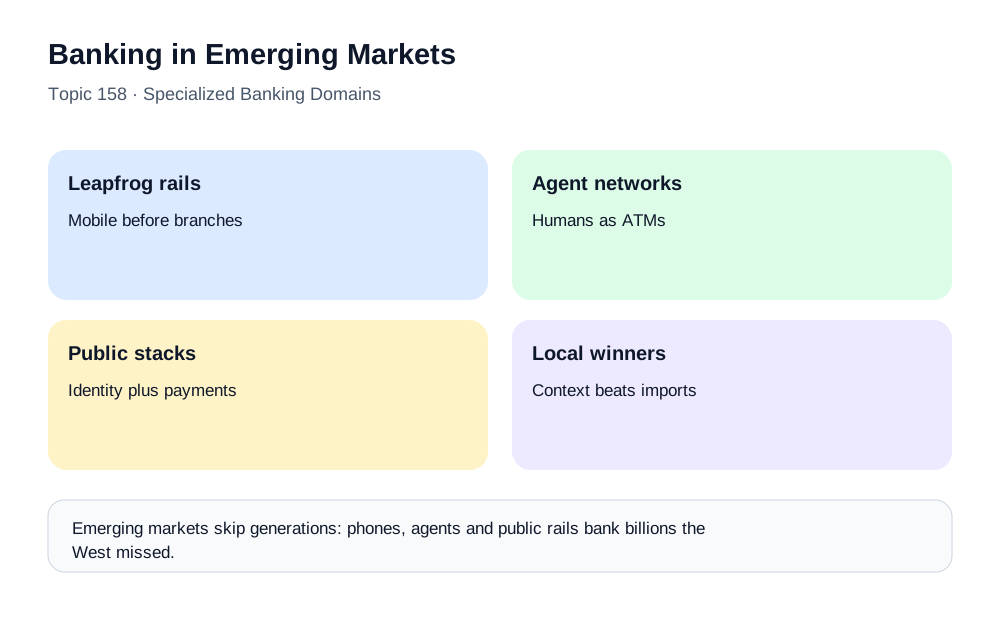
Banking in Emerging Markets at a glance — Development finance, financial inclusion, mobile money.
Financial Inclusion, Digital Public Infrastructure, Mobile Money, Agent Networks, and Local Innovation
Emerging markets are where some of the most important banking innovation is happening. These markets often face difficult conditions: large unbanked populations, informal income, limited branch reach, low ticket sizes, uneven connectivity, trust gaps, and heavy dependence on cash. But those constraints have pushed banks, fintechs, regulators, and governments to build new models that are fast, low-cost, mobile-first, interoperable, and inclusion-focused.
India's UPI and digital public infrastructure, Kenya's mobile money model, Brazil's Pix and neobank growth, Southeast Asia's super-app finance, and agent banking across many countries show that emerging markets are not only catching up. In many areas, they are creating models that developed markets now study.
This chapter explains banking in emerging markets from a practical perspective: what makes these markets different, why financial inclusion matters, how mobile money and instant payments work, why agent networks are important, how digital identity changes onboarding, and what risks banks must manage while serving customers at scale.
Learning objectives
By the end of this chapter, you should be able to:
- Explain the main characteristics of emerging markets banking.
- Understand financial inclusion and why traditional branch banking may not be enough.
- Describe mobile money, agent banking, digital wallets, and instant payment systems.
- Explain the role of digital identity, eKYC, and digital public infrastructure.
- Compare examples such as UPI, mobile money, Pix, and super-app finance.
- Identify risks: cash dependency, fraud, weak literacy, infrastructure gaps, regulatory fragmentation, and consumer protection.
- Understand why local context matters more than copying developed-market banking models.
- Recognise how emerging market innovations influence global banking.
1. What Emerging Markets Banking Means
Emerging markets banking refers to banking and financial services in economies that are still expanding access, infrastructure, regulation, and formal financial participation.
These markets may have:
- large young populations;
- rapid urbanisation;
- high mobile-phone usage;
- significant informal employment;
- low formal credit history;
- lower branch density;
- high cash usage;
- uneven internet connectivity;
- strong remittance flows;
- fast fintech adoption;
- active regulator-led infrastructure programmes;
- high need for low-cost payments and credit.
The banking opportunity is large, but the operating model must be adapted to local realities.
2. Why Traditional Banking Is Not Enough
Traditional banking often depends on branches, formal documents, fixed salaries, stable addresses, and larger transaction sizes.
Many emerging-market customers may have:
- informal income;
- seasonal cash flows;
- limited documentation;
- no credit history;
- no nearby branch;
- low balances;
- small frequent transactions;
- shared devices;
- limited literacy;
- distrust of formal institutions;
- preference for cash.
A bank cannot serve these customers well by simply shrinking a developed-market model. It needs different distribution, pricing, risk assessment, language, technology, and support.
3. Financial Inclusion
Financial inclusion means people and businesses can access useful, affordable, safe, and responsible financial services.
This includes:
- transaction accounts;
- payments;
- savings;
- credit;
- insurance;
- pensions;
- remittances;
- merchant acceptance;
- government benefit transfers;
- financial education;
- complaint redressal.
Inclusion is not only account opening. A dormant account with no useful service is not meaningful inclusion.
A good inclusion model helps customers store value safely, receive money, pay others, build records, manage emergencies, and access appropriate credit.
4. Mobile-First Banking
Many emerging markets move directly to mobile-first banking because branch expansion is expensive and smartphone or feature-phone access is widespread.
Mobile-first models include:
- mobile wallets;
- USSD banking for feature phones;
- QR payments;
- instant account-to-account payments;
- app-based savings;
- small digital loans;
- merchant collections;
- bill payments;
- remittance wallets;
- digital receipts;
- in-app customer support.
Mobile banking must still handle low bandwidth, older devices, local languages, shared phones, fraud education, and assisted support.
5. Mobile Money
Mobile money allows customers to store and transfer value using a mobile phone, often without a traditional bank account.
A typical mobile money model includes:
- customer registers with mobile number and basic identity checks;
- customer deposits cash with an agent;
- agent converts cash into mobile wallet value;
- customer sends money, pays bills, buys airtime, or pays merchants;
- receiver can keep wallet balance or cash out through an agent.
Mobile money became powerful because it solved a real problem: people needed to move money safely without bank branches nearby.
Agent networks are critical because digital value still needs cash-in and cash-out points where cash remains important.
6. Agent Banking
Agent banking uses local shops, merchants, post offices, kiosks, or individuals to provide basic financial access on behalf of banks or financial providers.
Agents may support:
- account opening assistance;
- cash deposits;
- cash withdrawals;
- money transfers;
- bill payments;
- loan repayment;
- balance enquiry;
- mini statements;
- government benefit cash-out;
- customer education.
Agent banking extends reach, but creates controls challenges.
Risks include:
- agent fraud;
- liquidity shortages;
- wrong customer authentication;
- overcharging;
- poor complaint handling;
- cash robbery;
- weak reconciliation;
- agent misconduct;
- operational downtime.
Banks must monitor agent performance, liquidity, commissions, customer complaints, cash movements, and transaction exceptions.
7. Digital Public Infrastructure
Digital public infrastructure means shared digital rails that many banks, fintechs, businesses, and citizens can use.
It may include:
- digital identity;
- electronic KYC;
- interoperable payments;
- consent-based data sharing;
- digital signatures;
- public registries;
- government benefit transfer rails;
- merchant acceptance infrastructure.
India is a leading example through digital identity, UPI, account aggregation, and related public rails. Brazil's Pix is another powerful example of regulator-led instant payment infrastructure.
The key value is interoperability. Customers should not be trapped inside one provider's closed system if public rails allow broader access.
8. Instant Payments and QR Acceptance
Instant payment systems help emerging markets reduce cash dependence.
They support:
- person-to-person transfers;
- merchant QR payments;
- bill payments;
- small business collections;
- government transfers;
- refunds;
- wallet top-ups;
- e-commerce checkout;
- request-to-pay use cases.
Low-cost instant payments are especially useful where card infrastructure is expensive or merchant acceptance is low.
For small merchants, QR acceptance can be easier than POS terminals because it needs less hardware and lower setup cost.
9. Super-App Finance
In some markets, financial services are embedded into daily-use platforms.
A super-app may begin with ride-hailing, food delivery, messaging, e-commerce, or logistics, then add:
- wallet;
- payments;
- merchant services;
- savings;
- credit;
- insurance;
- investments;
- rewards;
- payroll or gig-worker finance.
This works because customers already use the app frequently. Financial services become part of daily behaviour rather than a separate banking visit.
The risk is platform concentration, data misuse, unclear consent, aggressive lending, and weak customer recourse if financial products are buried inside non-bank journeys.
10. Alternative Credit Assessment
Many customers in emerging markets have thin credit files.
Banks and fintechs may use alternative data, subject to law and consent, such as:
- transaction history;
- wallet usage;
- merchant sales;
- utility payments;
- mobile recharge patterns;
- invoice data;
- platform earnings;
- cash-flow patterns;
- account aggregator data;
- psychometric or behavioural data, where permitted and appropriate.
Alternative data can improve access, but it must be used responsibly. Models should be explainable, fair, privacy-conscious, and monitored for bias and over-lending.
11. Examples of Emerging Market Innovation
| Market | Innovation pattern | Why it matters |
|---|---|---|
| India | UPI, digital identity, eKYC, account aggregation | Low-cost interoperable rails at national scale |
| Kenya and parts of Africa | Mobile money and agent networks | Financial access without dense branch networks |
| Brazil | Pix and digital banks | Instant payments plus strong fintech competition |
| Southeast Asia | Super-app finance | Financial services embedded into daily platforms |
| Philippines | Wallet-led inclusion and remittances | Digital access in a cash-heavy island economy |
| Mexico and Latin America | Fintech credit and digital wallets | Competition in concentrated banking markets |
The lesson is not that every country should copy one model. The lesson is that infrastructure, regulation, customer behaviour, and local economics shape the right model.
12. Key Risks in Emerging Markets Banking
| Risk | What can go wrong | Control focus |
|---|---|---|
| Inclusion without usage | Accounts opened but remain dormant | Activation, relevant products, customer education |
| Fraud and scams | New users targeted through social engineering | Alerts, education, transaction monitoring |
| Agent risk | Agent misuses cash or overcharges | Agent monitoring, reconciliation, complaints |
| Over-indebtedness | Digital credit becomes too easy | Affordability, credit bureau, limits |
| Data misuse | Alternative data collected unfairly | Consent, minimisation, privacy controls |
| Infrastructure gaps | Connectivity or power failures disrupt service | Offline support, resilience planning |
| Regulatory fragmentation | Rules differ across countries | Local compliance and legal review |
| Consumer harm | Customers do not understand fees or risks | Clear disclosure and grievance redressal |
| Cash dependency | Digital funds still need cash-out | Agent liquidity and cash management |
| Cyber risk | Rapid digital adoption attracts attackers | Secure apps, APIs, monitoring, incident response |
Fast growth is valuable only if trust keeps pace.
13. Regulation and Trust
Regulators in emerging markets often play an active role in building trust.
They may support:
- payment-system interoperability;
- digital identity frameworks;
- simplified KYC for low-risk accounts;
- consumer protection rules;
- agent banking regulations;
- fintech licensing;
- open banking or data-sharing frameworks;
- instant payment schemes;
- digital lending guidelines;
- cyber and operational resilience rules.
The right regulation encourages innovation while preventing customer harm and systemic risk.
14. Practical Example
A small merchant in a semi-urban area wants to accept digital payments.
A strong emerging-market banking model may offer:
- simple onboarding using digital KYC;
- QR code acceptance with no expensive terminal;
- instant customer payments into merchant account;
- transaction alerts in local language;
- small working-capital loan based on sales history;
- insurance or savings option;
- nearby agent support for cash-in and cash-out;
- grievance channel if settlement fails.
This is not only payment acceptance. It creates data, credit access, trust, and business growth.
15. Common Misconceptions
Misconception 1: Emerging markets are only behind developed markets.
Many emerging markets lead in instant payments, mobile money, QR acceptance, digital identity, and low-cost infrastructure.
Misconception 2: Opening accounts equals inclusion.
Real inclusion requires usage, trust, affordability, safety, and customer value.
Misconception 3: Mobile-first means smartphone-only.
Some successful models support feature phones, agents, USSD, assisted service, and low-bandwidth journeys.
Misconception 4: Alternative data automatically improves credit.
It can help, but it can also create privacy, bias, and over-lending risks if poorly governed.
16. Frequently Asked Questions
What is financial inclusion?
It means people and businesses can access and use useful, affordable, safe, and responsible financial services.
Why are agents important?
Agents provide local access for cash-in, cash-out, assistance, and trust where branches are limited or cash is still widely used.
What is digital public infrastructure?
It is shared digital infrastructure such as identity, payment rails, consent systems, or data-sharing rails that many providers can build on.
Why are instant payments important in emerging markets?
They reduce dependence on cash, lower transaction cost, improve merchant acceptance, and support real-time digital commerce.
What is the biggest challenge?
The challenge is balancing scale, inclusion, low cost, fraud control, consumer protection, and sustainable economics.
17. Key Terms
- Emerging market: Economy with developing financial infrastructure, access, and growth potential.
- Financial inclusion: Access to useful and responsible financial services.
- Mobile money: Phone-based stored value and transfer service.
- Agent banking: Local third parties providing basic banking services.
- Digital public infrastructure: Shared digital rails for identity, payments, data, or services.
- Instant payment: Real-time or near-real-time account-to-account transfer.
- QR payment: Payment initiated using a scannable code.
- USSD: Mobile menu technology that works on feature phones.
- Alternative data: Non-traditional data used for risk assessment.
- Super-app: Platform combining many services, often including finance.
- Interoperability: Ability of different providers and systems to work together.
- Dormant account: Account opened but not actively used.
18. Interview Insights
Interviewers may ask emerging market banking questions to test whether you understand inclusion, infrastructure, and local operating models.
Strong answers usually mention:
- large unbanked or underbanked populations;
- mobile-first delivery;
- agent networks;
- instant payments and QR acceptance;
- digital identity and eKYC;
- digital public infrastructure;
- alternative credit data;
- consumer protection;
- fraud and operational resilience;
- local context instead of copy-paste models.
A good short answer:
"Banking in emerging markets requires low-cost, mobile-first, inclusive models supported by digital identity, instant payments, agent networks, and customer education. The opportunity is huge, but banks must manage fraud, data privacy, over-lending, infrastructure gaps, and consumer protection carefully."
19. Summary
Emerging markets are not only future growth markets for banking. They are innovation laboratories for low-cost payments, digital identity, mobile money, agent banking, QR acceptance, alternative credit, and financial inclusion.
For banking learners, the key lesson is this: successful emerging-market banking starts with local reality. The best models solve real access, trust, cost, cash, identity, and customer-protection problems at scale.
Next: Topic 159 - Bank Merger Integration
<!-- MBA-DEEP-DIVE-START -->Emerging Markets Banking Deepening — Access, Infrastructure, Payments, Credit, Agents, Resilience, and Sustainable Scale
Emerging-market banking should be understood through constraints and opportunities, not labels
Countries grouped as emerging markets can differ enormously in income, regulation, population, currency stability, banking concentration, technology adoption, and institutional capacity. The useful analytical question is not whether a country fits a label but what financial problems customers and businesses face, which infrastructures exist, and what operating model can serve them sustainably. A bank entering a market should therefore map access, trust, cash usage, digital connectivity, identity systems, payment rails, credit information, agent networks, consumer protection, and macroeconomic risk before copying a product from elsewhere.
Financial inclusion is about useful access and sustained usage
Opening an account is an important milestone, but it does not prove that a customer can use finance safely and productively. Meaningful inclusion requires an account or wallet that can receive money, make payments, store value, access cash when needed, protect funds, resolve disputes, and connect to appropriate savings, credit, insurance, or pension services. Institutions should measure activation, transaction frequency, balances, failed transactions, complaints, fraud, and customer retention alongside headline account-opening numbers.
The latest Global Findex shows both progress and unfinished work
The World Bank’s Global Findex 2025, based on data collected during 2024 across 141 economies, reports that close to four in five adults globally now have an account, while about 1.3 billion adults remain without one. This is a powerful reminder that digital and mobile channels have expanded access but have not eliminated exclusion. Banks should use such data to understand broad trends while still researching local barriers because the reasons for exclusion differ by country, gender, income, age, geography, documentation, and trust.
Mobile ownership is an access rail, not automatically a banking relationship
A phone can reduce distribution cost and enable authentication, communication, payments, savings, credit, and support. But customers may use feature phones, share devices, change SIMs frequently, lack data, have low digital literacy, or face unreliable electricity. Product design should therefore consider USSD, apps, web, assisted channels, offline or low-bandwidth features, voice, local language, and agents as complementary options. “Mobile first” should not mean “smartphone only.”
Cash remains economically important even inside rapidly digitising markets
People may receive wages, agricultural income, remittances, or merchant sales in cash even when they also use digital payments. A financial service that ignores cash-in and cash-out can therefore fail to meet daily needs. Banks and mobile-money providers should understand where cash enters and leaves the ecosystem, what it costs, who supplies liquidity, and how physical cash risk is controlled. Digital adoption often grows by connecting cash to electronic value rather than by eliminating cash overnight.
Agent networks solve the last-mile problem but create a distributed control environment
An agent can give customers a nearby place to deposit or withdraw cash, pay bills, receive government transfers, register for services, or obtain assistance. The agent may be a shopkeeper, post office, kiosk, business correspondent, or other authorised participant. Because the bank does not control the premises like a branch, it needs onboarding, training, branding, liquidity management, transaction limits, authentication, commission governance, cash controls, mystery shopping, complaints, audit, and termination processes.
Agent liquidity is a customer-experience and treasury problem
An agent can be trustworthy and still fail customers if it has insufficient physical cash or electronic float. Providers should forecast demand by location, pay cycle, benefit distribution, market day, harvest season, and local events. Rebalancing arrangements must let agents replenish cash or electronic value safely. Repeated “cash unavailable” responses can push customers back to informal channels even when the digital system itself is functioning perfectly.
Agent commissions shape behaviour
If compensation rewards registration but not active usage, agents may open low-quality accounts. If cash-out pays much more than digital payment assistance, agents may steer customers toward cash. If pricing rules are unclear, customers can be overcharged. Commission design should therefore align with desired outcomes and be visible to customers where required. Monitoring should compare expected fees with actual transaction behaviour and complaint patterns.
Digital public infrastructure can reduce duplication across the financial sector
Shared identity, payment, consent, signature, or data-exchange rails can let many banks and fintechs build services without reproducing the same foundational capability. The public-policy value often comes from interoperability, open participation under rules, reusable trust, and lower marginal cost. Banks still need their own product, risk, fraud, compliance, customer-service, and resilience controls. Public infrastructure is a foundation, not a substitute for institution-level responsibility.
Interoperability changes competition and customer choice
Closed-loop wallets can grow quickly but may trap customers inside one network. Interoperable account-to-account or wallet-to-bank systems let customers pay across providers, which can increase usefulness and reduce merchant fragmentation. Interoperability also creates shared dependencies and requires common addressing, message rules, settlement, dispute processes, fraud cooperation, and technical certification. A scheme is successful only when operational coordination matches technical connectivity.
Instant payments can become a core economic utility
Low-cost real-time account-to-account payments can support person-to-person transfers, merchant purchases, bills, government payments, collections, payroll, refunds, and e-commerce. They are particularly powerful where cards or branch networks are expensive to expand. Banks must still manage 24/7 liquidity, fraud, sanctions or financial-crime controls as applicable, customer authentication, confirmation, reconciliation, exceptions, dispute handling, and high availability. Speed removes some old operational buffers, making real-time controls more important.
QR acceptance lowers merchant hardware barriers but moves complexity into software and standards
A printed or displayed QR can allow a micro merchant to accept payments without a traditional card terminal. The provider must manage merchant identity, account linking, static versus dynamic codes, amount integrity, customer confirmation, refunds, dispute evidence, fraud, and settlement reporting. QR interoperability depends on common standards and scheme governance. A low-cost acceptance method can still generate confusion if merchant names or payment statuses are unclear.
Merchant onboarding should connect payments to the real business
Small merchants may operate informally, use household and business funds together, move locations, or lack conventional documents. Risk-based onboarding should collect and verify what is necessary for the product and jurisdiction while understanding expected turnover, goods or services, settlement account, ownership, and fraud risk. Excessive documentation can exclude legitimate microbusinesses; weak due diligence can enable shell merchants, laundering, or scam networks.
Transaction data can create a bridge from payments to credit
A merchant with no traditional financial statements may still have a rich history of digital receipts and settlement flows. With lawful use and appropriate consent, cash-flow data can help lenders assess revenue stability, seasonality, concentration, refunds, and repayment capacity. The strongest models focus on economically meaningful variables rather than harvesting unrelated personal data. Alternative data should complement responsible underwriting, not become an excuse for opaque automated lending.
Thin credit files require disciplined uncertainty management
A customer with little formal credit history is not necessarily high risk; the lender simply has less evidence. Product design can start with modest limits, short observation periods, transaction-based assessments, secured or guaranteed structures where suitable, and gradual limit growth. The bank should distinguish “unknown” from “bad.” Treating every thin-file customer as unacceptable perpetuates exclusion, while treating every digital signal as proof of creditworthiness creates over-lending.
Digital credit can scale customer harm as quickly as it scales access
Instant approval and disbursement reduce friction, but repeated borrowing, hidden pricing, aggressive limit increases, unclear lender identity, excessive data collection, or coercive collection can turn convenient credit into a debt trap. Responsible digital lending requires affordability assessment, transparent cost, sensible limit management, consent, clear lender accountability, complaint channels, and monitoring of repeat use and early delinquency. Growth metrics should not overpower customer-outcome measures.
Remittances are a major entry point into formal finance
Many households receive domestic or international remittances regularly. A bank or wallet can use reliable receipt history to offer safer storage, bill payment, savings, insurance, or appropriate credit. The design should avoid automatically treating remittance inflow as permanent income. Fees, FX rates, cash-out availability, customer identification, sanctions obligations, and cross-border rules are central to the service proposition.
Government-to-person payments can accelerate account adoption
Social benefits, pensions, subsidies, or emergency transfers deposited directly into accounts can create millions of first-time users. The challenge is converting a transfer account into a useful financial relationship. Customers need reliable authentication, nearby cash access, transparent fees, accessible support, and protection from agent misconduct or fraud. A government-payment programme should not be judged only by successful bulk disbursement if recipients cannot safely access funds.
Digital identity can reduce onboarding cost while raising new concentration questions
A trusted reusable identity can remove repeated document collection and improve data quality. But if many institutions depend on one identity infrastructure, outages, cyber incidents, exclusion errors, or governance failures can have system-wide effects. Banks should understand assurance levels, permitted uses, fallback methods, privacy, correction routes, and operational dependencies. Resilience planning should include identity failure just as it includes payment failure.
Customer authentication should fit local device and fraud conditions
Authentication approaches built for customers with stable smartphones and private devices may fail where phones are shared or frequently changed. Banks can combine PINs, biometrics where appropriate, device binding, cryptographic methods, OTP, behavioural signals, and step-up controls based on risk. Recovery flows are particularly important because loss of a SIM or handset should not permanently exclude the customer while weak recovery can enable account takeover.
Social engineering can grow faster than digital literacy
New users are attractive targets for fake support calls, remote-access scams, phishing, QR substitution, impersonation, and “safe account” fraud. Customer education should appear at the moment of risk, not only in generic campaigns. Transaction confirmation should clearly show recipient and amount. Banks should monitor new fraud patterns, share intelligence through appropriate industry channels, and make reporting simple so customer reports become early-warning signals.
Consumer protection is essential to preserve trust in first-generation users
A customer who loses money or cannot resolve a failed transaction may return to cash permanently. Clear pricing, reliable receipts, prompt reversal where rules require, accessible complaints, local-language support, agent accountability, and fair collections are therefore infrastructure for adoption. Trust can be more fragile when customers have little prior experience with formal finance. Product economics should include the cost of service and remediation, not assume self-service will solve every problem.
Local language is an operational requirement, not a marketing feature
Contracts, error messages, fraud warnings, support scripts, and key disclosures should be understandable to the target customer. Translation must preserve legal and financial meaning. A technically accurate English message rendered poorly into another language can create payment errors or mis-selling. Banks should maintain controlled terminology and test comprehension with actual users.
Voice and assisted channels can bridge literacy and accessibility gaps
Interactive voice response, call centres, voice bots, agent assistance, and audio instructions can complement text-heavy apps. Security remains important because assisted channels can be targeted by impersonation and social engineering. Customer verification, call recording where lawful, agent access, consent, and escalation should be governed. Inclusion should not create a weaker security tier.
Shared-device design needs privacy protection
In some households or communities, several people may use one handset. The app should not assume that device possession means exclusive identity. Notifications, cached balances, account-switching, biometric use, logout, and recovery need careful design. Sensitive information should not remain visible after a session. Device risk models should distinguish shared-use patterns from automatic fraud assumptions where possible.
Connectivity outages need customer-safe states
A payment request that loses connectivity after submission can leave the customer unsure whether money moved. The system should use stable transaction identifiers, idempotency, authoritative status, and clear “pending” handling. Agents and merchants need similar controls because repeated retries can create duplicate financial events if backend design is weak. Offline acceptance, if supported, requires strict limits and reconciliation because real-time balance confirmation is unavailable.
Power resilience matters in cash and agent ecosystems
In areas with unreliable electricity, agent terminals, routers, phones, and charging can fail simultaneously. Providers may need battery support, multiple connectivity options, resilient local infrastructure, and business-continuity plans. National payment systems can be highly available while the last kilometre remains unavailable. Service availability should therefore be measured from the customer’s location, not only the data centre.
Cybersecurity should scale with digital adoption
Rapid digital growth increases the value of accounts, APIs, mobile applications, agent systems, and national rails to attackers. Banks need secure software development, API security, fraud analytics, identity protection, patching, security monitoring, incident response, vendor governance, and customer communication. Smaller transaction values do not imply small systemic risk when millions of customers use the platform.
Data sovereignty and localisation can shape architecture
Some jurisdictions restrict where certain financial or personal data can be stored or processed. Cross-border cloud, fraud, analytics, or KYC vendors may therefore need regional deployment or contractual controls. Banks should map data categories and legal requirements before selecting infrastructure. A global architecture that ignores local data rules can become impossible to remediate after large-scale migration.
Currency volatility affects both customers and bank balance sheets
Emerging markets can face periods of exchange-rate volatility that change import costs, loan servicing, foreign-currency deposits, remittance value, and bank funding. Banks should understand currency mismatches at customer and balance-sheet level. Lending in a foreign currency to borrowers earning only local currency can create severe credit stress when exchange rates move. Product suitability and ALM are therefore closely connected.
Inflation can change product economics quickly
High or volatile inflation affects deposit pricing, real savings value, loan affordability, operating expense, merchant working capital, and customer behaviour. Interest-rate repricing and disclosure should be managed carefully. A product designed under stable inflation may become unsuitable if instalments rise or customers move funds rapidly. Treasury, product, credit, and customer teams need a shared view of macroeconomic stress.
Sovereign and banking risk can reinforce one another
Banks may hold significant government securities while governments depend on banks for financing. Stress in sovereign credit can affect bank capital, funding, collateral values, and market confidence; bank stress can in turn pressure the public sector. Risk teams should monitor concentration, interest-rate sensitivity, liquidity, and regulatory treatment. Emerging-market analysis should not focus only on retail inclusion while ignoring the financial system’s balance sheet.
Dollarisation or foreign-currency use changes deposit and liquidity management
In some markets, households and businesses hold foreign currency because of trade, remittances, inflation concerns, or confidence. Banks need separate liquidity, reserve, FX, pricing, and settlement controls by currency. A bank can appear liquid in local currency while facing shortages in a foreign currency. Customer disclosures should make FX risk clear when products involve currency mismatch.
Informal businesses require cash-flow understanding rather than documentation theatre
Demanding audited financial statements from a market trader who has never produced them may exclude a viable borrower without improving risk assessment. Banks can use appropriate business evidence, transaction records, inventory, invoices, supplier relationships, merchant payments, site visits, and cash-flow analysis where permitted. Simplification should remove irrelevant paperwork while preserving real risk understanding.
Agricultural finance must reflect seasonality and correlated risk
Farming households often need funds before harvest and repay after production. Weather, commodity prices, pests, transport, and input costs can affect many borrowers at once. Loan schedules, insurance, guarantees, warehouse finance, value-chain arrangements, and diversification can help. Credit models should not mistake predictable seasonality for delinquency or assume that historical rainfall makes future risk stable.
Climate events can become payments, credit, and operational incidents simultaneously
A cyclone or flood can damage customer assets, close branches, disrupt agents, disable telecommunications, increase cash demand, delay repayments, and trigger insurance claims. Business continuity should prioritise access to funds and customer communication. Credit teams may need hardship programmes, while fraud teams should anticipate disaster-related scams. Climate resilience belongs across the bank, not in one sustainability report.
Micro and small businesses need working-capital products tied to their cycle
A merchant may need inventory today and receive customer payments over the next month. Revolving credit, invoice finance, supplier credit, merchant cash-flow lending, or overdraft-like products can fit better than a fixed consumer instalment loan. Product structures should reflect business use, not re-label consumer credit simply because it is easier to distribute digitally.
Super-app ecosystems can lower acquisition cost while concentrating gatekeeper power
A platform with payments, commerce, transport, messaging, or delivery can embed financial services at frequent moments of customer activity. This can produce useful data and convenience. It can also create conflicts over consent, ranking, tying, data use, customer ownership, complaints, and platform dependency. Banks partnering with such platforms need clear accountability and contingency plans if the partner relationship ends.
Open finance can expand competition if customers retain meaningful control
Consent-based sharing of banking, payment, investment, insurance, or other financial data can help customers compare products and let lenders assess broader cash flow. The value depends on secure APIs, consent scope, revocation, data quality, liability, accreditation, and customer understanding. Open finance should not become a mechanism for uncontrolled data extraction from financially vulnerable customers.
Domestic payment innovation must still connect to cross-border commerce
A country can have excellent instant payments domestically while businesses face high-friction international transfers. Banks need correspondent relationships, FX liquidity, sanctions controls, trade documentation, international messaging, settlement, and reconciliation. Regional payment links can lower cost, but interoperability across currencies and legal regimes is more complex than domestic QR acceptance.
Cross-border remittance pricing should be decomposed transparently
Customer cost can include transfer fee, FX spread, receiving fee, cash-out charge, and time value. Competition may reduce one component while others remain hidden. Product teams should understand the full customer price and delivery certainty. Operational design should track the payment end to end so a low headline fee is not offset by frequent delays or opaque foreign-exchange conversion.
Bank partnerships with fintechs need bank-grade control boundaries
A fintech may provide onboarding, scoring, wallet technology, merchant acquisition, distribution, or servicing. The regulated institution should know which party performs each activity, where data is stored, who handles complaints, what decisions are automated, how incidents are reported, and how customers are protected if the partner fails. Innovation is faster when accountability is explicit rather than negotiated after a problem.
Regulatory sandboxes can support learning but do not replace governance
Testing a new product in a supervised or limited environment can help regulators and firms understand risk. The institution still needs security, customer consent, data protection, operational resilience, monitoring, and clear exit arrangements. A sandbox should reduce uncertainty around innovation, not signal that ordinary customer protections are optional.
Prudential strength remains essential even in a digital-first model
A beautiful app and strong payment growth cannot compensate for weak capital, liquidity, asset quality, governance, or risk management. Banks in fast-growing markets can be especially vulnerable to credit booms, funding concentration, rapid deposit shifts, and operational scaling failures. Digital strategy should therefore be joined to capital planning, liquidity stress testing, credit risk, and recovery planning.
Deposit trust can change rapidly in a connected population
Mobile banking makes withdrawals and transfers easier, which is positive for customers but can accelerate deposit outflow during rumours or stress. Banks need strong liquidity management, clear customer communication, reliable channels, and contingency funding. Social-media misinformation can become a treasury event. Digital convenience changes the speed at which confidence can affect the balance sheet.
Data analytics should identify exclusion as well as risk
Banks can examine where applications fail, which regions have low activation, which groups rely on agents, where fraud false positives are high, and which customers abandon digital journeys. The analysis must follow local privacy and fairness requirements. A system optimised only to minimise loss may systematically exclude thin-file or low-income customers whom better product design could serve safely.
Customer-support design should reflect first-time financial users
Support staff may need to explain payment status, failed authentication, fees, account limits, fraud, cash-out, and dispute processes to customers unfamiliar with banking terminology. Scripts should use plain language and local context. Escalation to human support should be available for high-impact problems. A self-service model that leaves customers stranded can undermine years of inclusion work.
Reconciliation becomes more complex as ecosystems expand
A single customer transaction can involve bank ledger, mobile-money platform, agent, switch, instant-payment scheme, merchant, government programme, or fintech partner. Each party may have its own status and settlement cycle. Banks need common references, exception queues, suspense-account governance, ageing, and ownership. Small unmatched amounts at massive volume can become material financial and customer issues.
Settlement finality and customer status should be clearly distinguished
An app may show “successful” while inter-institution settlement is still completing according to the scheme. Conversely, a payment may be irrevocably settled while the receiver’s app has not refreshed. Product, operations, accounting, and customer messaging should use status definitions aligned with scheme rules. Ambiguity increases duplicate payments, complaints, and reconciliation breaks.
Scenario: a rural agent runs out of cash on benefit-payment day
The bank’s central platform is healthy, but hundreds of customers cannot withdraw government payments because local agents lack cash. Agent-liquidity monitoring detects the concentration, nearby rebalancing points are activated, customers are directed to alternatives, and future forecasting incorporates the benefit calendar. The incident shows why “system availability” must include distribution capacity.
Scenario: a QR network grows faster than fraud controls
Merchant adoption rises sharply and scammers begin replacing physical QR codes or creating deceptive merchant identities. The provider strengthens merchant verification, displays verified merchant name before customer approval, adds suspicious-merchant monitoring, improves refund and complaint workflows, and educates customers not to approve unexpected collect requests. Payment growth and fraud governance advance together.
Scenario: a thin-file merchant receives cash-flow credit
A small shop has little formal borrowing history but receives regular digital sales settlement. The lender uses permitted account cash-flow data, seasonality, concentration, existing obligations, and business tenure to offer a modest working-capital line. Limit growth depends on actual performance. The approach expands access without pretending that phone metadata alone is a substitute for repayment analysis.
Business analysts should map the ecosystem, not only the bank
Requirements should identify customer, agent, merchant, fintech, scheme operator, identity provider, telecom network, regulator, government payer, correspondent, and bank systems involved in each journey. For every handoff, document data, authentication, status, settlement, fees, ownership, timeout, retry, dispute, and reconciliation. Emerging-market banking often fails at ecosystem boundaries rather than inside the core ledger.
Testing should include infrastructure and human constraints
A realistic test programme includes low bandwidth, feature phones where supported, shared devices, local-language input, agent cash shortage, agent float shortage, offline retry, duplicate payment, wrong QR, identity-service outage, instant-payment timeout, cash-in reversal, customer fraud report, remittance FX change, disaster disruption, and partner failure. Laboratory-perfect connectivity will not reveal last-mile weakness.
Market-entry governance should begin with local evidence
Before launching, a bank should validate customer needs, unit economics, regulatory permissions, identity infrastructure, payment rails, agent viability, fraud patterns, language, support, competition, macro risk, and partner quality. Global standards provide useful control principles, but local law and customer behaviour determine how they are implemented. “It works in another country” is not a business case.
Closing perspective
The most successful emerging-market banking models combine low-cost digital rails with trust, last-mile distribution, fair credit, reliable cash access, strong consumer protection, and resilient operations. Innovation matters because it can remove structural cost and access barriers, but scale magnifies mistakes. The enduring lesson is to design around the customer’s real economic life and the market’s real infrastructure while maintaining the same discipline in identity, risk, accounting, settlement, security, reconciliation, and governance expected of any serious bank.
Banking in emerging markets requires infrastructure awareness, not stereotypes
Emerging markets are not one banking environment. Countries differ in income, regulation, currency arrangements, digital infrastructure, identity systems, payment rails, capital markets, customer behaviour, legal systems, and institutional capacity. A bank therefore gains little from treating “emerging market” as a single risk label. The more useful approach is to understand the local operating conditions that affect customer access, product economics, liquidity, compliance, technology, and resilience.
A modern emerging-market banking system can contain world-class instant payments, mobile wallets, digital identity, sophisticated corporate banks, and advanced fintech services while still relying heavily on cash in some customer segments or regions. Formal and informal economic activity often coexist. The bank's architecture and operating model need to bridge those realities rather than assuming that digital adoption eliminates physical distribution or cash management.
Identity infrastructure shapes onboarding economics
Where reliable national identity, digital signatures, credit information, or address data are widely available, banks can automate onboarding and credit assessment more effectively. Where coverage is incomplete, customers may have legitimate economic activity but limited formal documentation. The bank then needs alternative evidence and stronger controls around data quality, duplicate identity, agent-assisted onboarding, and manual review.
Weak documentation should not be equated automatically with suspicious behaviour. At the same time, inclusion objectives do not remove the need for customer identification and due diligence. Banks must design processes that can handle local evidence forms, transliteration, name variation, shared addresses, informal businesses, and changing mobile numbers while still producing a reliable customer record.
Identity resolution is especially important when institutions expand rapidly. Multiple customer profiles can distort credit exposure, transaction monitoring, sanctions screening, service history, and complaints. Good matching rules combine available identifiers, demographic information, contact details, document evidence, and human review for ambiguous cases.
Cash and digital channels often need to operate together
Rapid digital-payment growth does not mean cash disappears immediately. Customers may receive income digitally but cash out for local spending, or collect cash and deposit it before making a digital payment. Agent networks, branches, merchants, ATMs, and mobile channels can therefore form one connected distribution system.
This creates liquidity challenges at the edge. An agent may have enough electronic value but insufficient physical cash to serve withdrawals, or enough cash but insufficient electronic balance to accept deposits. Banks and payment providers can monitor agent positions, transaction patterns, failed cash-outs, geographic concentration, and replenishment needs. Customer access depends on this operational liquidity just as corporate payments depend on settlement liquidity at a different scale.
Cash-heavy environments also increase reconciliation and security requirements. Deposits collected through branches or agents should match system postings and bank balances. Delayed reconciliation can allow small differences to accumulate. Transaction evidence should be immediate enough that customers are not exposed to disputes over whether cash was actually received.
Local payment rails can be strategically more important than imported assumptions
Payment behaviour is shaped by domestic infrastructure. Some markets have strong real-time account-to-account rails, others rely more on cards, mobile money, bank transfers, cash, or combinations of these. A bank entering or expanding in a market should understand local clearing, settlement, operating hours, participant requirements, transaction limits, dispute rules, liquidity needs, customer identifiers, and failure handling.
The existence of an international standard does not remove local scheme rules. A payment can use modern messaging while still being governed by domestic cut-offs, settlement arrangements, participant obligations, or data requirements. Product teams should therefore design the customer proposition around the actual local payment service rather than assuming that one global flow works unchanged everywhere.
Corporate customers may need several rails simultaneously: payroll, supplier payments, tax, high-value settlement, collections, cross-border transfers, and real-time retail payments. A strong bank provides consistent visibility and reconciliation across those rails even when underlying infrastructures differ.
Foreign-exchange risk is operational as well as financial
In markets with material currency volatility or limited market liquidity, FX can affect customer pricing, funding, settlement, and liquidity management. A bank should know when an obligation becomes fixed, which currency is owed, how exchange rates are sourced, which spread applies, whether customers can hedge, and what happens if the market moves between instruction and execution.
Cross-border payments can involve correspondent accounts, local clearing, intermediary fees, cut-off times, compliance checks, and currency conversion. Customer communication should distinguish an estimated amount from a final booked or settled amount where uncertainty remains. Reconciliation should connect the original instruction, FX transaction, account posting, correspondent movement, and beneficiary outcome.
Banks also need liquidity buffers that reflect market conditions. A currency can be freely tradable in normal conditions yet become expensive or difficult to obtain during stress. Treasury teams should understand funding sources, intraday needs, collateral, correspondent limits, and contingency options by currency and legal entity.
Correspondent access and international connectivity can constrain products
Domestic capability does not guarantee easy access to international finance. Cross-border services may depend on correspondent banks, global clearing networks, trade-finance relationships, international card schemes, or foreign-currency settlement arrangements. If external banks reduce limits or relationships, local institutions can lose practical access even when customer demand remains strong.
Correspondent banking therefore involves more than finding a bank willing to process transactions. Institutions need robust due diligence, sanctions and AML controls, transparent customer information, payment-data quality, reconciliation, liquidity management, and responsive investigation handling. Poor operational quality can increase the cost or reduce the willingness of partners to maintain connectivity.
Concentration should be monitored. If a critical currency or corridor depends on one correspondent, an outage or risk decision at that provider can become a systemic business problem for the local bank. Alternative routing may not be immediately available.
SME banking should be built around cash flow, not only formal financial statements
Small and medium-sized enterprises can be economically significant while having limited audited history or complex mixtures of business and personal cash flows. Banks can improve assessment by understanding actual transaction patterns, supplier relationships, customer concentration, inventory cycles, seasonality, tax or invoice data where appropriate, and management capability.
Alternative data can improve visibility, but it needs governance. Transaction history is useful only if the bank understands account coverage and data quality. A merchant's digital receipts may represent only part of total sales. Model outputs should not overstate precision simply because large volumes of behavioural data are available.
Working-capital products should match the operating cycle. A trader buying inventory weekly has different financing needs from a contractor waiting months for payment. Product structures that ignore the cash-conversion cycle can create unnecessary default risk or push customers toward repeated refinancing.
Infrastructure resilience changes the architecture
Power, telecommunications, transport, cloud connectivity, and disaster exposure vary by market and region. A bank should design critical services around realistic local failure conditions. Mobile banking may need graceful handling of intermittent connectivity. Branches or agents may need controlled offline procedures. Operations centres may require backup power and alternative communications. Customer messages should avoid creating duplicate transactions when users retry after a network interruption.
Centralised technology can improve standardisation, but local dependencies still matter. A global platform may be available while domestic network access is disrupted. Resilience planning should therefore trace the full customer service from device or branch through telecommunications, authentication, core processing, external payment infrastructure, and settlement.
Third-party concentration can be significant when only a few vendors provide telecommunications, identity, payment switching, credit data, or cash logistics. Supplier due diligence should include continuity, financial health, security, capacity, and realistic substitution options.
Regulatory change and local interpretation require active governance
Banks operating across multiple emerging markets should avoid assuming that a policy implemented in one country can simply be copied into another. Licensing, capital, customer protection, data localisation, payments, FX, credit reporting, digital identity, outsourcing, and consumer rules can differ materially.
The operating model needs local regulatory expertise connected to central standards. Central teams can define minimum controls, architecture principles, and risk appetite, while local teams identify jurisdiction-specific obligations and market practices. Deviations should be documented rather than hidden inside manual processes.
Regulatory change should flow into products, procedures, systems, training, customer communication, and evidence. A legal interpretation that never reaches the operational workflow does not create compliance in practice.
Inclusion and profitability need to be designed together
Serving lower-income, rural, or previously unbanked customers can require low transaction fees, small balances, and broad distribution. The business model must therefore manage onboarding cost, servicing cost, agent commissions, fraud, credit loss, customer support, technology, and regulatory obligations carefully.
Digital channels can reduce cost per transaction, but they do not remove the need for trust, support, cash access, and fraud protection. Institutions that rely on hidden fees or weak customer understanding may produce short-term revenue but damage long-term adoption. Transparent pricing and reliable service are part of sustainable inclusion.
A bank can segment service according to customer need without creating second-class controls. Simpler products can reduce complexity, but identity, transaction evidence, complaints, security, and safeguarding remain important even for small balances.
A practical market-entry example
Imagine a bank launching a small-business account in a country with strong mobile payments, extensive agent distribution, significant cash usage, and volatile local-currency funding conditions. A superficial launch might copy the bank's product from another country and translate the interface. A stronger launch maps the local identity process, domestic payment rails, agent cash needs, customer documentation, merchant behaviour, FX rules, correspondent dependencies, complaint channels, network reliability, and treasury funding.
The account-opening journey supports local identity evidence and duplicate resolution. Cash deposits through agents reconcile quickly to the customer's account. The mobile app uses idempotent transaction handling so network retries do not create duplicate payments. Treasury monitors currency and settlement liquidity. Corporate customers receive consistent reporting across domestic and cross-border flows. Local regulatory requirements are built into the product rather than added as manual exceptions after launch.
That is the deeper lesson of emerging-market banking. The opportunity often comes from combining digital innovation with local knowledge, but the risk comes from assuming that technology makes local conditions irrelevant. Strong banks understand the actual infrastructure, cash flows, identity environment, currency, regulation, distribution network, and customer economics of each market and then build controls around that reality.
<!-- MBA-DEEP-DIVE-END -->