Visual overview
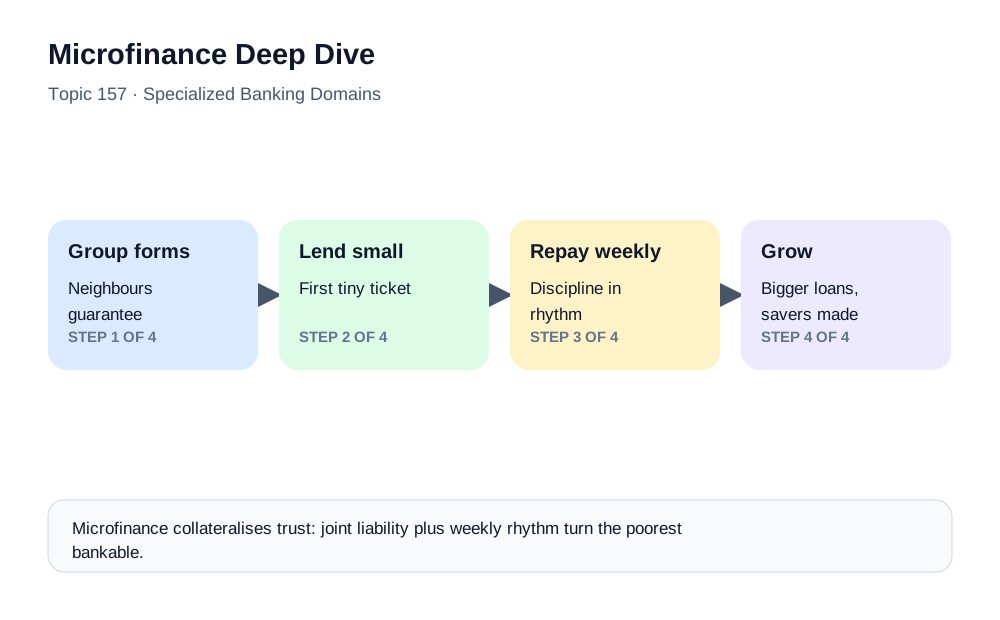
Microfinance Deep Dive at a glance — Microcredit, SHG model, microfinance operations.
Microcredit, Self-Help Groups, Joint Liability, Financial Inclusion, and Responsible Lending
Microfinance provides small financial services to people who are often excluded from traditional banking: low-income households, small vendors, rural workers, women entrepreneurs, informal businesses, and communities without easy access to branches, collateral, formal income documents, or credit history.
The core idea is not charity. It is financial inclusion through products designed for real cash flows, local trust, small ticket sizes, group discipline, and responsible repayment. When done well, microfinance helps customers build income, smooth emergencies, save regularly, reduce dependence on informal moneylenders, and enter the formal financial system.
When done poorly, it can create over-indebtedness, aggressive collections, hidden costs, and customer harm. That is why microfinance must combine access with responsible lending, transparent pricing, borrower protection, and strong field controls.
Learning objectives
By the end of this chapter, you should be able to:
- Explain what microfinance is and why it exists.
- Understand microcredit, micro-savings, micro-insurance, remittances, and small business finance.
- Describe Self-Help Groups, Joint Liability Groups, social collateral, and group meetings.
- Explain why microfinance often focuses on women and informal enterprises.
- Understand the operational model of field officers, collections, cash handling, and group records.
- Identify risks such as over-indebtedness, coercive recovery, political interference, fraud, and climate shocks.
- Explain responsible microfinance controls: affordability, bureau checks, transparent pricing, grievance redressal, and conduct rules.
- Recognise how microfinance supports financial inclusion while still needing bank-grade discipline.
1. What Microfinance Means
Microfinance is the delivery of small-value financial services to low-income or underserved customers.
It may include:
- microcredit;
- savings accounts;
- recurring savings;
- micro-insurance;
- pension products;
- remittance services;
- emergency loans;
- livelihood loans;
- small merchant finance;
- financial literacy support.
Microfinance customers may not fit traditional bank underwriting. They may have income, but it may be informal, seasonal, daily, or undocumented.
A good microfinance model understands the customer's real economy instead of excluding them for not having standard paperwork.
2. Why Microfinance Exists
Traditional banks may struggle to serve small borrowers because:
- loan sizes are small;
- documentation is limited;
- collateral is unavailable;
- branch access is difficult;
- income is irregular;
- credit history may be thin;
- servicing cost per loan is high;
- customers may be in remote locations.
Microfinance responds with different methods:
- group lending;
- frequent small repayments;
- local field officers;
- community trust;
- simplified documentation;
- financial literacy;
- doorstep or near-customer service;
- technology-enabled collections;
- small repeat loans based on repayment behaviour.
The operating model must be built around the customer segment, not copied from corporate or retail banking.
3. Main Microfinance Products
| Product | Purpose |
|---|---|
| Income-generation loan | Supports small business or livelihood activity |
| Agriculture-linked loan | Funds seeds, livestock, tools, irrigation, or farm inputs |
| Emergency loan | Helps cover urgent medical, family, or household needs |
| Housing improvement loan | Supports repair, sanitation, roofing, or small construction |
| Education loan | Pays school fees, books, or training costs |
| Micro-savings | Helps customers build small reserves |
| Micro-insurance | Covers life, health, crop, livestock, or asset risks |
| Remittance service | Allows safe movement of money to family members |
| Merchant loan | Supports tiny shops, vendors, and informal businesses |
The best products match cash flow. A vegetable seller, dairy farmer, tailor, and seasonal worker may need different repayment structures.
4. Self-Help Groups
A Self-Help Group (SHG) is usually a small group of members, often women from the same village or community, who save together and borrow together.
A typical SHG model includes:
- members form a group based on trust;
- each member saves a small amount regularly;
- group maintains records and meetings;
- internal loans are given from group savings;
- repayment discipline is built;
- bank account is opened for the group;
- bank provides credit linkage after group maturity;
- group allocates funds internally and monitors repayment.
The group creates social collateral. Members know each other and have a shared interest in repayment discipline.
5. Joint Liability Groups
A Joint Liability Group (JLG) is a smaller group where members take individual loans but are jointly responsible for repayment.
If one member defaults, others may be expected to support repayment under the group agreement.
| Area | SHG | JLG |
|---|---|---|
| Group size | Often larger | Often smaller |
| Savings first | Usually yes | Not always |
| Loan borrower | Group or members through group process | Individual members with joint liability |
| Relationship depth | Strong community and savings discipline | Faster credit access |
| Common lender | Banks, NGOs, development programmes | MFIs, banks, small finance banks |
Both models depend on trust, repayment discipline, and field-level monitoring.
6. Social Collateral
Microfinance often uses social collateral instead of physical collateral.
Social collateral means repayment discipline comes from:
- group trust;
- peer monitoring;
- community reputation;
- regular meetings;
- shared responsibility;
- future loan eligibility;
- local relationship with field officer.
This can work well, but it must be handled carefully. Social pressure should never become harassment, humiliation, or coercion.
7. Microfinance Operations Model
Microfinance operations are field-intensive.
Common operating activities include:
- customer identification;
- group formation;
- KYC collection;
- income and household assessment;
- credit bureau check where available;
- loan application;
- group training;
- disbursement;
- repayment collection;
- meeting attendance;
- cash or digital receipt handling;
- delinquency follow-up;
- customer grievance handling;
- portfolio monitoring;
- audit visits;
- staff conduct review.
The field officer is central. Good field officers build trust and discipline. Poor field conduct can damage customers, portfolio quality, and institutional reputation.
8. Credit Assessment
Microfinance credit assessment focuses on repayment capacity, not only documents.
Useful checks include:
- household income sources;
- business activity;
- daily or weekly cash flow;
- seasonality;
- existing loans;
- repayment obligations;
- family expenses;
- emergency risks;
- group reputation;
- credit bureau data;
- borrowing from other lenders;
- loan purpose;
- previous repayment behaviour.
Responsible lenders avoid pushing larger loans only to grow portfolio size. Loan size should match customer capacity.
9. Collections and Repayment
Microfinance often uses frequent repayments such as weekly, fortnightly, or monthly schedules.
Frequent meetings help:
- maintain repayment discipline;
- detect stress early;
- update records;
- answer questions;
- build financial habits;
- reduce large end-of-month burden.
Collections must follow conduct standards.
Good collection practice is:
- respectful;
- transparent;
- receipt-backed;
- during permitted times;
- free from threats;
- documented;
- sensitive to genuine hardship;
- escalated properly when repayment stress appears.
10. Responsible Pricing
Microfinance interest rates can look high compared with large bank loans because servicing small loans is expensive.
Costs include:
- field visits;
- small-ticket processing;
- group meetings;
- cash handling or collection infrastructure;
- technology systems;
- credit losses;
- funding costs;
- customer education;
- compliance and audit.
Even so, pricing must be transparent and responsible. Customers should understand the interest rate, processing fee, insurance premium, repayment amount, total cost, due dates, penalty rules, and grievance channel.
Hidden charges destroy trust.
11. Customer Protection
Important customer protection controls include:
- clear loan terms in local language;
- affordability assessment;
- total household obligation limits where required;
- credit bureau checks;
- no forced borrowing;
- no coercive recovery;
- receipt for every repayment;
- complaint channel;
- staff conduct monitoring;
- cooling-off or cancellation rules where applicable;
- privacy protection;
- transparent insurance linkage;
- fair treatment during hardship.
Microfinance serves vulnerable customers, so conduct risk is high.
12. Key Risks
| Risk | What can go wrong | Control focus |
|---|---|---|
| Over-indebtedness | Customer borrows from many lenders | Bureau checks, obligation limits, affordability |
| Coercive recovery | Field pressure becomes abusive | Conduct training, monitoring, complaints |
| Group pressure misuse | Social collateral becomes humiliation | Clear rules, staff supervision |
| Fraud | Fake borrowers, ghost groups, cash leakage | KYC, audit, digital receipts, surprise checks |
| Political interference | Repayment culture weakens | Communication, governance, responsible lending |
| Climate risk | Drought, flood, crop loss affects income | Product design, insurance, restructuring policy |
| Operational risk | Wrong records or collection errors | Digital systems, reconciliation, audit |
| Concentration risk | Too much lending in one area/activity | Portfolio diversification |
| Reputation risk | Customer harm becomes public issue | Fair conduct, grievance redressal |
Microfinance portfolio quality depends heavily on behaviour, not only numbers.
13. Role of Technology
Technology can improve microfinance when used carefully.
Useful tools include:
- mobile loan origination;
- digital KYC;
- credit bureau integration;
- field officer apps;
- GPS-tagged visits where appropriate;
- digital receipts;
- cashless disbursement;
- digital collections;
- group record digitisation;
- portfolio dashboards;
- early-warning alerts;
- customer SMS or voice reminders;
- grievance tracking.
Technology should reduce errors and improve transparency. It should not remove the human understanding needed for vulnerable customers.
14. Financial Inclusion Impact
Microfinance can support:
- women entrepreneurship;
- household income generation;
- savings discipline;
- access to formal credit history;
- reduced dependence on informal lenders;
- emergency resilience;
- children's education;
- health expenses;
- small asset creation;
- local business growth;
- community confidence.
Impact is strongest when credit is combined with savings, insurance, training, and fair customer treatment.
Credit alone is not a magic solution. It helps when it fits the customer's real life.
15. Practical Example
A group of 12 women forms an SHG in a village.
They save a small fixed amount every month. After several months, the group has a record of meetings, savings, internal loans, and repayment discipline. A bank links the group to a formal loan.
The group may use the loan for dairy animals, tailoring machines, petty trade, or farm inputs. Members repay regularly through group meetings. If one member faces difficulty, the group discusses support, but recovery must remain respectful and within rules.
For the bank, the SHG reduces individual documentation barriers and creates local repayment discipline. For members, it creates access, savings habits, confidence, and a relationship with formal finance.
16. Common Misconceptions
Misconception 1: Microfinance is charity.
It is financial services for underserved customers. It must be sustainable, responsible, and customer-protective.
Misconception 2: Poor customers cannot repay.
Many low-income customers repay well when products match cash flow and are delivered respectfully.
Misconception 3: Group pressure is always good.
Group discipline helps, but pressure must never become harassment or humiliation.
Misconception 4: Small loans mean small risk.
Small loans at large scale can create major portfolio, conduct, and reputation risk.
17. Frequently Asked Questions
What is microfinance?
Microfinance provides small financial services such as loans, savings, insurance, and remittances to underserved or low-income customers.
What is an SHG?
A Self-Help Group is a community-based group, often women, that saves together, manages records, and may borrow from banks as a group.
What is social collateral?
It is repayment discipline based on trust, group responsibility, reputation, and ongoing relationship rather than physical collateral.
Why are women central to microfinance?
Many programmes focus on women because lending through women often supports household welfare, savings discipline, community participation, and entrepreneurship.
What is the biggest risk in microfinance?
Over-indebtedness and poor recovery conduct are among the biggest risks because they harm customers and can damage repayment culture.
18. Key Terms
- Microfinance: Small-value financial services for underserved customers.
- Microcredit: Small loan for livelihood, household, or business needs.
- SHG: Self-Help Group.
- JLG: Joint Liability Group.
- Social collateral: Trust and group accountability replacing physical collateral.
- Field officer: Staff member managing customer and group relationships.
- Over-indebtedness: Borrower has more debt than they can reasonably repay.
- Financial inclusion: Bringing excluded people into formal financial services.
- Micro-insurance: Small-ticket insurance for low-income customers.
- Credit linkage: Bank lending relationship with a group or borrower.
- Grievance redressal: Complaint handling and resolution process.
19. Interview Insights
Interviewers may ask microfinance questions to test whether you understand inclusion with control.
Strong answers usually mention:
- small-ticket credit for underserved customers;
- SHG and JLG models;
- group discipline and social collateral;
- women-focused financial inclusion;
- field operations;
- repayment frequency;
- responsible pricing;
- over-indebtedness risk;
- fair collections and grievance redressal.
A good short answer:
"Microfinance provides small financial services to low-income or underserved customers using methods such as SHGs, JLGs, group discipline, field officers, and frequent repayments. It supports inclusion, but must be governed carefully to prevent over-indebtedness, coercive collections, hidden costs, and customer harm."
20. Summary
Microfinance shows that banking can reach customers who do not fit traditional branch, collateral, or income-document models. It works best when products match real cash flows and customer protection is taken seriously.
For banking learners, the key lesson is this: microfinance is not small banking. It is specialised banking for high-impact, high-trust, high-discipline customer segments.
Next: Topic 158 - Banking in Emerging Markets
<!-- MBA-DEEP-DIVE-START -->Microfinance Deepening — Household Cash Flow, Group Finance, Field Operations, Portfolio Risk, and Customer Protection
Microfinance is a specialised operating model, not merely a small loan
Reducing ticket size does not automatically create microfinance. The customer base, income patterns, distribution method, servicing economics, credit assessment, repayment design, and protection controls can differ significantly from conventional salaried retail lending. Many customers earn daily, weekly, seasonal, or business cash flows; may have thin formal credit files; and may live far from branches. A sound microfinance model is built around these realities while retaining disciplined underwriting, accounting, reconciliation, governance, and customer protection.
The unit of economic assessment may be the household
A borrower’s ability to repay can depend on several income sources and obligations across the household. Wage income, farming, livestock, petty trade, remittances, casual work, and microenterprise earnings may all contribute. Likewise, several family members may have debt. Household assessment therefore needs a consistent definition of who belongs to the household, what income is counted, how seasonality is treated, and which repayment obligations are included. Without that discipline, lenders can overestimate capacity by looking only at the applicant’s stated income.
Current Indian regulation gives household assessment concrete operational significance
Under RBI’s Regulatory Framework for Microfinance Loans, a microfinance loan for regulated entities in scope is a collateral-free loan to a household with annual household income up to ₹3,00,000. RBI’s January 30, 2025 FAQ also confirms that the directions require assessment of income and indebtedness at household level and that the monthly loan-repayment obligations of a low-income household should not exceed 50 per cent of monthly household income when the relevant rule applies. These are current regulatory parameters that systems and field processes must implement accurately, not generic global definitions.
Jurisdictional definitions should not be mixed with broader educational usage
Around the world, “microfinance” can refer broadly to small-value services for underserved customers, while a regulator may define a particular category using precise income, collateral, lender, or product criteria. A bank should therefore separate the general business concept from the classification used for regulatory reporting or policy. If a household no longer meets the regulatory definition, the institution may still offer a small loan, but it should not misclassify that exposure as a regulated microfinance loan merely because the ticket is small.
Income assessment needs methods that reflect informal and seasonal work
A farmer’s annual cash flow may peak after harvest. A street vendor may have daily turnover but little documentation. A tailor may earn more around festivals. A dairy household may receive frequent small payments. Field assessment should estimate sustainable household income using evidence appropriate to the context, such as business activity, sales patterns, crop cycles, expense structure, remittance history, bank transactions, cooperative records, or other approved sources. The methodology should avoid precision that the evidence cannot support.
Household expense assessment is as important as income
Gross inflow does not equal repayment capacity. Food, housing, education, healthcare, farming inputs, transport, existing debt, and emergency expenditure can consume much of household cash flow. Responsible underwriting should leave room for essential expenditure and variability. A lender that sizes loans only to maximise a permitted ratio can still create distress if the income estimate is optimistic or essential expenses are understated.
Existing indebtedness should be reconciled across available sources
Customers may borrow from banks, NBFCs, MFIs, self-help structures, cooperatives, informal lenders, family, merchants, or digital platforms. Credit bureau data is valuable where available, but it may not capture every obligation or may have reporting lag. The application process should combine bureau information, customer declaration, household interview, and other permitted evidence. Material discrepancies should trigger review rather than being ignored to preserve conversion.
Credit bureau checks are useful only when identity matching is reliable
A thin-file or rural customer may have name variants, transliteration differences, changed mobile numbers, or addresses that do not follow standard formats. Poor matching can create both false negatives and false positives. Systems should use robust identity attributes and preserve match confidence. Field staff should not override a bureau mismatch casually. Correct identity resolution is a credit control and a customer-fairness control.
Group methodology changes monitoring but does not remove affordability responsibility
Self-help groups, joint-liability groups, and other community mechanisms can support screening, discipline, savings behaviour, and peer knowledge. They should not become a substitute for assessing whether the actual borrower can repay. Group members may not know one another’s complete financial obligations, and social pressure can hide distress temporarily. Lenders should therefore combine group information with household-level assessment and formal controls.
Self-help groups create a savings-and-governance institution before external credit
A mature SHG can build meeting discipline, regular savings, internal lending, record keeping, collective decisions, and experience managing small financial obligations. When a bank links credit to such a group, it is relying partly on this operating history. The bank should understand group formation, leadership, records, internal loan allocation, member changes, and account authority. A group name alone is not evidence of genuine collective functioning.
Joint liability should not be interpreted as unlimited coercion
Joint-liability structures can align incentives by making members attentive to one another’s borrowing and repayment. But the contractual arrangement and applicable conduct rules govern what can actually be demanded. Staff should not turn group responsibility into public humiliation, threats, exclusion from community life, or pressure unrelated to lawful collection. Social capital is valuable only when customer dignity is protected.
Loan purpose helps understand risk even when regulation does not restrict end use
In India’s current RBI framework, all collateral-free loans to qualifying low-income households are treated as microfinance loans irrespective of end use, subject to the directions. Operationally, however, purpose still matters for understanding cash flow and customer need. A productive loan, emergency medical loan, education expense, debt consolidation, and consumption loan can have different repayment dynamics. Purpose information should improve assessment and monitoring without being misrepresented as a universal regulatory eligibility requirement.
Repayment frequency should follow cash flow, not historical habit
Weekly group collections may suit some livelihoods and create frequent engagement, but they can be inappropriate for seasonal or monthly income. The product should align instalment timing with how the customer earns money while respecting applicable policy. A repayment schedule that forces a farmer to borrow elsewhere before harvest can create artificial delinquency and debt cycling even if the annual income appears adequate.
Installment design should be understandable in local terms
Customers should know amount due, due date, number of instalments, interest or pricing basis, fees, total repayment, consequences of delay, prepayment terms, and available grievance channels. Field staff should not rely on verbal shorthand that differs from the contract. Where local language or low literacy requires assisted explanation, the bank should provide it and retain evidence that the approved information was delivered.
Pricing should be evaluated together with cost structure and customer outcome
Microfinance has high servicing costs relative to principal because of field travel, small transactions, frequent interactions, technology, collections, verification, funding, and credit losses. That explains why rates can differ from large secured bank loans, but it does not justify opaque pricing. Management should understand yield, cost of funds, operating expense, credit cost, insurance or partner fees, and customer all-in cost. Unexplained fee layers can turn a sustainable product into a conduct problem.
Fee configuration should be controlled centrally
If branches or field officers can add informal fees, mandatory “service charges,” or unapproved insurance, the product economics shown in policy will not match customer reality. Systems should generate permitted charges from approved configuration, display them before commitment, and reconcile collected amounts. Cash received outside the system should be treated as a serious control exception.
Disbursement should create a clean audit trail
Digital disbursement into the borrower’s account reduces some cash-handling risk, but the bank still needs to confirm the intended beneficiary and account. Where cash or assisted models exist under local rules, custody, authorization, receipts, and reconciliation become critical. Loan approval, disbursement, and collection duties should be segregated appropriately so one field employee cannot create a borrower, release funds, and conceal repayment manipulation without detection.
Collection receipts are evidence of the customer’s financial history
Every repayment should be recorded promptly and visibly to the customer. Digital receipts, passbook updates, SMS, or other approved acknowledgements reduce disputes and cash leakage. If connectivity is unavailable, offline collection should generate a controlled temporary record that synchronises later without duplicate posting. The bank should reconcile field collection, customer loan ledger, bank account, cash position, and agent settlement.
Cash handling is a high-risk operational process
Where field officers or agents handle cash, risks include theft, robbery, fake receipts, delayed deposit, temporary use of customer money, and concealment of delinquency. Controls can include cash limits, same-day or defined deposit rules, route management, dual control for larger amounts, surprise checks, digital collection migration, and independent reconciliation. Staff safety should also be considered; forcing officers to carry excessive cash creates physical risk.
Field-officer incentives can distort borrower outcomes
If compensation rewards only disbursement volume, staff may push larger loans or weaken assessment. If incentives punish delinquency without conduct safeguards, officers may use excessive pressure or hide arrears. Balanced performance measures can include portfolio quality, customer complaints, process compliance, data accuracy, retention, audit results, and responsible growth. Incentives should not make staff choose between their income and fair customer treatment.
Centre meetings can provide service value beyond collections
Group meetings may support repayments, customer education, product communication, grievance access, fraud warnings, insurance information, and early identification of hardship. The meeting should not become a public delinquency ceremony. Privacy and dignity matter, especially when discussing individual financial circumstances. Institutions should train field staff on which information can be shared with the group and which belongs in a private conversation.
Delinquency should be detected before an account becomes seriously overdue
Missed meetings, partial repayments, declining business activity, repeated rescheduling requests, climate events, illness, or unusual household borrowing can indicate stress. Early-warning processes should distinguish temporary liquidity problems from structural inability to repay. Timely engagement can prevent customers from taking another loan merely to keep the current one technically performing.
Over-indebtedness is both a customer-protection and portfolio risk
Rapid growth can create a market in which several lenders finance the same households. Each institution may see acceptable individual performance until debt burdens become unsustainable across the community. Portfolio monitoring should therefore analyse borrower leverage, multiple-lender exposure, geographic concentration, repeat-loan growth, early delinquency, refinancing behaviour, and credit-bureau trends. A strong repayment rate today does not prove that household leverage is healthy.
Refinancing should not be used to manufacture portfolio quality
Granting a new loan mainly so the borrower can repay an old one can hide distress. Repeat lending should have a genuine credit assessment and clear customer benefit. Systems should identify whether proceeds are being used to extinguish existing debt and whether this is permitted and responsible. Cohort analysis can reveal when portfolio growth depends increasingly on repeat borrowing rather than productive customer demand.
Hardship treatment needs predefined options
Flood, drought, illness, death, crop loss, market closure, local conflict, or employment shock can affect many borrowers simultaneously. Institutions should define what temporary support, rescheduling, restructuring, insurance claim, moratorium, or recovery action is available under policy and regulation. Field staff should not invent relief promises. Central governance ensures similar customers receive consistent treatment.
Climate risk is highly operational in microfinance
A flood can simultaneously reduce borrower income, damage assets, interrupt field visits, close roads, affect agent cash, and increase emergency borrowing. Portfolio maps should show geographic and livelihood concentration. Scenario analysis can estimate exposure to drought, cyclone, heat, crop disease, or other relevant hazards. Business continuity, credit risk, insurance, liquidity, and customer support should be planned together.
Livelihood concentration can create correlated losses
A lender may have thousands of small accounts but still be concentrated if many borrowers depend on the same crop, employer, factory, tourism area, or commodity. Diversification should therefore be measured by geography and economic activity, not borrower count alone. Field data on loan purpose and income source can improve this view when collected consistently.
Political and social events can affect repayment behaviour
Announcements, rumours of debt waivers, protests, local elections, or community campaigns can change willingness to repay even when borrowers remain financially capable. Institutions need careful communication, legal guidance, and community engagement. Staff should avoid confrontational tactics that escalate tension. Credit policy should distinguish a temporary behavioural disruption from permanent credit loss.
Fraud can occur at customer, staff, group, and intermediary level
Examples include ghost borrowers, fabricated groups, identity substitution, document reuse, staff diversion of instalments, collusion with agents, false field visits, manipulation of delinquency, or unauthorised account access. Fraud analytics can examine repeated devices, addresses, bank accounts, referral sources, officer patterns, geography, and repayment anomalies. Surprise field verification remains valuable because not every problem is visible in a central database.
Maker-checker should exist in field-originated credit
A field officer may collect customer data and recommend a loan, but independent approval or automated policy controls should determine final sanction according to the institution’s model. Exceptions need authority and reason. Separating acquisition from approval reduces pressure to book unsuitable loans. For very small loans, workflow can remain efficient while still enforcing this separation digitally.
Technology should support the field officer rather than turn them into a data-entry clerk
A good field app can prefill verified data, work in low connectivity, validate fields immediately, display household obligations, show consent text in the right language, capture geotag or evidence where appropriate, schedule visits, and record receipts. A poor app makes officers maintain paper plus digital records, creating inconsistency and customer delay. User experience for staff directly affects data quality.
Offline capability needs conflict and duplicate controls
Remote areas may lack continuous connectivity. An app can queue approved actions locally and synchronise later, but the system must handle duplicate submissions, stale policy, changed customer status, and conflicting edits. High-risk decisions should not rely on outdated offline data beyond approved limits. Synchronisation should be encrypted, authenticated, logged, and reconciled.
Digital collections change risk rather than eliminating it
Account-to-account payments, UPI or other instant rails, wallets, standing instructions, and agent-assisted digital payments can reduce cash exposure. They can introduce wrong-reference, fraud, failed-payment, chargeback, customer-device, and reconciliation issues. Payment status should update the loan ledger accurately, and failed or pending transactions should not be treated as collected until authoritative confirmation exists.
Customer data should not be exploited because borrowers have limited bargaining power
Microfinance customers may disclose household, location, family, livelihood, and financial information to obtain credit. Data minimisation, purpose limitation, access control, retention, and partner governance are therefore important. A field app should not collect unnecessary device or contact data simply because technology allows it. Responsible finance includes information dignity.
Grievance channels should not depend solely on the field officer
If the same officer whose conduct is being challenged controls access to the complaint process, customers may remain silent. Institutions should provide independent phone, branch, digital, postal, or community escalation routes appropriate to the customer base. Complaint references, timelines, resolution, compensation, and root cause should be tracked centrally. Local-language access can be essential.
Recovery conduct should be monitored through outcomes and observations
Written policy banning harassment is not enough. Management can review complaint patterns, field-visit timing, call records, officer delinquency performance, surprise audits, customer surveys, exit interviews, and serious incidents. Rapidly improving collections at one branch can be as worthy of investigation as deteriorating performance if the change is unexplained.
Women-focused programmes should avoid assuming all women have the same needs
Women often play a central role in SHGs and microfinance, and financial access can support enterprise and household resilience. But product design should not rely on stereotypes. Some women may lack control over borrowed funds, face mobility constraints, share phones, experience coercion, or require privacy. Customer research should examine who makes financial decisions, who uses the asset, and who bears repayment pressure.
Financial literacy should be tied to actual product decisions
Generic education has limited value if it is disconnected from the customer’s loan. Useful support explains instalment timing, total cost, how to verify a collector, fraud risks, how credit bureau reporting works, consequences of multiple borrowing, insurance claims, grievance routes, and how to read receipts. Education should not become a substitute for clear product design.
Microinsurance can protect cash flow but requires careful disclosure
Life, health, livestock, crop, or asset cover can make households more resilient, but customers need to know whether insurance is mandatory or optional, the premium, insured event, exclusions, beneficiary, claim process, and lender’s role. Bundled insurance should not become an undisclosed fee. Claims performance should be monitored because a policy that rarely pays valid claims can damage trust in the lender.
Savings can be as important as credit for resilience
Low-income households often need safe mechanisms to build buffers for school fees, health events, festivals, working capital, or seasonal income gaps. Institutions permitted to offer or distribute savings products should design for small frequent deposits and convenient access. Credit-only relationships can leave customers dependent on borrowing for every shock. Inclusion is broader than loan penetration.
Credit history creation can help customers graduate into wider finance
Accurate reporting of repayment performance to recognised credit information systems can allow a borrower to build a formal financial record. Data quality matters: wrong identity matching or delayed updates can harm access. Customers should have routes to dispute errors. Institutions should not regard a successful graduate to another financial provider as failure; it can be evidence that inclusion worked.
Portfolio analytics should be cohort-based
Management can compare vintages by geography, branch, officer, product, ticket size, customer cycle, income source, repayment frequency, and acquisition channel. Early delinquency often reveals weak origination sooner than aggregate NPA ratios. Repeat-loan cohorts should be compared with new borrowers. Sharp performance differences should lead to root-cause investigation rather than automatic tightening that excludes good customers.
Provisioning and accounting should not depend on optimistic field narratives
Loan status must follow applicable accounting and regulatory rules. Field officers may believe a borrower will catch up after harvest, but the ledger should recognise delinquency correctly until payment or approved restructuring changes the status. Accurate ageing, interest recognition, provisioning, write-off, recovery, and restructuring records protect financial reporting and management decisions.
Funding and liquidity affect customer continuity
MFIs and other specialised lenders may depend on bank borrowing, securitisation, equity, deposits where permitted, or other funding sources. A funding shock can force abrupt slowdown in new loans, affecting repeat customers whose businesses assumed continuing access. Treasury should understand maturity concentration and stress scenarios. Responsible growth requires stable funding, not only customer demand.
Securitisation or loan sale does not remove servicing responsibility to customers
When portfolios are transferred or financed, customers should still know where to pay and where to complain. Servicing data, payment allocation, consent, bureau reporting, and customer communication need continuity. A transaction between financial institutions should not create confusion at the village or borrower level. Reconciliation between investor records and servicing systems is essential.
Scenario: a household has loans from three institutions
The applicant requests a new livelihood loan and declares one existing obligation. Bureau and household review identify two more loans. Adding the proposed instalment would breach the institution’s affordability policy and, where the applicable Indian regulatory limit governs, the household repayment-obligation ceiling. The bank declines or reduces the facility according to policy, records the reason, explains the outcome appropriately, and avoids using group pressure to force additional borrowing.
Scenario: a flood affects several lending centres
Collections fall across one district after flooding damages livestock and closes markets. The lender activates a disaster playbook, suspends inappropriate field pressure, identifies insured events, assesses household impact, applies approved relief or restructuring where available, protects field staff, adjusts liquidity planning, and monitors portfolio concentration. The response is managed centrally rather than as thousands of isolated overdue accounts.
Scenario: cash collections reconcile but customer balances do not
A field officer deposits the expected total cash but has allocated several repayments to the wrong loan accounts. Central reconciliation compares receipts, customer references, collection file, and loan ledger and detects the mismatch. Corrections retain an audit trail, affected customers receive updated confirmations, and the app is changed to validate borrower identifiers before acceptance. Financial total matching alone would have missed the customer-level error.
Business analysts should model microfinance as a full loan lifecycle
Requirements should cover customer and household identification, income assessment, obligations, group membership, bureau check, policy decision, sanction, disbursement, meeting schedule, collection, receipt, reconciliation, delinquency, hardship, restructuring, insurance, complaint, closure, bureau update, and repeat lending. Each state needs field and central ownership, evidence, effective date, and exception handling. This prevents the field process from becoming an undocumented layer outside the core system.
Test data should reflect real household complexity
Strong test cases include seasonal income, multiple earners, shared addresses, several lenders, name variations, irregular instalments, group member exit, field-officer change, offline collection, duplicate receipt, failed digital payment, flood hardship, insurance claim, complaint against collector, restructuring, prepayment, and bureau correction. A test set containing only perfectly documented salaried borrowers does not test microfinance.
Audit should combine system evidence and field reality
Central data can show that every required field is populated while field visits reveal that household income was copied, group meetings did not occur, or receipts were not delivered. Internal audit and risk review should use data analytics to target unusual branches or officers and then validate real customer files and visits. Effective assurance connects the portfolio database to what happened in the community.
Authoritative-source discipline matters because microfinance rules change
Institutions should rely on current regulatory sources for their jurisdiction. For India, the RBI Microfinance Loans Directions and the updated official FAQs are the correct starting point for definitions, household income assessment, repayment-obligation limits, pricing governance, customer conduct, and other requirements for regulated entities in scope. Older thresholds from previous NBFC-MFI frameworks remain widely quoted online and should not be copied into current systems or educational material without historical context.
Closing perspective
Microfinance succeeds when a lender understands the household’s real cash flow, provides a product that fits it, records every rupee accurately, treats the customer with dignity, detects stress early, and remains financially sustainable enough to serve the community for years. Its most important controls are not exotic. They are disciplined household assessment, truthful pricing, clean field records, fair collections, strong reconciliation, responsible incentives, useful technology, and governance that sees both portfolio performance and customer outcomes.
Microfinance works only when field reality and banking control meet
Microfinance serves customers whose income patterns, documentation, geography, business scale, and access to formal financial services may differ from conventional retail-banking assumptions. That does not make the activity less disciplined. In fact, small ticket sizes and high transaction volumes make operational design especially important. A weak process can create large aggregate losses through repeated small errors, poor collections, duplicate customers, agent fraud, or lending that exceeds a borrower's realistic repayment capacity.
The starting point is the customer cash-flow cycle. Many microfinance customers earn irregularly rather than receiving a fixed monthly salary. Income can depend on daily trade, agriculture, seasonal work, small manufacturing, transport, household enterprise, or several sources combined. Underwriting should therefore understand cash generation, essential household expenditure, existing obligations, seasonality, shocks, and the timing of repayments. A standard salary-based affordability model can misread both risk and opportunity.
Group lending and individual lending create different control needs
Group-based models can use peer knowledge, regular meetings, and social accountability to reduce information gaps and collection cost. However, the group should not become a substitute for responsible underwriting. A customer may feel social pressure to borrow or repay even when the debt is unaffordable. Field staff should understand whether group structures are being used for support and verification or whether they are unintentionally creating coercive behaviour.
Individual microloans may provide more privacy and flexibility but can require stronger direct assessment of business cash flow and repayment capacity. The bank or microfinance institution should understand the customer's existing debt, use of proceeds, income resilience, and ability to absorb normal volatility. Product design, underwriting, and collection approach should match the segment rather than force every customer into one model.
Field operations need strong evidence and segregation
Where onboarding, disbursement, or collections involve field officers or agents, the institution needs controls around identity, authority, cash handling, devices, customer records, and transaction evidence. Field staff can become the customer's main face of the institution, so misconduct by one person can create financial loss and serious trust damage.
A field officer should not be able to create a customer, approve a loan, alter repayment records, and write off arrears without independent checks. Segregation can be adapted to the organisation's size, but critical decisions should have review or system controls. Device-based processes can capture time, location where appropriate, application reference, customer acknowledgement, and transaction status, reducing reliance on handwritten notes that are difficult to reconcile.
Cash is particularly sensitive. If collections are made in cash, the customer should receive immediate evidence and the payment should be recorded promptly against the correct loan. The institution should reconcile cash received, system postings, agent balances, and bank deposits. Delayed posting creates an opportunity for misuse and can cause a customer who has paid to appear delinquent.
Agent networks need liquidity and conduct controls
Digital financial inclusion often relies on agents who provide cash-in, cash-out, onboarding assistance, or basic servicing. The availability of an app does not help a customer if the local agent has no cash or electronic float. Agent liquidity therefore becomes part of service quality.
The institution can monitor transaction patterns, cash and electronic balances, failed transactions, reversal frequency, unusual fees, customer complaints, and dormant or excessively active agents. Training should cover permitted charges, customer privacy, authentication, fraud indicators, complaint escalation, and prohibited practices. Agents should not ask customers to reveal credentials that the agent does not need.
Geographic concentration also matters. A region dependent on a small number of agents can lose access quickly if those agents stop operating. Resilience planning can consider alternative agents, nearby branches, digital channels, and emergency cash-management arrangements.
Responsible lending is central to sustainability
Microfinance can support enterprise and household resilience, but repeated refinancing or multiple overlapping loans can create over-indebtedness. Underwriting should therefore look beyond whether the next instalment can technically be collected. The question is whether the customer's total obligation is sustainable without sacrificing essential needs or requiring another loan simply to repay the current one.
Credit-bureau or shared-credit information can help where available, but coverage may be incomplete. The institution can supplement external data with customer declarations, repayment history, account flows, field knowledge, and consistency checks. Missing formal data should not automatically be treated as low risk.
Loan purpose also deserves practical attention. If a product is intended for a small business, the bank should understand whether funds are likely to support productive activity, household consumption, debt repayment, or an emergency. The same customer may have legitimate needs across several categories, but product structure and repayment expectations should reflect how cash will actually be generated.
Collections are a conduct process as well as a credit process
Collections should restore a sustainable repayment relationship where possible, not simply maximise immediate recovery. Staff and agents need clear limits on contact methods, timing, language, visits, use of third parties, and treatment of vulnerable customers. Incentive schemes should avoid rewarding behaviour that pushes employees toward harassment or misrepresentation.
Early arrears are also an information source. A missed payment can result from temporary income disruption, illness, seasonal conditions, migration, a failed business, natural events, fraud, or deliberate non-payment. The appropriate response can differ. A controlled process records the cause, verifies material information, applies permitted restructuring or forbearance consistently, and prevents staff from hiding delinquency through informal refinancing.
Repeated rescheduling should be monitored. If a portfolio appears current only because troubled loans are continually modified, reported performance can hide underlying weakness. Management information should distinguish genuinely performing accounts from accounts receiving repeated relief.
Portfolio-at-risk measures need context
Microfinance portfolio quality is often monitored through arrears buckets and portfolio-at-risk measures. These indicators are valuable because small loan balances can make absolute loss amounts look harmless until deterioration spreads across many customers. The institution should examine delinquency by product, geography, branch, officer, agent, origination period, customer type, and economic activity.
Vintage analysis can reveal whether newer cohorts are deteriorating faster than older ones. Sudden concentration under one field officer may indicate weak underwriting or manipulation. Deterioration across a region may point to an economic or climate shock rather than individual customer behaviour. Good monitoring turns portfolio statistics into a question about cause and action.
Write-offs should remain visible in performance analysis. Removing a loan from the active book does not erase the underwriting lesson. Recovery after write-off, repeat borrowing by affected customers, and staff-level patterns can all help refine future decisions.
Digitalisation should reduce friction without creating exclusion
Mobile onboarding and digital repayment can lower operating cost, improve speed, and create better transaction evidence. But customers may have basic devices, unstable connectivity, shared phones, low digital literacy, limited data allowance, or difficulty reading complex interfaces. A digital-only process can therefore exclude exactly the customers the product intends to reach.
A strong design supports simple language, assisted journeys, accessible authentication, offline or delayed synchronisation where appropriate, clear confirmation, and safe recovery when a phone or SIM changes. Customer support should be reachable without requiring advanced digital skills.
The bank should also guard against account takeover and social engineering. A customer unfamiliar with digital banking may trust an agent or caller too readily. Authentication should minimise the need to share secrets, and education should explain which credentials employees or agents will never ask for.
Financial literacy should be linked to the actual product
General education is useful, but product-specific understanding is more actionable. Customers should understand repayment dates, total cost, late-payment consequences, whether instalments change, how to confirm a payment, how to complain, how to identify authorised agents, and what happens if income falls.
Education should not be treated as evidence that a complicated product is automatically fair. The product itself should still be understandable. Where customers repeatedly misunderstand one feature, the institution should consider redesigning the feature or communication rather than simply repeating the training.
Fraud patterns can be small individually and large collectively
Microfinance fraud can include ghost customers, fabricated groups, staff-created applications, diversion of disbursements, manipulated collections, false restructuring, identity reuse, agent collusion, or customer misrepresentation. Small loan sizes can delay detection if controls focus only on high-value individual events.
Analytics can look for repeated device use, unusual concentrations of addresses or contacts, rapid application patterns, common bank accounts across apparently unrelated customers, improbable repayment behaviour, excessive overrides, and officer-level anomalies. These signals should support investigation rather than automatically prove wrongdoing.
Independent customer confirmation can also be powerful. Randomly verifying that a customer exists, received the expected amount, understood the product, and has the stated outstanding balance can detect field-level manipulation that central systems may not reveal.
Unit economics must include the cost of responsible service
A microfinance product can appear profitable at the interest-margin level while being expensive to originate, service, collect, reconcile, and support. The business model should include field costs, agent commissions, technology, fraud losses, credit losses, customer support, funding cost, regulatory and control effort, and the cost of maintaining access in remote areas.
Digitalisation can lower marginal cost, but it may also introduce vendor, cybersecurity, device, connectivity, and support dependencies. A sustainable model is one where the institution can continue serving customers responsibly without relying on hidden fees, aggressive collections, or perpetual refinancing.
A practical borrower example
Consider a small market trader whose daily sales fluctuate and whose strongest months occur around local festivals. A conventional monthly-income form may show no stable salary. A microfinance assessment instead reconstructs typical sales, inventory purchases, household expenses, existing debt, seasonal peaks, and the amount of cash normally retained at the end of the week.
If the trader seeks financing for additional inventory, the lender can structure repayment around realistic cash generation rather than assuming constant income. Field or digital evidence can confirm business activity. Existing obligations are checked to prevent over-borrowing. The customer receives clear repayment confirmation and knows how to raise a problem. If a market closure temporarily disrupts income, collections staff follow a defined hardship process rather than pressuring the customer into a new loan.
This is what makes microfinance a banking discipline rather than simply small-value lending. The institution needs sound cash-flow understanding, responsible product design, controlled field operations, reliable transaction evidence, fair collections, portfolio analytics, fraud controls, and channels that work for the customer's actual environment. Inclusion is strongest when access and control improve together.
<!-- MBA-DEEP-DIVE-END -->