Visual overview
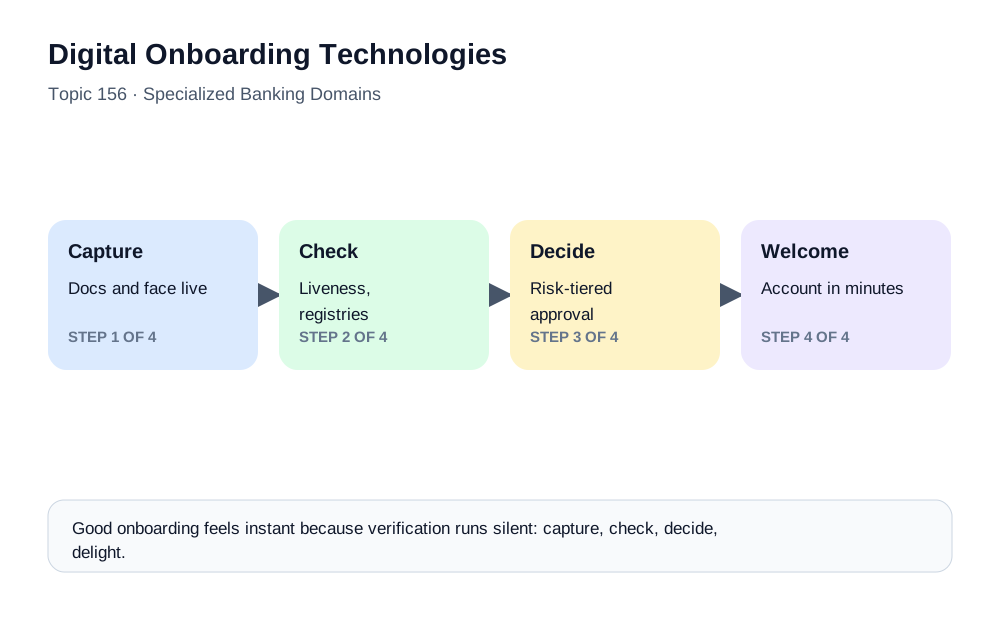
Digital Onboarding Technologies at a glance — eKYC, video KYC, digital document processing.
eKYC, Video KYC, Document Capture, Liveness, Consent, and Frictionless Account Opening
Digital onboarding is the process of converting a person from an interested prospect into a verified, active banking customer through digital channels. It may look like a simple mobile journey, but behind the screens are identity checks, KYC rules, fraud controls, document validation, consent capture, risk scoring, account creation, customer communication, and operational monitoring.
A good onboarding journey must do two things at the same time. It must be easy enough for genuine customers to complete without frustration, and controlled enough to stop fake identities, mule accounts, synthetic identity fraud, document tampering, and regulatory breaches.
This chapter explains digital onboarding from a practical banking perspective: eKYC, video KYC, document processing, selfie and liveness checks, consent, accessibility, funnel analytics, drop-off reduction, and the operational controls needed before a new customer is allowed into the bank.
Learning objectives
By the end of this chapter, you should be able to:
- Explain what digital onboarding means in banking.
- Understand eKYC, video KYC, document capture, OCR, face match, and liveness detection.
- Describe a typical account-opening funnel and where customers drop off.
- Identify fraud and compliance risks in onboarding.
- Explain consent, data minimisation, customer communication, and accessibility.
- Understand controls for duplicate checks, sanctions screening, PEP screening, adverse media, and mule-account prevention.
- Recognise the difference between good friction and bad friction.
- Explain how onboarding analytics improve conversion and risk outcomes.
1. What Digital Onboarding Means
Digital onboarding allows a customer to start and complete account opening or product registration without a full branch visit.
It can apply to:
- savings accounts;
- current accounts;
- wallets;
- credit cards;
- personal loans;
- merchant onboarding;
- small business accounts;
- investment accounts;
- insurance-linked banking products;
- payment-service access.
The exact process depends on country rules, product risk, customer type, and channel.
A basic onboarding journey may include:
- mobile number or email verification;
- identity capture;
- document upload or eKYC;
- selfie and liveness check;
- sanctions and risk screening;
- address verification;
- product selection;
- consent and declarations;
- account creation;
- first funding or activation.
2. Why Onboarding Matters
Onboarding is the first operational promise the bank makes to the customer.
If the journey is confusing, slow, or repeatedly fails, customers may abandon before the relationship begins. If the journey is too loose, the bank may onboard fraudsters, mule accounts, fake identities, or ineligible customers.
Good onboarding improves:
- customer acquisition;
- conversion rate;
- regulatory compliance;
- fraud prevention;
- data quality;
- first product usage;
- customer trust;
- operational efficiency;
- cost per acquisition.
The goal is not zero friction. The goal is the right friction at the right risk point.
3. Key Technologies
| Technology | Purpose |
|---|---|
| OTP verification | Confirms mobile number or email access |
| eKYC | Verifies identity using approved digital identity sources |
| OCR | Reads data from documents or images |
| Document validation | Checks authenticity, expiry, format, and tampering signals |
| Face match | Compares selfie with identity document image |
| Liveness detection | Checks that a real person is present, not a photo or video replay |
| Video KYC | Remote agent-assisted identity verification |
| Device fingerprinting | Assesses device risk and repeat usage patterns |
| Sanctions screening | Checks customer against restricted-party lists |
| PEP screening | Identifies politically exposed persons where required |
| Adverse media screening | Reviews negative public information where applicable |
| Risk scoring | Combines signals to decide accept, reject, or review |
| Digital signature | Captures legally valid customer approval where supported |
| Workflow engine | Routes applications through straight-through processing or manual review |
Technology should support compliance and customer experience together. Automation without governance can scale mistakes quickly.
4. Typical Onboarding Funnel
A funnel shows how many users move from one step to the next.
Example funnel:
| Stage | What happens | Common drop-off reason |
|---|---|---|
| App install or web visit | Customer enters journey | Low intent or unclear value |
| Start application | Customer begins registration | Too much information requested early |
| Mobile verification | OTP or device check | OTP delay, wrong number, network issue |
| Identity capture | Document or eKYC step | Trust concern, document unavailable |
| Selfie/liveness | Customer proves presence | Camera issue, poor lighting, confusion |
| Risk screening | Bank checks eligibility | Manual review, mismatch, sanctions alert |
| Product confirmation | Customer accepts terms | Fees or requirements unclear |
| Account creation | System opens account | Technical failure or duplicate record |
| First use | Customer funds or transacts | No clear next action |
Onboarding is not complete when the account is technically opened. It becomes meaningful when the customer starts using it.
5. eKYC
eKYC means electronic Know Your Customer verification using approved digital data sources or identity infrastructure.
Depending on jurisdiction, eKYC may validate:
- legal name;
- date of birth;
- address;
- identification number;
- photograph;
- mobile number;
- document status;
- biometric or consent-based identity assertion.
Benefits include speed, lower manual effort, better data quality, and reduced paper handling.
Risks include over-reliance on one data source, consent weakness, identity misuse, failed matching, outdated records, and privacy concerns.
Banks should record what was verified, from which source, when, under what consent, and with what result.
6. Document Capture and OCR
Document capture allows customers to upload or scan identity and address documents.
OCR reads data from images and converts it into structured fields.
Good document processing checks:
- document type;
- document number;
- expiry date;
- name consistency;
- date of birth;
- address;
- image quality;
- glare or blur;
- tampering indicators;
- duplicate document usage;
- document-template validity;
- match against customer-entered data.
OCR should reduce manual typing, but banks must handle OCR errors carefully. A wrongly read name, date, or document number can create downstream KYC and reporting issues.
7. Selfie, Face Match, and Liveness
Selfie capture proves that the applicant is present in the journey.
Face match compares the selfie with the photo on the identity document or trusted identity source.
Liveness detection checks whether the applicant is a real person, not a printed photo, recorded video, mask, deepfake, or screen replay.
Controls may include:
- passive liveness checks;
- blink or movement prompts;
- face-angle checks;
- lighting and image-quality checks;
- spoof detection;
- duplicate face detection;
- manual review for low-confidence matches.
Banks should not treat face match as perfect. Lighting, age, document quality, accessibility, and bias concerns must be considered.
8. Video KYC
Video KYC uses a trained agent to verify the customer remotely.
A video KYC process may include:
- customer joins secure video session;
- agent confirms identity details;
- customer shows original documents if required;
- liveness and location checks are performed where applicable;
- agent captures consent and observations;
- session is recorded and stored according to policy;
- case is approved, rejected, or sent for review.
Good video KYC design includes queue visibility, clear preparation instructions, retry options, language support, network checks, and respectful agent handling.
A poor video KYC journey can destroy an otherwise smooth digital onboarding experience.
9. Fraud and Compliance Checks
Digital onboarding must stop bad actors before they enter the bank.
Important checks may include:
- duplicate customer check;
- duplicate device check;
- document reuse check;
- sanctions screening;
- PEP screening;
- adverse media screening;
- fraud blacklist check;
- mule-account pattern check;
- synthetic identity signals;
- high-risk geography or IP signals;
- velocity checks across applications;
- suspicious referral or campaign pattern;
- device emulator or automation detection.
Some alerts are false positives. The bank needs a review process that is fast, documented, and fair.
10. Consent and Privacy
Onboarding collects sensitive data, so consent must be clear.
Customers should understand:
- what data is collected;
- why it is collected;
- which source it comes from;
- whether third parties are involved;
- how long data is retained;
- what happens if consent is not given;
- how the customer can raise questions or complaints.
Good onboarding follows data minimisation: collect what is needed, not everything that is technically possible.
Privacy is not a formality. It is part of trust.
11. Accessibility and Inclusion
Digital onboarding should work for real people in real conditions.
Design should consider:
- low literacy;
- local language needs;
- poor network coverage;
- older devices;
- small screens;
- visual impairment;
- motor difficulty;
- elderly customers;
- customers unfamiliar with banking terms;
- customers without immediate document access.
Good practices include simple language, large tap targets, screen-reader support, high contrast, save-and-resume, offline-friendly steps where possible, and branch or assisted-channel fallback.
Inclusion is not only social good. It improves conversion and reduces operational support load.
12. Good Friction vs Bad Friction
Not all friction is bad.
| Type | Example | Impact |
|---|---|---|
| Good friction | Extra check before high-risk account opening | Protects bank and customer |
| Good friction | Clear consent before pulling identity data | Builds trust and compliance |
| Bad friction | Asking same data three times | Causes abandonment |
| Bad friction | OTP fails without fallback | Blocks genuine customer |
| Bad friction | Long legal text without summary | Creates confusion |
| Bad friction | Manual review with no status | Damages trust |
The best onboarding journeys remove unnecessary friction and keep protective friction.
13. Onboarding Metrics
Banks should monitor onboarding performance carefully.
Useful metrics include:
- application start rate;
- step-wise completion rate;
- OTP success rate;
- document capture success rate;
- selfie/liveness pass rate;
- video KYC completion rate;
- straight-through processing rate;
- manual review rate;
- rejection rate by reason;
- average time to onboard;
- cost per completed account;
- first transaction rate;
- 30-day activation rate;
- fraud caught at onboarding;
- post-onboarding fraud rate;
- complaint rate;
- drop-off by device, language, and channel.
The best metric is not only completion. A journey that completes many fraudulent accounts is not successful.
14. Practical Example
A customer starts opening a digital savings account.
A strong journey may work like this:
- customer enters mobile number;
- OTP is auto-read with permission;
- customer chooses language;
- eKYC verifies identity with clear consent;
- selfie and liveness confirm applicant presence;
- sanctions and duplicate checks run in background;
- address and personal details are prefilled where permitted;
- customer reviews key terms and fees;
- account is opened;
- virtual debit card or account details are shown;
- customer is guided to first deposit or transaction.
The customer sees a simple flow. The bank runs identity, risk, consent, compliance, and account-creation controls underneath.
15. Common Misconceptions
Misconception 1: Digital onboarding means only a nice app screen.
Design matters, but onboarding also includes KYC, fraud controls, data quality, consent, risk scoring, account creation, and monitoring.
Misconception 2: More fields mean better risk control.
More fields can create abandonment and poor data. Better verification, trusted sources, and targeted controls are usually more effective.
Misconception 3: Automation removes the need for operations teams.
Automation reduces manual work, but operations teams still handle exceptions, false positives, failed verification, complaints, and quality review.
Misconception 4: Faster onboarding is always better.
Fast is good only when the bank still verifies identity, consent, eligibility, and fraud risk properly.
16. Frequently Asked Questions
What is eKYC?
eKYC is electronic identity verification using approved digital sources or processes instead of fully manual paper verification.
What is liveness detection?
It checks whether the person in front of the camera is live and present, not a photo, video, or spoof attempt.
Why do customers abandon onboarding?
Common reasons include too many steps, failed OTP, document capture problems, privacy concerns, unclear fees, video KYC queues, and technical errors.
What is straight-through processing?
It means the application is completed automatically without manual review because all checks pass within rules.
Why is consent important?
Because onboarding uses sensitive identity and financial data. Customers should know what is being accessed and why.
17. Key Terms
- Digital onboarding: Remote customer registration and verification journey.
- KYC: Know Your Customer.
- eKYC: Electronic KYC process.
- Video KYC: Remote video-based identity verification.
- OCR: Optical Character Recognition.
- Face match: Comparing customer selfie with trusted photo.
- Liveness detection: Checking that a real person is present.
- STP: Straight-Through Processing.
- PEP: Politically Exposed Person.
- Sanctions screening: Checking against restricted-party lists.
- Device fingerprinting: Identifying device risk signals.
- Mule account: Account used to receive or move illicit funds.
- Drop-off rate: Share of users who abandon a journey.
- Activation rate: Share of onboarded customers who start using the account.
18. Interview Insights
Interviewers may ask digital onboarding questions to test whether you can balance growth, compliance, and fraud prevention.
Strong answers usually mention:
- eKYC and document verification;
- selfie, face match, and liveness;
- video KYC where required;
- consent and privacy;
- sanctions, PEP, duplicate, and fraud checks;
- funnel analytics and drop-off reduction;
- accessibility and language support;
- straight-through processing plus manual review.
A good short answer:
"Digital onboarding is the controlled process of opening a banking relationship through digital channels. It must make the journey easy for genuine customers while verifying identity, capturing consent, checking fraud and compliance risk, creating accurate records, and monitoring activation after account opening."
19. Summary
Digital onboarding is where customer experience and banking control meet. It must be simple, inclusive, fast, and trustworthy, while still preventing identity fraud, mule accounts, poor data, and regulatory breaches.
For banking learners, the key lesson is this: onboarding is not just account opening. It is the bank's first test of customer trust, compliance discipline, fraud prevention, and digital design maturity.
Next: Topic 157 - Microfinance Deep Dive
<!-- MBA-DEEP-DIVE-START -->Digital Onboarding Deepening — Identity Proofing, KYC Architecture, Fraud Resistance, Workflow, and Customer Activation
Digital onboarding is a regulated identity-and-relationship creation process
The visible journey may take only a few minutes, but the bank is creating a legal customer relationship, establishing an identity record, assigning risk, capturing permissions, creating accounts or products, and determining what services the person can access. That makes onboarding much more than a user-interface funnel. A robust design joins customer experience, KYC, fraud prevention, sanctions and PEP screening, data quality, product eligibility, consent, core-banking creation, audit evidence, and post-opening monitoring into one controlled workflow.
The process should begin with a clearly defined onboarding perimeter
Before building screens, the bank should define which legal entity is onboarding the customer, which product is being opened, what countries or states are in scope, whether the customer is an individual or business, which identity routes are permitted, and which regulatory regime applies. The same mobile app can serve several legal entities, but the rules may differ. Architecture should therefore select the appropriate policy at the beginning rather than collecting one generic dataset and trying to interpret it later.
Customer identification and customer verification are different activities
Identification is collecting information about who the customer claims to be. Verification is obtaining sufficient evidence that those claims are reliable. A name and date of birth entered into a form identify a person but do not verify them. A well-designed journey records each identity attribute, its source, verification method, result, confidence, and timestamp. This distinction matters during audit and remediation because a bank must be able to explain what was actually checked rather than saying only that “KYC passed.”
KYC should be risk-based and jurisdiction-specific
FATF’s international standards support a risk-based approach to customer due diligence, but domestic laws and regulator directions determine the exact permitted methods. In India, for example, RBI’s KYC Direction and its amendments define customer-identification and digital or video-based processes for regulated entities in scope. A bank should map the current official requirement to system behaviour, including eligibility, evidence, retention, review, and exceptions. A method accepted for one entity or product should not be assumed valid everywhere.
Digital identity should be treated as evidence with a known assurance level
An electronic identity source can provide strong evidence, but the bank still needs to understand what it proves. Does it confirm legal identity, address, possession of a credential, biometric binding, or only access to an account? What controls were applied when the identity was originally issued? Is the assertion current? Can it be revoked? FATF’s digital identity guidance encourages financial institutions to understand the assurance and governance of the digital-ID system they rely on instead of assuming that “digital” automatically means reliable.
Identity orchestration should support multiple approved routes
Customers may have different documents, devices, connectivity, abilities, or legal statuses. An onboarding platform should therefore orchestrate several approved verification paths: trusted electronic identity, document plus selfie, video interaction, branch-assisted completion, or specialist review. The workflow should know why a customer moved from one route to another. Fallback should preserve assurance, not become an easier loophole chosen whenever the primary control fails.
Document capture is a chain of controls, not an OCR feature
A customer photographing a passport, national ID, tax document, or proof of address creates several tasks: image-quality assessment, document classification, field extraction, format validation, expiry checks, tamper analysis, comparison with customer-entered information, and where appropriate verification against authoritative or trusted sources. OCR improves speed but does not prove authenticity. The original image, extracted values, confidence scores, corrections, and validation results should remain linked for audit.
Manual correction of OCR needs traceability
Poor lighting or unusual fonts can cause OCR to misread a digit or name. Operations may need to correct the extracted value. The bank should preserve the machine-read result, corrected value, reason, operator, and supporting image. Silent replacement makes it impossible to know whether a later mismatch came from the customer, the document engine, or manual intervention. These details matter when a duplicate or sanctions-screening issue appears later.
Document authenticity checks should focus on realistic attack methods
Fraudsters can alter images, reuse genuine documents, create synthetic documents, manipulate metadata, or present high-quality digital replicas. Controls can examine layout, security features visible to the capture channel, data consistency, machine-readable zones, duplicate usage, source validation, and tamper signals. No one detector is perfect. A strong decision combines document evidence with face, device, behavioural, network, application, and external-data signals where lawful.
Face matching is probabilistic and needs thresholds with operational meaning
A face-match score is not a binary fact. The bank sets thresholds based on model performance, fraud risk, customer experience, and applicable requirements. Scores above a high threshold may proceed, low scores may fail, and an intermediate range may require another capture or manual review. Threshold changes are model or policy changes and should be tested. Teams should monitor false accepts and false rejects because both have consequences.
Liveness controls must evolve as presentation attacks evolve
A liveness engine attempts to distinguish a live applicant from a photograph, video replay, mask, injected stream, synthetic face, or other spoof. Passive methods can reduce customer friction; active challenges may add assurance in some contexts. Deepfake and injection techniques make ongoing testing important. The bank should know what attack classes the vendor claims to detect, how those claims were tested, and how uncertain results are handled operationally.
Biometric controls need fairness, accessibility, and fallback governance
Face algorithms can perform differently across conditions such as age, lighting, camera quality, pose, and demographic groups. Customers may also be unable to complete a particular biometric action because of disability, injury, religious practice, or device limitation. The bank should monitor outcome patterns and provide an alternative approved route. A secure fallback is part of inclusive design; a weak fallback is a fraud vulnerability.
Video customer identification is an operational service, not just a video call
Where remote video identification is permitted, the process may require trained staff, real-time interaction, prescribed observations, location or device checks where applicable, image or document capture, recording, quality standards, secure storage, and maker-checker review. Queue management matters because long waits cause abandonment. Operations should monitor call quality, agent decisions, failed sessions, reattempts, and suspicious patterns across agents and locations.
Agent quality can materially affect verification quality
Two agents can interpret the same borderline case differently. Training should use realistic examples of document damage, mismatched data, suspected coaching, low image quality, and vulnerable customers. Quality assurance should sample accepted and rejected sessions, not only failures. If one agent has an unusually high approval rate or rejection rate, management should investigate whether the issue is training, performance pressure, collusion, or customer mix.
Device intelligence helps identify repeated and industrialised abuse
Fraudsters can submit many applications from one device, emulator farm, automated environment, or coordinated network. Device and network signals can help identify unusual reuse, automation, anonymisation, impossible geography, compromised environments, and rapid application velocity. These are risk signals, not identity proof. Shared-family devices, public networks, resellers, and legitimate cyber tools can create false positives, so decisions should consider context.
Duplicate detection should operate across identity, device, document, and face
A bank can encounter the same person applying repeatedly, one identity used with several faces, one face used with several identities, or one device used for many applicants. Duplicate-control design should define which relationships are suspicious and which are normal. For example, a branch tablet or assisted agent device may legitimately serve many customers. Entity-resolution rules need contextual attributes, thresholds, review, and audit history.
Synthetic identity risk requires cross-field consistency analysis
A synthetic identity can combine real and fabricated attributes that individually pass simple checks. Controls can compare age, address, phone tenure, identity issuance, credit-file history, device data, email history, document evidence, and prior applications for implausible combinations. The objective is not to collect every possible data point but to identify contradictions using permitted evidence. Strong provenance helps analysts distinguish a thin-file customer from a constructed identity.
Mule-account prevention should begin at account opening
A genuine identity can still be recruited or coerced to open an account for criminals. Onboarding controls can look for repeated devices, common addresses or contact points, suspicious referral patterns, scripted behaviour, rapid post-opening beneficiary activity, unusual first funding, or connections to known fraud networks. Because many mule indicators emerge only after account creation, onboarding risk should feed enhanced early-life monitoring rather than pretending that KYC can eliminate all future misuse.
Sanctions screening is not the same as identity verification
Identity verification asks whether the applicant is the person they claim to be. Sanctions screening asks whether that person or connected party may be restricted under applicable rules. A high-quality verified identity can still produce a sanctions match. Screening systems need names, dates, countries, identifiers, aliases, and other relevant attributes, and they need a controlled alert-resolution process. The onboarding workflow should not label every screening hold as a failed KYC check because the downstream treatment and disclosure can differ.
PEP and adverse-information controls need scope definitions
Politically exposed person treatment and adverse-information review vary by jurisdiction, customer risk, and institutional policy. Requirements should state what sources are used, who is screened, how relationships or close associates are handled where required, how false positives are resolved, and what approvals are needed. A vendor returning “risk found” is not a complete control. The bank needs a documented decision and evidence.
Business onboarding needs beneficial ownership and authority controls
Onboarding a company is not simply the individual journey with a company-name field. The bank may need to verify legal existence, registered office, directors, beneficial owners, controllers, business activity, expected account use, tax information, source of funds, and the authority of the person acting for the entity. Ownership chains can include several corporate layers and jurisdictions. Workflow should support entity graphs rather than flatten complex structures into free text.
Beneficial-ownership data should preserve source and calculation logic
If ownership percentages are derived through several holding companies, the bank should retain the source documents and calculation path. When ownership changes, the previous structure should remain historically visible. This is important for KYC review, sanctions exposure, lending limits, related-party analysis, and regulatory requests. A single “UBO name” field is inadequate for complex corporate customers.
Product eligibility should be separate from KYC approval
A customer can pass identity and financial-crime checks but still be ineligible for a particular product because of age, residence, legal entity, tax status, employment, risk appetite, or product policy. Keeping product eligibility as a distinct decision improves reason codes and analytics. Otherwise teams can mistakenly interpret all failed applications as KYC failures and obscure where genuine customers are being lost.
Consent should be captured by purpose and version
An onboarding journey can contain acceptance of account terms, privacy notice acknowledgement, permission to access an identity source, marketing consent, data-sharing choices, credit-bureau authorization where required, and optional product consents. These should not be collapsed into one checkbox. The record should identify the text or version shown, timestamp, channel, customer action, and any later withdrawal. Consent evidence must survive front-end redesigns.
Data minimisation should be enforced in architecture
Forms tend to accumulate fields because each project asks for “just one more.” A data inventory should identify why each attribute is required, whether it is mandatory or optional, which system owns it, who can access it, how long it is retained, and whether it is transmitted to a vendor. Removing unused data reduces privacy exposure, customer effort, integration complexity, and security risk.
Prefill should never become silent customer attestation
Trusted sources can prefill name, address, date of birth, or tax information, reducing typing. The interface should show which information came from a source and whether the customer is expected to confirm or correct it. If a customer edits a verified value, the workflow should know whether reverification is required. Systems should not convert source data into “customer-declared” data without retaining provenance.
Save-and-resume needs secure state management
Longer business or investment onboarding may require customers to leave and return. Draft applications should be encrypted, access controlled, time limited, and associated with a known identity or secure recovery method. The workflow should define which checks expire. A sanctions result or document validity from several months ago may need refreshing before final approval.
Step expiry should be explicit
OTP verification, document validation, bureau data, sanctions screening, pricing, and product eligibility may have different validity periods. A customer who resumes after a long delay should not automatically inherit every old result. The workflow engine needs expiry rules and should rerun the correct controls. This is more reliable than forcing the customer to restart the whole journey unnecessarily.
Straight-through processing requires explainable routing rules
STP should mean that all required checks passed according to approved rules, not that “the computer approved it.” The bank should know which conditions permit automatic completion and which trigger manual review. Rules can include identity confidence, screening status, duplicate risk, product eligibility, fraud score, document quality, and jurisdictional requirements. Every automated decision should generate a trace that operations and audit can reconstruct.
Manual-review queues should be risk prioritised
A queue containing harmless OCR mismatches and serious suspected identity fraud in arrival order is inefficient. Cases can be prioritised by customer impact, risk, application age, product, alert type, and service commitment. Review screens should present the evidence needed for that alert rather than force analysts to open many systems. Good workflow design reduces both risk and abandonment.
Queue ageing is a customer-outcome metric
A customer waiting in manual review may not know whether the application is progressing. Operations should monitor age by queue and reason, define escalation thresholds, and communicate meaningful status. If a specific alert consistently takes days, management should address the control or staffing bottleneck rather than hide the delay inside an average onboarding time.
Exception outcomes need reason codes that support root cause analysis
“Rejected” is too broad. The bank should distinguish invalid identity, unverifiable evidence, sanctions hold, duplicate record, suspected fraud, product ineligibility, unsupported jurisdiction, incomplete application, customer withdrawal, technical failure, and other controlled states. Some reasons may not be disclosed to the customer in full, but internal precision is necessary for analytics, fairness monitoring, compliance, and remediation.
Core-banking customer creation should be idempotent
Network retries or workflow restarts must not create duplicate customer records or accounts. The onboarding platform should use stable application and customer references, check whether creation has already succeeded, and reconcile uncertain responses. A timeout after account creation is especially dangerous because the front end may retry while the core has already committed the first request.
Customer master matching needs careful survivorship rules
An applicant may already exist because of an old account, joint relationship, credit card, remittance, or abandoned application. Entity resolution should decide whether to reuse, update, or create a customer record. Fields from a new application should not blindly overwrite more reliable existing information. Survivorship rules should consider source quality, verification status, recency, and regulatory obligations.
Screening should be repeated at the right point before activation
If onboarding takes several days, the initial sanctions or risk-screen result can become stale. The bank should define when screening occurs and whether a final check is needed before account activation or funding. Long-running workflows should also respond to material list updates where required. The design should avoid both unnecessary repeated calls and gaps caused by stale results.
Account opening and account activation can be separate states
A core account may exist before all customer-facing capabilities are enabled. Funding, payments, cards, credit, or international transfers may require additional controls. Explicit activation states allow the bank to apply restrictions until conditions are satisfied. Operations should see these states clearly so a partially activated account is not mistaken for a system defect.
First funding deserves fraud and source checks appropriate to risk
The first deposit can reveal whether the account is behaving as expected. Funding from an unrelated third party, rapid cash-in and cash-out, repeated small transfers from many sources, or immediate high-risk payment activity can change the risk picture. Early-life monitoring should connect onboarding data with transaction behaviour and feed cases back to fraud or KYC teams where needed.
Onboarding success should include early-life quality
A bank that celebrates high account-opening conversion while half the accounts remain dormant or become fraud cases is optimising the wrong metric. Quality measures can include first funding, first successful transaction, 30- or 90-day activity, early fraud, early delinquency for credit products, complaint rate, closure rate, and KYC rework. These measures help distinguish genuine acquisition from superficial volume.
Funnel analytics should distinguish customer choice from control failure
A drop-off after product pricing may indicate the customer did not like the offer. A drop-off after repeated camera errors may indicate technology failure. A drop-off after an unexplained manual-review screen may indicate poor communication. Analytics should capture step, reason, technical errors, device, channel, language, and control outcome. Teams should not remove security checks simply because a funnel chart shows friction without understanding why it exists.
Conversion experiments need compliance guardrails
A/B testing can improve digital journeys, but regulated disclosures, consent, identity controls, and mandatory information should not be casually changed to improve conversion. Experiment governance should identify protected elements, legal approval requirements, sample risks, and monitoring. A design variant should not expose one customer cohort to materially weaker controls without explicit authorization.
Accessibility should be tested with the actual verification technology
A screen-reader-compatible form is not enough if the camera challenge cannot be completed by a customer with a disability. Testing should cover document positioning, gesture prompts, audio instructions, video sessions, timeouts, colour contrast, text scaling, local languages, and assisted alternatives. Inclusion requirements belong in vendor selection because some limitations cannot be fixed in the bank’s front end.
Low-bandwidth design can improve both inclusion and control quality
Customers with unstable connectivity may submit partial images, retry repeatedly, or abandon sessions. The app can compress images carefully, test network quality before video, save safe progress, and distinguish upload failure from verification failure. Otherwise technical problems may be misclassified as suspicious customer behaviour. Operational metrics should separate network issues from risk decisions.
Vendor architecture should avoid creating an identity black box
Banks commonly use specialist vendors for OCR, liveness, face matching, document verification, device intelligence, and screening. Contracts and interfaces should define data fields, confidence scores, reason codes, model changes, service levels, retention, subprocessors, incident reporting, audit rights, and exit arrangements. The bank needs enough information to challenge decisions and migrate providers without losing customer evidence.
Vendor model changes should trigger controlled validation
A provider can improve its liveness or face model without changing the API. That can materially alter acceptance rates. Contracts should require appropriate notification, and the bank should monitor outcome shifts by model version. A sudden improvement in conversion may be a genuine enhancement or a weakened fraud threshold. Version telemetry helps distinguish the two.
Cybersecurity is part of onboarding trust
Identity images, biometrics, tax identifiers, addresses, signatures, and business documents are valuable targets. Data should be encrypted in transit and at rest, access should follow least privilege, downloads should be controlled, and administrative activity should be logged. Test environments should not contain uncontrolled copies of production identity data. Security incidents can turn an efficient onboarding programme into a long-term identity-fraud problem for customers.
Operations need a clear incident playbook for onboarding outages
If an identity provider, screening vendor, video platform, or core-banking interface fails, the bank should know whether to queue applications, use an approved alternative, pause onboarding, or continue only low-risk steps. Staff should not invent bypasses under sales pressure. The customer interface should communicate the situation honestly and preserve completed work where possible.
Reconciliation should prove that approved applications became the intended accounts
The bank can reconcile onboarding approvals to customer-master creation, account creation, product configuration, KYC status, screening status, and customer communication. This detects cases where workflow says “complete” but downstream creation failed, or where an account was opened without all required approvals. Reconciliation is essential when multiple systems commit independently.
Data lineage supports later KYC refresh and remediation
Months or years later, the bank may need to know which address came from a customer declaration, which identity attribute came from a trusted source, which photograph was used, and which screening result was current at onboarding. Good lineage lets future reviews reuse reliable evidence appropriately and identify what must be refreshed. Without lineage, every field looks equally trustworthy even when it is not.
KYC refresh should be designed at onboarding
Customer due diligence is not a one-time event. The initial process should assign review rules, risk rating, expected activity, ownership of missing future information, and triggers for refresh. Events such as address change, ownership change, unusual activity, expired documents, or material risk changes may require review according to policy. The best onboarding platform creates the foundation for lifecycle KYC rather than handing off an opaque record.
Scenario: a deepfake passes image quality but fails broader risk checks
An application submits a high-quality synthetic face video and a manipulated identity image. The liveness score is borderline but not an automatic fail. Device intelligence shows repeated applications, document analysis identifies reuse, and identity data conflict with trusted records. The workflow routes the case to specialist review instead of relying on one biometric score. The case is declined under appropriate policy and linked indicators strengthen future detection.
Scenario: a genuine rural customer repeatedly fails video verification
The customer has poor connectivity and an older device. Rather than classifying the repeated disconnects as suspicious, the app identifies network instability and offers an approved assisted route. Previously completed identity steps are retained within their validity period. The customer completes onboarding without weakening KYC assurance. This is what risk-based inclusion looks like in system design.
Scenario: core account creation succeeds but the API response times out
The onboarding orchestrator does not simply send another create request. It queries the core using the stable application reference, confirms that the account exists, reconciles product configuration, and resumes the workflow. The customer receives one account, not two. Idempotency turns an ordinary network failure into a recoverable technical event instead of a financial-record problem.
Business analysts should document the onboarding state machine
A strong requirements model covers prospect, application started, identity collected, identity verified, screening pending, screening cleared, fraud review, product eligible, consent complete, manual review, approved, core creation pending, account created, activation pending, active, rejected, withdrawn, expired, and remediation states. Each transition needs trigger, owner, evidence, timeout, retry behaviour, customer message, and downstream effects. This makes complex onboarding testable and auditable.
Test design should include attack, accessibility, and recovery cases
A serious test pack includes valid and expired documents, OCR errors, duplicate identity, duplicate device, face mismatch, liveness spoof, deepfake injection where supported, sanctions alert, PEP review, low bandwidth, video interruption, accessibility fallback, consent withdrawal, resume after expiry, vendor timeout, core timeout, duplicate create retry, manual override, and early-life suspicious activity. Happy-path speed alone says little about onboarding quality.
Authoritative-source discipline is essential
Digital onboarding controls should be grounded in the current requirements applicable to the institution. FATF guidance is useful for understanding risk-based digital identity. Indian regulated entities should use the current RBI KYC Direction and amendments for permitted customer-identification and video processes, plus relevant digital-lending, outsourcing, privacy, and cyber requirements. Other jurisdictions have their own identity and customer-due-diligence frameworks. Vendor marketing should never be treated as the legal basis for an onboarding method.
Closing perspective
Digital onboarding is successful when a real eligible customer can establish a usable banking relationship with minimal unnecessary effort, while the bank can prove who was onboarded, how identity was verified, what screening occurred, which consent was given, why the product was approved, which systems created the relationship, and how suspicious or failed cases were handled. The most mature design does not choose between conversion and control. It makes control intelligent enough that genuine customers experience a simple journey and risky cases receive precisely targeted friction.
Digital onboarding is a controlled decision journey, not a form on a screen
A digital onboarding journey may look simple to a customer: enter details, upload evidence, complete identity checks, accept terms, and receive an account or product. Behind that experience the bank is coordinating identity, eligibility, fraud controls, compliance checks, data quality, consent, document evidence, product configuration, customer creation, account opening, channel access, and audit records. The journey is successful only when all of those outcomes agree. A visually smooth application that leaves incomplete records, duplicate customers, unreviewed alerts, or uncertain product status is not good onboarding.
The architecture should begin with a clear application state model. Typical states can include started, identity evidence captured, verification pending, additional information required, fraud review, compliance review, approved, rejected, expired, account creation pending, completed, or referred for manual handling. Exact names vary by bank, but the important principle is that the same customer application should not appear “approved” in one system and “pending” in another without a controlled explanation.
Identity resolution comes before creating another customer
A major onboarding risk is duplicate identity. A returning customer can accidentally be treated as a new customer because the bank relies on a single identifier or because old records contain different spellings, addresses, phone numbers, documents, or transliterations. Duplicate customer records create downstream problems in KYC, sanctions screening, credit exposure, fraud monitoring, statements, complaints, and customer service.
Digital onboarding should therefore distinguish identity verification from identity resolution. Verification asks whether the applicant can prove the claimed identity. Resolution asks whether that identity already exists in the bank's customer universe and, if so, which existing record is authoritative. Matching can use multiple attributes with rules for confidence, ambiguity, and manual review. A low-confidence match should not automatically merge customers, while a strong existing relationship should not silently create a second profile.
The process also needs a controlled response when evidence conflicts. A valid document may contain a new address, changed surname, or updated identifier. Rather than rejecting the application generically, the bank can route the difference into a known maintenance or review process and preserve both the original evidence and the resolution decision.
Orchestration should control retries and duplicate requests
Digital journeys operate over unreliable networks and impatient users often retry. If the customer taps “submit” twice or the mobile connection drops after the request reaches the bank, the platform must avoid creating two applications or two accounts. Idempotency and durable application references are therefore business controls, not merely technical conveniences.
Each material step should be repeatable safely. If a document-verification provider times out, the orchestration layer should know whether the request can be retried, whether a previous response might still arrive, and how multiple responses are correlated. If an account-creation service succeeds but the response is lost, the onboarding platform should query or reconcile the result instead of creating another account.
Timeouts also need business meaning. A technical timeout does not prove that the underlying action failed. The safest state may be “outcome unknown” until the bank confirms whether the external service or core system completed the request. Designing for uncertain outcomes prevents duplicate execution and contradictory customer messages.
Fraud, KYC, and product eligibility are different decisions
Digital onboarding combines controls that answer different questions. Identity verification asks whether evidence supports the claimed identity. Fraud controls assess whether behaviour, device, document characteristics, velocity, or other signals suggest deception or account-opening abuse. KYC and due-diligence processes assess whether the bank has sufficient information to establish and manage the relationship. Product eligibility checks whether the customer qualifies for the specific account, card, loan, or service.
These decisions should not be collapsed into one opaque score. A customer may pass identity checks but require additional due diligence. A legitimate existing customer may trigger a fraud review because a device or location pattern is unusual. A customer may be perfectly identifiable but ineligible for a specific product. Preserving reason codes and decision provenance helps operations explain what happened and apply the correct remediation path.
Manual review is part of the designed journey
A fully straight-through journey is desirable only for cases that can be decided safely and confidently. Manual review is not automatically a failure. The risk comes from uncontrolled review queues with unclear ownership, poor evidence, long ageing, inconsistent decisions, or no customer communication.
Review work should arrive with the application reference, triggering reason, relevant evidence, prior automated checks, timestamps, and permitted actions. Reviewers should not have to reconstruct the entire application from several systems. Decision options and override rights should be defined. If a reviewer changes an automated outcome, the reason should be captured for audit and later analysis.
Queue metrics should include volume, ageing, rework, approval and decline outcomes, repeated referral causes, and service level. A sudden increase in referrals can reveal an upstream data problem or over-sensitive rule. The bank can then fix the root cause rather than simply adding more staff.
Evidence must survive after the customer closes the browser
Onboarding evidence includes more than uploaded documents. The bank may need to retain what the customer declared, which terms were presented, what consent was given, which verification result was received, which rules or models contributed to the decision, which employee handled an exception, and when the account was created. The evidence should remain linked to the final customer and product records.
Versioning matters. If terms, disclosures, or eligibility rules change, the bank should be able to establish which version applied to a historical application. Likewise, a current risk rule should not be assumed to explain a decision made under an earlier configuration. Reconstructability is essential for complaints, investigations, audit, and control testing.
Customer communication should reflect the actual state
The interface should not promise completion before the bank has a confirmed outcome. “Application received,” “approved,” “account created,” and “ready to use” are different states. If downstream account creation or channel activation remains pending, the customer message should reflect that difference.
Rejection messages need appropriate clarity without exposing sensitive control logic. Where the bank can safely request more information or offer a remediation path, the message should tell the customer what to do next. Generic error messages should be reserved for genuine technical problems, not used to conceal every business exception.
Measure conversion together with control quality
Onboarding teams naturally monitor completion and abandonment, but optimisation should not weaken controls. Useful management information combines customer and risk outcomes: completion rate, time to onboard, referral rate, duplicate-customer rate, failed verification causes, fraud detection, false-positive review, application rework, account-creation failures, complaint themes, and post-onboarding fraud or remediation.
A lower abandonment rate is not a success if it is achieved by suppressing necessary evidence collection or creating accounts that later require restriction. Conversely, excessive friction can drive legitimate customers away without reducing risk. The purpose of measurement is to find where controls can become both safer and easier through better data, clearer workflow, and more precise decisioning.
A mature digital onboarding platform therefore behaves like an orchestrated banking process. It preserves one application identity, manages uncertain technical outcomes, resolves existing customers, separates control decisions, supports disciplined manual review, retains evidence, and communicates only confirmed states. The digital front end matters, but the real quality of onboarding is visible in the integrity of the customer record and the downstream account that emerges from it.
<!-- MBA-DEEP-DIVE-END -->