Visual overview
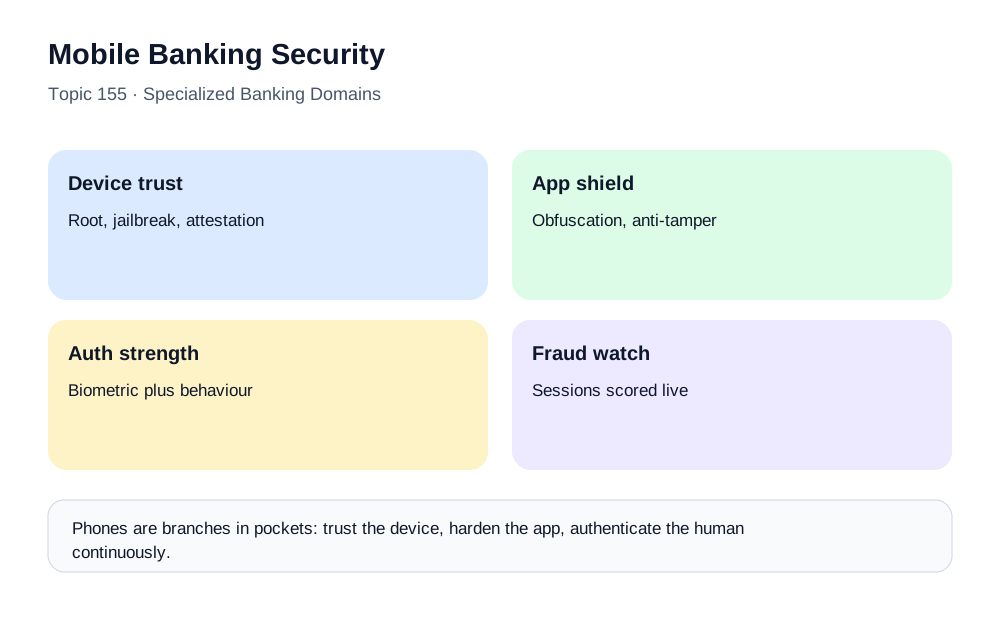
Mobile Banking Security at a glance — Device security, app security, fraud prevention.
App Security, Authentication, Device Trust, Fraud Controls, and Customer Protection
Mobile banking is now one of the most important banking channels. Customers use mobile apps to check balances, move money, approve payments, manage cards, open deposits, apply for loans, invest, raise complaints, and receive alerts. That convenience also makes mobile banking a major target for fraudsters, malware, social engineering, account takeover, and data theft.
Mobile banking security is not one control. It is a layered operating model covering app design, device binding, authentication, encryption, API security, transaction monitoring, fraud detection, customer education, incident response, and regulatory compliance.
This chapter explains mobile banking security from a practical bank perspective: the main threats, how banks protect apps and APIs, how authentication works, why device trust matters, how fraud patterns are detected, and how customer protection depends on both technology and behaviour.
Learning objectives
By the end of this chapter, you should be able to:
- Explain the main security risks in mobile banking.
- Understand app security controls such as code obfuscation, jailbreak/root detection, certificate pinning, and tamper detection.
- Describe authentication controls: PIN, password, biometrics, OTP, device binding, and transaction signing.
- Explain API security, encryption, session control, and server-side protection.
- Identify fraud patterns such as phishing, smishing, SIM swap, malware, screen sharing, overlay attacks, and social engineering.
- Understand device trust, behavioural monitoring, transaction limits, alerts, and risk-based authentication.
- Recognise customer responsibilities and bank responsibilities.
- Explain why mobile banking security must balance safety, usability, and customer trust.
1. What Mobile Banking Security Means
Mobile banking security protects the customer, the bank, and the financial system when banking services are accessed through a mobile device.
It covers:
- secure app development;
- customer authentication;
- device registration;
- transaction authorisation;
- encryption of data in transit and at rest;
- API protection;
- fraud monitoring;
- malware and device risk detection;
- session management;
- data privacy;
- customer alerts;
- dispute and fraud reporting;
- incident response;
- regulatory compliance.
The aim is not only to stop hackers. It is to prevent unauthorised access, unauthorised transactions, data leakage, customer manipulation, and operational failure.
2. Why Mobile Security Is Difficult
Mobile banking is hard to secure because the bank does not fully control the customer's environment.
Customers may use:
- old phones;
- outdated operating systems;
- unsafe Wi-Fi;
- rooted or jailbroken devices;
- fake apps;
- weak device locks;
- shared phones;
- screen-sharing tools;
- malware-infected devices;
- compromised SIM cards;
- poor password habits.
The bank controls its app and systems. It does not fully control the customer's device, network, or behaviour. That is why mobile security needs layered controls and customer education.
3. Common Threats
| Threat | How it works | Customer impact |
|---|---|---|
| Phishing | Fake website or message captures credentials | Account takeover or unauthorised transaction |
| Smishing | SMS or messaging fraud link tricks customer | Credential theft or malware installation |
| Vishing | Fraud call manipulates customer | OTP, PIN, or payment approval shared |
| SIM swap | Fraudster takes control of mobile number | OTPs or alerts intercepted |
| Malware | Malicious app reads screens, SMS, or keystrokes | Credential and OTP compromise |
| Overlay attack | Fake screen appears over banking app | Customer enters secrets into attacker screen |
| Screen sharing fraud | Customer is tricked into sharing screen | Fraudster watches OTP or guides transfer |
| Fake app | Imitation banking app steals data | Credentials and device data compromised |
| Man-in-the-middle | Attacker intercepts communication | Data theft or session compromise |
| Social engineering | Customer is psychologically manipulated | Customer authorises fraud themselves |
Many frauds do not break encryption. They trick the customer or compromise the device around the banking app.
4. App Security Controls
Banks build controls into the mobile app itself.
| Control | Purpose |
|---|---|
| Code obfuscation | Makes reverse engineering harder |
| Tamper detection | Detects modified or repackaged app |
| Root/jailbreak detection | Detects devices with weakened OS controls |
| Certificate pinning | Reduces man-in-the-middle certificate attacks |
| Secure storage | Protects tokens and keys on the device |
| Runtime protection | Detects debugging, hooking, or instrumentation attempts |
| Screen capture restriction | Prevents screenshots on sensitive screens where supported |
| App integrity checks | Confirms app is genuine and unchanged |
| Secure keyboard | Reduces keylogging risk for sensitive entry fields |
| Session timeout | Logs out inactive sessions |
No app control is perfect. The goal is to make attack harder, detect compromise earlier, and reduce loss if one layer fails.
5. Authentication Controls
Authentication proves that the user is allowed to access the account.
Common factors include:
- something the customer knows: password, PIN, passcode;
- something the customer has: registered device, SIM, token, authenticator;
- something the customer is: fingerprint, face, voice, behavioural pattern.
Mobile banking commonly uses multi-factor authentication, such as device binding plus app PIN or biometric plus transaction OTP.
Strong authentication should be risk-based. A balance check may need less friction than adding a beneficiary, changing a mobile number, resetting credentials, or sending a high-value payment.
6. Device Binding and Device Trust
Device binding links a customer's mobile banking access to a registered device.
During registration, the bank may check:
- mobile number;
- device identifier signals;
- SIM status;
- app installation source;
- OTP or activation code;
- customer credentials;
- biometric or PIN setup;
- risk score.
Device trust may consider:
- operating system version;
- security patch level;
- root or jailbreak status;
- malware signals;
- emulator detection;
- device change history;
- location and network risk;
- SIM swap indicators;
- unusual app behaviour.
If device trust is low, the bank may block, challenge, limit, or monitor activity more closely.
7. Transaction Authorisation
Login authentication is not enough. High-risk actions need transaction-level control.
High-risk actions include:
- adding a new beneficiary;
- changing registered mobile number;
- resetting password or PIN;
- initiating large payment;
- increasing transfer limit;
- enabling international card usage;
- changing email address;
- adding device or wallet;
- closing account or redeeming investment;
- changing standing instructions.
Controls may include:
- OTP;
- app approval prompt;
- biometric confirmation;
- transaction signing;
- cooling period;
- beneficiary activation delay;
- risk-based hold;
- call-back verification for high-risk cases.
A good system protects the exact action, not just the login session.
8. Encryption and API Security
Mobile apps communicate with bank APIs. These connections must be protected.
Important controls include:
- TLS encryption;
- certificate validation;
- certificate pinning where suitable;
- strong API authentication;
- short-lived tokens;
- refresh-token protection;
- rate limiting;
- replay protection;
- input validation;
- transaction signing;
- API gateway controls;
- monitoring for abnormal traffic;
- secrets not hardcoded in app code.
API security is critical because attackers may bypass the app interface and attack backend services directly.
9. Fraud Monitoring
Mobile banking fraud monitoring looks for suspicious patterns.
Signals may include:
- new device login followed by high-value transfer;
- SIM change before password reset;
- new beneficiary and immediate payment;
- unusual location or IP address;
- rapid failed login attempts;
- abnormal transaction velocity;
- screen-sharing app detected;
- malware or overlay signal;
- customer behaviour different from normal;
- mule-account destination;
- payment at unusual time;
- multiple customers paying same suspicious beneficiary.
The bank may respond by approving, challenging, delaying, declining, blocking, or sending for manual review.
Fraud monitoring must reduce loss without creating too many false positives.
10. Customer Alerts and Notifications
Alerts help customers detect unauthorised activity quickly.
Useful alerts include:
- login from new device;
- password or PIN change;
- beneficiary added;
- contact details changed;
- payment initiated;
- card blocked or unblocked;
- limit changed;
- failed login attempts;
- unusual transaction;
- loan or deposit change.
Alerts should be timely and clear. If customers receive vague alerts, they may ignore them. If alerts arrive late, the chance of stopping fraud reduces.
11. Customer Education
Customers are part of the security model.
Important guidance includes:
- download apps only from official app stores;
- never share OTP, PIN, password, CVV, or full card details;
- do not click suspicious links;
- avoid installing unknown APK files;
- keep phone OS and banking app updated;
- avoid banking on unsafe public Wi-Fi;
- do not allow strangers to guide through screen sharing;
- report lost phone or suspicious activity quickly;
- review transaction alerts;
- use strong device lock;
- beware urgent calls claiming to be from bank, regulator, police, courier, or support team.
Customer education should be repeated in simple language because fraudsters keep changing the story.
12. Bank Operational Controls
Behind the app, bank teams need operational controls.
These include:
- secure software development lifecycle;
- vulnerability scanning;
- penetration testing;
- incident response playbooks;
- fraud operations queue;
- customer dispute process;
- access control for staff tools;
- privileged-access monitoring;
- data masking;
- audit logs;
- disaster recovery;
- third-party vendor security review;
- API monitoring;
- release management;
- regulatory incident reporting where required.
Mobile security is not only an IT topic. Operations, fraud, compliance, legal, product, customer service, and technology all share responsibility.
13. Privacy and Data Protection
Mobile apps should collect only data needed for legitimate purposes.
Sensitive data may include:
- identity details;
- account numbers;
- card data;
- location;
- device information;
- contact details;
- transaction history;
- biometric authentication signals;
- behavioural data;
- documents and images.
Good privacy controls include consent, purpose limitation, minimisation, retention rules, encryption, masking, access control, and clear customer disclosure.
Security protects systems. Privacy protects customer dignity and trust.
14. Incident Response
Even strong banks must prepare for incidents.
A mobile security incident may involve:
- fake app discovery;
- phishing campaign;
- malware targeting customers;
- API attack;
- credential stuffing;
- data leakage;
- unauthorised transactions;
- SIM-swap fraud wave;
- app vulnerability;
- third-party compromise.
Response steps may include:
- detect and classify incident;
- contain affected systems or transactions;
- block malicious indicators;
- notify fraud, security, operations, and compliance teams;
- communicate with affected customers;
- report to regulators where required;
- investigate root cause;
- reimburse or resolve customer cases according to rules;
- fix controls;
- monitor recurrence.
Speed matters, but evidence and customer communication matter too.
15. Emerging Controls
Mobile banking security keeps evolving.
Emerging and advanced controls include:
- behavioural biometrics;
- passkeys and passwordless authentication;
- FIDO-based authentication;
- device risk scoring;
- transaction signing;
- AI-based fraud detection;
- mule-account network detection;
- scam intervention messages;
- real-time payment holds for suspicious beneficiaries;
- secure in-app customer support;
- voice and video verification for high-risk changes;
- continuous authentication.
New controls must be tested carefully. A security feature that customers cannot use will create service problems and workarounds.
16. Practical Example
A customer receives a message saying their mobile banking will be blocked. The link opens a fake page asking for customer ID, password, card details, and OTP.
A strong bank response includes:
- customer awareness campaigns warning about such messages;
- monitoring fake domains;
- takedown requests;
- transaction monitoring for compromised accounts;
- blocking suspicious beneficiary patterns;
- alerts for new device login and beneficiary addition;
- easy fraud reporting in app and call center;
- fast account freeze process;
- investigation and customer communication.
The bank cannot stop every customer from clicking. It can reduce the chance that one click becomes a total loss.
17. Common Misconceptions
Misconception 1: OTP means the transaction is always safe.
Fraudsters can trick customers into sharing OTPs or approving transactions. OTP is a control, not a guarantee.
Misconception 2: Biometrics are enough.
Biometrics help with convenience and authentication, but device compromise, social engineering, and transaction risk still need controls.
Misconception 3: Security belongs only to IT.
Mobile security needs technology, fraud operations, customer service, compliance, legal, product design, and customer education.
Misconception 4: Blocking more transactions always improves security.
Excessive false declines frustrate customers and may push them to unsafe workarounds. Security must be risk-based.
18. Frequently Asked Questions
What is device binding?
Device binding links a customer's mobile banking access to a specific registered device so stolen credentials alone are not enough.
What is certificate pinning?
Certificate pinning makes the app trust only expected server certificates, reducing some man-in-the-middle risks.
Why are rooted or jailbroken devices risky?
They may bypass operating-system security controls, allowing malware or other apps more access than normal.
What is risk-based authentication?
It adjusts security challenges based on risk. A low-risk balance check may be easy, while a high-value transfer to a new beneficiary may require stronger checks.
Why is customer education still needed if the app is secure?
Many frauds manipulate the customer outside the app through calls, messages, fake links, or screen sharing. Education reduces that risk.
19. Key Terms
- MFA: Multi-Factor Authentication.
- OTP: One-Time Password.
- Device binding: Linking access to a registered device.
- Device trust: Risk assessment of device safety.
- Rooting/jailbreaking: Removing operating-system restrictions.
- Certificate pinning: App control that checks expected server certificate.
- TLS: Encryption protocol for data in transit.
- API: Application Programming Interface.
- Session timeout: Automatic logout after inactivity.
- Phishing: Fake message or site used to steal credentials.
- Smishing: SMS or messaging-based phishing.
- Vishing: Voice-call based social engineering.
- SIM swap: Fraudulent takeover of a mobile number.
- Overlay attack: Fake screen placed over a genuine app.
- Behavioural biometrics: Authentication signals from user behaviour patterns.
20. Interview Insights
Interviewers may ask mobile banking security questions to test whether you understand both technology and customer fraud.
Strong answers usually mention:
- layered security;
- secure app controls;
- device binding;
- MFA and transaction-level authentication;
- encryption and API security;
- fraud monitoring;
- customer alerts;
- social engineering and scam risk;
- incident response;
- balance between security and usability.
A good short answer:
"Mobile banking security combines app protection, device trust, strong authentication, encrypted APIs, transaction monitoring, fraud controls, customer alerts, privacy protection, and incident response. The bank must secure both the technology and the customer journey because many frauds exploit human behaviour, not only system weakness."
21. Summary
Mobile banking security protects a high-volume, high-trust channel where customers manage real money every day. It requires strong technical controls, careful fraud monitoring, clear customer communication, secure operations, and continuous adaptation.
For banking learners, the key lesson is this: mobile banking security is not one password, one OTP, or one biometric check. It is a layered control system that must protect login, device, app, API, transaction, data, customer behaviour, and incident response together.
Next: Topic 156 - Digital Onboarding Technologies
<!-- MBA-DEEP-DIVE-START -->Mobile Banking Security Deepening — Device Trust, Application Security, Authentication, Fraud, APIs, and Operational Resilience
Mobile banking security is an end-to-end control problem
A bank does not secure mobile banking by securing only the app package. A customer transaction travels through the handset, operating system, app, network, API gateway, identity service, session layer, fraud engine, payment or core system, notification service, and operational monitoring. A weakness anywhere in that chain can become a mobile-banking incident. Security design therefore needs one threat model that joins device risk, application risk, customer authentication, backend authorization, transaction controls, fraud analytics, and incident response.
The phone should be treated as a partially trusted environment
The bank does not control every device on which its app runs. Phones can be outdated, rooted or jailbroken, infected with malware, screen-shared to a fraudster, used over hostile networks, or physically stolen. A secure architecture assumes the client can be inspected and manipulated. Sensitive authorization decisions should therefore be enforced by trusted backend services, while device signals are used as risk inputs rather than as the sole source of truth.
Device registration should establish a durable relationship without creating permanent trust
Many banking apps bind an installation to a customer and device. Registration can use authenticated onboarding, cryptographic keys generated in device-protected storage, device attributes, and risk checks. The resulting binding should be revocable and replaceable. A new handset, restored backup, SIM change, operating-system reset, or suspicious re-registration can trigger additional verification. Device binding reduces attack surface, but it should not become a shortcut that bypasses transaction-level risk.
Hardware-backed keys strengthen proof of possession
Modern mobile platforms can generate cryptographic keys inside protected hardware or secure execution environments. The private key can remain non-exportable while the app asks the device to perform cryptographic operations. This gives the bank a stronger signal that an authenticated action originated from the registered installation. Architects should still plan for device compromise, key rotation, recovery, replacement, and compatibility because no control should be treated as absolute.
Root and jailbreak detection are risk signals, not perfect barriers
A modified device can weaken sandboxing, expose application memory, or allow instrumentation. The app can detect indicators of compromise and decide whether to block, restrict, or step up authentication. Attackers can also conceal modification. The control is therefore best used as one input in a wider risk engine. A bank should document what happens when detection is uncertain so genuine customers are not locked out without a recovery path.
Secure storage should minimise what the app retains
Tokens, account data, personal information, cryptographic material, and cached documents should be stored only when necessary and in platform-protected storage where appropriate. Secrets should not be written to logs, screenshots, shared preferences without suitable protection, or publicly accessible folders. The cleanest security control is often not storing sensitive data at all. Cache expiry and secure deletion should be part of design rather than post-release housekeeping.
Authentication and authorization must remain separate concepts
Authentication establishes who the user appears to be. Authorization determines what that authenticated identity is allowed to do. A customer successfully logging in does not mean every payment, beneficiary change, profile update, or administrative action should be permitted automatically. Backend services should validate entitlement, account ownership, limits, product state, risk status, and transaction permissions for each sensitive request.
Biometrics should unlock a secure credential, not replace backend security
Face or fingerprint authentication can improve usability, but the bank should understand what the biometric actually proves. In well-designed implementations, the operating system validates the biometric and releases access to a protected cryptographic capability or local credential. The bank does not need raw biometric data. Sensitive operations can still require additional verification according to risk. Biometric changes, device re-enrolment, fallback PINs, and accessibility requirements need explicit policy.
Authentication strength should be proportional to the action
Viewing a balance, adding a new beneficiary, changing a phone number, creating a large payment, resetting credentials, or exporting data do not carry the same risk. A bank can use risk-based step-up controls based on device history, transaction value, beneficiary novelty, behavioural signals, geolocation anomalies, session age, and fraud intelligence. The objective is to add friction where risk rises rather than make every ordinary interaction equally difficult.
Transaction signing should bind approval to the transaction
A strong confirmation flow does more than ask the customer to re-enter a generic OTP. It can cryptographically or logically bind the approval to material transaction details such as beneficiary and amount. This helps defend against malware or social-engineering attacks in which a customer thinks they are approving one action while the backend receives another. The customer-facing confirmation screen should therefore display the details that matter before authorization.
OTP is a control with known social-engineering weaknesses
One-time passwords can reduce some credential-reuse attacks, but customers can be tricked into disclosing them through phishing, vishing, smishing, fake support calls, or screen sharing. Attackers can also attempt SIM-related abuse or intercept messages in compromised environments. OTP should be viewed within a layered authentication strategy rather than as proof that a transaction is genuine. Banks increasingly use device binding, cryptographic approval, behavioural risk, and in-app confirmation to strengthen assurance.
Session management deserves its own threat model
A session token is effectively a temporary credential. It needs secure generation, transport, storage, expiry, revocation, and scope. Sensitive events such as password reset, device deregistration, suspicious login, or customer request may require invalidating existing sessions. Long-lived sessions improve convenience but increase exposure if a device or token is compromised. Idle timeout, absolute timeout, refresh-token rules, and concurrent-session policy should reflect the product risk.
APIs must assume that the mobile app can be reverse engineered
An attacker can inspect app binaries, API paths, request formats, feature flags, and embedded configuration. Security cannot rely on hidden endpoints or secret values compiled into the application. Backend APIs should enforce authentication, authorization, schema validation, rate limits, replay protection where relevant, idempotency, and business rules independently of the client. The mobile app is a consumer of the API, not the security perimeter.
API authorization should be object-specific
A common flaw occurs when a valid customer can alter an account or resource identifier and access another customer’s data. Backend services should verify that the authenticated principal is entitled to the specific account, beneficiary, document, payment, or card being requested. This check must happen server-side on every sensitive object access. Interface controls that hide another account number are not authorization.
Transport security protects confidentiality and integrity in transit
Mobile banking traffic should use strong, current transport security and properly validated server identities. OWASP MASVS treats secure network communication as a fundamental mobile control, while application and infrastructure teams must manage certificates, supported protocols, cipher policies, expiry, and rotation. Certificate pinning can add resilience for endpoints under the bank’s control but introduces operational considerations such as planned certificate changes and emergency recovery.
Network security is not enough if the endpoint is compromised
TLS can protect data between the device and server while malware reads information before encryption or after decryption on the device. Security teams should therefore distinguish network interception from endpoint compromise. Screen-overlay attacks, accessibility-service abuse, malicious keyboards, screen recording, clipboard exposure, and remote-control scams require controls beyond encrypted transport.
App integrity controls raise the cost of tampering
Code signing, platform integrity checks, obfuscation, anti-debugging, anti-tampering controls, runtime integrity signals, and secure update mechanisms can make repackaging or instrumentation harder. They do not make reverse engineering impossible. Their purpose is to create friction, detect abnormal environments, and feed risk decisions. Controls should be tested against realistic attack techniques rather than judged by the presence of a vendor SDK.
Secrets should never depend on obscurity inside the app
API credentials, encryption keys, administrative tokens, database passwords, or long-lived shared secrets embedded in a mobile package can eventually be extracted. Client-specific public identifiers are different from secrets. Sensitive credentials belong in secure backend or platform-managed stores. When the app needs proof of possession, asymmetric device-generated keys are generally stronger than a universal secret shared across every installation.
Logging should help investigations without leaking customer data
Mobile and backend logs are critical during incidents, but they can create a second exposure if they contain passwords, OTPs, full card data, authentication tokens, confidential personal information, or secret keys. Logging standards should define allowed and prohibited fields, masking, retention, access, and correlation identifiers. The ideal log records what happened, when, where in the flow, with which safe reference, and the outcome without reproducing sensitive payloads.
Correlation IDs should follow the customer journey
A transaction may cross dozens of services. A safe, unique correlation identifier enables operations and security teams to connect mobile request, API gateway call, authentication decision, fraud score, payment instruction, and notification without searching by sensitive customer data. Distributed tracing improves detection and investigation, but traces themselves need access control because metadata can still reveal business activity.
Fraud and cybersecurity signals should be combined carefully
Cyber controls may detect an unfamiliar device, malicious IP reputation, automation, tampering, or impossible travel. Fraud systems may detect a new beneficiary, unusual amount, transaction velocity, mule-account intelligence, or behaviour inconsistent with the customer. Combining these signals can improve risk decisions. Governance should prevent uncontrolled duplication, contradictory thresholds, and black-box blocking that customer-service teams cannot explain or resolve.
Behavioural signals are useful when they support rather than replace identity controls
Typing cadence, touch patterns, navigation behaviour, device motion, usual transaction timing, and interaction patterns can help identify anomalies. These signals are probabilistic and can change because of injury, travel, new devices, accessibility tools, or ordinary customer behaviour. They should therefore contribute to risk scoring and step-up decisions rather than become inflexible identity proof. Privacy and consent requirements also vary by jurisdiction.
Beneficiary creation is often a higher-risk event than ordinary login
Fraudsters who obtain account access often try to create or alter a destination for funds. Banks can apply stronger verification, cooling or observation periods where appropriate, transaction limits, beneficiary risk scoring, account-name checks where available, confirmation of changes, and enhanced monitoring of first payments. The exact design should reflect local payment speeds and customer needs because excessive delay can make legitimate real-time services unusable.
Device change and credential reset are account-takeover hotspots
A customer who loses a phone genuinely needs a smooth recovery path, but the same process is attractive to criminals. Recovery should verify identity using independent evidence and avoid relying solely on information that an attacker may already possess. High-risk profile changes can trigger alerts and temporary restrictions. Help-desk staff should have strong procedures because social engineering often targets them rather than the cryptography.
SIM-related events should be risk inputs, not simplistic blockers
A recent SIM change, port, or mobile-number update may indicate risk, but many legitimate customers change carriers or devices. Where reliable signals are available and lawful to use, the bank can combine them with device, identity, login, and transaction context. Hard-coded assumptions such as “SIM changed equals fraud” create false positives. Risk decisions should be evidence-based and recoverable.
Screen-sharing scams require customer-experience controls
A fraudster may persuade a customer to install remote-access software or share the screen while making a payment. Technical controls can look for risky environments, overlays, active screen sharing, suspicious accessibility usage, or known malicious applications where platform rules permit. Equally important are contextual warnings: the app can remind customers that bank staff will not ask them to transfer money to a “safe account” or reveal authentication codes.
Warning fatigue can make security messaging useless
If every action produces a red warning, customers learn to dismiss all warnings. Messages should be specific to the risk and action. A new-beneficiary alert should name the beneficiary; a screen-sharing alert should explain the immediate danger; a high-value transfer warning should not resemble a routine login message. Security UX should be tested for comprehension, not just legal coverage.
Fraud controls need a safe path for false positives
Blocking a genuine customer can be financially harmful, especially during emergencies. A bank should define how a customer proves legitimacy, how operations review blocked transactions, what evidence is available, and how quickly access can be restored. Fraud decisions should have case references and reason categories. Manual release should require appropriate authority and should not erase the original risk event.
Mobile app releases are security changes
Every release can change libraries, permissions, authentication, API calls, cryptographic behaviour, logging, and data storage. Secure software development should include code review, dependency management, static and dynamic testing, mobile-specific security tests, backend API tests, threat-model updates for material features, and release approval. Emergency fixes need expedited governance without eliminating essential controls.
Third-party SDKs expand the attack and privacy surface
Analytics, crash reporting, marketing, chat, identity, biometrics, fraud, and payment SDKs can access app context or customer data. The bank should know what each SDK collects, where data goes, how it is secured, which subprocessors are involved, and how quickly vulnerabilities can be remediated. An SDK that is harmless in a game can be unacceptable in a banking app because the data sensitivity and threat environment differ.
Software supply-chain controls should cover transitive dependencies
A mobile project may depend on hundreds of packages indirectly. Security teams need inventory, versioning, vulnerability scanning, provenance where possible, and a patch process. Removing a vulnerable library can require testing because a forced upgrade may change application behaviour. Software bills of materials can improve visibility, but they are useful only when tied to ownership and remediation workflows.
Secure coding standards should reflect mobile-specific attack surfaces
General web security knowledge remains valuable, but mobile apps introduce platform storage, intents or URL schemes, deep links, exported components, WebViews, local databases, biometric APIs, secure enclaves, clipboard use, backup behaviour, screenshots, and app-to-app communication. OWASP MASVS provides a structured mobile-app verification framework across storage, cryptography, authentication, network communication, platform interaction, code quality, and resilience. Banks should tailor it to their architecture and regulatory obligations.
Deep links and app links need strict validation
Mobile apps often open directly to a screen from email, browser, QR code, or another app. Unvalidated deep-link parameters can expose data, trigger unsafe navigation, or support phishing. The app should verify scheme, host, path, authentication state, and allowed parameters and should require explicit customer authorization before any financial action. A link may pre-fill a transaction but should not silently approve it.
WebViews should be treated as a security boundary
Embedding web content inside a native app can combine browser and application risk. JavaScript bridges, local file access, mixed content, cookies, authentication tokens, and navigation need careful configuration. Sensitive banking functions should not rely on unrestricted remote content. Teams should know whether a screen is native or web-based because incident response and patch ownership differ.
Push notifications should reveal only appropriate information
Notification previews can be visible on locked screens or mirrored to other devices. Banks should decide how much account, balance, beneficiary, or transaction data appears. A push notification can be useful for rapid fraud detection, but sensitive detail may belong inside the authenticated app. Notification actions that trigger financial operations require especially strong authorization.
App-store distribution is part of the security model
Fake apps can imitate a bank and harvest credentials. Banks should monitor official stores, maintain verified publisher identities, communicate official download channels, and act against impersonation. Enterprise and regional app-store strategies need governance. Customers should not be trained to sideload banking applications from links sent through messaging or email.
Version support should balance security and financial inclusion
Forcing an immediate upgrade can protect customers from a critical flaw, while aggressive minimum-version policies can exclude customers with older devices. The bank should define supported OS versions based on vendor security support, threat level, customer population, and regulatory expectations. Critical vulnerabilities may justify blocking older versions, but customers need clear communication and alternative service channels.
Mobile security requires backend rate limiting and abuse detection
Attackers can automate login attempts, password reset, device registration, OTP requests, beneficiary checks, or account-enumeration calls. Rate limits should consider account, device, IP, session, and behavioural context and should avoid creating denial-of-service opportunities against legitimate customers. Abuse monitoring should detect distributed attacks that stay below simple per-IP thresholds.
Credential stuffing needs controls beyond password complexity
When customers reuse passwords breached elsewhere, attackers can test them at scale. Banks can use compromised-credential intelligence, bot detection, device risk, adaptive authentication, rate controls, and customer alerts. Password rules that force predictable changes may not solve the problem. Authentication design should follow current evidence and standards appropriate to the jurisdiction and risk profile.
Authorization logic should fail closed in a controlled way
If the entitlement service, fraud engine, or critical validation dependency is unavailable, the bank needs an explicit policy. Some low-risk read-only services may have safe degraded modes; high-risk payment authorization may need to stop. Ad hoc “bypass to keep the app working” is dangerous. Resilience architecture should define which controls are mandatory, what fallback data are trusted, and who can activate contingency modes.
Retry behaviour can create duplicate financial actions
Mobile networks are unreliable. A customer may tap Send twice after a timeout, or the app may automatically retry. The backend should use idempotency and transaction identifiers so the same logical instruction is not booked twice. The interface should distinguish “request not received,” “processing,” and “result unknown” rather than encouraging repeated submission when the outcome is uncertain.
Payment status should reflect backend truth
A green checkmark is a financial statement to the customer. The app should not display success merely because it submitted a request. Status models should distinguish accepted, processing, pending external confirmation, completed, rejected, returned, reversed, or failed as relevant to the payment type. Clear status reduces duplicate attempts, complaints, and operational investigations.
Security monitoring should join app telemetry with enterprise detection
Mobile-app signals are most powerful when security operations can correlate them with API logs, identity events, fraud cases, infrastructure telemetry, and threat intelligence. Monitoring should cover unusual device registrations, login failure patterns, credential-reset bursts, suspicious API sequences, transaction anomalies, tamper signals, and malware campaigns. Alert design should include ownership and response playbooks so detections do not become an unread queue.
Customer-reported fraud should feed controls quickly
When a customer marks a transaction as fraudulent, the event should create a case, preserve evidence, trigger appropriate account protection, and contribute to network intelligence where lawful. RBI’s digital-payment security framework, for example, has required regulated entities in scope to provide mechanisms in mobile and internet banking for customers to identify or mark fraudulent transactions. The operational value comes from connecting that report to rapid action rather than treating it as a generic complaint.
Incident response needs mobile-specific evidence
A mobile incident may require device-registration history, app version, OS version, IP and network data, authentication events, transaction approval evidence, API traces, fraud scores, push notifications, customer calls, and help-desk actions. Teams should know what can be collected lawfully and how long it is retained. Evidence should be timestamped consistently so investigators can reconstruct the sequence across systems.
Kill switches should be granular
A bank may need to disable a vulnerable feature without taking the entire app offline. Feature flags, API-level blocks, transaction-limit changes, forced upgrade, device-risk rules, or temporary suspension of a partner integration can reduce exposure. These controls need governance because a poorly designed kill switch can itself create a major outage. Activation should be logged, authorised, reversible, and tested.
Disaster recovery should include authentication dependencies
An app can be technically available while customers cannot log in because identity, OTP, push, certificate, HSM, or directory services failed. Business-continuity testing should therefore exercise end-to-end customer journeys from login through payment and status confirmation. Recovery time objectives should reflect the full dependency chain, not just the mobile backend.
Capacity planning is a security issue during stress
Fraud events, salary days, market volatility, natural disasters, or public rumours can cause sudden traffic spikes. If authentication or fraud services collapse under load, customers may be unable to protect funds or the bank may be tempted to bypass controls. Load testing should include security services and degraded-mode behaviour. Rate limiting must protect shared services without blocking legitimate critical access.
Mobile-banking security metrics should reflect customer risk
Useful measures include account-takeover rate, fraudulent loss by attack type, suspicious device-registration rate, authentication failure distribution, step-up success, false-positive blocking, time to freeze after customer report, vulnerable app versions in use, patch age, API abuse events, dependency vulnerabilities, incident detection time, and recovery time. Raw alert counts are less meaningful than outcomes and control effectiveness.
Scenario: a customer is tricked into screen sharing
The customer receives a fake support call and shares their screen. The fraudster guides them to add a beneficiary and initiate a transfer. The app detects an unusual device-control environment and a new beneficiary, the fraud engine raises risk, and the confirmation screen clearly displays the beneficiary and warns that bank staff will never ask for a transfer to protect funds. The payment is held for review. No single control guarantees success; the defence comes from layers reinforcing one another.
Scenario: a stolen phone still has an active session
A thief gains physical access to an unlocked device. The banking app’s local biometric gate protects access to the session, sensitive payment actions require fresh authorization, and the backend monitors the change in behavioural and location signals. The customer reports the phone stolen through another channel, which revokes device binding and sessions. Recovery requires independent identity checks before a replacement device is enrolled.
Scenario: the app times out after payment submission
The customer sees a network error and taps Send again. Both requests carry the same idempotency key for the logical payment, so the backend returns the existing result rather than booking twice. The app shows “processing” until an authoritative status arrives. This is a reliability control and a financial-security control at the same time.
Business analysts should specify control behaviour, not just security labels
A requirement such as “use MFA” is incomplete. Requirements should state when authentication occurs, what factors are accepted, what happens when a factor fails, how device changes are handled, how high-risk transactions trigger step-up, what evidence is retained, what the customer sees, what operations can override, and how sessions are revoked. Security requirements become testable only when behaviour is explicit.
Testers should attack the transaction state, not only the screen
A mobile security test set should include replayed requests, altered object identifiers, token theft, expired sessions, simultaneous sessions, rooted devices, app tampering, deep-link manipulation, retry storms, duplicate payment attempts, beneficiary change followed by high-value transfer, credential reset followed by payment, API rate abuse, offline-to-online transitions, and backend dependency failure. Penetration testing and functional resilience testing should complement each other.
Authoritative standards should be kept current
Banks should use current primary or authoritative standards relevant to their environment. OWASP MASVS provides a widely used mobile application security verification framework. NIST SP 800-124 Rev. 2 provides guidance on managing mobile-device security in enterprise environments. In India, RBI’s Digital Payment Security Controls establish relevant expectations for regulated entities in scope, alongside broader IT governance, cyber resilience, outsourcing, and fraud requirements. These sources should be versioned in the bank’s control library because mobile threats and regulatory expectations evolve.
Closing perspective
Secure mobile banking is the ability to let a genuine customer act quickly while making it difficult for an attacker, malware, compromised device, fake app, social engineer, or abused API to produce an unauthorised financial outcome. The strongest design assumes that individual layers can fail. Device trust can fail, passwords can be stolen, networks can be hostile, customers can be deceived, and services can time out. Security comes from binding identity, device, session, transaction, authorization, risk, observability, and recovery into one controlled lifecycle.
Mobile Security Operations — Recovery, Kill Switches, Certificate Rotation, and Incident Evidence
Secure account recovery should be exercised like a payment control
A customer who loses a device can be unable to use the normal authentication factor. The bank needs an alternate route strong enough to resist social engineering while still serving genuine customers. Recovery can combine verified identity information, existing trusted channels, device history, risk signals, cooling periods for high-risk changes, and specialist review. The process should be tested end to end, including what happens when the customer also changed phone number or no longer has access to the registered email.
Recovery events should create temporary transaction context
A credential reset or new-device binding can raise uncertainty even after the customer successfully completes recovery. Fraud systems should receive the event and apply proportionate monitoring to sensitive actions for a defined period. This does not require blocking every customer who buys a new phone. It means recent security changes become contextual evidence when a high-value transfer or beneficiary addition follows immediately.
Device-attestation failure needs a safe fallback policy
A mobile platform or attestation provider can become unavailable. The bank should decide which actions can continue using alternative device and customer evidence and which high-risk functions should be restricted. Failing every login may create large service impact, while ignoring attestation entirely can weaken account-takeover controls. The fallback should be approved, time-bound, monitored, and reversed when the dependency recovers.
Security feature flags should have privileged governance
Banks may use configuration to disable a vulnerable feature, force stronger authentication, block a compromised app version, or restrict one payment capability. These switches are powerful production controls and should not be editable by ordinary application administrators. Access, maker-checker, audit, expiry, and rollback should be defined. An emergency switch without governance can itself become a pathway to disable security.
An application kill switch should be selective when possible
If one function is vulnerable, stopping every mobile banking service can create unnecessary harm. Architecture can support scoped containment: disable beneficiary creation, block a specific deep link, stop one payment type, or require step-up for a risky action while leaving balance view and card blocking available. Selective control improves resilience and helps customers protect themselves during an incident.
Signing-certificate and key rotation should be rehearsed
Mobile distribution, push notification, backend authentication, and cryptographic signing can depend on certificates or keys with expiry dates. Teams should maintain inventory, owner, renewal lead time, test plan, and emergency rotation process. A certificate expiring unexpectedly can become a banking outage; a compromised key can become a security incident. Rotation should therefore be a routine operational capability rather than a rare specialist activity.
Backend entitlement caches should not outlive security changes
A customer may revoke a device, close an account, lose a corporate role, or be placed under a fraud restriction. If an API gateway or mobile backend continues using a stale entitlement cache, sensitive actions can remain available after authority ended. Cache entries should carry version or short expiry, and high-risk changes should trigger invalidation. Security decisions need authoritative state, not only performance-optimised copies.
App rollback requires compatibility with current APIs
If a new release contains a serious defect, the bank may need to revert or stop rollout. Backend services should understand which app versions remain safe and supported. Feature negotiation and API versioning can prevent an older app from calling a new endpoint incorrectly. A rollback plan that restores the binary but leaves it incompatible with production services is not a usable incident response.
Forced upgrade should be proportionate to vulnerability severity
A critical security flaw may justify blocking an old app version, while a minor defect may be handled through normal update. The bank should define who can mandate upgrade, which customers are affected, how the decision is communicated, and what alternate channels remain. Forced upgrade metrics should show customers unable to update because of unsupported operating systems or device constraints so the bank can manage exclusion risk.
Mobile incident forensics should preserve safe transaction context
When investigating account takeover, teams need device registration history, session events, authentication method, profile changes, beneficiary creation, fraud decisions, transaction references, notification events, and relevant application telemetry. Logs should use safe identifiers and avoid storing secrets. A coherent timeline is more useful than massive raw log volumes that cannot be connected to the customer's financial activity.
Contact-center events belong in the mobile threat picture
An attacker may call the bank to reset a password, replace a phone number, or remove a device and then use the mobile app. Service-desk security events should therefore be available to fraud and identity systems. Conversely, contact-center agents should see recent high-risk mobile events when handling a recovery call, subject to role-based access. Joining the channels closes a gap attackers exploit when each service operates independently.
Security alerts should distinguish device compromise from customer coercion
Malware, credential theft, remote access, and scam manipulation can produce different evidence and require different interventions. A technically clean device does not prove a payment is genuine if the customer is being coached. Fraud and cyber teams should share signals but preserve the reason behind them so customer warnings, investigation, and recovery are appropriate to the attack.
Notification integrity is part of transaction assurance
A push or SMS can tell the customer that a new device was registered or a payment was made. Security monitoring should verify that critical notifications are generated from authoritative events and that delivery failures are visible. Attackers sometimes try to change contact details before moving money. A notification sent only to the newly changed channel provides less independent protection than an alert through an existing trusted route where feasible.
Deep-link configuration should be included in release testing
A new marketing or payment link can accidentally expose privileged navigation or pass unvalidated parameters. Automated tests should enumerate allowed hosts, schemes, routes, authentication requirements, and financial-action boundaries. Links from external sources should never bypass the confirmation screens required by the transaction policy. Because deep links can be changed by both app and web teams, ownership should be explicit.
Web content embedded in the app needs independent change control
A bank can update a WebView or remote configuration without publishing a new app-store release. That flexibility also allows customer-visible security behaviour to change outside the mobile release process. Remote pages that participate in authentication, consent, payment confirmation, or sensitive data entry should have security review, content integrity, and rollback comparable to native functionality.
Third-party SDK compromise should have a containment plan
If an analytics, chat, identity, or fraud SDK is found vulnerable, the bank should know which app versions contain it, what data it can access, whether remote configuration can disable it, and how quickly a patched release can reach customers. Vendor notification should not be the first time the bank maps the dependency. A software inventory tied to production versions makes incident scope measurable.
Mobile API abuse can continue after the app itself is blocked
Attackers can automate backend calls directly after reverse engineering the protocol. Disabling a UI button does not remove the API. Server-side authorization, device or client credentials where appropriate, rate limits, anomaly detection, and transaction controls must enforce the restriction. Emergency containment should therefore operate at authoritative backend policy points, not only through front-end display logic.
Security operations should monitor customer-impact indicators
Login failure bursts, device-binding failures, OTP delays, fraud-review queues, blocked genuine payments, and app crashes can all signal that a control is harming customers or being attacked. Security dashboards should include service effects as well as threat alerts. A defensive change that stops fraud but locks out a large legitimate population needs rapid calibration and clear executive visibility.
Recovery after an incident should include control validation
Restoring servers is only one step. Teams should verify certificate trust, authentication, device state, entitlements, fraud rules, queued transactions, notifications, and audit logging before declaring mobile banking fully recovered. Transactions held during the incident should be re-evaluated rather than released blindly. This prevents the restoration process from creating a second wave of security or financial errors.
The strongest mobile design assumes both technology failure and human attack
Customers will lose phones, vendors will fail, certificates will expire, applications will contain defects, and criminals will manipulate people as well as software. A resilient bank therefore combines secure coding with controlled recovery, strong backend authorization, cross-channel intelligence, scoped kill switches, auditable emergency change, and precise incident evidence. Mobile security becomes dependable when the bank can keep legitimate customers operating safely while containing abnormal conditions.
<!-- MBA-DEEP-DIVE-END -->