Visual overview
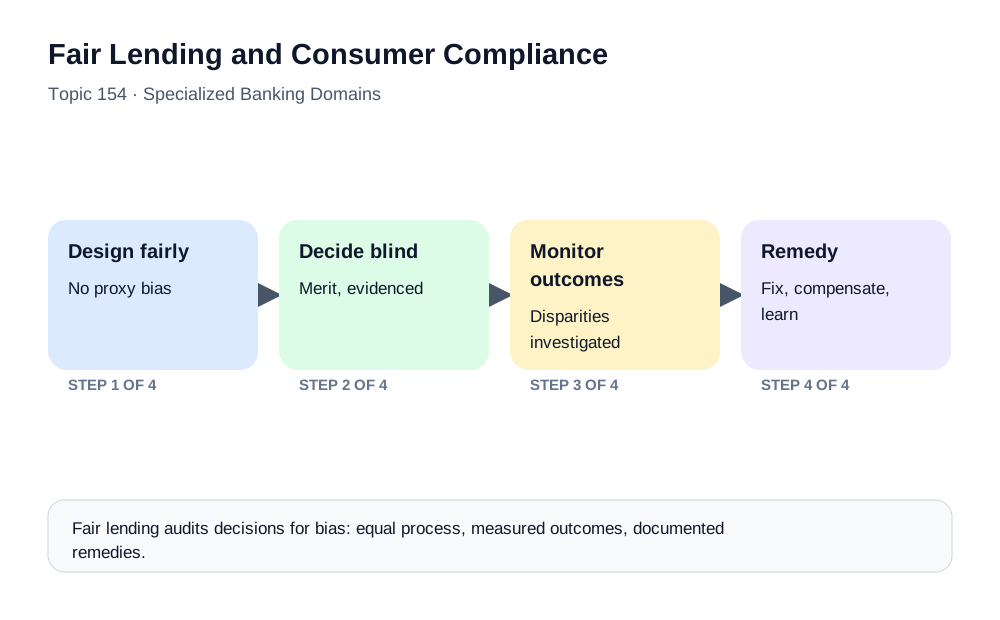
Fair Lending and Consumer Compliance at a glance — Fair lending laws, consumer protection, compliance.
Responsible Credit, Customer Rights, Product Suitability, Grievance Redressal, and Conduct Risk
Banks do not only move money and lend money. They decide who gets access to credit, how fees are charged, how customers are treated in distress, how complaints are resolved, and how financial products are explained. These decisions affect lives, businesses, homes, education, savings, and trust in the financial system.
Fair lending and consumer compliance exist to make sure customers are treated fairly, credit decisions are based on legitimate risk factors, products are suitable and transparent, recovery practices are respectful, and customers have a clear path to raise complaints when something goes wrong.
This chapter explains fair lending and consumer compliance from a practical banking perspective. It is written globally, with India examples where useful, because the principles are widely shared even though rules differ by country.
Learning objectives
By the end of this chapter, you should be able to:
- Explain fair lending, responsible lending, consumer protection, and conduct risk.
- Understand the difference between discrimination, unfair treatment, mis-selling, and poor disclosure.
- Describe how banks should assess affordability and suitability.
- Identify customer rights around transparency, privacy, grievance redressal, and fair treatment.
- Explain complaint handling, escalation, ombudsman-style recourse, and regulatory expectations.
- Understand digital lending risks such as hidden lenders, excessive data access, aggressive recovery, and unclear charges.
- Recognise controls banks use to prevent unfair outcomes.
- Explain why fair treatment is both an ethical obligation and a banking risk-control discipline.
1. What Fair Lending Means
Fair lending means credit decisions should be based on relevant credit factors, not on unfair or prohibited characteristics.
Relevant credit factors may include:
- income;
- repayment capacity;
- existing debt obligations;
- credit history;
- employment or business stability;
- cash flow;
- collateral value;
- loan purpose;
- borrower behaviour;
- verified documentation;
- risk score and policy rules.
Unfair factors may include characteristics unrelated to repayment ability, such as religion, caste, race, gender, ethnicity, disability, marital status, or other protected characteristics depending on local law.
The practical test is simple: can the bank explain the credit decision using legitimate, documented, consistently applied criteria?
2. Consumer Compliance
Consumer compliance means following laws, rules, codes, policies, and ethical standards designed to protect customers.
It covers:
- product disclosure;
- fees and charges;
- interest calculation;
- advertising and sales conduct;
- lending assessment;
- complaint handling;
- debt collection;
- customer privacy;
- vulnerable customer treatment;
- digital channel fairness;
- data usage and consent;
- dispute resolution;
- regulatory reporting.
Consumer compliance is not only a legal department topic. Product, sales, credit, operations, collections, technology, analytics, call centers, branches, and third-party partners all influence customer outcomes.
3. Fair Lending vs Responsible Lending vs Conduct Risk
| Concept | Meaning | Practical focus |
|---|---|---|
| Fair lending | Credit access and terms should not be discriminatory | Decision fairness and equal treatment |
| Responsible lending | Customer should be able to repay without unreasonable harm | Affordability and suitability |
| Consumer protection | Customers should receive clear, fair, and safe financial services | Rights, disclosures, complaints, privacy |
| Conduct risk | Risk that bank behaviour harms customers or market integrity | Culture, incentives, governance, controls |
| Mis-selling | Selling unsuitable or misrepresented products | Sales quality and disclosure |
These concepts overlap. A bank may approve a loan without discrimination but still fail responsible lending if the loan is unaffordable.
4. Core Principles
Strong consumer compliance rests on a few core principles.
| Principle | Meaning |
|---|---|
| Fair treatment | Customers should be treated respectfully and consistently |
| Transparency | Terms, fees, risks, and obligations should be clear |
| Suitability | Products should match customer needs and capacity |
| Responsible credit | Lending should consider repayment ability |
| Data privacy | Customer information should be protected and used properly |
| Complaint access | Customers should have clear routes to raise issues |
| Timely resolution | Problems should be handled within defined timelines |
| Accountability | Bank should own the conduct of employees and agents |
These principles protect customers and also protect the bank from legal, reputational, credit, and operational risk.
5. Unfair or Prohibited Practices
Examples of unfair practices include:
- rejecting credit based on prohibited identity factors;
- charging different terms without legitimate risk basis;
- hiding fees or penalties;
- advertising a low rate while concealing actual cost;
- selling insurance or add-ons without clear consent;
- forcing tied products without proper basis;
- approving loans without affordability checks;
- using aggressive or humiliating recovery practices;
- making product terms too complex for the target customer;
- using customer data without valid consent;
- giving misleading comparison or performance claims;
- delaying complaint resolution without reason.
Not every rejected loan is unfair. A bank may reject a loan for genuine credit reasons. The issue is whether the decision is fair, documented, explainable, and consistent.
6. Credit Decision Controls
Banks use controls to make credit decisions fair and consistent.
Good controls include:
- documented credit policy;
- clear eligibility rules;
- affordability assessment;
- income verification;
- debt-burden calculation;
- credit bureau review where available;
- collateral valuation standards;
- exception approval workflow;
- adverse decision reason codes;
- model validation for scorecards;
- bias and outcome monitoring;
- audit trail for manual overrides;
- periodic portfolio review.
A credit model can be efficient, but the bank must still understand whether it creates unfair outcomes or relies on weak data.
7. Affordability and Suitability
Affordability asks: can the customer reasonably repay?
Suitability asks: is this product appropriate for the customer's need, profile, and understanding?
Example:
A customer may technically qualify for a high-limit credit card. But if their income is unstable and existing obligations are high, a responsible bank should be careful about limit size, pricing, and communication.
Affordability factors may include:
- regular income;
- existing EMIs;
- rent or household obligations;
- business cash flow;
- credit history;
- repayment stress under rate changes;
- customer age and loan tenor;
- verified documentation;
- foreseeable financial hardship.
Suitability matters especially for complex products, insurance-linked products, investments, FX derivatives, variable-rate loans, and products sold to vulnerable customers.
8. Transparent Disclosure
Customers should understand what they are accepting.
Important disclosures include:
- interest rate;
- annual percentage rate or all-in cost where applicable;
- processing fee;
- late payment fee;
- prepayment or foreclosure terms;
- penal charges;
- insurance or add-on charges;
- repayment schedule;
- total amount payable;
- risks of floating rates;
- cooling-off or cancellation rights where applicable;
- complaint and escalation process.
Good disclosure is not just legal text. It should be readable, timely, and visible before the customer commits.
9. Digital Lending Risks
Digital lending can improve access and speed, but it can also create consumer harm if poorly governed.
Key risks include:
- customer does not know the actual lender;
- app collects excessive phone data;
- consent is bundled or unclear;
- fees are hidden until after approval;
- loan is disbursed through opaque wallets;
- recovery agents misuse contact lists;
- customers are pushed into repeated borrowing;
- loan terms are shown in confusing language;
- third-party partners act beyond bank policy;
- customer complaints fall between lender and app provider.
Strong digital lending controls include clear lender disclosure, key fact statements, direct disbursement and repayment flows where required, consent controls, partner oversight, recovery conduct rules, grievance channels, and audit logs.
10. Customer Rights
Many regulators and banking codes recognise customer rights similar to these:
| Right | Meaning |
|---|---|
| Fair treatment | No unfair discrimination or abusive conduct |
| Transparency | Clear information about products, risks, and costs |
| Suitability | Products should fit customer needs and capacity |
| Privacy | Customer data should be protected |
| Grievance redressal | Customer can complain and receive a response |
| Security | Bank should protect accounts and sensitive information |
| Choice | Customer should not be forced into unnecessary products |
| Dignity | Collections and service interactions must remain respectful |
These rights become real only when bank processes, training, systems, and incentives support them.
11. Complaint Handling
A good complaint process is easy to access and easy to track.
A typical process:
- Customer raises complaint through branch, call center, app, email, website, or written channel.
- Bank acknowledges complaint and gives reference number.
- Complaint is classified by product, issue, risk, and urgency.
- Responsible team investigates.
- Bank communicates decision or interim status.
- Corrective action is completed if needed.
- Customer receives final response.
- Complaint is closed with evidence.
- Root cause is analysed.
- Serious or repeated issues are escalated.
Complaint operations should monitor timelines, ageing, repeat complaints, vulnerable customers, regulatory complaints, compensation, and unresolved cases.
12. External Redressal
If the bank does not resolve a complaint satisfactorily, customers may have access to external redressal, depending on jurisdiction.
This may include:
- banking ombudsman;
- financial services ombudsman;
- consumer court or tribunal;
- regulator complaint portal;
- mediation process;
- arbitration or legal process where applicable.
In India, the RBI Integrated Ombudsman Scheme provides a route for customers to raise eligible complaints against regulated entities after internal resolution fails or timelines are exceeded. Exact eligibility and process should be checked from the current official RBI framework because rules can change.
13. Collections and Recovery Conduct
Banks have a legitimate right to recover dues. But recovery must be lawful, respectful, and controlled.
Acceptable recovery practices may include:
- written reminders;
- calls during permitted hours;
- structured repayment discussions;
- settlement options where policy allows;
- lawful notices;
- authorised recovery agents following conduct standards;
- legal proceedings where required.
Unacceptable practices include:
- threats;
- abusive language;
- public humiliation;
- misleading legal claims;
- contacting unrelated people improperly;
- harassment at odd hours;
- misuse of customer data;
- unauthorised asset seizure;
- pressure tactics against vulnerable customers.
Collections is a conduct-risk hotspot because financial stress already makes customers vulnerable.
14. Vulnerable Customers
Some customers may need additional care.
Examples include customers facing:
- financial hardship;
- illness;
- bereavement;
- disability;
- age-related difficulty;
- low financial literacy;
- language barriers;
- fraud victimisation;
- domestic abuse or coercive control;
- natural disaster or job loss.
Banks should train staff to recognise vulnerability, avoid rigid scripts, offer appropriate support, and document decisions carefully.
Fair treatment sometimes means consistent rules. It also sometimes means thoughtful flexibility within policy.
15. Monitoring Fair Outcomes
Banks should monitor whether customer outcomes are fair.
Useful checks include:
- approval rates by segment;
- pricing differences by segment;
- exception approval patterns;
- complaints by product and channel;
- repeat complaints;
- rejected application reason codes;
- model override frequency;
- collections complaints;
- sales incentive impact;
- refund and fee-waiver patterns;
- digital journey drop-offs;
- vulnerable customer cases;
- partner and agent conduct.
Data monitoring helps identify issues that individual case reviews may miss.
16. Practical Example
A customer applies for a small business loan and is rejected.
A fair process should:
- assess the application using documented criteria;
- consider verified income, cash flow, debt, repayment history, and risk;
- avoid prohibited personal characteristics;
- record the reason for rejection;
- communicate the outcome respectfully;
- explain broad reasons where policy or law requires;
- allow correction if data was wrong;
- keep an audit trail;
- monitor rejection patterns across customer groups.
The bank does not have to approve every loan. It must make decisions fairly and explainably.
17. Common Misconceptions
Misconception 1: Fair lending means every customer must be approved.
No. Banks can reject applications for genuine credit reasons. Fair lending means decisions must be based on legitimate, consistent, explainable criteria.
Misconception 2: Consumer compliance is only about documents.
Documents matter, but real compliance depends on sales behaviour, systems, disclosures, complaints, collections, partner conduct, and customer outcomes.
Misconception 3: Digital journeys are automatically fair because they are automated.
Automation can scale unfairness if data, models, consent, disclosures, or exception handling are weak.
Misconception 4: Recovery pressure is acceptable if the customer has defaulted.
Default does not remove customer dignity or legal protections. Recovery must follow law and bank policy.
18. Frequently Asked Questions
What is fair lending?
Fair lending means credit decisions are based on legitimate creditworthiness factors and not on prohibited or unfair discrimination.
What is mis-selling?
Mis-selling means selling a product that is unsuitable, poorly explained, misleading, or not genuinely consented to.
Why is affordability important?
Because approving unaffordable credit can harm customers and create losses for the bank.
What is conduct risk?
Conduct risk is the risk that bank behaviour harms customers, markets, or trust in the financial system.
Why does complaint handling matter?
Complaints reveal customer harm, process failures, unclear products, operational errors, and potential regulatory issues.
19. Key Terms
- Fair lending: Fair and non-discriminatory access to credit.
- Responsible lending: Lending based on realistic repayment capacity.
- Consumer protection: Rules and practices that protect customers from unfair harm.
- Conduct risk: Risk from inappropriate bank behaviour.
- Mis-selling: Selling unsuitable or misrepresented products.
- Affordability: Customer's ability to repay without unreasonable hardship.
- Suitability: Fit between product and customer need/profile.
- Disclosure: Clear communication of terms, costs, and risks.
- Grievance redressal: Complaint resolution process.
- Ombudsman: Independent external complaint resolution body in many jurisdictions.
- Vulnerable customer: Customer needing additional care due to circumstances or capability.
- Key fact statement: Standardised summary of important product or loan terms.
20. Interview Insights
Interviewers may ask fair lending and consumer compliance questions to test whether you understand banking as a trust business.
Strong answers usually mention:
- legitimate credit criteria;
- non-discrimination;
- affordability;
- clear disclosure;
- suitability;
- complaint handling;
- responsible collections;
- data privacy;
- digital lending controls;
- monitoring customer outcomes.
A good short answer:
"Fair lending means credit decisions must be based on relevant credit risk factors, not unfair or prohibited characteristics. Consumer compliance ensures customers receive clear disclosures, suitable products, respectful service, privacy protection, responsible collections, and effective complaint resolution."
21. Summary
Fair lending and consumer compliance protect customers and protect the bank's licence to operate. They ensure that products are explained clearly, credit is assessed responsibly, complaints are handled properly, recovery is respectful, and customer outcomes are monitored.
For banking learners, the key lesson is this: fair treatment is not only a legal requirement. It is a practical banking control that preserves trust, reduces complaints, improves portfolio quality, and strengthens the financial system.
Next: Topic 155 - Mobile Banking Security
<!-- MBA-DEEP-DIVE-START -->Fair Lending and Consumer Compliance Deepening — Decision Governance, Customer Outcomes, Digital Credit, and Conduct Control
Fair lending begins before the credit decision
A fair-lending programme cannot start only when an underwriter clicks approve or decline. Customer outcomes are shaped earlier by advertising, channel design, eligibility screens, lead allocation, branch behaviour, broker conduct, digital pre-qualification, documentation requirements, pricing logic, and the way staff describe products. A bank can operate a technically neutral approval model and still create unfair access if some customer groups are discouraged before an application is ever recorded. For that reason, conduct governance should map the full customer journey from first contact through application, decision, servicing, collections, complaint handling, closure, and any later remediation.
A credit policy should separate legitimate risk factors from protected or irrelevant characteristics
Credit risk assessment needs information that has a demonstrable relationship to repayment capacity, product suitability, fraud risk, collateral, or legal enforceability. Income, verified cash flow, debt obligations, repayment history, tenor, security, and business performance can all be legitimate inputs depending on the product and jurisdiction. Protected characteristics and other legally restricted data require different treatment. The key control is not simply a prohibited-field list; it is a documented rationale for each decision variable, its permissible purpose, its data source, its use in policy or models, and the governance process that approves changes.
Jurisdiction matters, so a global bank needs a rule inventory rather than one universal rule
Consumer and fair-lending obligations differ materially across countries. A global bank should maintain a jurisdictional obligations register showing which legal entities, customer types, products, channels, and lifecycle stages each rule covers. In the United States, for example, the Equal Credit Opportunity Act and Regulation B form an important fair-credit framework, while other statutes can apply to housing and consumer finance. In the United Kingdom, the FCA Consumer Duty focuses firms on delivering good outcomes for retail customers. India combines fair-practice, customer-service, KYC, digital-lending, penal-charge, grievance, and sector-specific regulatory requirements. These frameworks share principles but are not interchangeable.
Current regulatory interpretation should be versioned like software
Compliance teams should never rely on a paragraph copied years ago into a procedure. Rules, official interpretations, scope, supervisory expectations, and enforcement priorities can change. The United States Regulation B framework, for example, was amended again in 2026, demonstrating why a bank must identify the effective version that applies to a decision date. A requirement catalogue should therefore include source, publication date, effective date, applicability, owner, interpretation, implementation evidence, and retirement date. Version control is especially important when models, adverse-action reasons, special programmes, or data collection depend on regulatory wording.
Product governance should ask who the product is designed for
Before a product is launched, the bank should define the target customer, financial need, expected use, key risks, affordability assumptions, pricing logic, distribution channels, servicing model, and circumstances in which the product may be unsuitable. This turns customer fairness from a complaint-stage activity into a design-stage control. If a short-tenor loan depends on repeated refinancing to remain profitable, if a fee structure is difficult to understand, or if the product creates predictable harm for the target group, the issue should be addressed before sales incentives and technology make it difficult to reverse.
Eligibility criteria need an explainable business purpose
Every eligibility rule should answer a simple question: why is this criterion needed? Geographic restrictions may be driven by licensing or servicing capacity, minimum turnover by product economics, age restrictions by legal capacity, and residence requirements by legal or operational constraints. But rules can become embedded in systems long after their original justification disappears. Periodic review should test whether each criterion remains necessary, proportionate, and lawful. Legacy filters deserve particular attention because teams often assume that a rule is legitimate merely because it has been in production for years.
Advertising can create unfair outcomes before a customer applies
Marketing should be assessed for accuracy, balance, audience, exclusions, and the prominence of important conditions. A headline rate available only to a small minority can mislead when qualification criteria are buried. An advertisement that emphasises speed while hiding cost or repayment consequences can distort customer understanding. Targeted digital advertising can also create distribution risks if the bank does not understand who is being included or excluded by platform algorithms. Marketing compliance should therefore review not only the final creative asset but also targeting logic, affiliate behaviour, landing pages, and lead-routing rules.
Pre-qualification and pre-approval are not the same as final credit approval
Digital journeys often show customers an indicative eligibility result before a full assessment. The interface should communicate clearly whether the result is an estimate, a conditional offer, or a binding decision. If the customer later receives different pricing or a decline because additional data changed the assessment, the reason should be traceable. Ambiguous labels such as “approved” can create complaints and mis-selling risk when the bank has actually completed only an initial screen.
Application data quality is a fairness control
A fair model can still produce unfair outcomes if the input data are wrong. Names can be mistransliterated, addresses can fail validation, income can be mapped to the wrong frequency, employment categories can be inconsistent, and bureau files can be matched to the wrong person. Application systems should validate critical fields, preserve source documents or trusted digital evidence, flag unusual changes, and allow customers to correct material errors. Data lineage should show where each decision input came from and whether it was customer-provided, bureau-derived, inferred, or calculated.
Manual overrides need stronger governance than automated decisions
Human judgement is valuable, but an override can bypass the consistency that policy and models are designed to create. The bank should record original system outcome, override direction, reason, evidence, decision maker, authority level, and any second-line review requirement. Override patterns should be analysed by branch, officer, segment, product, and outcome. A cluster of overrides may indicate weak policy, pressure to meet sales targets, favouritism, training gaps, or a model that does not handle a legitimate customer group well.
Decision models should be governed as both risk models and conduct mechanisms
A scorecard may predict default accurately while still creating questions about fairness, data provenance, transparency, or customer impact. Model governance should therefore address development data, variable selection, stability, validation, monitoring, overrides, reason codes, drift, and appropriate fairness analysis under applicable law. Teams should distinguish statistical correlation from a justified business purpose. A variable that improves predictive power slightly may not be worth the conduct, explainability, or privacy risk it introduces.
Proxy variables deserve careful challenge
A model may not include a protected attribute directly yet still use variables strongly correlated with it. Postal code, device type, education, language, occupation, behavioural data, or merchant patterns can sometimes act as proxies depending on context. This does not mean every correlated variable is automatically prohibited. It means the bank should understand why the variable is used, whether less risky alternatives exist, how it affects outcomes, and what the law in the relevant jurisdiction permits. Proxy-risk assessment should be documented rather than left to intuition.
Explainability should be designed before the model goes live
If a bank cannot explain the principal reasons behind a material credit decision, it will struggle with customer communication, complaint handling, model validation, audit, and regulatory review. Reason codes should map faithfully to the actual decision logic rather than to generic phrases selected after the event. If several rules and models combine, the system should preserve which threshold or factor materially affected the result. Explainability is strongest when it is part of architecture, not a reporting layer added later.
Pricing fairness is different from approval fairness
Two customers can both receive credit while being charged different rates, fees, limits, or collateral requirements. Those differences need a legitimate and consistently applied basis. Pricing engines should show how risk grade, product cost, funding, collateral, tenor, relationship, campaign, and approved discretion affect the final offer. Where relationship managers have discretion, the bank should monitor whether concessions or mark-ups create unexplained patterns. Pricing governance therefore belongs inside fair-lending oversight, not only treasury or product profitability.
Affordability is about the customer’s realistic financial capacity
A credit model predicts the bank’s probability of loss; an affordability assessment asks whether the customer can meet repayments without unreasonable financial stress. These are related but not identical questions. A secured loan may be low-risk to the bank because valuable collateral exists, yet unaffordable to the borrower. Responsible-lending controls can consider verified income, essential expenditure, existing commitments, variable income, interest-rate sensitivity, household circumstances, and credible future changes appropriate to the product and applicable rules.
Stress testing can reveal affordability that a point-in-time ratio misses
A variable-rate mortgage may be affordable at origination but vulnerable to a rate increase. A business borrower may rely on seasonal revenue. A household may have irregular gig income. A bank can therefore test reasonable adverse scenarios rather than rely only on one current debt-service ratio. The purpose is not to predict every future event but to identify fragility. Assumptions should be proportionate to the product and should not become hidden barriers that arbitrarily exclude customers.
Suitability becomes more important as product complexity rises
A simple transaction account and a leveraged investment-linked loan do not require the same customer understanding. Product governance should define what knowledge, experience, financial capacity, time horizon, and risk tolerance are relevant. Sales journeys should identify when advice is being provided, when execution-only rules apply, and what warnings or disclosures are necessary. A signed disclosure does not automatically prove suitability if the surrounding sales process pushed the customer toward a product they did not understand.
Disclosure quality should be tested with real users
Legal accuracy is necessary but insufficient. A disclosure can be technically complete and functionally useless if it is too long, poorly ordered, hidden behind links, or displayed after the customer has mentally committed. Important information should be presented when it can influence the decision. Banks can test whether customers understand total cost, repayment obligations, rate variability, fees, penalties, cancellation rights, and key risks. Readability, language, accessibility, screen size, and timing are operational design requirements.
Key fact information should reconcile to the booking engine
Where a jurisdiction requires a standardised key-fact or cost disclosure, values shown to the customer should be generated from or reconciled to the same product configuration used to book and service the account. Manual duplication creates risk that the document says one rate while the core system applies another. The bank should retain the exact version delivered, delivery timestamp, customer acknowledgement where relevant, and calculations supporting figures such as annualised cost or repayment schedule.
Consent is an event, not a checkbox
Meaningful consent requires knowledge of what the customer agreed to, for what purpose, through which channel, under which terms, and at what time. Digital systems should capture consent version, scope, source, and withdrawal where applicable. Bundling unrelated permissions into one acceptance can create privacy and conduct problems. A strong design separates contractual acceptance, marketing consent, data-sharing consent, optional add-ons, and any permission to access device or third-party data.
Digital lending requires clear accountability between the regulated entity and its partners
A bank may use a fintech, lending service provider, marketplace, broker, data provider, verification vendor, collection agency, or technology platform. Outsourcing an activity does not remove the bank’s need to understand customer outcomes. Partner governance should cover onboarding due diligence, permitted activities, scripts and disclosures, data access, fees, complaints, recovery conduct, subcontractors, security, monitoring, audit rights, incident reporting, termination, and customer transition. The customer should not be forced to discover which company is responsible when something goes wrong.
The customer should know who the lender is
Digital interfaces can create ambiguity between a brand that provides the app and the regulated entity that provides the loan. The legal lender, material terms, grievance route, repayment destination, and relevant disclosures should be clear before commitment. This protects the customer and also reduces fraud risk from unauthorised apps pretending to represent legitimate institutions. In India, RBI’s digital-lending framework has placed particular emphasis on regulated-entity accountability, transparent key information, data practices, and customer grievance mechanisms.
Data minimisation reduces both privacy and conduct risk
A lending app may technically be able to request contacts, messages, media, precise location, call logs, or other device data, but access should be limited to what is lawful, necessary, proportionate, and appropriately consented to. Excessive collection creates cyber risk and can enable abusive collection practices. Product teams should maintain a data-purpose inventory that links every field and permission to a defined use, retention period, access role, and deletion rule.
Collections strategy should distinguish inability to pay from unwillingness to pay
Customers can miss payments for very different reasons: temporary cash-flow stress, job loss, illness, operational error, dispute, fraud, deliberate avoidance, or insolvency. A single aggressive strategy produces poor outcomes and may worsen credit loss. Collections systems should support segmentation, early engagement, hardship treatment, dispute holds, repayment arrangements, appropriate escalation, and legal recovery when necessary. The customer’s dignity remains relevant after default.
Contact strategy should be controlled across all channels
Harassment can occur even when each individual call appears reasonable. A bank should therefore monitor total contact attempts across phone, SMS, email, messaging, field visits, agents, and automated diallers. Frequency, permitted times, vulnerable-customer flags, dispute status, cease-contact requirements where applicable, and failed contact attempts should be centrally visible. Third-party collectors should not create a separate contact universe outside the bank’s controls.
Settlement and restructuring offers need transparent authority
If the bank offers a payment plan, reduced interest, settlement, moratorium, or other forbearance, the customer should receive clear conditions and consequences. Staff should have defined authority levels. The system should prevent an agent from promising a concession that cannot be honoured. Accounting, credit reporting, collateral, tax, legal, and product impacts may differ by jurisdiction, so the offer should be generated from approved programmes rather than improvised in conversation.
Vulnerability should be treated as an operational circumstance, not a label
A customer can become vulnerable temporarily or permanently because of illness, bereavement, disability, cognitive difficulty, financial distress, language barriers, digital exclusion, domestic abuse, fraud victimisation, or other circumstances. The bank should focus on what support is needed rather than categorising people unnecessarily. Controls may include alternative communication, additional time, trusted-person processes where lawful, accessible formats, specialist teams, fee relief within policy, or protection from inappropriate sales pressure.
Accessibility is part of fair treatment
A mobile app that cannot be used with assistive technology, a branch process inaccessible to a customer with disability, or disclosures unavailable in suitable formats can create exclusion even without discriminatory intent. Accessibility should be included in design standards, testing, procurement, and change management. Digital accessibility also benefits older customers and people using devices under constrained conditions. Fairness therefore extends into user experience and technology quality.
Complaints are a control sensor, not only a service queue
Each complaint contains information about product design, sales conduct, operational failure, technology defects, disclosure, fraud, collections, or staff behaviour. Complaint systems should capture structured root-cause categories, product, channel, customer impact, financial remediation, responsible process, and recurrence. Senior management should see trends rather than only closure volumes. A low complaint rate is not automatically good if customers cannot easily complain or cases are misclassified as enquiries.
Complaint classification should follow the substance of the issue
Customers do not use regulatory vocabulary. A person may say “the app cheated me” when the underlying issue is an undisclosed fee, failed cancellation, duplicate debit, fraud, or poor communication. Front-line staff and text-classification tools should identify the substance and route the case correctly. Misclassification can hide regulatory complaints from required timelines and distort management information.
Remediation should repair both the individual case and the population
When the bank finds a systemic problem, fixing only the customer who complained may be inadequate. It should assess affected population, time period, products, channels, financial harm, non-financial harm, interest or fee correction, credit-file consequences, tax implications, and communication. The remediation method should be reproducible and independently checked. Population analysis is particularly important for system defects because thousands of silent customers may have experienced the same issue.
Root cause should lead to control change
A complaint programme fails when the same root cause produces recurring cases every month. Management should assign actions to product, process, technology, training, vendor, policy, or data owners and track them to closure. Where a temporary manual control is introduced, it should have an owner and expiry condition. Root-cause metrics should distinguish symptoms from underlying design failures.
Incentive design can create conduct risk even when policies are strong
Employees and intermediaries respond to targets. If compensation rewards volume without considering suitability, cancellations, arrears, complaints, or customer outcomes, pressure can shift behaviour. Sales governance should examine scorecards, thresholds, accelerators, contests, manager pressure, clawbacks, and quality measures. The most dangerous incentive may be unofficial: a culture where staff know that only sales numbers affect promotion.
Training should be role-specific and scenario-based
A generic annual compliance module cannot prepare every employee for real decisions. Underwriters need policy and override training. Relationship managers need suitability and disclosure scenarios. Collections staff need hardship and conduct training. Product managers need governance obligations. Data scientists need model and proxy-risk awareness. Complaint teams need root-cause and remediation skills. Scenario-based testing shows whether people can apply principles under pressure.
Quality assurance should sample customer journeys end to end
Checking whether one form contains the required wording is too narrow. Quality assurance can reconstruct complete journeys: advertisement, application, call recording, document set, decision, pricing, disbursement, servicing events, contact history, complaint, and closure. This reveals interactions between systems and teams that isolated control tests miss. Higher-risk segments, products, branches, partners, and overrides should receive targeted sampling.
Fair-outcome monitoring needs denominators
Counts alone mislead. Ten complaints may be serious in a portfolio of one hundred customers and insignificant in a portfolio of one million. Approval rates, decline rates, price concessions, arrears, restructures, refunds, complaints, and sales outcomes should therefore be analysed with appropriate populations and context. Monitoring should consider customer characteristics only where collection and analysis are lawful. Statistical differences are signals for investigation, not automatic proof of wrongdoing.
Cohort analysis can reveal lifecycle harm
A product may look healthy at origination but perform poorly after six months. Cohort analysis can compare customers by booking month, channel, campaign, partner, risk grade, product version, and other legitimate dimensions. Early delinquency, repeat borrowing, fee incidence, complaints, refinancing, and closure behaviour can indicate that customer understanding or affordability was weaker than expected. Product governance should use these outcomes to revise policy.
Management information should connect customer outcomes to financial incentives
Boards and senior management need more than regulatory breach counts. Useful conduct dashboards can show sales volumes, approval and decline patterns, pricing dispersion, arrears, restructures, complaints, vulnerable-customer outcomes, refunds, partner performance, model overrides, exceptions, customer attrition, and remediation. These measures should be linked to responsible executives and product committees. A metric without an action threshold or owner becomes reporting theatre.
Three lines of defence should have distinct roles
The first line owns customer outcomes in product, sales, credit, operations, collections, and technology. Compliance and risk in the second line set frameworks, advise, challenge, monitor, and escalate. Internal audit provides independent assurance over governance and control effectiveness. If the first line treats fairness as “compliance’s job,” problems will be discovered late. If the second line designs every operational control itself, ownership becomes confused.
Change management should include conduct impact
A small technology change can affect fairness. Changing a bureau provider, model threshold, default repayment date, fee description, digital screen, collection dialler, or CRM field can alter customer outcomes. Change templates should ask whether the modification affects eligibility, pricing, disclosure, consent, servicing, vulnerable customers, complaints, data use, or regulatory reporting. High-impact changes should receive compliance and model review before release.
Production monitoring should detect policy drift
A rule configured incorrectly in production can create thousands of inconsistent decisions before anyone notices. Banks should reconcile approved policy parameters to deployed configuration and monitor decision distributions after releases. Sudden changes in approval rate, average price, reason-code mix, or override volume can indicate a defect. Model and rule deployment should be traceable to approved versions and tested with known cases.
Decision replay is a powerful control
For any historical application, the bank should ideally be able to reconstruct the data used, policy version, model version, external bureau response, calculations, decision path, pricing, reason codes, manual interventions, and final communication. Replay capability accelerates complaints, audit, regulatory review, model validation, and remediation. It also helps identify whether a current result is caused by today’s rules or by a historical configuration.
Adverse-action reasons should be specific enough to be meaningful
Where law or policy requires reasons for a decline or other adverse outcome, the reason should reflect the real decision. Generic phrases such as “internal policy” provide little value and can conceal defects. The system should distinguish, for example, insufficient verified income, excessive existing obligations, unacceptable delinquency history, unsupported collateral, or inability to verify required information where those are genuine reasons. Wording must still follow local legal requirements.
Customer communication should not reveal fraud or security logic unnecessarily
Fair explanation does not require the bank to disclose information that would help criminals defeat fraud controls or compromise investigations. A declined application may involve identity inconsistencies or suspicious activity that cannot be described in detail. Requirements should therefore distinguish credit-decision explanation from fraud, AML, sanctions, and legal confidentiality. The bank should give the clearest lawful explanation without exposing protected controls.
Fair lending and financial crime controls need coordinated exceptions
A customer may satisfy credit policy but fail KYC, sanctions, fraud, or legal checks. The resulting outcome should not be presented as a credit decline if it was not one. Systems should preserve the stage and reason category while respecting legal restrictions on disclosure. This prevents fair-lending analytics from being distorted by non-credit decisions and helps complaint teams route cases correctly.
Data retention should support both privacy and accountability
Keeping everything forever creates privacy and security risk; deleting too early destroys evidence. Retention schedules should consider legal requirements, limitation periods, model validation, complaints, regulatory examination, litigation hold, and customer rights. Decision evidence, consent records, disclosures, communications, and override logs may have different retention rules. Automated deletion should respect legal holds and preserve required audit history.
Third-party monitoring should use customer outcomes, not only SLA metrics
A vendor can meet uptime and response-time targets while producing poor customer outcomes. Banks should monitor partner complaint rates, error rates, consent failures, recovery incidents, application conversion, unusual declines, data-access behaviour, and remediation. Mystery shopping, call review, digital-journey testing, and targeted audits can complement contractual reports. Exit plans should protect customer records and servicing continuity.
Scenario: a model change causes a sudden decline-rate increase
A bank releases a new credit-score model and overall default prediction improves, but one legitimate customer segment experiences a sharp increase in declines. Monitoring detects the change within days. The bank checks data mapping, variable behaviour, policy overlays, model validation, and legal requirements. It identifies that an employment category was mapped incorrectly during deployment. The rule is corrected, affected applications are identified, customers are reconsidered where appropriate, and the incident is documented. The lesson is that fair outcomes depend on technology controls as much as policy intent.
Scenario: a digital lender’s partner displays the wrong annualised cost
A partner app uses an outdated fee configuration. Customers see a lower displayed cost than the loan system will actually charge. Reconciliation between approved product configuration and the partner’s disclosure feed flags the mismatch. New originations are paused, the interface is corrected, affected customers are identified, financial remediation is calculated, complaints are reviewed, and the partner’s change process is strengthened. Contractual outsourcing does not transfer accountability for the customer outcome.
Scenario: collections activity becomes excessive across channels
A delinquent customer receives calls from the bank, SMS from an automated platform, and visits from a third-party agent because each channel tracks contact independently. A conduct review aggregates the interaction history and shows excessive contact. The bank implements a central contact-policy engine, adds vulnerability and dispute flags, changes agent instructions, and reviews similarly affected customers. The problem was architecture, not merely one rude collector.
Scenario: a complaint reveals a population-wide fee error
One customer disputes a late fee and the investigation finds that a payment-holiday flag did not suppress charges after a system migration. The bank does not stop at refunding the complainant. It queries all accounts with the same product and flag, calculates fees and interest, corrects credit reporting where needed, communicates remediation, tests the migration logic, and adds reconciliation. Complaint handling becomes a route to systemic control improvement.
Business analysts should model customer outcome states explicitly
Requirements should identify not only transaction statuses but customer-decision states: application started, information incomplete, eligibility failed, credit declined, fraud review, approved subject to conditions, offer made, offer accepted, cooling-off or cancellation where relevant, booked, active, hardship, dispute, collection, restructured, closed, and remediated. Each state needs permitted transitions, reason codes, communications, evidence, ownership, timers, and downstream effects. Ambiguous states create inconsistent treatment.
Technology architects should avoid hidden decision logic
When eligibility rules live partly in channel code, partly in a workflow engine, partly in a model, and partly in manual spreadsheets, the bank cannot demonstrate consistent decisions. Architecture should centralise or at least catalogue decision components, expose versioned interfaces, preserve trace data, and make configuration reviewable. Shadow rules inside user-interface code are particularly dangerous because they can prevent customers from reaching the formal application process.
Test design should include fairness and conduct scenarios
Testing should cover more than successful approval. Cases should include boundary income values, missing documents, variable income, customer corrections, model timeout, bureau mismatch, manual override, pricing discretion, accessible interface needs, vulnerable customer flags, partner channel differences, complaint reopening, hardship, debt collection, and remediation. Regression packs should verify that the same legitimate facts produce consistent results across channels unless a documented channel rule applies.
Audit should test whether governance works in real customer files
Policies can look excellent on paper. Audit should sample actual decisions and reconstruct the evidence. It can compare documented eligibility with production configuration, examine overrides, trace disclosures, review call recordings, test complaint root cause, challenge model governance, and assess board reporting. Findings should distinguish isolated execution errors from systemic design weaknesses because remediation scope differs dramatically.
The board’s question is ultimately about outcomes and evidence
Senior governance should be able to answer: which customers are this product intended for, what could harm them, how do we know the product is performing as designed, where are outcomes worse than expected, what partners are involved, what complaints and remediation have occurred, and what changed after those findings? These questions make fair lending and consumer compliance a management discipline rather than a legal appendix.
Authoritative-source discipline protects educational and operational accuracy
Rules and interpretations should be verified against current primary sources before implementation. For current United States fair-credit requirements, banks should check the applicable statute, Regulation B, official CFPB materials, and other relevant regulators. UK firms should use the current FCA Handbook and Consumer Duty materials. Indian regulated entities should use current RBI Master Directions, circulars, digital-lending requirements, customer-service and ombudsman materials applicable to their entity and product. Secondary summaries are useful for orientation but should not become the control source.
Closing perspective
Fair lending and consumer compliance are not separate from banking operations. They are the discipline of ensuring that legitimate commercial and risk decisions are made consistently, explained appropriately, implemented correctly in technology, monitored for customer impact, and repaired when they fail. A bank earns trust when a customer can understand the product, receive a decision based on relevant factors, be treated with dignity through difficulty, challenge an error, and obtain meaningful resolution. The strongest programmes join policy, models, data, interface design, partner oversight, operations, complaints, collections, technology, and governance into one evidence-based system of customer protection.
Fair-Lending Production Assurance
Decision replay should be possible for material customer outcomes
When a customer challenges a decline, price, limit, or eligibility result, the bank should be able to reconstruct the application data, policy version, model version, reason codes, manual overrides, and final offer that existed at the decision time. Re-running today's system against today's data is not enough. Reproducible decision evidence helps complaints teams identify genuine errors and helps model or compliance teams assess whether a wider population was affected.
Release governance should include outcome testing
A change to an input mapping, eligibility rule, threshold, pricing table, model feature, or partner API can alter customer outcomes even when the software release passes technical testing. Pre-production testing should compare representative customer cohorts and expected reasons before and after the change. Material unexplained movement should be investigated before release. This makes fairness and conduct part of production change control rather than a retrospective statistical exercise.
Remediation should restore connected consequences
If a decision defect caused a customer to receive the wrong price or decline, correction may involve more than issuing a refund. The bank should consider interest, fees, credit-file reporting, limits, account history, disclosures, collections status, and downstream decisions that used the original result. A remediation ledger can show what was corrected for each affected customer and reconcile the total financial impact.
<!-- MBA-DEEP-DIVE-END -->