Visual overview
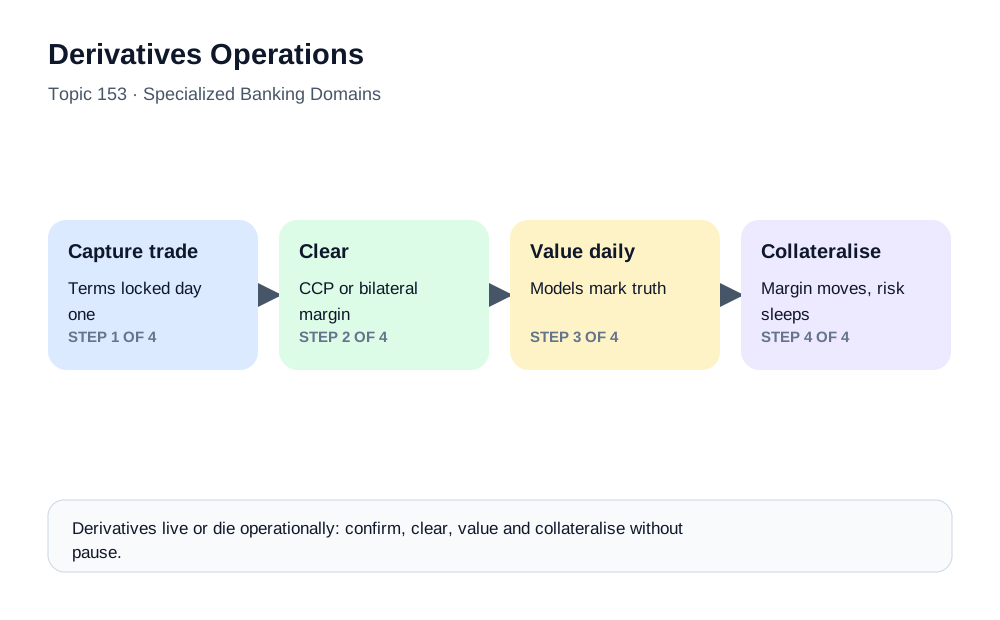
Derivatives Operations at a glance — Trade processing, margin management, collateral.
Swaps, Futures, Options, Clearing, Collateral, Valuation, and Lifecycle Controls
Derivatives are financial contracts whose value comes from something else: an interest rate, currency pair, equity index, commodity price, credit event, inflation index, or another market variable. Banks use derivatives to hedge risk, serve customers, manage balance sheets, support treasury activity, and provide market access.
A derivative trade may look like a deal agreed between two parties, but the operational work continues for years. The bank must capture the trade correctly, confirm terms, value the position, exchange collateral, settle cash flows, monitor risk, handle amendments, process maturity, report to regulators, and reconcile records across front office, operations, finance, risk, collateral systems, clearing houses, and counterparties.
This chapter explains derivatives operations from a practical banking perspective: what derivatives are, how common instruments work, how the trade lifecycle is controlled, why collateral matters, how clearing reduces risk, and where operational failures can become expensive.
Learning objectives
By the end of this chapter, you should be able to:
- Explain what derivatives are and why banks use them.
- Understand swaps, forwards, futures, options, and credit derivatives at a practical level.
- Describe the derivatives trade lifecycle from execution to maturity.
- Explain trade capture, confirmation, valuation, settlement, collateral, and reconciliation.
- Understand cleared versus bilateral OTC derivatives.
- Explain initial margin, variation margin, CSA, netting, and mark-to-market.
- Identify key risks: market risk, counterparty credit risk, liquidity risk, model risk, settlement risk, and operational risk.
- Recognise why derivatives require strong governance, documentation, and regulatory reporting.
1. What Derivatives Mean
A derivative is a contract whose value depends on an underlying reference.
The underlying may be:
- an interest rate;
- a currency pair;
- a bond price;
- an equity or equity index;
- a commodity price;
- a credit default event;
- an inflation index;
- a benchmark rate;
- another financial variable.
The derivative does not always involve buying the underlying asset. It may only exchange cash flows based on how the underlying moves.
For example, an interest rate swap can exchange fixed interest payments for floating interest payments without either party lending the full notional amount.
2. Why Banks Use Derivatives
Banks use derivatives for several purposes.
| Purpose | Meaning | Example |
|---|---|---|
| Hedging | Reducing an existing risk | Bank swaps floating-rate exposure into fixed-rate exposure |
| Customer service | Helping clients manage market risk | Exporter buys FX option to protect future receivable |
| Balance-sheet management | Managing interest-rate, FX, or liquidity exposure | Treasury uses swaps to manage ALM position |
| Market making | Providing buy and sell prices to clients | Bank quotes corporate customer an FX forward |
| Trading | Taking market positions within approved limits | Desk expects rate movement and positions accordingly |
| Arbitrage | Exploiting pricing differences | Related instruments priced inconsistently |
The safest explanation is this: derivatives are tools. They can reduce risk when governed well, but they can increase risk when used without understanding, limits, or control.
3. Common Derivative Types
| Instrument | Simple meaning | Typical banking use |
|---|---|---|
| Forward | Agreement today for future exchange at agreed terms | FX hedge for importer/exporter |
| Future | Standardised exchange-traded forward | Interest-rate, equity, currency, or commodity exposure |
| Swap | Exchange of cash flows over time | Interest-rate or currency risk management |
| Option | Right but not obligation to buy or sell | Protection with upside flexibility |
| Credit default swap | Protection against credit default | Credit risk transfer or hedging |
| Cap/floor | Interest-rate option structure | Limit floating-rate exposure |
| Cross-currency swap | Exchange interest and principal across currencies | Long-term currency funding and hedging |
Different derivatives create different operational events. A future may be margined daily through an exchange. A bilateral swap may require periodic settlements, collateral calls, valuations, and long-term lifecycle management.
4. Interest Rate Swaps
An interest rate swap exchanges interest cash flows between two parties.
A common structure:
- Party A pays fixed interest.
- Party B pays floating interest.
- Payments are calculated on a notional amount.
- The notional amount is usually not exchanged.
- Net payment is made on each settlement date.
Example:
A bank has floating-rate assets but fixed-rate liabilities. If rates rise, the bank may benefit on assets but not liabilities. If the mismatch is the other way around, treasury may use swaps to adjust exposure.
Interest rate swaps are central to ALM, treasury hedging, customer hedging, and market risk management.
5. Currency Swaps and FX Derivatives
FX derivatives help manage currency exposure.
Common instruments include:
- FX forwards;
- FX swaps;
- currency options;
- cross-currency swaps.
A cross-currency swap may exchange principal and interest in two different currencies. It can help a bank or corporate borrow in one currency but create economic exposure in another.
Operationally, FX derivatives need strong control over:
- currency pair;
- value dates;
- settlement instructions;
- nostro funding;
- exchange rates;
- fixing dates;
- payment netting;
- regulatory purpose and documentation;
- sanctions screening where payment movement is involved.
6. Options
An option gives the buyer a right, but not an obligation.
- A call option gives the right to buy.
- A put option gives the right to sell.
- The strike price is the agreed exercise price.
- The premium is the price paid for the option.
- The expiry date is when the option right ends.
Options are useful when a customer wants protection but wants to keep upside.
Example:
An importer wants protection if USD becomes more expensive but wants to benefit if USD becomes cheaper. The importer may buy a USD call option. The cost is the premium.
Options require careful suitability, disclosure, valuation, and lifecycle controls because customers may misunderstand the payoff.
7. Exchange-Traded vs OTC Derivatives
| Area | Exchange-traded derivatives | OTC derivatives |
|---|---|---|
| Contract terms | Standardised | Customised |
| Trading venue | Exchange | Bilateral or platform-based |
| Clearing | Usually centrally cleared | Bilateral or cleared depending on rules |
| Counterparty | Clearing house becomes central counterparty | Original counterparty unless cleared |
| Flexibility | Lower | Higher |
| Operational focus | Margin, daily settlement, exchange rules | Confirmation, documentation, collateral, valuation, lifecycle |
OTC derivatives give flexibility, but flexibility increases documentation, valuation, and lifecycle complexity.
8. Cleared vs Bilateral OTC Derivatives
A derivative may be centrally cleared or remain bilateral.
In central clearing:
- a clearing house stands between buyer and seller;
- both parties face the clearing house;
- margin rules are standardised;
- daily mark-to-market is enforced;
- default management is handled through clearing-house rules.
In bilateral OTC trading:
- the two parties face each other directly;
- collateral is governed by their legal agreement;
- valuation disputes may arise;
- counterparty risk is managed through credit limits, netting, collateral, and documentation.
Clearing reduces some counterparty risk but does not eliminate operational risk.
9. Documentation
Derivatives rely heavily on legal documentation.
Common documents may include:
- master agreement;
- schedule or local law addendum;
- credit support annex or collateral agreement;
- trade confirmation;
- clearing agreement;
- client suitability and risk disclosure documents;
- netting opinion support;
- regulatory reporting agreements.
The master agreement defines general legal terms. Each confirmation defines specific trade economics.
If documentation is weak or missing, the bank may face disputes during stress, default, or early termination.
10. Derivatives Trade Lifecycle
A typical derivatives lifecycle includes:
- Pre-trade checks: counterparty eligibility, limit, product approval, documentation, suitability.
- Execution: trade agreed by dealer, platform, broker, or electronic channel.
- Trade capture: economics entered into trading system.
- Validation: operations checks key fields and completeness.
- Confirmation: both parties agree trade details.
- Clearing submission: eligible trades are sent to clearing house where required.
- Valuation: trade is marked to market daily or at required frequency.
- Collateral management: margin calls are calculated, agreed, moved, and reconciled.
- Settlement: periodic cash flows, premiums, fees, resets, or final amounts are paid.
- Lifecycle events: amendments, novations, terminations, exercises, compressions, resets.
- Accounting and reporting: entries and regulatory reports are generated.
- Maturity: final settlement, closeout, archive, and reconciliation.
Derivatives operations is a lifecycle discipline, not a one-time booking task.
11. Trade Capture Fields
Important trade fields include:
- counterparty;
- product type;
- trade date;
- effective date;
- maturity date;
- notional amount;
- currency;
- fixed rate or floating index;
- reset dates;
- payment dates;
- day-count convention;
- business-day convention;
- option strike and expiry, if applicable;
- clearing status;
- collateral agreement;
- settlement instructions;
- trader, desk, and portfolio.
A small trade-capture error can affect valuation, risk, settlement, accounting, and collateral.
12. Valuation and Mark-to-Market
Mark-to-market means valuing a position using current market data.
Derivative valuation may require:
- yield curves;
- FX rates;
- volatility surfaces;
- credit spreads;
- discount curves;
- benchmark rates;
- model assumptions;
- counterparty credit adjustments;
- funding valuation adjustments.
Independent price verification is important because front-office valuations affect P&L, collateral calls, regulatory reports, and risk limits.
Valuation disputes can occur when two counterparties calculate different mark-to-market values.
13. Collateral and Margin
Collateral protects counterparties against default.
| Term | Meaning |
|---|---|
| Initial margin | Collateral posted to cover potential future exposure |
| Variation margin | Collateral exchanged for current mark-to-market movement |
| Threshold | Exposure amount allowed before collateral is required |
| Minimum transfer amount | Smallest collateral movement required |
| Eligible collateral | Cash or securities accepted under agreement |
| Haircut | Discount applied to collateral value |
| Margin call | Request to deliver collateral |
| Dispute | Difference between parties on required collateral amount |
Collateral operations must calculate, agree, instruct, settle, and reconcile margin movements. Missed collateral calls can create credit and liquidity risk.
14. Settlements and Cash Flows
Derivative settlements may include:
- option premium payments;
- periodic swap interest payments;
- final settlement amounts;
- exercise settlement;
- early termination payments;
- collateral interest;
- cleared margin flows;
- compression or novation payments.
Operations teams must track payment calendars, holidays, reset rates, settlement instructions, currency cut-offs, nostro funding, and failed payments.
Derivative settlement breaks can affect both cash management and counterparty relationships.
15. Regulatory Reporting
Many jurisdictions require derivative trades to be reported to trade repositories or regulators.
Reporting may include:
- counterparty identifiers;
- product type;
- notional;
- price;
- maturity;
- collateralisation;
- clearing status;
- valuation;
- lifecycle events;
- unique transaction identifier;
- action type such as new, modify, terminate, or correct.
Reporting errors may not affect the customer immediately, but they can create regulatory breaches and remediation work.
16. Key Risks in Derivatives Operations
| Risk | What can go wrong | Control focus |
|---|---|---|
| Market risk | Rate, FX, equity, commodity, or credit movement causes loss | Limits, VaR, stress testing |
| Counterparty risk | Counterparty defaults before settlement or maturity | Collateral, netting, limits, clearing |
| Settlement risk | Cash flow fails or goes to wrong account | Confirmation, SSI controls, reconciliation |
| Liquidity risk | Large margin call creates funding pressure | Liquidity forecasting, stress testing |
| Model risk | Valuation model or assumptions are wrong | Model validation, independent review |
| Legal risk | Documentation or netting enforceability fails | Master agreements, legal review |
| Operational risk | Trade booked incorrectly or lifecycle event missed | Maker-checker, workflow, exception control |
| Conduct risk | Customer sold unsuitable product | Suitability, disclosure, approvals |
| Reporting risk | Trade repository report wrong or late | Data controls, reconciliations, governance |
Derivatives risk is multidimensional. A bank must manage market movement, counterparty failure, operational accuracy, and legal enforceability together.
17. Practical Example
A corporate customer has floating-rate debt and fears rates will rise. The bank offers an interest rate swap where the customer pays fixed and receives floating.
The bank must:
- check customer eligibility and suitability;
- confirm approved documentation is in place;
- quote swap terms;
- book the trade accurately;
- send and match confirmation;
- value the swap daily;
- manage collateral if applicable;
- settle periodic net payments;
- report the trade where required;
- handle amendments, termination, or maturity.
The customer may see only a hedge. The bank must control a long-running trade lifecycle.
18. Common Misconceptions
Misconception 1: Derivatives are always speculative.
Many derivatives are used to hedge genuine risks such as interest-rate, FX, commodity, or credit exposure.
Misconception 2: Notional amount equals the bank's loss.
Notional is a reference amount. Actual exposure depends on market value, replacement cost, collateral, netting, and potential future exposure.
Misconception 3: A trade is complete after execution.
Execution is only the start. Confirmation, valuation, collateral, settlement, reporting, and lifecycle events continue.
Misconception 4: Clearing removes all risk.
Clearing reduces bilateral counterparty risk, but operational, liquidity, margin, market, and legal risks remain.
19. Frequently Asked Questions
What is the difference between a swap and a forward?
A forward usually settles once at a future date. A swap exchanges cash flows across multiple dates or combines near and far exchanges.
Why is collateral important in derivatives?
Collateral reduces credit exposure if one party defaults while the derivative has positive value to the other party.
What is mark-to-market?
It is the process of valuing a derivative using current market data.
Why do derivatives need confirmations?
Confirmations ensure both parties agree on the trade economics and settlement terms.
What is a lifecycle event?
A lifecycle event is any post-trade change or action, such as amendment, novation, exercise, reset, compression, termination, or maturity.
20. Key Terms
- Derivative: Contract whose value depends on an underlying variable.
- Underlying: Reference asset, rate, index, currency, or event.
- Notional: Reference amount used for calculations.
- Swap: Exchange of cash flows over time.
- Forward: Agreement for future exchange at agreed terms.
- Future: Standardised exchange-traded forward contract.
- Option: Right but not obligation to buy or sell.
- Strike: Exercise price of an option.
- Premium: Price paid for an option.
- Mark-to-market: Current valuation of a position.
- Initial margin: Collateral for potential future exposure.
- Variation margin: Collateral for current mark-to-market movement.
- CSA: Credit Support Annex or collateral agreement.
- Netting: Offsetting obligations between parties.
- Central clearing: Clearing house stands between counterparties.
- Novation: Transfer of a trade from one counterparty to another.
21. Interview Insights
Interviewers may ask derivatives operations questions to test whether you understand post-trade control, not only product theory.
Strong answers usually mention:
- derivatives derive value from an underlying;
- hedging versus trading;
- swaps, forwards, futures, and options;
- trade capture and confirmation;
- valuation and mark-to-market;
- collateral and margin calls;
- clearing versus bilateral OTC;
- settlement and lifecycle events;
- regulatory reporting and reconciliation.
A good short answer:
"Derivatives operations controls the full post-trade lifecycle: capture, confirmation, valuation, collateral, settlement, lifecycle events, reporting, and reconciliation. The main risks are market movement, counterparty default, margin liquidity, model valuation, legal documentation, and operational errors."
22. Summary
Derivatives help banks and customers transfer, hedge, and manage financial risk. But they require disciplined operations because a derivative can remain active for years and generate many events after execution.
For banking learners, the key lesson is this: derivatives are not just formulas or trading products. They are living contracts that need accurate data, legal documentation, valuation, collateral, settlement, reporting, and control until final maturity.
Next: Topic 154 - Fair Lending and Consumer Compliance
<!-- MBA-DEEP-DIVE-START -->Derivatives Operations Deepening — Legal Architecture, Lifecycle Processing, Margin, Clearing, and Default Control
A derivative is a long-lived state machine, not a trade ticket
Execution creates the initial contract, but the economic state can change every day until maturity or termination. Rates reset, market value changes, collateral moves, cash flows are fixed, options become exercisable, counterparties transfer trades, compression reduces notional, and regulations can require reporting updates. A derivatives platform should therefore preserve a lifecycle of events around an immutable core identity rather than overwrite a row whenever something changes.
Product economics must be represented independently from presentation labels
Two products both called “swap” can have very different cash-flow structures. An interest-rate swap can have fixed versus floating legs, amortising notional, compounding, stubs, caps, floors, or multiple currencies. A cross-currency swap can exchange principal and coupons. Systems should store the actual leg schedules, indices, day counts, calendars, resets, and settlement rules. Product names help people; cash-flow terms drive valuation and settlement.
Legal documentation defines how individual trades behave in default
A master agreement, schedule, collateral agreement, confirmation, clearing documentation, and jurisdiction-specific terms can together determine payment netting, close-out, collateral, events of default, transfer rights, and dispute procedures. Operations should know which agreement governs each trade. An identical economic transaction under a different legal entity or agreement can produce different collateral and netting outcomes.
Netting set identification is critical for counterparty risk
The bank may have hundreds of positive and negative derivative values with one corporate group. It cannot assume they all offset legally. Enforceable close-out netting depends on the contracting entities, documentation, jurisdiction, product scope, and legal opinion. Risk systems should group trades into approved netting sets and preserve the legal basis. Aggregating by customer name alone can materially understate credit exposure.
Pre-trade credit should consider potential future exposure, not only today's value
A new swap can have near-zero market value at inception yet become a large receivable after market movement. Credit frameworks can estimate potential future exposure through regulatory or internal methods and consider collateral, netting, tenor, volatility, and wrong-way risk. A trader seeing “zero MTM” should not conclude that the deal consumes no counterparty capacity.
Wrong-way risk links counterparty weakness to adverse market movement
A derivative exposure is more dangerous when it grows precisely when the counterparty is likely to fail. Buying credit protection from an institution highly correlated with the referenced borrower is one example. A commodity producer owing the bank under a hedge when commodity prices collapse can be another. Counterparty credit assessment should identify these relationships rather than treat market and credit risk as independent.
Confirmation should establish economic certainty early
Electronic matching can confirm standard products quickly, while bespoke OTC trades may need more detailed documents. Material economics such as notional, rates, dates, options, settlement, and governing identifiers should be compared promptly. An unconfirmed trade still creates market exposure. Operations should age confirmation breaks and escalate high-risk or near-settlement exceptions instead of allowing them to remain informal between dealers.
Confirmation discrepancy should not be fixed by silently changing the trade
If the counterparties disagree on rate or date, the bank should establish what was actually executed using recorded evidence and authorised amendment procedures. Editing the booking simply to match the incoming confirmation can conceal a trading or conduct issue. The original record, correction reason, approver, and counterparty agreement should remain auditable.
Economic affirmation and legal confirmation can be different control stages
Some workflows first compare key economics electronically and later complete formal confirmation under the applicable agreement. The bank should know which stage creates sufficient certainty for risk, settlement, and reporting. A matched economic record is useful but should not be misrepresented as completed legal documentation where a signed or platform confirmation is still required.
Unique transaction identifiers support lifecycle traceability
Where regulatory or market frameworks use a UTI or equivalent identifier, it helps counterparties and regulators connect reports about the same transaction. Internal systems should preserve that identifier across amendments, valuations, collateral, and relevant lifecycle events. A new internal trade ID created during migration should not break the external transaction history.
Interest-rate swap schedules require exact calendar logic
A fixed or floating leg can have effective date, maturity, payment frequency, reset frequency, business-day convention, holiday calendar, day-count method, payment lag, observation method, and stub periods. One wrong calendar or day-count setting changes every later cash flow. Schedule generation should therefore be deterministic, testable, and visible to operations rather than buried inside an opaque valuation engine.
Floating-rate reset is an operational event
At each reset, the system identifies the relevant benchmark observation according to the contract and determines the rate for the accrual period. Overnight compounded rates can require observation of many daily values, lookbacks, shifts, or other conventions. The actual contract controls. Operations should retain the source data and calculation so a future payment dispute can be reproduced.
Benchmark fallback is part of contract continuity
A benchmark can cease, become non-representative, or encounter temporary publication disruption. Derivative documentation can contain fallback waterfalls or replacement mechanisms. Systems should distinguish temporary data unavailability from permanent benchmark transition. Staff should not substitute an alternative curve simply to make a valuation run succeed when the contract requires a defined fallback process.
Stub periods deserve explicit testing
A first or final accrual period can be shorter or longer than the regular frequency. Incorrect stub handling changes interest and can cause confirmation mismatch. Front-office, valuation, and settlement systems should derive the same accrual dates. Migration projects should include irregular schedules because happy-path quarterly swaps do not expose date-engine weaknesses.
Amortising and accreting notionals change future cash flows without a separate trade
Project finance, mortgage hedging, and structured transactions can use notionals that decrease or increase over time. The notional schedule should be part of the contract. Operations should not treat each change as a manual amendment. Collateral and exposure models need the same schedule used by valuation.
Options require event state beyond valuation
An option can be live, exercised, expired, knocked in or out for certain structures, assigned, or terminated. Exercise can create an underlying cash or securities transaction. The platform should distinguish the option's contractual state from the settlement state of the resulting transaction. Missing an exercise event can produce a correct option valuation yesterday and a completely wrong position today.
Barrier products require observable event governance
Where a contract depends on a market level crossing a barrier, the source, observation period, market disruption rules, and evidence matter. Operations should not rely on an informal trader statement that a barrier was hit. The contractual terms and approved market data determine whether the lifecycle event occurred.
Premium settlement should be monitored separately from option performance
The buyer's premium is typically due according to the trade terms regardless of whether the option later becomes profitable. A failed premium can have contractual consequences and should be reconciled like any other payment. It should not be lost inside the option's mark-to-market because premium and valuation are different economic events.
Futures are standardised but operationally intensive
Exchange-traded futures reduce bespoke confirmation work, yet positions are marked to market through clearing and can create daily or intraday margin calls. Contracts expire, can be rolled, and may have physical or cash settlement. Clearing feeds, exchange positions, broker statements, margin accounts, and internal books need daily reconciliation. Standardisation changes the work; it does not eliminate it.
Central clearing replaces bilateral exposure with a CCP framework
When a qualifying OTC derivative is cleared, the original transaction is typically transformed according to the clearing structure so the parties face the central counterparty through relevant memberships or clients. This reduces direct bilateral counterparty exposure but concentrates risk management in the CCP ecosystem. Margin, default fund, clearing broker, porting, liquidity, and operational dependencies become important.
Clearing membership and client clearing create different responsibilities
A direct clearing member faces the CCP and must meet membership, margin, default-management, and operational requirements. A client can access clearing through a clearing member. The exact legal and segregation structure depends on the CCP and jurisdiction. Systems should know whether the bank is principal, clearing member, client, or service provider because margin and default treatment differ.
Initial margin is designed for potential future exposure after default
A CCP or bilateral framework can collect initial margin based on a model of market movement during a liquidation period. The amount changes with positions, volatility, concentration, and model parameters. Initial margin is not the same as current mark-to-market. Treasury should forecast potential increases because stress can raise IM exactly when liquidity is scarce.
Variation margin converts market movement into current cash or collateral flows
As derivatives gain and lose value, variation margin transfers current exposure according to the applicable arrangement. A large market move can create a major same-day cash requirement. The bank may be economically hedged overall while still needing liquidity if one leg posts margin before another receives it. Collateral and treasury functions need intraday coordination.
Bilateral collateral agreements have negotiated terms
A CSA or equivalent agreement can define eligible collateral, currency, thresholds, minimum transfer amount, independent amounts, valuation agent, timing, dispute rules, haircuts, interest, and settlement instructions. Systems should capture the actual terms per counterparty. Applying one generic collateral profile to every agreement can misstate both credit exposure and operational calls.
Eligible collateral value depends on haircut and FX mismatch
A security worth 100 in market value may receive lower collateral value due to volatility, maturity, issuer, or currency haircut. If the exposure is in one currency and collateral in another, additional treatment can apply. Collateral management should calculate usable value from current positions and terms, not from accounting carrying value.
Collateral substitution should preserve protection continuously
A counterparty may ask to replace one security with another. The release of existing collateral should normally be coordinated with receipt or confirmation of acceptable substitute according to the agreement. Operational sequencing matters. Returning protection before the substitute is controlled can create temporary unsecured exposure.
Margin calls need independent calculation and agreement
The collateral system determines exposure under the agreement, compares collateral already held, applies thresholds and transfer rules, and issues or receives a call. The counterparty can agree or dispute. The process should identify calculated amount, agreed amount, currency or securities to move, settlement date, and outstanding difference. Manual emails without structured records make dispute history and aging hard to control.
Margin disputes should be decomposed into causes
Differences can arise from trade population, valuation, market data, collateral inventory, haircut, settlement timing, or agreement terms. Operations should reconcile these components before escalating to valuation or legal teams. A “valuation dispute” may actually be a missing terminated trade. Root-cause coding improves recurring issue analysis.
Collateral interest is a real cash-flow process
Cash collateral can accrue interest according to the agreement. Rates, spreads, day count, compounding, and payment frequency should be calculated and reconciled. Benchmark transition affected collateral interest as well as derivative coupons in many agreements. Missing interest may be small relative to notional but material across large portfolios.
Collateral settlement instructions deserve the same fraud protection as any treasury payment
A malicious change to a cash collateral account or securities destination can divert large value. SSI governance should use independent verification, maker-checker, effective dating, restricted access, and audit logs. Margin urgency is not a reason to accept settlement detail changes through unverified email.
Independent valuation protects more than accounting
Market values drive P&L, collateral, credit exposure, reserves, risk limits, and customer statements. Front-office models need independent challenge through market-data controls, model validation, and price verification. Less liquid products may require reserves or valuation adjustments. A trade can be legally correct and still produce incorrect daily risk if its model is wrong.
Valuation adjustments recognise risks beyond risk-free cash flows
Depending on accounting and risk framework, banks can consider counterparty credit, own credit, funding, collateral, capital, bid-offer, model, and other adjustments. Terminology such as CVA and FVA should be taught as concepts whose exact methodology is governed by accounting, regulation, and internal policy. Operations should understand which adjustments affect accounting and which are management metrics rather than treating every valuation acronym as one universal formula.
Model version changes can move P&L without market movement
Updating a volatility surface construction, discounting method, or model can change value. Governance should separate model-change P&L from market P&L and require approval, testing, and communication. If a valuation dispute appears after a model release, teams should be able to reproduce both old and new values.
Market-data snapshots need timestamps and source control
A derivative portfolio can be valued at close of business in each legal entity using defined sources. FX, curves, volatilities, credit spreads, and commodity prices can update at different times. The bank should know exactly which snapshot generated official valuation. “Latest market data” is not sufficiently reproducible for accounting or dispute.
Settlement cash flows should be generated from the contractual engine
Periodic swap payments, option premiums, fees, final settlements, and termination amounts should flow from approved trade terms and market observations. Manually keyed payment amounts increase operational risk. Where manual adjustment is necessary, it should retain the original calculation, reason, approver, and reconciliation.
Payment netting and close-out netting are different
Payment netting can combine due cash flows in the same currency and date under contractual terms during normal operation. Close-out netting applies after termination or default to calculate one net amount across covered transactions. Systems and staff should not confuse them. A relationship may permit one and not the other for certain products or entities.
Cash-flow netting depends on legal agreement and currency
Two trades with opposite payments do not automatically net merely because they have the same counterparty. The applicable agreement, product, currency, payment date, and legal entities determine the netting set. Settlement systems should use approved netting instructions and provide gross detail supporting the net amount.
Novation changes counterparty, not the economic history
In a novation, rights and obligations transfer from one party to another with the required consents. The original trade history should remain linked to the new counterparty record, and credit, collateral, reporting, and settlement should update from the effective time. Treating a novation as an unrelated new trade can break regulatory and P&L continuity.
Partial termination reduces a trade while preserving the remaining contract
A counterparty can terminate part of a notional. The bank needs the termination amount, effective date, remaining schedule, valuation, cash payment, and regulatory update. Systems should retain pre-event terms and new notional. Overwriting the original notional without lifecycle history makes prior confirmations and settlements impossible to reproduce.
Compression reduces gross notional without necessarily changing economic risk materially
Portfolio compression can terminate offsetting trades and replace them with a smaller set. This can reduce operational burden, counterparty exposure measures, and balance-sheet usage depending on context. Operations needs accurate termination lists, replacement trades, consent, settlement, and reporting. A failed compression cycle can leave the bank with both old and new positions if idempotency is weak.
Backloading and migration require economic reconciliation
When derivatives move to a new platform, every schedule, lifecycle event, market-data dependency, collateral agreement, and historical identifier can matter. Comparing only current market value is not enough. Future cash flows, next reset, accrued interest, confirmation status, regulatory identifiers, collateral linkage, and accounting balances should be reconciled before cutover.
Trade-repository reporting is a lifecycle obligation
Jurisdictions can require reporting of new trades, modifications, valuations, collateral, terminations, and corrections under current rules. Fields and deadlines differ and evolve. The bank should maintain versioned regulatory mappings and reconcile repository acknowledgements with source trades. A successful message transmission is not proof the regulator accepted the economic content.
Reconciliation should compare reported state to internal state
The bank can periodically reconcile trade populations and key economics between internal books and trade repositories or reporting agents. Differences in UTI, notional, maturity, counterparty, action type, or valuation can reveal reporting defects. Repeated corrections should lead to root-cause fixes rather than endless manual resubmission.
Derivative cash flows affect treasury liquidity forecasts
Variation margin, option premiums, coupon settlements, futures margin, and termination payments can be large and volatile. Treasury should receive expected and stress cash flows by currency and time. A bank can have modest net market risk yet enormous gross collateral movement. Liquidity planning should recognise settlement timing and collateral eligibility.
Clearing intraday calls can be more urgent than normal end-of-day funding
CCPs may issue additional margin calls during volatile markets according to their rules. The bank needs available cash or eligible collateral inside the required window. Contingency funding should include clearing obligations because missing a CCP margin call can have severe consequences far beyond an ordinary supplier payment.
Default management should use a pre-agreed legal and operational playbook
If a bilateral counterparty defaults, the bank may suspend payments where legally permitted, value and terminate covered transactions, apply collateral, calculate close-out, hedge residual market risk, and pursue settlement under the agreement. The exact sequence depends on law and contract. Operations should be able to identify every covered trade and collateral position quickly. A crisis is the worst time to discover that systems disagree on the portfolio.
A CCP default-management process affects surviving members too
Central clearing mutualises some risk through margins, default resources, and rules. A member default can lead to hedging, auctions, default-fund use, or assessments according to the CCP framework. Banks that are clearing members need operational and liquidity preparedness for these processes. Clearing transforms counterparty risk; it does not make it disappear.
Client clearing adds porting and asset-segregation questions
If a clearing broker fails, client positions and collateral may be portable to another broker under the relevant legal and CCP arrangements if conditions are satisfied. Clients should understand the chosen segregation model and operational requirements. Porting is not automatic if another member is unwilling or unable to accept the portfolio.
Conduct controls matter at trade inception
Derivatives can be complex and can expose clients to losses they do not intuitively understand. Product governance, client classification, disclosures, suitability or appropriateness where required, recorded execution, and fair pricing are important. Strong post-trade operations cannot repair a product that was mis-sold at inception.
Hedge accounting adds a finance lifecycle around the derivative
A derivative may be designated in an accounting hedge relationship subject to applicable accounting rules. Documentation, effectiveness assessment, rebalancing, discontinuation, and accounting entries can then depend on both derivative and hedged item. Treasury, risk, and finance systems should preserve the designation without assuming every economic hedge qualifies for hedge accounting.
Corporate actions can affect equity derivatives
Splits, special dividends, mergers, rights issues, spin-offs, and other events can require adjustments to option strikes, notionals, or settlement under contractual or exchange rules. Operations should consume authoritative corporate-action data and apply the correct adjustment method. A stock option is not isolated from events affecting the underlying security.
Credit derivatives require event determination and settlement logic
A credit default swap can depend on defined credit events and settlement procedures. The legal definitions, determination process, auction or settlement mechanism, deliverable obligations, and timeline matter. Operations should not decide informally that “the company defaulted.” The contract and relevant market process determine whether a credit event triggers payment.
Commodity derivatives add physical-delivery and location complexity
Some commodity contracts can result in physical delivery, while others are financially settled. Quality, location, storage, transport, delivery window, and exchange rules can matter. A bank that intends only financial trading still needs controls to avoid unintended physical delivery after a position remains open into the wrong period.
Scenario: a collateral call jumps after a rate shock
Interest rates move sharply and the bank's bilateral swap portfolio loses value to several counterparties. Variation-margin calls are due in multiple currencies. Collateral operations agrees amounts, treasury sources cash, and payments settle before deadlines. The hedged assets may gain economic value, but those gains are not necessarily immediately liquid. The example shows how derivatives can transform market movement into liquidity demand.
Scenario: a trade confirmation disagrees on the maturity date
The bank booked a ten-year swap while the counterparty confirmation shows nine years. Operations retrieves execution evidence and identifies a booking error. The trade is corrected through authorised process, risk and valuation are recalculated, the counterparty agrees the amendment, and regulatory reporting is corrected. Staff do not simply change the field to make matching green.
Scenario: a counterparty fails while positions are partially collateralised
The bank identifies the enforceable netting set, stops ordinary processing according to legal direction, values covered trades under close-out terms, reconciles collateral, and hedges material market risk. The final claim is based on the net legal amount rather than the sum of positive individual trades. The quality of master data and legal mapping determines how fast the bank can act.
Scenario: a cleared position creates a large intraday margin call
A volatile futures market triggers a CCP call before the normal end-of-day cycle. The clearing operation sends the obligation to treasury with currency and deadline. Available collateral is mobilised and the call is met. The event is later reconciled to clearing statements and client allocations. This is why derivatives operations and intraday liquidity cannot be separated.
Business analysts should model lifecycle events as first-class objects
Requirements should cover execute, confirm, clear, reset, fix, settle, margin, dispute, exercise, novate, compress, partially terminate, amend, mature, default, and report. Each event needs effective time, source, approver, prior state, new state, downstream impacts, and external identifiers. Idempotency is essential because duplicate lifecycle messages can create duplicate payments or positions.
Testing should include long-dated and irregular structures
A strong test set includes irregular stubs, amortising notional, benchmark fallback, negative rates or floors where contractually relevant, option exercise, barrier event, cash-flow netting, collateral dispute, substitution, CCP margin, partial termination, novation, compression, default, reporting correction, and system migration. The test should reconcile valuation, cash, risk, accounting, and legal state after each event.
Closing perspective
Derivatives operations is the discipline of keeping a changing contract legally, economically, and operationally consistent for its entire life. The bank must know what was executed, which agreement governs it, how it is valued, what collateral protects it, what cash is due, which regulatory state has been reported, and what rights apply if the counterparty fails. The product may be mathematically complex, but many of the largest operational risks are simple: a wrong date, missing trade, stale price, disputed margin call, bad settlement instruction, or lifecycle event that one system never received. Bank-grade derivatives processing makes those failures visible before they become losses.
Derivatives Production Control — Lifecycle Sequencing, Cash Forecasts, Clearing Reconciliation, and Resilience
Lifecycle events should be processed in a deterministic order
A derivative can be amended, partially terminated, novated, reset, exercised, compressed, or matured while reporting and collateral processes run simultaneously. Each event should have effective time, sequence, source, approval, and resulting economic version. A late-arriving amendment must not overwrite a later valid termination. Versioned lifecycle processing lets valuation, collateral, accounting, and reporting consume a consistent contract state.
Pending lifecycle events should be visible before valuation cut-off
A trade agreed for novation or termination may not yet have completed all confirmations, but it can materially change future exposure. Operations should distinguish requested, agreed, effective, and fully processed states. Valuation and risk policy should define which state drives official positions. This avoids one desk excluding a trade while another still includes it, creating unexplained P&L and collateral difference.
Cash-flow forecasts should originate from the same contractual engine used for settlement
Treasury needs expected coupons, premiums, maturities, termination payments, variation margin, and clearing obligations by currency and time. If the forecast is produced from a separate spreadsheet, date or rate differences can emerge. The authoritative derivative engine should generate both the payment instruction and forecast event, with status updated as fixing, agreement, or settlement changes the amount.
Cash-flow certainty should be classified
A fixed coupon due tomorrow is different from an estimated collateral call or an option cash flow dependent on exercise. Treasury should see whether an amount is contractual, calculated but not agreed, forecast, disputed, or contingent. This prevents liquidity planning from treating every projected derivative movement as equally certain and supports buffers around volatile margin obligations.
Collateral disputes should have ageing and escalation service levels
A margin difference can remain unresolved because of valuation, missing trade, settlement timing, agreement term, or collateral inventory. Workflow should record disputed amount, undisputed amount, root-cause category, owner, last evidence exchange, and next action. High-value disputes should escalate before exposure grows. The undisputed amount should continue to be processed according to the agreement instead of waiting for every issue to be solved.
Clearing-broker records should reconcile to CCP-facing economic positions
A client clearing through a broker may receive position and margin statements from the broker while the bank maintains internal trades. Reconciliation should compare contract identifiers, notional, maturity, valuation, margin, fees, and settlement. A position accepted internally but rejected or missing at the clearing broker can leave the bank with unintended bilateral or market exposure.
Give-up and allocation failures need a defined fallback
Exchange-traded or cleared activity may be executed by one party and allocated to another account or clearer. If allocation misses a cut-off, the position may remain temporarily with the executing or carrying entity. Operations should know who owns market risk, margin, and eventual transfer. Unresolved allocation should not disappear inside a generic trade break because the economic exposure moves with the position.
Compression should use pre- and post-cycle population controls
Before a compression run, the bank should freeze or identify the eligible trade population and reconcile it with the service provider or counterparties. After the cycle, terminated trades, replacement trades, cash settlements, regulatory updates, and collateral impact should reconcile back to the agreed result. If a message is replayed, idempotency should prevent old trades from being terminated twice or replacement trades duplicated.
Novation effective time should drive legal, credit, and collateral state together
Once a novation becomes effective, the old counterparty should cease to carry the transferred exposure according to the contract, and the new one should enter the relevant netting, collateral, and reporting relationships. Systems should coordinate these changes from one effective event. Updating only the trade counterparty while collateral remains under the old agreement produces material exposure errors.
Collateral reuse should retain ownership and encumbrance lineage
Where law and agreement permit received securities to be reused, the bank should know which client or counterparty delivered them, what obligation they secure, whether title transferred, where the asset was subsequently pledged, and what return obligation remains. An asset appearing in inventory is not necessarily free house collateral. Lineage prevents double counting and supports client-asset or prudential reporting.
Corporate-action events can affect equity and credit derivatives
A merger, split, dividend, tender, default, succession event, or other reference-entity action can alter contract economics depending on documentation. Operations should capture the authoritative event, contractual adjustment, effective date, calculation, and counterparty communication. The event should not be represented as an ad hoc trader booking with no link to the underlying corporate action.
Model releases should be coordinated with operations cut-offs
A valuation-model change can alter margin, P&L, reserves, and client statements immediately. Deployment should therefore consider valuation cycle, collateral call timing, and market close. A model pushed mid-call cycle can create disputes because counterparties compare values generated under different methods. Release governance should state the effective valuation date and preserve both model versions for historical reproduction.
Market-data corrections should trigger controlled recalculation
If a benchmark or curve input was wrong, the bank should identify affected trades, valuations, cash flows, collateral calls, and reports. Recalculation should use an approved corrected snapshot and preserve the original output. Teams should not edit a fixing silently, because counterparties may already have acted on the prior amount and regulatory reporting may require correction.
Manual cash adjustments should never be detached from a derivative event
A settlement difference may require a fee, compensation, or correcting payment. The payment should carry trade, lifecycle event, reason, amount, currency, and approval. Otherwise operations can clear a nostro break while derivatives accounting remains wrong. Linking adjustment to the contract preserves the economic explanation across treasury, finance, and customer service.
Clearing defaults require liquidity as well as market-risk preparation
A clearing member participating in default management may need to bid on portfolios, meet additional assessments, provide margin, and hedge positions under stressed markets. Treasury and clearing operations should understand the potential cash and collateral timetable. Default-management exercises should include settlement and liquidity staff, not only risk traders.
Porting assumptions should be tested with actual data requirements
Client clearing arrangements may contemplate transfer of positions and collateral to another clearer. The bank should know what account data, documentation, consent, margin information, and cut-off are needed. A legal right that cannot be executed because required data cannot be produced quickly is weak operational protection.
Derivative-platform recovery should protect contract sequence
During disaster recovery, events may have been accepted by external venues or counterparties after the last replicated internal checkpoint. Recovery should reconcile external acknowledgements, clearing records, confirmations, and payment status before replaying queues. Otherwise the bank can duplicate amendments, cash flows, or reports. Recovery design should favour evidence-based state reconstruction over blind replay.
End-of-day position certification should include unresolved lifecycle breaks
Risk can calculate a portfolio value even when some trades have unmatched confirmations, pending novations, disputed resets, or failed cash settlements. Certification should disclose material unresolved items and whether estimates were used. This helps finance and risk distinguish a clean official position from one carrying known operational uncertainty.
Settlement calendars should be common across valuation and cash operations
If the valuation engine and payment system use different holiday calendars, accrual and payment dates can diverge. Reference-data governance should distribute one approved calendar version or reconcile differences explicitly. A calendar release should be tested on representative products with stubs, resets, exercise dates, and multi-currency legs.
Derivative operations should preserve one history across system migration
A new platform needs more than current notional and mark-to-market. It needs original trade identity, legal agreement, lifecycle events, next reset, cash history, regulatory identifiers, collateral relationship, settlement instructions, and accounting references. Parallel valuation should be accompanied by lifecycle and cash-flow reconciliation. A migrated portfolio is correct only when the new system can explain both future obligations and the historical path that created them.
The control objective is consistent contract truth across every consumer
Front office, risk, collateral, finance, clearing, reporting, treasury, and operations can each view a derivative differently, but they must consume the same contractual state. Versioned lifecycle events, governed reference data, reconciled positions, linked cash flows, and reproducible valuation prevent those views from drifting. This is what allows a complex derivative book to remain controllable throughout its life.
<!-- MBA-DEEP-DIVE-END -->