Visual overview
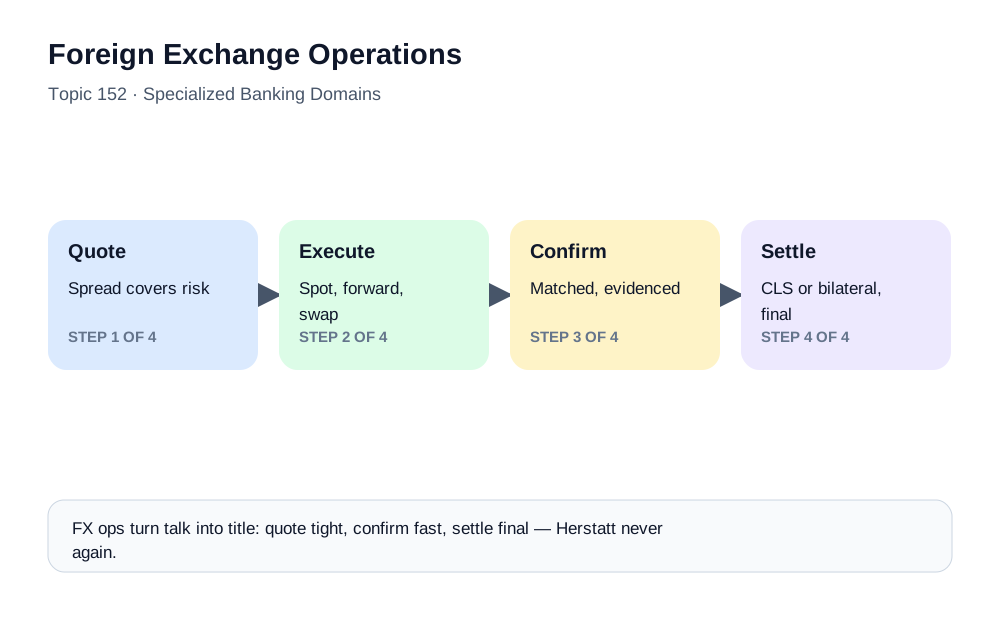
Foreign Exchange Operations at a glance — FX trading, risk management, settlement.
Spot, Forwards, Swaps, Options, Currency Risk, Settlement, and Controls
Foreign exchange operations help banks and customers convert, hedge, settle, and manage money across currencies. A company importing equipment may need to buy USD. An exporter may need to sell EUR. A traveller may use a card abroad. A bank may need to fund a nostro account. A treasury desk may hedge currency exposure. All of these activities depend on FX operations working accurately.
FX is not only about exchange rates on a screen. It includes quotation, trade capture, deal confirmation, limit checks, settlement instructions, nostro funding, cut-off times, regulatory reporting, sanctions screening, accounting, reconciliation, and exception handling. A wrong currency, wrong value date, wrong rate, or missed settlement can create direct financial loss and customer impact.
This chapter explains FX operations from a practical banking perspective: market participants, spot and forward deals, swaps and options, customer flows, bank position management, settlement risk, controls, and the operating discipline needed for cross-currency banking.
Learning objectives
By the end of this chapter, you should be able to:
- Explain the role of banks in foreign exchange markets.
- Understand spot, forward, swap, and option transactions.
- Describe bid, ask, spread, value date, forward points, and currency pairs.
- Explain how banks serve customer FX needs and manage open positions.
- Understand FX settlement, nostro accounts, cut-off times, CLS, and settlement risk.
- Identify transaction risk, translation risk, economic risk, liquidity risk, and operational risk.
- Explain controls such as limits, confirmations, sanctions screening, reconciliation, and trade lifecycle monitoring.
- Recognise why FX operations connects treasury, payments, trade finance, compliance, and accounting.
1. What Foreign Exchange Operations Means
Foreign exchange operations covers the processing and control of currency transactions.
It includes:
- quoting rates to customers;
- booking FX deals;
- checking limits and approvals;
- confirming trade details;
- generating settlement instructions;
- funding nostro accounts;
- monitoring value dates;
- screening payments where required;
- settling currency legs;
- posting accounting entries;
- reconciling cash movements;
- reporting regulatory data;
- managing exceptions and failed settlements.
The front office may agree the deal. Operations makes sure the deal is real, correct, settled, posted, and controlled.
2. Why FX Matters to Banks
Banks use FX operations to support:
- imports and exports;
- foreign remittances;
- international card transactions;
- correspondent banking;
- treasury funding;
- foreign-currency loans and deposits;
- trade finance;
- investment flows;
- hedging for corporates;
- institutional trading;
- centralised liquidity management;
- cross-border payments.
Any bank serving international customers needs reliable FX capability. Even a domestic bank may touch FX through cards, remittances, trade, or treasury investments.
3. Basic FX Terms
| Term | Meaning |
|---|---|
| Currency pair | Two currencies being exchanged, such as EUR/USD or USD/INR |
| Base currency | First currency in a pair |
| Quote currency | Second currency in a pair |
| Exchange rate | Price of one currency in terms of another |
| Bid rate | Rate at which bank buys the base currency |
| Ask rate | Rate at which bank sells the base currency |
| Spread | Difference between bid and ask |
| Value date | Date when currencies are exchanged |
| Spot date | Standard settlement date for a spot FX deal |
| Forward points | Adjustment from spot rate based on interest-rate differential |
| Mark-to-market | Revaluing a position using current market rates |
| Open position | Net currency exposure not fully offset |
A simple quotation has two sides because the bank must be clear whether it is buying or selling the currency.
4. Spot FX
A spot FX transaction is an agreement to exchange currencies for near-term settlement, commonly two business days after trade date for many currency pairs, though some pairs settle faster.
Example:
An importer needs USD 100,000 to pay a supplier. The bank quotes USD/INR. The importer buys USD and pays INR. The bank debits the customer's INR account and arranges USD settlement to the beneficiary or the customer's foreign-currency account depending on the transaction.
Spot FX is used for:
- import payments;
- export conversion;
- remittances;
- travel and education payments;
- treasury funding;
- settlement of foreign-currency obligations;
- immediate hedging needs.
Operations must check currency, amount, rate, value date, customer account, settlement route, regulatory purpose, and payment instruction.
5. Forward FX
A forward FX contract fixes an exchange rate today for currency exchange on a future date.
Corporates use forwards to reduce uncertainty.
Example:
An exporter expects to receive USD 1 million after three months. If the exporter fears the domestic currency may strengthen, reducing local-currency proceeds, the exporter can sell USD forward. The future rate becomes known today.
Forward rates are influenced by:
- spot rate;
- interest-rate differential between currencies;
- tenor;
- market liquidity;
- credit and funding considerations;
- bank margin.
Forward operations must monitor maturity date, utilisation, cancellation, rollover, margin, underlying documentation where required, and customer settlement readiness.
6. FX Swaps
An FX swap combines two currency exchanges: one near leg and one far leg.
A common structure is:
- buy one currency spot and sell it forward;
- or sell one currency spot and buy it forward.
Banks use FX swaps to manage foreign-currency funding without taking full outright currency exposure.
Example:
A bank needs USD liquidity for one week. It can buy USD spot and sell USD forward one week later. Economically, it has borrowed USD against another currency for that period.
FX swaps are important for treasury funding, nostro liquidity, and short-term balance-sheet management.
7. FX Options
An FX option gives the buyer the right, but not the obligation, to exchange currency at a specified rate on or before a specified date, depending on option style.
The buyer pays a premium for this flexibility.
Options are useful when a customer wants protection but also wants to benefit if rates move favourably.
Example:
An importer can buy a USD call option. If USD becomes expensive, the importer can use the option. If USD becomes cheaper, the importer can ignore the option and buy at the better market rate.
Options are more complex than spot and forwards. They require suitability checks, valuation, premium handling, documentation, and risk disclosure.
8. Customer FX Flow
A typical customer FX flow may look like this:
- Customer requests a rate for a currency pair and amount.
- Bank checks customer eligibility, limit, purpose, and documentation requirements.
- Bank quotes bid or ask rate.
- Customer accepts the quote.
- Deal is booked in the treasury or FX system.
- Confirmation is generated and matched.
- Settlement instructions are created.
- Payment messages or internal transfers are processed.
- Accounts are debited and credited on value date.
- Nostro accounts are reconciled.
- Regulatory and accounting entries are completed.
The customer may think the job is done after accepting the rate. The bank still has to settle both currency legs correctly.
9. Bank Position Management
When a bank executes customer FX deals, it may create currency exposure.
Example:
- Exporters sell USD to the bank.
- Importers buy USD from the bank.
- If the bank buys more USD than it sells, it becomes long USD.
- If the bank sells more USD than it buys, it becomes short USD.
Treasury monitors net open positions by currency, desk, product, tenor, and legal entity.
Controls include:
- dealer limits;
- desk limits;
- currency limits;
- overnight limits;
- stop-loss limits;
- Value-at-Risk;
- stress testing;
- independent market-risk monitoring;
- end-of-day position reporting.
The bank may offset excess positions in the interbank market.
10. FX Settlement and Nostro Accounts
FX settlement means exchanging the two currency legs on the value date.
Banks use nostro accounts to hold money in foreign currencies with correspondent banks.
Example:
A bank in India may maintain a USD nostro account with a correspondent bank in the United States. When it sells USD to a customer or settles a USD obligation, the USD leg may move through that nostro account.
Operations must manage:
- value date;
- settlement cut-off;
- correspondent bank details;
- payment message accuracy;
- sanctions and compliance checks;
- cash availability;
- nostro reconciliation;
- failed or delayed settlement;
- charges and deductions;
- repair and investigation.
Nostro funding errors can create failed payments even when the FX trade itself was booked correctly.
11. Settlement Risk and CLS
FX settlement risk is the risk that one currency leg settles but the other does not.
This is sometimes called principal risk. It can be serious because FX deals involve exchanging full principal amounts.
CLS, or Continuous Linked Settlement, is a market infrastructure that reduces FX settlement risk for eligible currencies by linking payment-versus-payment settlement. Both currency legs settle together or neither settles.
Not every currency or transaction is eligible for CLS. Where CLS is not used, banks rely on correspondent controls, limits, cut-offs, confirmations, and counterparty risk management.
12. FX Risk Types
| Risk type | Meaning | Example |
|---|---|---|
| Transaction risk | Loss from exchange-rate movement on a specific exposure | Import payable becomes more expensive |
| Translation risk | Accounting impact when foreign assets are translated into reporting currency | Foreign branch balance sheet changes value |
| Economic risk | Long-term business impact of currency movements | Export customers become less competitive |
| Settlement risk | One currency leg settles but the other fails | Bank pays out currency but does not receive counter-currency |
| Liquidity risk | Required currency is not available on time | Nostro has insufficient USD for value date |
| Operational risk | Booking, confirmation, payment, or reconciliation error | Wrong value date or wrong beneficiary bank |
| Compliance risk | Transaction breaches sanctions, purpose, or regulatory rules | Restricted party or missing purpose code |
| Model risk | Valuation or hedge model is wrong | Incorrect option valuation or hedge ratio |
FX operations must control both market risk and payment operations risk.
13. Trade Confirmation and Matching
After an FX deal is booked, both parties should confirm trade details.
Important fields include:
- trade date;
- value date;
- currency pair;
- bought currency and amount;
- sold currency and amount;
- exchange rate;
- counterparty;
- settlement instructions;
- dealer or channel;
- reference number;
- product type;
- fees or charges where applicable.
Confirmation matching reduces disputes and settlement failures. A small mismatch in value date, currency, or settlement account can cause a failed trade.
14. Regulatory and Compliance Controls
FX is closely monitored because it can be used for trade, investment, remittance, speculation, sanctions evasion, or capital movement.
Controls may include:
- KYC and customer eligibility;
- sanctions screening;
- anti-money-laundering monitoring;
- purpose-code validation;
- underlying-document checks;
- country and currency restrictions;
- transaction limits;
- suitability checks for derivatives;
- regulatory reporting;
- audit trail and record retention.
Rules vary by jurisdiction. Banks must apply the law and regulator expectations of the countries involved.
15. Reconciliation and Exceptions
FX operations relies heavily on reconciliation.
Teams compare:
- front-office trades versus operations records;
- confirmations versus booked trades;
- expected settlement versus nostro statements;
- customer debits and credits versus trade records;
- accounting entries versus product systems;
- regulatory reports versus source transactions;
- failed payments versus open FX deals.
Common exceptions include:
- unmatched confirmation;
- wrong value date;
- missing settlement instruction;
- insufficient nostro balance;
- delayed correspondent credit;
- wrong exchange rate applied;
- duplicate booking;
- cancelled forward not updated;
- customer did not provide documents;
- sanctions or compliance hold.
Exception handling must be fast because FX markets and payment cut-offs do not wait.
16. Practical Example
An importer must pay EUR 500,000 to a supplier in Germany.
The bank may:
- check customer eligibility and documentation;
- quote EUR/local-currency rate;
- book the FX deal after customer acceptance;
- debit the customer's local-currency account;
- arrange EUR funding through treasury or existing nostro balance;
- generate payment instruction to supplier bank;
- screen the payment;
- settle on value date;
- reconcile the EUR nostro debit;
- provide advice or confirmation to the customer.
If the EUR nostro is not funded or the payment misses cut-off, the customer may face supplier delay even though the FX rate was agreed correctly.
17. Common Misconceptions
Misconception 1: FX is only about predicting exchange rates.
Bank FX operations is also about booking, confirmation, settlement, nostro funding, compliance, reporting, and reconciliation.
Misconception 2: Spot means instant settlement.
Spot usually means near-term standard settlement, not always immediate settlement. Actual timing depends on currency pair and market rules.
Misconception 3: A forward removes every risk.
A forward reduces exchange-rate uncertainty, but settlement risk, counterparty risk, documentation risk, and liquidity risk remain.
Misconception 4: One FX rate applies to everyone.
Customer rates may differ based on amount, currency pair, market liquidity, channel, timing, relationship, cost, and bank margin.
18. Frequently Asked Questions
What is the difference between spot and forward FX?
Spot is for near-term currency exchange. Forward fixes a rate today for exchange on a future date.
What is a currency spread?
Spread is the difference between the bank's buy and sell rates. It compensates the bank for service, cost, liquidity, and risk.
Why do banks use nostro accounts for FX?
Nostro accounts allow banks to hold and settle foreign-currency funds through correspondent banking relationships.
What is FX settlement risk?
It is the risk that one currency leg settles but the other does not.
Why are cut-off times important?
If a transaction misses market, correspondent, or payment cut-off, settlement may be delayed to the next eligible day.
19. Key Terms
- FX: Foreign exchange.
- Spot: Near-term currency exchange transaction.
- Forward: Agreement to exchange currency at a future date at a fixed rate.
- FX swap: Combined near and far currency exchange.
- FX option: Right but not obligation to exchange currency at a defined rate.
- Bid: Rate at which bank buys.
- Ask: Rate at which bank sells.
- Spread: Difference between bid and ask.
- Value date: Date on which settlement occurs.
- Forward points: Difference between spot and forward rate.
- Nostro account: Bank's account held with another bank in foreign currency.
- Open position: Net currency exposure.
- CLS: Continuous Linked Settlement.
- PvP: Payment versus Payment, linked settlement of both currency legs.
- Mark-to-market: Revaluing using current market rates.
20. Interview Insights
Interviewers may ask FX operations questions to see whether you understand both markets and settlement.
Strong answers usually mention:
- spot, forward, swap, and option basics;
- bid, ask, spread, and value date;
- customer flow from quote to settlement;
- open position and limits;
- nostro funding;
- settlement risk and CLS;
- confirmations and matching;
- regulatory and sanctions controls;
- reconciliation and exception handling.
A good short answer:
"FX operations processes and controls currency transactions from quote and booking through confirmation, settlement, accounting, reporting, and reconciliation. Banks must manage exchange-rate exposure, settlement risk, nostro funding, cut-offs, sanctions checks, regulatory purpose requirements, and customer communication."
21. Summary
Foreign exchange operations is where global markets meet bank processing. It supports trade, remittances, treasury funding, cards, investments, and hedging.
For banking learners, the key lesson is this: an FX deal is not complete when the rate is agreed. It is complete only when both currency legs are correctly confirmed, settled, posted, reconciled, and controlled.
Next: Topic 153 - Derivatives Operations
<!-- MBA-DEEP-DIVE-START -->Foreign Exchange Operations Deepening — Pricing, Lifecycle Events, Settlement, Liquidity, and Control
An FX trade creates two money obligations that must agree in one economic transaction
When a bank buys one currency and sells another, the two legs are inseparable commercially even though they may settle through different accounts, time zones, correspondents, and payment systems. Operations should therefore preserve one deal identity connecting bought currency, sold currency, amounts, rate, value date, counterparty, and settlement instructions. Treating each leg as an unrelated payment makes it harder to detect a missing or duplicated side and obscures settlement risk.
Currency-pair notation should not be confused with the bank's customer direction
EUR/USD states a market convention for quoting euros in dollars, but a customer request should still say clearly which currency the customer buys and which it sells. “Customer buys EUR 1 million and sells USD at 1.10” is operationally clearer than “EUR/USD buy” when systems or staff can interpret perspective differently. Trade capture should store explicit bought and sold amounts in addition to the displayed market pair.
Precision and rounding rules matter in real money
Currencies have different minor-unit conventions, market rates can use different decimal precision, and derived counter-values may require defined rounding. A tiny difference can create settlement mismatch across large notional amounts. Pricing, confirmation, payment, accounting, and customer advice should use the same approved precision rules. A front-end showing fewer decimals than the booking engine should distinguish display rounding from contractual rate.
A customer quote has a short economic life
FX markets move continuously. When a bank presents an executable rate, the quote can have an expiry or acceptance window. The system should distinguish indicative rates from executable quotes and record the rate accepted by the customer. If acceptance arrives after expiry, the bank should requote rather than silently book the stale price unless the channel and product explicitly support that behaviour.
Customer spread is only one layer of FX pricing
The bank's all-in rate can reflect the market mid or executable hedge rate, liquidity, transaction size, tenor, credit, capital, funding, channel, service cost, and commercial margin. Large or illiquid trades may require dealer intervention. Straight-through pricing should have controls for stale market data, outlier spreads, and extreme volatility so the bank does not quote obviously incorrect rates because a feed froze.
Market-data source governance protects both client fairness and bank P&L
FX systems can use primary and fallback market-data providers. Each feed should have timestamp, quality checks, stale-price thresholds, currency-pair coverage, and fallback logic. If the primary feed fails, the bank should know whether automated pricing stops, switches to an approved alternative, or requires dealer confirmation. An unlabeled fallback rate can create customer disputes and valuation breaks.
Value date depends on both currency calendars
A standard spot date is determined by market convention and business days for the currencies involved. Holidays in either relevant currency can move settlement. Some pairs have different conventions and near-date transactions can settle today or tomorrow where supported. The system should calculate dates from governed currency calendars rather than hard-code “spot equals T+2” for every pair.
Broken-date forwards need exact day treatment
Customers do not always hedge to standard monthly maturities. A forward can settle on a custom business date matching an invoice or cash flow. Pricing then uses the relevant forward curve and day calculation rather than simply interpolating informally. Operations should store the actual contractual date and not replace it with the nearest standard tenor label.
Forward points express interest-rate economics, not a forecast of where spot must trade
The forward rate generally reflects spot plus or minus points related to the interest-rate differential and market basis between currencies. It should not be explained as the bank predicting the future spot rate. This distinction helps customers and learners understand why a currency can trade at a forward premium or discount even when nobody can know its future market price.
Forward contracts create future credit exposure before settlement
A customer forward can move substantially in or out of the money before maturity. If the customer defaults when the bank has positive replacement value, the bank can suffer loss. Credit lines, collateral, margin, limits, and mark-to-market monitoring can therefore apply even though no principal exchanges on trade date. Operations should connect the deal to the approved counterparty credit framework.
Pre-delivery settlement risk and replacement-cost risk are different
Before value date, the bank's exposure is commonly the cost of replacing the trade if the counterparty defaults. On settlement day, if one full currency leg has been paid without receiving the other, principal settlement exposure can be far larger. Risk systems should distinguish these stages and not apply one generic “FX exposure” number to both.
An FX swap is one trade structure with two linked value dates
The near and far legs should remain linked for economics, valuation, confirmations, and lifecycle processing. Operations should prevent one leg from being cancelled or amended accidentally without considering the other. The swap points and implied funding economics should reconcile with the pair's conventions. Cash-flow forecasts need both legs so treasury understands today's inflow and the future reversal.
FX swaps can fund a currency without leaving the same open spot position as an outright purchase
If a bank temporarily needs dollars, it can exchange another currency for dollars now and reverse later. The arrangement still consumes counterparty, settlement, liquidity, and balance-sheet capacity. It can also expose the bank to cross-currency basis and rollover conditions. Calling a swap “just two FX trades” misses its funding purpose and linked-risk profile.
Forward rollovers are economically new decisions
A customer unable to settle a maturing forward may request an extension. The bank normally needs to close or offset the original maturity and establish a new forward under current market conditions, according to product and legal terms. Loss or gain on the original contract should not disappear inside the new rate. Operations should preserve the original deal, rollover economics, approvals, and new maturity.
Early termination should use current market value
Cancelling a forward before maturity can create a positive or negative close-out amount because market rates changed. The bank should calculate the economic value using approved curves and policy, communicate the amount, and post the resulting cash flow. Simply deleting the trade or returning the original spread ignores the market exposure that arose after booking.
FX option operations adds premium and exercise state
An option has strike, expiry, style, notional, currencies, premium, settlement terms, and exercise rules. The premium itself has a payment date and settlement instruction. At or before expiry, the option can be exercised, expire worthless, or be cash or physically settled according to contract. Operations should separate option premium settlement from the underlying currency exchange that may occur on exercise.
Exercise cut-offs are economically critical
An option can lose all value if an exercise instruction misses the contractual deadline. Systems should present time zone, cut-off, automatic-exercise rules where applicable, and authorised instruction channel clearly. A generic calendar date is insufficient. Operations should monitor material expiries and escalate missing instructions according to the contract and bank policy without making the investment decision for the customer.
Customer suitability and appropriateness depend on product and jurisdiction
Plain spot conversion, deliverable forwards, leveraged derivatives, barrier options, and structured products create very different complexity. Applicable conduct rules can require specific disclosures, classification, suitability, appropriateness, or documentation. A global bank should configure requirements by legal entity and client type rather than assume one derivative-selling process applies everywhere.
Trade capture should occur at execution, not when operations has time later
Late booking creates hidden market and credit exposure, incorrect positions, missed confirmations, and settlement risk. Electronic channels should book automatically when the customer accepts. Voice or dealer trades should enter the authoritative system promptly under controlled timestamps. Any after-the-fact correction should preserve the original entry and reason.
Deal amendments require a clear distinction between correction and economic change
Fixing a typo before confirmation is different from changing the rate, notional, or maturity after a valid trade exists. Material economic changes may require cancellation and rebooking or formal amendment depending on system, legal agreement, accounting, and market practice. Controls should prevent staff from editing trade economics silently to make a break disappear.
Electronic confirmation reduces manual mismatch but does not eliminate reference-data risk
Automated matching can compare amounts, dates, and rates efficiently. If both parties loaded the same wrong settlement instruction from stale reference data, the confirmation can still “match.” Static settlement instruction governance remains separate. Confirmation proves agreement on trade terms; it does not prove the destination account is legitimate.
Standing settlement instructions should be effective-dated and currency-specific
A counterparty may use different correspondent accounts for USD, EUR, GBP, or other currencies and may change them over time. SSI records should identify beneficiary institution, account, intermediary where needed, currency, product scope, effective date, and authenticated source. Ad hoc changes immediately before value date deserve enhanced scrutiny because payment diversion fraud often exploits urgency.
Customer settlement accounts should be validated before value date
A corporate may want delivery to its foreign-currency account, supplier, or another permitted destination depending on product. The FX contract and payment instruction can therefore be related but legally distinct. Operations should confirm whether the bank is settling to the customer or executing an associated cross-border payment, because sanctions, beneficiary data, fees, and payment rules can differ.
Prefunding should be based on expected nostro obligations
Treasury needs a view of each currency's projected debit and credit by correspondent and cut-off. Net positions across many customer and interbank trades can reduce the required external cash, but timing matters. A large expected receipt after the outgoing cut-off cannot fund an earlier payment. FX operations should feed accurate settlement forecasts to liquidity management throughout the day.
Nostro overdrafts can be expensive and operationally restricted
A correspondent can provide an agreed intraday or overnight line, but the bank should not rely on unplanned overdraft as normal funding. Charges, limits, credit appetite, and regulatory treatment can matter. Nostro monitoring should alert before the account breaches an agreed threshold and identify the largest upcoming settlements driving the shortage.
Payment-versus-payment addresses principal settlement risk for eligible activity
CLS and other PvP arrangements can coordinate final settlement so one currency leg does not settle without the other under the relevant service design. Eligibility depends on currencies, participants, products, cut-offs, and operational setup. Banks should not state that “CLS covers FX” generally. Non-eligible transactions and currencies still need bilateral or correspondent settlement controls.
CLS participation also creates funding and cut-off obligations
Risk reduction does not eliminate operational discipline. Participants or settlement members must meet funding requirements within defined windows. Treasury therefore needs intraday currency liquidity and accurate instructions. Missing a pay-in can create service and liquidity consequences. Operations should understand both the risk benefit and the funding mechanics.
Bilateral settlement needs principal-risk limits
Where PvP is unavailable, the bank can be exposed from the point it can no longer cancel its outgoing currency until the incoming currency is received with finality. This period can span time zones. Counterparty settlement limits, cut-off knowledge, correspondent status, and payment monitoring are therefore crucial. A creditworthy counterparty can still create large exposure if operational failure delays the received leg.
Time-zone differences create “pay first, receive later” risk
An Asian currency may settle hours before a North American currency. The bank's outgoing payment can become final while the counter-leg is still pending. Settlement-risk measurement should use actual cancellation deadlines and receipt finality rather than assume both currencies move simultaneously because they share one value date.
Sanctions screening should follow the actual payment and parties
An FX trade between two banks can have different sanctions-screening needs from a customer payment using the purchased currency. Screening rules depend on jurisdiction, transaction structure, parties, financial institution obligations, and data available. Operations should not assume a clean FX confirmation automatically clears the associated beneficiary payment.
Purpose and capital-control requirements are jurisdiction-specific
Some countries require reporting codes, underlying documents, eligibility checks, or limits for certain cross-border currency conversions. These rules can change. Product configuration should identify which legal entity, customer type, transaction purpose, currency, and amount require evidence. Educational material should avoid presenting one country's foreign-exchange control as a global rule.
Regulatory reporting should use source trade data rather than reconstructed spreadsheets
FX reporting can include transaction, position, derivative, large exposure, statistical, tax, or conduct requirements depending on jurisdiction. Data lineage should connect the submitted record to the booked deal and any later lifecycle event. A forward that is rolled, cancelled, or exercised should remain traceable through regulatory corrections or updates where required.
Trade surveillance can apply to FX conduct
Banks should monitor for unauthorised trading, manipulation, misuse of confidential client information, suspicious pricing, or other conduct issues relevant to the markets in which they operate. Dealer communications, electronic orders, timestamps, and transaction records can support review. The control framework should distinguish legitimate risk management from behaviour that disadvantages clients or the market.
Position management should distinguish customer flow from residual bank risk
A customer trade can be hedged immediately, warehoused within limits, or netted against other customer flows. Treasury needs gross client transactions for service and reporting, while market-risk systems need the residual open position. Operations should not delete the original client economics simply because the bank executed an offsetting interbank hedge.
Back-to-back hedging still leaves operational and basis risks
A dealer may book a customer forward and an almost identical market hedge. The bank can remain exposed to spread, credit, settlement, timing, and basis differences between the two transactions. If one deal is amended or fails to settle, the hedge may no longer offset. Systems should link hedges for analysis without assuming perfect cancellation of all risk.
Net open position should be measured by currency and legal entity
Long EUR in one subsidiary and short EUR in another may offset economically at group level but not be freely transferable. Local limits and capital rules can apply. Risk reports should show both entity and consolidated views. Intragroup trades used to transfer risk should themselves be booked, confirmed, and settled or accounted according to policy.
Stop-loss limits are a governance tool, not a trading strategy
A stop-loss threshold can force escalation or reduction of risk after losses. It should not be treated as a guarantee that loss cannot exceed the threshold because markets can gap and liquidity can disappear. Breaches need independent monitoring and accountable approval. Repeated temporary overrides can indicate risk appetite is being bypassed.
Mark-to-market should use independently governed curves
Forwards and swaps require spot and forward curves; options can require volatility surfaces and model inputs. Independent valuation control should compare trader marks with approved data and investigate material differences. Model and market-data changes should be versioned because they can alter P&L without any new trade.
P&L explain should identify spot, forward, carry, volatility, and new-trade effects
A daily movement should be attributable to market factors, time decay, new business, cancellations, settlements, fees, or valuation adjustments. Large unexplained residuals can signal missing or wrong trades. Finance and front office should resolve them before final reporting rather than carry unexplained amounts indefinitely.
FX settlement can create accounting timing differences
Trade-date accounting, value-date cash, unrealised revaluation, realised gain or loss, customer account postings, and correspondent cash can occur at different moments. Finance rules should be consistent by product and accounting framework. Reconciliation should understand expected timing instead of treating every temporary difference as a break.
Failed settlement should be treated as both operational and credit information
If the counterparty does not deliver the expected currency, the bank may need replacement funding and can hold an unsecured receivable. Operations should escalate immediately based on amount, currency, and timing. Risk may reduce counterparty limits while treasury manages the liquidity gap. The failure should remain open until cash is received and accounting is corrected.
Settlement compensation should follow documented rules
A late payment can create overdraft interest, lost investment income, claims, or value-date adjustment. Banks can use agreed market or bilateral practices for compensation. Operations should calculate claims from evidence rather than apply arbitrary fees. Repeated fails from one counterparty should also influence service and credit review.
Holiday mismatches can create accidental open positions
If one leg is moved to a new date because of a currency holiday but the other is not, the bank can create an unintended short-term loan or FX exposure. Date engines should validate both currencies whenever a settlement date changes. Manual value-date overrides deserve strong controls and independent review.
Non-deliverable forwards require a different settlement model
An NDF typically settles a net cash amount in an agreed settlement currency based on a fixing rather than exchanging the two principal currencies. Fixing source, fixing date, reference rate, settlement currency, and calculation are therefore critical. Operations should not process an NDF through the same physical-delivery workflow as a deliverable forward.
Fixing-source governance matters in NDFs and some options
The contract defines which benchmark or official rate determines settlement. If a source is unavailable or disrupted, fallback provisions apply. Staff should not substitute a convenient screen price. The fixing evidence should be retained so the settlement amount can be reproduced during dispute or audit.
Same-day FX creates compressed operational risk
For T+0 transactions, rate acceptance, funding, compliance, confirmation, and payment can occur within hours or minutes. The bank needs earlier cut-offs and tighter automation. A deal accepted after the last feasible settlement window should either be declined, moved to another value date with customer consent, or handled through a controlled exception rather than promised without capacity.
Card and small-value FX uses different pricing and settlement architecture
A customer's card purchase abroad may be converted under card-network and issuer rules rather than a separately negotiated treasury deal. Remittance channels can use prefunded balances or batch hedging. Treasury still manages aggregate currency risk, but operations should not force every retail conversion into the institutional-dealer lifecycle.
Scenario: a corporate forward matures but the export receipt is delayed
The customer sold USD forward expecting receivables that have not arrived. The original contract remains due. The bank assesses the customer's request under credit and product rules, values the maturing deal, and if approved books an appropriate rollover or new transaction rather than simply changing the maturity. The economic impact is transparent and the hedge position remains controlled.
Scenario: the USD nostro is short before a large settlement window
FX operations forecasts several customer USD payments and interbank trades. Expected receipts are delayed. Treasury raises dollars through an approved market transaction and funds the correspondent before cut-off. The original FX deals settle normally. This is a good example of trade operations and liquidity management cooperating before the customer experiences a failure.
Scenario: an SSI-change email arrives on value date
A counterparty requests that a large EUR payment be sent to a new bank account, citing an urgent migration. Operations refuses to change the destination based only on email, uses the established authentication process, and retains the previously verified instruction until the amendment is confirmed. The trade economics can be genuine while the settlement-change request is fraudulent.
Scenario: one leg is sent and the incoming currency does not arrive
The bank's outgoing payment has become final. The counterparty reports a technical outage. Operations escalates the unsettled receivable, treasury sources replacement currency to protect payment obligations, and credit risk reviews exposure. When funds arrive later, value-date and compensation are reconciled. The incident demonstrates why principal settlement risk can dwarf normal replacement-cost exposure.
Business analysts should model FX as a trade plus two settlement obligations
Requirements should connect quote, acceptance, booking, credit check, product terms, valuation, confirmation, SSI, currency calendars, payment instructions, compliance, nostro forecast, settlement status, accounting, and reconciliation. Each leg should have its own operational state while remaining linked to the deal. Lifecycle events such as amend, cancel, rollover, exercise, fix, and fail need explicit states and audit history.
Testing should include market and operational edge cases
Useful cases include stale quote, extreme market move, holiday change, T+0 cut-off, forward rollover, NDF fixing, option expiry, missing premium, unmatched confirmation, SSI change, sanctions hold, insufficient nostro balance, PvP ineligible currency, failed incoming leg, duplicate payment, value-date correction, and market-data outage. Tests should verify both currency amounts and accounting, not only workflow status.
Closing perspective
Foreign exchange operations is where a market price becomes two legally and operationally deliverable cash flows. The rate can be perfect and the customer hedge economically sound, yet the bank can still lose money through a wrong value date, stale settlement instruction, unmatched confirmation, insufficient nostro balance, missed option exercise, or one-sided settlement. Strong FX operations therefore joins precise market conventions with payment discipline, liquidity forecasting, counterparty control, compliance, independent valuation, and reconciliation until both sides of the currency promise are fully closed.
FX Operations Control Layer — Cut-Offs, Settlement Repair, Nostro Evidence, and Lifecycle Discipline
The settlement plan should be created when the trade is booked
An FX deal should not wait until value date before operations discovers where each currency will settle. Trade capture should resolve approved settlement instructions, correspondent route, currency cut-off, expected funding source, and whether the trade is eligible for a payment-versus-payment mechanism or will settle bilaterally. Exceptions can then be repaired while time remains. Early settlement enrichment reduces the number of urgent same-day SSI changes and manual payments.
Currency calendars should be governed as critical reference data
A wrong holiday can place one leg on a day when the local payment system is closed. Calendar services should identify source, market, currency, effective version, and emergency changes. When a holiday is added unexpectedly, operations should identify affected trades and determine the contractual date treatment rather than shifting all transactions automatically. The two currency legs and related customer payment must remain economically aligned.
Cut-off monitoring should use the actual settlement route
The final feasible time for a USD payment through one correspondent may differ from another route, and internal approval or sanctions review consumes part of the window. Operations should therefore calculate a latest safe release time from the chosen route rather than publish one generic “USD cut-off.” Trades approaching that time with missing SSI, funding, or confirmation should be escalated before the external deadline is missed.
Partial settlement should remain an explicit exception
If one currency leg settles and the other does not, the bank now has principal exposure and a liquidity difference. Systems should not mark the trade partially complete and move on without escalation. The settled leg, failed leg, cancellation deadline, amount, counterparty, and replacement funding requirement should be visible to treasury and credit risk. Recovery continues until the missing currency is received or the exposure is otherwise resolved under approved process.
A timeout after sending an FX payment requires status enquiry
Correspondent and payment networks can accept a payment even when the sending application does not receive the acknowledgement. Blindly resending the same currency leg can create a duplicate. Stable payment references, idempotent submission, network enquiry, and nostro reconciliation should determine whether the first instruction settled before another is created. The FX trade remains linked to both the original attempt and any controlled replacement.
SSI changes should be treated as security-sensitive master-data events
Counterparties sometimes change correspondent accounts, but settlement fraud often exploits the same scenario. A new instruction should be received through an authenticated source, independently verified, maker-checked, effective-dated, and approved before use. Operations should be cautious when a change arrives shortly before a large value date. The economic legitimacy of the FX deal does not validate the destination account.
One-off settlement instructions need stronger evidence than standing instructions
Some client transactions legitimately require delivery to a non-standard account or underlying beneficiary. The bank should distinguish this from normal counterparty SSI and establish who is authorised to request it, what product permits it, which financial-crime controls apply, and how the instruction is verified. A free-text dealer note should not be sufficient authority for a large-value destination change.
Nostro forecasting should be reconciled to booked trade populations
For each currency and correspondent, operations can aggregate expected debits and credits from trades due that day. The forecast should reconcile to the underlying population so one missing interface does not understate funding. As trades settle, actual statement or intraday balance evidence should replace expected movement. The remaining forecast then shows which obligations still require liquidity.
Nostro breaks should identify whether the problem is trade, payment, or accounting
An unexpected debit can arise from a duplicated settlement, bank fee, value-date correction, correspondent adjustment, or an FX deal not captured in the expected population. An expected credit can be missing because the counterparty failed to pay. Reconciliation should classify these causes and route them correctly. Booking a manual journal to clear the difference without resolving the external cash leaves treasury exposed.
Trade amendments after payment release need coordinated control
If notional, currency, or value date changes after a settlement instruction was generated, the old payment may still be live. The amendment workflow should cancel or supersede pending instructions where possible, generate replacement cash flows, and confirm the resulting external state. Editing the trade alone can leave the bank settling the original economics while the booking system displays the amended version.
Cancellation deadlines should be visible for each outgoing leg
Principal settlement risk begins to increase when the bank can no longer stop its outgoing payment even though the incoming leg has not been received. Operations should know the cancellation cut-off for the relevant correspondent or system and monitor unmatched receipts after that point. Risk measurement becomes more accurate when it uses actual payment finality windows rather than treating the whole calendar day as one exposure period.
Settlement repair should preserve original references
A rejected payment may require correction of account, intermediary, reference, or regulatory data. The repair should link the new instruction to the failed one and record reason, operator, approval, and amount. This prevents the same trade from accumulating several unrelated payment records and helps reconciliation prove that only one economic obligation ultimately settled.
Fixing disputes need source evidence
For NDFs and other contracts using a benchmark fixing, operations should retain the official or contractually defined observation used, timestamp, fallback if any, and calculation. If two parties disagree on settlement amount, the dispute can then be decomposed into fixing source, rate, notional, and formula. A screenshot copied into an email is weaker than governed market-data evidence stored with the deal.
Option exercise instructions should be authenticated and time-stamped
An exercise can create a large underlying FX obligation. The bank should know who was authorised to exercise, when the instruction was received relative to cut-off, what amount or notional was exercised, and what settlement instruction applies. Late or ambiguous instructions should follow the contract and approved escalation rather than being accepted informally because market value is large.
Same-day deal acceptance should consider operations capacity
A salesperson can see a live price while the settlement route is already near cut-off. Product controls should determine whether same-day value remains feasible before an executable quote is offered. If the operational window has closed, the system should offer another value date or an explicitly approved exception. This prevents commercial execution from creating an impossible settlement promise.
Settlement fails should feed counterparty behaviour analytics
Repeated late receipts, wrong instructions, disputed values, or unmatched confirmations can indicate operational weakness at a counterparty even when every fail is eventually cured. Treasury, credit risk, and operations should see the pattern. Service or settlement limits can then reflect observed reliability instead of assessing the institution only through external credit ratings.
Back-to-back client and hedge trades need separate settlement proof
A bank can be economically flat while facing two independent cash settlements: one with the customer and one with the hedge counterparty. If the customer pays late while the hedge settles, the bank has a liquidity and credit exposure despite minimal market risk. Operations should therefore track both deals independently while retaining the hedge relationship for P&L and risk analysis.
FX fees and spread should not be confused with settlement differences
A customer may be charged an explicit fee, embedded spread, correspondent charge, or payment fee depending on product. Accounting should identify these revenue or expense components separately from unexplained cash difference. This enables accurate customer disclosure and prevents reconciliation teams from treating every small mismatch as an acceptable “FX spread.”
Transaction-cost analysis can identify operational as well as pricing issues
For institutional flows, the bank may compare executed price with relevant market benchmarks, while operations can examine delays between quote, booking, confirmation, hedge, and settlement. Unusual slippage may come from market movement or from a process that holds a trade before hedge. Combining timing and pricing data helps distinguish commercial execution quality from operational latency.
FX operations should hand off unresolved risk explicitly at shift boundaries
Global currency settlement follows the sun. An unresolved SSI, missing receipt, disputed fixing, or short nostro can move from one regional team to another. Handover should identify transaction, amount, currency, current state, cancellation deadline, external contact, action taken, and next decision. A generic shared mailbox is insufficient for principal-risk exposures that can remain live across time zones.
Disaster recovery should test ability to settle, not only book trades
A backup trading platform is useful only if operations can still access confirmations, SSI, market data, payment channels, correspondents, and nostro evidence. Exercises should include a real or simulated value-day population and prove that the bank can fund and settle it safely from the recovery environment. This exposes hidden dependencies that ordinary technology failover tests miss.
The best FX control links economics to two proven cash outcomes
For every deal, the bank should be able to explain what was bought and sold, the contractual rate and date, where each currency was instructed, when each leg became final, what fees or adjustments applied, and how accounting reconciled. The trade is operationally complete only when both money legs and the books tell the same story.
<!-- MBA-DEEP-DIVE-END -->