Visual overview
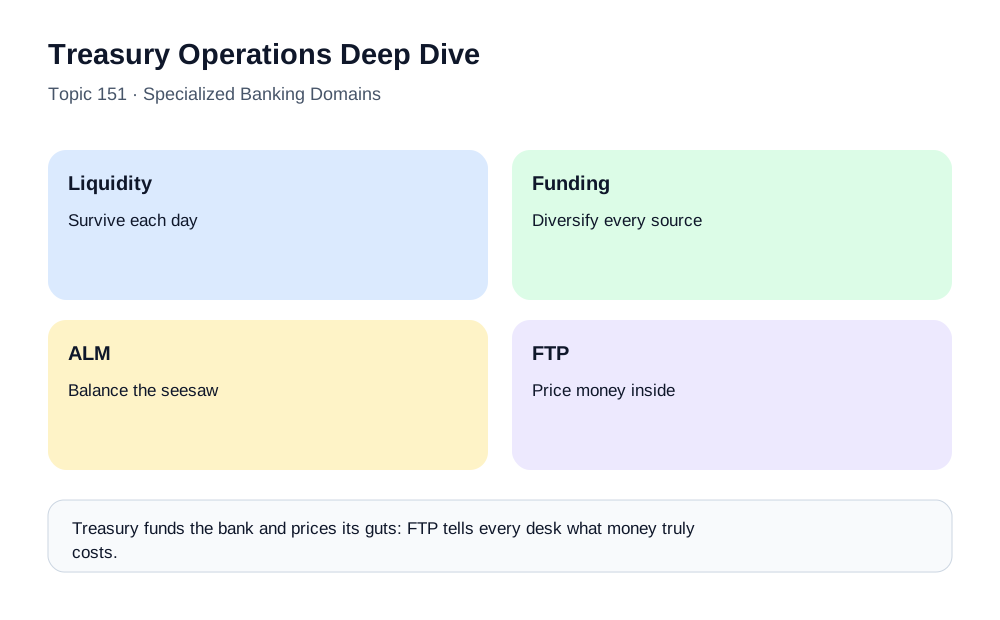
Treasury Operations Deep Dive at a glance — Funding management, investment portfolio, ALM.
Liquidity, Funding, ALM, Investment Portfolios, FTP, and Treasury Risk
Treasury is the part of a bank that manages money at the balance-sheet level. It makes sure the bank has enough liquidity to meet obligations, funds the balance sheet efficiently, invests surplus funds, manages interest-rate and currency risk, supports business units with pricing, and keeps the bank within regulatory liquidity and market-risk limits.
A lending team may focus on customers and credit. A deposits team may focus on accounts and relationships. Payments teams may focus on movement of money. Treasury connects all of them because every loan needs funding, every deposit affects liquidity, every payment changes cash position, every market movement affects valuation, and every regulatory ratio depends on balance-sheet behaviour.
This chapter explains treasury from a practical banking perspective: daily liquidity, money markets, Asset-Liability Management, investment portfolios, funds transfer pricing, treasury P&L, controls, and the difference between profit generation and safety management.
Learning objectives
By the end of this chapter, you should be able to:
- Explain the main responsibilities of a bank treasury function.
- Understand liquidity management, funding, cash positioning, and money-market operations.
- Describe Asset-Liability Management and the risk created by maturity and repricing mismatches.
- Explain gap analysis, duration, NII sensitivity, EVE sensitivity, LCR, NSFR, and stress testing.
- Understand investment portfolio classifications and treasury securities management.
- Explain Funds Transfer Pricing and why it matters for business-unit profitability.
- Identify treasury revenue sources and major risks.
- Recognise the governance role of ALCO, limits, reporting, and independent risk control.
1. What Bank Treasury Means
Bank treasury manages the financial resources and market exposures of the bank.
Common responsibilities include:
- daily liquidity management;
- cash and nostro account positioning;
- short-term borrowing and lending;
- interbank money-market activity;
- investment portfolio management;
- statutory or regulatory liquidity portfolio management;
- interest-rate risk management;
- foreign-exchange risk management;
- derivatives hedging;
- balance-sheet funding strategy;
- funds transfer pricing;
- liquidity stress testing;
- regulatory ratio monitoring;
- treasury P&L reporting;
- market-risk and limit monitoring.
Treasury is both an operating function and a strategic function. It must handle today's funding needs while protecting the bank's future stability.
2. Treasury Is Not Only Trading
Many learners think treasury means buying and selling securities. Trading can be part of treasury, but the function is broader.
| Treasury area | Practical purpose |
|---|---|
| Liquidity management | Ensure the bank can meet obligations when due |
| Funding management | Decide how the bank funds loans and investments |
| ALM | Manage mismatch between assets and liabilities |
| Investment portfolio | Hold securities for liquidity, regulation, income, and risk management |
| Money markets | Borrow and lend short-term funds |
| FX and derivatives | Hedge or manage currency and interest-rate exposure |
| FTP | Price internal funding between business units |
| Regulatory liquidity | Maintain required buffers and ratios |
| Treasury operations | Confirm, settle, reconcile, and report treasury trades |
| Treasury risk | Monitor limits, valuation, market risk, and stress scenarios |
A good treasury function is measured not only by profit, but by resilience.
3. Daily Liquidity Management
Liquidity management means ensuring the bank can meet cash obligations as they fall due.
Daily treasury teams monitor:
- opening cash positions;
- central bank account balances;
- nostro account balances;
- expected incoming and outgoing payments;
- deposit inflows and withdrawals;
- loan disbursements;
- card and ATM settlement flows;
- securities settlement obligations;
- interbank borrowing and lending maturities;
- collateral calls;
- intraday liquidity needs;
- end-of-day funding gaps or surpluses.
A bank can be solvent but still fail if it cannot meet payments on time. Liquidity is therefore a survival function.
4. Funding Sources
Banks fund themselves through several sources.
| Funding source | Meaning | Stability |
|---|---|---|
| Current accounts | Transaction balances from customers | Can be volatile, but often sticky in aggregate |
| Savings accounts | Retail balances | Usually stable but withdrawable |
| Term deposits | Fixed maturity customer deposits | More predictable until maturity |
| Wholesale deposits | Large deposits from institutions | Can move quickly under stress |
| Interbank borrowing | Borrowing from other banks | Sensitive to market confidence |
| Repo | Borrowing secured by securities | Important short-term funding tool |
| Bonds | Medium or long-term market funding | Stable but depends on market access |
| Covered bonds or secured funding | Funding backed by asset pools | Strong but legally structured |
| Central bank facilities | Liquidity from central bank under conditions | Stress or policy tool |
| Equity capital | Permanent funding and loss absorption | Not liquidity funding, but supports confidence |
Treasury must balance cost, tenor, stability, concentration, collateral usage, and regulatory treatment.
5. Asset-Liability Management
Asset-Liability Management (ALM) manages the mismatch between what the bank owns and what the bank owes.
A bank's assets may include:
- home loans;
- corporate loans;
- personal loans;
- credit card receivables;
- government securities;
- corporate bonds;
- interbank placements.
Its liabilities may include:
- current accounts;
- savings accounts;
- term deposits;
- wholesale deposits;
- borrowings;
- issued bonds;
- subordinated debt.
The challenge is that assets and liabilities mature or reprice at different times. A 20-year mortgage may be funded partly by deposits that can leave much earlier. If interest rates rise, funding costs may increase before asset yields reprice. If deposits leave suddenly, treasury must find replacement liquidity.
ALM measures and manages these mismatches.
6. Repricing and Maturity Gaps
A maturity gap compares assets and liabilities by when cash is due.
A repricing gap compares assets and liabilities by when interest rates can reset.
Example:
A bank has many fixed-rate loans that reprice after three years, but deposits that reprice within one month. If market rates rise next month, deposit costs may rise quickly while loan income stays fixed. Net interest margin may compress.
Gap reports commonly use time buckets such as:
- overnight;
- 2 to 7 days;
- 8 days to 1 month;
- 1 to 3 months;
- 3 to 6 months;
- 6 to 12 months;
- 1 to 3 years;
- 3 to 5 years;
- over 5 years.
These buckets help treasury and ALCO see where the balance sheet is exposed.
7. Key Treasury and ALM Metrics
| Metric | Meaning | Why it matters |
|---|---|---|
| LCR | Liquidity Coverage Ratio | Tests ability to survive short-term liquidity stress |
| NSFR | Net Stable Funding Ratio | Tests stable funding over a longer horizon |
| NII sensitivity | Change in net interest income under rate shocks | Shows earnings impact of interest-rate movements |
| EVE sensitivity | Change in economic value of equity under rate shocks | Shows balance-sheet value sensitivity |
| Duration | Weighted average timing of cash flows | Measures interest-rate sensitivity |
| Modified duration | Price sensitivity to interest-rate movement | Helps estimate bond price impact |
| Repricing gap | Assets minus liabilities repricing in a time bucket | Shows rate-reset mismatch |
| Liquidity gap | Cash inflows minus outflows in a time bucket | Shows funding mismatch |
| VaR | Statistical estimate of market loss under assumptions | Used for market-risk control |
| Stress test | Loss or liquidity impact under severe scenarios | Tests resilience beyond normal conditions |
Metrics do not manage risk by themselves. They help leaders make decisions before stress becomes a crisis.
8. ALCO Governance
The Asset-Liability Committee (ALCO) is usually the senior governance forum for balance-sheet risk.
ALCO may review:
- liquidity position;
- funding plan;
- deposit trends;
- loan growth;
- interest-rate outlook;
- repricing gaps;
- liquidity gaps;
- LCR and NSFR;
- investment portfolio position;
- FTP curves;
- market-risk limits;
- stress-test results;
- contingency funding plan;
- hedging strategy.
ALCO connects treasury, finance, risk, business units, and senior management. Its role is to ensure the bank grows without building hidden liquidity or rate risk.
9. Investment Portfolio Management
Banks hold investment portfolios for several reasons:
- regulatory liquidity requirements;
- high-quality liquid asset buffers;
- income generation;
- collateral for repo or central bank facilities;
- balance-sheet management;
- interest-rate positioning;
- customer and market-making support where permitted.
Common instruments include:
- treasury bills;
- government bonds;
- agency securities;
- central bank bills;
- state or municipal securities;
- covered bonds;
- high-quality corporate bonds;
- certificates of deposit;
- commercial paper, subject to policy and risk appetite.
Investment portfolio management must balance yield, credit quality, liquidity, duration, accounting treatment, capital impact, and regulatory eligibility.
10. Accounting Classifications
Investment securities may be classified differently depending on accounting standards and management intent.
| Category | Practical meaning |
|---|---|
| Held to maturity | Bank intends and is able to hold until maturity |
| Available for sale or fair value through OCI | Valuation changes may go through equity/reserves depending on rules |
| Trading or fair value through P&L | Mark-to-market changes affect profit and loss |
The exact terminology depends on local accounting rules. The banking logic remains important: classification affects reported profit, capital, volatility, and management behaviour.
11. Funds Transfer Pricing
Funds Transfer Pricing (FTP) is the internal pricing system that transfers the economic cost or benefit of funds between business units and treasury.
A simple example:
- Deposit business gathers customer deposits at 5%.
- Treasury credits that business an FTP rate of 6%.
- The deposit business earns a 1% margin for gathering funds.
- Lending business borrows internal funds from treasury at 6%.
- Lending business lends to customers at 9%.
- The lending business earns a 3% lending spread.
- Treasury manages the bank's central funding and interest-rate risk.
FTP helps answer a difficult question: which business unit is truly profitable after funding cost is considered?
Without FTP, a loan team may look profitable simply because it ignores funding cost, or a deposit team may look weak even though it provides valuable stable funding.
12. Treasury P&L
Treasury revenue and cost may come from:
- net interest income from investment portfolios;
- money-market borrowing and lending spreads;
- securities trading gains or losses;
- foreign-exchange spreads;
- derivatives valuation and hedging results;
- funding cost optimisation;
- liquidity buffer carry cost;
- valuation adjustments;
- realised and unrealised mark-to-market movements.
Treasury P&L must be interpreted carefully. A profitable trading position may still create unacceptable risk. A liquidity buffer may reduce profit but protect the bank during stress.
13. Treasury Operations
Treasury front office executes transactions. Treasury operations ensures they are confirmed, settled, reconciled, and reported correctly.
Treasury operations may handle:
- trade capture validation;
- confirmation matching;
- settlement instructions;
- nostro funding;
- cash projection updates;
- collateral movements;
- coupon and maturity processing;
- trade lifecycle events;
- market data checks;
- P&L explain support;
- accounting feeds;
- regulatory reporting feeds;
- reconciliations and exceptions.
A brilliant market trade is still a problem if it is booked incorrectly, confirmed late, settled to the wrong account, or missed in reporting.
14. Treasury Risks
| Risk | What can go wrong | Control focus |
|---|---|---|
| Liquidity risk | Bank cannot meet obligations when due | Liquidity buffers, stress tests, contingency funding |
| Interest-rate risk | Rate changes reduce earnings or economic value | ALM limits, hedging, gap management |
| Market risk | Securities or FX positions lose value | VaR, stress tests, stop-loss, limits |
| Funding concentration risk | Bank depends too much on one source | Diversified funding plan |
| Counterparty risk | Interbank or derivative counterparty fails | Limits, collateral, credit support agreements |
| Settlement risk | Treasury trade fails to settle | Confirmation, settlement controls, nostro monitoring |
| Model risk | ALM or valuation model assumptions are wrong | Model validation and governance |
| Operational risk | Trade booking, payment, or reporting error | Maker-checker, reconciliation, audit trail |
| Regulatory risk | Liquidity or market-risk rules breached | Monitoring, escalation, reporting controls |
Treasury decisions can affect the whole bank, so independent risk oversight is essential.
15. Stress Testing and Contingency Funding
Treasury must plan for stress before stress happens.
Stress scenarios may include:
- sudden deposit withdrawals;
- wholesale funding market closure;
- credit rating downgrade;
- sharp interest-rate movement;
- currency shock;
- securities market illiquidity;
- payment-system disruption;
- operational outage;
- reputational event;
- sector-wide banking stress.
A contingency funding plan defines what the bank will do under stress. It may include using liquid securities, repo funding, central bank facilities, deposit campaigns, asset sales, business restrictions, communication plans, and escalation to senior management.
16. Practical Example
Assume a bank sees heavy corporate deposit withdrawals at the same time large loan disbursements are scheduled.
Treasury must:
- update intraday and end-of-day cash forecasts;
- check central bank and nostro balances;
- identify available liquid securities;
- decide whether to borrow in money markets or repo;
- monitor LCR and internal liquidity limits;
- inform ALCO or senior management if limits are pressured;
- coordinate with payments teams if large outgoing payments affect timing;
- update funding projections for the next days;
- document actions and exceptions.
This is why treasury needs visibility across deposits, loans, payments, markets, and regulatory ratios.
17. Common Misconceptions
Misconception 1: Treasury is only a profit center.
Treasury may generate profit, but its first responsibility is bank stability, liquidity, and balance-sheet control.
Misconception 2: Deposits are always cheap and stable.
Some deposits are sticky, but large or rate-sensitive deposits can move quickly, especially during stress.
Misconception 3: ALM is only a regulatory report.
ALM is a live management discipline. It influences pricing, funding, hedging, investment strategy, and growth.
Misconception 4: Liquidity and profitability always move together.
Holding strong liquidity buffers may reduce short-term profit but protect the bank when markets are stressed.
18. Frequently Asked Questions
What is the difference between liquidity risk and interest-rate risk?
Liquidity risk is the risk of not having cash when needed. Interest-rate risk is the risk that rate movements reduce earnings or balance-sheet value.
What does ALCO do?
ALCO reviews balance-sheet risks such as liquidity, funding, interest-rate exposure, investment portfolio strategy, FTP, and regulatory ratios.
Why does FTP matter?
FTP gives business units an internal funding price so profitability is measured fairly and interest-rate risk is managed centrally.
Is a high-yield investment portfolio always better?
No. Higher yield may come with higher credit risk, duration risk, liquidity risk, or capital impact.
Why do banks run liquidity stress tests?
Because normal conditions can change quickly. Stress tests show whether the bank can survive severe but plausible funding pressure.
19. Key Terms
- Treasury: Bank function managing liquidity, funding, investments, and market exposures.
- ALM: Asset-Liability Management.
- ALCO: Asset-Liability Committee.
- LCR: Liquidity Coverage Ratio.
- NSFR: Net Stable Funding Ratio.
- FTP: Funds Transfer Pricing.
- NII: Net Interest Income.
- EVE: Economic Value of Equity.
- Duration: Measure of timing and interest-rate sensitivity of cash flows.
- Repricing gap: Difference between assets and liabilities repricing in a period.
- Liquidity gap: Difference between cash inflows and outflows in a period.
- Repo: Secured borrowing or lending using securities as collateral.
- HQLA: High-Quality Liquid Assets.
- Stress test: Scenario analysis under severe conditions.
- Contingency funding plan: Action plan for liquidity stress.
20. Interview Insights
Interviewers often test whether you can explain treasury as a bank-wide control function, not only a market desk.
Strong answers usually mention:
- liquidity management;
- funding strategy;
- ALM and mismatch risk;
- investment portfolio;
- regulatory liquidity ratios;
- FTP;
- ALCO governance;
- stress testing;
- treasury operations and settlement control.
A good short answer:
"Bank treasury manages liquidity, funding, investment portfolios, interest-rate risk, FX risk, and internal funding prices. It ensures the bank can meet obligations, funds business growth efficiently, stays within regulatory ratios, and controls balance-sheet risk through ALM, ALCO governance, limits, and stress testing."
21. Summary
Treasury is the balance-sheet control room of a bank. It connects deposits, loans, payments, investments, markets, liquidity, capital, and regulation into one financial management discipline.
For banking learners, the key lesson is this: treasury is not just trading. It is the discipline that helps the bank stay funded, liquid, profitable, and resilient under both normal and stressed conditions.
Next: Topic 152 - Foreign Exchange Operations
<!-- MBA-DEEP-DIVE-START -->Treasury Operations Deepening — Balance-Sheet Steering, Liquidity Buffers, ALM, FTP, and Control
Treasury manages the bank as one economic balance sheet
Individual business lines see deposits, loans, mortgages, cards, trade finance, payments, securities, and derivatives as separate products. Treasury sees how all of them combine into funding demand, cash flows, interest-rate exposure, foreign-currency positions, collateral needs, and regulatory liquidity. This enterprise view is why treasury cannot be judged only by its own dealing profit. A treasury desk that maximises short-term revenue while leaving the bank short of stable funding or badly exposed to rate movements has failed its larger purpose.
The opening liquidity position should be explainable by currency and legal entity
A consolidated cash surplus can hide a deficit in the entity or currency that actually owes payments. Treasury therefore needs opening central-bank balances, nostro balances, expected securities settlement, wholesale maturities, customer flows, collateral calls, and intragroup movements by location. Transferability matters. Cash in one subsidiary cannot always be moved instantly to another, and domestic currency liquidity does not automatically settle a foreign-currency obligation.
Intraday liquidity should be monitored separately from end-of-day liquidity
A bank can expect a positive closing cash balance yet still face a midday settlement shortfall because outgoing high-value payments occur before incoming flows. Treasury needs time-of-day forecasts for material payment systems and correspondents, not merely daily buckets. Payment queues, collateralised intraday credit, expected receipts, cut-offs, and liquidity-saving mechanisms can all influence whether obligations settle on time.
Forecast quality is a treasury control metric
Treasury should compare forecast cash flows with realised flows and identify persistent error by source. A corporate business that routinely underestimates large drawdowns, a securities desk that sends late settlement updates, or a payments platform that omits certain clearing obligations can create expensive emergency funding. Forecast error should therefore feed process improvement, model recalibration, and business accountability.
Liquidity buffers are held for usability under stress
A security is valuable to liquidity management only if the bank can sell it, repo it, or mobilise it to an eligible facility quickly enough and without unacceptable loss. The buffer should therefore be viewed by market liquidity, legal owner, currency, settlement location, encumbrance, haircut, central-bank eligibility, and operational readiness. A portfolio can appear large in accounting value while much less is immediately usable.
HQLA classification and internal liquidity value are related but not identical
Regulatory high-quality liquid asset treatment is determined by the applicable liquidity framework. Treasury can also apply stricter internal haircuts or exclude assets it believes would be difficult to monetise. A security can be eligible under a rule yet operationally inconvenient because it sits in the wrong custodian or legal entity. Good treasury practice therefore combines regulatory classification with real-world monetisation testing.
The Liquidity Coverage Ratio is a stress metric, not a cash forecast
LCR compares a defined stock of high-quality liquid assets with prescribed net cash outflows over a 30-day stress horizon under the applicable framework. It should not be interpreted as “the bank has exactly 30 days of cash.” The calculation uses regulatory assumptions, caps, inflow treatment, and asset eligibility. Internal treasury forecasts can be more granular and should examine additional scenarios beyond the regulatory formula.
The Net Stable Funding Ratio addresses structural funding rather than tomorrow's cash
NSFR compares available stable funding with required stable funding over a longer horizon using regulatory factors. A bank can have a strong NSFR and still encounter an acute intraday liquidity problem. Conversely, a bank can be liquid today while relying on unstable short-term funding for long-lived assets. Treasury should use short-term and structural metrics together rather than treating one ratio as a complete liquidity answer.
Survival-horizon analysis complements regulatory ratios
An internal stress can project day-by-day cash flows under deposit runoff, market closure, collateral changes, margin calls, and asset monetisation assumptions. The survival horizon is the point at which available counterbalancing capacity would no longer meet projected outflows absent new actions. The result depends heavily on assumptions, so treasury should test several severities and identify which actions are executable at each stage.
Funding plans should distinguish business growth from refinancing
A bank may need 20 billion of new funding even if loan growth is zero because existing wholesale debt matures. Conversely, strong deposit growth can fund new lending without equal market issuance. Treasury therefore forecasts asset growth, deposit behaviour, debt maturities, collateralised funding capacity, capital actions, and expected balance-sheet changes. A funding plan should identify currency, tenor, instrument, investor base, and timing rather than only one annual amount.
Funding diversification is economic, not cosmetic
Issuing several instruments does not create true diversification if they are bought by the same investor type or mature in the same week. Treasury should monitor concentration by depositor, investor sector, product, maturity, currency, market, and legal entity. A broad retail deposit base behaves differently from a few price-sensitive institutional balances even if the accounting label says “customer deposits” for both.
Deposit behaviour should be modelled from observed customer characteristics
Contractual maturity is an incomplete guide to liquidity. Demand deposits can be legally withdrawable overnight but stable in aggregate, while a large corporate operating account can move quickly after a credit event. Treasury uses behavioural assumptions for non-maturity deposits and early withdrawal where appropriate. These models need validation because they affect liquidity, interest-rate risk, FTP, and hedging.
Deposit beta matters for interest-rate risk
When policy or market rates change, deposit pricing does not always move one-for-one. The percentage and speed of pass-through is often called deposit beta. Different customer segments and products respond differently. Underestimating beta can overstate future net interest income in a rising-rate environment; overestimating it can lead to overly conservative pricing. Historical relationships can change when competition intensifies, so behaviour needs monitoring.
Non-maturity deposits create both liquidity and interest-rate modelling challenges
A current account has no contractual repricing maturity in the same sense as a fixed-term instrument. ALM models therefore make behavioural assumptions about how long balances remain and how rapidly rates paid change. Those assumptions influence economic value, income sensitivity, hedge tenor, and FTP. The bank should avoid using one average life for every customer segment without evidence.
Repricing gap analysis is a useful first view but not a complete interest-rate-risk measure
Grouping assets and liabilities by next repricing date shows where earnings may respond to rate changes. However, products have optionality, behavioural assumptions, caps, floors, prepayments, and nonlinear cash flows. A simple gap can therefore miss substantial risk. Treasury and risk teams typically supplement it with income simulation, economic-value measures, duration analysis, and scenario testing.
Net interest income sensitivity measures earnings over a horizon
NII simulations reprice assets, liabilities, and off-balance-sheet positions under defined rate scenarios and business assumptions. Results depend on balance-sheet evolution, deposit beta, loan prepayments, new business, floors, hedges, and timing. A “+200 basis point” result is not a universal fact; it is an output of a scenario and set of assumptions that should be traceable and reviewed.
Economic value of equity focuses on the present value of future cash flows
EVE-style measures estimate how the economic value of assets, liabilities, and relevant off-balance-sheet positions changes when rates move. Long-dated fixed-rate assets can lose economic value even if near-term accounting income remains stable. NII and EVE therefore answer different questions and can signal different risk. ALCO should understand both rather than selecting whichever metric looks more favourable.
Basis risk matters when related rates do not move together
A loan can reprice to one benchmark while its funding cost depends on another. Deposit pricing can respond to policy rates differently from market benchmarks. Hedging one curve does not eliminate spread changes between curves. Treasury should identify benchmark and behavioural basis risk separately from pure parallel-rate risk.
Optionality creates asymmetric interest-rate exposure
Mortgage borrowers can prepay when rates fall, depositors can move money when competitors raise rates, and customers can draw committed credit facilities when funding markets are stressed. The bank often grants options to customers that become most valuable when conditions move against the bank. ALM should model those behaviours and price their cost rather than treating all contractual cash flows as fixed.
Prepayment assumptions change duration and hedge effectiveness
A portfolio of fixed-rate mortgages expected to remain for ten years can behave like a much shorter asset if customers refinance. If rates rise, prepayments may slow and duration extends exactly when fixed-rate assets lose value. This extension risk should be reflected in scenario analysis and hedging. Historical prepayment data should be segmented by product, incentive, customer, and market environment.
Funds Transfer Pricing separates customer franchise value from market risk
A lending business should earn for originating and managing credit, while treasury should centrally manage the funding and interest-rate consequences of that loan. FTP can charge the loan a term-matched internal funding price. Similarly, a deposit business can receive credit for providing stable funding. This prevents one business unit from appearing profitable because it silently transfers market risk to the rest of the bank.
A matched-maturity FTP curve improves economic attribution
Charging every loan the same short-term funding rate rewards long-term fixed-rate lending without recognising duration risk. A matched-maturity approach uses a curve appropriate to tenor and characteristics. Additional components can reflect liquidity, optionality, basis, and other costs according to the bank's framework. The exact methodology is an internal management choice subject to governance; there is no single universal FTP formula.
FTP should change prospectively with market conditions while preserving deal economics
A loan originated last year can retain the internal transfer price assigned at origination for performance attribution while new lending uses today's curve. If FTP is overwritten monthly, business profitability becomes difficult to understand. Systems should preserve vintage, curve, term, and any subsequent behavioural reallocation according to policy.
Deposit FTP can recognise both funding benefit and embedded optionality
Stable operational deposits can provide valuable funding, but they can also reprice unpredictably and be withdrawn. Treasury can analyse behavioural maturity, rate sensitivity, and liquidity value to determine internal credit. Paying a business unit a generous FTP based only on the contractual overnight maturity or only on historical stability can distort incentives in opposite directions.
ALCO decisions should connect metrics to actions
A dashboard showing rate gaps, liquidity ratios, and funding concentration is useful only if limits and triggers lead to decisions. ALCO can change deposit pricing, slow asset growth, alter hedge positions, issue term funding, increase liquid assets, adjust FTP, or reduce concentrations. Minutes should capture rationale, assumptions, actions, owners, and due dates. Governance is strongest when the next meeting can verify what actually happened.
Risk appetite should distinguish normal operating range from hard limits
Treasury metrics can have early-warning thresholds, management targets, internal limits, and regulatory minima. Breaching a management target may trigger remediation without representing a regulatory violation. Conflating all thresholds can cause either complacency or unnecessary crisis escalation. Systems and reports should state which level was breached and what response is required.
Interest-rate hedges should be tied to an identified risk objective
Treasury may use swaps, futures, options, or other permitted instruments to reduce rate sensitivity. A hedge should have a documented purpose, not become a speculative position simply because the desk has market access. Effectiveness can be measured against the exposure and scenario it was intended to manage. Basis, optionality, collateral, valuation, and counterparty risk remain after a hedge is executed.
Macro hedging and micro hedging create different operational needs
A micro hedge can be linked to a particular asset, liability, or transaction, while macro hedging manages portfolio-level exposure. Accounting designation may add further rules. Risk and finance systems should know whether a derivative is an economic hedge, accounting hedge, trading position, or combination. Labels should not be inferred from the trading desk alone.
Treasury investment portfolios serve several objectives that can conflict
Government and high-quality securities can provide liquidity, collateral, regulatory buffer, income, and interest-rate positioning. Longer duration can increase yield but also price sensitivity. More liquid securities can carry lower returns. Assets optimal for accounting income may be less useful for intraday liquidity. Portfolio construction should therefore reflect hierarchy of objectives and risk appetite.
Accounting classification should not drive risk blindness
Whether unrealised value changes flow through profit, OCI, or are treated differently under the applicable accounting framework does not change the economic sensitivity of the position. Treasury and risk should monitor market value, duration, liquidity, and capital consequences even when accounting presentation dampens immediate earnings volatility.
Unrealised losses can become liquidity-relevant
A security intended to be held may need to be sold or pledged during stress. Market-value decline can reduce sale proceeds or repo capacity and can generate collateral implications. Treasury stress tests should therefore connect interest-rate scenarios with liquidity monetisation, not place market and liquidity risk in entirely separate models.
Collateral optimisation has opportunity costs
A high-quality security can be used for repo, central-bank facilities, CCP margin, derivatives collateral, or regulatory liquidity. Allocating it to one purpose may make it unavailable for another. Collateral systems should show eligibility and encumbrance across uses. Treasury should avoid consuming the most flexible assets for low-value transactions when less versatile collateral would suffice.
Margin calls can transform market risk into immediate liquidity risk
A derivative position can hedge economic exposure successfully while requiring cash or securities margin after market movement. The bank may ultimately profit from the hedge but still need substantial collateral today. Treasury stress testing should therefore include variation margin and initial margin demands alongside contractual cash flows.
FX liquidity and FX risk are related but distinct
A bank can have little net FX position yet still need a large amount of one currency for settlement. FX swaps may convert currency temporarily without creating the same directional risk as an outright position, but they introduce rollover, basis, settlement, and counterparty considerations. Treasury should monitor significant currencies independently and understand central-bank or correspondent access in each.
Nostro balances should be optimised without starving payments
Holding excess cash in every correspondent account is expensive, while insufficient cash can delay customer payments. Treasury can use forecasts, sweeps, intercompany transfers, FX, and intraday credit to target balances. Payments operations needs clear escalation when an outgoing queue exceeds available funding. The correct target is enough liquidity with controlled buffer, not the smallest possible idle balance.
Treasury front office, middle office, operations, finance, and risk have different control roles
Front office executes authorised funding, investment, FX, and hedging activity. Independent risk monitors exposure and limits. Operations confirms and settles trades. Finance books and explains accounting results. Valuation control can independently verify prices. Clear segregation reduces the chance that one trader can create, conceal, value, and settle an unauthorised position.
Trade capture should occur promptly and in the authoritative system
Late booking hides risk and can cause settlement failure. Trade records should include counterparty, product, notional, currency, rate or price, dates, settlement instructions, trader, portfolio, and relevant references. Amendments and cancellations should preserve history. Spreadsheet side-books can support analysis but should not become the only record of material positions.
Confirmation matching detects economic disagreement before money moves
Treasury counterparties exchange confirmations or use matching platforms to agree terms. Mismatches in notional, rate, currency, maturity, settlement, or collateral can create direct loss. Operations should escalate outstanding confirmations based on risk and settlement date. A trade booked by both firms is not operationally safe until material terms agree.
Settlement instructions need independent governance
Changing a counterparty's bank details is a high-risk event. Static data should use authenticated sources, maker-checker control, effective dates, and restricted access. Traders should not be able to change destination accounts and release the resulting payment without independent control. Treasury payment fraud can involve legitimate trade economics and fraudulent settlement data.
P&L explain should separate market movement from operational error
Daily treasury P&L can arise from carry, curve movement, spread movement, FX, new trades, unwind, fees, valuation adjustments, and model changes. Unexplained P&L deserves investigation because it can indicate missing trades, wrong curves, stale prices, or booking errors. Finance and front office should be able to reconcile movement without forcing unexplained differences into manual plugs.
Valuation reserves recognise uncertainty
Less liquid instruments can have model, bid-offer, close-out, concentration, or funding uncertainty. Independent valuation processes can apply prudent adjustments according to policy and regulation. Traders should not be the sole source of fair value for positions that determine their own P&L. Governance should define price-source hierarchy and dispute process.
Counterparty exposure can change when market value changes
A derivative that starts near zero market value can become a large receivable. Credit support agreements and margin can reduce exposure, but collateral timing, thresholds, minimum transfer amounts, disputes, and wrong-way risk remain. Treasury should coordinate with counterparty credit risk and collateral operations rather than view derivatives solely as market hedges.
Liquidity stress testing should combine behavioural and market shocks
Scenarios can include retail runoff, corporate deposit withdrawal, loss of unsecured funding, repo haircut increases, collateral downgrade, margin calls, committed-facility drawdown, asset-price falls, payment disruption, and restricted intragroup transfer. Severe stress often comes from several channels interacting. Assuming only one shock at a time can materially overstate resilience.
Management actions in stress tests must be credible
“Sell securities” should specify which assets, volume, market depth, settlement time, haircut, legal entity, and expected price. “Raise deposits” should consider required pricing and customer response. “Use central bank” should reflect eligibility, collateral, and operational access. A stress model that counts impossible actions creates false comfort.
Contingency funding plans should have staged triggers
Early stages can increase monitoring and reduce discretionary balance-sheet growth. More severe stages can mobilise collateral, raise term funding, adjust deposit pricing, or activate senior crisis governance. The plan should identify actions, owners, execution time, communication, and dependencies. It should be tested periodically so emergency contacts, settlement routes, and collateral capabilities remain current.
Treasury resilience includes people and vendor dependencies
Market data, trading venues, confirmation platforms, settlement systems, central-bank access, correspondent banking, collateral platforms, and key staff can all fail. Business continuity should protect the ability to know the bank's position and execute essential funding even if normal dealing infrastructure is unavailable. Alternate procedures should be secured against fraud because crisis conditions increase social-engineering risk.
Scenario: deposit pricing competition accelerates
Competitors raise savings rates quickly. The bank sees deposits migrate toward higher-yield accounts and deposit beta rises above the assumption used in NII forecasts. Treasury updates behavioural modelling, increases FTP credit for genuinely stable deposits where policy supports it, and ALCO adjusts pricing and hedging. The issue is not simply “funding got expensive”; the bank's asset pricing and interest-rate exposure need to respond together.
Scenario: rates rise and securities lose value while margin calls increase
The bank's investment portfolio declines in market value and derivative hedges generate variation-margin outflows. The hedges protect economic rate exposure but consume cash. Treasury monetises selected unencumbered assets, monitors LCR and intraday balances, and adjusts funding. This scenario demonstrates why market, collateral, accounting, and liquidity views need one coordinated response.
Scenario: a large corporate drawdown arrives unexpectedly
A customer uses a committed credit facility much more quickly than forecast. The loan is valid and the bank must fund it. Treasury updates the day's liquidity position, raises short-term funding, and revises forward liquidity because the facility may remain drawn. Credit commitment management and treasury funding are connected: an undrawn line is a contingent liquidity risk, not just unused customer capacity.
Business analysts should map treasury decisions to data lineage
Requirements should connect customer deposits, loan schedules, payment forecasts, securities, derivatives, collateral, market data, settlement accounts, FTP curves, regulatory liquidity, limits, and accounting. Each dashboard number should have source, transformation, cut-off, owner, and reconciliation. Treasury systems become dangerous when similar terms such as “cash,” “liquidity,” “available collateral,” or “duration” mean different things across reports.
Testing should prove both calculation and action
Useful scenarios include deposit runoff, payment spike, rate shock, repricing change, prepayment slowdown, hedge trade, collateral haircut increase, margin call, failed settlement, market-data outage, FTP curve change, limit breach, intragroup transfer restriction, and contingency funding activation. A test should confirm not only the metric but the workflow, approval, accounting, settlement, and audit evidence that follows.
Closing perspective
Bank treasury is the mechanism that converts thousands of customer and market activities into one coherent funding and risk position. It protects daily settlement, prices the economic value of money inside the bank, manages maturity and repricing mismatch, maintains usable liquidity, and ensures growth can be funded under both normal and stressed conditions. The strongest treasury function combines balance-sheet economics with operational precision: it knows where cash is, when it is needed, what it costs, how exposures behave when markets move, and which actions remain genuinely executable when ordinary assumptions stop working.
Treasury Control Architecture — Intraday Decisions, Data Lineage, Limits, and Execution Readiness
Treasury starts each day by proving the usable opening position
A treasury dashboard should not treat yesterday's closing balances as today's usable liquidity without validation. Opening central-bank accounts, correspondent balances, securities available for mobilisation, collateral already encumbered, maturing wholesale funding, expected margin, and major known customer flows should be refreshed from authoritative sources. Data-quality flags matter because a stale nostro balance can make the bank appear funded when the cash was already consumed after the previous snapshot. The opening control should identify source time, currency, legal entity, and whether each balance is confirmed or estimated.
Legal-entity transferability should be visible beside consolidated liquidity
A group can have surplus cash overall while one regulated subsidiary cannot transfer funds because of local rules, internal limits, tax, collateral, or crisis restrictions. Treasury systems should therefore show both consolidated and entity-level positions. An assumed intragroup transfer should be represented as an action with approval, settlement route, timing, and capacity rather than simply netted away in a spreadsheet. This becomes critical during stress, when normally available internal liquidity can become trapped.
Large-payment intelligence should arrive before settlement cut-off
Corporate drawdowns, securities settlements, tax payments, central-bank obligations, and major customer transfers can alter an intraday position rapidly. Payment systems should provide treasury with early visibility once an instruction becomes sufficiently committed. The signal should include value, currency, expected settlement time, current control status, and probability where appropriate. Treasury can then distinguish a customer draft from an approved outgoing payment and avoid funding every tentative instruction as though it were final.
Payment-queue ageing should trigger treasury action rather than only operations alerts
A payment can be technically valid yet remain queued because liquidity is insufficient. Treasury should receive the queued amount, age, priority, settlement system, deadline, and largest contributing transactions. Thresholds can escalate when a queue approaches a scheme cut-off or when high-priority obligations accumulate. The response may be collateral mobilisation, FX funding, correspondent transfer, or reprioritisation within permitted rules. This joins payment operations to liquidity control instead of allowing each team to assume the other owns the delay.
Collateral mobilisation should be tested as an operational capability
A list of eligible securities does not prove the bank can turn them into liquidity quickly. Treasury should periodically test whether assets are located in the right account, free of encumbrance, correctly valued, accepted by the facility, and operationally transferable. Staff should know the cut-off, instruction route, approval, settlement time, and contingency contact. A stress buffer is credible only when the bank has demonstrated that it can mobilise the collateral within the time assumed by the stress model.
Encumbrance should update when collateral moves, not at end of day
The same security may be eligible for repo, central-bank credit, derivatives margin, CCP margin, or secured funding. Once pledged, it should cease to appear as freely available elsewhere. Collateral systems should publish an authoritative encumbrance state with effective time and transaction reference. Treasury decisions based on a delayed batch can double-count one asset across several funding plans and overstate the bank's counterbalancing capacity.
Central-bank operational readiness is separate from policy eligibility
A bank can satisfy the formal criteria for a standing or emergency facility yet fail to draw because credentials, signatories, test certificates, collateral links, or settlement accounts are not operational. Treasury contingency planning should therefore include periodic end-to-end testing where permitted. Contact lists, delegated authorities, legal documents, and system access should be kept current. The purpose is not to assume central-bank funding will always be available; it is to avoid preventable operational failure if the approved facility must be used.
Wholesale maturity ladders should identify refinancing cliffs
Treasury should view debt maturities by day, week, month, investor class, currency, instrument, and legal entity. Several individually manageable maturities can form a concentration if they fall together during a known volatile period. Refinancing plans should begin before the maturity date and consider market-access assumptions, investor appetite, collateral, and alternative sources. A maturity is a known cash event, so emergency funding on the final day generally signals weak planning rather than unforeseeable stress.
Deposit concentration should include behavioural linkage
Ten large corporate deposits can appear to be ten independent funding sources while all belong to companies in one industry, sponsor group, geographic region, or payment ecosystem. Treasury analysis should therefore consider common drivers of withdrawal as well as legal customer name. Operational deposits used for payroll or collections can behave differently from surplus cash placed for yield. Concentration dashboards should separate relationship purpose, pricing sensitivity, and historic volatility so the bank does not overstate diversification.
Early-warning indicators should lead to named actions
A rise in deposit outflow, wholesale spread, collateral haircut, payment queue, credit-default spread, digital withdrawal velocity, or intraday overdraft can indicate increasing stress. Each early-warning indicator should have threshold, owner, escalation route, and possible action. A dashboard full of amber lights is not a contingency plan. Governance is effective when management can show what decision was taken after the indicator moved and whether the action reduced the exposure.
Limit breaches should have a controlled workflow
Treasury limits can cover liquidity gaps, funding concentration, interest-rate sensitivity, FX position, counterparty exposure, collateral, or market risk. A breach should record metric, amount, time, source data, immediate containment, owner, approver, and remediation. Temporary excesses may be permitted under defined authority, but repeated waivers should be visible to risk committees. An emailed approval that never updates the system leaves monitoring unable to distinguish a tolerated exception from an uncontrolled breach.
ALCO actions should be tracked to completion
Asset-liability committees may decide to change deposit pricing, issue term funding, reduce asset growth, rebalance securities, or modify hedges. Meeting minutes should become tracked actions with owner, deadline, expected risk effect, and completion evidence. At the next meeting, management should compare the actual balance-sheet effect with the intended one. This turns governance from discussion into measurable steering.
FTP exceptions need transparent economics
A business unit may request an internal transfer price concession for a strategic customer or campaign. If exceptions are granted, the bank should record rationale, duration, approving authority, and which unit bears the economic cost. Otherwise management can distort product profitability by silently subsidising one portfolio. The original FTP curve and the concession should both remain visible so commercial performance can be evaluated fairly.
Treasury curve changes should be versioned and impact-assessed
Funding curves, liquidity premiums, behavioural assumptions, and transfer-pricing parameters can affect thousands of customer pricing and profitability decisions. A curve release should have source data, effective time, validation, approval, and downstream distribution evidence. If a wrong curve is published, the bank needs to know which transactions or reports consumed it. Version control makes correction and customer-impact assessment possible.
Intraday liquidity forecasts should distinguish model error from unexpected business
When actual cash differs from forecast, the reason matters. The customer may have sent an unforeseen payment, an expected receipt may have been delayed, a settlement feed may have failed, or the model may systematically mis-time a product. Variance coding should feed forecast improvement. Treating every miss as “business volatility” prevents the bank from discovering persistent data or modelling defects.
Funding actions should be reconciled to the position they were meant to solve
If treasury raises one billion of short-term cash because the projected deficit was eight hundred million, the post-trade position should show the new funding, cost, maturity, and remaining buffer. This sounds obvious, yet fragmented dealing and liquidity systems can make it difficult to connect the action with the forecast. A common action identifier helps management understand which intervention solved which exposure and whether the bank over- or under-funded.
Treasury dealing should be separated from settlement instruction control
A dealer can negotiate economic terms, but beneficiary bank details and settlement routes should come from approved static data. Urgent market conditions should not permit a trader to type an unverified destination account into a payment. Maker-checker, effective dating, independent authentication of changes, and restricted access are essential because treasury transactions can move very large values with legitimate-looking trade rationale.
Failed treasury settlement should update liquidity immediately
A repo, FX swap, deposit, security sale, or debt issuance can be expected to provide cash. If the incoming leg fails, the liquidity forecast must remove or downgrade that receipt rather than continue counting it. Operations should publish settlement status in near real time for material funding trades. Treasury can then replace the missing cash before customer or infrastructure obligations are affected.
Contingency funding actions should include execution time
A plan may say “sell securities,” “repo the portfolio,” or “raise deposits,” but each action has operational latency. Asset sale requires market, instruction, settlement, and possibly legal-entity transfer. Deposit campaigns require pricing and customer response. Repo needs eligible collateral and counterparty capacity. A contingency plan should therefore state how much liquidity each action can realistically produce and how long it takes under the stress scenario.
Crisis dashboards should present decision-quality data, not every available metric
During severe stress, senior management needs current cash, projected gaps, major outflows, usable collateral, funding access, key counterparties, payment queues, and executed actions by legal entity and currency. Hundreds of unrelated treasury statistics can obscure the immediate problem. The dashboard should preserve drill-down for specialists while presenting a concise common fact base for crisis decisions.
Treasury data lineage should support post-event review
After a funding incident, the bank should be able to reconstruct what position management saw at each decision point, which data were stale or estimated, what action was approved, what trade settled, and how the exposure evolved. Historical dashboard snapshots, source timestamps, action logs, and settlement evidence support this reconstruction. Without lineage, lessons from the incident become subjective and controls are harder to improve.
The strongest treasury process connects forecast, decision, execution, and proof
Treasury is not complete when a trader books a funding transaction or ALCO approves a strategy. The bank must see the resulting cash, collateral, risk, and maturity reflected in authoritative positions, reconcile the movement, and confirm the original exposure was addressed. This closed loop—observe, forecast, decide, execute, settle, reconcile, and learn—is what makes balance-sheet steering reliable in both normal markets and stress.
<!-- MBA-DEEP-DIVE-END -->