Visual overview
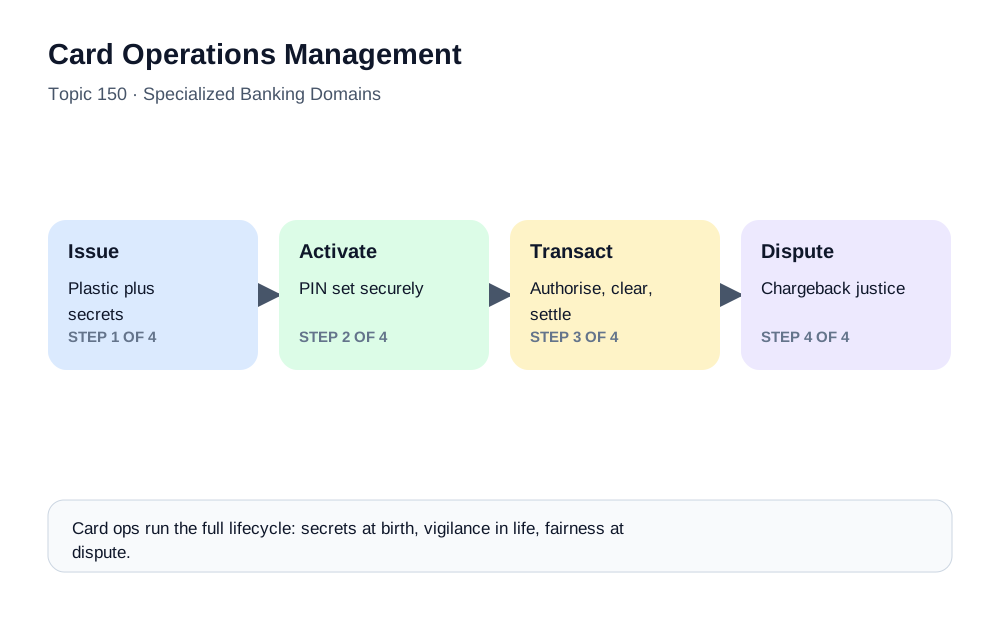
Card Operations Management at a glance — Card production, PIN management, card lifecycle.
Issuance, Authorisation, Settlement, Disputes, Fraud Controls, and the Card Lifecycle
A payment card looks simple to the customer. Tap, insert, swipe, or enter card details online, and the payment is approved or declined within seconds. Behind that moment sits a large banking operation involving card issuance, personalisation, PIN management, network routing, authorisation rules, fraud screening, settlement, disputes, rewards, renewals, blocking, replacement, compliance, and customer service.
Card operations is where banking, payments, risk, technology, and customer experience meet. A small failure can become visible immediately: a card not delivered, an incorrect limit, a failed authorisation, a false fraud block, a delayed chargeback, a wrong fee, or a replacement card sent to the wrong address.
This chapter explains card operations from a practical bank perspective: how cards are issued, how transactions are authorised, how settlement works, how disputes and chargebacks are handled, how lifecycle events are controlled, and why fraud prevention must be fast but carefully tuned.
Learning objectives
By the end of this chapter, you should be able to:
- Explain debit, credit, prepaid, virtual, contactless, corporate, and co-branded cards.
- Understand the card lifecycle from application to closure.
- Describe card production, personalisation, PIN generation, delivery, and activation.
- Explain card transaction authorisation across cardholder, merchant, acquirer, network, and issuer.
- Understand clearing, settlement, interchange, merchant discount rate, and chargebacks.
- Identify key operational risks in cards: fraud, wrong limits, delivery failure, dispute delay, data compromise, and false declines.
- Explain card controls such as tokenisation, EMV, CVV, 3-D Secure, OTP, velocity checks, and contactless limits.
- Recognise why card operations needs strong monitoring, reconciliation, and customer communication.
1. What Card Operations Means
Card operations is the end-to-end management of payment card products after and around the customer proposition.
It includes:
- card application processing;
- credit assessment for credit cards;
- card account creation;
- plastic or metal card production;
- virtual card issuance;
- PIN generation and delivery;
- card activation;
- authorisation processing;
- fraud monitoring;
- transaction posting;
- clearing and settlement;
- fee and interest calculation;
- rewards processing;
- disputes and chargebacks;
- replacement, renewal, closure, and upgrade;
- regulatory reporting and complaint handling.
The product may be marketed as a lifestyle card, travel card, debit card, business card, or premium credit card. Operationally, it is a controlled payment instrument connected to customer identity, account rules, network rules, risk scoring, and settlement obligations.
2. Main Types of Cards
| Card type | How it works | Main operational focus |
|---|---|---|
| Debit card | Funds are debited from the customer's bank account | Balance check, account status, daily limits, fraud controls |
| Credit card | Bank gives a credit line and bills customer later | Credit limit, billing, interest, collections, disputes |
| Prepaid card | Value is loaded before use | Load rules, balance tracking, expiry, KYC limits |
| Virtual card | Card details are issued digitally | Instant issuance, tokenisation, online usage controls |
| Contactless card | Tap-and-pay using NFC | Contactless limits, EMV rules, lost-card risk |
| Corporate card | Used by employees for business spending | Spend controls, expense reporting, company liability |
| Co-branded card | Issued with a partner brand | Partner rewards, data sharing rules, offer operations |
| Charge card | Full balance usually due each cycle | Spend monitoring, payment discipline, premium servicing |
A bank may run many card types on the same core card processing platform, with different rules by product, customer segment, network, and country.
3. Card Lifecycle
A card moves through a lifecycle.
- Application: customer applies through branch, app, website, campaign, or partner.
- KYC and eligibility: identity, income, account status, and risk checks are completed.
- Credit decision: credit card applications go through bureau, income, affordability, and internal scoring.
- Card account setup: product, limits, billing cycle, fees, rewards, and controls are configured.
- Personalisation: card number, expiry, name, chip data, and other values are prepared.
- PIN setup: PIN is generated or customer sets it through a secure channel.
- Delivery or digital issuance: physical card is dispatched or virtual card appears in app.
- Activation: customer activates card before use.
- Usage: transactions are authorised, posted, monitored, billed, and settled.
- Servicing: limits, disputes, statements, rewards, replacement, and queries are managed.
- Renewal or reissue: card is replaced before expiry or after damage/loss.
- Closure: card is closed, dues are settled, and linked services are disabled.
Each stage needs controls. A card delivered to the wrong person or activated without proper verification can create serious fraud exposure.
4. Card Production and Personalisation
Physical card issuance involves secure manufacturing and personalisation.
Common steps include:
- selecting card product and design;
- generating Primary Account Number or tokenised card number;
- assigning expiry date;
- creating chip and magnetic stripe data where applicable;
- printing or embossing customer name;
- packaging card securely;
- dispatching through approved logistics;
- tracking delivery status;
- blocking cards lost in transit;
- activating only after customer verification.
Card production vendors and bank operations teams must follow strict data-security controls because card data is sensitive.
5. PIN Management
PIN management is a high-risk operational area.
Banks must ensure:
- PINs are generated securely;
- PINs are not visible to staff;
- PIN mailers or digital PIN setup are controlled;
- PIN reset requires customer authentication;
- failed PIN attempts are limited;
- blocked PINs follow defined reset rules;
- ATM and POS PIN validation is secure.
Modern banking increasingly allows customers to set or reset PINs through mobile apps, internet banking, ATMs, or IVR after strong authentication.
The bank should never ask customers to disclose a full PIN to an agent, branch employee, or merchant.
6. Card Transaction Participants
A standard card transaction involves several parties.
| Party | Role |
|---|---|
| Cardholder | Customer using the card |
| Merchant | Business accepting the card payment |
| Acquirer | Merchant's bank or payment processor |
| Card network | Visa, Mastercard, RuPay, American Express, or another network routing and rule system |
| Issuer | Bank that issued the card to the customer |
| Processor | Technology provider processing authorisation, clearing, and posting for issuer or acquirer |
The customer sees one payment. The bank sees a networked transaction with authorisation, risk scoring, messaging, clearing, settlement, fees, and potential dispute rights.
7. Authorisation Flow
A card authorisation asks: should this transaction be approved now?
A simplified POS transaction flow:
- Customer taps, inserts, swipes, or enters card details.
- Merchant terminal sends transaction to acquirer.
- Acquirer sends request to card network.
- Network routes request to issuer.
- Issuer checks card status, balance or credit limit, customer controls, merchant category, country, channel, fraud score, and authentication result.
- Issuer approves or declines.
- Response returns through network and acquirer to merchant.
- Merchant completes or rejects sale.
This usually happens within seconds.
Common decline reasons include:
- insufficient balance or credit limit;
- blocked or inactive card;
- expired card;
- wrong PIN;
- suspicious transaction pattern;
- country or channel disabled;
- merchant category blocked;
- network or processor issue;
- transaction exceeds daily or per-transaction limit.
8. Card Security Controls
| Control | Purpose |
|---|---|
| EMV chip | Generates dynamic transaction data and reduces counterfeit-card risk |
| CVV/CVC | Helps validate card-not-present transactions |
| PIN | Authenticates cardholder for many POS and ATM transactions |
| OTP | Adds authentication for online or high-risk transactions |
| 3-D Secure | Adds issuer authentication layer for e-commerce |
| Tokenisation | Replaces card number with token for wallets or merchants |
| Contactless limit | Allows low-value tap payments with risk threshold |
| Velocity checks | Detect unusual frequency or value of transactions |
| Geo controls | Detect unusual country or location patterns |
| Merchant-category controls | Restrict usage at certain merchant categories |
| Real-time fraud scoring | Scores transactions before approval |
Security must avoid two failures: allowing fraud and blocking too many genuine customers.
9. Clearing and Settlement
Authorisation is not the same as settlement.
Authorisation confirms that the transaction may proceed. Clearing and settlement move the final financial obligations between issuer, acquirer, merchant, and network.
A simplified flow:
- Merchant submits approved transactions for clearing.
- Acquirer sends transaction files to card network.
- Network calculates issuer and acquirer positions.
- Issuer posts the transaction to the cardholder account.
- Funds move through settlement arrangements.
- Acquirer credits merchant after fees.
- Reconciliation confirms that authorisation, clearing, posting, and settlement match.
Operations teams monitor unmatched transactions, late presentments, duplicate transactions, reversals, refunds, and settlement breaks.
10. Card Economics
Card economics can include several revenue and cost elements.
| Item | Meaning |
|---|---|
| Interchange | Fee usually paid by acquirer to issuer under network rules |
| Merchant Discount Rate | Total cost charged to merchant for card acceptance |
| Network fee | Fee charged by card network for routing and scheme services |
| Annual fee | Fee charged to cardholder for card membership |
| Interest income | Credit card interest on revolving balances |
| Late payment fee | Fee when customer misses payment date, subject to rules |
| FX markup | Fee or spread for foreign-currency card transactions |
| Rewards cost | Cost of points, cashback, miles, or benefits |
| Fraud loss | Loss from unauthorised or disputed transactions |
| Chargeback cost | Operational and financial cost of disputes |
A card portfolio must balance customer value, merchant economics, regulatory rules, risk cost, and profitability.
11. Billing and Payments for Credit Cards
Credit card operations include billing-cycle management.
Key activities include:
- statement generation;
- minimum amount due calculation;
- total amount due calculation;
- interest-free period logic;
- payment due date tracking;
- payment posting;
- late fee and interest calculation;
- EMI conversion;
- overlimit monitoring;
- delinquency and collections handoff;
- credit bureau reporting.
Credit card billing must be clear. Confusing statements create complaints, missed payments, disputes, and regulatory risk.
12. Disputes and Chargebacks
A dispute happens when a cardholder challenges a transaction.
Common reasons include:
- unauthorised transaction;
- goods or services not received;
- duplicate billing;
- incorrect amount;
- refund not processed;
- cancelled subscription still charged;
- ATM cash not dispensed but account debited;
- merchant did not honour cancellation.
A chargeback is a formal dispute process under card-network rules where the issuer may recover funds from the acquirer or merchant if the claim is valid.
Good dispute operations require:
- clear intake of customer complaint;
- transaction evidence collection;
- provisional credit rules where applicable;
- network deadline tracking;
- merchant response review;
- customer communication;
- final decision and posting;
- regulatory complaint escalation if needed.
Network deadlines are critical. Missing a deadline can cause the bank to lose dispute rights.
13. Rewards Operations
Rewards make cards attractive, but they create operational complexity.
Rewards operations may include:
- points accrual;
- cashback calculation;
- merchant offer eligibility;
- bonus campaigns;
- reversal of rewards on refund;
- expiry of points;
- redemption fulfilment;
- partner settlement;
- customer communication;
- fraud checks on reward abuse.
If a campaign promises 5% cashback but the rules are unclear, the bank can face complaints. Product, technology, operations, and marketing must align before launching offers.
14. Fraud Monitoring
Card fraud can occur across channels.
Examples include:
- lost or stolen card usage;
- counterfeit card attempts;
- card-not-present fraud;
- account takeover;
- SIM swap linked to OTP compromise;
- phishing and social engineering;
- merchant collusion;
- mule-linked transactions;
- testing small amounts before larger fraud;
- refund abuse.
Fraud systems check transaction value, merchant, country, time, device, velocity, previous behaviour, and risk signals. High-risk transactions may be declined, challenged, or sent for review.
Fraud controls must be tuned carefully. Too strict creates false declines. Too weak creates losses.
15. Operational Risks
| Risk | What can go wrong | Control focus |
|---|---|---|
| Issuance risk | Card issued to wrong customer or wrong address | KYC, address validation, activation control |
| PIN risk | PIN exposed or reset incorrectly | Secure PIN generation, authentication, encryption |
| Authorisation risk | Genuine transaction declined or fraud approved | Rule tuning, fraud scoring, monitoring |
| Settlement risk | Network, issuer, acquirer, or merchant values do not match | Reconciliation, exception queues |
| Chargeback risk | Deadline missed or evidence incomplete | SLA tracking, workflow controls |
| Data risk | Card data exposed | PCI DSS, masking, encryption, access control |
| Complaint risk | Customer not updated or resolution delayed | Case tracking, communication standards |
| Rewards risk | Wrong points or cashback posted | Campaign testing, reconciliation |
| Regulatory risk | Fees, disclosures, or customer liability handled incorrectly | Compliance review, audit trail |
Card operations is a scale business. Even a low error rate can affect many customers when transaction volumes are high.
16. Practical Example
A customer reports that an online card transaction was unauthorised.
The bank should:
- authenticate the customer;
- block or restrict the card if risk continues;
- check transaction date, merchant, amount, authentication method, and device signals;
- register a dispute or fraud case;
- explain provisional credit or investigation rules where applicable;
- raise chargeback within network timelines if eligible;
- monitor related transactions;
- issue replacement card if needed;
- update customer until closure;
- record final outcome and loss responsibility.
The customer cares about speed and trust. The bank must also protect evidence, rules, and liability positions.
17. Common Misconceptions
Misconception 1: Card payment is final when the terminal says approved.
Approval is authorisation. Clearing, settlement, posting, reversal, refund, and dispute processes can still follow.
Misconception 2: Fraud systems should block every suspicious transaction.
They must balance fraud prevention with customer experience. Too many false declines damage trust.
Misconception 3: Rewards are only marketing.
Rewards require serious operations: calculation, eligibility, reversals, partner settlement, complaints, and fraud control.
Misconception 4: PIN and CVV can be handled like normal customer data.
Sensitive authentication data must be protected with strict controls and should never be casually collected or exposed.
18. Frequently Asked Questions
What is the difference between issuer and acquirer?
The issuer provides the card to the customer. The acquirer provides card acceptance services to the merchant.
What is authorisation?
Authorisation is the real-time approval or decline decision for a card transaction.
What is a chargeback?
A chargeback is a formal network dispute process where the issuer may recover funds from the acquirer or merchant for eligible disputed transactions.
Why do contactless cards have limits?
Limits balance convenience with risk, especially when low-value transactions do not require PIN entry.
Why are card operations heavily reconciled?
Because issuer records, network files, acquirer settlement, merchant credits, customer posting, reversals, refunds, and disputes must all agree.
19. Key Terms
- Issuer: Bank that issues the card to the customer.
- Acquirer: Bank or processor serving the merchant.
- Card network: Scheme that routes transactions and sets rules.
- Authorisation: Real-time approval or decline decision.
- Clearing: Exchange of transaction information for settlement.
- Settlement: Movement of funds between parties.
- Interchange: Fee usually paid to issuer under network rules.
- MDR: Merchant Discount Rate, cost charged to merchant.
- EMV: Chip-card standard improving transaction security.
- CVV/CVC: Card verification value/code.
- 3-D Secure: Authentication protocol for online card transactions.
- Tokenisation: Replacing card number with a token.
- Chargeback: Formal card dispute recovery process.
- False decline: Genuine transaction incorrectly declined.
20. Interview Insights
Interviewers often test whether you understand that card operations is more than card issuance.
Strong answers usually mention:
- issuer, acquirer, merchant, network, and cardholder roles;
- authorisation versus settlement;
- EMV, PIN, OTP, tokenisation, and fraud scoring;
- chargebacks and dispute timelines;
- credit card billing and collections;
- reconciliation across network, issuer, and customer records;
- customer impact of false declines and delayed disputes.
A good short answer:
"Card operations manages the full card lifecycle: issuance, activation, authorisation, fraud controls, clearing, settlement, billing, rewards, disputes, renewals, and closure. The bank must approve genuine transactions quickly, block fraud, reconcile settlement correctly, and handle customer disputes within scheme and regulatory timelines."
21. Summary
Card operations turns a small piece of plastic, metal, or virtual card data into a controlled payment product. It must be fast enough for real-time customer use and disciplined enough for fraud, settlement, billing, disputes, and compliance.
For banking learners, the key lesson is simple: a card transaction is not just a payment. It is a networked banking event with authorisation, risk scoring, posting, settlement, reconciliation, and customer protection behind it.
Next: Topic 151 - Treasury Operations Deep Dive
<!-- MBA-DEEP-DIVE-START -->Card Operations Deepening — Lifecycle Control, Authorisation State, Clearing, Fraud, and Dispute Operations
A card product is an account, credential, network instrument, and risk profile at the same time
A physical or virtual card is only the customer-facing credential. Behind it sits a card account, funding source or credit line, product configuration, network membership, authorisation profile, fraud rules, token relationships, billing logic, fees, rewards, dispute rights, and lifecycle state. Good card operations separates these concepts. Replacing a plastic card should not accidentally close the underlying credit account, while closing an account should reliably disable every physical card, virtual card, token, wallet credential, recurring-payment permission, and related access path that policy requires.
Card lifecycle status should be precise
Useful states can include created, awaiting production, dispatched, delivered, inactive, active, temporarily locked, hotlisted, damaged, compromised, expired, replacement pending, renewed, closed, and retained by ATM, depending on the processor and product. The card account itself can have different states such as open, delinquent, restricted, charged off, or closed. A customer-facing screen should derive understandable language from these detailed states instead of collapsing everything into “active” or “blocked.”
Primary account number generation belongs inside a controlled issuance domain
A PAN identifies the card relationship for network processing and should be generated and managed under strict security controls. Product systems need the correct issuer identification range, check digit, account mapping, expiry logic, and network configuration. Staff should not manually construct or edit PANs. Test environments should avoid unnecessary use of production card data, and masked values should be used wherever the full number is not operationally required.
Card personalisation is a supply-chain control problem
A production bureau can receive customer name, PAN-related data, chip profile, expiry, artwork, carrier information, and delivery destination. Files should be encrypted, transmitted through approved channels, reconciled by count, and subject to least-privilege access. The bank should know how rejected records, damaged cards, excess stock, spoiled cards, and production waste are destroyed. Outsourcing card manufacturing does not outsource the issuer's responsibility for secure issuance.
Blank card stock can be sensitive even before personalisation
High-value materials, issuer-branded stock, chips, holograms, and other components can become targets for theft or counterfeit activity. Inventory controls, restricted areas, dual custody, serial tracking, and destruction procedures can therefore matter at production vendors. Operations assurance should cover the physical supply chain as well as digital card data.
Delivery is a fraud control, not just logistics
A card delivered to the wrong person can become a usable credential if activation controls are weak. The bank should track dispatch, delivery attempt, returned mail, undeliverable address, customer acknowledgement where applicable, and cards reported missing in transit. Replacement requests soon after delivery can deserve risk review. Address changes close to reissue are particularly sensitive and may require stronger verification.
Activation should prove customer control without exposing secrets
A card can be activated through secure app, online banking, ATM, IVR, branch, or another approved channel. Activation should rely on authenticated customer context and not on easily obtained card details alone. The exact method can vary by risk and jurisdiction. A dormant delivered card should not become active merely because an attacker knows the PAN and expiry date.
PIN generation should keep the clear PIN away from people and applications that do not need it
PIN management typically uses cryptographic systems and secure PIN-block processing so employees and ordinary applications do not see the customer's secret. PIN set, change, verification, retry counter, unblock, and reset should be governed actions. Contact-center and branch staff should never request the full PIN. A process that asks the customer to disclose the PIN in order to reset it has inverted the security model.
PIN retry counters need state synchronisation
The chip, issuer host, ATM network, and processor can each hold relevant authentication state depending on the transaction. Offline and online PIN mechanisms also differ. Operations should understand how failed attempts lead to card or PIN blocking, how counters reset, and what happens after replacement. Inconsistent retry state can cause repeated declines or create a security weakness.
Chip and magnetic-stripe capabilities should be managed deliberately
EMV chip data provides stronger dynamic authentication than traditional static stripe data, but fallback processing and legacy acceptance can remain in some markets. Issuers can apply geography, merchant, transaction, and fallback controls based on risk. A card should not automatically accept a weaker method simply because the preferred interface failed. Network and terminal rules determine the exact processing path.
Contactless payment is an interface mode, not a separate account
A contactless transaction normally uses the same underlying card relationship with interface-specific verification and risk management. Limits, cumulative controls, device verification, terminal capabilities, issuer risk rules, and network specifications influence whether a tap is approved or requires another cardholder-verification method. Contactless limits are not universal; they vary by market, scheme, product, and evolving rules.
Virtual cards shorten issuance but increase lifecycle volume
A bank can issue virtual credentials instantly, create single-use or merchant-specific numbers, and replace compromised details without waiting for physical delivery. This flexibility creates more objects to manage. The system must know which virtual credential maps to which account, where it may be used, its expiry, spend limits, token status, and whether closure of the main relationship invalidates it.
Network tokenisation changes the credential presented to merchants and wallets
Mobile wallets and merchant token services can replace the PAN with a token associated with a device, merchant, or usage domain. Tokenisation can reduce exposure of the underlying PAN and allow a token to be suspended without necessarily replacing the physical card. Operations need token lifecycle events such as provisioning, activation, suspension, resume, deletion, and re-provisioning. A card replacement should invoke the scheme or token-service rules for linked tokens rather than assume they all disappear automatically.
Token requestor identity is part of fraud assessment
When a wallet or merchant requests token provisioning, the issuer can receive information about the requestor, device, account, and risk signals. Provisioning may be approved, declined, or require step-up verification. Fraudsters can attempt to add stolen cards to wallets, so token provisioning deserves controls as strong as other credential-creation events.
Cardholder controls should be treated as policy inputs to authorisation
Customers can be offered switches for online, international, contactless, ATM, merchant categories, regions, or limits. These preferences should propagate reliably to the authorisation engine and be time-stamped. If a customer disables international use, an overseas transaction should not be approved because one processor has stale settings. Channel controls need low-latency synchronisation and clear customer confirmation.
Authorisation is a decision on the transaction in front of the bank, not final settlement
The issuer receives a request containing card, merchant, amount, currency, transaction type, terminal or e-commerce data, authentication indicators, and other scheme fields. It checks product rules, card state, account funding or available credit, limits, fraud score, merchant or country restrictions, cardholder verification, and sometimes stand-in or network conditions. The result is an approval or decline code, often within a strict latency target. That decision reserves or expects value but does not prove final clearing will arrive exactly as authorised.
Available balance and ledger balance have different roles for debit cards
A current account can show posted ledger balance plus pending card holds, other reservations, overdraft rules, and incoming or unavailable funds. Authorisation should use the bank's definition of spendable or available funds, not the customer's raw posted balance. If pending holds are ignored, the bank can permit overspending; if expired holds remain too long, genuine customers lose access to money.
Credit-card available limit is a dynamic exposure calculation
The available amount can reflect assigned credit limit, posted balance, pending authorisations, instalment plans, fees, payments in transit, cash sublimits, temporary limits, and overlimit policy. Limit changes should have effective dates and approval. A large payment should not restore spending capacity before the issuer is satisfied the payment is good according to its policy, particularly where reversal or return risk exists.
Authorisation holds require expiry and completion logic
Hotels, car rentals, fuel stations, restaurants, and other merchants can use estimated or incremental authorisations. The final clearing amount can differ from the initial hold. Issuers need rules for partial reversals, incremental requests, completion, hold expiry, and unmatched presentment. Leaving every hold until a long generic timeout creates customer frustration; releasing too early can increase exposure.
Reversals are not refunds
An authorisation reversal tells the issuer that a prior hold is no longer needed or should be reduced. A refund is a separate financial transaction that credits the cardholder after a purchase or other posting. Contact-center and ledger systems should distinguish them. Customers often describe both as “money coming back,” but operationally they have different messages, timelines, reconciliation, and dispute implications.
Offline authorisation and floor limits introduce deferred issuer visibility
Some environments can permit transactions without real-time issuer approval under network, terminal, or product rules. The issuer then sees the item later in clearing. Risk controls around chip profiles, offline limits, merchant type, and country matter because the bank cannot make a real-time host decision. The availability and exact rules differ by scheme and market and should not be generalised.
Stand-in processing protects acceptance during issuer unavailability but changes control ownership
A card network or processor can sometimes make limited decisions when the issuer host is unreachable, based on pre-agreed parameters. Stand-in can reduce customer disruption during outages, but the issuer should define limits, risk rules, excluded products, and reconciliation. When service returns, stand-in approvals must be integrated into account and fraud state quickly to avoid duplicate exposure.
Decline codes should be customer-safe and operationally actionable
The internal reason may be insufficient funds, suspected fraud, restricted merchant, expired card, authentication failure, invalid transaction, system problem, or other rule. Merchants and networks receive defined response codes, while customer channels may need a simplified explanation that does not reveal fraud controls or sensitive logic. Operations should map technical codes to truthful next steps rather than display “bank declined” for every situation.
False declines are measurable customer harm
Blocking a genuine transaction can cause embarrassment, lost sales, travel disruption, and reduced card usage. Fraud teams should monitor approval rate, fraud loss, false-positive rate, customer complaints, step-up success, and segment impact together. A model that cuts fraud by declining an excessive share of good transactions is not a successful control.
Card-not-present risk depends heavily on authentication and merchant data quality
E-commerce transactions lack physical card presentation and can rely on account data, device intelligence, 3-D Secure, merchant risk, tokenisation, and issuer fraud models. The exact allocation of liability can depend on scheme rules and authentication outcome. Operations should record authentication indicators accurately because they can affect dispute rights and risk analysis later.
3-D Secure is an authentication framework, not an OTP product
Modern 3-D Secure can support frictionless risk-based authentication, app-based challenges, biometrics, one-time codes, or other methods depending on issuer design and regulation. Describing it simply as “the OTP screen” misses the underlying exchange between merchant, directory, and issuer authentication components. Card operations should distinguish authentication result from final payment authorisation.
Merchant category code is a useful signal but not a complete description of a purchase
MCC helps classify merchant business and supports card controls, rewards, interchange, and risk decisions. A merchant can sell many types of goods under one code, and coding can be wrong. Issuers should avoid making sensitive customer inferences solely from MCC. For control purposes, it is one network attribute among several.
Dynamic currency conversion and issuer FX are different services
A customer abroad can sometimes be offered conversion by the merchant or acquirer into the card's billing currency. Alternatively, the transaction can be submitted in local currency and converted under issuer or network arrangements. Customer cost and exchange-rate presentation can differ. Contact-center and dispute teams should identify which conversion occurred before explaining an FX amount.
Clearing is where authorised activity becomes detailed financial posting
Merchants or acquirers submit clearing records containing the final amount and transaction data. The issuer matches or relates these to prior authorisations where applicable, posts the cardholder account, calculates relevant fees or FX, and accepts its network settlement obligation. Late, duplicate, altered, or unmatched clearing items need exception logic. Authorisation and clearing references should be linked for investigation.
Presentment can legitimately differ from authorisation
Tips, incremental hotel charges, currency conversion, partial shipments, estimated fuel amounts, and other use cases can cause final clearing to differ from the original authorised amount within scheme rules. A mismatch is therefore not automatically fraud. The system should use transaction type and network rules to determine whether the difference is valid or requires investigation.
Settlement is a network-level cash obligation distinct from customer posting
Card networks calculate issuer and acquirer positions and settle according to their arrangements. The issuer may owe settlement even if a customer account posting is delayed. Treasury needs expected settlement totals and currency. Operations reconciles scheme files, settlement accounts, processor totals, and general ledger. A break at this layer can become a liquidity or accounting issue even if individual customer transactions look correct.
Interchange is rule-based economics, not simply an issuer fee chosen per transaction
Rates and qualification can depend on network, region, card type, merchant type, channel, transaction attributes, and regulation. Acquirer merchant pricing contains other components as well. Educational content should avoid treating MDR and interchange as interchangeable. Finance systems need transparent fee components for profitability and reconciliation.
Scheme fees and processor fees matter at scale
A card business can earn interest and interchange while paying network, processing, fraud, reward, loyalty, servicing, production, and dispute costs. Unit economics should be measured by product and customer behaviour. High-spend transactors can be profitable differently from revolving credit customers. Operations affects profitability through fraud loss, chargebacks, false declines, contact volume, and processing efficiency.
Credit-card billing needs exact transaction cut-off logic
A transaction clearing near statement generation can fall into the current or next billing cycle depending on posting and product rules. Payments, refunds, disputes, instalments, fees, and interest adjustments need similar timing rules. Customers should be able to reconcile statement balance to transactions. Re-running a statement after late data should be controlled and preserve the originally issued version where recordkeeping requires it.
Minimum payment should never be explained without the product's formula
Minimum amount due can include a percentage of balance, instalments, fees, overdue amounts, overlimit amounts, or other components depending on product and law. Contact-center and statement systems should use the same calculation source. Generic scripts risk misinforming customers, especially when minimum payment changes after an instalment plan or arrears.
Interest calculation requires daily balance and transaction-category precision
Purchases, cash advances, balance transfers, instalments, fees, and promotional transactions can have different rates, grace periods, and accrual rules. Payments may be allocated according to contractual and regulatory rules. A credit-card platform should preserve rate history and transaction category. An “APR” display alone is not enough to reconstruct accrued interest.
Delinquency status is a lifecycle with customer consequences
A missed due date can trigger late fees, interest, collections contact, risk restriction, bureau reporting, and eventual charge-off according to product and law. Cure, payment arrangement, hardship treatment, and re-age rules need governance. Card operations should coordinate with collections so a payment posted in one system promptly updates card availability and customer communication where appropriate.
Dispute intake should classify the customer's claim before choosing the network path
Unauthorised fraud, duplicate charge, wrong amount, goods not received, cancelled recurring payment, refund not processed, cash not received, and merchant dispute can require different evidence and rights. An agent should not select “fraud” because it appears quickest. Correct classification affects card blocking, provisional credit, merchant contact, scheme reason code, and investigation.
Chargeback is only one possible resolution path
Some disputes can be resolved through merchant refund, representment, pre-arbitration, arbitration, issuer write-off, insurance, or customer liability according to the applicable rules. Network terminology and processes change over time. Banks should maintain current scheme procedures rather than hard-code training from an old rulebook into permanent workflows.
Dispute deadlines should be system-calculated
Time limits can depend on transaction date, processing date, expected service date, dispute type, and network rules. A case platform should calculate critical deadlines and alert before expiry. Manual diary management is too risky at scale. If an external rule changes, configuration should be versioned by effective date so old and new cases are treated correctly.
Provisional credit should be separated from final liability
A customer may receive temporary credit while investigation continues where law, network rules, or bank policy requires or permits it. That does not necessarily mean the dispute has been finally upheld. The ledger should identify provisional status and communicate what happens if the merchant later provides valid evidence.
Representment requires evidence quality
An acquirer or merchant can respond to a chargeback with transaction evidence. Issuer staff need to determine whether it answers the specific claim and meets network requirements. A generic receipt does not prove every dispute invalid. Case systems should preserve evidence, decision rationale, and customer communication.
ATM cash disputes connect card operations with terminal and cash reconciliation
A customer can be debited while cash is not dispensed, receive a partial amount, or dispute a withdrawal. Investigation can use ATM electronic journal, switch records, cash counters, terminal error codes, camera evidence where law permits, and physical cash balancing. Card network or domestic ATM rules can also apply. Customer posting alone cannot determine whether cash was actually delivered.
Lost or stolen card handling should separate the old credential from the replacement relationship
The compromised card should be blocked promptly. A replacement can retain the same underlying account but usually receives new credential details according to product and scheme rules. Recurring merchant arrangements and network tokens may update automatically in some ecosystems or require customer action. The bank should communicate which services will continue and which must be re-established.
Compromise reissue can be different from customer-reported loss
If the bank or network identifies a batch of PANs exposed through a merchant breach, it may proactively reissue cards even when no fraud has occurred. Operations must identify affected cards, create replacements, manage customer notification, monitor existing transactions, and control old-card shutdown. Large reissue campaigns need production and call-center capacity planning.
Renewal should start before expiry but respect product changes
Cards are commonly reissued before expiration if the account remains eligible. The bank may change design, network product, chip profile, contactless capability, or terms. Renewal logic should exclude closed, fraud-blocked, delinquent, inactive, or otherwise ineligible relationships according to policy. Sending a renewal to a stale address creates cost and fraud risk.
Token lifecycle should respond to account events
A physical card can be lost while one device token remains safe, or a token can be compromised while the physical card remains safe. The issuer should be able to suspend the appropriate credential rather than always terminate the entire account. Card replacement, expiration, account closure, device removal, and fraud events should trigger token actions according to network and issuer policy.
Recurring and card-on-file payments complicate card replacement
Merchants may hold credentials for subscriptions or repeated purchases. Account updater or token services can help maintain continuity after card replacement where supported and permitted. Customers may expect some subscriptions to continue and others to stop. Banks should avoid promising that replacing a card automatically cancels every recurring merchant agreement.
Merchant disputes and subscription cancellation require good customer explanation
A card issuer cannot always cancel the underlying contract between customer and merchant. It can block credentials, support dispute rights, or stop certain recurring transactions according to rules, but the customer may also need to cancel with the merchant. Contact-center guidance should distinguish payment-instrument control from the commercial agreement.
Fraud models should use current transaction and account context
Useful signals include transaction amount, merchant, device, channel, location, historical behaviour, token status, recent credential changes, failed authentication, velocity, account takeover indicators, and known compromised data. Rules and machine-learning models should be monitored for drift. Fraudsters deliberately adapt when controls change, so static thresholds deteriorate quickly.
Velocity controls need a business window
“Five transactions in ten minutes” can be suspicious for one product and normal for another. Repeated low-value e-commerce attempts can indicate card testing, while transit systems can create many legitimate small payments. Rules should account for merchant category, cardholder pattern, token, country, and amount. Blind velocity controls produce avoidable declines.
Card-testing attacks deserve rapid portfolio response
Criminals can validate stolen credentials with small transactions across merchants before larger fraud. Detection can look for unusual decline patterns, sequential PAN activity, merchant concentration, repeated CVV errors, or token provisioning attempts. When a common compromise is suspected, the issuer may need to block, reissue, alert customers, or coordinate with network and acquirers.
Fraud operations and disputes should share evidence without becoming the same process
Fraud teams identify compromise and protect accounts; dispute teams recover funds and decide claims under network or legal frameworks. A single unauthorised transaction can involve both. Shared identifiers, transaction data, authentication evidence, and customer statements reduce duplication. Different ownership and timelines should remain clear.
Rewards should follow posted economics, not authorisation alone
An authorisation can reverse or settle for a different amount. Reward accrual should therefore follow the product's defined event, commonly posted eligible spend rather than every approval. Refunds, chargebacks, cash advances, fees, balance transfers, and excluded merchant categories can affect eligibility. Rewards systems need transaction references so reversals remove the correct accrual.
Campaign rules should be executable before marketing begins
A cashback promotion may depend on date, merchant category, minimum spend, maximum cap, channel, customer segment, registration, and exclusions. Product and technology teams should test real examples before launch. A promise that cannot be calculated consistently becomes an operations and complaint problem.
Reconciliation should cover authorisation, clearing, settlement, and customer ledger separately
An issuer can have an approved authorisation that never clears, a clearing item with no matching authorisation, a posted customer item that disagrees with network settlement, or a settlement total that differs from processor files. Each layer needs expected-versus-actual checks. One end-of-day total is not enough to diagnose where value diverged.
Duplicate transactions require identifiers and business interpretation
Two transactions with the same amount at the same merchant are not automatically duplicates; a customer can legitimately buy twice. Duplicate detection should use network references, timestamps, authorisation links, terminal data, and clearing records. Operational correction should preserve the original entries and apply reversal or adjustment rather than silently deleting ledger history.
General-ledger controls should reconcile scheme settlement and cardholder accounting
The card processor creates receivables, payables, fees, cash, and settlement entries. Finance should reconcile scheme statements, settlement bank accounts, processor subledger, and general ledger. Outstanding breaks need aging and ownership. A card portfolio can appear operationally healthy while unreconciled settlement differences accumulate in suspense.
PCI DSS should be treated as a living standard, not a one-time certificate
Organisations that store, process, or transmit payment account data can fall within Payment Card Industry Data Security Standard obligations according to their role and environment. Requirements and validation methods evolve. Banks should rely on the current official PCI Security Standards Council materials and applicable scheme requirements rather than hard-code an old version number into permanent educational content. Scope reduction through tokenisation and architecture can help, but does not automatically eliminate all obligations.
Sensitive authentication data deserves stricter handling than ordinary transaction data
PIN blocks, card verification values, and other authentication elements have specific security treatment. Systems should avoid logging or exposing them in analytics, support screens, recordings, or test data. Customer-service employees should have enough information to help a customer without seeing secrets that could authorise transactions.
Scheme rule changes require effective-date governance
Card networks update operating, dispute, security, fee, and technical rules. Issuers should maintain a standards inventory, impact-assess changes, configure systems by effective date, update procedures and training, and test before launch. A dispute right or fee rule learned five years ago may not be current. Card operations needs active scheme management.
Regulatory rules can override or supplement network rules
Consumer liability, strong authentication, disclosure, fee, credit, complaint, and data-protection requirements vary by jurisdiction. Scheme compliance alone does not prove legal compliance. Global issuers should therefore separate network configuration from country legal requirements in their product and operations design.
Scenario: an authorisation is approved but the merchant never clears it
The customer sees a pending hold for several days. The merchant's system ultimately does not submit the transaction. The issuer releases the hold according to its expiry policy and no posted purchase appears. Contact-center staff explain that the pending item was an authorisation, not a completed debit. This reduces the common confusion between reserved funds and final posting.
Scenario: a hotel final amount exceeds the original estimate
A hotel obtains an initial authorisation and later submits an incremental request or final presentment for additional charges within the applicable processing rules. The issuer links the records, updates the hold, and posts the final amount. A simplistic duplicate detector would incorrectly flag the second message; transaction-type-aware logic recognises the lifecycle.
Scenario: a customer disputes an e-commerce transaction authenticated through a wallet token
The issuer retrieves token data, device and authentication indicators, merchant records, prior account activity, and customer statement. Fraud operations secure the credentials while dispute operations determine the correct liability and network process. The fact that a token was used is important evidence but not, by itself, proof that the customer authorised the purchase.
Scenario: the issuer host fails during a busy shopping period
The network invokes approved stand-in parameters for eligible transactions while the bank's incident team restores service. High-risk transaction types remain blocked according to configuration. When the host returns, stand-in authorisations are loaded, available limits are adjusted, fraud models receive the events, and reconciliation confirms no duplicate postings. Resilience design protects both acceptance and risk.
Business analysts should map the complete card state chain
Requirements should link card account, PAN or credential, token, product, limits, cardholder controls, authorisation, reversal, clearing, settlement, posting, billing, payment, rewards, fraud case, dispute, replacement, and closure. Each event needs authoritative source, idempotent identifier, effective time, and exception path. Card platforms fail when teams model only the transaction and ignore the long credential and account lifecycle around it.
Testing should follow a card from creation to exceptional closure
Test cases should include new issuance, failed personalisation, undelivered card, activation fraud, PIN retry block, contactless use, e-commerce authentication, insufficient funds, partial reversal, incremental authorisation, offline or stand-in path where supported, unmatched clearing, refund, dispute, lost card, token suspension, replacement, recurring payment, renewal, delinquency, settlement break, and final closure. Financial assertions should accompany workflow assertions.
Closing perspective
Card operations turns a small credential into a global payment instrument by coordinating identity, account funding, cryptography, network rules, real-time fraud decisions, clearing, settlement, billing, disputes, rewards, and customer service. The customer expects a tap to be simple because the bank has absorbed the complexity. The strongest operation maintains precise lifecycle state, protects secrets, separates authorisation from final money movement, reconciles every layer, adapts to changing scheme rules, and gives customers clear explanations when the seemingly simple card payment does not follow the happy path.
<!-- MBA-DEEP-DIVE-END -->