Visual overview
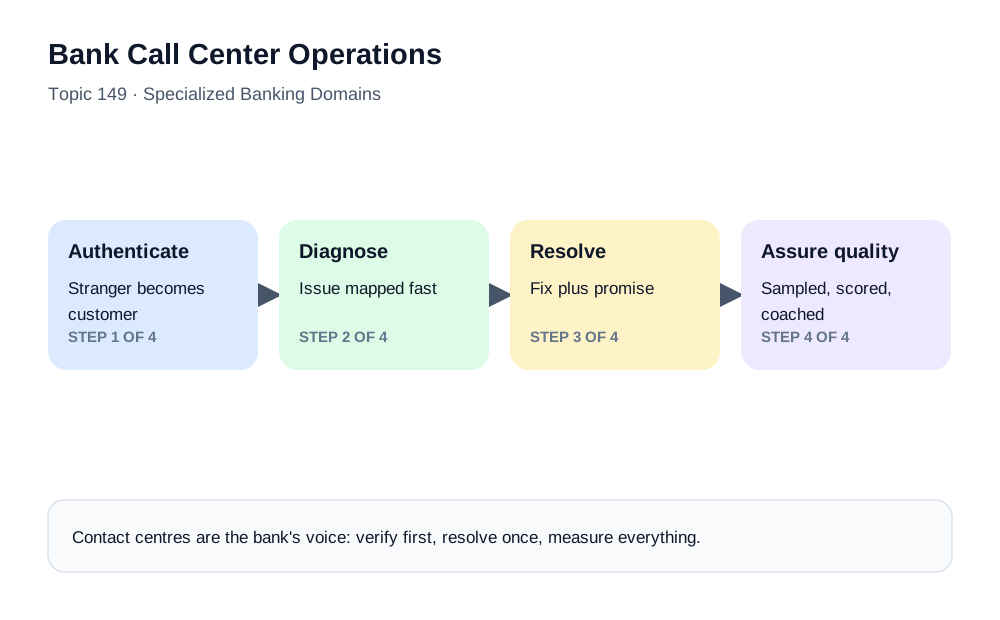
Bank Call Center Operations at a glance — Customer service, issue resolution, quality management.
Customer Support, IVR, Omnichannel Service, Workforce Planning, and Quality Control
A bank call center is often where customer trust is either protected or damaged. A customer may call because a card is blocked, a payment failed, an EMI is unclear, a fraud alert appeared, a loan statement is needed, or a mobile banking login is not working. The customer may already be anxious. The bank's response must be fast, accurate, compliant, and human.
Modern bank service centers are no longer only voice call centers. They are contact centers that support phone, chat, email, mobile app messages, WhatsApp or messaging channels where permitted, social media escalation, video support, and AI-assisted self-service. They combine people, process, technology, risk controls, and service culture.
This chapter explains how bank contact centers work: how customers are routed, how agents resolve issues, how service quality is measured, how workforce planning works, how AI supports operations, and why banks must balance speed with security and compliance.
Learning objectives
By the end of this chapter, you should be able to:
- Explain the difference between a call center and an omnichannel contact center.
- Understand IVR, skill-based routing, CRM, knowledge bases, case management, and agent desktops.
- Describe common banking service workflows such as card blocking, dispute reporting, account servicing, and loan support.
- Explain service metrics such as service level, average handle time, first contact resolution, abandonment rate, CSAT, NPS, and quality score.
- Understand workforce management: forecasting, scheduling, adherence, shrinkage, and real-time queue control.
- Identify compliance and security controls in customer authentication, complaint handling, and sensitive data protection.
- Explain how AI, chatbots, speech analytics, and agent assist improve service when governed well.
- Recognise why contact centers are strategic customer-experience assets, not just cost centers.
1. Call Center vs Contact Center
A call center mainly handles voice calls.
A contact center handles customer interactions across multiple channels.
| Area | Call center | Contact center |
|---|---|---|
| Main channel | Phone | Phone, chat, email, app, messaging, social, video |
| Routing | Call queues | Omnichannel routing |
| Customer record | Often voice-focused | Unified customer view across channels |
| Automation | IVR | IVR, chatbot, virtual assistant, AI routing, self-service |
| Agent tools | Telephony and account screens | Unified desktop, CRM, case management, knowledge base |
| Experience goal | Answer calls | Resolve customer needs across the channel journey |
Banks increasingly use the contact center model because customers expect continuity. If a customer starts with chat and then calls, the agent should already see the earlier conversation.
2. Why Contact Centers Matter in Banking
Banking is a trust business. Contact centers matter because they handle moments when trust is tested.
Common high-impact moments include:
- suspected fraud;
- failed payment;
- lost or stolen card;
- loan repayment confusion;
- blocked digital banking access;
- complaint escalation;
- bereavement or vulnerable-customer support;
- charge dispute;
- account freeze or compliance review;
- urgent travel or card usage issue.
A good contact center reduces customer effort, protects the bank from operational risk, and gives management early warning about product, technology, or process failures.
3. Main Components of a Bank Contact Center
| Component | Purpose |
|---|---|
| IVR | Helps identify the customer's need and route or resolve basic requests |
| Automatic call distributor | Sends calls to the right queue or agent |
| Skill-based routing | Matches customers with agents trained for the issue |
| CRM | Shows customer profile, relationship, history, and open cases |
| Agent desktop | Unified screen for account lookup, scripts, workflows, and notes |
| Knowledge base | Approved answers, policies, troubleshooting steps, and product rules |
| Case management | Tracks issues that cannot be resolved immediately |
| Call recording | Supports quality review, training, and dispute investigation |
| Workforce management | Forecasts demand and schedules agents |
| Quality monitoring | Reviews service accuracy, empathy, compliance, and process adherence |
| Speech and text analytics | Detects themes, complaints, sentiment, compliance issues, and coaching needs |
| Reporting dashboard | Tracks performance, risk, customer experience, and volumes |
The best centers integrate these tools so agents do not have to move between many disconnected screens while the customer waits.
4. Customer Authentication
Before discussing account details, the bank must confirm that the customer is authorised.
Authentication may include:
- registered mobile number or device checks;
- OTP verification;
- debit card or account information checks;
- security questions;
- voice biometrics, where used;
- mobile app approval prompts;
- risk-based authentication for suspicious activity.
Authentication must balance security and customer effort. Too little security invites fraud. Too much friction frustrates genuine customers, especially during urgent situations.
Agents should never ask for full passwords, full card PINs, full CVV values, or other secrets that bank policy prohibits.
5. Common Banking Contact Center Workflows
Lost or Stolen Card
- Authenticate customer quickly.
- Block or hotlist the card.
- Check recent transactions.
- Raise dispute or fraud case if needed.
- Confirm replacement card process.
- Educate customer on next steps and safety.
Failed Payment
- Identify payment channel and reference number.
- Check account debit status.
- Check payment network or beneficiary status.
- Explain expected reversal timeline if applicable.
- Raise investigation if SLA is breached.
- Provide case number and follow-up path.
Loan EMI Query
- Verify loan account.
- Explain EMI amount, due date, interest, principal, and charges.
- Check bounce, overdue, or mandate issues.
- Share payment options.
- Escalate if statement or correction is needed.
Digital Banking Login Issue
- Authenticate customer.
- Check account status and device registration.
- Guide password reset or app reactivation.
- Watch for fraud indicators.
- Escalate technical issues with logs and screenshots where available.
Complaint Registration
- Listen and classify issue accurately.
- Capture facts, dates, amounts, references, and desired resolution.
- Give complaint or case number.
- Explain SLA and escalation path.
- Track until closure.
These workflows show why contact center agents need both empathy and process discipline.
6. IVR and Conversational Self-Service
Interactive Voice Response (IVR) helps route or resolve customer needs before an agent joins.
Traditional IVR uses menus such as "press 1 for cards, press 2 for loans." Modern conversational systems allow customers to speak naturally, such as "I want to block my debit card" or "My UPI payment failed."
Good IVR design should:
- identify the reason for contact quickly;
- authenticate safely when needed;
- offer self-service for simple requests;
- avoid trapping customers in loops;
- allow escalation to a human agent;
- pass context to the agent so the customer does not repeat everything;
- prioritise urgent issues such as fraud or card blocking.
Automation is useful only when it reduces effort and resolves issues correctly.
7. Omnichannel Service
Omnichannel service means customer context travels across channels.
Example:
A customer starts with a chatbot about a failed card transaction. The bot cannot resolve the issue, so the customer requests a call. When the agent receives the call, the agent sees the chat transcript, customer profile, transaction reference, and failed troubleshooting steps.
This avoids repeated questioning and improves resolution speed.
Omnichannel operations require:
- unified customer identity;
- channel integration;
- consistent case numbers;
- shared knowledge base;
- clear ownership of follow-up;
- privacy controls across channels;
- consistent service standards.
A bank should not feel like different companies depending on whether the customer uses app chat, phone, email, or branch escalation.
8. Key Contact Center Metrics
| Metric | Meaning | Why it matters |
|---|---|---|
| Service level | Percentage of contacts answered within target time | Measures speed of access |
| Average speed of answer | Average wait before agent response | Shows queue pressure |
| Average handle time | Talk/chat time plus hold and after-call work | Measures efficiency, but must be balanced with quality |
| First contact resolution | Percentage resolved without repeat contact | Strong indicator of customer effort |
| Abandonment rate | Customers who leave before being served | Shows wait-time pain |
| CSAT | Customer satisfaction after interaction | Captures immediate experience |
| NPS | Likelihood to recommend the bank | Broader loyalty indicator |
| Quality score | Internal review of accuracy, compliance, empathy, and process | Measures service discipline |
| Transfer rate | Contacts moved between agents or departments | High transfer rate may indicate poor routing or empowerment |
| Repeat contact rate | Customers returning for the same issue | Indicates unresolved root causes |
A dangerous mistake is optimising only average handle time. A short call that fails to solve the problem is not good service.
9. Workforce Management
Workforce management ensures the right number of trained agents are available at the right time.
It includes:
- Forecasting: predicting contact volumes by channel, day, hour, product, season, and event.
- Scheduling: assigning shifts, breaks, and skills to meet expected demand.
- Shrinkage planning: allowing for leave, training, meetings, breaks, absenteeism, and system downtime.
- Adherence: checking whether agents are following planned schedules.
- Real-time management: moving agents, changing priorities, or escalating issues when queues spike.
- Capacity planning: hiring and training ahead of long-term demand changes.
Banking contact volumes can spike because of salary days, festivals, loan due dates, payment outages, fraud campaigns, app releases, regulatory changes, or market events.
Good workforce planning prevents both customer frustration and agent burnout.
10. Quality Management
Quality management reviews whether interactions are accurate, compliant, and helpful.
A quality scorecard may check:
- greeting and verification;
- issue diagnosis;
- product and policy accuracy;
- empathy and professionalism;
- regulatory disclosures;
- complaint handling;
- data privacy;
- documentation quality;
- closure and next-step clarity;
- avoidance of prohibited statements.
Quality teams may review call recordings, chat transcripts, email replies, case notes, and screen activity.
Quality is not only a score. It should feed coaching, process improvement, knowledge-base updates, and root-cause fixes.
11. Compliance and Risk Controls
Bank contact centers handle sensitive information and regulated workflows.
Important controls include:
- customer authentication before disclosure;
- masking of card and account details;
- prohibition on asking for passwords or PINs;
- call recording and retention controls;
- consent capture where required;
- complaint registration and SLA tracking;
- escalation rules for fraud, vulnerable customers, legal notices, and regulatory complaints;
- maker-checker controls for high-risk changes;
- access controls based on agent role;
- monitoring for social engineering and insider misuse;
- scripts for required disclosures;
- secure handling of documents and screenshots.
The center must solve problems without creating new fraud, privacy, or compliance risk.
12. AI in Contact Centers
AI can improve contact center operations when governed well.
Common uses include:
- chatbots for routine queries;
- voice bots for simple service requests;
- agent-assist suggestions during live calls;
- automatic call summaries;
- sentiment detection;
- speech analytics;
- knowledge-base search;
- predictive routing;
- fraud pattern detection;
- quality monitoring support;
- volume forecasting.
AI should be monitored carefully. Banks must check accuracy, bias, escalation rules, privacy, auditability, and customer consent where required.
For sensitive topics such as fraud, complaints, financial hardship, death claims, or vulnerable customers, human support remains important.
13. Root-Cause Feedback Loop
A strong contact center does not only answer questions. It tells the bank what is broken.
Repeated customer contacts may reveal:
- confusing product terms;
- app defects;
- delayed reversals;
- poor branch communication;
- card delivery issues;
- loan statement confusion;
- unclear fees;
- fraud attempts;
- failed campaigns;
- policy gaps.
Leaders should review contact drivers and fix root causes. Otherwise, the bank keeps paying agents to explain the same avoidable problems.
14. Practical Example
A bank's mobile app update creates login failures for some customers.
A weak contact center response:
- agents receive no alert;
- customers wait in long queues;
- agents ask customers to repeat troubleshooting steps;
- cases are logged inconsistently;
- social media complaints grow;
- technology teams do not see clear incident data.
A strong response:
- incident alert is pushed to agents;
- IVR and chatbot identify affected customers;
- agents use an approved troubleshooting script;
- cases are tagged consistently;
- real-time dashboard tracks volume and impact;
- technology team receives clear evidence;
- customers receive updates and workaround guidance.
The difference is not only technology. It is operational readiness.
15. Common Misconceptions
Misconception 1: Contact centers are only cost centers.
They are also trust, retention, risk detection, sales support, and customer-insight engines.
Misconception 2: Faster calls always mean better performance.
Speed matters, but incomplete resolution creates repeat contacts and customer frustration.
Misconception 3: AI can replace all agents.
AI can handle many routine tasks, but complex, emotional, high-risk, or judgment-heavy issues still need skilled humans.
Misconception 4: Quality monitoring is only for policing agents.
Quality review should improve coaching, processes, products, knowledge articles, and customer outcomes.
16. Frequently Asked Questions
What is first contact resolution?
It is the percentage of customer issues resolved in the first interaction without requiring the customer to contact the bank again for the same problem.
Why is average handle time not enough?
Because an agent can keep calls short by rushing or transferring. Good measurement balances speed, accuracy, compliance, and resolution.
What is skill-based routing?
It routes customers to agents trained for the specific issue, such as cards, loans, digital banking, fraud, or premium support.
Why do banks record calls?
Call recordings support quality review, dispute resolution, training, fraud investigation, and regulatory compliance, subject to applicable rules.
What is after-call work?
After-call work is the time agents spend completing notes, case updates, forms, or follow-up tasks after the customer interaction ends.
17. Key Terms
- IVR: Interactive Voice Response system that routes or resolves calls.
- ACD: Automatic Call Distributor that assigns contacts to queues or agents.
- CRM: Customer Relationship Management system.
- AHT: Average Handle Time.
- FCR: First Contact Resolution.
- CSAT: Customer Satisfaction score.
- NPS: Net Promoter Score.
- Abandonment rate: Share of customers who disconnect before being served.
- Service level: Percentage of contacts answered within a target time.
- Shrinkage: Paid agent time unavailable for handling contacts due to leave, breaks, training, meetings, or absence.
- Adherence: Degree to which agents follow planned schedules.
- Quality score: Internal evaluation of service accuracy, compliance, and customer handling.
- Agent assist: Technology that guides agents during live interactions.
- Case management: System for tracking unresolved issues until closure.
18. Interview Insights
Interviewers may ask contact center questions to test whether you understand customer operations as a controlled banking function.
Strong answers usually mention:
- omnichannel service;
- IVR and routing;
- authentication and data privacy;
- first contact resolution;
- complaint tracking;
- workforce management;
- quality monitoring;
- AI support with human escalation;
- root-cause feedback to improve products and processes.
A good short answer:
"A bank contact center handles customer service across phone, chat, email, app, and other channels. It must resolve issues quickly while protecting security, privacy, compliance, and service quality. The best centers use strong routing, CRM context, workforce planning, quality monitoring, and root-cause feedback to improve the whole bank."
19. Summary
Bank contact centers sit at the front line of customer trust. They handle urgent problems, routine servicing, complaint capture, fraud alerts, digital support, and service recovery.
For banking learners, the key lesson is this: contact center excellence is not just polite conversation. It is disciplined operations, secure authentication, good technology, trained people, measurable quality, and a feedback loop that helps the bank fix the causes of customer pain.
Next: Topic 150 - Card Operations Management
<!-- MBA-DEEP-DIVE-START -->Bank Contact Center Deepening — Authentication, Case Ownership, Incident Response, Workforce Control, and Customer Outcomes
A contact center is part of the bank's operational-control environment
Customers often contact the bank when something has already gone wrong: money is missing, a transfer is uncertain, a card has been stolen, an account is blocked, a fraud alert has appeared, or a complaint has not been resolved. The agent therefore sits at the point where customer experience and risk control meet. A warm tone is important, but the center must also authenticate correctly, interpret account and transaction state, follow legal and policy rules, document evidence, trigger the right operational action, and create a traceable case when immediate resolution is impossible.
Contact reason should be captured as a business event
A call, chat, or message is not useful management information unless the reason for contact is classified consistently. “Payments” is too broad if one customer is asking about a pending card transaction and another about a duplicate instant payment. Reason hierarchies can capture product, journey, failure type, root cause, risk, and resolution path. Good taxonomy allows management to identify whether volume is driven by product design, system defect, fraud campaign, processing delay, unclear communication, or staffing issue.
Authentication should be risk-based rather than identical for every request
A customer asking for branch opening hours requires little or no authentication. A customer asking for recent account transactions needs stronger verification. Changing a mobile number, adding a beneficiary, resetting digital access, or reporting fraud may require even more controlled steps. A risk-based model avoids unnecessary friction while protecting sensitive actions. Authentication policy should identify what evidence is acceptable for each action and what an agent must never request.
Knowledge-based questions can be weak when data has been exposed
Questions based on date of birth, address, or recent public information can be guessed or obtained through data breaches and social engineering. Stronger approaches can combine possession of a registered device, one-time approval through the mobile app, secure OTP where appropriate, behavioural signals, and customer knowledge. The exact method depends on the bank and jurisdiction. Agents should recognise that a caller confidently knowing personal information is not proof of legitimacy.
Fraud callers often use urgency against the agent
Social engineers can claim a phone was stolen, a customer is travelling, an elderly relative needs help, or a payment must be stopped immediately. The emotional story may be genuine or malicious. The contact center should have safe urgent paths that protect the customer without bypassing verification. For example, an agent may be allowed to block a card with limited authentication because blocking reduces risk, while reactivating or changing credentials requires stronger proof.
Vulnerable-customer handling needs flexibility with control
Customers can be elderly, bereaved, seriously ill, financially distressed, disabled, affected by domestic abuse, or temporarily unable to complete normal authentication. Banks should define supported alternative processes and escalation channels rather than forcing agents to improvise. The center needs to protect privacy and security while avoiding unreasonable barriers. Notes about vulnerability should be recorded only as permitted and necessary, with access controls appropriate to the sensitivity.
Bereavement is a multi-product service journey
When a family reports a death, the contact can affect deposits, loans, cards, digital banking, standing instructions, investments, insurance, joint accounts, and estate documentation. The agent should not promise immediate closure of every relationship. A specialised case can coordinate required evidence and product-specific treatment. The family should receive clear next steps and a single reference where feasible instead of contacting every department independently.
Fraud reporting should prioritise containment before complete investigation
If a customer reports an unauthorised transaction, the first actions may include blocking a card, securing digital credentials, stopping pending instruments where legally and operationally possible, or escalating to fraud operations. Determining liability can take longer. The agent should distinguish immediate protection, dispute registration, investigation, provisional treatment where applicable, and final outcome. Telling the customer “fraud confirmed” before investigation can create incorrect expectations.
Transaction status requires source-specific interpretation
A customer may say a payment “failed” because the beneficiary has not received it. Internally, the payment may be pending, queued, accepted by the scheme, rejected, reversed, returned, or under investigation. The contact-center screen should show a customer-safe interpretation based on authoritative system states. Agents should not infer outcome from one ledger debit or from a generic error message. Payment uncertainty is one of the areas where a good integrated status model directly improves customer service.
Timeout should not be explained as failure unless the transaction is final
If an external network has not returned a final status, the agent may need to explain that the bank is confirming the outcome and advise the customer not to retry until safe. This reduces duplicate-payment risk. Service scripts should distinguish expected pending periods from breached service levels and give the customer a reference for follow-up. Contact centers are a critical last line of defence against duplicate customer attempts caused by unclear status.
Reversal timelines should be explained by event, not by a universal promise
A failed card authorisation, ATM cash dispute, instant payment, transfer return, or merchant refund can follow different processes. The agent should use product-specific guidance and current transaction data. Saying “all reversals take seven days” is usually poor banking practice because it replaces real process knowledge with a generic promise. Knowledge articles should identify the event that starts the clock and the conditions requiring investigation.
Case creation should happen when ownership extends beyond the conversation
If the agent cannot fully resolve the issue, the interaction should produce a case with customer, product, transaction reference, category, facts, requested remedy, evidence, responsible team, priority, service target, and communication plan. Free-text notes alone are not enough. Case management ensures the customer does not need to retell the entire story and makes overdue work visible.
A case number is a control, not just a courtesy
The reference links later contacts, evidence, decisions, compensation, and regulatory reporting. Repeated cases for the same incident can fragment ownership and make service-level reporting inaccurate. Systems should search for existing active cases and support linking or merging according to policy while preserving history.
Complaint identification should depend on substance, not the customer's vocabulary
A customer does not need to use the word “complaint” for dissatisfaction to require complaint treatment under internal policy or applicable rules. Agents should recognise expressions of dissatisfaction about service, product, conduct, delay, fees, or outcome and route them appropriately. Failure to classify complaints can create misleading regulatory metrics and deprive customers of escalation rights.
Complaint taxonomy should separate cause from outcome
Two customers can complain about the same fee but for different reasons: fee not disclosed, fee calculated incorrectly, fee charged despite waiver, or policy disagreement. Capturing root cause supports remediation. Complaint reporting should identify upheld, partially upheld, not upheld, withdrawn, duplicate, or other outcome according to the bank's framework without using the outcome to erase the original customer issue.
Service levels should be designed around customer harm
A card-block request has different urgency from a request for an old statement. Fraud, inaccessible wages, bereavement, vulnerable customers, regulatory complaints, and high-value payment uncertainty may deserve priority routing. Queue design can therefore use risk and urgency in addition to customer segment. A premium customer should not automatically be served ahead of an ordinary customer reporting active account takeover.
Skill-based routing should reflect authority as well as knowledge
An agent can understand mortgages but lack permission to alter a repayment arrangement. Another can handle disputes but not fraud claims. Routing should therefore consider training, certification, language, product skill, approval authority, and risk permissions. Sending a customer to an agent who understands the issue but cannot perform the necessary action simply creates another transfer.
Transfer rate should be analysed by reason
Some transfers are appropriate because specialist teams exist. Others indicate poor routing, missing training, limited system access, or avoidance behaviour. Metrics should distinguish warm transfer, cold transfer, consult transfer, escalation, and customer-requested transfer where useful. A low transfer rate achieved by agents keeping calls they cannot solve is not success.
First-contact resolution needs a strict definition
A contact can be considered resolved only if the customer's need is actually completed according to the bank's definition. An agent who registers an investigation has handled the contact but not necessarily resolved the underlying issue. Some organisations define FCR using no repeat contact within a period; others use case outcome. The metric should be documented so teams cannot improve it merely by changing labels.
Repeat contact is a powerful root-cause signal
If a customer calls three times about one transaction, the bank has created effort even if each call individually met service level. Repeat-contact analysis can identify unclear communication, broken handoffs, poor case updates, or unresolved defects. Linking contacts to the same case or transaction reference improves this analysis.
Average handle time should be used diagnostically, not as a blunt target
A rising AHT can indicate new complex issues, system slowness, knowledge gaps, more rigorous authentication, or inadequate self-service. Pressuring agents to shorten every call can lead to rushed authentication, missed complaints, poor notes, and repeat contacts. Leaders should decompose talk time, hold time, transfers, and after-call work and remove waste rather than simply demand faster conversation.
Hold time often exposes internal-system problems
Customers experience silence while agents wait for slow screens, consult another team, or search knowledge articles. Measuring hold reasons can reveal application latency, fragmented desktops, missing authority, or unclear procedures. Technology improvement can therefore reduce both AHT and customer frustration without asking agents to speak faster.
After-call work protects future service when it captures the right evidence
Agents need time to document what happened, actions taken, commitments made, and follow-up required. Excessive free text wastes time and creates inconsistent records, while too little documentation forces the next agent to start again. Structured fields plus concise narrative can balance efficiency and auditability. Where AI drafts summaries, the agent should verify material facts before saving them.
Contact recording is evidence with privacy obligations
Voice and digital interactions can support quality review, dispute investigation, fraud analysis, and required recordkeeping, but access and retention should follow applicable law and policy. Recordings can contain account details, personal information, health circumstances, or authentication data. Storage, retrieval, deletion, monitoring, and third-party processing therefore need security controls.
Sensitive authentication data should be suppressed from recordings where required
Payment-card or security processes can require masking or pausing capture of certain data. The agent desktop and telephony design should minimise the need for customers to speak sensitive secrets. A quality program should never reward an agent for collecting data the bank's security policy prohibits.
Knowledge management is a production control
A bank can train agents well and still generate wrong answers if the knowledge base is stale. Articles should have owner, version, effective date, product scope, approval, linked procedures, and review date. Regulatory or product changes should trigger updates before customer launch. Search should prioritise current approved content rather than whichever article has the most keywords.
Knowledge articles should distinguish explanation from action
An article can explain why an account is dormant but agents also need the exact permitted steps to reactivate it, required documents, systems, approval, and customer communication. Good knowledge therefore links policy, customer language, workflow, and escalation. Vague educational content is insufficient for operational execution.
Agent permissions should follow least privilege
A general-service agent may view transactions but not change a beneficiary. A fraud specialist may block digital access but not alter loan terms. Entitlements should reflect role and be reviewed when agents move teams. Shared accounts and broad administrator access undermine both fraud prevention and audit evidence.
High-risk servicing actions need stronger maker-checker or step-up control
Address changes, phone-number changes, digital reset, cheque stop, beneficiary changes, limit increases, card replacement, and manual financial adjustments can have different risk profiles. Some may require a second approver, supervisor, secure customer confirmation, or cooling-off period. The customer should not be disadvantaged by controls, but convenience must not turn the call center into an account-takeover channel.
Supervisor override should be transparent
Supervisors need authority to resolve exceptions, but overrides should record original block, reason, approver, evidence, and final action. A culture where agents ask a supervisor to “just unlock it” without data creates hidden risk. Override analysis can reveal whether policies are too strict, training is weak, or certain teams are circumventing controls.
Workforce forecasting should start with contact drivers
Historical call volume is useful, but banking demand is shaped by salary dates, statement cycles, EMI due dates, tax periods, holidays, card renewals, campaigns, regulatory changes, app releases, system incidents, and fraud waves. Forecasting should incorporate known events and uncertainty. New products deserve launch scenarios because no historical contact pattern exists.
Shrinkage should be planned honestly
Agents are not available for contacts every paid minute. Training, coaching, meetings, leave, sickness, breaks, system downtime, and administrative work reduce capacity. Underestimating shrinkage creates queues and overtime; overestimating it creates excess cost. Workforce management should use actual patterns and distinguish controllable from unavoidable components.
Schedule adherence should not become a customer-harming metric
Adherence matters because a few absent agents can materially affect queues, but an agent helping a distressed customer should not be penalised for finishing a critical interaction after the planned break time. Real-time management should support supervisors in distinguishing service necessity from avoidable non-adherence. Metrics should reinforce judgement, not robotic behaviour.
Real-time queue management is incident management on a smaller scale
When wait times spike, leaders can move multi-skilled agents, pause non-urgent outbound work, adjust self-service messaging, change routing, delay coaching sessions, or activate overflow. They should first understand the cause. A technology incident needs customer communication and root-cause escalation, not merely more agents answering calls about the same failure.
Major incidents need a contact-center command channel
When payments fail or digital banking is unavailable, agents should receive one authoritative incident summary, affected services, customer-safe wording, workarounds, case-tagging instructions, escalation rules, and update time. Uncoordinated messages create rumours inside the bank. The center should send structured impact data back to incident management so engineers know which customer journeys are failing.
Proactive messaging can prevent avoidable calls
If the bank knows a service is unavailable, an app banner, push notification, SMS, IVR message, or website notice can reduce uncertainty and contact volume, subject to channel and privacy rules. The message should be timely and truthful. Pretending everything is normal while queues grow damages trust more than acknowledging a known issue.
Outbound service calls create their own authentication challenge
A customer receiving an unexpected bank call cannot easily know that the caller is genuine. Banks should avoid asking for secrets during unsolicited calls and can use secure app confirmation, published callback channels, or other approved methods. Scripts should educate customers that the bank will never request prohibited credentials. This is important because fraudsters imitate legitimate bank calls.
Call-back functionality needs queue integrity
A virtual call-back can reduce time spent waiting, but the system should preserve the customer's queue priority and authenticate the returned contact safely. Failed callbacks, wrong numbers, or repeated retries should be monitored. A callback is not resolved simply because the dialler attempted a number once.
Omnichannel means one case history, not merely many channels
A bank can offer phone, chat, email, and messaging yet still force the customer to repeat the issue because each channel has a separate system. True omnichannel operation links identity, case, prior conversation, documents, and commitments where privacy and architecture permit. Channel handoff should preserve context without exposing data to unauthorised agents.
Asynchronous messaging changes service-level design
A customer may send a secure message and return later rather than remain connected. Metrics such as first response, meaningful response, total resolution time, and customer waiting time become more useful than telephony AHT. Workforce planning should recognise that an agent can manage multiple asynchronous conversations, but too many concurrent chats can reduce quality.
AI agent assist should cite approved bank knowledge
An AI tool can suggest answers or next steps, but high-confidence language can conceal hallucination. Grounding the assistant in approved knowledge and exposing source links helps the agent verify before speaking. Sensitive actions should remain controlled by workflow permissions rather than executed simply because the AI generated an instruction.
Automated summarisation needs material-fact verification
AI can reduce after-call work by drafting notes, but names, amounts, dates, transaction references, customer requests, and commitments must be accurate. An agent should correct the summary before it becomes the legal or operational case record. Models should not infer sensitive facts that the customer did not state.
Speech analytics should support review, not replace judgement blindly
Analytics can detect silence, escalation language, complaint terms, prohibited phrases, sentiment, or fraud indicators across large volumes. False positives and accent or language differences can affect performance. Quality teams should validate models and use them to prioritise review, identify themes, and coach rather than assume every machine score is objectively correct.
Quality monitoring should sample risk as well as random interactions
A purely random sample can miss rare high-impact actions. Quality programs can intentionally review fraud calls, vulnerable customers, complaints, high-value servicing, overrides, new agents, and interactions flagged by analytics. Scores should identify both customer experience and control adherence. Critical failures can have separate treatment from minor style issues.
Calibration keeps quality scoring consistent
Two reviewers may score the same interaction differently. Regular calibration sessions compare interpretations, update guidance, and identify ambiguous scorecard criteria. Without calibration, agents lose trust in the quality program and managers can draw false conclusions from team scores.
Coaching should address root behaviour
Telling an agent to “improve empathy” is less useful than showing the exact moment they interrupted the customer or failed to acknowledge loss. Similarly, a compliance failure may be caused by a confusing system prompt rather than poor attitude. Coaching should combine interaction evidence with process improvement and follow-up measurement.
Contact-center fraud can involve insiders as well as external callers
Agents can see personal and account information that criminals value. Monitoring can identify unusual searches, repeated access to unrelated accounts, excessive data viewing, suspicious resets, and activity outside assigned queues. Role-based access, screen masking, logging, background controls, and investigation procedures help reduce insider misuse.
Remote-agent models need secure environments
Home working can improve resilience and staffing flexibility, but banks should manage device security, network access, recording, screen privacy, print restrictions, local storage, physical environment, and support. A secure virtual desktop is useful but not enough if an agent can photograph sensitive data. Policy, training, monitoring, and technical controls should work together.
Business-continuity plans should prioritise critical contact types
If the primary center becomes unavailable, the bank may not be able to maintain every normal service. Recovery plans can prioritise fraud, card blocking, payment issues, digital-access security, vulnerable customers, and regulatory complaints while deferring low-risk enquiries. Alternate sites, remote agents, cloud telephony, and self-service need testing under actual failover conditions.
Contact centers can be early-warning sensors for systemic problems
A sudden spike in password resets can signal credential-stuffing attacks. Many calls about one merchant can indicate card compromise. Repeated transfer complaints can reveal a scheme incident. Rising hardship contacts can show economic stress in a customer segment. Analytics should feed fraud, operations, product, credit, and incident teams rather than remain inside customer service.
Root-cause elimination changes the economics of service
The cheapest contact is often the one the customer never needs to make because the product worked or communication answered the question proactively. Leaders should rank avoidable contact drivers by volume, customer harm, cost, and risk. Fixing a confusing fee description can reduce thousands of calls while improving trust. A contact center should therefore measure contribution to prevention, not only unit cost per call.
Scenario: app login failures begin after a release
Within minutes, authentication-related chats and calls rise sharply. The center tags the issue consistently and alerts incident management. An approved message appears in IVR and chat. Agents avoid repeatedly resetting passwords because that would not fix the defect and could create security risk. Technology rolls back the release, customers regain access, and analytics quantify the impact. Contact-center evidence improves both incident response and post-incident review.
Scenario: a caller claims an urgent SIM change and transfer request
The customer says the old phone is unavailable and asks the agent to change the registered number and immediately raise a high-value transfer. Policy treats the combination as high risk. The agent can secure the account but cannot complete both changes through the normal low-friction path. A controlled verification process is initiated. The scenario shows why fraud resistance sometimes requires separating urgent protective actions from value-moving actions.
Scenario: a complaint remains open across three departments
A customer disputes a loan fee. The service team obtains one calculation, finance another, and product a third. Instead of creating three tickets, one complaint case retains ownership and assigns internal tasks. The customer receives updates from the owning team until a final decision and any correction are completed. Case ownership prevents organisational complexity from becoming customer effort.
Business analysts should design from contact reason to final outcome
Requirements should map authentication, customer profile, account and transaction lookup, knowledge, permitted actions, case creation, complaint identification, routing, escalation, notes, documents, SLAs, communication, and closure. Every high-risk servicing action should have clear authority and audit evidence. Integration failures should degrade safely; if a transaction-status service is unavailable, the agent should not guess.
Testing should include human and system failure paths
Useful tests include failed authentication, vulnerable-customer alternative verification, stolen-card urgent block, payment status unknown, duplicate complaint, late callback, agent transfer, supervisor override, knowledge article expiry, incident banner, AI hallucination, call-recording failure, remote-site failover, and unauthorised account access. The objective is to prove that the center remains both helpful and controlled when the straightforward script does not apply.
Closing perspective
A banking contact center is where complex internal systems are translated into a customer's next action. The center earns trust when it gives accurate status, protects identity, contains fraud, owns unresolved cases, recognises complaints, communicates incidents, and treats difficult circumstances with judgement. Operational excellence comes from connecting agents with reliable data, precise authority, current knowledge, strong case management, realistic workforce planning, and feedback loops that remove the reasons customers needed to contact the bank in the first place.
Contact Center Operations — Promise Control, Case Updates, Authentication Recovery, and Service Resilience
Customer promises should be stored as obligations
When an agent tells a customer the bank will call back, refund a fee, investigate a payment, send a document, or complete an action by a date, the promise should become a tracked task or case milestone. Relying on free-text notes makes missed commitments invisible. Promise tracking can record owner, due date, action, completion evidence, and customer notification so service quality is measured against what the bank actually committed to do.
Case updates can reduce repeat contact even before final resolution
A customer may tolerate a complex investigation if the bank confirms ownership and provides meaningful progress. Case systems should support proactive updates at important milestones or agreed intervals. Messages should distinguish “we are still investigating” from concrete events such as “the receiving bank has been contacted” or “the disputed amount has been provisionally credited” where applicable. Silence forces customers to call again simply to learn whether the case still exists.
Authentication recovery should not become the weakest security channel
Customers who lose a device or phone number need a safe path back into banking. Attackers know this and deliberately target service desks. Recovery should use strong alternative evidence, risk signals, cooling periods for high-risk changes, and escalation when identity cannot be established confidently. A helpful agent should not be pressured into bypassing security because the customer cannot use the normal authenticator.
High-risk changes should be linked to subsequent transactions
A phone reset or digital credential recovery can be legitimate, but a large transfer minutes later deserves additional context. Contact-center events should feed fraud systems so recent profile changes can influence transaction risk. This integration also helps fraud investigators reconstruct whether an attacker socially engineered a service agent before moving funds.
Agent desktop design should present one authoritative transaction story
If the contact-center screen shows ledger debit, payment status, fraud hold, and investigation case in separate tabs with inconsistent labels, agents will create their own interpretation. A consolidated view should explain the customer-safe state and link to specialist evidence where permitted. Better information reduces wrong promises such as telling a customer to retry an instruction that is actually still pending externally.
Knowledge changes should be deployed before product changes reach customers
A new fee, payment route, authentication flow, or policy can create immediate contact volume. Launch readiness should include approved knowledge articles, agent training, scripts, escalation routes, and examples of expected exceptions. Contact-center preparation is part of product deployment, not a communication task to complete after customers begin calling.
Service recovery can be more important than first-contact speed
When the bank made an error, the quality of correction matters. The agent should acknowledge the issue, stop further harm where possible, create the correct financial or operational repair, explain next steps, and avoid making a promise the downstream team cannot meet. Fast but inaccurate reassurance creates a second failure. Recovery metrics should therefore include final resolution and repeat contact, not only initial response time.
Workforce planning should include specialist bottlenecks
Adding general agents does not solve a queue if every difficult case requires one small fraud, payments, mortgage, or complaints team. Forecasting should identify transfer demand and specialist handling capacity. Cross-skilling can improve resilience, but only where authority and training are adequate. Queue design should make specialist scarcity visible rather than hiding it behind repeated transfers.
Contact-center incident tags should feed enterprise incident management
A sudden rise in calls about one payment error can be the first sign of a production problem. Structured reason codes and anomaly detection can alert technology or operations before monitoring detects it. The same incident identifier can later link affected contacts, cases, compensation, and system recovery. Customer-service data becomes an operational sensor rather than a passive record.
Outbound callbacks should protect against impersonation risk
When the bank calls a customer about a sensitive case, the customer should have a way to verify that the call is genuine without disclosing secrets first. Secure app messages, case references, or a published inbound callback path can support trust. Agents should never ask for full credentials simply to prove the bank initiated the call.
Quality assurance should review consequential actions more heavily
Random sampling is useful for general service, but a mistaken address change, card replacement, fraud unblock, or financial adjustment can cause far more harm than a minor conversational weakness. QA programmes should oversample high-risk actions and evaluate authentication, authority, evidence, and outcome. A critical control failure should not be diluted inside an average quality score.
Contact-center resilience includes telecommunications and identity services
A working CRM is not enough if telephony, secure messaging, customer authentication, knowledge, or case routing is unavailable. Continuity planning should identify which services are essential for urgent actions such as card blocking or fraud reporting and provide safe alternatives. Recovery tests should include customer contact from alternate sites or remote environments under real security controls.
The strongest contact center resolves uncertainty without creating new risk
Customers often contact the bank at moments of fear or confusion. A mature center combines empathy with disciplined authentication, accurate transaction state, owned cases, tracked promises, secure servicing actions, and feedback into product and incident management. The result is not merely faster calls; it is reliable human intervention when automated banking journeys need help.
Service metrics should distinguish answered from solved
A short wait and quick call can still produce poor service if the customer must contact the bank again. Management should view answer speed together with case resolution, repeat contact, promise completion, complaints, and control errors. This keeps productivity targets from encouraging agents to end interactions before the underlying banking problem is actually owned.
<!-- MBA-DEEP-DIVE-END -->