Visual overview
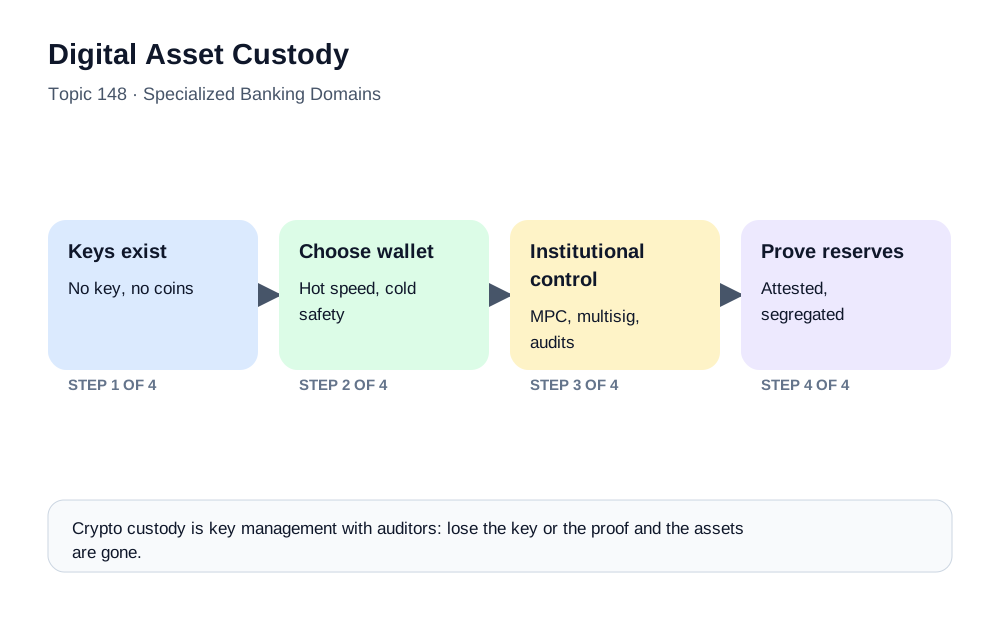
Digital Asset Custody at a glance — Cryptocurrency custody, digital asset services, key management.
Private Keys, Wallets, Institutional Controls, and the New Safekeeping Challenge
Digital asset custody is the safekeeping and control of cryptoassets, tokenised assets, stablecoins, and other blockchain-based financial instruments. It is one of the most important parts of the digital asset ecosystem because ownership is controlled differently from traditional securities.
In traditional securities markets, ownership is usually recorded through regulated depositories, custodians, registrars, and account systems. If an account record is wrong, there may be legal and operational processes to correct it.
In many blockchain systems, control depends on cryptographic private keys. If the private key is lost, the asset may become permanently inaccessible. If the private key is stolen, the asset can be transferred quickly and may be very difficult or impossible to recover. That makes digital asset custody a mix of banking, cybersecurity, cryptography, operations, law, and risk management.
Learning objectives
By the end of this chapter, you should be able to:
- Explain why digital asset custody differs from traditional custody.
- Understand private keys, public keys, wallet addresses, seed phrases, and transaction signing.
- Compare hot wallets, cold wallets, hardware wallets, multi-signature wallets, and multi-party computation.
- Explain self-custody, exchange custody, and institutional custody.
- Identify key controls: segregation, approval workflows, whitelisting, audit logs, insurance, reconciliation, and disaster recovery.
- Understand custody risks such as key loss, theft, insider fraud, smart contract risk, chain risk, and commingling.
- Explain why regulation and legal ownership remain complex for digital assets.
- Recognise how tokenised securities connect traditional custody with blockchain infrastructure.
1. What Digital Asset Custody Means
Digital asset custody means protecting the keys, systems, processes, and legal arrangements that control blockchain-based assets.
A custodian may safeguard:
- cryptocurrencies;
- stablecoins;
- tokenised securities;
- tokenised deposits;
- tokenised fund units;
- non-fungible tokens;
- central-bank digital currency balances, where permitted;
- blockchain-based collateral.
The custodian's job is not only to store something. It must control who can move assets, how approvals happen, how transactions are signed, how records are reconciled, how clients are protected, and how incidents are handled.
2. Why Digital Asset Custody Is Different
| Area | Traditional securities custody | Digital asset custody |
|---|---|---|
| Ownership record | Depository, registrar, custodian, or account system | Blockchain ledger plus control of private keys |
| Transfer method | Market infrastructure and account instructions | Cryptographic transaction signed and broadcast to network |
| Recovery | Legal and operational correction may be possible | Lost private keys may make assets inaccessible |
| Reversal | Some processes may allow correction or legal recovery | Confirmed blockchain transactions are usually irreversible |
| Risk focus | Settlement, reconciliation, corporate actions, legal title | Key security, signing control, chain risk, wallet operations, cyber risk |
| Operating hours | Often market-hour based | Many networks operate continuously |
| Custody model | Centralised intermediaries | Self-custody, exchange custody, institutional custody, hybrid models |
The big difference is finality. In many digital asset systems, a bad transfer cannot simply be cancelled like an internal bank instruction.
3. Private Keys and Public Keys
A private key is a secret cryptographic value that can authorise transactions from a blockchain address.
A public key or wallet address can be shared to receive assets. The private key must be protected.
A simple model:
- Public address: where assets can be received.
- Private key: what proves control and signs transactions.
- Seed phrase: backup phrase that can recreate wallet keys.
- Signature: cryptographic approval of a transaction.
- Blockchain confirmation: network acceptance of the transaction.
Whoever controls the private key can usually control the asset. This is why key management is the heart of digital asset custody.
4. Wallet Types
| Wallet type | Meaning | Strength | Weakness |
|---|---|---|---|
| Hot wallet | Keys are connected to online systems | Fast transactions | Higher cyber exposure |
| Cold wallet | Keys are kept offline | Strong security | Slower movement and more manual control |
| Hardware wallet | Physical device stores keys and signs transactions | Secure signing environment | Device and backup must be protected |
| Multi-signature wallet | Multiple keys are required to approve movement | No single key can move assets alone | Setup and coordination complexity |
| MPC wallet | Key control is split into mathematical shares | No single party holds full key | Requires strong technical governance |
Institutions often use a mix. For example, a small operating balance may sit in a hot wallet for liquidity, while most assets are stored in cold or MPC-based custody.
5. Self-Custody, Exchange Custody, and Institutional Custody
There are several custody models.
| Model | How it works | Main risk |
|---|---|---|
| Self-custody | User controls their own keys | User may lose keys or be targeted directly |
| Exchange custody | Exchange holds assets for customers | Commingling, insolvency, platform failure, weak controls |
| Institutional custody | Regulated or specialised custodian safeguards assets for clients | Operational, legal, technology, and counterparty risk |
| Hybrid custody | Responsibilities split between client and provider | Governance and accountability can be complex |
Self-custody gives control but also full responsibility. Institutional custody reduces individual key-management burden but introduces reliance on the custodian's controls.
6. Institutional Custody Architecture
A professional digital asset custody platform may include:
- segregated client wallets or account structures;
- hot, warm, and cold wallet tiers;
- multi-person approval workflows;
- role-based access controls;
- withdrawal address whitelisting;
- transaction limits;
- multi-signature or MPC signing;
- hardware security modules;
- audit logs;
- transaction screening;
- blockchain monitoring;
- incident response procedures;
- disaster recovery and key backup arrangements;
- independent control reviews;
- insurance where available and meaningful.
The aim is to prevent one person, one compromised system, or one operational mistake from moving client assets improperly.
7. Transaction Approval Flow
A simplified institutional withdrawal process may look like this:
- Client submits a withdrawal request.
- Custodian validates client identity and account authority.
- System checks limits, whitelisted address, sanctions screening, and risk rules.
- Operations team reviews the request.
- Multiple authorised approvers approve the transaction.
- The transaction is signed using approved key-management technology.
- Transaction is broadcast to the blockchain.
- Network confirmations are monitored.
- Client records are updated.
- Custody books are reconciled with on-chain balances.
The process is intentionally controlled. Fast movement is useful, but uncontrolled fast movement is dangerous.
8. Segregation and Proof of Control
Segregation means client assets are separated from the custodian's own assets and, where possible, from other clients' assets.
This matters because customers need clarity on what they own if the custodian, exchange, or service provider fails.
Important control questions include:
- Are client assets legally segregated?
- Are client assets operationally segregated on-chain or in internal ledgers?
- Can the custodian prove control of wallets?
- Are liabilities matched against assets?
- Are customer assets ever lent, pledged, or reused?
- Who authorises movement?
- What happens if the custodian becomes insolvent?
Digital asset custody failures often involve poor segregation, weak governance, or unclear claims over assets.
9. Tokenised Securities
Tokenised securities are traditional financial instruments represented on a blockchain or distributed ledger.
Examples may include:
- tokenised bonds;
- tokenised fund units;
- tokenised equities, where permitted;
- tokenised money-market instruments;
- tokenised real-world assets;
- tokenised collateral.
Tokenisation creates new custody questions:
- Is the blockchain token the legal security or only a digital representation?
- Who maintains the official ownership register?
- How are corporate actions processed?
- How are transfers restricted to eligible investors?
- How are lost keys handled?
- How does settlement connect with traditional payment systems?
- How do custodians reconcile on-chain and off-chain records?
Tokenised securities may improve settlement efficiency, but they do not remove the need for legal clarity and operational controls.
10. Key Risks in Digital Asset Custody
| Risk | What can go wrong | Control focus |
|---|---|---|
| Key loss | Private key or seed phrase becomes unavailable | Backup, recovery, geographic distribution, tested procedures |
| Key theft | Attacker obtains signing authority | Cold storage, MPC, multi-sig, access controls, monitoring |
| Insider fraud | Employee abuses privileged access | Segregation of duties, approvals, audit logs, surveillance |
| Commingling | Client and firm assets are mixed | Legal segregation, account structure, independent records |
| Smart contract risk | Code flaw causes loss or lock-up | Contract review, limits, risk acceptance, monitoring |
| Chain risk | Blockchain fork, outage, attack, or congestion | Network due diligence, confirmation policy, contingency procedures |
| Address error | Assets sent to wrong address | Whitelisting, address validation, maker-checker controls |
| Regulatory risk | Rules change or licensing gaps emerge | Compliance review, jurisdiction monitoring, legal advice |
| Valuation risk | Illiquid or volatile assets are misvalued | Pricing controls, independent sources, haircut policy |
| Operational risk | Wrong approval, delayed transfer, failed reconciliation | Workflow controls, exception queues, reconciliation |
A digital asset custodian must think like a bank, a cybersecurity firm, a payment operator, and a market infrastructure provider at the same time.
11. Regulation and Governance
Digital asset custody regulation varies by country and continues to evolve.
Some jurisdictions require licensing for digital asset custodians. Some require qualified custodians for certain investor assets. Some focus on anti-money laundering rules, consumer protection, cybersecurity, capital requirements, or segregation of client assets. Others are still developing detailed frameworks.
Because rules change, banks and learners should avoid assuming that one country's approach applies everywhere. The practical governance questions remain consistent:
- Is the custodian licensed or supervised where required?
- Are client assets segregated?
- Are conflicts of interest controlled?
- Are reserves and liabilities transparent?
- Are cybersecurity controls independently reviewed?
- Are recovery and incident response plans tested?
- Are disclosures clear about what protection clients do and do not have?
Regulation is trying to bring institutional discipline to an asset class built originally around decentralised control.
12. Practical Example
An institutional investor wants to hold a large amount of tokenised bonds and stablecoins.
A digital asset custodian may:
- create segregated custody wallets;
- approve only whitelisted withdrawal addresses;
- keep most assets in cold or MPC-based custody;
- require multiple approvals for every transfer;
- monitor blockchain confirmations;
- reconcile on-chain balances with client statements;
- screen transfers for sanctions and illicit-finance risk;
- provide audit reports and transaction history;
- define recovery procedures if an approver is unavailable;
- clarify legal ownership and insolvency treatment in the custody agreement.
The investor receives a custody statement, but the real protection comes from the custodian's key controls, governance, legal structure, and operational discipline.
13. Common Misconceptions
Misconception 1: Blockchain removes the need for custody.
Blockchain can allow self-custody, but institutions still need secure controls, reporting, approvals, audit trails, insurance, compliance, and operational accountability.
Misconception 2: A wallet is the same as a bank account.
A wallet controls keys and blockchain addresses. A bank account sits inside a regulated banking ledger with different legal and recovery processes.
Misconception 3: Cold storage means there is no risk.
Cold storage reduces online attack risk, but key backup, physical security, access governance, recovery testing, and insider controls still matter.
Misconception 4: Tokenisation automatically makes settlement risk disappear.
Tokenisation can change settlement mechanics, but legal title, payment finality, investor eligibility, custody controls, and reconciliation still matter.
14. Frequently Asked Questions
What is the most important control in digital asset custody?
There is no single control. Strong custody combines key security, segregation, approval workflows, monitoring, reconciliation, legal clarity, and tested recovery procedures.
What happens if a private key is lost?
If no backup or recovery mechanism exists, the assets controlled by that key may become permanently inaccessible.
What is MPC?
Multi-Party Computation splits signing authority into mathematical shares so that no single party needs to hold the full private key.
Why do institutions avoid keeping all assets in hot wallets?
Hot wallets are convenient but exposed to online threats. Institutions usually keep only operational liquidity online and store most assets in stronger custody tiers.
Is digital asset custody the same in every country?
No. Legal status, licensing, investor protection, tax treatment, and custody rules vary significantly by jurisdiction.
15. Key Terms
- Private key: Secret cryptographic value used to sign transactions.
- Public key: Cryptographic value linked to the private key and used in address generation.
- Wallet address: Destination used to receive blockchain assets.
- Seed phrase: Backup phrase that can recreate wallet keys.
- Hot wallet: Online wallet used for fast access.
- Cold wallet: Offline wallet used for stronger security.
- Multi-signature: Wallet setup requiring multiple keys to approve a transaction.
- MPC: Multi-Party Computation, a method for distributed transaction signing.
- Whitelisting: Restricting withdrawals to pre-approved addresses.
- Tokenised security: Traditional financial instrument represented on a blockchain or distributed ledger.
- Smart contract: Code that executes rules on a blockchain.
- On-chain: Recorded directly on a blockchain.
- Off-chain: Recorded outside the blockchain.
16. Interview Insights
Interviewers may use digital asset custody to test whether you can apply banking controls to a new technology.
Strong answers usually mention:
- private keys as the control point;
- hot versus cold storage;
- multi-signature or MPC;
- segregation of client assets;
- approval workflows;
- irreversibility of transactions;
- reconciliation between client books and on-chain records;
- evolving regulation.
A good short answer:
"Digital asset custody is about protecting the private keys and controls that move blockchain assets. Unlike traditional securities custody, lost or stolen keys can lead to irreversible loss, so institutions need strong segregation, multi-person approvals, cold or MPC-based storage, monitoring, reconciliation, legal clarity, and recovery planning."
17. Summary
Digital asset custody brings the old banking principle of safekeeping into a new technical environment. The asset may be digital, but the control requirements are familiar: protect ownership, prevent unauthorised movement, separate client assets, maintain records, reconcile balances, comply with law, and prepare for failure scenarios.
For banking learners, the key lesson is this: digital asset custody is not just technology. It is technology plus trust, governance, operational discipline, and legal clarity.
Next: Topic 149 - Bank Call Center Operations
<!-- MBA-DEEP-DIVE-START -->Digital Asset Custody Deepening — Key Governance, On-Chain Control, Segregation, and Institutional Operations
Digital custody protects authority to move value
A traditional custodian proves entitlement through account records and market infrastructure. A digital-asset custodian may additionally control cryptographic signing authority that can move assets directly on a distributed ledger. This changes the operational centre of gravity. The critical question is not simply where a token appears on-chain, but who can cause a valid transaction to be signed, what approvals are required, how keys or key shares are protected, how client rights are recorded, and how the custodian proves that its internal liabilities are supported by assets it actually controls.
Private-key control and legal ownership are different questions
Possession of a key can provide technical ability to sign, but technical control does not automatically settle legal ownership. A custodian can control keys for assets beneficially owned by clients. A bankruptcy, trust, agency, nominee, or custody arrangement can determine the client's legal rights. This distinction becomes essential when assessing segregation and insolvency treatment. “Not your keys, not your coins” is an oversimplification for institutional custody because legal rights and operational control can be deliberately separated through contract and regulation.
A wallet is better understood as a control arrangement than a container
Tokens are not literally stored inside a wallet device. The distributed ledger records balances or states associated with addresses or accounts, while wallet systems manage the credentials needed to authorise transactions. This mental model improves requirements. Backing up a hardware device is not the same as backing up the asset. The institution must preserve the cryptographic capability, policies, recovery information, and operational context required to control the relevant blockchain addresses.
Address generation is part of custody infrastructure
Institutional platforms can create large numbers of deposit addresses using hierarchical deterministic methods or other key-management designs. Address-generation logic should be controlled because duplicate allocation, incorrect derivation, or use of an unsupported network can misdirect client deposits. Systems should know which client, asset, chain, and account each address belongs to and preserve that association even if the client relationship later closes.
Network identity must be explicit
The same-looking token symbol can exist on multiple networks. An asset called USDC, for example, can be issued or represented across several supported chains, and similarly named tokens can have different contract addresses. A custody instruction should identify chain, asset identifier or contract, destination address, and any required memo or tag. Relying on ticker alone can send value to an unsupported network or wrong contract.
Hot, warm, and cold are operational categories, not universal technical standards
A hot wallet is normally online enough to support rapid signing. Cold arrangements reduce online exposure, while organisations can use intermediate designs sometimes called warm. The exact architecture varies. Risk assessment should focus on network connectivity, key accessibility, signing approvals, attack surface, recovery, and transaction capacity rather than assuming that a marketing label proves a specific level of security.
Cold storage trades speed for attack-surface reduction
Keeping signing material offline can significantly reduce remote compromise risk, but cold custody introduces physical procedures, ceremony risk, transport or access dependencies, and slower emergency movement. A cold-wallet process should define who can access secure locations, how devices or shares are authenticated, how transactions are transferred into and out of the offline environment, and what happens if a site is unavailable. Cold storage is strongest when the operational ceremony is tested, repeatable, and resistant to insider collusion.
Hardware security modules protect cryptographic operations but do not replace governance
HSMs can generate and use keys inside tamper-resistant hardware so raw key material does not need to leave the secure boundary. Yet an HSM will sign what authorised systems instruct it to sign. If privileged credentials, policy engines, or approval workflows are compromised, strong hardware alone may not prevent an unauthorised transfer. Institutional custody therefore combines cryptographic hardware with identity, transaction policy, segregation of duties, monitoring, and incident response.
Multi-signature distributes authority across independent keys
A multi-signature arrangement can require, for example, two or three independent signatures before a transaction is valid under the relevant script or smart-contract design. This reduces single-key risk, but institutions must manage every key's lifecycle and understand the blockchain's specific implementation. Signer replacement, quorum, loss, chain fees, address compatibility, and recovery need to be designed before assets are deposited.
MPC distributes signing without necessarily creating an on-chain multisig address
Multi-party computation can allow several parties or systems to collaborate in producing a valid signature without reconstructing the complete private key in one place. This can improve operational flexibility and reduce a single point of compromise. It still requires secure share generation, device binding, quorum policy, backup, recovery, participant replacement, and vendor-risk management. “No full key exists in one place” does not mean there is no custody risk.
Key generation is a high-risk ceremony
If a key is weak, copied, exposed, or generated using compromised entropy, later controls cannot repair the original weakness. Institutional key generation should use approved cryptographic processes and controlled environments. Participants, devices, randomness sources, evidence, and resulting public addresses should be documented as appropriate. Key ceremonies should minimise the possibility that one person can secretly retain enough material to recreate signing authority.
Key backup must avoid creating an easier attack path than production signing
A beautifully secured production wallet is undermined if its backup seed sits unprotected in one location. Backups can be encrypted, split, distributed geographically, or protected through institutional recovery designs. The correct method depends on architecture. The important principle is that recovery material deserves security at least commensurate with the economic value it can unlock.
Recovery should be tested using a safe environment
A disaster-recovery procedure that has never reconstructed signing capability is an assumption. Institutions should test recovery with controlled test assets or equivalent safe mechanisms, verify that required people and systems can be restored, and record the evidence. Tests should include loss of one signer, one data centre, one HSM, one vendor connection, or one authorised approver rather than only complete normal conditions.
Key rotation is more complex than changing a password
On many blockchains, changing signing authority can require an on-chain movement or smart-contract administration. The custodian should plan for compromised-key rotation, employee departure, technology migration, vendor exit, and cryptographic deprecation. Assets should not be trapped in an address architecture that cannot be safely migrated without extraordinary manual intervention.
Transaction policy should constrain what a valid key can do
Approval logic can restrict asset, amount, destination, frequency, time, network, client, or risk category. High-value transactions can require additional signers or offline approval. New addresses can have cooling-off periods. Smart-contract interactions can be prohibited unless specifically approved. These controls reduce the blast radius if one user credential is compromised even though the underlying signing system remains available.
Address whitelisting is valuable but must have stronger controls than withdrawals
If an attacker cannot send to a new address immediately, a stolen user session becomes less powerful. But that shifts risk to the whitelist-change process. Adding or changing a destination should use strong authentication, independent approval, client verification, and possibly a delay before first use. A whitelist maintained through an administrator's single password is not a strong control.
Blockchain transaction simulation can prevent avoidable signing errors
For programmable networks, a transaction may call a smart contract whose result is more complex than a simple transfer. Simulation or policy analysis can identify unexpected token approvals, contract calls, high fees, or potential reverts before signing. Simulation is not proof of safety because blockchain state can change and contracts can behave unexpectedly, but it can add a useful pre-signing control for institutional operations.
Client authentication and cryptographic signing should remain separate control layers
A client authorises the custodian to act; the custody platform then performs institutional signing. Compromising the client portal should not automatically expose private keys. Conversely, a secure HSM cannot prove that the client actually requested the transfer. End-to-end control must authenticate the client instruction, validate business rules, approve internally, and only then invoke cryptographic signing.
Travel-rule and financial-crime controls depend on jurisdiction and transaction context
Crypto-asset transfers can be subject to AML, sanctions, counter-terrorist-financing, transfer-information, or travel-rule requirements depending on location, parties, asset, and service. Custodians should maintain current regulatory rules rather than treating public blockchain transparency as a substitute for due diligence. Blockchain analytics can support risk assessment, but an address-risk score is evidence to interpret, not an infallible legal conclusion.
Blockchain analytics has attribution uncertainty
Analytic providers cluster addresses and assign labels using public and proprietary information. Labels can be wrong, incomplete, or become outdated. A transaction touching a high-risk cluster can deserve investigation, but operations should understand confidence, path depth, exposure method, and policy threshold. Automated rejection based on opaque scoring can create both customer harm and false assurance.
On-chain finality differs by protocol
Some networks use probabilistic confirmation where confidence increases with additional blocks. Others use consensus designs that provide different forms of economic or protocol finality. A custodian should set deposit-credit and withdrawal-completion policies per network rather than use one universal number of confirmations. Network reorganisations, validator failures, forks, or congestion can change the safe operating assumption.
A confirmed transaction can still have business uncertainty
The blockchain may prove that assets moved from address A to address B, while the custodian still needs to determine which client account owns the deposit, whether the token is supported, whether a memo was missing, or whether the transfer is subject to review. On-chain settlement state and internal client-account state should therefore be related but separate.
Reconciliation should connect blockchain assets to the custody subledger
At minimum, the custodian should reconcile known wallet balances and movements against client positions and pending activity. The process should account for network fees, staking movements, token contract events, internal transfers, unsupported deposits, and chain reorganisations. A balance match at one address is insufficient if the institution operates thousands of wallets or an omnibus structure.
Omnibus and segregated wallet structures have different control trade-offs
A segregated on-chain address can simplify client asset identification but increase address and key-management complexity. Omnibus structures can improve operational efficiency while requiring a strong internal subledger proving each client's entitlement. Neither model is automatically superior. Legal segregation, operational segregation, bankruptcy treatment, privacy, transaction cost, scalability, and client requirements all influence design.
Segregation must be tested in both legal documentation and operational books
As a current example, the EU Markets in Crypto-Assets Regulation requires providers offering custody and administration to maintain client position registers and to segregate client crypto-assets from their own holdings, with specific legal and operational safeguards. Other jurisdictions use different frameworks. A global custodian should therefore map the exact legal requirements of each entity and client service instead of presenting “segregated wallets” as proof of universal insolvency protection.
MiCA also makes custody policy an explicit control in the European Union
Under Regulation (EU) 2023/1114, custody providers in scope must maintain custody policies and agreements containing specified information, keep records of client positions, and have procedures aimed at protecting crypto-assets or means of access. This is a useful illustration of traditional custody principles being applied to crypto-assets, but it should not be copied into documentation for another country without checking that country's law.
U.S. bank permissibility and prudential treatment are separate questions
The U.S. Office of the Comptroller of the Currency clarified in May 2025 that national banks and federal savings associations may engage in certain crypto-asset custody and execution services and may use third parties for permissible activities, subject to safe-and-sound operation and applicable law. That does not mean every U.S. bank can launch every digital-asset product without other approvals, controls, or legal analysis. Product permissibility, securities law, consumer obligations, sanctions, accounting, capital, and third-party risk can still matter.
Basel crypto-asset rules concern bank exposure, not a universal custody licence
The Basel Committee's consolidated prudential framework includes standards for banks' crypto-asset exposures effective from 1 January 2026, and the Committee continued a targeted review in 2026. These standards address prudential exposure treatment and disclosure; they should not be misrepresented as a global custody authorisation regime. A bank offering custody still needs the relevant local legal and supervisory basis.
Asset classification affects the control model
A token can represent a native cryptoasset, stablecoin, fund interest, debt security, deposit claim, commodity-linked instrument, or other right. Legal classification influences custody, disclosures, capital, client eligibility, trading, settlement, tax, and corporate actions. Operations should not infer legal status from blockchain technology. Two ERC-20 tokens can represent legally very different assets.
Tokenised traditional assets can retain traditional legal infrastructure
A bond issued using distributed-ledger technology may still be a regulated security with issuer, registrar, CSD, or settlement arrangements defined by law. The blockchain record may be authoritative, supplementary, or one component of a broader register. Custodians must know the legal source of truth. “It is on-chain” does not answer who owns it or which record prevails during dispute.
Stablecoin custody requires understanding the issuer and redemption mechanism
Holding a stablecoin is not the same as holding the reserve assets that may support it. The custodian should understand the issuer, legal claim, redemption rules, supported networks, freeze or blacklist capabilities where relevant, and operational dependencies. A stable price target does not eliminate issuer, reserve, legal, technology, or liquidity risk.
Smart-contract risk belongs in asset onboarding
Before supporting a token, the custodian can review contract address, upgradeability, administrator privileges, transfer restrictions, pause functions, token decimals, supported operations, and known audits where applicable. A technically valid token contract can include controls allowing an issuer or administrator to freeze or alter behaviour. Client disclosure and operational procedures should reflect these features.
Asset onboarding should be governed like a product launch
Supporting a new blockchain or token creates key-management, transaction, fee, reconciliation, financial-crime, legal, accounting, and incident-response dependencies. A committee or equivalent governance should approve the asset based on defined criteria. Engineers should not add a chain to production solely because an SDK exists. The institution must be able to operate and control the asset throughout its lifecycle.
Chain upgrades and forks need decision rights
A network can change consensus rules or split into competing chains. The custodian must decide which network it will support, how deposits and withdrawals are paused, how client entitlements to forked assets are treated, and how replay or signing risks are managed. Client agreements should explain that support for newly created assets can depend on technical, legal, security, and operational feasibility.
Airdrops and token distributions resemble corporate actions but can carry extra risk
Clients may believe any token distributed to an address automatically belongs to them. The custodian must assess legal status, security risk, sanctions exposure, tax, technical support, and economic materiality before enabling access. Some unsolicited tokens can be malicious or designed to lure users into unsafe contract interactions. Institutional custody therefore needs an event-governance process, not automatic interaction with every token appearing on-chain.
Staking changes custody from passive safekeeping to an active service
If a custodian supports staking, it may delegate or operate validator processes, handle rewards, slashing risk, lock-up periods, unbonding, and tax or regulatory reporting. Client consent and service terms should distinguish custody from staking. Assets locked in a protocol may not be immediately available for withdrawal, and slashing can create loss even without key theft.
Governance participation can create another client-rights process
Some digital assets carry voting or protocol-governance rights. A custodian needs a policy on whether and how it passes those rights to clients, handles delegation, meets deadlines, and avoids conflicts. The process resembles proxy voting conceptually but can be technically different and can itself require on-chain transactions.
Network fees are an operational funding requirement
A token transfer can require fees paid in the network's native asset. A wallet holding plenty of a token can be unable to move it if it lacks the gas asset. Custodians should manage fee wallets, thresholds, replenishment, fee estimation, and controls on treasury movements. Fee spikes during congestion can affect client withdrawal timing and profitability.
Fee estimation should avoid both failed transactions and uncontrolled overpayment
Setting fees too low can delay settlement; setting them unnecessarily high wastes client or firm funds. Policy can use network conditions, urgency, transaction type, and maximum limits. High-value urgent transfers can justify a different approach from low-priority consolidations. The custodian should record the fee policy and actual network outcome for reconciliation.
Wallet consolidation reduces operational fragmentation but creates visible large movements
Institutions may sweep many deposit addresses into central wallets. Consolidation helps manage balances and key exposure but creates additional on-chain transactions and fee costs. Large sweeps can also be publicly visible. Treasury, compliance, and client-support teams should understand that an internal consolidation is not a client withdrawal even though blockchain explorers show value moving.
Privacy on a public ledger is not the same as anonymity
Addresses can be pseudonymous while transaction histories remain public. Linking an institutional address to a client can expose portfolio information. Custody design should consider address reuse, omnibus structures, privacy obligations, analytics providers, and public disclosure. Privacy-enhancing technologies introduce additional legal and financial-crime questions that should be evaluated explicitly.
Signing-service availability is part of payment resilience
A custodian can have all assets safely recorded yet be unable to meet client withdrawals if the signing service, HSM cluster, MPC provider, policy engine, or network node fails. Recovery objectives should distinguish loss of data from loss of transaction capability. Business continuity should include alternate nodes, provider failover, authorised manual processes where safe, and tested recovery of signing authority.
Third-party custody technology creates concentration risk
Many institutions rely on specialised wallet, MPC, blockchain-node, analytics, or orchestration vendors. The bank remains responsible for the service it provides. Due diligence should cover security, financial resilience, software supply chain, key architecture, subcontractors, incident reporting, access to logs, data location, recovery, and exit capability. A vendor's certification is useful evidence but not a substitute for understanding the control model.
Vendor exit must be designed before the relationship starts
If the custody provider needs to replace an MPC or wallet vendor, it must know how keys or shares can be migrated, whether the vendor controls indispensable infrastructure, how assets move to new addresses, and how clients remain served during transition. Proprietary architectures can create lock-in. Contractual exit rights are weak if there is no tested technical path to exercise them.
Insider threat deserves explicit design attention
An employee may have legitimate access to approve, configure, or operate sensitive systems. Controls can include separated roles, quorum approvals, just-in-time privileged access, session recording, transaction limits, independent monitoring, mandatory leave, and tamper-evident logs. The architecture should assume that one trusted individual can become malicious or compromised.
Audit logs should prove both human and machine decisions
For a withdrawal, the institution may need to reconstruct client request, authentication, screening outcome, policy evaluation, manual approvals, signing participants, transaction hash, network confirmation, internal posting, and client notification. Logs should use consistent identifiers and timestamps. A blockchain transaction hash proves that a transaction occurred; it does not prove that the institution authorised it correctly.
Incident response should distinguish compromise from uncertainty
If a suspicious transaction appears, the custodian must rapidly determine whether keys are compromised, a client instruction was fraudulent, a policy control failed, or the movement was legitimate but poorly recorded. Possible actions include pausing withdrawals, revoking user access, changing policies, moving assets to clean wallets, contacting infrastructure or issuers where appropriate, and preserving forensic evidence. Overreaction can harm clients, but delay can allow irreversible loss.
Emergency asset migration needs pre-approved mechanics
If one signing domain is suspected compromised, the institution may need to transfer many assets quickly. That requires destination wallets, sufficient gas, transaction batching strategy, approval authority, network capacity, and client-account mapping. Creating all of this during an active attack wastes critical time. High-value custodians should simulate migration before it is needed.
Insurance should be understood by scope rather than headline amount
Digital-asset custody insurance can cover defined crime, key, cyber, or operational events, but exclusions, deductibles, limits, sublimits, valuation dates, and custody conditions matter. A provider advertising a large policy does not mean every client loss is covered. Client disclosures should avoid implying insurance is equivalent to a government deposit guarantee.
Proof of reserves is not a complete custody audit
Cryptographic or on-chain evidence can help demonstrate control of certain assets, but it may not show all liabilities, off-chain obligations, encumbrances, legal ownership, or undisclosed borrowing. Strong assurance combines asset evidence with liability records, segregation, accounting, and independent controls. A wallet balance by itself does not prove customer solvency protection.
Client statements need asset, network, and status precision
A statement should identify the relevant asset and, where material, network or contract. It should distinguish settled holdings, pending deposits, pending withdrawals, staking or locked positions, and unsupported or restricted assets. Valuation should identify price source and time where required. Clients should not see one number that silently combines assets with different transferability.
Scenario: a client submits a high-value withdrawal to a new address
The request passes normal authentication but the destination has never been used before. Policy requires independent address verification and a cooling-off period. Blockchain analytics also produces a risk flag requiring investigation. The transaction remains pending rather than being automatically signed. The customer sees a truthful review status. The process demonstrates that strong custody deliberately separates client intent from immediate cryptographic execution.
Scenario: an MPC participant becomes unavailable
A three-party signing arrangement requires two shares. One secure region fails, but the remaining approved recovery participant can join the second healthy production participant under emergency governance. A small test transaction confirms correct signing before larger withdrawals resume. The institution continues service without reconstructing a complete private key or bypassing quorum controls.
Scenario: a network experiences a deep reorganisation
The custodian has credited deposits after a defined confirmation threshold. An unusual network event reverses some recently confirmed transactions. The custody platform freezes affected asset movement, reconciles the canonical chain, identifies impacted client credits, and follows its chain-incident policy. This is why confirmation rules reduce risk but cannot convert every blockchain into absolute instantaneous finality.
Scenario: an unsupported token appears in an institutional wallet
The on-chain address receives a token the custodian did not list. The platform detects it but does not automatically value, transfer, or interact with the smart contract. Asset-onboarding and security teams review the contract and legal implications. Client entitlement is recorded according to policy while technical support remains restricted. The control avoids malicious-token interactions and accounting confusion.
Requirements should connect client entitlement to cryptographic movement
A banking BA should model client account, wallet or address, asset, network, key domain, approval policy, withdrawal instruction, screening, signing event, blockchain transaction, confirmation state, internal ledger posting, fees, and reconciliation. Exceptions should include wrong network, insufficient fee asset, unsupported token, delayed confirmation, failed transaction, duplicate callback, address change, chain halt, and key-recovery event. Every on-chain movement should map to a governed business reason.
Testing should use adversarial and recovery scenarios
Tests should include invalid address, wrong network, duplicate withdrawal, compromised user credentials, privileged-user misuse, whitelist amendment, HSM failure, MPC-share loss, stale node, chain reorg, gas spike, smart-contract revert, fork, unsupported airdrop, staking lock, reconciliation break, vendor outage, and disaster recovery. Successful transaction signing is only the beginning of custody testing.
Closing perspective
Digital asset custody is where cryptography meets fiduciary-style operational responsibility. Keys create technical control, but banking-grade custody requires much more: legal clarity, segregation, resilient signing architecture, transaction policy, financial-crime controls, on-chain and off-chain reconciliation, client reporting, third-party oversight, and tested recovery. The safest institutional design assumes that people, devices, vendors, networks, and software can all fail and ensures that no single failure can silently convert a client asset into an irreversible loss.
Digital Asset Custody Operations — Transaction Evidence, Key Change, and Reconciliation Control
Withdrawal orchestration should separate client approval from blockchain broadcast
A client instruction can pass authentication, financial-crime controls, policy checks, internal approval, signing, broadcast, and network confirmation. Each stage should have its own status. A withdrawal marked approved has not necessarily left the wallet, while a transaction hash does not prove final confirmation. Clear state prevents support teams from promising completion before the authoritative chain evidence exists.
Nonce or sequence management can become a production-control issue
Some networks require transactions from an account to use ordered nonces or sequence values. Concurrent withdrawals can fail, replace one another, or remain blocked if the sequence is handled incorrectly. Custody platforms should coordinate transaction construction and recovery carefully. An infrastructure detail can become a client-service and financial-control problem when one stuck transaction blocks later transfers.
Failed blockchain transactions should be reconciled to fees
A contract call can fail while still consuming network fee. Internal accounting should distinguish asset movement, failed execution, and fee expense. Retrying without recognising the earlier fee can create unexplained custody cash or token differences. Operations should link every broadcast attempt to the client instruction and its final accounting treatment.
Chain reorganisation policy should match the asset's risk
A custodian can credit a deposit after a defined confirmation threshold and later face an unusual reorganisation. Policy should define what confirmation level is required, whether high-value deposits need more evidence, and how exceptional reversals are handled. The objective is not to promise absolute immutability but to make the institution's settlement-risk appetite explicit per network.
Wallet migrations should be reconciled as controlled internal transfers
When assets move from old key architecture to new wallets, every source address, destination address, amount, network fee, and client allocation should be accounted for. Migration should avoid changing beneficial ownership merely because on-chain addresses change. The bank should reconcile pre-migration client liabilities to post-migration controlled assets before declaring the old wallet retired.
Key-compromise response requires pre-authorised emergency actions
If signing material may be compromised, the institution may need to pause withdrawals, move assets, revoke signer access, rotate policy, and notify internal governance quickly. These actions should be planned before an incident. Waiting for a normal change committee while an attacker can move assets is unsafe, but emergency action should still require controlled quorum and preserved evidence.
Unsupported deposits need a consistent client policy
Clients can send an unsupported token or use the wrong network. The asset may be technically recoverable but recovery can require custom signing, new chain support, or risky contract interaction. The custodian should define when recovery is attempted, fees, approvals, and when recovery is impossible. Operations should not improvise high-risk blockchain interaction for one customer request.
Asset and liability proof should rely on full reconciliation
Public wallet balances can provide evidence of controlled assets, but they do not by themselves prove which clients own them or whether off-chain liabilities are complete. Internal client subledgers, pending withdrawals, fees, staking balances, and wallet assets must reconcile. External attestations can complement this control, but operational books remain necessary to explain individual entitlement.
Signing-policy changes should be versioned like financial rules
Changing transaction limits, quorum, whitelist requirements, or approval tiers alters who can move assets. The institution should record policy version, approver, effective date, testing, and rollback. A historical transaction should be traceable to the signing policy in force when it was authorised.
Node and RPC providers need integrity monitoring
A custody platform can receive incorrect or delayed chain data if its node or external provider is faulty or compromised. High-value operations can compare multiple independent sources or validate critical chain state directly. Availability monitoring should also detect lagging nodes, because a connected service can still be stale enough to misrepresent confirmations.
Client statements should map on-chain events into understandable banking records
A customer does not need raw blockchain logs for every transfer. Statements should present asset, amount, fee, direction, timestamp, destination or source reference where appropriate, transaction hash, and status. Internal consolidations should not appear as client withdrawals. Good reporting translates public-chain events into the client's legal and economic account history without losing traceability.
Digital-asset custody should be controlled as a financial service, not a wallet feature
The durable operating model combines legal entitlement, secure signing, transaction policy, blockchain evidence, subledger accounting, financial-crime controls, reconciliation, incident response, and customer service. Cryptography protects part of the process; banking-grade custody emerges only when the whole lifecycle is governed.
Operational wallets should have purpose-specific limits
Fee wallets, deposit wallets, withdrawal wallets, staking wallets, and deep cold storage can serve different functions. Applying one universal transaction limit or signer policy ignores those differences. Purpose-specific controls reduce blast radius while allowing necessary operational speed.
Blockchain explorer data should not replace internal accounting
Public data can confirm that an address moved an asset, but it does not contain the bank's client entitlement, fee treatment, approval evidence, or legal context. Operations should use chain data as independent settlement evidence and reconcile it to the custody subledger rather than treat the explorer as the complete book of record.
Emergency pauses need client-safe recovery rules
A custodian may temporarily stop deposits or withdrawals during a chain incident, fork, or signing problem. The pause should identify affected assets, transactions already in flight, communication, and restart criteria. Recovery should re-check pending instructions so they are not duplicated when service resumes.
Chain incidents should preserve the distinction between ownership and transferability
A network pause, fork, or degraded node service can make an asset temporarily difficult to move without changing the client's beneficial entitlement. Custody records should therefore keep ownership intact while placing a controlled operational restriction on deposits or withdrawals until reliable settlement evidence returns.
<!-- MBA-DEEP-DIVE-END -->