Visual overview
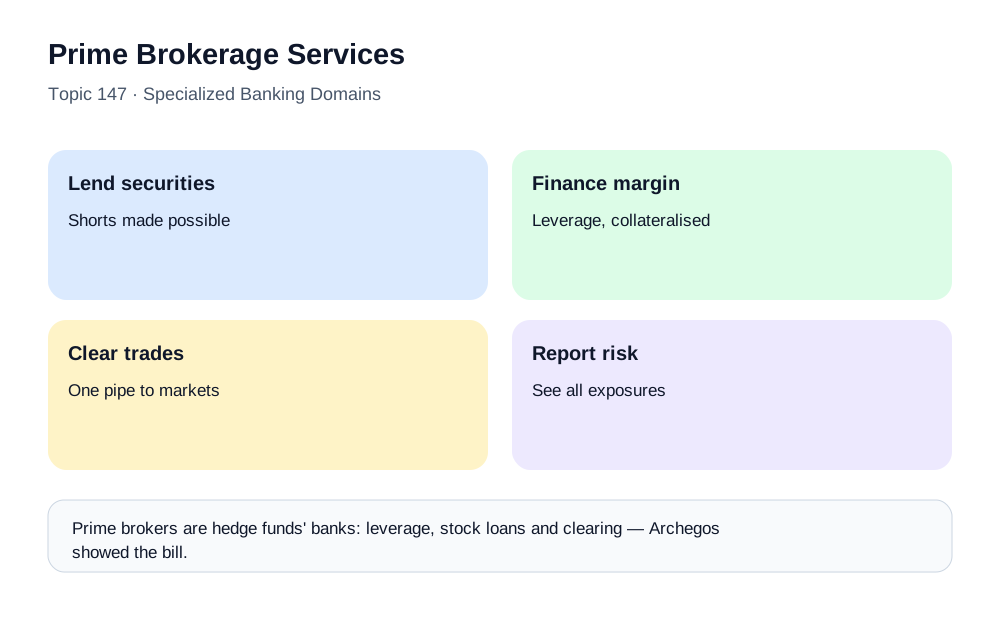
Prime Brokerage Services at a glance — Securities lending, margin financing, hedge fund services.
Hedge Fund Infrastructure, Securities Lending, Margin Financing, and Risk Control
Prime brokerage is a set of services that investment banks and large broker-dealers provide to hedge funds, institutional traders, family offices, and other professional investors. It is not one product. It is a platform that combines trading access, clearing, custody, financing, securities lending, reporting, collateral management, and risk support.
A hedge fund may trade equities, bonds, futures, options, swaps, currencies, and other instruments across many markets. It may use leverage. It may sell securities short. It may need to move collateral quickly. It may need daily reporting for investors, auditors, and regulators. Building all of that infrastructure alone would be expensive and slow.
The prime broker provides that infrastructure. In return, the bank earns commissions, financing spreads, securities lending fees, custody fees, technology fees, and deeper institutional client relationships.
Learning objectives
By the end of this chapter, you should be able to:
- Explain what prime brokerage is and who uses it.
- Identify core services: execution, clearing, custody, margin financing, securities lending, reporting, and capital introduction.
- Understand how short selling works through securities borrowing.
- Explain margin financing, collateral, margin calls, and leverage risk.
- Understand rehypothecation and why asset segregation matters.
- Describe why hedge funds often use more than one prime broker.
- Identify key risks for the prime broker and the client.
- Explain how prime brokerage differs from ordinary retail brokerage.
1. What Prime Brokerage Means
Prime brokerage is a bundled service model for sophisticated trading clients.
A retail broker may help an individual buy or sell shares. A prime broker supports institutional trading businesses that need financing, settlement, custody, securities lending, reporting, and operational infrastructure across many markets.
Prime brokerage clients may include:
- hedge funds;
- long-short equity funds;
- market-neutral funds;
- macro funds;
- event-driven funds;
- proprietary trading firms;
- family offices;
- asset managers with complex trading needs;
- institutional investors using shorting or leverage.
The prime broker becomes the client's operating backbone for trading activity.
2. Core Prime Brokerage Services
| Service | What it does |
|---|---|
| Trade execution | Provides access to markets, algorithms, trading desks, and electronic platforms |
| Clearing | Processes trades after execution and prepares them for settlement |
| Custody | Holds client securities and supports asset servicing |
| Margin financing | Lends cash against the client's portfolio |
| Securities lending | Sources securities that clients can borrow, often for short selling |
| Collateral management | Tracks pledged assets, margin requirements, and eligibility |
| Reporting | Provides daily positions, cash, P&L, margin, exposure, and financing reports |
| Capital introduction | Introduces hedge funds to potential institutional investors |
| Risk analytics | Helps clients and the bank monitor exposure, leverage, liquidity, and concentration |
A strong prime brokerage platform is valuable because it reduces operational complexity for the client while giving the bank visibility into risk.
3. How Prime Brokerage Differs from Retail Brokerage
| Area | Retail brokerage | Prime brokerage |
|---|---|---|
| Client type | Individuals and small investors | Hedge funds and institutions |
| Main service | Order execution and account access | Full trading, custody, financing, and reporting platform |
| Leverage | Limited and standardised | Negotiated and risk-based |
| Short selling | Usually restricted or simple | Core service through securities lending |
| Reporting | Basic statements and portfolio view | Detailed exposure, P&L, margin, financing, and risk reports |
| Relationship | Mass-market service | Relationship-managed institutional service |
| Risk management | Account-level controls | Portfolio-level, client-level, and market-wide risk controls |
Prime brokerage is closer to institutional infrastructure than simple brokerage.
4. Securities Lending and Short Selling
Short selling requires borrowing securities before selling them.
Suppose a hedge fund believes a share currently trading at 500 will fall. The fund cannot simply sell shares it does not own unless market rules allow and delivery can be made. The prime broker helps the fund borrow the shares from a lender, such as a pension fund, mutual fund, insurance company, or the prime broker's own inventory.
A simplified short sale flow:
- The hedge fund asks to borrow shares.
- The prime broker locates available shares.
- The fund borrows the shares and posts collateral.
- The fund sells the borrowed shares in the market.
- Later, the fund buys shares back.
- The shares are returned to the lender.
- The fund keeps profit if the price falls, after fees and costs.
If the price rises instead, the fund may lose money. Short selling losses can be very large because a share price can rise far more than it can fall.
5. Securities Lending Fees and Collateral
The borrower pays a fee to borrow securities. Fees depend on supply and demand.
- Easy-to-borrow securities usually have low fees.
- Hard-to-borrow securities can have high fees.
- Securities involved in corporate actions, high short interest, or limited supply may become expensive to borrow.
The borrower also posts collateral. Collateral protects the lender if the borrower fails to return the securities.
Collateral may be:
- cash;
- government securities;
- high-quality liquid securities;
- letters of credit or other approved support, depending on market rules and agreements.
Collateral is marked to market. If the borrowed security price changes, collateral requirements may change.
6. Margin Financing and Leverage
Prime brokers lend money to clients against portfolios. This is margin financing.
Example:
A hedge fund has 100 million of capital. With financing, it may hold 200 million of positions. The extra 100 million is funded by borrowing from the prime broker.
Leverage can improve returns when trades work. It can also magnify losses when trades move against the fund.
Prime brokers manage margin risk through:
- initial margin requirements;
- variation margin;
- daily mark-to-market;
- collateral eligibility rules;
- concentration limits;
- liquidity haircuts;
- stress testing;
- margin calls;
- rights to liquidate collateral after default.
A margin call occurs when the client must provide more collateral or reduce positions because the portfolio no longer supports the required financing level.
7. Custody and Asset Servicing Inside Prime Brokerage
Prime brokers often hold client assets or coordinate custody arrangements.
Custody support may include:
- holding securities;
- settling trades;
- collecting dividends and interest;
- processing corporate actions;
- tracking collateral pledged against financing;
- reporting positions and cash;
- reconciling records;
- supporting audit and investor reporting.
This creates operational complexity. A security may be part of the client's investment portfolio, pledged as collateral, loaned out, recalled for sale, or affected by a corporate action. The prime broker must track status accurately.
8. Rehypothecation and Asset Segregation
Rehypothecation means a prime broker uses client assets pledged as collateral for its own financing or collateral needs, subject to legal agreements and regulation.
This can reduce financing costs, but it creates risk. If the prime broker fails, clients may face delays or losses when trying to recover assets that were reused.
After major market failures, institutional clients became more sensitive to:
- segregation of client assets;
- limits on rehypothecation;
- bankruptcy treatment;
- transparency of collateral use;
- use of multiple prime brokers;
- independent custody or tri-party structures.
For learners, the key point is that custody risk is not only about theft. It is also about legal ownership, collateral use, insolvency, and operational control.
9. Capital Introduction
Capital introduction is a service where prime brokers introduce hedge fund clients to potential investors.
This may include:
- investor events;
- fund conferences;
- due diligence meetings;
- introductions to family offices, funds of funds, pension consultants, or institutions;
- performance and strategy presentations;
- market intelligence on investor appetite.
The prime broker does not usually guarantee that investors will invest. It creates access and relationship opportunities.
Capital introduction is valuable for hedge funds because raising assets is one of the hardest parts of the business.
10. Multi-Prime Arrangements
Many hedge funds use more than one prime broker.
This is called a multi-prime setup.
Benefits include:
- reduced dependency on one bank;
- access to different securities lending pools;
- stronger negotiating power;
- backup if one prime broker faces operational or financial stress;
- diversification of financing sources.
Challenges include:
- more reconciliation work;
- fragmented reporting;
- duplicated collateral requirements;
- more legal agreements;
- greater operational complexity.
Large funds usually accept this complexity because counterparty concentration risk can be dangerous.
11. Prime Broker Risk Management
Prime brokers take several risks when serving clients.
| Risk | Meaning | Control focus |
|---|---|---|
| Client default risk | Client cannot meet margin calls or repay financing | Collateral, margin, liquidation rights |
| Market risk | Collateral value falls quickly | Haircuts, stress tests, concentration limits |
| Liquidity risk | Positions cannot be sold easily | Liquidity scoring, financing limits |
| Securities lending risk | Borrowed securities cannot be returned or recalled | Collateral, recalls, locate controls |
| Operational risk | Settlement, booking, collateral, or reporting error | Reconciliation, workflow controls, exception management |
| Legal risk | Agreements do not protect rights in default | Strong documentation and jurisdiction review |
| Counterparty risk | Exposure to clients, lenders, clearing houses, or custodians | Limits, monitoring, diversification |
| Reputational risk | Client loss or market stress damages bank reputation | Governance, escalation, transparent communication |
Prime brokerage is profitable because it serves complex clients. It is risky for the same reason.
12. Practical Example
A long-short equity fund has 500 million in investor capital.
It wants to:
- buy undervalued shares;
- short overvalued shares;
- borrow money to increase exposure;
- settle trades across several markets;
- receive daily P&L and exposure reports;
- borrow hard-to-find shares;
- meet institutional investor reporting needs.
The prime broker provides financing, securities lending, trade settlement, custody, collateral management, and reports. If the fund loses money and collateral falls below required levels, the prime broker issues a margin call. If the fund cannot meet it, the prime broker may reduce exposure or liquidate collateral according to the legal agreement.
13. Common Misconceptions
Misconception 1: Prime brokerage is only brokerage for rich clients.
It is much more than execution. It is a financing, custody, securities lending, clearing, reporting, and risk platform for institutional trading clients.
Misconception 2: Securities lending is the same as lending money.
Securities lending means lending financial instruments such as shares or bonds, usually against collateral. Money may also move, but the borrowed item is the security.
Misconception 3: More leverage always means better returns.
Leverage increases both gains and losses. It can force a fund to sell positions during stress if margin calls arrive at the wrong time.
Misconception 4: One prime broker is always simpler and better.
One provider may reduce complexity, but it creates concentration risk. Many funds prefer multiple prime brokers for resilience.
14. Frequently Asked Questions
Who uses prime brokerage?
Mostly hedge funds and institutional trading clients that need financing, securities lending, settlement, custody, and advanced reporting.
Why do hedge funds borrow securities?
They borrow securities mainly to support short selling or settlement needs.
What is a margin call?
A margin call is a request for additional collateral or position reduction when the client's portfolio no longer supports the required financing level.
Does a prime broker manage the hedge fund's investments?
Usually no. The fund manager makes investment decisions. The prime broker provides the infrastructure and financing to execute and support those decisions.
Why did prime brokerage risk receive attention after 2008?
Market failures showed that client assets, rehypothecation, counterparty exposure, and bankruptcy treatment can become critical during stress.
15. Key Terms
- Prime broker: Institution providing bundled services to hedge funds and professional investors.
- Securities lending: Lending securities to another party, usually against collateral.
- Short selling: Selling borrowed securities in expectation of buying them back later.
- Margin financing: Lending against a portfolio to provide leverage.
- Margin call: Requirement to post more collateral or reduce exposure.
- Collateral: Assets pledged to secure borrowing or performance.
- Rehypothecation: Reuse of client collateral by the prime broker, subject to agreement and law.
- Haircut: Discount applied to collateral value for risk management.
- Capital introduction: Introductions between hedge funds and potential investors.
- Multi-prime: Using more than one prime broker.
- Locate: Confirmation that securities can be borrowed before short selling.
16. Interview Insights
Interviewers may ask prime brokerage questions to see whether you understand institutional markets beyond simple buying and selling.
Strong answers usually mention:
- hedge funds as primary clients;
- bundled services;
- short selling through securities lending;
- margin financing and leverage;
- custody and reporting;
- collateral and margin calls;
- counterparty and operational risk;
- multi-prime arrangements.
A good short answer:
"Prime brokerage is the institutional platform that helps hedge funds trade, borrow securities, use leverage, settle trades, hold assets, manage collateral, and receive reporting. It is profitable for banks, but it requires strong risk controls because clients often use leverage and complex strategies."
17. Summary
Prime brokerage is the operating infrastructure behind many hedge funds and institutional trading strategies. It combines execution, clearing, custody, financing, securities lending, reporting, and capital introduction.
For banking learners, the key lesson is this: prime brokerage is not just trading access. It is a balance-sheet, collateral, custody, and risk-management business wrapped around sophisticated clients.
Next: Topic 148 - Digital Asset Custody
<!-- MBA-DEEP-DIVE-START -->Prime Brokerage Deepening — Financing, Short Inventory, Margin, Default Management, and Client Infrastructure
Prime brokerage is a balance-sheet relationship, not only a brokerage service
A prime broker gives sophisticated clients access to financing, securities borrowing, clearing, custody, reporting, and operational support, but the defining commercial feature is that the bank commits its balance sheet and credit appetite to the relationship. When a client borrows cash, shorts stock through securities lending, posts collateral, or enters transactions that create exposure, the prime broker is taking risk. Revenue therefore has to be evaluated against capital, liquidity, funding, counterparty credit risk, market stress, operational complexity, and the value of the wider client relationship.
Client onboarding combines credit, legal, operational, tax, and financial-crime controls
Before a hedge fund or institutional client becomes active, the prime broker needs to understand the legal entity, ownership, investment manager, strategy, expected markets, leverage, investor base, service requirements, and source of assets. Credit approves exposure and margin terms. Legal negotiates prime brokerage and securities-lending documentation. Operations establishes accounts and settlement instructions. Financial-crime teams complete required due diligence. Tax and regulatory classifications can affect reporting and withholding. A client is not operationally ready merely because a salesperson has agreed commercial pricing.
Strategy understanding is a credit control
A long-short equity fund, convertible-arbitrage fund, global macro fund, event-driven fund, quantitative market-neutral fund, and concentrated family office can create very different risk even at similar net asset value. The prime broker should understand expected gross exposure, net exposure, liquidity, concentration, shorting pattern, derivative use, turnover, financing tenor, and sensitivity to market moves. The goal is not to judge investment merit but to estimate how quickly losses and margin demands could emerge.
Gross and net exposure answer different questions
A portfolio can have low net market exposure and very high gross positions. A fund that owns 500 of long positions and shorts 480 may appear only 20 net long, but it still has 980 of gross market positions that must be financed, settled, and managed. Correlations can break, short positions can rally, and both sides can lose simultaneously. Prime-broker risk models therefore examine gross exposure, directional exposure, factor exposure, liquidity, concentration, and stress loss rather than relying on one net number.
Leverage should be measured in more than one way
Leverage can arise through borrowed cash, securities borrowing, derivatives, repo, futures, or economically similar structures. Balance-sheet leverage alone can miss derivative exposure. Gross-notional measures can overstate risk for offsetting positions. Risk-based measures can depend heavily on model assumptions. A prime broker therefore uses several views and supplements them with stress testing and qualitative understanding of the strategy.
Margin is the mechanism that converts uncertain future loss into today's collateral requirement
Initial margin protects against potential loss between the last collateral exchange and the point at which the prime broker can close or hedge positions after client default. Variation margin or daily mark-to-market addresses current changes in value. House margin can be higher than exchange or regulatory minimums because the bank incorporates client credit, concentration, volatility, liquidity, wrong-way risk, financing structure, and its own risk appetite. Margin is therefore a dynamic credit tool, not a fixed product tariff.
Portfolio margin recognises offsets, but offsets are not free
A risk-sensitive margin approach can recognise diversification between positions. However, an apparent hedge can weaken under stress. Two securities may historically move together but diverge in a crisis. A cash equity position and an option may have nonlinear behaviour. A cross-market hedge can face different trading hours or settlement constraints. Prime brokers apply correlation assumptions, concentration add-ons, liquidity charges, and stress scenarios so normal-period diversification does not create excessive leverage.
Concentration risk can dominate a diversified portfolio metric
A fund can hold hundreds of positions but still have one very large exposure to a single issuer, sector, theme, or crowded trade. The prime broker should identify both outright concentration and hidden common-factor concentration. A position that represents a large percentage of an issuer's free float can be difficult to liquidate after default. Margin should reflect the cost and time required to exit, not only current volatility.
Liquidity matters because the prime broker may need to liquidate after default
A mark-to-market loss is manageable if collateral can be realised and positions can be closed. A concentrated or illiquid portfolio can continue moving against the bank while liquidation takes days. Risk models can estimate days to liquidate using market volume, bid-ask spreads, trading restrictions, market depth, and stressed conditions. The bank should avoid assuming yesterday's average volume remains available when a distressed client and other investors are all trying to sell at once.
Gap risk exists between margin calls
Prices can move sharply overnight, over weekends, during trading halts, or before collateral arrives. Margin calls reduce but cannot eliminate this gap. Events such as earnings announcements, merger decisions, court rulings, political shocks, or short squeezes can create discontinuous moves. The bank may impose event add-ons, reduce financing, or require extra collateral when a known catalyst increases gap risk.
Short positions can create asymmetric loss
A long share position can fall toward zero, limiting the price loss to the invested amount. A short position can theoretically rise without a fixed upper bound. In practice, short squeezes, borrow recalls, hard-to-borrow fees, and forced buy-ins can magnify stress. Prime brokers therefore monitor short concentration, borrow depth, days-to-cover, utilisation, corporate actions, and the availability of alternative supply.
Securities lending requires a real inventory view
A trader cannot responsibly promise borrow based on yesterday's position report. Securities can be recalled, sold, restricted, moved to another client, or become unavailable. The prime broker needs inventory from internal holdings, agent lenders, custodians, pension funds, asset managers, and other sources, with terms and recall rights. Availability should be linked to the specific market, legal entity, settlement location, and client need.
A locate is not the same as a completed borrow
Depending on market rules, a short sale may require reasonable grounds to believe securities can be borrowed or delivered. The exact requirement varies by jurisdiction. Operationally, the prime broker should distinguish a preliminary locate from a booked stock loan and from settled securities actually available for delivery. Treating these statuses as interchangeable can create settlement failures and regulatory risk.
Hard-to-borrow pricing can change rapidly
Borrow fees reflect scarcity, demand, lender terms, corporate events, and market conditions. A security that is cheap today can become expensive tomorrow if short interest rises or supply is recalled. Client agreements should specify how fees are determined and communicated. Profit-and-loss reporting should separate trading performance from financing and borrow costs so a strategy does not appear profitable before the cost of maintaining the short is considered.
Recalls create time-critical obligations
A securities lender can have contractual rights to recall assets. The prime broker then must return the security within the applicable terms, which may require recalling from the hedge-fund client or finding replacement supply. A client that cannot return the asset may need to buy it in the market. Operations should track recall dates, market cut-offs, settlement status, and escalation, because a securities-lending problem can become a market buy-in or client-default issue.
Corporate actions can make borrowed securities operationally complex
Dividends, rights issues, tender offers, splits, conversions, mergers, and voting events can affect securities on loan. The economic benefit may need to be manufactured or adjusted between borrower and lender. A voluntary corporate action can also create recall pressure if the lender wants to participate. Prime brokerage, securities lending, and custody systems should share event data so financing positions do not lose entitlement accuracy.
Cash financing must be connected to the bank's own funding cost
The prime broker may finance a client's long positions using internal cash, repo, securities financing, or other wholesale funding. The client financing rate should therefore reflect benchmark, tenor, collateral, balance-sheet usage, currency, liquidity premium, and relationship economics. A spread above an overnight rate does not automatically represent pure profit; the bank has funding, capital, liquidity, and operational costs.
Term financing reduces client rollover risk but can increase bank commitment
A client may prefer financing that cannot be repriced or withdrawn every day, particularly for less liquid strategies. The prime broker then accepts more funding and market risk over the commitment period. Legal terms can include break rights, margin maintenance, eligible collateral, events of default, and repricing conditions. Relationship managers should not promise stable financing without understanding the bank's own balance-sheet capacity.
Collateral eligibility should reflect liquidation quality
A client can own valuable assets that the prime broker does not accept at full value. Illiquid bonds, concentrated equities, structured products, private assets, or highly volatile securities can receive large haircuts or be ineligible. The bank needs clear eligibility, valuation sources, concentration rules, currency treatment, wrong-way-risk restrictions, and substitution processes. Collateral value is a risk-adjusted amount, not merely the latest market price.
Wrong-way risk occurs when collateral weakens with the client
If a fund is heavily exposed to one sector and posts securities from the same sector as collateral, a common shock can damage both the portfolio and the protection. Similar risk exists if collateral is issued by an affiliate of the client or closely tied to its strategy. Margin models and eligibility rules should identify these correlations rather than assuming separate security identifiers imply diversification.
Rehypothecation is a legal right that changes the client's insolvency exposure
Where law and contract permit, the prime broker may reuse certain collateral to fund its own activity. This can lower financing cost but affects what happens if the prime broker fails. Clients therefore negotiate segregation, reuse limits, custody arrangements, and disclosure. The operational system should know which assets are freely reusable, pledged but segregated, subject to regulatory protection, or otherwise restricted. Rehypothecation is not a universal feature and should always be described subject to the governing agreement and law.
Client asset protection needs legal and operational alignment
A statement saying assets are “segregated” is meaningful only if account structures, books and records, depository arrangements, legal documentation, and daily reconciliations support the claim. In a failure scenario, the client should be identifiable and the status of each asset clear. Multi-prime clients often pay close attention to this because counterparty risk to the prime broker can be as important as investment risk.
Multi-prime arrangements diversify bank exposure but fragment the fund's risk picture
A hedge fund using three prime brokers can reduce dependence on any one bank and access different financing or securities-lending pools. Each prime broker, however, may see only the positions booked with it. The client can have offsetting or amplifying positions elsewhere. Prime brokers therefore seek transparency appropriate to the credit arrangement, while fund managers need independent aggregation to understand enterprise leverage, liquidity, and collateral.
Margin disputes need controlled resolution
The client and prime broker can disagree on price, position, haircut, model input, or legal interpretation. A dispute process should identify the contested amount, undisputed collateral that must still be posted, escalation contacts, valuation evidence, and resolution timeline. Allowing a dispute to suspend the entire margin call can increase credit exposure exactly when markets are moving quickly.
Valuation controls are crucial for less liquid instruments
Exchange-traded equities can be marked from observable prices, but OTC derivatives, bonds, loans, or complex securities may need models or evaluated prices. The prime broker should apply independent price verification and valuation reserves where appropriate. A client-provided price should not automatically determine collateral value. During stress, previously reliable pricing sources can become stale.
Intraday risk can matter more than end-of-day reports
Highly leveraged funds can change positions rapidly. A risk view generated only overnight can miss a large directional trade, option exposure, or concentration created during the day. Prime brokers increasingly combine trade feeds, market data, margin calculations, and limit monitoring intraday for material clients. Escalation should identify both current breach and projected risk if pending trades settle.
Limit frameworks should separate types of exposure
The bank can set limits for financing, unsecured exposure, gross notional, stress loss, concentration, short inventory, country, product, and legal entity. One overall credit line can hide the mechanism that is actually becoming dangerous. Limit usage should include booked, pending, and contingent transactions where they can become effective. Overrides require accountable approval and expiry.
Stress testing should imagine the portfolio after correlations break
Normal-value-at-risk or historical volatility can understate extreme risk. Prime-broker stress tests can apply large equity moves, volatility shocks, credit-spread widening, FX moves, rate changes, sector-specific shocks, short squeezes, liquidity deterioration, and correlated moves across asset classes. The objective is to estimate the bank's loss after considering collateral and liquidation, not merely the client's mark-to-market change.
Reverse stress asks what scenario exhausts the protection
Instead of asking what happens under a predefined shock, the bank can ask how large a move, liquidity deterioration, or correlation break would create a loss beyond available margin. This helps identify clients whose apparent collateral buffer is thin relative to concentration or optionality. Reverse stress is especially useful for novel strategies that are not well represented in historical scenarios.
Default management requires speed and governance
If a client misses margin, breaches a financing agreement, becomes insolvent, or otherwise triggers default rights, the bank must quickly determine its exposure and legal options. Actions can include freezing new activity, hedging risk, liquidating collateral, closing positions, recalling securities, netting obligations, and coordinating with clearing brokers or custodians. A pre-agreed default-management playbook reduces hesitation and inconsistent decisions during volatile markets.
Liquidation should consider market impact
Selling the whole portfolio immediately may look prudent but can worsen prices, particularly in concentrated positions. The bank may hedge first, work orders over time, use auctions, or prioritise liquid positions depending on legal rights and risk. The objective is to minimise total loss, not simply maximise speed. Default teams therefore need trading, risk, legal, operations, and senior-management coordination.
Close-out netting can reduce exposure if legally enforceable
Master agreements may allow positive and negative transaction values to be combined into one close-out amount after default, subject to applicable law and documentation. The bank should maintain legal opinions and agreement data needed to support netting treatment. Systems need to know which transactions belong to the same enforceable netting set rather than netting every position belonging to the same brand name.
Client default can create operational failures before credit loss is final
Pending securities trades, stock-loan recalls, corporate actions, unsettled cash, futures margin, and OTC derivatives can all continue generating events after the relationship is frozen. Operations needs a default flag that changes workflow without erasing transaction history. Payments should be controlled carefully so required settlement or asset-protection actions continue while unauthorised withdrawals stop.
Counterparty default can affect the client too
Prime brokerage is a two-way dependency. If the prime broker itself comes under stress, the hedge fund can lose financing access, face delays recovering assets, or need to move positions rapidly. This is one reason funds monitor prime-broker credit quality, negotiate segregation, use multiple providers, and maintain transfer capabilities. A resilient service model should be able to provide accurate asset and liability records under crisis conditions.
Portability is operationally difficult
Moving a portfolio to another prime broker can require new documentation, KYC, account opening, transfer of securities, novation of derivatives, cash movement, settlement instruction changes, and re-establishment of financing. It is not a one-click process. Funds that treat multi-prime as resilience should periodically assess how quickly meaningful positions could actually move.
Clearing creates another layer of margin and liquidity
Exchange-traded derivatives and centrally cleared products can require margin at a CCP or clearing broker. The prime broker may finance or intermediate the client's obligations. Sudden variation-margin calls can create large intraday cash needs even if the longer-term strategy remains sound. Funding and collateral systems should therefore connect client margin with the bank's own clearing obligations.
Prime brokerage reporting should reconcile to the books that move money
Clients receive positions, cash, P&L, financing, borrow fees, margin, and exposure reports. Those reports should reconcile with custody, trade, loan, collateral, and accounting systems. A glossy portal is not reliable if underlying books disagree. Breaks should be visible and corrected rather than hidden by report-level adjustments.
P&L attribution helps distinguish trading loss from financing pressure
A client's total return can be decomposed into market movement, realised trading result, financing cost, securities-borrow fee, dividends or manufactured payments, FX, fees, and other adjustments. This is useful for both the client and bank. A strategy may be directionally profitable but economically weak after expensive borrow and leverage costs. Accurate attribution also supports dispute resolution.
Capital introduction must remain distinct from investment recommendation
Prime brokers can facilitate introductions between funds and institutional investors, but the service should not be represented as a guarantee of fund quality or investment performance. Conflicts and disclosure should be managed according to applicable rules and internal policy. The bank's commercial interest in a prime-brokerage client should not override investor-protection obligations in another part of the institution.
Information barriers can be important inside a universal bank
A prime broker can possess confidential position and strategy information about hedge funds while other desks trade the same securities or advise issuers. Access should be restricted according to law and policy. Data generated for credit and margin management should not automatically become a trading signal for unrelated desks.
Securities-lending revenue should be allocated transparently
When client or third-party assets generate lending revenue, contractual fee splits, rebates, collateral earnings, and costs should be calculated accurately. The party entitled to income can depend on the agreement and lending structure. Operations and finance should be able to reconstruct how the fee was derived from loan quantity, rate, collateral, and days outstanding.
Corporate-action economics on shorts can surprise clients
A short seller can owe manufactured dividend or other economic compensation to the lender. Certain events can also change borrow availability or cause position adjustments. Client reporting should explain these costs and events. Risk teams should anticipate major corporate actions when evaluating short concentration because a merger or tender can sharply change economics.
Scenario: a crowded short rallies sharply
A hedge fund has a large short in a security with limited borrow supply. Unexpected positive news triggers a rapid price rise. Mark-to-market loss grows, borrow lenders issue recalls, and replacement supply becomes expensive. The prime broker increases margin, reduces new short capacity, and monitors the client's liquidity. The client meets the call and buys back part of the position. The case shows how market risk, securities lending, margin, and liquidity can reinforce one another.
Scenario: a concentrated long gaps down overnight
A fund financed a large single-name equity position. A regulatory announcement causes a large pre-market decline. The initial margin buffer is partly consumed before trading opens. The bank's stress framework had applied a concentration add-on, so collateral remains adequate. The prime broker issues a margin call and reduces financing headroom while the client reassesses the position. Concentration margin exists precisely for this gap-risk scenario.
Scenario: the client disputes the bank's bond valuation
The fund values a thinly traded bond using a broker quote while the prime broker's independent service marks it materially lower. The difference changes collateral value and creates a margin call. The dispute workflow preserves the bank's risk mark, records the client's evidence, and escalates to independent valuation specialists. The undisputed margin amount is still due. This prevents a pricing disagreement from becoming an uncontrolled credit extension.
Business analysts should model prime brokerage as linked ledgers
Requirements should connect trades, positions, financing loans, collateral, securities borrows, cash, margin, limits, client agreements, fees, and settlement. A position can simultaneously create market exposure, financing balance, custody holding, and collateral eligibility. The system should preserve each dimension rather than reduce the client to one portfolio value. Event-driven updates need idempotency because duplicate trades or margin movements can create direct financial loss.
Testing should include stress and default paths
Important tests include large intraday trade, short recall, hard-to-borrow rate change, margin call, partial collateral delivery, ineligible collateral, valuation dispute, client limit breach, corporate action on borrowed stock, failed settlement, multi-currency funding, financing repricing, client default, position liquidation, and prime-broker outage. Testing should verify money, securities, legal status, and reporting together.
Closing perspective
Prime brokerage succeeds when it lets sophisticated clients move quickly without allowing speed to outrun risk control. Securities lending enables shorting, financing creates leverage, custody and clearing keep assets moving, reporting gives the client an operating view, and margin protects the bank against uncertain future loss. The difficult part is that all of these services interact during stress. A strong prime broker therefore sees the relationship as one connected exposure and maintains the data, legal rights, collateral, liquidity, and operational capability needed to manage it before a volatile portfolio becomes a bank loss.
Prime Brokerage Operations — Intraday Credit, Collateral Movement, and Default Readiness
Client exposure should be recalculated when pending trades change the future book
A hedge fund can enter large trades that have not yet settled. If risk systems consider only current settled positions, the prime broker can underestimate tomorrow's financing, concentration, or short requirement. Exposure views should include pending transactions according to their probability and contractual status so margin and limit decisions anticipate the portfolio that is forming, not only the portfolio already settled.
Intraday credit should have explicit authority
Client cash can become temporarily negative because trades settle before sale proceeds, margin receipts, or FX funding. The prime broker may permit intraday or overnight financing within approved limits, but operations should not create unofficial credit by allowing debit balances simply because expected cash is coming later. The system should identify facility, limit, currency, pricing, expected cure, and escalation when the deficit persists.
Collateral calls should become settlement obligations with traceable status
Once a margin call is agreed or due under the relationship, the bank needs to know whether the client instructed collateral, whether cash or securities arrived, whether assets were eligible, and whether the collateral ledger updated. A call marked “issued” is not satisfied. Operations should reconcile the expected call to actual receipt and escalate short or late delivery before exposure grows further.
Collateral substitutions can increase risk if assessed only by market value
A client may ask to replace one security with another of similar price. The replacement should be tested for eligibility, haircut, liquidity, concentration, currency, settlement location, wrong-way risk, and legal availability. Releasing original collateral before the substitute is final can leave the bank temporarily under-secured. Delivery-versus-delivery or controlled sequencing can reduce this gap where infrastructure permits.
Financing books should reconcile to custody and trading books
The bank may finance securities held in custody, borrowed from another lender, or pending settlement. Prime-broker financing balances should reconcile with actual client assets and liabilities. A discrepancy can lead to charging interest on the wrong balance, allowing unsupported withdrawals, or misreporting exposure. Daily reconciliation should therefore bridge trades, cash, stock loans, collateral, financing, and client statements.
Short inventory should distinguish source reliability
Not every indicated borrow has the same certainty. Internal inventory, committed lender supply, indicative availability, and expected recalls can be classified differently. Risk and client-facing systems should know the quality of the source before representing that a short can be maintained. This reduces the chance that a strategy is financed on inventory that disappears immediately under market stress.
Locate and borrow records should remain linked to the client short
Operations should be able to trace why a short sale was considered deliverable, which lender supplied the stock, what fee applies, when the loan settled, and whether a recall later occurred. This lineage supports market compliance, fee disputes, and fail management. A spreadsheet of daily borrow availability disconnected from the actual short position is weak evidence.
Margin methodology changes should be communicated and controlled
House margin may change because volatility, concentration, liquidity, or bank risk appetite changes. Material methodology changes should follow governance and be tested against representative portfolios. Client communication should distinguish routine daily mark-to-market from a structural change in margin requirement. Sudden unexplained increases can create avoidable liquidity stress and disputes.
Concentration add-ons should consider exit capacity
A position may be only a small percentage of a large portfolio yet still represent many days of market trading volume. Margin should reflect how quickly the prime broker could reduce the position after default without assuming unlimited liquidity. Days-to-liquidate estimates should be stressed because volumes often decline exactly when the bank needs to exit.
Cross-product netting should follow enforceable agreements
A client can have equities, swaps, options, futures, repo, and cash financing across several bank entities. Economic dashboards may show offsets, but legal close-out rights can differ by agreement and entity. Credit exposure should recognise netting only where the bank has the required contractual and legal basis. A consolidated client name is not a legal netting set.
Client withdrawals should respect collateral and financing constraints
A profitable fund may request a large cash withdrawal while still owing margin or financing. Available-to-withdraw should consider unsettled trades, margin requirement, haircuts, pending calls, fees, and restricted assets. A custody cash balance alone can overstate what can safely leave the relationship. This control connects client service directly to counterparty risk.
Default playbooks should contain position-level actions
A generic instruction to “liquidate the portfolio” is not enough. The default team needs current positions, collateral, financing, short recalls, pending settlements, exchange margin, legal netting sets, market liquidity, and authorised traders. Some positions may be hedged before sale; others may need immediate close-out. Playbooks should define decision authority and communication so execution can begin without waiting for data assembly.
Client default status should propagate to dependent systems safely
When credit declares default or restricted status, new trading, withdrawals, and financing may stop while settlement of existing obligations continues. The flag should therefore carry precise permissions rather than disable every process blindly. Custody, stock loan, derivatives, payments, and client portal systems need consistent interpretation so necessary close-out actions remain possible.
Default liquidation accounting should remain separate from ordinary client trading
Trades executed by the bank to reduce exposure after default are not normal client-directed investment activity. Systems should tag them appropriately, preserve decision authority, allocate proceeds according to the agreement, and reconcile the resulting exposure. This distinction matters for legal evidence and post-event review.
Stress losses should be compared with readily realisable protection
Collateral can be valuable but illiquid, concentrated, legally restricted, or operationally unavailable. Risk dashboards should distinguish gross collateral value from risk-adjusted and immediately available protection. Reverse stress is more informative when it asks how the bank performs after realistic liquidation discounts and timing, not after assuming every pledged asset can be sold instantly at screen price.
Client profitability should include balance-sheet consumption
Financing spread, stock-loan revenue, commissions, and ancillary fees can look attractive before capital, liquidity, and operational costs are allocated. Relationship profitability should include credit exposure, leverage, funding tenor, scarce collateral, and stress capacity. This prevents commercial teams from rewarding volume that uses disproportionate bank resources.
Multi-prime information gaps need explicit assumptions
A prime broker often sees only part of the hedge fund's portfolio. Credit assessment should document what transparency the client provides about other prime brokers, derivatives, financing, and liquidity. Where the view is incomplete, limits or margin can reflect that uncertainty. The bank should not assume unseen positions perfectly hedge the exposures on its own books.
Prime-broker reporting should identify data freshness
Intraday clients may see positions from different markets and systems with different update times. Reports should indicate whether cash, margin, P&L, and positions are real time, previous close, or pending reconciliation. A stale value presented as current can cause the client to trade or withdraw based on a position that no longer exists.
The strongest prime-broker operation treats every service as one exposure chain
Trading, custody, financing, securities borrowing, collateral, margin, settlement, and reporting are economically connected. A change in one can alter risk everywhere else. Shared identifiers, reconciliations, effective legal data, and intraday visibility allow the bank to manage the relationship as one controlled exposure rather than a collection of profitable but disconnected products.
Intraday margin collection should be linked to liquidity forecasting
A large client margin call is simultaneously a credit-control action and an expected cash inflow. Treasury should know whether the call is issued, agreed, instructed, or actually received before counting it as available liquidity. Risk should likewise know if expected collateral is delayed. One shared status prevents the bank from assuming protection that has not yet arrived.
Prime-broker concentration should include common strategy risk
Ten clients can appear diversified by legal name while all hold the same crowded trade or depend on the same financing market. Portfolio-level risk should identify common factors, short concentrations, correlated collateral, and similar redemption pressure. Client-by-client limits alone can miss a loss mechanism that hits many relationships simultaneously.
Client money movement should use controlled destination data
Withdrawals and financing settlements can involve very large values. Beneficiary instructions should come from approved static data or a strongly authenticated change process. A relationship manager's urgent email should not be sufficient to redirect cash. Operations should preserve the verified instruction source and effective date.
Default exercises should include real operational feeds
A table-top discussion is useful, but a stronger test extracts actual positions, collateral, stock loans, pending settlements, and legal sets for a sample client and asks teams to construct a liquidation plan under time pressure. This reveals whether the bank can assemble the information it claims to have during a real default.
Financing maturity concentration should be visible by client
A prime broker can finance a diversified portfolio with funding that matures in a narrow window. Risk should therefore compare client asset liquidity with the tenor and reliability of the bank's own funding. A relationship that looks well collateralised can still create liquidity stress if the bank must refinance large balances during a disrupted market.
Margin-call disputes should not suspend unrelated controls
A client may dispute one valuation while other undisputed collateral obligations remain due. Workflow should isolate the disputed component, preserve the agreed amount, and escalate the difference under the contractual process. Treating the whole call as frozen can allow unsecured exposure to grow unnecessarily.
<!-- MBA-DEEP-DIVE-END -->