Visual overview
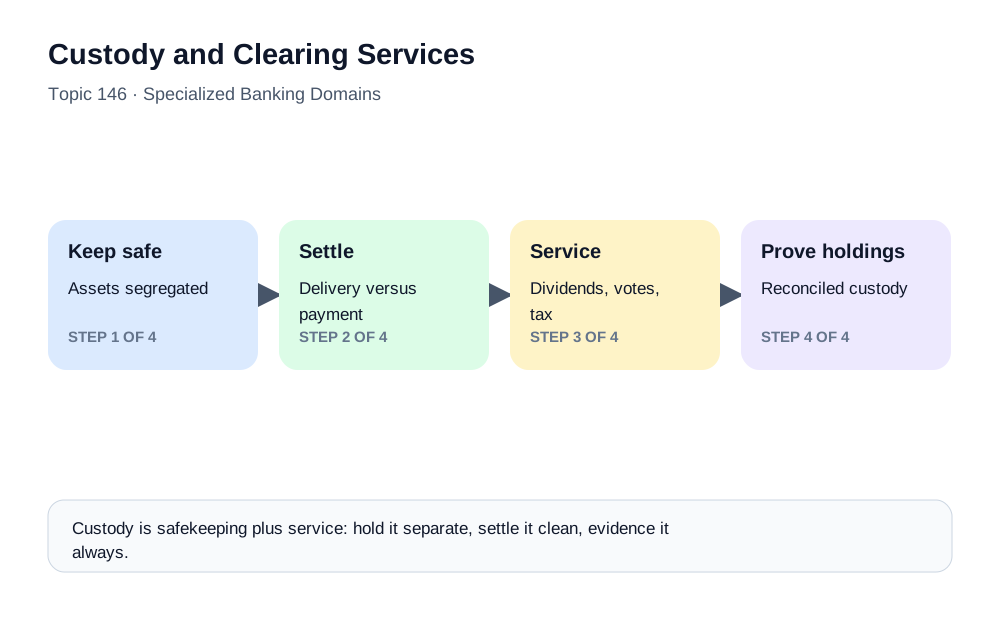
Custody and Clearing Services at a glance — Asset servicing, corporate actions, settlement.
Safekeeping Securities, Settling Trades, and Servicing Investor Assets
When an investor buys a share, bond, mutual fund unit, government security, or exchange-traded fund, the visible action may look simple: place an order, execute a trade, and see the holding in an account. Behind that simple experience sits a large operating system of custodians, brokers, clearing houses, depositories, settlement banks, registrars, fund accountants, and market infrastructure.
Custody and clearing services make securities ownership reliable. They keep assets safe, record ownership, settle trades, collect income, process corporate actions, support tax reporting, reconcile positions, and help institutional investors meet regulatory obligations.
This chapter explains custody and clearing from a practical banking perspective: what a custodian does, how clearing differs from settlement, how depositories support demat ownership, how delivery-versus-payment works, why corporate actions are operationally sensitive, and what risks banks must control.
Learning objectives
By the end of this chapter, you should be able to:
- Explain custody, clearing, settlement, safekeeping, and depository services.
- Identify the roles of custodians, sub-custodians, CSDs, ICSDs, CCPs, brokers, exchanges, and registrars.
- Understand how securities trades move from execution to settlement.
- Explain delivery-versus-payment and settlement cycles such as T+1 and T+2.
- Describe income collection, corporate actions, proxy voting, tax support, and reporting.
- Understand institutional custody, foreign portfolio investor custody, and cross-border custody networks.
- Identify key operational risks such as failed trades, reconciliation breaks, missed elections, tax errors, and cyber access risk.
- Explain how custody supports fund accounting and NAV production.
1. What Custody Means
Custody means holding and servicing financial assets on behalf of clients.
A custodian bank or custody provider may hold assets for:
- mutual funds;
- pension funds;
- insurance companies;
- foreign portfolio investors;
- sovereign wealth funds;
- asset managers;
- banks and broker-dealers;
- wealthy individuals and family offices;
- corporate treasury portfolios.
The custodian's job is not usually to choose investments. Its job is to make ownership work correctly after the investment decision is made.
Custody includes:
- safekeeping of securities;
- settlement of purchases and sales;
- income collection;
- corporate action processing;
- proxy voting support;
- tax documentation and withholding support;
- cash and securities reconciliation;
- portfolio reporting;
- regulatory reporting support;
- fund accounting and NAV support in some arrangements.
2. Custody vs Clearing vs Settlement vs Depository
These terms are related, but they are not the same.
| Term | Meaning | Simple example |
|---|---|---|
| Custody | Safekeeping and servicing securities for an investor | A bank holds a fund's securities and processes dividends |
| Clearing | Confirming obligations after a trade and preparing for settlement | A clearing house calculates who must deliver shares and who must pay cash |
| Settlement | Final exchange of securities and money | Buyer receives shares and seller receives funds |
| Depository | Central system that records electronic securities ownership | A central depository maintains demat holdings |
| Safekeeping | Protecting securities from loss, error, or unauthorised movement | Securities are held in controlled accounts with reconciliations |
| Asset servicing | Handling events after ownership | Dividend, interest, stock split, rights issue, merger, proxy vote |
A useful way to remember it: clearing decides obligations, settlement completes the exchange, custody maintains and services ownership after and between trades.
3. Main Parties in the Custody Value Chain
| Party | Role |
|---|---|
| Investor | Owns or benefits from the securities |
| Broker | Executes buy and sell orders in the market |
| Custodian | Holds and services assets for the investor |
| Sub-custodian | Local custodian used by a global custodian in a specific market |
| Exchange | Marketplace where securities are traded |
| Clearing house / CCP | Becomes central counterparty and manages clearing risk |
| Central securities depository | Records securities in electronic form in a domestic market |
| International CSD | Supports international securities settlement and custody |
| Settlement bank | Moves cash needed for settlement |
| Registrar / transfer agent | Maintains issuer shareholder records and corporate action data |
| Issuer | Company, government, or entity that issued the security |
| Fund accountant | Calculates fund NAV, valuations, income, and expenses |
In India, NSDL and CDSL are the main central depositories for dematerialised securities. Depository Participants, including banks and brokers, connect investors to these depositories. Clearing corporations linked to exchanges handle clearing and settlement for exchange-traded securities.
4. Core Custody Services
A custodian may provide a wide range of services.
Safekeeping
Safekeeping means ensuring securities are properly recorded, protected, and controlled. In modern markets, most securities are electronic rather than paper certificates.
Settlement Support
The custodian sends or receives settlement instructions, monitors trade status, manages settlement exceptions, and confirms that securities and cash move correctly.
Income Collection
The custodian collects dividends, interest, coupons, redemption proceeds, and maturity payments, then credits them to client accounts.
Corporate Actions
The custodian informs clients about events such as stock splits, rights issues, mergers, buybacks, tender offers, bonus issues, redemptions, conversions, and dividend elections.
Proxy Voting
Institutional investors may vote on shareholder resolutions. Custodians help route ballots, deadlines, meeting notices, and vote confirmations.
Tax Support
Custodians may support tax withholding, treaty documentation, tax reclaim processes, and investor-level reporting.
Reporting
Clients receive statements showing holdings, transactions, cash balances, valuations, income, corporate actions, and settlement status.
Reconciliation
Custodians reconcile their records against depositories, brokers, fund accountants, settlement systems, cash accounts, and client books.
5. How Securities Settlement Works
A simplified securities settlement flow looks like this:
- An investor places an order through a broker.
- The trade is executed on an exchange or trading venue.
- Trade details are confirmed and matched.
- The clearing house calculates settlement obligations.
- The seller must deliver securities.
- The buyer must deliver cash.
- Settlement occurs through market infrastructure.
- The buyer's securities account is credited and the seller's cash account is credited.
- Custodians and brokers reconcile the final positions.
Many markets use settlement cycles such as T+1 or T+2. T means trade date. T+1 means settlement occurs one business day after trade date. T+2 means settlement occurs two business days after trade date.
Shorter settlement cycles reduce counterparty exposure but increase operational pressure. Instructions, funding, securities availability, and exception handling must happen faster.
6. Delivery Versus Payment
Delivery versus Payment (DvP) means securities are delivered only if payment is made, and payment is made only if securities are delivered.
DvP reduces the risk that one party delivers securities or cash but does not receive the other side.
Without DvP:
- a seller might deliver securities and not receive cash;
- a buyer might pay cash and not receive securities.
With DvP, both legs are linked. This is a core control in modern settlement systems.
7. Failed Trades
A failed trade occurs when settlement does not complete on the expected date.
Common reasons include:
- seller does not have securities available;
- buyer does not have sufficient cash;
- incorrect settlement instruction;
- mismatched account details;
- market cut-off missed;
- corporate action affects the security;
- sanctions, compliance, or account restriction blocks movement;
- technical or messaging failure.
Failed trades matter because they can create market risk, funding cost, penalties, client dissatisfaction, regulatory reporting issues, and reconciliation breaks.
Custody operations teams spend significant time preventing, tracking, and resolving settlement exceptions.
8. Corporate Actions
Corporate actions are issuer events that affect securities holders.
They can be mandatory or voluntary.
| Type | Meaning | Examples |
|---|---|---|
| Mandatory | Investor receives the outcome automatically | Cash dividend, stock split, bonus issue, bond redemption |
| Voluntary | Investor must make an election | Rights issue, tender offer, optional dividend, buyback participation |
| Mandatory with choice | Event happens, but investor may choose between options | Cash or stock dividend election |
Corporate actions are operationally sensitive because deadlines matter. A missed election can cost a client money or create reputational damage for the custodian.
A strong custody process includes:
- accurate event capture;
- timely client notification;
- clear election deadlines;
- validation of client instructions;
- submission to market infrastructure;
- entitlement calculation;
- income or securities credit;
- post-event reconciliation.
9. Institutional and Cross-Border Custody
Large investors often hold securities across many countries. They may use a global custodian, which then uses local sub-custodians in each market.
For example, a global asset manager may hold equities in India, bonds in the United States, government securities in Europe, and cash in multiple currencies. The investor wants one consolidated custody relationship, but each local market has its own rules, depositories, taxes, settlement cycles, holidays, documentation, and cut-off times.
A global custodian manages this network by coordinating:
- local market access;
- sub-custodian oversight;
- settlement instructions;
- tax documentation;
- FX and cash movements;
- corporate action deadlines;
- position and cash reporting;
- local regulatory requirements.
In India, foreign portfolio investors must meet market-entry, KYC, tax, reporting, and custody requirements. Domestic custodians play an important role in helping foreign investors operate within the local market framework.
10. Demat Accounts and Depositories
A demat account holds securities in dematerialised electronic form.
This removed many risks associated with physical certificates, such as:
- theft;
- forgery;
- loss;
- damage;
- signature mismatch;
- slow transfer;
- manual paperwork.
In India, investors usually access depositories through Depository Participants. A DP may be a bank, broker, or financial institution authorised to provide depository services.
For retail investors, the demat account is the visible face of custody. For institutional investors, custody is broader and includes settlement, reporting, asset servicing, tax, compliance, and fund-accounting support.
11. Fund Accounting and NAV Support
Custody often connects closely with fund accounting.
A mutual fund or investment fund needs daily records of:
- securities held;
- market prices;
- accrued interest;
- dividends receivable;
- expenses payable;
- cash balances;
- subscriptions and redemptions;
- realised and unrealised gains;
- tax adjustments;
- corporate action effects.
The fund's Net Asset Value (NAV) depends on accurate custody and accounting data.
If a trade fails, a price is wrong, income is missed, or a corporate action is not processed correctly, the NAV can be wrong. That is why custody reconciliation and fund accounting controls are central to investor protection.
12. Key Risks in Custody and Clearing
| Risk | What can go wrong | Control focus |
|---|---|---|
| Settlement risk | Trade does not settle on time | Matching, funding checks, securities availability, exception tracking |
| Asset safety risk | Securities are moved incorrectly or unauthorised | Segregated accounts, approvals, access controls, reconciliations |
| Reconciliation risk | Custodian books do not match market or client records | Daily cash and position reconciliation |
| Corporate action risk | Event missed, entitlement wrong, election late | Event capture, maker-checker review, deadline control |
| Tax risk | Wrong withholding or missed reclaim | Documentation review, tax rules, client classification |
| FX risk | Currency conversion delayed or incorrect | Cut-off controls, rate validation, confirmation matching |
| Operational risk | Manual error, system issue, missed instruction | Workflow controls, audit trail, escalation queues |
| Cyber risk | Credentials or instructions compromised | Strong authentication, entitlement controls, monitoring |
| Legal risk | Local holding structure unclear | Legal opinions, account segregation, market due diligence |
Custody is a high-trust business. Errors may not look dramatic at first, but even a small missed deadline or wrong entitlement can affect large portfolios.
13. Practical Example
A foreign investment fund buys shares of an Indian listed company.
The process may involve:
- The fund gives an order to its broker.
- The trade executes on the exchange.
- The clearing corporation calculates settlement obligations.
- The custodian receives trade details and matches them with broker instructions.
- Cash is arranged for settlement.
- Securities are credited to the fund's custody account after settlement.
- The custodian updates holdings and reports the position.
- If the company later declares a dividend, the custodian collects the dividend after withholding tax.
- The fund accountant uses custody records to calculate NAV.
- The custodian and fund reconcile records.
The fund may see only a clean holding statement. Behind it are multiple checks across trade matching, cash funding, depository movement, tax, accounting, and reconciliation.
14. Common Misconceptions
Misconception 1: Custody means only storing securities.
Safekeeping is only one part. Modern custody includes settlement, income, corporate actions, tax, reporting, proxy voting, reconciliation, and regulatory support.
Misconception 2: Clearing and settlement are the same.
Clearing prepares and confirms obligations after trade execution. Settlement is the final exchange of cash and securities.
Misconception 3: Electronic securities remove all operational risk.
Electronic systems reduce paper-related risk, but operational risk remains in instructions, access, reconciliations, corporate actions, tax, and system controls.
Misconception 4: Custodians decide what clients should buy.
Custodians generally do not make investment decisions. They support the ownership and administration of assets chosen by the client or asset manager.
15. Frequently Asked Questions
Why do institutional investors need custodians?
Because large portfolios require secure safekeeping, settlement, income collection, reporting, tax support, corporate action processing, and independent records.
What is a sub-custodian?
A sub-custodian is a local market custodian used by a global custodian to provide custody services in a specific country.
What is a central securities depository?
A CSD is market infrastructure that records electronic securities ownership and supports settlement in a domestic market.
Why are corporate actions risky?
Because deadlines, options, tax treatment, and entitlements can be complex. A missed or wrong instruction can directly affect investor value.
What does DvP protect against?
DvP protects against one party delivering securities or cash without receiving the other side of the trade.
16. Key Terms
- Custodian: Institution that safekeeps and services securities for clients.
- Clearing: Process of determining trade obligations after execution.
- Settlement: Final transfer of securities and cash.
- CSD: Central Securities Depository.
- ICSD: International Central Securities Depository.
- CCP: Central Counterparty, often a clearing house that stands between buyer and seller.
- DvP: Delivery versus Payment.
- Demat account: Electronic account for holding securities in dematerialised form.
- Corporate action: Issuer event affecting securities holders.
- Proxy voting: Voting on shareholder matters through authorised instructions.
- Sub-custodian: Local custody provider used by a global custodian.
- NAV: Net Asset Value of a fund.
- Reconciliation: Comparing records across systems to find and resolve differences.
- Settlement fail: Trade that does not settle on the scheduled date.
17. Interview Insights
Interviewers often use custody questions to test whether you understand capital-market operations beyond trade execution.
Strong answers usually mention:
- custody as safekeeping plus asset servicing;
- clearing as obligation calculation;
- settlement as final exchange;
- depositories and demat accounts;
- DvP as a risk control;
- corporate actions and reconciliation as high-risk operational areas;
- institutional custody and sub-custody networks.
A good short answer:
"Custody protects and services investor assets, while clearing and settlement make trades final. The custodian helps ensure securities and cash move correctly, income and corporate actions are processed, records are reconciled, and investors receive accurate reporting."
18. Summary
Custody and clearing services are the operating foundation of securities markets. Investors may focus on returns, but markets need accurate ownership records, timely settlement, secure safekeeping, corporate action processing, tax support, and daily reconciliation to function reliably.
For banking learners, the big lesson is simple: securities markets do not end at trade execution. The real work continues through clearing, settlement, custody, asset servicing, reporting, and control.
Next: Topic 147 - Prime Brokerage Services
<!-- MBA-DEEP-DIVE-START -->Custody and Clearing Deepening — Position Integrity, Settlement Control, Asset Servicing, and Client Protection
Custody is a record-of-rights business before it is a storage business
In modern securities markets, a custodian rarely protects value by locking paper certificates in a vault. It protects value by maintaining accurate records of who is entitled to which assets, where those assets are held, what restrictions apply, which transactions are pending, and which cash or corporate-action entitlements belong to the client. The strongest custody control is therefore position integrity. If the custodian's books, depository records, sub-custodian statements, and client records disagree, the institution must know why before the difference becomes a loss or an incorrect client statement.
Legal ownership, beneficial ownership, and account structure must be distinguished
Securities can be held directly in an investor's name, through nominee structures, omnibus accounts, segregated accounts, or intermediated chains depending on market and client type. The legal holder visible to a depository may not be the ultimate beneficial owner. Custody systems therefore need client, account, legal-entity, beneficial-owner, and market-account data that reflects the local legal model. Operational staff should not infer ownership merely from an internal account name.
Asset segregation protects clients when an intermediary fails
One reason custody structures matter is insolvency protection. Client assets should be identifiable and treated according to applicable law and account structure rather than becoming indistinguishable from the custodian's proprietary assets. Books and records, account naming, depository setup, reconciliation, and legal documentation all support this segregation. A technology platform that combines balances efficiently but cannot demonstrate client ownership under stress creates a serious custody risk.
Global custody is a network-management business
A global custodian can provide one relationship to an investor holding assets across dozens of markets, but it usually depends on local sub-custodians, CSDs, ICSDs, cash correspondents, and market infrastructures. The global provider is therefore managing a network of dependencies. Due diligence should assess local financial strength, operational resilience, cyber controls, legal protections, asset segregation, market access, service quality, cut-offs, and business continuity. A weak sub-custodian can create client risk even when the global custodian's own systems are excellent.
Market opening is a controlled onboarding process
Before a client can settle securities in a new country, the custodian may need account-opening documents, tax forms, investor-registration evidence, powers of attorney, regulatory classifications, beneficial-owner information, cash accounts, settlement instructions, and depository access. These requirements differ by market. A trade executed before market-opening readiness can fail even though the investment decision itself is valid. Custody onboarding therefore needs coordination with trading teams and investment managers.
Static settlement instructions deserve bank-grade protection
Standing settlement instructions define where securities and cash should move. Fraudsters can target them because a legitimate trade can be diverted if account details are changed. New or amended instructions should use authenticated channels, maker-checker control, effective dates, independent verification, and audit history. Urgent trading pressure should not override controls. A secure custody process protects both securities destinations and cash beneficiaries.
Trade capture should preserve the economics agreed at execution
Custody systems receive trades from brokers, investment managers, order-management systems, matching platforms, or market infrastructure. Key data includes security identifier, buy or sell, quantity, price, trade date, settlement date, currency, market, counterparty, account, place of settlement, and cash amount. Data transformation should be traceable. A mismatch between ISIN, market, account, or settlement date can create a fail even if all parties agree on the commercial intention.
Matching is the bridge between trade agreement and settlement readiness
Before settlement, counterparties or their agents compare relevant trade details. A matched instruction means the core terms agree; it does not guarantee cash or securities are available. Unmatched trades need reason codes and owner escalation. Common causes include quantity differences, price or currency mismatch, wrong account, incorrect settlement date, missing counterparty instruction, or reference-data error. Early matching improves the time available to repair a trade before cut-off.
Settlement status is a lifecycle, not a binary flag
A trade can be instructed, unmatched, matched, pending, partially settled where market rules allow, failed, cancelled, repaired, settled, or reversed in exceptional circumstances. Custody platforms should store the event history and reason behind each transition. A current “failed” status without the prior sequence makes root-cause analysis difficult and can hide whether the problem came from the client, broker, custodian, sub-custodian, market infrastructure, cash shortage, or securities shortage.
Securities availability needs location and restriction detail
A client can own 100,000 shares but still be unable to deliver 100,000 shares today. Some may be pledged, lent, pending receipt, blocked by corporate action, held in another market account, or subject to legal restriction. Position systems should therefore distinguish total, settled, available, pledged, on-loan, pending-delivery, pending-receipt, and blocked quantities. Selling against an aggregate holding without availability logic can create preventable settlement fails.
Cash funding is the other half of settlement readiness
A purchase requires cash in the correct currency, account, legal entity, and settlement window. The custodian may provide FX, overdraft, or credit according to client agreements, but those services have limits and pricing. Funding forecasts should incorporate expected purchases, sales, income, corporate actions, margin, and fees. A securities transaction can fail because the investment manager had plenty of money elsewhere but not usable cash at the settlement location.
Delivery versus payment reduces principal risk but does not remove all settlement risk
DvP links securities delivery with cash payment so one side is not intended to become final without the other. It substantially reduces principal risk. Participants can still face liquidity risk, replacement cost, operational failure, market movement, or a settlement fail. Risk analysis should therefore explain what DvP solves and what remains rather than describing it as a universal guarantee.
Settlement finality is a legal and operational boundary
A market's rules and applicable law determine when transfer becomes final and cannot ordinarily be revoked. This matters in participant default, insolvency, and dispute. Custody systems should preserve timestamps and market confirmations that evidence final settlement. A local application status should not claim finality before the authoritative settlement layer has reached it.
Shorter settlement cycles compress every upstream process
When a market moves from a longer cycle to T+1 or another shorter standard, the benefit is reduced counterparty exposure, but operations have less time to allocate trades, complete FX, resolve mismatches, borrow securities, fund cash, and correct reference data. Global investors operating across time zones can be particularly affected. A settlement-cycle change should therefore be treated as a front-to-back programme, not a simple date-parameter update.
Time zones create hidden same-day dependencies
An asset manager can execute late in one market while its operations team in another region is closing. Funding currency may need to be raised before a local cut-off that occurs only hours later. Corporate-action deadlines can use local market time rather than the client's time zone. Systems should store explicit time zones and calendars. “Due today” is not precise enough for cross-border custody.
Market calendars are critical reference data
Settlement date calculations depend on exchange holidays, banking holidays, currency holidays, and depository operating days. A security can trade in one jurisdiction and settle cash in another. Calendar errors can produce wrong settlement dates and interest calculations. Changes should be centrally governed and tested because a single missing holiday can affect thousands of instructions.
Partial settlement can reduce fails but changes position logic
Where the market supports it, part of an instruction can settle when the full quantity is unavailable. The custodian then has settled and residual quantities, related cash changes, and potentially repeated attempts. Client reporting and reconciliation should show this clearly. A system that assumes one trade maps to one settlement event will struggle with partials.
Securities borrowing can be a fail-management tool
If a seller is temporarily short securities, it may borrow the asset under an approved securities-lending arrangement to meet delivery. This avoids a settlement fail but creates a separate borrowing obligation, collateral requirement, fee, and recall risk. Custody and securities-finance systems therefore need consistent positions so the bank does not solve one shortage while losing track of the resulting loan.
Buy-ins, penalties, and market discipline increase the cost of poor settlement
Some markets or regimes can apply cash penalties, mandatory or discretionary buy-in processes, or other consequences for settlement failure. The details vary and can change. Custodians should classify fail reasons accurately, monitor aging, and allocate costs according to client agreements and market rules. Operations teams need current market-rule knowledge rather than generic assumptions.
Corporate actions begin with event-source quality
An issuer event can be announced by an exchange, depository, issuer agent, market-data vendor, or local sub-custodian. Event terms can later be amended. The custodian should identify authoritative sources, compare notifications, version changes, and record announcement timestamps. A missed or incorrectly captured event can affect every client holding the security, making event ingestion a high-leverage control.
Mandatory and voluntary classifications have operational consequences
A mandatory event can be processed based on entitled holdings, while a voluntary event requires the client to choose whether or how to participate. Mandatory-with-choice events combine elements of both. Classification affects workflow, client communication, deadlines, and liability. Staff should not rely only on an event name such as “dividend” because some dividends include currency, cash-or-stock, or reinvestment elections.
Entitlement calculation requires a correct record-date position
Corporate-action value often depends on holdings at a defined record date, ex-date, or other market-specific basis. Pending trades, securities lending, market claims, and settlement timing can affect economic entitlement. The custodian should use the market's rules rather than simply the current position. A client who sold after record date may still be entitled, while market-claim processes can transfer value between counterparties.
Client deadlines are deliberately earlier than market deadlines
A custodian needs time to validate, aggregate, repair, and submit client elections before the market cut-off. It therefore sets an internal deadline earlier than the external deadline. Clients should understand the consequence of late instructions. Operations should monitor high-value non-responses and distinguish “no election” from a system failing to deliver the notification.
Election instructions need authority and completeness checks
A voluntary corporate-action instruction can involve quantity, option, currency, account, and certification. The custodian should verify authorised sender, eligible holding, deadline, minimum or maximum amounts, and required documents. Maker-checker controls are appropriate for manual processing. If an instruction is amended, the latest valid version and cancellation history must be clear.
Default options should not be assumed to be economically neutral
If the client does not respond, the event may have a default treatment defined by the issuer or market. That option can be less attractive than an active election. Custodians should communicate the default clearly without giving unapproved investment advice. A process should not silently select a non-default option merely because operations believes it is better for the client.
Corporate-action proceeds need post-event reconciliation
After payment or securities distribution, the custodian should compare expected entitlement with actual receipt. Differences can result from withholding tax, proration, FX, rounding, market fees, rejected elections, or position discrepancies. Exceptions should be investigated before client accounts are treated as final. Corporate-action reconciliation closes the loop between announcement, instruction, entitlement, and receipt.
Income processing is repetitive but financially material
Bond coupons, dividends, fund distributions, and redemptions occur at scale. The custodian tracks expected amount, currency, pay date, tax, and actual receipt. Late or missing income can affect client cash management and fund NAV. Automation reduces manual workload, but source data and tax logic still need control.
Tax treatment depends on client status and market documentation
Withholding rates can differ by investor type, residency, treaty entitlement, security, documentation, and account structure. Relief at source, quick refund, and reclaim processes vary. Custodians need valid tax documentation and effective dates. An expired form can turn a low withholding rate into a higher one. Tax operations should preserve evidence supporting the rate applied.
Tax reclaims can create long-lived receivables
Some markets require the investor to reclaim excess withholding after payment. Claims can take months or longer, depend on documents, and be rejected. Custody reporting should distinguish expected reclaim from received cash. Asset managers and fund accountants need this distinction for valuation and NAV policy.
Proxy voting is another deadline-driven entitlement process
Institutional investors may instruct votes on director elections, mergers, remuneration, capital actions, or governance proposals. Custodians and voting agents distribute meeting notices and route instructions through the custody chain. Share blocking, record dates, market cut-offs, beneficial-owner disclosure, and confirmation availability vary. A missed vote can have governance consequences even though no cash moves.
Reconciliation should be multi-layered
Position reconciliation compares internal books with depository or sub-custodian holdings. Cash reconciliation compares ledger or custody cash records with bank statements. Transaction reconciliation compares expected settlement with market confirmations. Income and corporate-action reconciliation compare expected entitlements with receipts. Client reporting should be generated from records that have passed these controls or clearly identify pending items.
A break is information, not merely an operational nuisance
A securities excess can be as dangerous as a shortage because it may indicate another client's asset is missing, a duplicate posting occurred, or a transaction was booked incorrectly. Breaks need aging, materiality, owner, root cause, and escalation. Repeated small breaks from the same source can reveal a structural defect.
Client asset statements should distinguish settled and pending activity
An investor needs to know what it owns and what is still moving. Reporting can show settled holdings, pending purchases, pending sales, cash, income receivable, corporate actions, and restrictions. Presenting pending receipts as settled holdings can lead the investment manager to sell assets that are not actually available.
Fund accounting depends on custody but is not identical to custody
The custodian records securities and cash; the fund accountant values assets, accrues income and expenses, records subscriptions and redemptions, and calculates NAV according to fund rules. The two should reconcile but can be performed by different entities or teams. Independent books can create a valuable control because differences must be investigated.
NAV error can originate from a custody event
A missed trade, late dividend, wrong position, incorrect tax accrual, or unprocessed corporate action can change fund assets and therefore NAV. Funds often have escalation rules for NAV error materiality and investor compensation. Custody accuracy has a direct investor-value consequence beyond simple statement correctness.
Corporate-action processing can create fractional entitlements
Stock splits, mergers, and distributions can produce fractions that markets handle through cash-in-lieu, rounding, or aggregation. Systems should apply the documented rule and preserve calculation detail. A seemingly tiny rounding difference becomes material across millions of positions.
Securities lending interacts with custody entitlements
When securities are on loan, legal title and economic benefit can be separated. Manufactured payments can compensate the lender for dividends or coupons, and recall may be needed for voting or sale. Custody systems should know the on-loan quantity and entitlement treatment. Ignoring securities finance can produce double counting or missed benefits.
Collateral movements are custody movements with additional eligibility rules
Institutional clients and banks use securities as collateral for derivatives, repo, clearing, and secured borrowing. Custodians can support pledge, transfer, substitution, and segregation. The system should distinguish owned-but-encumbered assets from freely available holdings and track collateral location. Reconciliation must include both custody and collateral records.
Client money and custody cash need clear legal treatment
Cash associated with securities activity can sit in accounts with different legal and operational characteristics. The bank should know whether the cash is a deposit, client money, settlement cash, or another category under local rules. Account design and reconciliation should follow the applicable framework. Treating every custody cash balance as ordinary bank cash can misstate client protection.
Operational resilience must include market cut-offs
A custody platform outage for one hour can be minor at night and severe immediately before a corporate-action or settlement deadline. Recovery objectives should therefore reflect time-critical market processes. Business continuity may require alternate instruction channels, emergency access to sub-custodians, and controlled manual procedures. Recovery should avoid duplicate instructions when the primary system returns.
Cyber risk can target both access and instruction integrity
Attackers can attempt to steal credentials, change settlement instructions, alter corporate-action elections, or compromise client portals. Strong authentication, privileged-access management, behavioural monitoring, transaction approval, secure messaging, and immutable logs are important. Cyber controls should prioritise high-value movement and static-data changes, not only login security.
Privacy and confidentiality matter even when the assets are public securities
Custody data can reveal investor identity, portfolio strategy, trading activity, beneficial ownership, and liquidity. Access should follow need-to-know principles. Data sharing with sub-custodians and infrastructure must comply with applicable legal and contractual requirements. A custody provider is entrusted with commercially sensitive information as well as assets.
Scenario: a matched trade fails because securities are on loan
An investment manager sells shares that the portfolio owns, but most of the settled position is currently on loan. The trade matches correctly, yet available quantity is insufficient. The custody system identifies the shortfall before settlement, triggers a recall through securities lending, and monitors expected return. If the loan cannot return in time, operations assesses permitted fail-management alternatives. The scenario shows why ownership and availability are different states.
Scenario: a voluntary tender offer is amended
The custodian announces a tender with a client deadline. Two days later the issuer changes the consideration and extends the market deadline. The event version is updated, affected clients receive a new notification, prior elections are checked against amendment rules, and revised instructions are tracked. The system should not create a second unrelated event because that could split entitlements and produce conflicting elections.
Scenario: a cross-border purchase lacks local cash
A fund buys securities in a market where settlement is T+1. Trade data arrives after the client's home-office funding cut-off. The custodian identifies the expected cash shortfall, executes or facilitates approved FX according to mandate, and funds the settlement account before the local deadline. Without early settlement forecasting, the trade would fail despite the client having sufficient assets globally.
Business analysts should model custody as events and positions
Requirements should cover trade instruction, matching, settlement state, position availability, cash forecast, corporate actions, tax, proxy voting, asset restrictions, market calendars, reconciliations, fees, client reporting, and exception ownership. Every position should be explainable by opening balance plus transactions and events. Every outgoing movement should have authority, destination, and evidence. That is the functional core of a custody platform.
Testing should use time, quantity, and market-specific edge cases
Important tests include partial settlement, insufficient securities, insufficient cash, wrong holiday, late FX, amended SSI, failed matching, corporate-action amendment, late election, tax-document expiry, fractional entitlement, securities on loan, restricted asset, duplicate market message, sub-custodian outage, and recovery after manual fallback. Testing only happy-path buy and sell trades misses the processes where custody losses usually arise.
Closing perspective
Custody and clearing are the trust layer beneath investment markets. The custodian is expected to know what the client owns, where it is held, whether it can be moved, what cash is due, which issuer events require action, and whether market records agree with internal books. Clearing and settlement complete transactions; custody preserves the integrity of ownership afterward. When these disciplines work well they are nearly invisible, but a single missed election, failed settlement, wrong tax rate, or unauthorised transfer can immediately show why asset servicing is a bank-grade control function.
Custody Control — Client Asset Evidence, Settlement Repair, and Network Resilience
Custody position integrity should be certified from independent records
A custodian's client subledger can agree internally while still disagreeing with the market. Daily or appropriately frequent reconciliation should compare internal positions with CSD, ICSD, sub-custodian, registrar, or other authoritative external records according to the holding model. Breaks should identify security, account, quantity, age, source, and owner. A zero aggregate difference is insufficient when a shortage in one client account is offset by an excess in another.
Omnibus structures require strong allocation evidence
When many clients' securities are held in one external omnibus account, the custodian must prove how the total is allocated internally. The sum of client entitlements plus any properly identified house position should reconcile to the omnibus balance. Corporate actions, transfers, lending, and settlement must update the internal allocation consistently. A failure in the subledger can create client-asset uncertainty even if the external account balance is correct.
Settlement repair should preserve the original instruction
A trade can fail because of account, quantity, market, counterparty, or reference-data error. Repair should create an amended or replacement instruction with controlled linkage to the original rather than silently editing historical fields. This helps operations explain why the instruction changed and prevents two versions from settling. Cancellation and replacement should follow the relevant infrastructure rules and retain market acknowledgements.
A fail should have economic as well as operational ownership
Operations can chase the instruction, but trading, portfolio management, treasury, or client service may need to understand the consequence. A failed sale can leave market exposure open; a failed purchase can leave cash unused; a failed collateral movement can create margin risk. Fail dashboards should therefore show value, ageing, market consequence, and potential penalties in addition to technical reason.
Settlement forecasting should include securities and cash together
A custody platform should identify whether each due trade has deliverable securities and usable cash in the right location. Cash may depend on an incoming sale, FX conversion, credit facility, or client funding. Securities may depend on a pending purchase, stock-loan recall, or market transfer. Forecasting both sides before cut-off creates time to resolve shortages instead of discovering them when settlement is already failing.
Market claims need transaction lineage
Corporate-action entitlement can arise on securities that traded around record date but did not settle as expected. Market-claim processes move the economic entitlement between counterparties under local rules. Custody systems should connect the claim to the original trade, event, quantity, amount, tax treatment, and settlement result. Treating the claim as an unrelated cash adjustment can distort client performance and reconciliation.
Corporate-action amendments should trigger impact analysis
When an issuer changes terms or dates, the custodian should identify which clients received the earlier notice, which elections were already submitted, and whether those instructions remain valid. The workflow needs version comparison rather than simply overwriting the event. High-value elections may require proactive client contact when a change materially affects the choice.
Client instructions should be authenticated independently from email display names
Custody operations often handle large transactions and corporate-action elections through institutional channels. An email that appears to come from a familiar person is not sufficient evidence for a sensitive instruction. Approved secure messaging, digital signatures, authenticated portals, callback controls, or other agreed methods should establish authority. Static settlement instruction changes deserve even stronger controls because they redirect future cash or securities.
Network-manager oversight should use operational evidence
A sub-custodian review should include settlement performance, reconciliation breaks, corporate-action errors, service incidents, cyber events, capital and financial health, control reports, and responsiveness. A provider may meet contractual uptime while producing persistent late or inaccurate data. Service quality should therefore be assessed from end-to-end client outcomes, not vendor assurances alone.
Sub-custodian exit requires an asset-migration plan
Replacing a local provider can require opening new accounts, transferring securities, moving cash, updating standing settlement instructions, changing tax registrations, and coordinating pending corporate actions. Migration should identify assets that cannot move normally because they are restricted, pledged, on loan, or involved in unsettled trades. The bank should understand exit complexity before a provider becomes critical.
Securities positions should carry provenance
A position displayed to a client may derive from settled holdings, pending trades, corporate-action receipts, stock loans, collateral, or internal adjustments. The system should know which events created the quantity. This lineage allows a disputed holding to be reconstructed and helps prevent manual balance adjustments from becoming unexplained permanent truth.
Cash associated with custody should reconcile by client and currency
A global custodian can hold many client cash balances across currencies and correspondent accounts. Client subledger totals should reconcile to the relevant bank accounts after accounting for known settlement timing, fees, FX, and pending movements. Unallocated cash should be escalated quickly because it can represent an unidentified client receipt or an incorrect distribution.
Asset servicing needs maker-checker at high-risk decision points
Manual entitlement adjustments, late voluntary elections, payment instruction changes, tax-rate overrides, and corporate-action corrections can have material financial effect. These actions should require appropriate approval and evidence. Automation can reduce manual work, but the exceptional paths remain important because that is where large errors often occur.
Settlement-cycle compression increases dependency on upstream data quality
As markets shorten settlement cycles, incorrect account data or late trade allocation has less time to be repaired. Custody firms should measure the time from trade execution to complete settlement instruction and identify where client or broker data arrives too late. Improving upstream allocation and reference data can be more effective than adding staff to the final settlement queue.
Resilience testing should include missed market deadlines
A disaster-recovery exercise should not only prove the custody application can start in another site. It should test whether staff can receive trades, authenticate instructions, fund cash, submit elections, reconcile positions, and communicate with sub-custodians before real cut-offs. Missing a corporate-action election or securities settlement deadline can cause irreversible client impact even when infrastructure is restored later the same day.
Custody records should remain usable after client exit
A former client may later dispute a tax reclaim, corporate action, settlement, or asset transfer. Retention should preserve relevant positions, transaction history, instructions, statements, and case evidence for the required period. Closing the live account should not destroy the ability to explain what happened while the relationship was active.
The strongest custody platform makes entitlement explainable at any date
For any client and security, the bank should be able to explain opening position, trades, settlements, lending, collateral, corporate actions, transfers, and closing position. External reconciliation then confirms that those client entitlements are supported by market-held assets. This combination of internal lineage and external proof is the operational foundation of custody trust.
Client-asset breaks should have escalation based on ownership uncertainty
A missing position that may affect client ownership deserves faster escalation than an ordinary timing difference. The custodian should distinguish known settlement timing, confirmed market claim, reference-data mismatch, and unexplained asset shortage. When ownership is uncertain, restrictions on further movement may be appropriate until records are reconciled.
Corporate-action cash should not be released before entitlement is controlled
When proceeds arrive before every client entitlement is final, the custodian should use controlled suspense or pending states rather than allocate on assumption. Once record-date position, tax, election, proration, and market receipt agree, the distribution can be posted with full lineage. This avoids later clawbacks caused by premature allocation.
Market cut-off breaches should become root-cause data
A missed deadline should record whether the cause was late client instruction, internal processing, sub-custodian delay, reference data, outage, or funding. Trend analysis can then identify which markets or processes repeatedly create preventable fails. Operational learning is more valuable than treating each late settlement as an isolated incident.
Custody controls should survive high-volume corporate events
Large index rebalances, tender offers, or market-wide events can multiply settlements and client elections in a narrow window. Capacity testing should include peak event volume, not only average daily processing. Queues, maker-checker, and reconciliation must remain effective when manual workload rises sharply.
Asset-release controls should check the complete client position
Before securities leave custody, the platform should consider settled entitlement, pending sales, collateral pledges, lending obligations, legal restrictions, and any unresolved reconciliation break. A quantity visible in one position screen may not be fully transferable. A central availability calculation reduces the risk of releasing assets that support another obligation.
Reconciliation repair should never manufacture entitlement
When external and internal positions disagree, operations should investigate source trades, settlements, corporate actions, transfers, and prior adjustments before changing the client subledger. A manual balance adjustment can make the control appear green while creating an unsupported client asset. Every repair should therefore link to independent evidence and approval.
<!-- MBA-DEEP-DIVE-END -->